
CLOTHES IN THE PHILIPPINES
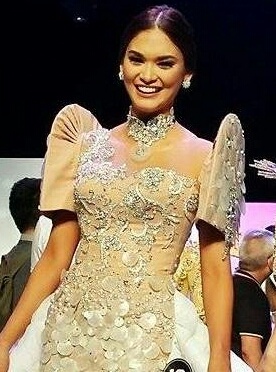
Pia Alonzo Wurtzbach, Miss Universe contestant 2015 from the Philippines, in a Philippine Terno
Most people in the Philippines wear Western style clothes. Men usually wear light trousers and a shirt. Many wear shorts. Women wear pants, a skirt or a sarong, sometimes with a colorful blouse. People often wear flip flops or sandals and sometimes go barefoot. In the old days they wore wooden shoes called “bakya” in the wet season. When working outside some people wear a traditional sun hat, called a “salakot”, woven from bamboo and palm leaves.
People try to dress according to their profession and social class. Many office personnel, particularly in government offices and private banks, wear uniforms. This prevents intra-office fashion competition while giving individuals prestige through group identity. Schoolchildren and private security guards also wear uniforms. Roman Catholics in the Philippines dress modestly in Western clothes. Traditionally, women covered their heads when attending mass. However, this custom is not practiced so much any more. Many orders of nuns in the Philippines still wear religious habits in public. However, missionary and diocesan priests wear their holy garb primarily when performing sacred ceremonies and religious services. Otherwise, they wear clothing indistinguishable from that worn by any other Filipino men. [Source: Kathleen M. Nadeau, Worldmark Encyclopedia of Religious Practices, Thomson Gale, 2006]
There is a small silk industry in the Philippines. Marikina (eastern outskirts of Manila) is the home of the Philippines’s shoe industry which has fallen on hard times in recent years. Fashion designers enjoy high social status in the Philippines. Fashion shows are popular events held in urban areas, hotels, nightclubs, and at charity balls. Rajo Laurel and Joel Bautista are two well-known designers in the Philippines.
In the southern Philippines many men wear ankle-length sarongs and colored shirts. The sarongs are often make of checked cotton. A scarf is sometimes tied around the head and knotted at the side. Traditional straw “buli” or “balanot” hats are similar to flat-topped Spanish “Codobes” hats. The Bagobo from the coast of Mindanao are known for their elaborately beaded and embroidered garments. Some members of some groups in the mountains of northern Luzon such as the Ifagao still wear loin clothes.
One traditional product that gained prominence in the early 20th century is the bakya, a type of wooden footwear made from light materials like laniti and santol wood. Carefully carved, smoothed, and often decorated with floral designs or polished finishes, bakya became a popular export item in the 1930s. Its simple yet functional design reflects both practicality and aesthetic sensibility.
RELATED ARTICLES:
APPEARANCE IN THE PHILIPPINES: BEAUTY, HYGIENE, TATTOOS factsanddetails.com
SEX IN THE PHILIPPINES: HISTORY, INFLUENCES, STORIES factsanddetails.com
MARRIAGE IN THE PHILIPPINES factsanddetails.com
COURTSHIP, DATING AND LOVE IN THE PHILIPPINES factsanddetails.com
LGBTQ, HOMOSEXUALITY AND TRANSGENDER IN THE PHILIPPINES factsanddetails.com
Barongs— Traditional Filipino Men’s Shirts
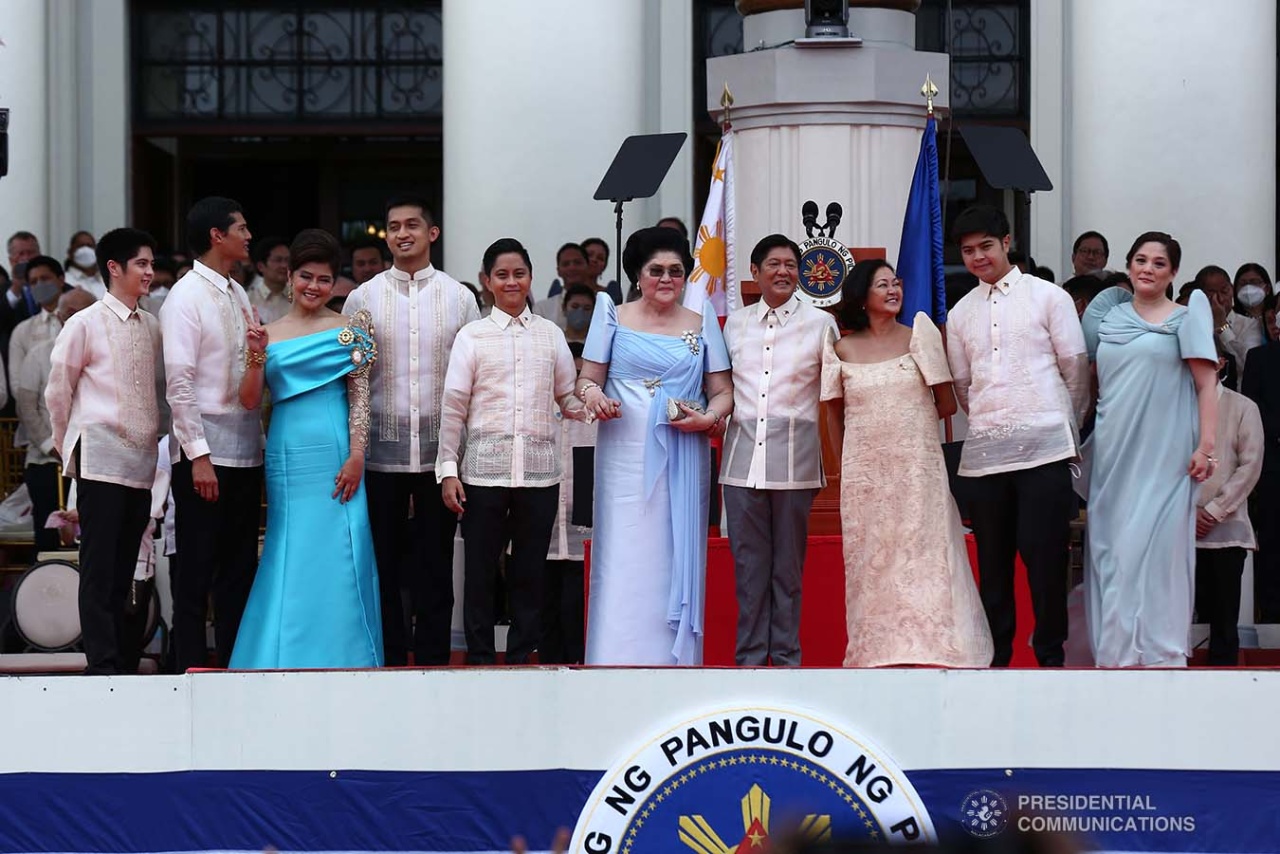
The “baraong tagalog” is lightweight pen-neck shirt worn by men untucked, outside their pants. Long-sleeve ones are are considered the traditional dress-up attire for men and are formally worn in place of a suit and tie. Short-sleeve ones are regarded as casual wear. Versions of these shirts, called “barong Filipino”, are made with sheer banana fibers. Others are woven from thin “pina” cloth made from pineapple fiber. Barongs have traditionally beem worn with long cotton black trousers. These days they are usally worn with Western style trousers.
Almost every Filipino man has a barong tagalog in his closet—or at least has worn one at some point in his life. Whether for a third-grade declamation contest or for dancing in a cotillion, the barong tagalog has long been a staple. In Filipino weddings, it is almost always present.[Source: Jett Pe Benito, kasal.com]
designer Joel Bautista of La Herminia Piña Weaving Industry says: I think the Western style of dressing will never be able to catch up in a sense that the prime consideration of the majority is focused on comfort dressing for a tropical climate that we have in our country." Designer Bong De Ocampo of Exclusively says: "The barong is a classic and traditional option for weddings, not to mention, cooler than wearing a tux or suit. It's got a quiet unassuming elegance and can blend pretty much with any entourage design." She adds, "Moreover, you can be in any size, shape, or color and still look decent in a barong."
Origin of Barongs
The barong tagalog traces its origins to the baro—the Tagalog term for “shirt” or “clothing,” with related forms such as barú, badu, bado, and bayú in other Philippine languages, and baju in Malaysia and Indonesia. This early garment was a simple, collarless shirt, tunic, or jacket with close-fitting long sleeves, worn by both men and women across many pre-colonial Filipino communities. These garments were typically made from coarse, linen-like textiles woven from native abacá fiber, though imported materials such as silk, cotton, and kapok were also used. The original baro design reflected the Philippines’ long history of regional trade and cultural exchange, drawing influence from neighboring traditions, including the Malay and Javanese baju and the South Asian kurta. [Source: Wikipedia]
De Ocampo says: "The origin of the barong stemmed from the social strata between the hacienderos and the indios. To distinguish the noble man from the masses, indios were required to keep their shirts untucked." She adds, "The shirt had to be transparent enough to be sure that he carried no weapons nor stolen goods. Thus, the barong was created. It used to be made of lightweight cotton until it evolved into the different kinds of fabrics that we know today such as jusi and piña." [Source: Jett Pe Benito, kasal.com]
Designer Arlyne Tumbokon of La Herminia Piña Weaving Industry says: "the barong was the attire of the Gobernador Heneral, but the wearing of piña was done even in the pre-Spanish era where piña cloth was used to barter with porcelain products of the Chinese."
Barong Designs and Fabrics
When it comes to trends, Bautista says that details and design largely determine a barong’s final look. "Though the embroidered types of barong remain a classic, the sinuksok-type of design has gained more popularity and preference with the groom's attire. A combination of the sinuksok and various patterns of embroidery are also incorporated nowadays," he says. Tumbokon adds that the sinuksok (hand-woven design) is created as the barong itself is being woven. [Source: Jett Pe Benito, kasal.com]
As a traditional staple of Filipino menswear, fabrics like jusi and piña remain timeless. De Ocampo shares that a new fabric blending more silk with piña is currently being developed, making it less itchy and more wearable. She adds, "Embroidery designs actually play the largest part in the design of the barong. The u-shaped ethnic design is the most popularly used presently." At the same time, she observes that designers are becoming more experimental: "Lately, we've been infusing some Oriental touches to the design or East Indian touches by giving the neckline a mao collar or nehru collar. Sometimes, we use Chinese frog buttons or knot buttons to add more interest."
Tumbokon prefers working with piña-silk and favors the sinuksok technique for its simplicity and elegance. De Ocampo, on the other hand, is partial to jusi or piña. She explains, "Recently, a faux version of piña was developed on jusi called piña-piñahan or piña jusi wherein the appearance of piña is painted on jusi. Hence it appears textured but is actually as smooth as jusi." She adds, "I usually design according to the theme of the wedding. But it doesn't deviate much from the usual design of the traditional barong. With men, it's just a matter of embroidery shape, whether they want it u-shaped or full-open or scattered all around. But generally, the more elaborate designs are applied on piña. I've been toying a lot with the suksok design for piña which means that the design is woven into the fabric as opposed to embroidered on the fabric."
Bautista, meanwhile, prefers working with pure piña cloth, a material he has mastered, though he also considers piña blended with silk a "go-getter." His designs often draw from geometric patterns, as well as flora and fauna. He also incorporates artworks and silhouettes inspired by various Western colonial periods.
Women’s Clothes in the Philippines
The “mestiza” is a traditional outfit worn by women. The blouse has puffy sleeves and a wide, upstanding collar of stiff, wiry cloth, and may be richly embroidered. The “terno” is a traditional evening gown for women with butterfly sleeves. The “Maria Clara,” “serpentina,” “paloma,” and “siete cuchillos” are names for an outfit, usually made of silk, fine cotton, or taffeta, with a full length, often with a train, and a blouse with wide, loose sleeves and a “boat neck,” and a draped shawl that is caught at the waist.
Dance costumes worn by women include the “balintawak” style and the “patadyong.” The “balintawak” is comprised of a white or pale-colored, ankle-length, full-skirted dress with a “boat neck” and short, wide, puffed sleeves. A second, shorter skirt is worn over the dress. It is draped around the waist in a V-line and is often a contrasting color to the dress. The “patadyong” consists of a sarong-style skirt with a white blouse. The skirt has a large fold or pleat in front that allows the wearer to move freely. It is often worn with large, bright checks.
Contrary to the observations of some foreigners in the past, the veil was not an intrinsic part of native attire. It was only worn to church; however, since our female ancestors were pious, they often covered their heads. The church-going Colegiada of the 18th century wore a thick Baro't Saya with long, narrow sleeves; a shroudlike veil; and an Estampita (a saint's picture) hanging from her neck to protect her from evil. By the 1750s, the collegiala's mother wore a large, cape-like pañuelo and a wide, floor-length saya.
Terno — the Traditional Butterfly-Sleeves Filipino Dress
The terno is a traditional, long, one-piece Philippine dress with butterfly sleeves. It is worn by women for formal occasions, and sometimes for weddings. It should be distinguished from other Filipino dresses, such as the informal balintawak and patadyong. Unlike the terno, these rural costumes lack the svelte sophistication and are mainly worn by barefoot dancers of the tinikling and carabao-riding maidens in Amorsolo's landscapes. The terno, on the other hand, is associated with the stately grace of the rigodon de honor, Flores de Mayo processions, coronation nights, and the Malacañang Palace. [Source: kasal.com]
The terno evolved from an ensemble called baro’t saya (blouse and skirt) from the Spanish word "matching." Traditionally, it consisted of four parts: the camisa (a short blouse with sleeves), the alampay or pañuelo (a shawl worn over the camisa), the saya (a long skirt), and the tapis (a short overskirt wrapped around the saya). ^
By the beginning of the nineteenth century, the terno had acquired the features that would distinguish it until the end of the colonial era. In 1803, Fr. Joaquín Martínez de Zuñiga noted that Tagalog women wore "a kind of little shift which scarcely reaches the navel." He described the alampay as a "handkerchief loosely covering the neck" and the saya as "a white linen cloth encircling the body and fastened by a button at the waist. They throw over this a colored stuff, manufactured by the inhabitants of Panay" — undoubtedly the tapis. "Over all is worn a mantle, for the most part black, which covers the body from head to foot" — probably the view from the confessional.
Manila’s Underground Fashion in the Pedestrian Tunnels along Recto Boulevard
In a dim, sweltering pedestrian tunnel beneath Manila’s university district, according to AFP in the early 2010s, shoemaker Julius Wilfredo Gregorio bends over his work, stitching rubber soles onto hand-crafted leather boots. At 37, he aims to finish five pairs a day to keep up with growing demand from budget-conscious fashion enthusiasts. [Source: Jason Gutierrez, Agence France-Presse, April 27, 2011]
Since taking over his father’s shop, “Freddie’s Leather Haus,” in 1991, Gregorio has built a loyal following among both local and foreign customers. His designs, inspired by high-end boutique styles, offer quality and flair at a fraction of the cost. “You don’t have to be a rich action movie star to own top-quality boots and be fashionable,” he said, sweat dripping as a worn electric fan struggled to cool the space. “I can make you shoes that will make you feel like one—all you have to add is a little attitude.”
Gregorio is part of Manila’s underground fashion scene, a semi-legal network of tailors, cobblers, and craftsmen operating out of pedestrian tunnels along Recto Boulevard. Over the years, these cramped stalls have become a symbol of resistance to the city’s luxury-driven fashion industry, catering instead to students and young people with limited budgets but strong personal style.
The tunnels offer a wide range of goods—jeans, boots, leatherwear, accessories, uniforms, and athletic gear—all at affordable prices. While many designs are inspired by popular American brands, customers can also commission custom pieces or choose from original creations. Prices remain accessible, with jeans selling for as little as 300 to 400 pesos ($6–9), and handmade cowhide boots reaching around 4,000 pesos ($93).
Among the most popular items are colorful basketball jerseys, reflecting the country’s deep love for the sport. “I often go here to get my clothes done,” said Pauline Banigued, a 23-year-old communications student having a blouse tailored nearby. “They are not exactly fashion runway material, but they suit my taste just the same.”
Though the shops began operating illegally in the 1970s, authorities have largely tolerated them, allowing the vendors to continue in exchange for minimal rent and electricity fees. Despite competition from global brands in modern malls, the tunnel businesses have endured, sustained by loyal customers and word-of-mouth. Even natural disasters have failed to shut them down. After devastating floods in 2009 submerged the tunnels, the vendors quickly returned, driven by continued demand.
Veteran tailor Ruben Rosal, 59, has witnessed the evolution firsthand. Starting with denim jeans, he expanded his offerings to include blouses, skirts, and uniforms. His shop, Crazy Horse Jeans—named after the popularity of spaghetti westerns in the 1970s—has grown into a family business with four locations, helping fund his children’s university educations.
More than just a livelihood, Rosal sees his work as a service to the community. “I’ve been a farmer and a fisherman in the province, but this is what I do best,” he said. “I have made clothes for all sorts of people, and I feel happy when they come back because they are satisfied. I always say that good, quality clothes are for everyone—not just those who have the money to buy them.”
Image Sources: Wikimedia Commons
Text Sources: “Encyclopedia of World Cultures Volume 5: East/Southeast Asia:” edited by Paul Hockings, 1993; “Culture Shock!: Philippines” by Alfredo Roces and Grace Roces, Marshall Cavendish International, 2010; Metropolitan Museum of Art; National Geographic, Live Science, Philippines Department of Tourism, New York Times, Washington Post, Los Angeles Times, Smithsonian magazine, Encyclopedia.com, Library of Congress, The Conversation, The New Yorker, Time, BBC, CNN, Reuters, Associated Press, AFP, Lonely Planet Guides, Google AI, Wikipedia, The Guardian and various websites, books and other publications.
Last updated March 2026