
BEAUTY IN THE PHILIPPINES
From an early age, Filipina girls are made aware of the social prestige associated with being recognized as a “beauty.” In many communities, the most attractive young women—or sometimes the daughters of prominent or wealthy families—are chosen to take part in Flores de Mayo, a religious procession held in May in honor of the Blessed Virgin. There, they appear as sagalas (princesses) and reinas (queens), symbolizing grace and status. [Source: “Culture Shock!: Philippines” by Alfredo Roces and Grace Roces, Marshall Cavendish International, 2010]
The idea of beauty is woven into everyday social life. Athletic teams and community organizations often designate a “muse,” typically the member considered the most attractive. Being chosen as a beauty queen or muse is regarded as a significant honor, not just for the individual but for her entire family. Some women put white stuff in face to keep their skin looking young. Gold teeth and gold root caps are big status symbol among some groups in the Philippines and on neighboring islands.
In the Filipino context, beauty extends beyond physical appearance to include good grooming, style, and self-presentation. It involves a sense of fashion, careful hair styling, appropriate jewelry, as well as posture, poise, and personality. Talents such as singing, dancing, playing musical instruments, public speaking, cooking, and participation in sports or community activities are also seen as part of one’s overall attractiveness.
Appearance, therefore, is not limited to looks alone but reflects taste, refinement, and social awareness. Clothing choices, coordination of colors, and the use of fine jewelry—often preferred over simple accessories—signal both personal style and social standing. Courtesy, manners, and confidence further enhance one’s presentation in social settings.
Social gatherings often become spaces where these elements are subtly evaluated. Guests may take note of what others are wearing, particularly the attire and jewelry of prominent individuals. In the past, lavish balls hosted by elite social clubs showcased extravagant displays of wealth and status, though such overt opulence has since been toned down.
RELATED ARTICLES:
CLOTHES IN THE PHILIPPINES: MEN'S, WOMEN'S, TRADITIONAL GARMENTS factsanddetails.com
SEX IN THE PHILIPPINES: HISTORY, INFLUENCES, STORIES factsanddetails.com
MARRIAGE IN THE PHILIPPINES factsanddetails.com
COURTSHIP, DATING AND LOVE IN THE PHILIPPINES factsanddetails.com
SEXUAL PRACTICES IN THE PHILIPPINES: AFFAIRS, ADOLESCENCE, ORAL SEX factsanddetails.com
LGBTQ, HOMOSEXUALITY AND TRANSGENDER IN THE PHILIPPINES factsanddetails.com
Bathing and Hygiene in the Philippines Grooming
Personal cleanliness is a notable aspect of Filipino daily life, shaped in part by the tropical climate, which encourages frequent bathing. A daily bath is considered routine for people of all ages. As early as the twentieth century, Western observer James Le Roy noted that Filipinos were “scrupulous about personal cleanliness,” treating bathing as a necessity rather than a luxury. While crowded public spaces may sometimes have unpleasant odors, Filipinos generally distinguish between such conditions and the strong expectation of personal hygiene. [Source: “Culture Shock!: Philippines” by Alfredo Roces and Grace Roces, Marshall Cavendish International, 2010]
Early Filipinos practiced a lot of traditions and rituals. One of them was taking a sacred bath in the river for good health. They would often sprinkle themselves with bundles of sacred herbs as they dipped in the river. Filipinos also believed that taking a bath on Fridays, especially Good Friday, was bad. This is traced to the Spanish friars who found the Filipinos' daily baths odd and told them they would be stricken ill should they bathe on a Friday. [Source: Gladys Pinky D. Tolete, kasal.com ^]
Filipinos often bath several times a day because of the heat. Many homes have only cold showers. There are many bathing superstitions, including:. 1) Pregnant women should bathe in the afternoon to prevent hypertension. 2) A woman who has just delivered a baby should take hot soup after her first bath so that she will regain her youthful skin. 3) A newly-born baby should be tossed up into the air after its first bath so that it will not grow up a frightful person. 5) A child's bath should be withheld on Fridays to prevent his developing serious illness.
Meaning of Mixed in the Philippines
In July 2023, Filipino American creator Krystl Fabella shared a recurring experience she had while in the Philippines: strangers would often ask if she was “full Filipina” or assume she was mixed. The question came up casually—in salons, in introductions, in everyday conversations—and was usually followed by surprise when she answered, “No, I’m full Filipina.” [Source: Neia Balao, In The Know by Yahoo, July 29, 2023]
What stood out most was not just the assumption, but the reaction. People often responded with excitement or disbelief, sometimes adding, “Oh, but you’re so pretty.” For Fabella, that small phrase revealed something deeper—a quiet expectation that being mixed might better explain her appearance, as if beauty were more naturally associated with mixed heritage than with being fully Filipino.
Her experience reflects a broader reality: in the Philippines, looking “mixed” has increasingly become associated with desirability. This perception is rooted in a long history of colonial influence, where Western and lighter-skinned features were elevated as ideals. Over time, these standards shaped how beauty is defined, often privileging those with Eurocentric traits or mixed ancestry.
Media and representation reinforce this pattern. On global and national stages—especially in high-profile beauty pageants—many of the most visible Filipina figures are of mixed heritage or have lighter skin. As a result, the image of what a “Filipina” looks like has, for many, become intertwined with being part foreign, subtly shifting expectations and perceptions.
Yet this creates a complicated reality for identity. Those who are mixed may be seen as more desirable, but are sometimes told they are “not fully Filipino,” while those who are fully Filipino may face surprise or backhanded compliments when they don’t fit narrow stereotypes. Fabella’s experience highlights this tension: being mixed has come to represent an ideal, but it also exposes an ongoing struggle within Filipino identity—one shaped by history, representation, and evolving ideas of what it means to belong.
Moles and the Filipino Man Who Got Plastic Surgery to Look Like Superman
Herbert Chavez, a Filipino fashion designer, is known for transforming himself into a near-replica of Superman through multiple cosmetic surgeries and cosplay. Inspired since childhood, he built a vast Superman collection and began undergoing procedures in 1998 to resemble actor Christopher Reeve, including facial enhancements, liposuction, and body implants. [Source: Cecil Morella, Agence France-Presse, October 14, 2011]
Outside his superhero persona, Chavez runs a successful fashion and costume business, having previously worked abroad designing for royalty. He regularly dresses as Superman for cosplay events and personal fulfillment, despite criticism from some people.
Chavez defends his choices as personal and harmless, emphasizing self-expression and positivity. While he continues to consider further enhancements, he draws limits—rejecting extreme procedures like height-lengthening surgery. Supported by his parents and admired by some in his community, Chavez remains committed to living out his lifelong dream of embodying his favorite superhero.
1) A mole on the back of a man augurs conflict and misfortune, while on a woman it foretells hardship in life and difficulty in giving birth. 2) A mole on the back of the neck means that the person is a liar and is an unfaithful lover. 3) A mole on the left shoulder means that the person will carry a heavy burden in life. 4) A mole on the temple is a sign of wisdom and courage. 5) A mole in between the eyebrows means that a person easily attracts the opposite sex and has magnetic appeal. 6 ) A mole on the eyebrow in a man means that he is a flirt and is inconstant in affairs of the heart. In the case of a woman it means loyalty when it comes to love. [Source: felixfojas.wordpress.com , March 6, 2012 ^*^]
For More on Miles See SUPERSTITIONS IN THE PHILIPPINES factsanddetails.com
Tattoos in the Philippines
Spanish explorers who arrived in the Philippines in 1521 called it the “Islands of the Painted Ones” because of the heavily tattooed indigenous people. Today, however, traditional tribal tattooing is nearly extinct. The practice survives mainly through the work of Whang-Od, a Kalinga tattoo artist who has spent over 80 years preserving this ancient art. [Source: BBC, May 27, 2014]
Whang-Od uses a centuries-old “tapping” technique, hammering ink into the skin with a bamboo stick and a citrus thorn dipped in charcoal. Her designs—often inspired by nature, such as centipedes, snakes, and geometric shapes—are believed to offer protection and spiritual meaning. The process is slow and painful, sometimes taking months to complete large tattoos.
Outside the Philippines, members of the Filipino diaspora are working to revive the tradition. Groups like Tatak Ng Apat na Alon in Los Angeles promote tribal tattooing as a way to reconnect with Filipino heritage. They carefully research designs based on ancestry and personal stories, ensuring the cultural meaning behind each tattoo is preserved.
Historically, tattoos signified identity, status, and protection among pre-colonial Filipinos, Dr. Lars Krutak, a tattoo anthropologist who is knowledgeable about the Visayas region of the central Philippines, says that traditional tattooing practices vanished from the region by the 1700s due to the presence of the Spanish military and the influence of the Church. However, the practice survived in Mindanao, an island in the country's far south, and in the mountainous Cordillera region — the home of Whang-Od — because of the area's remoteness and the warrior tribes who successfully defended their ancestral homelands from foreign invaders like the colonial Spanish.
See Kalinga Tattoos and 108-Year-Old Tattoo Artist Under KALINGA: HISTORY, LIFE, SOCIETY, CULTURE, TATTOOS factsanddetails.com
Beauty Contests in the Philippines
Filipinos are really into beauty pageants, with millions of Filipinos closely following competitions like Miss Universe. They take pride in the success of Filipina contestants on the international stage. For many, pageants are part of national culture—alongside boxing and basketball—and serve as sources of inspiration in a country where success stories resonate deeply. [Source: Stephy Chung, CNN, November 21, 2025]
Beauty contests are widely held across the Philippines, with barrios, towns, cities, and provinces all hosting their own pageants. Titles gained in youth often carry lasting recognition. For example, former First Lady Imelda Marcos was once known as the “Rose of Tacloban,” and her later participation in a fiercely contested Miss Manila pageant further elevated her profile. Even decades later, such titles are still used to introduce women, long after their pageant days have passed. For men, marrying a beauty titleholder is a mark of prestige. [Source: “Culture Shock!: Philippines” by Alfredo Roces and Grace Roces, Marshall Cavendish International, 2010]
Beauty contests are held year-round across the country, from small village events to major national competitions. These pageants are woven into festivals, schools, and community life, creating a widespread culture of participation and support. For many contestants, local pageants are the first step toward bigger stages. This extensive pageant scene has also created a thriving industry. Coaches, designers, stylists, and social media experts all contribute to training and promoting candidates, forming an ecosystem that supports aspiring beauty queens and provides livelihoods for many.
One government official said, "Beauty contests are part of Philippine culture. They say if you want anything to succeed in the Philippines, hold a beauty contest or a cockfight." In the 1990s, Future Philippines President Erap Estrada confessed an infatuation with Miss Colombia at the Miss World contest and joked that he was thinking about having his wife assassinated. The wife of President Ramos said before the pageant that her husband refused to pick a winner because he "has ogled them already."
History of Beauty Pageants in the Philippines
The Philippines became the first Asian country to win five major international beauty pageant crowns—two for Miss Universe, in 1969 and 1973, and three for Miss International, in 1965, 1970, and 1979. The country’s global reputation grew significantly after Gloria Diaz won Miss Universe in 1969, sparking national pride and widespread interest. Since then, Filipinas have consistently performed well internationally, with multiple wins in major competitions such as Miss Universe, Miss World, Miss International, and Miss Earth.
Historically, pageantry in the Philippines dates back to Spanish colonial religious festivals and later evolved during American rule. Early contests like the Manila Carnival queen competition helped shape modern pageants and even became platforms for emerging Filipino nationalism. [Source: Stephy Chung, CNN, November 21, 2025]
The Philippines had to deal with numerous problems when Manila hosted the 1994 Miss Universe contest. The government was criticized by feminists as hosting a "crime against women" and by local politicians for wasting scarce resources. Basketball stars Magic Johnson and Larry Bird, who had been selected as celebrity judges, failed to show up, and President Ramos was accused of being a "world-class pimp." In the weeks before the contest, street children were rounded up because they were considered an eyesore. Manila also hosted the Miss Universe contest in 1974, when street children were again rounded up and Imelda Marcos ordered the construction of walls to hide some of the city's worst slums. [Source: William Branigin, The Washington Post]
In 1994, Contestants complained that some of the pre-pageant competitions were rigged in favor of Miss Philippines, and conservative Catholics were upset when the contestants paraded down the streets in see-through hoop skirts with short pants underneath during a procession honoring the Virgin Mary. There were at least two drunken knifing incidents that occurred after arguments between supporters of Miss Philippines and supporters of Miss Belgium, another popular contestant.
Black Filipino Woman Crowned Miss Universe Philippines
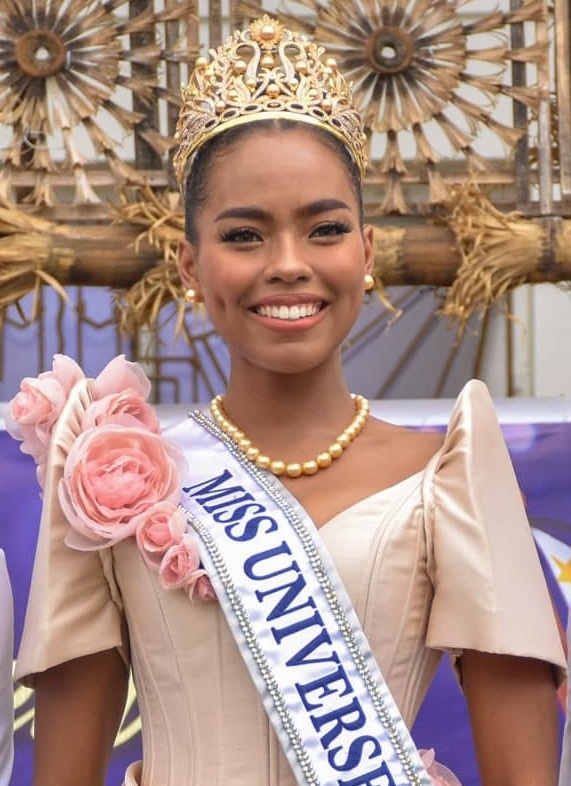
In May, 2024 Filipino American Chelsea Manalo made history after becoming the first Black woman to be crowned Miss Universe Philippines. Born to a Filipino mother and an African American father, her victory was widely celebrated online as a breakthrough moment, with many saying it helped challenge long-standing beauty ideals in the country. [Source: Kathleen Magramo, CNN, May 24, 2024]
Representing Bulacan, Manalo competed against 52 other contestants from across the Philippines and abroad, ultimately winning the title at the SM Mall of Asia Arena. Her win quickly sparked conversations about identity, particularly what it means to be mixed in a society where beauty has often been tied to lighter skin and Eurocentric features.
During the competition, Manalo spoke openly about her experiences as a woman of color. She shared that she had faced challenges growing up, including being told that beauty had strict standards. Reflecting on her journey, she emphasized the importance of self-belief and staying true to oneself, noting that her story has allowed her to inspire others facing similar struggles.
Manalo’s victory highlights the complex space that mixed individuals occupy in Filipino society. While mixed heritage is often associated with beauty and desirability, her story also reveals the discrimination and insecurity that can come with not fitting narrow ideals. Her win signals a shift toward broader and more inclusive definitions of beauty.
Set to represent the Philippines at the Miss Universe pageant in Mexico, Manalo now carries both national pride and a larger cultural message. Her success contributes to an ongoing redefinition of Filipino identity—one that increasingly embraces diversity, challenges colonial-era standards, and expands what it means to be seen as beautiful.
Filipina Megan Young Wins 2013 Miss World Pageant
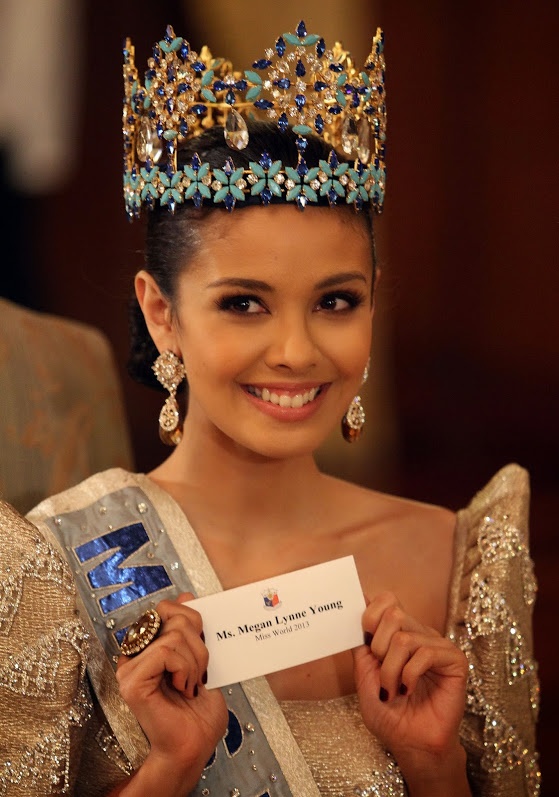
In September 2013, Miss Philippines, Megan Young, won the Miss World contest in a glittering finale on the Indonesian resort island of Bali “I promise to be the best Miss World ever,” Young, 23, said after winning the 63rd annual event, as a large number of Filipino fans who traveled with her celebrated by jumping and waving the country’s flag. “Salamat sa mga kababayan ko. Mahal na mahal ko kayo (Thanks to my compatriots. I love you very much),” said the teary-eyed actress after she was crowned at the end of a three-week contest [Source: Associated Press, Inquirer.net, September 28, 2013].
Young, wearing a pearl-white gown, beat out 127 contestants from around the world to become the first Filipina to win the Miss World crown, in a pageant broadcast to over 180 countries. France’s Marine Lorphelin finished second, while Ghana’s Carranzar Naa Okailey Shooter placed third.
The contestants were introduced in dazzling evening gowns adorned with sequins, many with plunging necklines and high slits. Born in the United States, Young moved to the Philippines at age 10 and later built a career in film and television. After her victory, Young thanked the judges and promised to remain authentic, saying she would “just be myself in everything I do, to share what I know and to educate people.” When asked why she should be Miss World, she emphasized compassion and understanding, stating, “I treasure a core value of humanity… as one, we can help society.”
Her win marked a historic first for the Philippines in the Miss World pageant, which had never crowned a Filipina in its more than six decades of history. Prior to her victory, the country’s closest finishes were first runner-up placements in 1973 and 2011.
Young had been a standout throughout the competition, entering the semifinals with the highest overall score based on preliminary events. She also excelled in several categories, winning the Top Model competition and placing highly in multimedia and beach beauty segments. Even before the international pageant, Young had already established herself as a strong contender. She dominated the Miss World Philippines competition, winning numerous special awards and emerging as a clear favorite.
Her performance on the global stage further reinforced her appeal. She participated in key events, including press engagements and the “Dances of the World” segment, where only select contestants were featured, solidifying her place as one of the competition’s most memorable winners.
Image Sources: Wikimedia Commons
Text Sources: “Encyclopedia of World Cultures Volume 5: East/Southeast Asia:” edited by Paul Hockings, 1993; “Culture Shock!: Philippines” by Alfredo Roces and Grace Roces, Marshall Cavendish International, 2010; Metropolitan Museum of Art; National Geographic, Live Science, Philippines Department of Tourism, New York Times, Washington Post, Los Angeles Times, Smithsonian magazine, Encyclopedia.com, Library of Congress, The Conversation, The New Yorker, Time, BBC, CNN, Reuters, Associated Press, AFP, Lonely Planet Guides, Google AI, Wikipedia, The Guardian and various websites, books and other publications.
Last updated March 2026