
SABLES AND ERMINE (STOATS) IN JAPAN

With the extinction of wolves, the only true carnivores found in Japan are small weasels, ermine (stoats), sables and and martens. In Japan there are two species of ermine: hondo-okojo (Hondo stoat) and ezo-okojo (Ezo stoat). Both are stoats that have brown fur in the summer and white in winter. Stoats belong to the weasel family. Hondo okojo, also known as Yama-Itachi or Kuda-Gitsune, are found in Honshu. Ezo okojo are found in Hokkaido. They usually eat birds’ eggs, insects, mice and rats. Due to their aggressive nature, they are known to attack hares, which are almost twice as big as they are. These animals are considered Near Threatened.
The okojo is a carnivore that reaches a length of 20 centimeters and is found primarily in forested and alpine regions. It loses its white winter coat in early April, weeks earlier than it did in the 1980s and starts getting the white coat in December, weeks later than it did in the 1980s. Warm winters and global warming are seen as the reason why. In the 1980s the species was often spotted at elevations below 1,300 meters. But these days you don’t see them below 1,500. Competition from foxes in the ermine’s habitat to chase mice and voles that have moved to higher elevations is the explanation for this.
Japanese sables (M. zibellina brachyurus) are a subspecies of sable. Known locally as kuroten and native to Hokkaido, they have black on their legs and feet and a light patch of fur on their throat which may be gray, white, or pale yellow. They have been reported to be attracted to bird feeders and have been seen around guesthouses in Hokkaido. Sables have a long, lithe body with short, stout legs, short rounded ears, a tapered face and a long, bushy tail. Their tapered face is a creamy white color and their round eyes and tiny nose are black. Before the introduction of the Japanese marten, sables ranged throughout Hokkaido The Ishikari Lowland separates the distribution ranges of the two species. The marten might be able to cross the lowland in the south and expand its range to the east in the future
Sables (Martes zibellina) are species of marten found mainly in Russia, from the Ural Mountains throughout Siberia, and northern Mongolia. The Siberian sable marten is the source of expensive and sumptuous sable fur. They are found almost exclusively in Siberia. Other kinds of sables and martens include the American marten, Chinese sable, American sable, baum marten, and stone marten. Sables are members of the mustelid (or weasel) family. The fur of the Japanese sable is softer and silkier than that of American martens.
See Separate Article: WEASELS factsanddetails.com; SABLES factsanddetails.com ; ERMINE (STOATS): factsanddetails.com
RELATED ARTICLES:
ANIMALS IN JAPAN: WILDLIFE, BIODIVERSITY, RESEARCH factsanddetails.com
ENDANGERED ANIMALS AND JAPAN: MAMMALS, BIRDS, SPECIES, PROTECTION, ILLEGAL WILDLIFE TRADE factsanddetails.com
EXTINCT ANIMALS IN JAPAN: WOLVES, BIRDS AND OTTERS factsanddetails.com
IRIOMOTE CATS: CHARACTERISTICS, BEHAVIOR, CONSERVATION factsanddetails.com
JAPANESE BADGERS: CHARACTERISTICS, BEHAVIOR, FOLKLORE factsanddetails.com
ITACHI (JAPANESE WEASEL): CHARACTERISTICS, BEHAVIOR, FOLKLORE factsanddetails.com
FLYING SQUIRRELS IN JAPAN: CHARACTERISTICS, BEHAVIOR, SPECIES, REPRODUCTION factsanddetails.com
JAPANESE SEROW: CHARACTERISTICS, BEHAVIOR. CONSERVATION factsanddetails.com
BEARS IN JAPAN: CHARACTERISTICS, BEHAVIOR, SPECIES, HUMANS factsanddetails.com
Musteleids
Weasels, ferrets, minks, sables, ermines (stoats), martens and polecats are closely related. They belong to the musteleid (or weasel) family, which also includes otters, badgers, wolverines, and skunks. Weasels, minks and sables are all very similar and have similar characteristics and behavior. Minks and sables live primarily in northern regions of North America, Asia and Europe and produce highly-prized fur used in coats and stoles. Weasels are found in more southern areas and have shorter fur. Nowadays furs are out of fashion in North America and Europe but are still popular in Russia and have become popular in China.
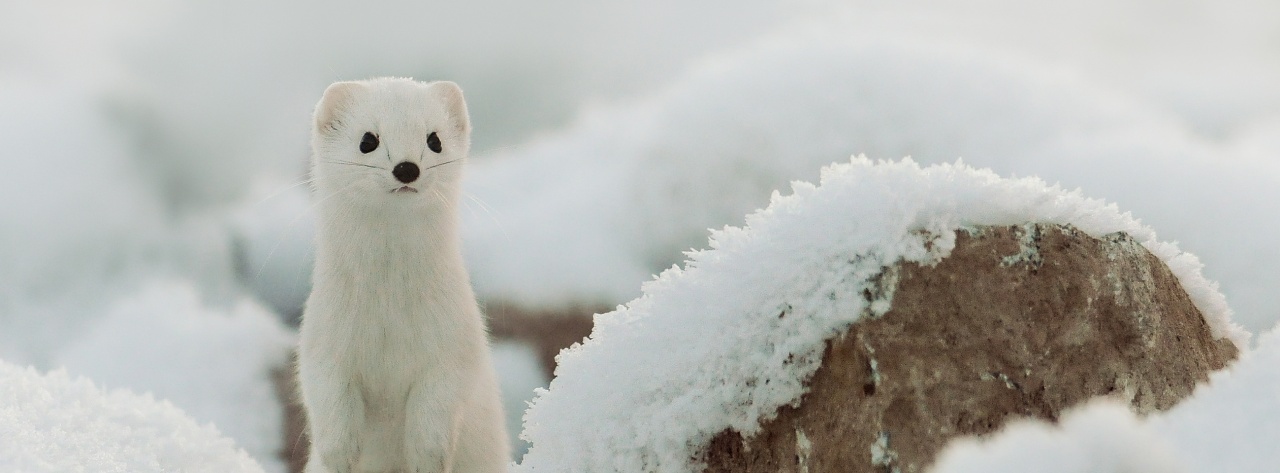
Ermine—also called stoat, short-tailed weasel, or Bonaparte weasel—is a northern weasel species that turn white in the winter. Widely distributed across northern North America and Eurasia, ermines are most abundant in thickets, woodlands, and semi-timbered areas. These slender, agile, voracious mammals measure 13 to 29 centimeters (5 to 12 inches) in head and body length. The term “ermine” also describes the animal’s pelt was used historically in royal robes and crowns in Europe. [Source: Encyclopedia Britannica]
Mustelidae, or the mustelid family, is a group of mostly long, slender-bodied mammals in the Order Carnivora. Mustelids have razor-sharp teeth, and most are primarily carnivorous. Some of the smaller species, however, are quite omnivorous, and supplement their diet heavily with fruits and berries. A characteristic of the family is powerful anal scent glands that are used to mark territory and as a form of communication among individuals in a breeding population.
“The Mustelidae also includes such familiar creatures as badgers, sea and river otters, martens, minks and stoats. The most formidable members of the family are the wolverines, which hold their own in scrapes against lynxes, timber wolves and even bears. Mink, sable and ermine are mustelids especially valued for their luxurious fur. The cutest and most popular members are usually the intelligent, sociable otters, but ferrets are also kept as pets.
Japanese Squirrels
There aren't many squirrels in Japan. The Siberian Squirrel, native to Hokkaido but also found elsewhere in Japan, is a kind of chipmunk. The Japanese squirrel is found on Honshu and Kyushu. It has tufted ears and fur that changes color in the seasons (from red orange in the summer to whitish grey in the winter). They spend nearly all their time in trees, moving between several bell-shaped nests, and use their tail as a kind of a parachute when they jump between trees. They don’t hibernate. Like other squirrels, they horde food so they can retrieve it when food supplies are low in the winter.
The nihon-risu, or Japanese squirrel, is sometimes called a ki-nezumi, or "tree mouse,” in the countryside. Kevin Short wrote in the Daily Yomiuri: Squirrels actually are close relatives of mice, classified in the same Order Rodentia (gesshi-moku). All animals in this order have a set of chisel-like incisor teeth that are ideal for gnawing. These teeth continue to grow throughout the animal's lifetime, and are kept honed to a sharp edge by constant use. Squirrels belong in the family Sciuridae, which also includes chipmunks, woodchucks and prairie dogs. [Source: Kevin Short, Daily Yomiuri, may 24, 2012]
“Japan is home to two native species of tree squirrel, one species of chipmunk, and three species of flying squirrel. There is also an invasive alien species of squirrel that has been introduced and now breeds. The nihon-risu (Sciurus lis) is an endemic species, originally found on the islands of Honshu, Shikoku and Kyushu. A separate species, the ezo-risu, is found on Hokkaido. This is a subspecies of the common red squirrel (S. vulgaris) that distributes clear across the Eurasian continent from the British Isles to the Pacific seaboard.

Hokkaido squirrel
“Squirrels are almost exclusively vegetarian in diet, feeding on a wide variety of leaves, flowers, buds, bark and berries. Their specialty, however, is hard nuts and seeds. Ecologists refer to their lifestyle as scatter-hoarding. They do not hibernate. From summer through autumn, when food is abundant, they collect seeds and nuts to bury or stuff into small openings and corners in tree trunks and branches. Nihon-risu are active during the day, especially in the early morning and late afternoon. Among their favorite foods are walnuts, which they are able to split neatly in half at the seams, and pine nuts, which they obtain by gnawing through the cones, starting at the base and working their way up to the tip. Stripped pine cones, which Japanese call ebi-furai to "fried shrimp," are typical indicators of squirrels at work.
“Squirrel nests, usually located high in the branches of a sturdy conifer, are woven with twigs, leaves, moss and long strips of bark peeled from cryptomeria and cypress trees. Squirrels rest and sleep in these nests, and also raise their families in the protected environment.Nihon-risu mate in early spring, and the females give birth to three to six blind, naked young, which are weaned in about four to six weeks. Females can begin mating the following spring.
“Japanese squirrels are not officially listed as an endangered species, but local populations in westernmost Honshu and the Kyushu region are in grave trouble, and may already be extinct. In the area of northern Chiba Prefecture where I live, local squirrels appear to have moved out of the countryside and onto golf courses.
“This reason behind this move was a pine-wilt disease, caused by an alien worm spread by a native longhorn beetle, which over the past half century has almost completely wiped out the local satoyama pine woods in the warmer areas of Japan. Squirrels, it seems, depend heavily on the nutrient rich pine nuts. Our local golf courses have planted and through careful nursing have been able to maintain substantial pine groves, which attract the squirrels.
Flying Squirrels in Japan
Japan is home to three species of flying squirrel. Ezomomonga live only in northern Hokkaido. Regarded as a subspecies of the Russian flying squirrel or Siberian flying squirrel, they live in holes in trees and measure 15 centimeters from their snout to the tip of their tails.
Among the largest flying squirrel in the world is the Japanese giant flying squirrel, or musasabi. Found on Honshu, Kyushu and Shikoku and parts of China, it measures 60 centimeters (two feet) from the top of its head to the tip of its tail, has a wingspan of more than 45 centimeters (1½ feet) and weighs up to 2.2 kilograms (five pounds). Japanese giant flying squirrels glide low and slow. The longest recorded flight on flat land is 50 meters (165 feet). Flights of over 150 meters (500 feet) have been reported on downhill slopes.
The momonga is a small Japanese flying squirrel. Found in Honshu, Kyushu and Shikoku, it is only 15 centimeters long (six inches), not including the tail, and weighs less than 200 grams. The musabi and momonga are primarily herbivorous, eating most tree leaves, buds, flowers, fruits, nuts, seeds and bark and occasionally insects. The Ainu people worshiped flying squirrels as protector gods of children.
See Separate Article: FLYING SQUIRRELS IN JAPAN factsanddetails.com
Japanese Martens
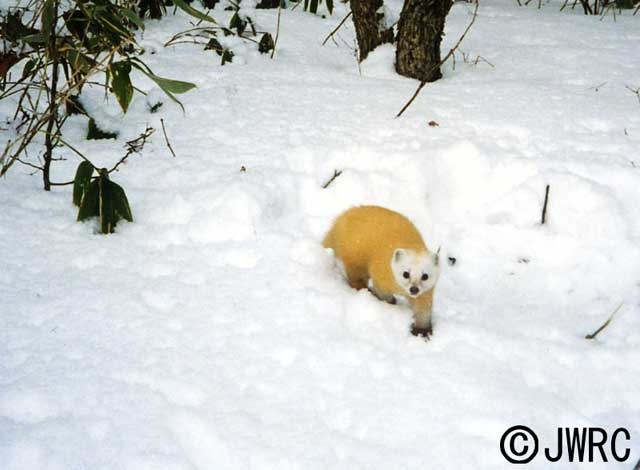
Japanese martens (Martes melampus) are found on the islands of Honshu, Shikoku, and Kyushu in Japan. They are most closely related to sables (M. zibellina), with which it is sympatric on Hokkaido. Genetic studies show that Japanese martens separated from sables about 1.8 million years ago. The Japanese marten's presence on Hokkaido and Sado islands is due to introductions.
There are two confirmed subspecies of Japanese marten: 1) Martes melampus melampus (M. m. melampus), which lives on several Japanese islands; and 2) Martes melampus tsuensis (M. m. tsuensis), which is endemic to Tsushima Island.M. m. melampus is found on the islands of Honshu, Shikoku, and Kyushu in Japan. They were introduced from Honshu to Sado and Hokkaido Islands in Japan before 1949 for fur production. They inhabit southwestern Hokkaido, specifically the low altitude areas of the Oshima Peninsula and Ishikari. M. m. tsuensis is sparsely distributed on the Tsushima Islands of Japan. Japanese martens have been recorded in South Korea, into North Koream but no locality details prove a wild origin and no native population has been confirmed. These are sometimes referred to as Japanese martens coreensis.
Japanese martens are found along valleys, primarily in broad-leaved forests, conifer plantations and open fields up to 1807 meters (5928.48 feet). The climate of the places they live are similar to that the northern U.S. and Europe. They use dens in trees and ground burrows, often made by other animals. Japanese martens are (or were) trapped for fur from in December and January on Honshu. On the International Union for Conservation of Nature (IUCN) Red List they are listed as a species of Least Concern. In CITES (Convention on International Trade in Endangered Species of Wild) they have no special status.[Source: Bill Barthen, Animal Diversity Web (ADW) /=]
Scat analyses indicate that Japanese martens are omnivorous and opportunistic generalists. They eat a wide range of food throughout the year, including fruits and berries from spring to autumn, insects in the summer and autumn, and small mammals and birds when they can catch them all year round. Among the prey that have been documented taking are rabbits and other small mammals, birds and their eggs, centipedes, spiders, frogs and their eggs, earthworms, fish, gastropods, and crustaceans. Japanese martens adapt their fruit and berry foraging to local plant phenology and are adaptable to human disturbances.
People in the Iga region, Mie Prefecture, have a saying about the Japanese marten: "the fox has seven disguises, the tanuki has eight, and the marten has nine." It refers to a story about how the marten has greater ability to change its form than foxes or tanukis. In the Akita and Ishikawa Prefectures, if a marten crosses in front of someone, it is said to be an omen for bad luck. In Hiroshima Prefecture, if one kills a marten, one will soon encounter a fire. In the Fukushima Prefecture, Japanese martens are called heko, fuchikari, komono, and haya. They have traditionally believed that martens were the ghosts of people who have died in avalanches. [Source: Lauren Dubberley, Animal Diversity Web (ADW) |=|]
Japanese Marten Characteristics, Behavior and Reproduction
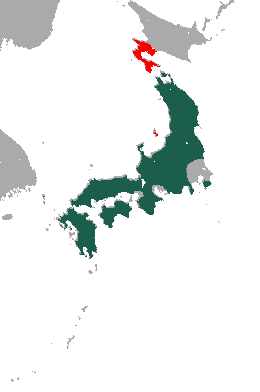
Japanese marten range: green: native; red: introduced
Japanese martens are brown to dark brown in color with a white to cream-colored neck patch. They range in weight from 0.5 to 1.7 kilograms (1.1 to 3.75 pounds) and have a head and body length that ranges from 47. to 54.5 centimeters (18.5 to 21.5 inches), with a tail between 17 and 22.3 centimeters (6.7 to 8.8 inches). They are endothermic (use their metabolism to generate heat and regulate body temperature independent of the temperatures around them), warm-blooded (homoiothermic, have a constant body temperature, usually higher than the temperature of their surroundings). Sexual Dimorphism (differences between males and females) is present: Males are larger than females. Nine live-captured males averaged 1.56 kilograms and four females averaged one kilograms. The age of martens is determined by tooth eruption and wear. [Source: Bill Barthen, Animal Diversity Web (ADW) /=]
Japanese martens are terricolous (live on the ground), nocturnal (active at night), motile (move around as opposed to being stationary), sedentary (remain in the same area), solitary, and territorial (defend an area within the home range). They sense using touch and chemicals usually detected with smell. Juveniles try to establish territories shortly after becoming sexually mature. The home range of males averages 0.70 square kilometers; for females 0.63 square kilometers, with less than 10 percent overlap between any two home ranges. Relatively small home range are believed to have abundant food supplies. Scats have been found primarily in home range peripheries in a doughnut-shaped distribution. Scat placement confirms active maintenance of boundaries by scent marking, a common social behavior in mustelids. Japanese martens have been observed jumping up to two meters from the ground into a tree /=\
Japanese martens engage in seasonal breeding: once yearly between late March to mid-May and giving birth between mid-July and early August. They engage in delayed implantation (a condition in which a fertilized egg reaches the uterus but delays its implantation in the uterine lining, sometimes for several months). The number of offspring ranges from one to five, with the average number of offspring being one of two. Females and males reach sexual or reproductive maturity at one to two years. The mating process is largely unknown and females do all the parenting. Young are altricial, meaning they are born relatively underdeveloped and are unable to feed or care for themselves or move independently for a period of time after birth. They are cared for by the mother. Japanese Marten kits are born deaf, blind, and furred. They can kill prey by three to four months and leave their mother shortly thereafter.
Itachi (Japanese Weasel)
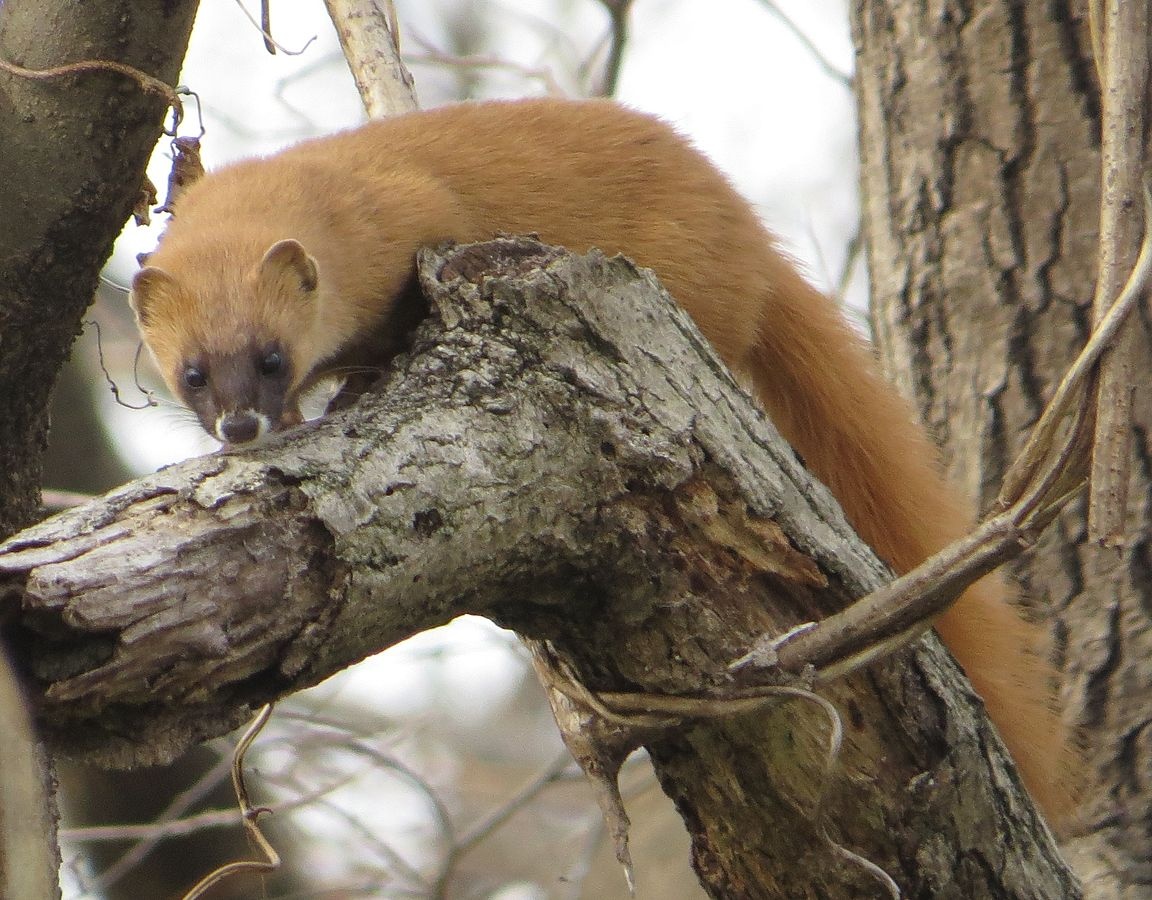
The “itachi” (Mustela itatsi), or Japanese weasel, is endemic to Honshu, Shikoku and Kyushu and has been introduced to other islands as a means of controlling the rodent populations there. A carnivore, it thrives in both the country where they often feed on snakes, frogs, crayfish and crabs from rice paddies, and in urban areas, where they feed on mice and large insects such as grasshoppers. Siberian weasel have been introduced to Japan and in some places are displacing Japanese natives.
Kevin Short wrote in the Daily Yomiuri: Once in a while a lucky observer in the Japanese countryside catches a fleeting glimpse of a small brown animal darting along an irrigation ditch. With a long, narrow tubular body and short legs, and able to run very fast and very low to the ground, this is an itachi, or Japanese weasel. As is the case with many Japanese mammals, the itachi's natural distribution includes Kyushu, Shikoku and Honshu but not Hokkaido. [Source: Kevin Short, April 5, 2012]
Out here in the rice paddy countryside of northern Chiba Prefecture, I most frequently spot weasels along the drainage canals that run through the center of the valleys. Here fish, frogs, crabs and crayfish are plentiful in and around the water, and rodents and small birds hide in the tall grasses that flourish on the banks. The Japanese itachi, however, also eats many fruits and berries available in the nearby fields and thickets, and in some areas may even be an important disperser for plant seeds.
See Separate Article: ITACHI (JAPANESE WEASEL): CHARACTERISTICS, BEHAVIOR AND REPRODUCTION factsanddetails.com
Shrew Moles and Moles in Japan
Kevin Short wrote in the Daily Yomiuri, “Shrew-moles are tiny soft-grey mammals that are not particularly rare in the rice paddy countryside, but they live such secluded lives that few people are even aware of their existence. The Japanese shrew-mole is an endemic species found only on Honshu, Shikoku, Kyushu and some near-shore islands. The Japanese name, hi-mizu, means something like "Sun — No Look," and refers to these animals' habit of spending most of their lives underground...Japan is also home to the hime-himizu (Dymecodon pilirostris), a smaller species, also endemic, that prefers higher elevations. The American shrew-mole of the Pacific Northwest is only distantly related to the Japanese species. [Source: Kevin Short, Daily Yomiuri, April 11, 2011]
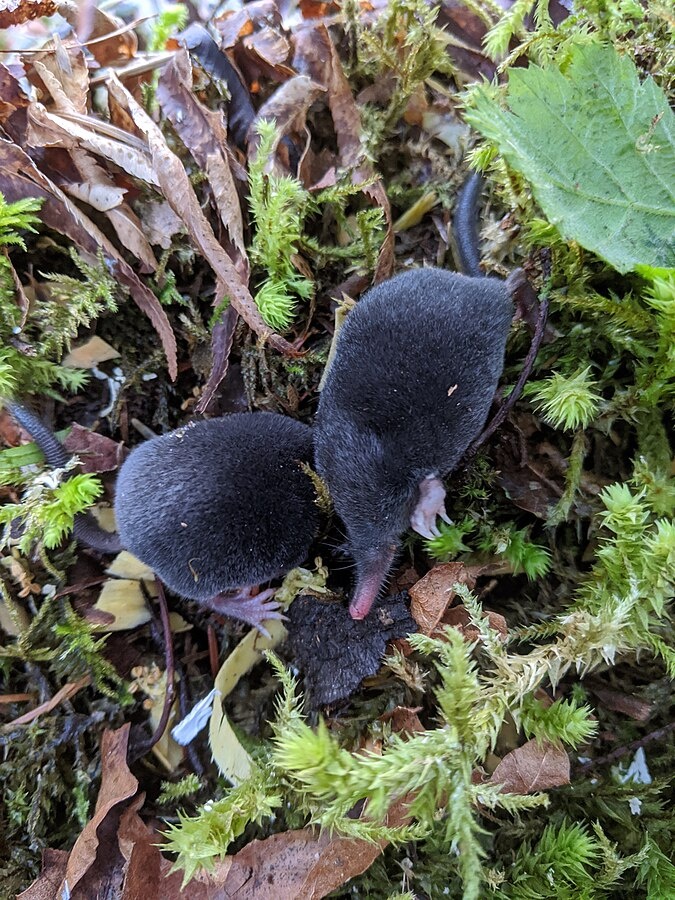
“Moles, which thrive in grassy areas and produce fields of molehills, are far more familiar creatures than shrew-moles. These two types of creatures have similar grey bodies, and may look alike at first glance, but can easily be told apart. Moles have short, thick snouts, short tails, and very wide powerful front feet. Shrew-moles, in contrast, have long, trunklike snouts, medium-length tails, and smaller feet...Although often thought to be blind, both moles and shrew-moles do have eyes. These are so tiny, however, and so well hidden among the soft fur, you have to spend some time searching to find them. These mammals do not hear very well either, but are very sensitive to touch. Their snouts, in particular, are equipped with long hairs that help them feel obstacles as well as prey.”
“The wide front feet of a mole are splayed out almost directly to the side of the body. They are adapted to efficiently excavating elaborate networks of tunnels through soil, and are also quite useful for swimming. Shrew-moles, however, do not live deep down in the soil. They instead spend much of their time shuffling through the humus and leaf litter that collects on the floor of the forest. Their feet are thus narrower and directed more in a downward slant — not nearly as efficient for digging but better for getting around on the ground.”
“Although small in size, shrew-moles have powerful jaws and sharp teeth. They prowl actively for earthworms, centipedes, hunting spiders, pill-bugs, ground beetles, snails and other small forest-floor animals. Occasionally they emerge to hunt in the open, especially after dark, and sometimes supplement their diet with seeds they find on the ground...Shrew-moles make a fine meal for various predators, including tanuki, fox, badger, owls and hawks. Weasels and martens are especially dangerous, as are snakes. Several of Japan's rat snakes are easily large enough to swallow a shrew-mole; while mamushi pit-vipers, with their heat-sensitive organs, can locate the tiny mammals at night by zoning in on their body heat.”
Eurasian Least Shrews — Smallest Mammal in Japan, 2nd Smallest on the World
Eurasian least shrews (Sorex minutissimus hawkeri) are also called Tokyo shrews, lesser pygmy shrews and least Siberian shrews. They are the smallest mammal in Japan and regarded as one of the three smallest mammals in the world along with Etruscan shrews from Italy and bumblebee bats in Thailand. Endangered species, Eurasian least shrews measures just five centimeters (two inches) from nose to tail. They are widely scattered in different places in northern Asia and Europe. In Japan, they live in the grasslands and wetlands around Kushiro in Hokkaido, where they feed on insects.
Eurasian least shrew weighs only 1.2 to four grams (0.042–0.141 ounces) and has a body less than four centimeters (1.6 inches) long, with a 2.5 centimeters (one inch) tail. They have a brown back and a light grey underside, with a fairly clear boundary in between. The color of the back varies seasonally from chocolate brown in summer to light brown in winter. The same bicolor pattern extends to the tail, which has a dark brown tuft of hair at the end. The feet are the same color as the belly, with brown heels.
Adults bumblebee bats are about 2.9 to 3.3 centimeters (1.1 to 1.3 inches) in length and weigh two grams (0.071 ounces). There are a number of shrews that are very small. Etruscan shrews weigh 1.2 to 2.7 grams (0.042 to 0.095 ounces) but is longer than Eurasian least shrews, measuring 3.6 to 5.3 centimeters (1.4 to 2.1 inches) from its head to the base of the tail. [Source: Wikipedia +]
Shrews resemble mice but are more closely related to moles and hedgehogs. The Eurasian least shrew is one of four species of shrew unique to Hokkaido.The name “Tokyo shrew” arose from a simple labeling mistake. When the Eurasian least shrew was discovered during the Meiji era (1868–1912), a specimen of the shrew was labeled “Ezo,” referring to Hokkaido. However, it was later misread as “Edo,” theold name for Tokyo, and the name stu
Image Sources: Japan Animals blogs except tanuki statues (Ray Kinnane), Wikimedia Commons
Text Sources: Animal Diversity Web animaldiversity.org ; National Geographic, Live Science, Natural History magazine, David Attenborough books, Daily Yomiuri, Yomiuri Shimbun, Japan National Tourist Organization (JNTO), New York Times, Washington Post, Los Angeles Times, Smithsonian magazine, Discover magazine, The New Yorker, Time, BBC, CNN, Reuters, Associated Press, AFP, Lonely Planet Guides, Wikipedia, The Guardian, Top Secret Animal Attack Files website and various books and other publications.
Last updated March 2025