
IRIOMOTE CATS
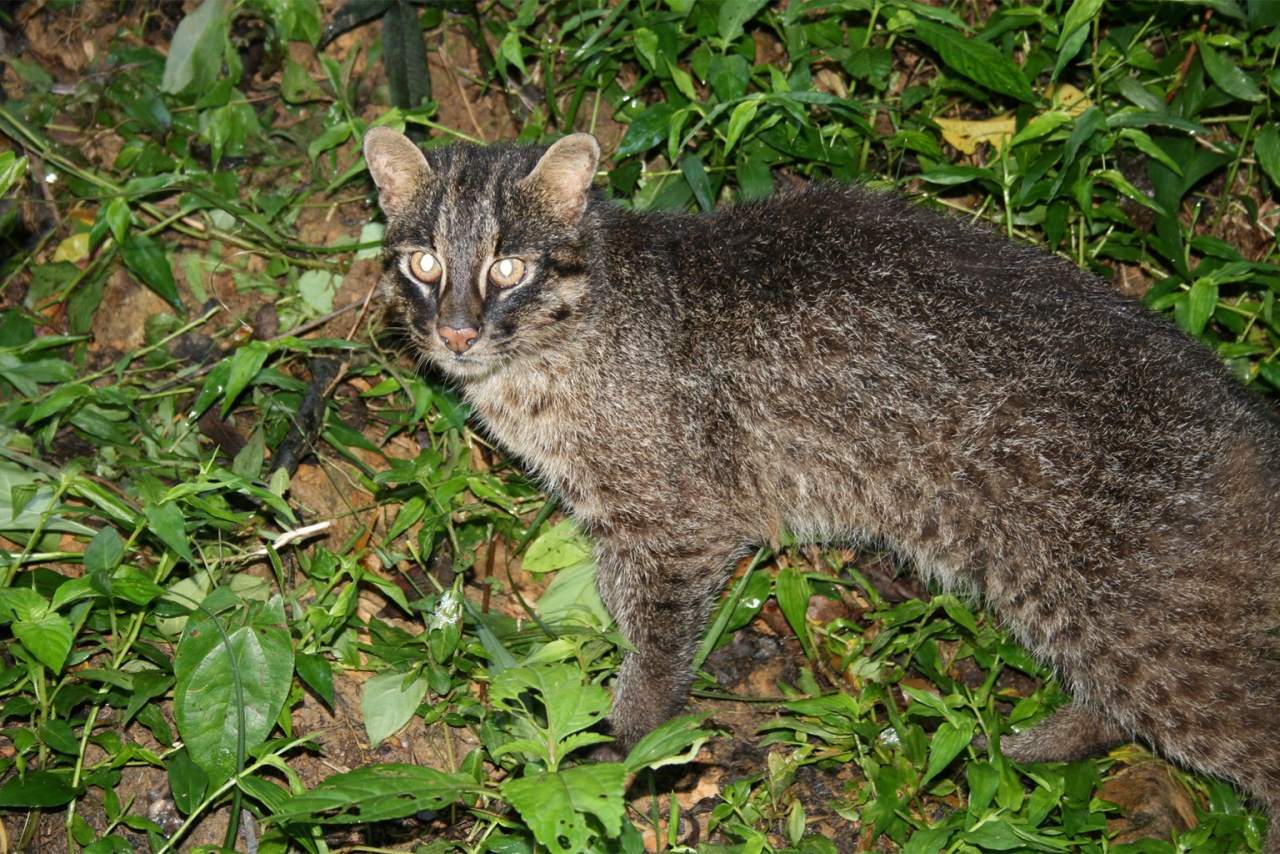
Iriomote cats (Prionailurus iriomotensis) have been designated an endangered species. Only about 100 are believed to be left, all of them living on 289-square-kilometer (111-square-mile) Iriomote island in Okinawa. They are one of the world's most endangered cats and were only discovered in 1965 and confirmed as a unique species in 1967. Even so they closely resemble cats that lived three million years ago and are thought have developed from mainland Asia’s leopard cat.
Iriomote cats are solitary, nocturnal animals. About the size of domestic cats, they are dark, mottled brown in colored and have a rounded club-like tail. They eat lizards, fruit bats, birds, snakes, crabs, fish and insects and are equally comfortable in forests, in the trees or on the beach. They prefer coastal regions and areas around streams and rivers. The make dens and give birth in the hollows of large tree trunks and usually don’t eat like many cats do by holding their prey with their fore paws, an adaption that seems to have come from spending a lot of time in trees.
Iriomote cats look a lot like house cats and are closely related to leopard cats. It was once thought they were a subspecies to leopard cats. An analysis of DNA from both cats suggests that Iriomote cats are in fact a distinct species. The population of Iriomote cats has experienced at least one if not many "extreme demographic bottlenecks". Current evidence suggests that the entire population of this species is derived from as few as two females and one male. [Source: Holly Schroeder, Animal Diversity Web (ADW) /=]
Iriomote cats are endemic only to Iriomote Island, the southernmost isle in the Ryukyu Archipelago, Japan. Near Taiwan, this island consists mainly of low mountains covered by broad-leaved, evergreen, and sub-tropical primary forest. The highest point is 469-meter (1539-foot) -high Mt. Komidake. Mangrove forests are common among the estuaries on the island. Cleared areas along with cultivated fields are found in the coastal flats. Iriomote cats range throughout the mountains and forested areas, and sometimes appears along the coastal beaches and near human settlements.
RELATED ARTICLES:
ANIMALS IN JAPAN: WILDLIFE, BIODIVERSITY, RESEARCH factsanddetails.com
ENDANGERED ANIMALS AND JAPAN: MAMMALS, BIRDS, SPECIES, PROTECTION, ILLEGAL WILDLIFE TRADE factsanddetails.com
EXTINCT ANIMALS IN JAPAN: WOLVES, BIRDS AND OTTERS factsanddetails.com
TANUKIS (JAPANESE RACCOON DOGS): CHARACTERISTICS, BEHAVIOR, FOLKLORE factsanddetails.com
JAPANESE BADGERS: CHARACTERISTICS, BEHAVIOR, FOLKLORE factsanddetails.com
SMALL MAMMALS IN JAPAN: SABLES, CUTE STOATS, MARTENS, SHREW MOLES factsanddetails.com
ITACHI (JAPANESE WEASEL): CHARACTERISTICS, BEHAVIOR, FOLKLORE factsanddetails.com
FLYING SQUIRRELS IN JAPAN: CHARACTERISTICS, BEHAVIOR, SPECIES, REPRODUCTION factsanddetails.com
JAPANESE SEROW: CHARACTERISTICS, BEHAVIOR. CONSERVATION factsanddetails.com
BEARS IN JAPAN: CHARACTERISTICS, BEHAVIOR, SPECIES, HUMANS factsanddetails.com
Iriomote Cat Characteristics and Diet
Iriomote cats range in weight from 3.2 to 4.2 kilograms (7 to 9.25 pounds). The body and head length of adults is between 70 and 90 centimeters (27.5 and 35.4 inches), excluding their short tail.. They are endothermic (use their metabolism to generate heat and regulate body temperature independent of the temperatures around them) and warm-blooded (homoiothermic, have a constant body temperature, usually higher than the temperature of their surroundings). Sexual Dimorphism (differences between males and females) is not present: Both sexes are roughly equal in size and look similar. [Source: Holly Schroeder, Animal Diversity Web (ADW) /=]
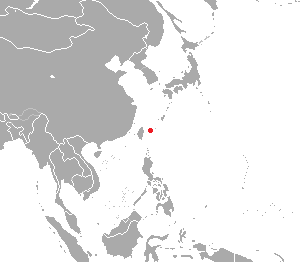
Iriomote cat range
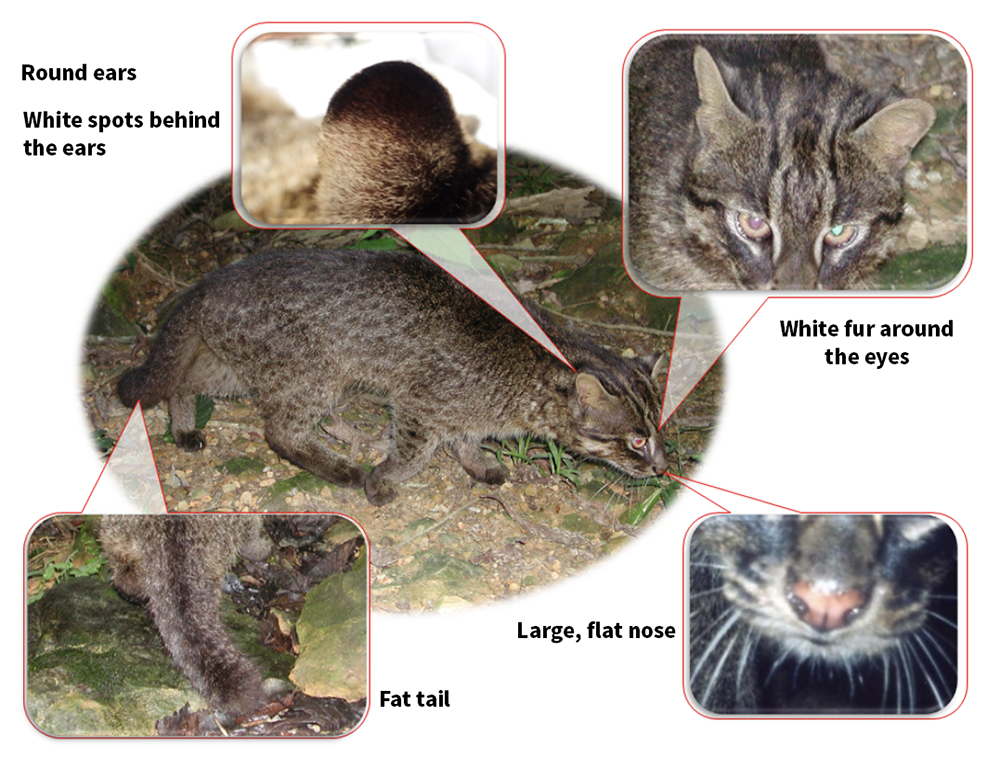
The fur of Iriomote cats is dark brown and of medium length. Dark spots occur in rows along the body, and dark stripes are prevalent along the neck. On the outside of the ears are white spots. There is a characteristic white area surrounding the eyes. The irises vary from yellowish-gold to amber.
Compared to other cats, Iriomote cats have a somewhat elongated body and relatively short legs, giving them a "low-slung" appearance. Conjectures about their lifespan are based upon comparisons to leopard cats who can live up to 15 years, but generally tooth loss their teeth between the ages of eight to 10 years, making it hard for them to survive in the wild.
Iriomote cats are carnivores as is case with all cats. They are opportunistic feeders, who will feed on almost all the animals found on their island home: mammals, particularly as fruit bats and rats, birds, snakes, frogs, lizards, insects and occasionally fish, crabs and other aquatic crustaceans. After killing prey, Iriomote cats have been observed temporarily abandoning it. It has been speculated that the cats are in the general vicinity during the vacated time.
Iriomote Cat Behavior
Iriomote cats are arboreal (live in trees), terricolous (live on the ground), diurnal (active during the daytime), nocturnal (active at night), crepuscular (active at dawn and dusk), motile (move around as opposed to being stationary), sedentary (remain in the same area), solitary, territorial (defend an area within the home range). Their average territory size is one to three square kilometers. [Source: Holly Schroeder, Animal Diversity Web (ADW) /=]
Iriomote cats are usually solitary, but may form pairs when breeding. Males have larger territories than females. Male territories can overlap whereas female territories are less likely to do so. Females also exhibit more stable home ranges and seem to use a consistent feeding site for several years, whereas males shift their areas of activity after several months. /=\
Iriomote cats are active mainly from evening to early morning, but occasionally do hunt during the day, when they apparently prey upon a skink species (Plestiodon kishinouyei) that is only active during the daytime and estivates from dusk till dawn. Although they often travel along the ground, Iriomote cats exhibit arboreal trees), agility. This suggests that they spend some of their time hunting or resting in trees.
Iriomote cats sense and communicate with vision, touch, sound and chemicals usually detected by smelling. They also employ pheromones (chemicals released into air or water that are detected by and responded to by other animals of the same species) and scent marks produced by special glands and placed so others can smell and taste them.
Iriomote cats are usually pretty quiet but do vocalize quite a bit during the breeding season. Mating sounds are similar to those of domestic cats. They have also been reported making low murmuring "bow-wow" sounds when fighting. Scent marking is important in relaying information on territory and sexual receptiveness. Tactile communication is thought to an integral part of bonding between a mother and her kittens, between mates, and between rivals.
Iriomote Cat Mating, Reproduction and Offspring
Iriomote cats are monogamous (having one mate at a time) and engage in seasonal breeding. They generally mate once per year, usually between February and March and sometimes again in September and October. The number of offspring ranges from one to three, with the usual number being one. The average gestation period is 60 days based on what is known about leopard cats. The age in which young are weaned ranges from 60 to 90 days and the age in which they become independent ranges from four to 4.5 months. Females and males reach sexual or reproductive maturity at eight months or older..[Source: Holly Schroeder, Animal Diversity Web (ADW) /=]
Males typically roam a territory of two or three square kilometers while females move in area of one square kilometer. Their dens are typically six feet off the ground. In one study, only six of 686 reported chance observations of Iriomote cats resulted in pair sightings. The sightings all took place between December and March, suggesting monogamy and that is when the breeding season occurs. Male and female "courtship behavior" hav been observed in the month of January. Urine marking frequency in males— believed to be indicative of breeding — appears to peak February to April. The male of captive pair was observed to engage in increased marking during breeding activity.
Most mating likely occurs from February to March, based on the distribution of birth months from April to July. There is a clear peak in births in May. In one study the majority of kittens observed were single offspring. Out of 41 chance observations of mothers and offspring, only four had twins.
Parental duties are performed by females. There is an extended period of juvenile learning. The post-independence period is characterized by the association of offspring with their parents. Young may inherit their territory of their mother. Young are altricial, meaning that they are born relatively underdeveloped and are unable to feed or care for themselves or move independently for a period of time after birth. As the kittens develop in their den their mother provides them with milk, protection, and grooming. After the kittens are able to follow the mother, they must be taught to hunt for themselves. The mother appeers to do this alone, with the help of a male. Territory has been observed to be shared between mothers and daughters up to 6.5 months of age, inidcating a post-independence association between mothers and their female offspring. /=\
Iriomote Cat Conservation
Iriomote cats are the world's most vulnerable and rarest felid species, based on their very small range and population size. On the International Union for Conservation of Nature (IUCN) Red List they are listed as Critically Endangered. On the US Federal List they are classified as Endangered. In CITES (Convention on International Trade in Endangered Species of Wild) they are in Appendix II, which lists species not necessarily threatened with extinction now but that may become so unless trade is closely controlled. Iriomote cats have been fully protected since 1967.
Iriomote cats were at one time eaten as a delicacy. They are threatened by loss of habitat, accidental trapping in crab traps, stray dogs, and inbreeding with domestic cats and competition and diseases from domestic cats. About one or two cats die every year from being run over by cars. Counting cats is done with photo traps.
In 2007 Iriomote cats were moved from the endangered list to the critically endangered list. To help Iriomote cats survive the Japanese government has made one third of Iriomote island into a national park aimed at protecting the cat. Some would like to see development such as dams and roads banned to protect the cats even further.
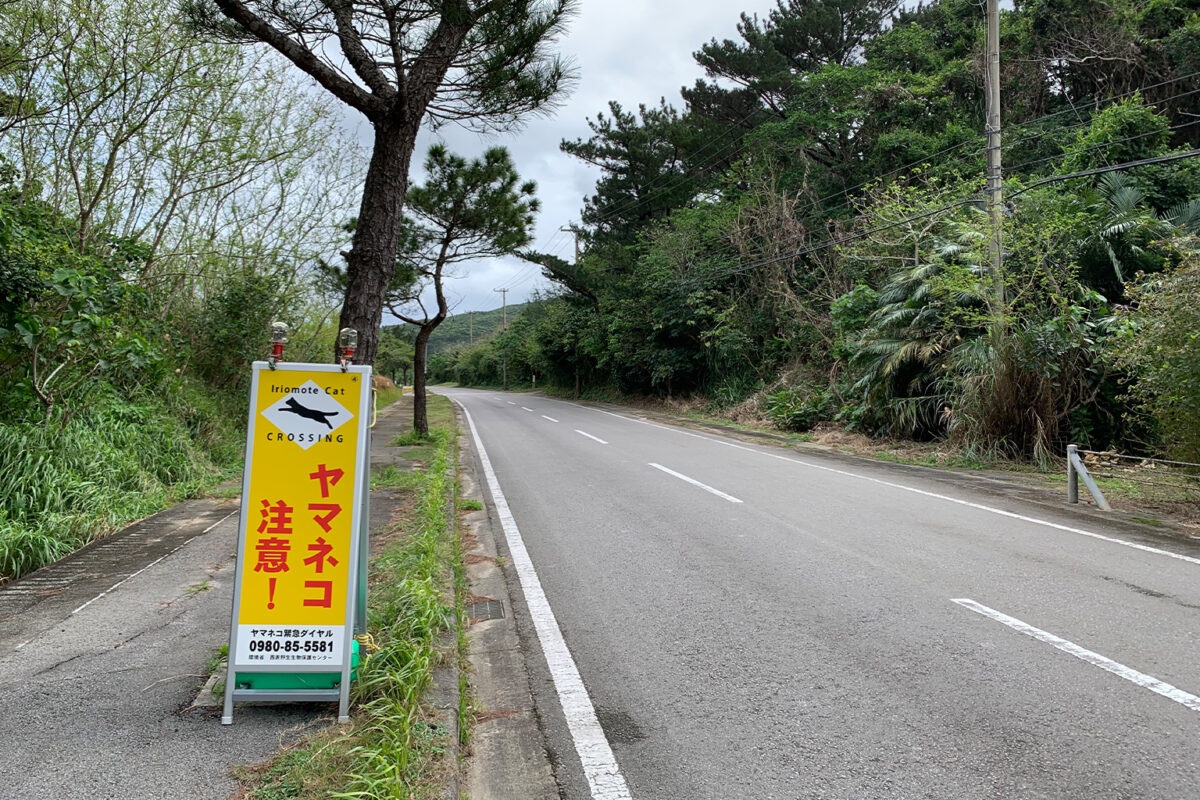
Effort to protect Iriomote cats include raising awareness by putting images of the cat on everything from buses to coffee mugs and putting up signs to ask drivers to drive slowly and keep a watch out for the cats. There is a 24 hour hot line for reports of cats hurt in road accidents and a rehabilitation center for injured cats. Despite the fact that few people actually see an Iriomote cat, the cat helped draw 700,000 tourists to the island in the 2000s, a 14-fold increase from the 1970s.
Image Sources: Wikimedia Commons, Iriomote Wildlife Conservation Center.
Text Sources: Animal Diversity Web animaldiversity.org ; National Geographic, Live Science, Natural History magazine, David Attenborough books, New York Times, Washington Post, Los Angeles Times, Smithsonian magazine, Discover magazine, The New Yorker, Time, BBC, CNN, Reuters, Associated Press, AFP, Lonely Planet Guides, Wikipedia, The Guardian, Top Secret Animal Attack Files website and various books and other publications.
Last updated March 2025