
ERMINE

Ermine (Mustela erminea) are also called stoats, short-tailed weasels and Bonaparte weasels. They are a northern weasel species that turn white in the winter. Widely distributed across northern North America and Eurasia, ermines are most abundant in thickets, woodlands, and semi-timbered areas. These slender, agile, voracious mammals have head and body length of measure 13 to 29 centimeters (5 to 12 inches). Their lifespan in the wild is as high as seven years but is typically less than two years. They have lived up to 12.5 years in captivity. The term “ermine” also describes the animal’s pelt and white winter fur has long been used in trimming coats and making stoles and was used historically in royal robes and crowns in Europe. [Source: Encyclopedia Britannica]
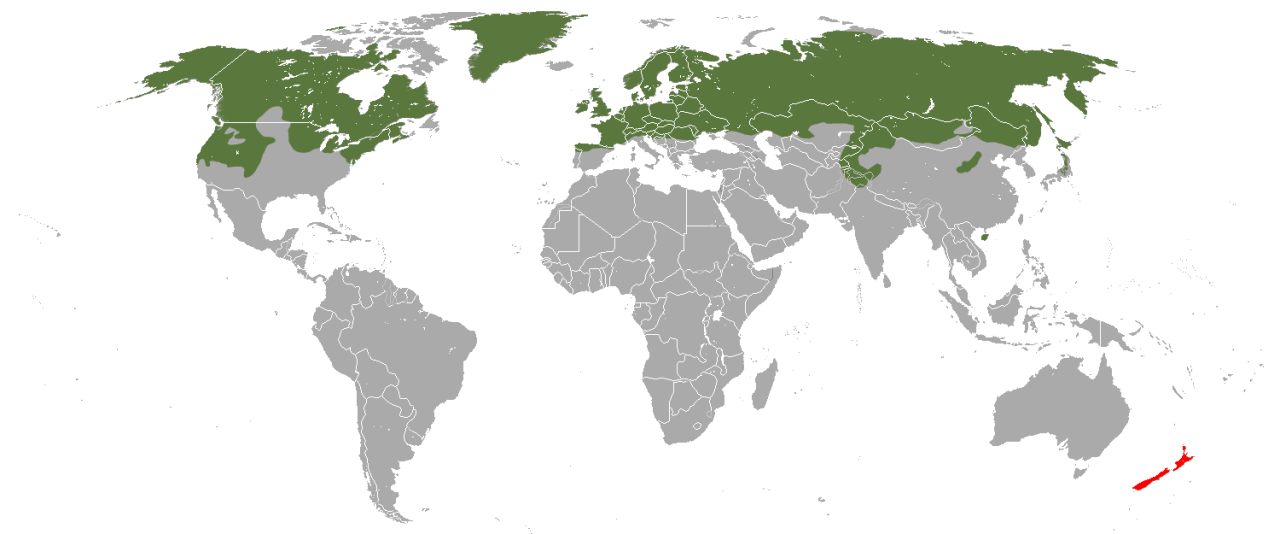
Ermine have a circumpolar distribution. They are found above the Arctic Circle and range from east to west in a broad belt from the Arctic Ocean and adjacent islands of the Canadian Archipelago southward into the northern United States, central Europe and Central Asia. Ermine are absent from the Great Plains in the U.S. but are common in the British Isles and live in tundra, taiga, savannas, grasslands, forests, scrub forests, mountains, areas adjacent to rivers and other water bodies. |=|
Ermine prefer riparian woodlands near rivers, marshes, shrubby fencerows, and open areas adjacent to forests or shrub borders. Although ermine are primarily terrestrial, they are good tree cilbers and swimmers. Tree roots, hollow logs, stone walls, and rodent burrows are used as dens. Dens are usually around 30 centimeters below ground. Ermine line their nests with dry vegetation, and fur and feathers from prey. Side cavities of burrows are used as food caches and latrines. [Source: Heather Loso, Animal Diversity Web (ADW) |=|]
Ermine are not considered threatened or endangered, even people trap thousands of them each year for fur. They are designated as a species of least concern on the International Union for Conservation of Nature (IUCN) Red List and have no special status on the Convention on International Trade in Endangered Species (CITES). Demand for fur has decreased in much of the world but still exists in Russia and China and some other places. Ermine are excellent mousers, which makes them valuable to humans, but they are also known for taking domestic fowl when they have access to them. |=|
RELATED ARTICLES:
WEASELS: CHARACTERISTICS, BEHAVIOR, SPECIES factsanddetails.com
WEASEL SPECIES OF ASIA AND EUROPE factsanddetails.com
LEAST WEASELS: CHARACTERISTICS, BEHAVIOR AND REPRODUCTION factsanddetails.com
POLECATS: CHARACTERISTICS, BEHAVIOR, SPECIES, REPRODUCTION factsanddetails.com
MARTENS: CHARACTERISTICS, BEHAVIOR, SPECIES AND REPRODUCTION factsanddetails.com
MINKS: CHARACTERISTICS, BEHAVIOR, INVASIVE AND ENDANGERED SPECIES factsanddetails.com
MINK FUR: QUALITY, FARMS AND ANIMAL RIGHTS factsanddetails.com
SABLES: CHARACTERISTICS, FUR, BEHAVIOR, TRAPPING, REPRODUCTION factsanddetails.com
FURS; RUSSIA, HISTORY, FARMS factsanddetails.com
Mustelids

Ermine are mustelids (Mustelidae), a diverse family of carnivoran mammals, including weasels, badgers, otters, stoats, mink, sables, ermine, fishers, ferrets, polecats, martens, grisons, wolverines, hog badgers, honey badgers and ferret badgers. Mustelids, make up the largest family within Carnivora with about 66 to 70 species in eight or nine subfamilies and 22 genera. Skunks were considered a subfamily within Mustelidae, but recent molecular evidence has led their removal from the mustelid group. They are now recognized as a their own single family, Mephitidae. [Source: Wikipedia, Matt Wund, Animal Diversity Web (ADW) |=|]
Mustelids inhabit all continents except Australia and Antarctica, and do not live on Madagascar or oceanic islands. They are found in diverse terrestrial and aquatic habitats in temperate, tropical and polar environments — in tundra, taiga (boreal forest), conifer forests, temperate forests, deserts, dune areas, savanna, grasslands, steppe, chaparral forests, tropical and temperate rainforests, scrub forests, mountains, lakes, ponds, rivers, streams. coastal brackish water, wetlands such as marshes, swamps and bogs, suburban areas, farms, orchard and areas near rivers, estuaries and intertidal (littoral) zones.
Mustelids vary greatly in behavior. They are mainly carnivorous and exploit a wide diversity of both vertebrate and invertebrate prey, with different members specializing in certain kinds of prey. Most mustelids are adept hunters with some weasels able take prey much larger than themselves. Many species hunt in burrows and crevices; some species have evolved to become adept at climbing trees (such as martens) or swimming (such as otters and mink) in search of prey. Wolverines can crush bones as thick as the femur of a moose to get at the marrow, and have been seen attempting to drive bears away from their kills. Mustelids typically live between five and 20 years in the wild. |=|
See Separate Article: MUSTELIDS: CHARACTERISTICS, BEHAVIOR, REPRODUCTION, TYPES, SPECIES factsanddetails.com
Ermine Characteristics
David Attenborough wrote The European stoat is not a large animal, only about a foot long from the tip of its nose to the end of its slim, sinuous, softly-furred body. It is brown above and cream beneath, with a short four-inch-long black-tipped tail.[Source: “Life of Mammals” by David Attenborough]
Ermine (stoats) range in weight from 25 to 116 grams (9 to 4 ounces) and have a head and body length ranging from 17 to 33 centimeters (6.7 to 13 inches). The tail length is about a third of the total body length, ranging from 4.2 to 12 centimeters. Their average basal metabolic rate is 1.276 watts. Sexual Dimorphism (differences between males and females) is present: Males are generally twice as large as females, with males weighing from 67 to 116 grams and females from 25 to 80 grams.[Source: Heather Loso, Animal Diversity Web (ADW) |=|]
According to Animal Diversity Web: Ermine have the typical weasel form: long body, short legs, long neck supporting a triangular head, slightly protruding round ears, bright black eyes, and long whiskers. Their short, moderately fine fur is white in the winter and the tip of the tail is black. In the summer, the dorsal fur is chocolate brown while the ventral fur extending to the upper lip is yellowish white. |=|
Ermine Food, Hunting Style and Predators
Ermine are carnivores that hunt primarily at night. They are specialist predators who mainly prey on mammals of rabbit size or smaller. When such prey is scarce, they eat birds, eggs, frogs, fish, and insects. In the winter, ermine frequently hunt under snow and survive entirely on small rodents and lemmings. They need to eat a lot for their body size and feed relatively frequently to meet their high energy and heat production requirements. Ermine cache leftover meals as a way of meeting these demands when they don’t makr daily kills. [Source: Heather Loso, Animal Diversity Web (ADW) |=|]
When potential prey has been selected, ermine approach as closely as they can. Then with a remarkable burst of speed they grasp the back of their prey’s head and neck with their sharp teeth, and wrap their body and feet around the victim. The victim dies from repeated bites to the base of the skull. Ermine can kill prey such as rabbits up to ten times their size this way. Ermine have keen senses that help them locate prey. Hares and rodents are mainly followed by scent, insects by sound, and fish by sight. |=|
Ermine hunt in a zigzag pattern, progressing in a series of leaps of up to 50 centimeters each. They investigate every hole and crevice, often stopping to survey their surroundings by raising their heads and standing upright on their hindlegs. They may travel up to 15 kilometers in one night. |=|
Among the known predators of ermine are red fox, gray fox, martens, fishers, badgers, raptors, and occasionally domestic cats. Ermine are fierce and aggressive for their size and well camouflaged and quiet. If need be they can escape into a burrow or climb a tree. , although diminutive, animals. Many ermine die from a parasitic nematode (Skrjabingylus nasicola) that infects the nasal passage, distorting the sinuses and causing death by perforating the skill and putting pressure on the brain, Shrews are believed to be the carrier hosts of this parasite. |=|
Ermine Behavior
Ermine are terricolous (live on the ground), nocturnal (active at night), crepuscular (active at dawn and dusk), motile (move around as opposed to being stationary), sedentary (remain in the same area), territorial (defend an area within the home range) and solitary. Male and female ermine only associate with one another during the breeding season. Adult males dominate females and young. [Source: Heather Loso, Animal Diversity Web (ADW) |=|]
Ermine home territories range from 10 to 20 hectares (25 to 50 acres). Ermine population densities rise and fall with prey abundance. When prey is plentiful an individual may occupy a smaller 10 hectare area. Home ranges of males are usually twice the size of those of females. Home range boundaries are patrolled and marked by scent. Females tend to remain in their birth places throughout their lives. Males disperse and attain large territories that may encompass or overlap females' territories. |=|
The ermines’ lithe, agile body allows them to move swiftly both above ground and through underground burrows. Females hunt in tunnels more than males, which may explain why more males are trapped. With their light weight and relatively large, splaying paws, ermine can also run easily across snow.
Ermine sense and communicate with vision, touch, sound and chemicals usually detected by smelling. They have keen senses of smell, vision, hearing, and touch, all of which help them to locate prey. Most mustelids are fairly quiet animals, but some vocalizations may be used to communicate. Ermine leave scent marks produced by special glands and placed so others can smell and taste them. Chemical cues are probably the main means of communicating reproductive readiness to potential mates. |=|
Hunting Style and Odd Sexual Behavior of Stoat
David Attenborough wrote : “The European stoat weighs only about a tenth as much as a rabbit. Yet it hunts them. Crouching in the long grass, it creeps close to unsuspecting victim sitting not far from its burrow. “Once within range, the stoat deliberately shows itself. It starts to dance, leaping up and down apparently chasing its own tail. It somersaults. It bounces up again and makes a back flip. The rabbit, maybe only a couple of yards or so away, is transfixed. It stops nibbling and stares with bulging eyes at this extraordinary performance. Suddenly the stoat bursts out from the grass, stabs its teeth into the back of the rabbit's neck smashing the rear end of its skull. The rabbit's legs twitch for a few moments. Then it slumps motionless. It is dead and the stoat begins the laborious business of hauling the great slack body back to its burrow." [Source: “Life of Mammals” by David Attenborough]
Stoats are so active and burn up so much energy so swiftly that they need to feed every few hours. In spring a female must hunt with particular zeal for then she is likely to have young in her den and she has to only feed herself but to maintain a regular supply of milk for them. Her brood is large — a many as a dozen young kits. They are born blind and naked. The male who is their father plays no part whatever in caring for them. She must look after them by herself, first supplying them with milk. and then with fragments of meat, So she has to hunt almost continuously and much of the time she is compelled to leave her young unguarded.”
“In her absence from the den a male stoat may pay a visit. He is unlikely to be her mate. Most probably he is a young male, perhaps only a year or so old. Inside the den he finds the naked youngsters. Even at three weeks old, they are still blind so they cannot see him, but they instinctively recognize his nature, perhaps from the scent, for the infant females among them react to him by making high-pitched trilling calls and lifting their hind quarters. One after the other the male copulates with them, and then scampers away. The eggs he has fertilized within the kits do not develop immediately
Ermine Mating, Reproduction and Offspring
Ermine are polygynandrous (promiscuous), with both males and females having multiple partners. They engage in embryonic diapause (temporary suspension of development of the embryo) and They engage in delayed implantation (a condition in which a fertilized egg reaches the uterus but delays its implantation in the uterine lining, sometimes for several months). In the wild, females may survive for at least two breeding seasons, while males generally do not survive that long. Reproductive success is highly dependent on food availability. [Source: Heather Loso, Animal Diversity Web (ADW) |=|]
Ermine engage in seasonal breeding. They generally breed once a year — in late spring to early summer. The number of offspring ranges from three to 18, with the average number being four to nine. The average gestation period is 43 days; 280 days.is delayed implantion is included. Longer days beginning in March trigger the resumption of fetal development and young are born in April or May..
Females are polyestrous, but produce only one litter per year. Pre-weaning and pre-independence provisioning and protecting are done by females. Young are altricial. This means that they are born relatively underdeveloped The sex ratio at birth is unequal. Young are born with their eyes closed and are covered with fine white hair. A prominent dark mane of dense fur, whose function is unknown, develops around the neck by the third week.
Young grow quickly and are able to hunt with their mother by their eighth week. The average weaning age is 8-10 weeks. On average females reach sexual or reproductive maturity at 60 to 95 days; males do so at one to two years. Although females do not reach adult size until a least six weeks after birth, they are able to mate very early, often before they are weaned. Males do not breed or obtain adult size until their second summer.
Ermine Fur
The winter fur of ermine is very dense and silky, but quite short and close to the skin. Summer fur is rougher, shorter and sparser. In summer, the fur is sandy-brown on the back and head and a white below. Ermine. moult twice a year. In spring, the moult is slow and starts at forehead and moves across the back, toward the belly. In autumn, the moult is quicker and progresses in the reverse direction. The moult is initiated by changes in the amount of daylight during autumn and spring. In northern parts of its range, ermine develop a completely white coat (except for the black tail-tip) during the winter period. Differences in the winter and summer coats are less obvious in their southern range. Subspecies there keep a brown coat in the summer, but the denser and sometimes paler. [Source: Wikipedia]
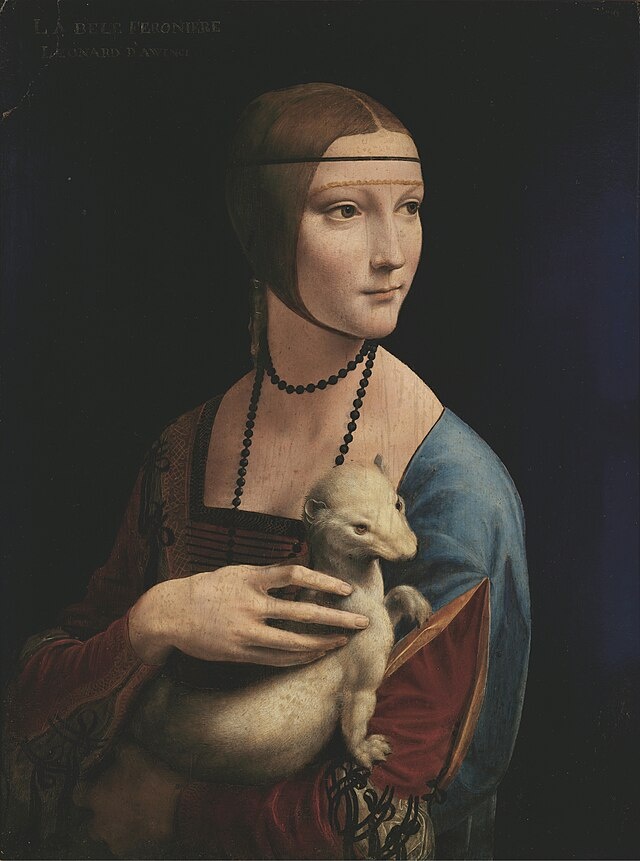
Ermine furs have long been a symbol of high status, prestige and nobility. Prelates of the Catholic Church still wear ecclesiastical garments featuring ermine (a sign of their status equal to that of the nobility). Cecilia Gallerani, lady-in-waiting of the Duke of Milan, is depicted holding an ermine in her 1491 portrait, Lady with an Ermine, by Leonardo da Vinci.
Ermine was an important trade item for the Soviet Union. Half of the world’s harvest came from within its borders. The Soviet Union also contained the highest grades of ermine pelts, with the best grades from North American pelts being comparable to the 9th grade in the quality criteria of former Soviet ermine standards. Ermine trapping was never a specific goal. Most ermine were caught incidentally in traps or intened for minks or sables. Some were caught using dogs, box-traps or jaw-traps. Guns were rarely used, as they could damage the pelt.
Ermine and Royalty
Winter white ermine skins have traditionally been greatly valued in the fur trade, especially to make make winter coat, and trim coats and stoles. The fur from the winter coat is called ermine and has been used in various ways by states, government bodies, aristocracies and academic institutions. Ermine is the ancient symbol of the Duchy of Brittany. The ceremonial robes of members of the British House of Lords and the academic hoods of the universities of Oxford and Cambridge have traditionally been trimmed with ermine, although today rabbit or fake fur is now often used as a bow to animal rightist.
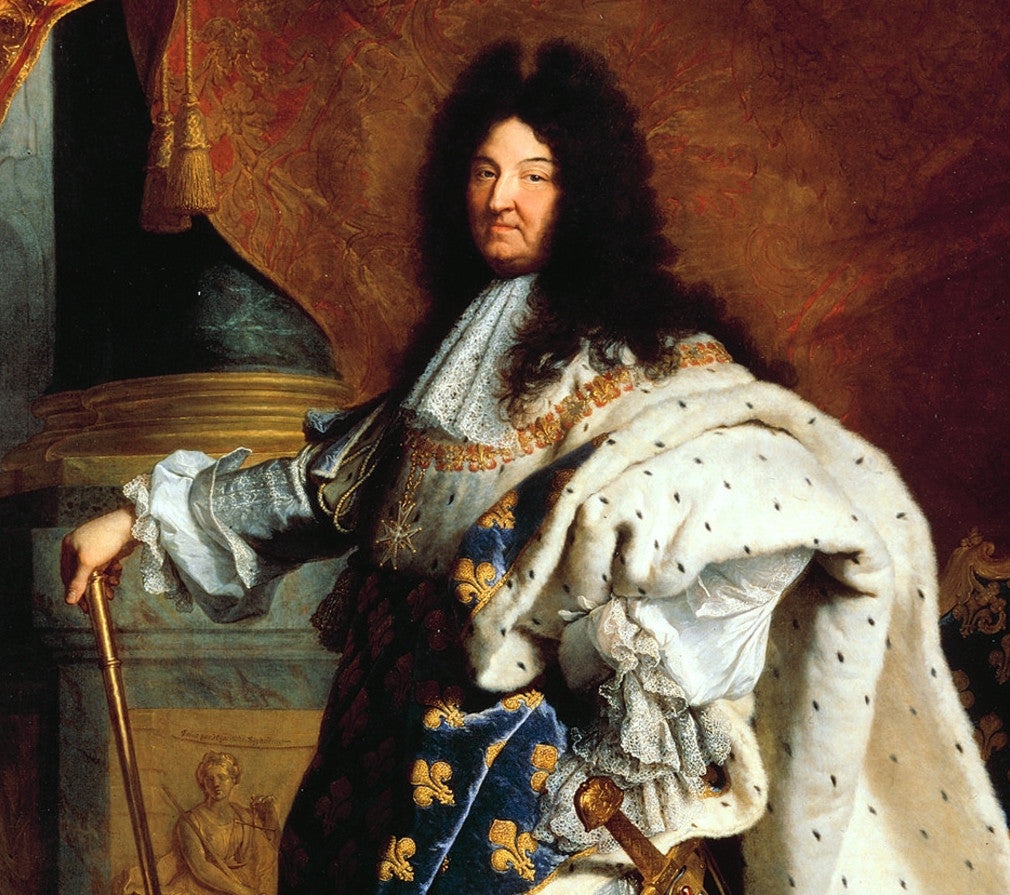
The Imperial State Crown is in the Crown Jewels of the United Kingdom symbolises the sovereignty of the monarch and is worn by the British monarch after coronation. It is made of gold, silver and platinum, and decorated with 2,868 diamonds, 273 pearls, 17 sapphires, 11 emeralds, and 5 rubies. Its purple velvet cap is trimmed with ermine. Louis XIV of France (in 1701), Henry VIII of England and Emperor Napoleon I of France (1805) were painted wearing ermine robes. A painting of Queen Elizabeth I from 1559 appears to show a pet ermine on her sleeve.
Erin Blakemore wrote in National Geographic History: Ermine long held a special allure to high-ranking Europeans, who even incorporated it into their family coats of arms. Though it is unclear how long European royals have been wearing ermine, the practice is thought to date back to before the Middle Ages, by which time they were already a royal must. [Source: Erin Blakemore, National Geographic History, March 28, 2024]
The furs’ limited availability also influenced their reputation as rare and royal, says Jacqueline Musacchio, an art historian at Wellesley University who specializes in Italian Renaissance and Baroque art. “Ermine initially required hunting and trapping in distant reaches of Europe and Asia and as a result their pelts were expensive,” says Musacchio. “And these are rather small animals, so you needed quite a lot of them to trim a cape or line a jacket.”
In royal circles, robes and gowns trimmed or lined with the fur became ceremonial must-haves for the monarchs of France, England, Sweden, Russia, and other European powers. The dramatic, furry accents of long velvet robes favored by these sovereigns would have deeply impressed their subjects, who would have assumed that the robes conferred “dignity, honor, and authority” to their wearer, writes art historian Paola Rapelli.
Ermine and the Renaissance
Erin Blakemore wrote in National Geographic History, The animals’ pelts also figured heavily in Renaissance artwork, even after their supply fell off in the 1500s due to the Ottoman Empire’s seizure of Constantinople, a critical trade center for the pelts of winter-white weasels from Siberia. Musacchio’s research has revealed why: For Renaissance viewers, the weasel was likely a protective symbol indicating pregnancy and childbirth. [Source: Erin Blakemore, National Geographic History, March 28, 2024]
Take Leonardo da Vinci’s famous portrait “Lady with an Ermine,” which depicts Italian noblewoman Cecilia Gallerani holding a white-coated weasel. “With their powerful jaws, non-retractile claws, and pungent anal scent glands, weasels would not have served as suitable pets for court ladies,” writes Musacchio. Instead, she believes the presence of the unlikely lap animal represented Gallerani’s pregnancy. The animal pelts’ presence in a variety of women’s portraits, Musacchio notes, is likely due to a prevailing myth of the era that weasels conceive through the ear and give birth through the mouth, or vice versa.
Renaissance women would have tied the mystery of weasel reproduction to their own desires to survive pregnancy and childbirth — risky ventures at the time — with a bit of divine intervention. As a result, high-ranking Renaissance-era women were often given metalwork weasel heads that they wore around their waist, along with pricey weasel pelts.
Image Sources: Wikimedia Commons
Text Sources: Animal Diversity Web animaldiversity.org ; National Geographic, Live Science, Natural History magazine, CNTO (China National Tourism Administration) David Attenborough books, New York Times, Washington Post, Los Angeles Times, Smithsonian magazine, Discover magazine, The New Yorker, Time, BBC, CNN, Reuters, Associated Press, AFP, Lonely Planet Guides, Wikipedia, The Guardian, Top Secret Animal Attack Files website and various books and other publications.
Last updated June 2025