
LEAST WEASELS

Least weasels (Mustela nivalis) are also called little weasels, common weasels, or simply weasels. They are the smallest weasels and the smallest member of the genus Mustela. One of the world’s most widespread mammals, they are found in most of the Northern Hemisphere — in Asia, Europe, North America and North Africa. [Source: Wikipedia]
Least weasels vary greatly in size over their range. Their body is slender and elongated, and their legs and tail are relatively short. Colour varies geographically, as does the pelage type and length of tail. The back, surface, flanks, limbs and tail of the animal are usually some shade of brown while the underparts are white. The line delineating the boundary between the two colours is usually straight. At high altitudes and in the northern part of their range, their coat becomes pure white in winter. Eighteen subspecies are recognized.
Least weasels are not endangered. They are designated as a species of least concern on the International Union for Conservation of Nature (IUCN) Red List due to their wide distribution and large population throughout the Northern Hemisphere and have no special status on the Convention on International Trade in Endangered Species (CITES). Least weasels help humans by preying on rodents, which can transmit disease, eat crops, and cause property damage. On the other hand they are also blamed for attacks on domesticated chickens and other avian livestock but is seems that while it does happen it doesn’t happen so much. Least weasels are not targeted by trappers by they are caught as bycatch in traps set fur-bearing mustelids like minks and sables. Least weasel pelts do not have a high economic value but they are used as lining and trim on garments such as luxury coats and mittens. least weasels are more common in Europe and Asia, While they are not considered rare in North America, and are not globally threatened. As a whole, populations of least weasels are considered stable. [Source: Gina Campbell, Animal Diversity Web (ADW) |=|]
RELATED ARTICLES:
MUSTELIDS: CHARACTERISTICS, BEHAVIOR, REPRODUCTION, TYPES, SPECIES factsanddetails.com
WEASELS: CHARACTERISTICS, BEHAVIOR, SPECIES factsanddetails.com
WEASEL SPECIES OF ASIA AND EUROPE factsanddetails.com
POLECATS: CHARACTERISTICS, BEHAVIOR, SPECIES, REPRODUCTION factsanddetails.com
MARTENS: CHARACTERISTICS, BEHAVIOR, SPECIES AND REPRODUCTION factsanddetails.com
MINKS: CHARACTERISTICS, BEHAVIOR, INVASIVE AND ENDANGERED SPECIES factsanddetails.com
MINK FUR: QUALITY, FARMS AND ANIMAL RIGHTS factsanddetails.com
SABLES: CHARACTERISTICS, FUR, BEHAVIOR, TRAPPING, REPRODUCTION factsanddetails.com
ERMINE (STOATS): CHARACTERISTICS, FUR, BEHAVIOR, ROYALTY, REPRODUCTION factsanddetails.com
FURS; RUSSIA, HISTORY, FARMS factsanddetails.com
Least Weasel Habitat and Range
Least weasels are widespread and abundant throughout the Northern Hemisphere. They live in temperate and cold areas, where the climates are similar to that of the northern North America and Europe in tundra, taiga, savannas, grasslands, forests and agricultural areas. They are found North America, from Alaska, south throughout Canada and the northern continental United States, and Europe (excluding Ireland, Greenland, and Iceland). They have been introduced to New Zealand, Malta, Crete, the Azores, and São Tomé. [Source: Gina Campbell, Animal Diversity Web (ADW) |=|]
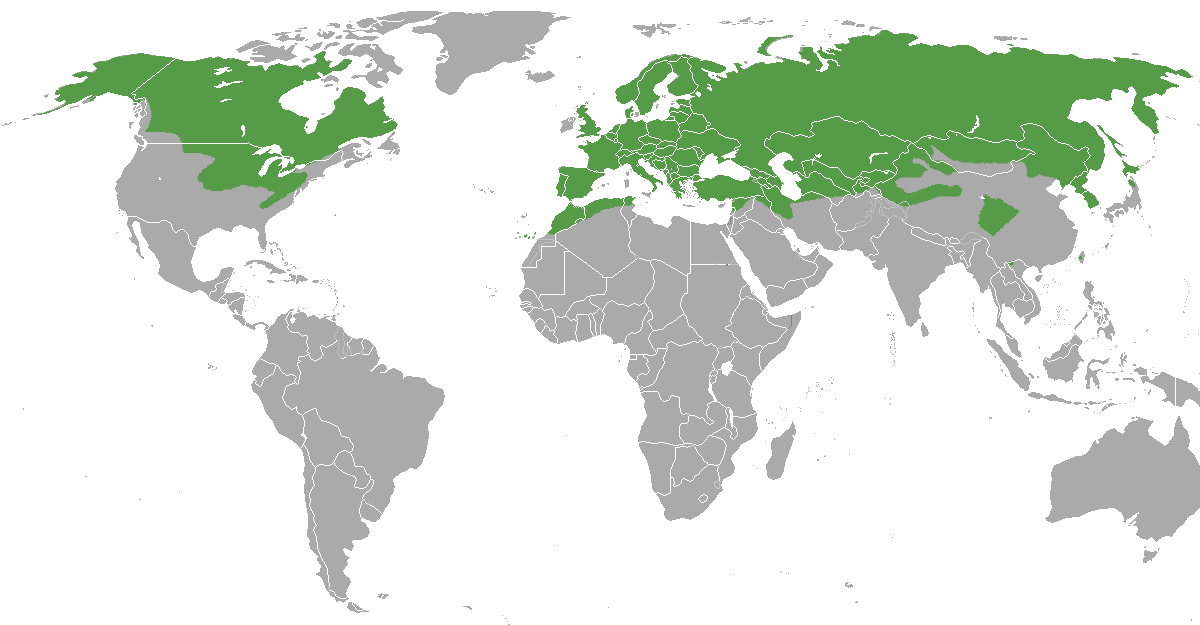
Least weasels are very adaptable and able to thrive in a many different kinds of habitats — coniferous and deciduous forests, in prairie grasslands, open tundra, bushy taiga, and rainforests that undergo a dry season in the summer months. Least weasels are comfortable above and below ground, maneuvering easily through both leaf litter, subterranean, and subnivean tunnels. They are no slouches in water and trees either; they are good climbers and swimmers.
Weasels have different kinds of dens in different substrates in different habitats but generally do not burrow or dig dens; they use the abandoned dens from prey or other fossorial species (animals engaged in a burrowing life-style). Weasels only temporarily reside in their dens, and many dens can be found in a single least weasel’s territory. Weasels commonly choose dens at the base of trees in habitats with tree stands, such as coniferous, deciduous or mixed forests. When trees are not available, weasels reside in brush or log piles, and tall grass patches, such as those found in prairie habitats or on agricultural lands. The type of vegetation present in the habitat is not as important as the amount of the vegetation available to use as cover for ambush hunting, as having enough cover is key for successful hunts. |=|
Least Weasel Characteristics
Least weasels are the world’s smallest terrestrial carnivorous predator. They range in weight from 30 to 100 grams (one to 3.5 ounces), with an average weight is 55 gram (1.94 ounces). They have a head and body length ranging from 16.5 to 21.7 centimeters (6.5 to 8.5 inches), with their average length being 19 centimeters (7.5inches). Their basal metabolic rate ranges from 137.5 to 205.7 cubic centimeter per gram per hour. Sexual Dimorphism (differences between males and females) is present: Males are larger than females. [Source: Gina Campbell, Animal Diversity Web (ADW) |=|]
Least weasels have a typical mustelid body shape: a long, tubular body, with short limbs and a short tail that is less than a quarter of the head-body length. The cranium is long and flat, with short, round ears, long vibrissae (whiskers) and large, dark eyes. The white paws are pentadactyl (five-toed) with non-retractile claws at the end of each of the five digits. The dental formula is 3/3 incisors, 1/1 canines, 3/3 premolars and 1/2 molars; 34 teeth in total.

The fur color of least weasels changes seasonally in northern populations, but not in more southerly populations. Among northern populations, in winter, the coat is pure white, but always lacks the black tail tip found in two similar species: ermines (stoats) and long-tailed weasels (Mustela frenata). In summer, the coat turns rusty-chocolate brown on the back and remains white on the belly.
Body mass varies according to region. The largest least weasels are found in warm climates, such as North Africa, where individuals can weigh over 70 grams and reach total lengths (including the tail) of over 21.7 centimeters. The smallest weasels are in North American, where on on average they weigh about 45 grams, and have an average length (including the tail) of about 19 centimeters. Sexual Dimorphism (differences between males and females) is present. Males are larger than the females by approximately two to three centimeters and 30 to 50 grams. There are approximately 10 subspecies of least weasel, all of which can be distinguished only by geographic location, which are not clearly defined and still debated.
Least Weasel Diet and Eating Behavior
Least weasels are primarily carnivores (eat meat or animal parts) and mostly eat terrestrial vertebrates but are also recognized as piscivores (eat fish), insectivores (eat insects) and scavengers. Animal foods include birds, mammals, amphibians, reptiles, fish, eggs, carrion and insects. They store and cache food. [Source: Gina Campbell, Animal Diversity Web (ADW) |=|]
Gina Campbell wrote in Animal Diversity Web: Least weasels, like many other mustelid species, have a reputation for killing prey much larger than themselves, then caching the remains. Least weasels are highly specialized rodent predators and as such, they rely heavily upon rodent species for food. Least weasels are, however, opportunistic feeders and will not overlook an easy meal, such as carrion. Field voles, wood mice, and bank voles constitute much of a least weasel’s diet in more southern populations; almost 100 percent of a weasel's diet is made up of rodents if they are abundant.
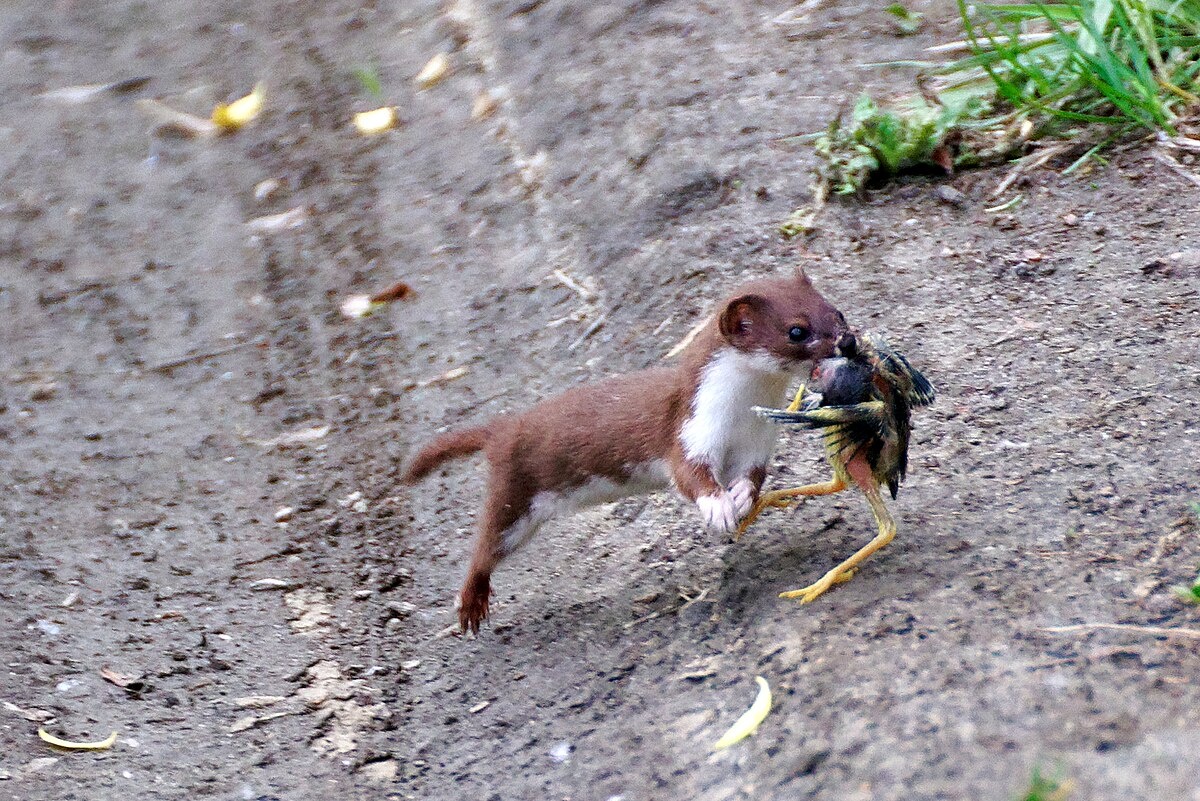
When rodents are scarce, least weasels will also feed upon birds’ eggs, lizards, amphibians, small fish, and invertebrates. Rodents, especially collared lemmings in the northern Arctic regions, are vitally important for weasel reproductive success. Least weasel reproduction is tightly interconnected with lemming abundance, as there are not many other prey species for northern populations of least weasels. Northern populations of weasels cycle more apparently than those found in southern populations due to the strong food requirements placed upon lemmings, which also undergo population cycling; however, least weasel populations naturally peak and subside, even with alternative food sources available, like populations in more southern regions. |=|
Least weasels must eat very regularly to avoid starvation and death and are often found foraging at all hours, day or night. Weasels can consume over 50 percent of their body weight every day and even more so in the winter months. Food caching is a common occurrence, as weasels frequently kill prey larger than themselves, yet they only eat a few grams of meat per meal. Caching is especially important for lactating females with kits, as lactation is such an energetically expensive time. Caches are concealed around the den entrance, as are latrine sites. An individual will scent-mark around a den site using secretions from their anal glands. When cornered or startled, anal gland secretions can be discharged, which release a foul-smelling fluid that can deter an antagonist.
Least Weasel Behavior
Least weasels are mostly solitary and terricolous (live on the ground), diurnal (active during the daytime), nocturnal (active at night), motile (move around as opposed to being stationary), sedentary (remain in the same area), and have dominance hierarchies (ranking systems or pecking orders among members of a long-term social group, where dominance status affects access to resources or mates).[Source: Gina Campbell, Animal Diversity Web (ADW) |=|]
Their home territories range from 0.2 to 1.0 square kilometers, with their average territory size being 6.0 square kilometers. Least weasels don’t dig their own dens but rather use abandoned dens left by prey species or other burrowing animals and maintain a territory around the temporary den site only if the rodent population within the territory is large. The boundaries are marked by scent secretions from their anal glands. There is often significant overlap of territories. Males, being dominant, appear to enter the territory of females whenever they feel like it. Overlap is more likely when weasel population densities are high or due to dominance. Dominant males seem to be able to do what they want while non-dominant weasels rarely enter the territories of dominant ones and if they do they might provoke a nasty fight with a dominant male,
Least weasels, like other members of the weasel family, are solitary except for females with young and during the breeding season, when males, who normally stay in one place, travel some distance to find females. Least weasels form sex-based dominance hierarchies, where older males are dominant over females and juvenile males. Males are thought to be dominant over females largely due to Sexual Dimorphism (differences between males and females) is present: the males are larger than the females, in both mass and length. Dominant males make physical and vocal threats, and will viciously attack submissive males, which will retreat, sometimes squealing as they leave. These vicious attacks rarely happen to females, as females fight back unlike submissive males, although females will submit to the dominant male.
Least Weasel Lifespan, Mortality and Predation
While the lifespan of least weasels in captivity has been as high as 10 years their average lifespan in the wild is believed to be around two years or less. Because least weasels are so small, have limited abilities to store fat, and have such high metabolic demands, they have a hard to keep going unless they have a constant supply of food. If their food supply is cut off they are in trouble. The majority of young do not make it to the age of weaning, which occurs 18 to 56 days after birth, especially in the second and third litters of the year, likely due to the increased predation risk on kits in nests. [Source: Gina Campbell, Animal Diversity Web (ADW) |=|]
The mortality rate for least weasels is highest in weeks after they are born when their eyes are still closed and they are helpless in their nests. Juvenile mortality is common from predation by snakes and foxes, while adults are typically preyed upon by owls, such as tawny owls, and other birds of prey, such as falcons, eagles, and hawks. Least weasels may also be preyed upon by other larger weasel species, such as ermines and long-tailed weasels.
As a defense against predation least weasels are well camouflaged. Their fur blends in with soil, rocks, dry grass and the brown bark of trees and bushes. They can also fight back aggressively, make loud vocalizations, bite, scamper up a tree, or hide in a burrow. Least weasels can also release nasty-smelling secretions from their anal glands when startled or afraid. The secretions contain the sulfuric compounds thietane and dithiacyclopentane, thought be aimed at deterring predators, especially those that rely heavily on smell. |=|
Least Weasel Mating and Reproduction
Least weasels are polygynandrous (promiscuous), with both males and females having multiple partners. Females have an estrus cycle, which is similar to the menstrual cycle of human females. They engage in year-round breeding and employ sexual-induced ovulation (release of a mature egg from the ovary). Least weasels breed one to three times per year, depending on prey density. Their breeding season is concentrated from March to June (although breeding is known to occur year-round). The number of offspring ranges from one to 13, with the average number of offspring being five. The gestation period ranges from 34 to 37 days. Young from the earliest birthing of the the have the highest survival rates. of the young),[Source: Gina Campbell, Animal Diversity Web (ADW) |=|]
Least weasel males and females mate numerous times with multiple partners. Breeding may occur intermittently throughout the year. Females are in estrus for an average of four days and will mate with several males over the estrus period. Males do not compete for females. Under normal circumstances outside the breeding season, male least weasels defend territories, typically against other males, but during the breeding season, they abandon their territories in search of females in estrus. Because of differences in size between males and females and rigid dominance hierarchies between males and females, males are able to invade a female’s territory at any time. Females defend their territories mainly against other females; they will fiercely their a home range, regardless of the intruders’ sex, during late-stage pregnancy and lactation.
Ovulation is induced by baculum (penis bone) stimulation, which is straight, not curved, with a hook-shaped tip, which is a distinguishing feature of least weasels. Courtship is a rough affair, involving fighting, biting, and tumbling about until the male is able to grasp the female at the nape of her neck. Once the position is accomplished, the male mounts the female. Copulation can last over an hour. Prolonged copulation is required in order to stimulate female ovulation.
Prey density has a dramatic effect on the number of litters per year and the number of young per litter. During years of high prey abundance and in areas such as the Arctic, where lemming populations can reach astronomical numbers, up to 15 offspring can be born, and up to three litters per year can occur, partially because of post-partum estrus and partially because of high prey density. On average, there are only one or two reproductive events per year.
Least Weasel Offspring and Parenting
Young are called “kits”, They altricial, meaning they are relatively underdeveloped at birth. Kits weigh between 1.0 to 1.7 grams at birth. Parental care is provided by females.The age in which young are weaned ranges from 18 to 56 days and the age in which they become independent ranges from eight to 10 weeks. Females reach sexual or reproductive maturity between three to eight months, at an average of five months; males do so between five to nine months.[Source: Gina Campbell, Animal Diversity Web (ADW) |=|]
Soon after copulation, males depart and females begin the process of caring for offspring, with no help from the male. Altricial young are born hairless, blind, deaf, and helpless and rely completely on maternal care for their survival. Kits rely on their mother’s milk for about a monthalthough the mother may bring meat to the kits as early as two weeks post-parturition.
At about 47 days, the kits are able to kill prey for themselves and at about nine to ten weeks, the kits disperse and are independent. It has been demonstrated that killing is an innate behavior and kits in captivity kill prey with no previous experience or exposure to prey; however, kits that remain with their mother and gain practical hunting experience have higher success rates than those isolated from their mother. |=|
Image Sources: Wikimedia Commons
Text Sources: Animal Diversity Web animaldiversity.org ; National Geographic, Live Science, Natural History magazine, David Attenborough books, New York Times, Washington Post, Los Angeles Times, Smithsonian magazine, Discover magazine, The New Yorker, Time, BBC, CNN, Reuters, Associated Press, AFP, Lonely Planet Guides, Wikipedia, The Guardian, Top Secret Animal Attack Files website and various books and other publications.
Last updated June 2025