
MINK FUR
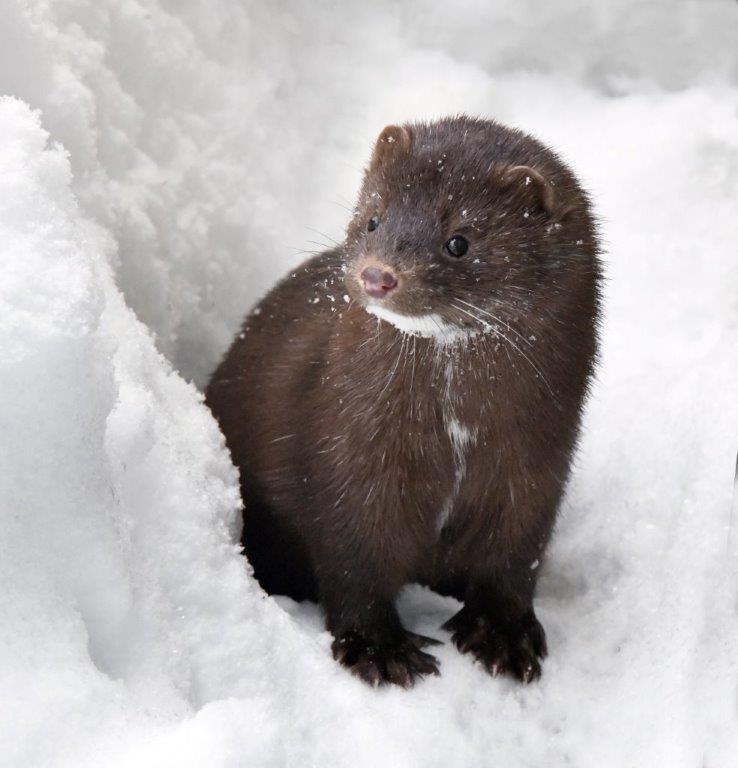
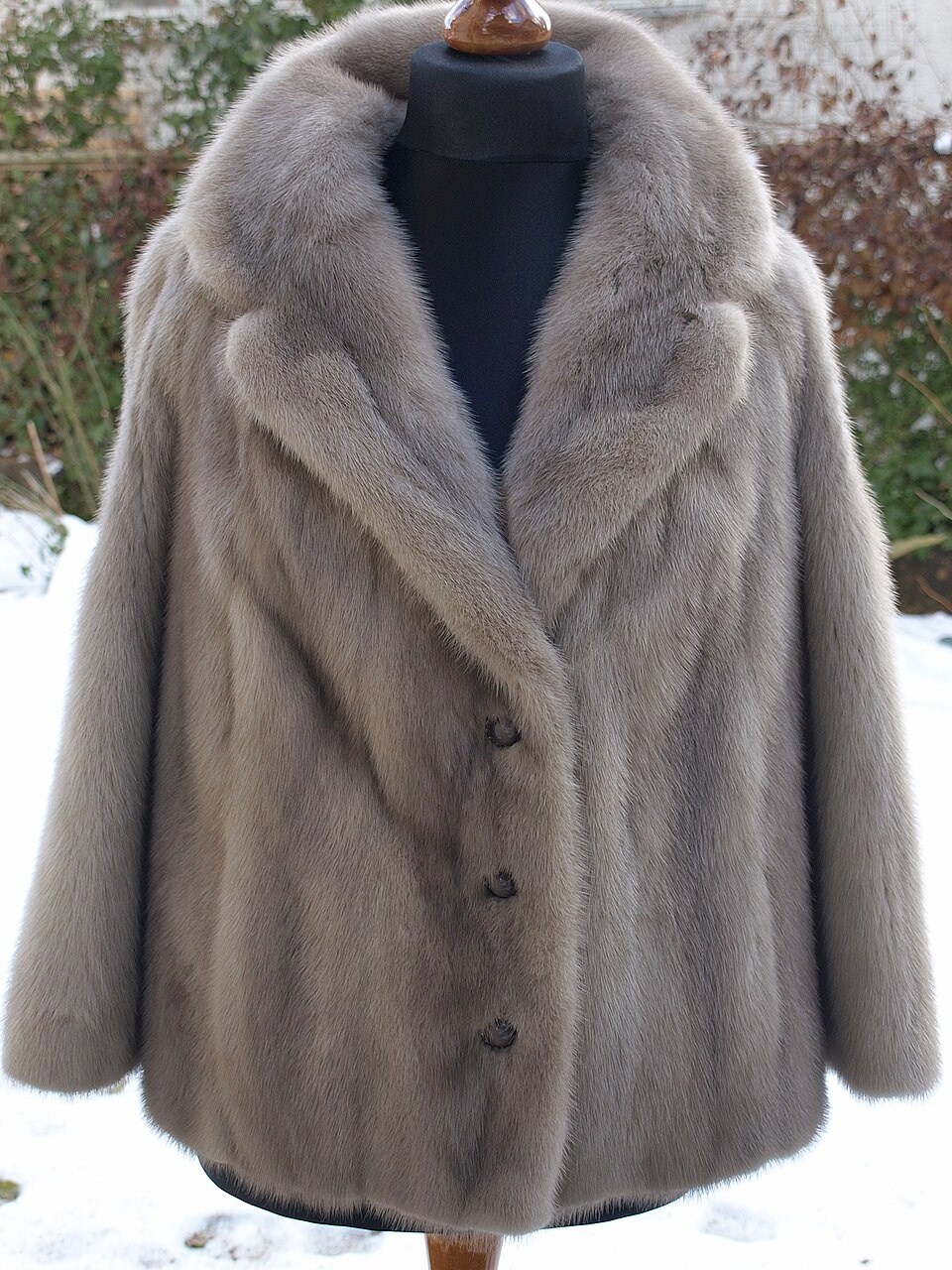
Mink fur is thick and soft and has a beautiful sheen so it is no surprise that mink pelts are considered one of the most luxurious furs. Minks have long, stiff, shiny guard hairs. Their fur is a rich brown that darkens along the back, becoming almost black at the tip of the tail. The minks of northern regions have the darkest and most lustrous fur. Mink do not change color in winter. On average a full length mink coat requires 60 to 70 skins to make. Blending is used in mink furs.
The winter fur of American mink is denser, longer, softer, and more close-fitting than that of the European mink. The winter fur's tone is generally very dark blackish-tawny to light-tawny. Color is evenly distributed over all the body, with the under side being only slightly lighter than the back. The guard hairs are bright and dark-tawny, often approaching black on the spine. The underfur on the back is very wavy and greyish-tawny with a bluish tint. The tail is darker than the trunk and sometimes becomes pure black on the tip. The summer fur is generally shorter, sparser and duller than the winter fur. The thick underfur and oily guard hairs render the pelage water-resistant. A variety of different colour mutations have arisen from experimental breeding on fur farms. [Source: Wikipedia]
The quality of a pelt, which significantly affects the price, is determined by its size, color, texture and density. According to the furrier Elpidio Loffredo: If we find ourselves in front of a shiny and thick mink fur coat, characterized by a smooth and compact hair, we can be sure that we are on the right track to buying a quality item. Secondly, we should consider the consistency; a good mink fur coat should feel a little stiff to the touch. Furthermore, by running your hand against the grain, the fur should lift easily, but it should also immediately return to its original position. In some ways, the fur of female minks is better than that of male minks: it is not only softer and silkier, but also lighter and shinier. All characteristics that will make your new fur coat truly beautiful and enviable.
Sable is the most prized fur. Pelts from wild animals are regarded as more valuable than farm-raised ones. Mink fur is more common and minks — as well as foxes — are easier to raise in fur farms than sable. The fur farm industry in Russia produces mostly minks and polar foxes. There are some for sables but the fur from these animals is regarded as much lower quality than that of wild sable. A significant portion of Russia’s furs come from hunters and trappers that range the wilderness trapping and shooting fox, sable, squirrel, mink, lynx and wolverine.
RELATED ARTICLES:
MINKS: CHARACTERISTICS, BEHAVIOR, INVASIVE AND ENDANGERED SPECIES factsanddetails.com
MUSTELIDS: CHARACTERISTICS, BEHAVIOR, REPRODUCTION, TYPES, SPECIES factsanddetails.com
MARTENS: CHARACTERISTICS, BEHAVIOR, SPECIES AND REPRODUCTION factsanddetails.com
SABLES: CHARACTERISTICS, FUR, BEHAVIOR, TRAPPING, REPRODUCTION factsanddetails.com
ERMINE (STOATS): CHARACTERISTICS, FUR, BEHAVIOR, ROYALTY, REPRODUCTION factsanddetails.com
FURS; RUSSIA, HISTORY, FARMS factsanddetails.com
WEASELS: CHARACTERISTICS, BEHAVIOR, SPECIES factsanddetails.com
WEASEL SPECIES OF ASIA AND EUROPE factsanddetails.com
LEAST WEASELS: CHARACTERISTICS, BEHAVIOR AND REPRODUCTION factsanddetails.com
POLECATS: CHARACTERISTICS, BEHAVIOR, SPECIES, REPRODUCTION factsanddetails.com
Mink Fur Farms
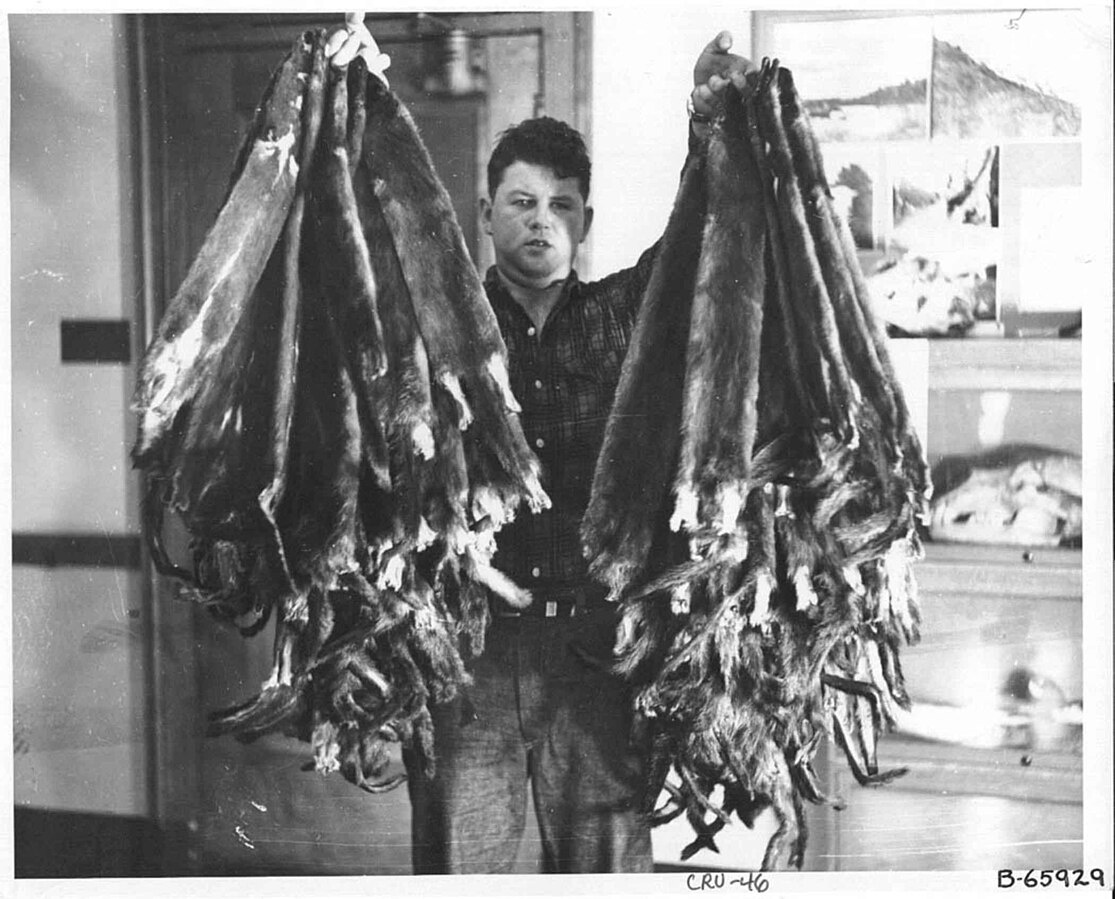
Most minks used to make fur garments are raised in fur farms. Careful breeding has produced black, black and white, platinum and silver-blue mink.American mink are currently the most important species in fur-farming operations. The main fur producing countries are Denmark, the Netherlands, Poland, and China, where the first mink farms were established in the 1950s.
Originally all fur came from natural populations, causing a severe strain on the species. Starting in the mid 1900s, mink farms were established to help bring a more consistent pelt supply to the market. Farming was very successful, with the number of mink farms in the United States reaching a high of 7,200 during the mid-1960s. While the number of farms declined nationally to 439 in 1998 a total of 2.94 million pelts were were still produced (both wild and domestic mink), with a value at $72.9 million dollars, in the late 1990s. [Source: Kurt Schlimme, Animal Diversity Web (ADW) |=|]
Throughout their history, mink farmers have employed selective breeding to develop a wide variety of pelt colors, many of them either rare or unknown in nature. These include white, plus a host of shades of brown and gray, sometimes with tinges of blue or pink, and bearing such exotic names as lavendar hope, sapphire, gun metal and mahogany. [Source: People for the Ethical Treatment (PETA); Fur Commission USA]
Mink typically breed in March, and give birth to their litters of young, or “kits”, in May. These litters may range from three to 13, but four to five is average. The kits are weaned at six to eight weeks of age. Farmers vaccinate their kits for botulism, distemper, enteritis, and, if needed, pneumonia. The animals molt in the late summer and early fall, after which they produce their winter fur. They are then harvested in their prime in late November and December.
“In the wild, most young mink don’t survive through the first year. In contrast, a farmer’s care ensures that almost all domesticated mink live until the end of the year, when they are harvested. The best of the herd are selected for breeding in the following spring, ensuring that the farmer’s stock keeps improving. Providing animals with humane care is an ethical obligation of all livestock farmers, while for mink farmers it also makes good business sense, since the healthiest animals produce the finest pelts. ^^
Animal Rights Groups Free Fur-Farm Minks

In the late 1990s, animal rights groups launched a campaign in Britain to free minks in fur farms. T.R. Reid wrote in the Washington Post, “Since mid-summer, animal rights activists here have stepped up use of a furiously controversial tactic in their never-ending guerrilla war against fur farmers. Under cover of night, militants from the Animals Betrayed Coalition have been cutting fences and smashing cages to "liberate" thousands of minks into the surrounding woods. Most of the freed minks are run over on nearby roads, or quickly starve to death in the unfamiliar surroundings of a forest. But others make their way to ponds and streams, where they discover the delicious, but defenseless, water vole. [Source: T.R. Reid, Washington Post, October 11, 1998 =]
“In a sense, the mink liberations do no one any good. The mink farmer loses his livelihood, the vast majority of freed minks quickly die and for miles around other animals fall prey to hungry minks ? ducks, dogs, cats and especially water voles. "These lunatics don't even help animal rights," noted James Barrington, director of the Wildlife Network, "because they just infuriate everybody." =
"The mink is an extremely efficient vole-killer," Nick Mott, of the Otter and Water Vole Project in Britain told the Washington Post. "The strategies that work for the water vole against other predators don't stop the mink. A female mink can squirm down those burrows and reach the vole and her cubs. And your mink, now, she won't stop feeding until she's wiped out every vole within her range." =
There were also worries of minks spreading to urban areas. Paul Kelbie of The Independent wrote: “City dwelleres in Scotland, well used to the habits of foxes, have been warned to look out for a more vicious urban scavenger— the mink. An attack on a rabbit at a children's pet farm in the centre of Edinburgh has fuelled fears that mink, once confined to the countryside, are working their way into urban areas using canals and inland waterways. They are thought to be preying on fish, ducklings and signets. The fear is that they might even pose a risk of injury to humans. The Scottish Society for the Prevention of Cruelty to Animals (SSPCA) has launched a campaign to monitor sightings of the animals after one was killed close to Gorgie City Farm in the West End of Edinburgh. Last week there were other sightings in residential parts of the city. "We are hoping we don't have an urban mink problem because they are voracious killers," said Doreen Graham, an SSPCA spokeswoman. "From time to time we get reports of mink attacks but they tend to be more of an agricultural nature, with attacks on hens or ducks. [Source: Paul Kelbie, The Independent, April 3, 2002]
6,000 Minks “Freed” from British Fur Farm
In August 1998, 6,000 minks were “freed” from a fur far in Hampshire, England by animal rightists. Adrian Lee wrote in The Times, “Animal rights extremists released thousands of the vicious killers from a fur farm. Police warned people living within five miles of Ringwood, Hampshire, to keep pets indoors and said that the area was facing a wildlife disaster. It was estimated last night that more than 3,000 mink - one of the animal kingdom's most ferocious predators - were still loose. As householders reported the first attacks on cats and dogs, farmers were organising mink hunts and a team of trappers was trying to contain the carnage. Experts said that birds and small farm animals were also at risk. A kestrel and an owl at a bird sanctuary near Crow Hill Farm have already fallen victim, but at one farm Suzy, a Jack Russell owned by Elizabeth Wiseman, protected 1,000 piglets by killing six mink. [Source: Adrian Lee, The Times, August 10, 1998 ^|^]
“The Animal Liberation Front claimed responsibility for the release of the mink, which happened in the early hours of Saturday. Cages containing about 6,000 were opened and holes cut in perimeter fences. The RSPCA condemned the release and animal welfare groups said the ALF operation was a damaging own goal because many of the mink, which were bred in captivity for export to the United States, Scandinavia and Russia, would die of starvation. It is feared that thousands of young pheasants, released a week ago for the shooting season, will become easy prey. Although the animals are dangerous to humans only when cornered, they will attack pets. ^|^
“Ringwood's small police station was inundated with calls about the mink. One was found in a rabbit hutch, another was cornered in a garage and a chihuahua dog was attacked. About 300 male stud mink, which measure 28in from nose to tail, were among those on the loose. They were said to be the most dangerous and could easily slip through cat flaps. PC Rob Ellis, a wildlife liaison officer for Hampshire police, said: "We have told farmers to shoot the mink." Although bred in captivity, they will adapt quickly and attack anything. "They are not shy of humans and could be dangerous if cornered. They are very aggressive animals and no one should try to catch them. It is going to be a complete catastrophe for wildlife in the area." ^|^
“Traps are being set at the nearby River Avon and the Ministry of Agriculture has offered its assistance. Police said many of the mink would never be recaptured - 200 were shot yesterday, including three at the New Forest Owl Sanctuary where the two birds of prey died. A keeper was patrolling the sanctuary last night and steel plates were placed in front of aviaries to prevent more mink burrowing in. ^|^
“Ed Gurd, who lives in Burley Lawn, about three miles away, described how he trapped one mink after it attacked Nutmeg, the family cat. "It was a hot day, so all the doors and windows were open. It just walked in through the front door. We think it had its eye on our pet hamster. It ran into the lounge - we shut the door and it was running all over the settee and tearing at the carpet trying to get out. We used some bacon and bread to lure it into a conservatory, where it fell asleep.'
Mink Farm Targeted by Animal Rightists
The mink farm targeted in the August 1998 was founded 40 years earlier and was owned by 73-year-old Terry Smith. Adrian Lee wrote in The Times, “The isolated farm, covering 13 acres, has been targeted several times previously, including an arson attack in February. On Friday, Mr Smith appeared at Lyndhurst Magistrates' Court accused of cruelty to the mink. He denied the charge but said he believed the attack could be linked to it.’ On the attack, Smith said: "This was a mindless act. No-one who did this can have the welfare of animals at heart." [Source: Adrian Lee, The Times, August 10, 1998 ^|^]
“At the farm, where the animals are kept in 15 sheds resembling a battery chicken farm, thousands of recaptured mink were roaming behind perimeter fences. "When we catch them we are just getting them behind the fences - we haven't had a chance to put them back in cages," Mr Smith said. The screams of the animals could be heard for several hundred yards. Mr Smith said he did not blame farmers for shooting his animals - and others came to grief on roads, which were busy with tourists to the New Forest.^|^
“"Pound for pound these animals are among the most vicious in the world," Mr Smith said. He was hoping the inquisitiveness of the mink would make the traps he was laying effective. His men, wearing thick gloves, scoured the fields for stray mink. Linda Shelton, who saw the aftermath of the mink liberation, said: "They were everywhere. It was absolute chaos." Police reporting for duty at Ringwood found one in their backyard. ^|^
“Mark Glover, of the campaign group Respect for Animals, said: "It seems unlikely they would be freed by anybody with true animal welfare intentions." However, the ALF was unrepentant. In a statement admitting responsibility it said: "Even if 1 per cent of the mink are to survive in the wild it means that individuals of the species are living a life free from pain, free from exploitation and free from abuse. "Even if mink are being shot, at least it is quicker than the way they are killed in the fur farms for coats that nobody really needs these days." ^|^
Chinese Demand Drive Boom in US Mink Farming in the 2010s
In 2013, Reuters reported: Battered by years of animal rights activism in their own backyard, American mink farmers are scrambling to keep up with China's demand for all things fur. Driven by a hunger for high-end clothing and luxury home goods among China's burgeoning middle class, U.S. exports of mink pelts to China jumped to a record $215.5 million in 2012 — more than double both the value and volume shipped in 2009. That Chinese consumers are clamoring for fuzzy-trimmed backpacks, ermine-edged coats and mink-covered office supplies comes as a welcome respite for the U.S. mustelidae world. [Source: Reuters, April 15, 2013]
The industry's fortunes had chilled in recent years, with farms shuttering and prices slumping amid the past two recessions and mounting criticism of the fur trade by U.S. and European animal rights groups. Now, prices of farmed mink pelts are soaring to all-time highs. South Korea and Russia, too, have contributed to a surge in demand that led to shipments of 11.8 million pelts worth $479 million worldwide by U.S. farmers, trappers and auction houses last year. That was nearly triple the level in 2009.
Weather has kept the demand piling on in recent months. Both Russia and China experienced unusually cold winters in 2012. The bitter temperatures half a world away were something to celebrate on Ron Gengel's mink ranch. For three generations, the Gengel family has raised minks in a northern Illinois farm for furriers around the world. They've survived competition from overseas rivals, slumping prices and an American consumer more interested in fakes than the real pelt.
Such down times have made the Gengels cautious of the current boom and quick to adjust to shifting trends. When international buyers began talking about white fur being considered more chic than black pelts, the family started raising more white mink — and fewer black. "You have to keep track of so much, from what's happening to the Russian currency to what's the weather forecast in China," said Justine Gengel, Ron's daughter-in-law. "You have to know what the buyers want."
For now, at least, Chinese buyers and manufacturers are flocking to fur auction houses in Seattle and Canada by the droves. At a recent sale held at North American Fur Auctions in Toronto, the demand drove black male mink pelts to an average price of more than $141 each. Two years ago, similar quality pelts were selling for $98. "We had over 700 registered buyers and the majority were from China," said Nancy Daigneault, communications director for NAFA. "It was jammed. We've never had that many buyers before, ever." Chinese consumers bought more than half of the fur coats sold worldwide in 2010, and China's retail sales of fur-related goods — ranging from full-length mink coats to ermine-covered toilet paper holders — were forecast to hit $6 billion in 2012, according to data from the China Chamber of Commerce of Foodstuffs and Native Produce.
Few people understand the mink boom better than Zhang Lingli, manager of Shanghai Zhichuan Garment Co. Ltd. Inside her cozy shop, on the sixth floor of a downtown Shanghai mall, mink pelts are stacked in hues of black, blue and silver. Mink fur, Zhang said, has become particularly popular among those who have the extra cash to spare. The demand for mink pelts has been increasing every year in the past few years, Zhang said, and so has the price. But her customers simply shrug that off — and pepper her with requests for higher-quality furs from the United States, Canada and Europe. "They just want fur products," she said.
Image Sources: Wikimedia Commons
Text Sources: Animal Diversity Web animaldiversity.org ; National Geographic, Live Science, Natural History magazine, CNTO (China National Tourism Administration) David Attenborough books, New York Times, Washington Post, Los Angeles Times, Smithsonian magazine, Discover magazine, The New Yorker, Time, BBC, CNN, Reuters, Associated Press, AFP, Lonely Planet Guides, Wikipedia, The Guardian, Top Secret Animal Attack Files website and various books and other publications.
Last updated June 2025