
MINKS
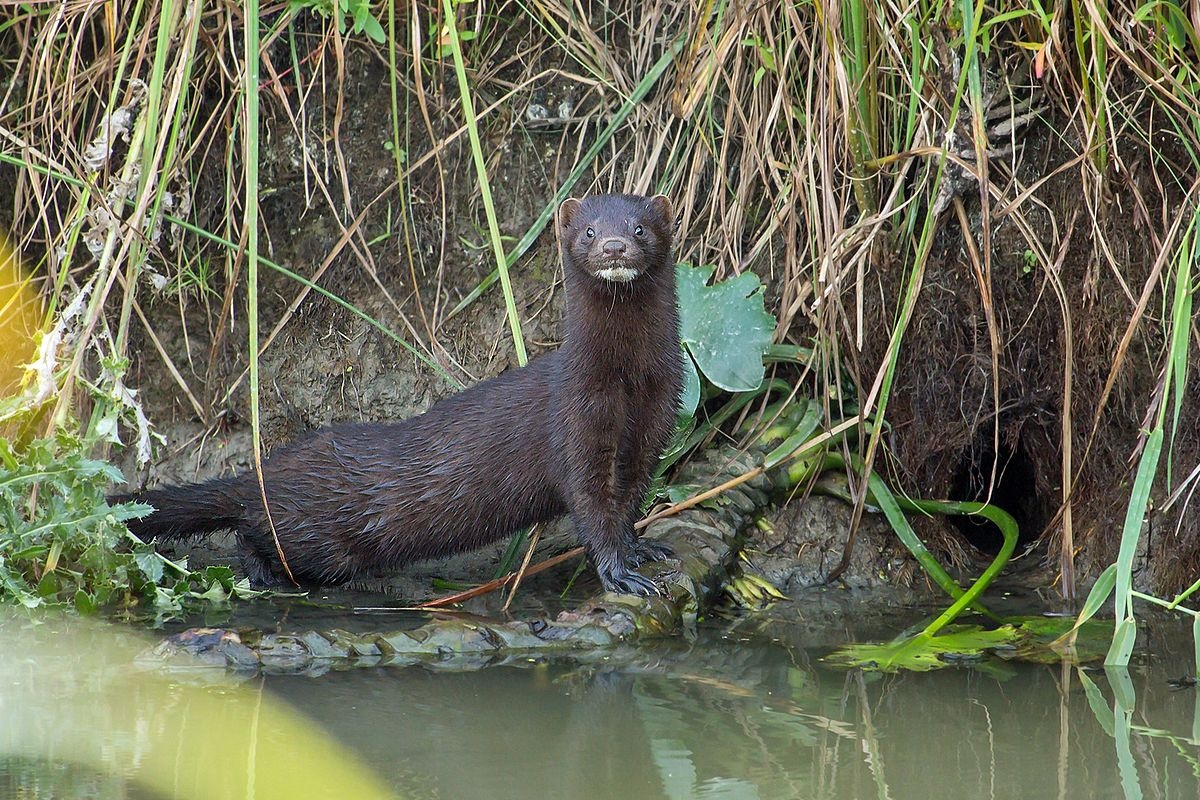
Minks are among the most well known fur-bearing animals. Members of the mustelid familyalong with weasels, martens, badgers and otter, they produce a luxurious, warm fur and are found primarily in Canada, Russia, Alaska and Scandinavia. European minks are slightly smaller than American minks and have a white upper lip. Those found in Siberia have tawny brown fur. Minks live five to six years.
Minks are small, long-bodied and slender. The are generally around about 60 centimeters (two feet) in length, including a bushy 20 centimeter (eight-inch) tail, and usually weigh less than one kilogram (2.2 pounds). They have short legs, small ears, broad flat heads, long necks and powerful jaw muscles. The length of the guard hairs on minks is in between those of otters and polecats, suggesting minks are incompletely adapted to an aquatic life. American minks moult twice a year, during spring and autumn. They do not turn white in winter]
Minks live along the banks of rivers, streams and ponds and in forests and plains. They are skillful tree climbers and swimmers. When cornered minks fight very fiercely. Like skunks and weasels, minks posses a gland that can release a nasty smell. Mink females give birth and raise their young in nests prepared in hollow logs, or holes among rocks. Females produce about one liter a year with five or six young although there may be from three to ten.
Minks hunt on land, in water and in trees. Their primary prey animals are rodents such as rabbits, rats, musk rats, voles and mice. They also eat birds, frogs, fish, grubs, eggs and insects. It is said minks are viscous animals that get pleasure from killing animals and kill even when not hungry. They are one of the few animals that routinely kill animals much larger than themselves.
"The mink is an extremely efficient vole-killer," Nick Mott, of the Otter and Water Vole Project in Britain, told the Washington Post. "The strategies that work for the water vole against other predators don't stop the mink. A female mink can squirm down those burrows and reach the vole and her cubs. And your mink, now, she won't stop feeding until she's wiped out every vole within her range."
RELATED ARTICLES:
MINK FUR: QUALITY, FARMS AND ANIMAL RIGHTS factsanddetails.com
MARTENS: CHARACTERISTICS, BEHAVIOR, SPECIES AND REPRODUCTION factsanddetails.com
SABLES: CHARACTERISTICS, FUR, BEHAVIOR, TRAPPING, REPRODUCTION factsanddetails.com
ERMINE (STOATS): CHARACTERISTICS, FUR, BEHAVIOR, ROYALTY, REPRODUCTION factsanddetails.com
FURS; RUSSIA, HISTORY, FARMS factsanddetails.com
WEASELS: CHARACTERISTICS, BEHAVIOR, SPECIES factsanddetails.com
WEASEL SPECIES OF ASIA AND EUROPE factsanddetails.com
LEAST WEASELS: CHARACTERISTICS, BEHAVIOR AND REPRODUCTION factsanddetails.com
POLECATS: CHARACTERISTICS, BEHAVIOR, SPECIES, REPRODUCTION factsanddetails.com
Mustelids
Minks are mustelids (Mustelidae), a diverse family of carnivoran mammals, including weasels, badgers, otters, stoats, mink, sables, ermine, fishers, ferrets, polecats, martens, grisons, wolverines, hog badgers, honey badgers and ferret badgers. Mustelids, make up the largest family within Carnivora with about 66 to 70 species in eight or nine subfamilies and 22 genera. Skunks were considered a subfamily within Mustelidae, but recent molecular evidence has led their removal from the mustelid group. They are now recognized as a their own single family, Mephitidae. [Source: Wikipedia, Matt Wund, Animal Diversity Web (ADW) |=|]

Mustelids inhabit all continents except Australia and Antarctica, and do not live on Madagascar or oceanic islands. They are found in diverse terrestrial and aquatic habitats in temperate, tropical and polar environments — in tundra, taiga (boreal forest), conifer forests, temperate forests, deserts, dune areas, savanna, grasslands, steppe, chaparral forests, tropical and temperate rainforests, scrub forests, mountains, lakes, ponds, rivers, streams. coastal brackish water, wetlands such as marshes, swamps and bogs, suburban areas, farms, orchard and areas near rivers, estuaries and intertidal (littoral) zones.
Mustelids vary greatly in behavior. They are mainly carnivorous and exploit a wide diversity of both vertebrate and invertebrate prey, with different members specializing in certain kinds of prey. Most mustelids are adept hunters with some weasels able take prey much larger than themselves. Many species hunt in burrows and crevices; some species have evolved to become adept at climbing trees (such as martens) or swimming (such as otters and mink) in search of prey. Wolverines can crush bones as thick as the femur of a moose to get at the marrow, and have been seen attempting to drive bears away from their kills. Mustelids typically live between five and 20 years in the wild. |=|
See Separate Article: MUSTELIDS: CHARACTERISTICS, BEHAVIOR, REPRODUCTION, TYPES, SPECIES factsanddetails.com
Weasels, Ermine, Minks and Sables
Weasels, minks and sables are all very similar and have similar characteristics and behavior. Minks and sables live primarily in northern regions of North America, Asia and Europe and produce highly-prized fur used in coats and stoles. Weasels are found in more southern areas and have shorter fur. Nowadays furs are out of fashion in North America and Europe but are still popular in Russia and have become popular in China.
Ermine — also called stoats, short-tailed weasels, or Bonaparte weasels — are a northern weasel species that turn white in the winter. Widely distributed across northern North America and Eurasia, ermines are most abundant in thickets, woodlands, and semi-timbered areas. These slender, agile, voracious mammals measure 13 to 29 centimeters (5 to 12 inches) in head and body length. The term “ermine” also describes the animal’s pelt was used historically in royal robes and crowns in Europe. [Source: Encyclopedia Britannica]
Weasels, minks and sables are closely related to ferrets, martens and polecats. They all have similar body shapes and are belong to the mustels. There are much fewer sables and minks than fox, which are all prized in the fur industry. These days minks are raised on farms. In the old days they were caught by trappers. Because they don’t breed well in captivity sables are still largely caught by trappers and hunters.
European Mink
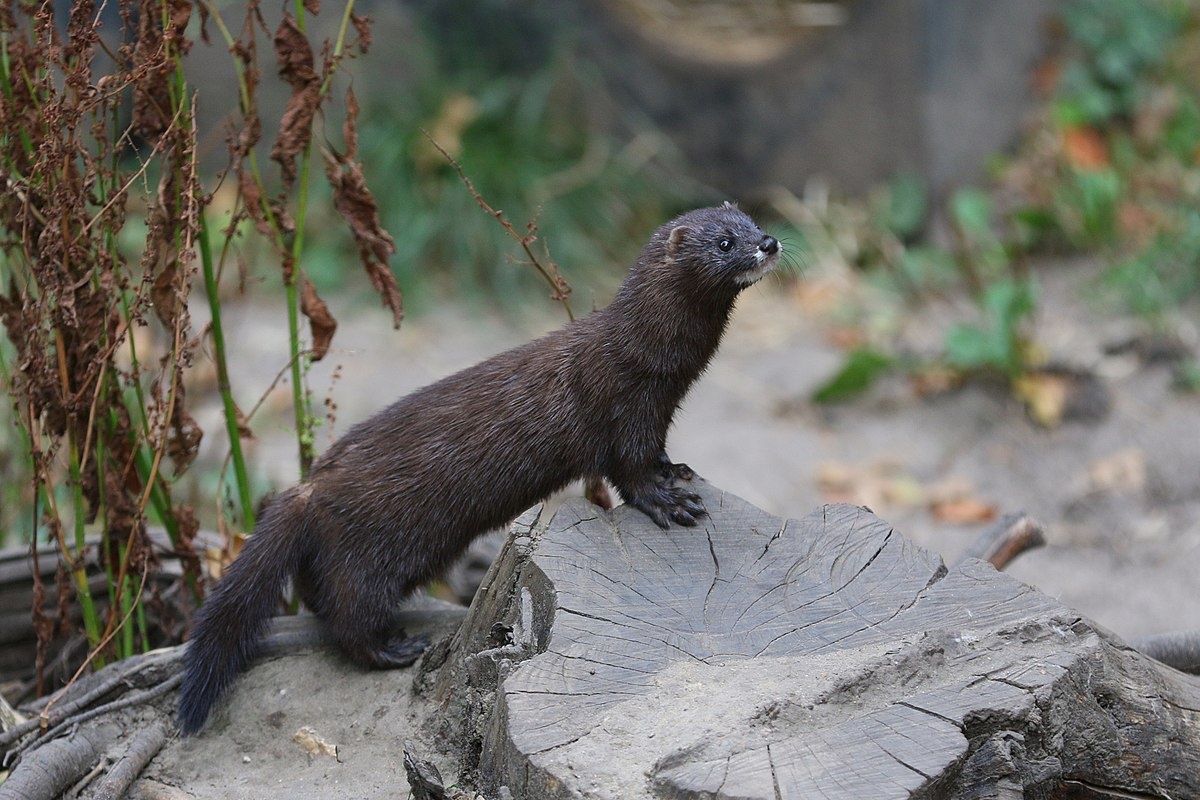
Wild European minks (Mustela lutreola) weigh .45 to one kilograms (1 to 1.2 pounds). The head and body length is 19 to 21.6 centimeters (7.5-8.5 inches) with a tail that is 12 to 17 centimeter (4.7 to 9.9 inches) long They live in semi–aquatic habitats, frequenting small rived with wood banks and marshes, in pockets in eastern Europe and Russia. Their average lifespan in the wild is 10 years. There[Source: Canon advertisement]
The range of European minks extends from northeast Spain and France in the west throughout Europe to the Irtysh and Ob Rivers in Russian Siberia in the west. They prefer densely shaded banks of fresh water creeks, rivers, and lakes. European minks may construct their own burrows, inhabit an evacuated burrow of water voles (Arvicola) or may live in crevices among trees roots. [Source: Tuteja Shalu, Animal Diversity Web (ADW) |=|]
European minks are medium sized mustelids. They have a long body, short legs, and a short tail. The average total length for males is around 37.8 centimeters (14.8 inches). The average total length for females is around 31.5 centimeters (12.4 inches). During the winter, European mink have a thick, water-repellent undercoat. Fur color is dark brown to black, and the underfur is usually brown. These minks have both white lips and a white chin. Some European minks may have white spots on the throat, chest, and stomach area.
European Mink Behavior, Reproduction and Diet
Minks are one of only a handful of native European carnivore species. They are rarely found less than 100 meters from water. Taking advantage of the variety of life forms and creatures found in their semi-aquatic habitat, European minks eat a wide variety of foods and prey primarily on on small mammals and aquatic animals such frogs, fish and crayfish. A study of stomach contents revealed small mammals (muskrats, voles, shrews, moles), birds, frogs, fishes, insects, and vegetation. [Source: Tuteja Shalu, Animal Diversity Web (ADW) |=|]
European minks are most active around dusk and before day break. They are motile (move around as opposed to being stationary) and good swimmers and tree climbers. They have good vision and also sense using touch and chemicals usually detected with smell. Male breeds with females within their territory, generally near a small river or marsh.
The mating season is generally from February to March. Pregnancy lasts 35 to 72 days, with the average gestation period being 54 days. Births usually occur in April and May. The number of young in a litter is between two and seven, with the average number of offspring being four or five. At birth males are approximately 7.39 centimeters in total length and weigh 8.4 grams and females are 7.19 centimeters and weigh 7.6 grams. Young are able to open their eyes after four weeks and their external ears open within 23 to 27 days. Teeth appear in young within 15 to 17 days and are replaced by adult teeth by 60 to 72 days. Young are weaned at about 10 weeks, and begin tracking and capturing prey. Young begin to disperse at about 2.5 to four months. Females are polyestrous. On average males and females reach sexual or reproductive maturity at 10.5 months.
Endangered European Minks
European mink are classified as Critically Endangered on On the International Union for Conservation of Nature (IUCN) Red List. The wild European mink population is estimated to be around 30,000 individuals, with a majority residing in Russia. Their endangered status reflects significant population decline due to overhunting, habitat loss, and competition from the invasive American mink.
The European mink's range has shrunk dramatically, and the species is now limited to small, fragmented populations in a few areas of Europe. Historically, European minks were trapped for their fur. Between 1922 to 1924 in the Soviet Union an average of 49,850 pelts were harvested each year. European minks are threatened primarily by loss of habitat. Destruction and degradation of wetlands and rivers have reduced their habitat. Undisturbed rivers and marshes, where they are most at home, and being lost at an alarming rate plus they are being outcompeted in many places by the alien species — the American mink
European minks have also suffered as a result of water pollution and hydroelectric constructions. A recent study reported that there are approximately 25,000 European minks in Russia. Efforts to introduce European minks in the Kuril Islands and Tajikistan have been initiated. There are also approximately 2,000 European minks found in France and approximately 1,000 in northern Spain. In an attempt to save European minks, British and Estonian biologists have established a breeding population on an island in the Baltic Sea. [Source: Tuteja Shalu, Animal Diversity Web (ADW) |=|]
American Minks
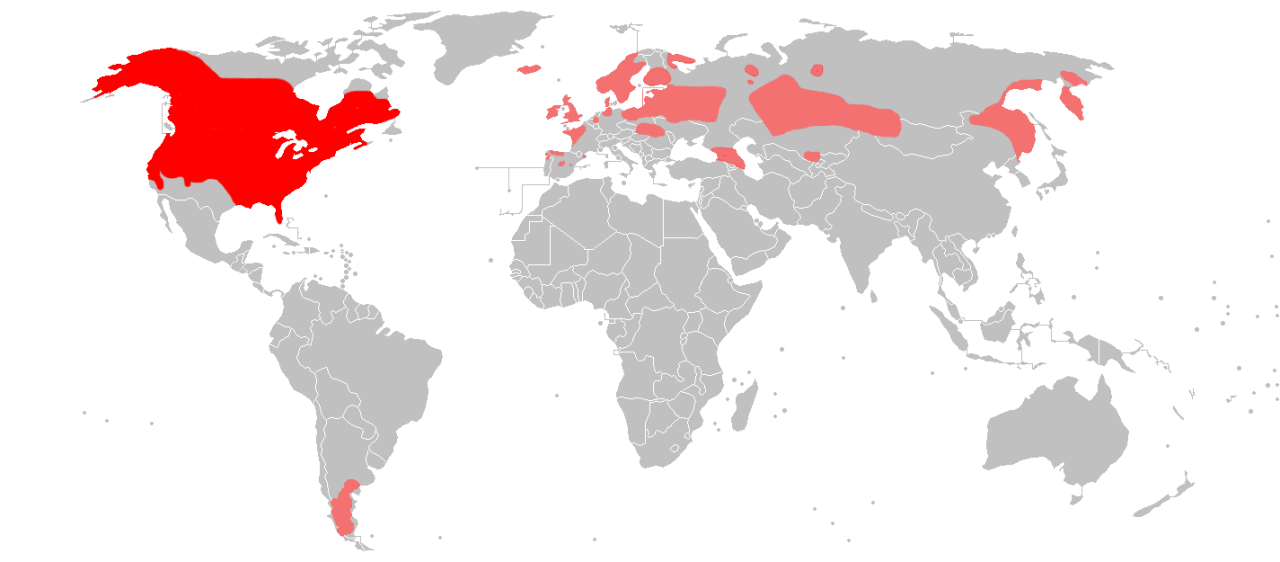
American mink (Neogale vison or Neovison vison) are found throughout Canada and the United States. They can be found in every U.S. state except Arizona and also present in most of Canadian provinces, including an introduced population on Newfoundland. Only along the Arctic coast and some offshore islands are they absent. American mink have also been inadvertently introduced to a number of places, including the British Isles, where they escaped from fur farms in the 1960s. [Source: Kurt Schlimme, Animal Diversity Web (ADW) |=|]
Although American can be found in a number of habitats, they prefer forested areas relatively close to water. Wetlands or places with streams, ponds, and lakes, and some sort of brushy or rocky cover nearby are considered ideal environments for them. Their maximum lifespan in the wild is thought to be 10 years.
American mink are not endangered like their European counterparts. They are designated as a species of least concern on the International Union for Conservation of Nature (IUCN) Red List and have no special status on according to the Convention on International Trade in Endangered Species (CITES). The main threat towards mink survival is the continued existence of the fur trade. Forty-seven U.S. states and all Canadian provinces currently conduct limited trapping seasons on mink. There are trapping seasons and quotas on catch size aimed at keeping mink populations stable. Another threat to American mink is the destruction of mink habitat, especially aquatic areas that depend on. The presence of environmental contaminants such as mercury and hydrocarbon compounds (such as DDT and PCBs) pose an additional threat to mink. These chemicals accumulate within the mink's tissues and can cause problems in reproduction or even threaten the animal's life. Closer regulation over the use and disposal of these chemicals is necessary.|=|
American mink are considered a pest and an invasive species in some places. They are fierce predators and infamous for raiding chicken coops and rabbit hatches. They can also hunt local endangered species in places they have been introduced and outcompete them for food resources. They have been particularly damaging to populations of smaller European minks in places the American ones have been introduced in Europe.
American Mink Characteristics and Diet
American minks range in weight from.7 to 1.6 kilograms (1.5 to 3.5 pounds) and range in length from 46 to 70 centimeters (18.1 to 27.6 inches), with their average length being 61 centimeters (two feet), including a 15.6–24.7 centimeter (6 to 10 inch) tail. Sexual Dimorphism (differences between males and females) is present: Females are significantly smaller than males. Adult females weigh between 0.7 to 1.1 kilograms and have a head and body length of 31 to 37.5 centimeters (12 to 15 inches), while males range from 0.9 to 1.6 kilograms and have a head and body length of 34 to 45 centimeters (13 to 18 inches). [Source: Kurt Schlimme, Animal Diversity Web (ADW) |=|]

The body of American minks is long and slender with short legs and a pointy, flat face. The toes are partially webbed, an adaption to their semi-aquatic lifestyle. American mink fur is usually dark brown with white patches on the chin, chest, and throat areas. The fur is soft and thick, with oily guard hairs that waterproof the animal's coat.
American mink are primarily carnivores (eat meat or animal parts) and mostly eat terrestrial vertebrates. Animal foods include birds, mammals, amphibians, reptiles, fish aquatic crustaceans. Their of mink varies with the season. During the summer they mainly eat crayfish and small frogs, along with small mammals such as shrews, rabbits, mice, and muskrats. Occasionally they take fish, ducks and other water fowl. In the winter, they primarily prey on mammals.
American Mink Behavior and Communication
American mink are terricolous (live on the ground), natatorial (equipped for swimming), nocturnal (active at night), motile (move around as opposed to being stationary) and sedentary (remain in the same area). Mink are primarily solitary, feisty animals, with males being particularly intolerant of each other. They are especially active near dawn and dusk and are skilled swimmers and climbers. When searching for food, they can swim up to 30 meters (100 feet) underwater and dive to depths of five meters. Mink sometimes dig burrows in the banks of rivers, lakes and streams. Other time they use old dens of other mammals, such as muskrats. Mink may line the interior of their dens with dried grass and leaves, and fur from mammal prey. [Source: Kurt Schlimme, Animal Diversity Web (ADW) |=|]
American mink sense and communicate with vision, touch, sound and chemicals usually detected by smelling. Mink have excellent senses of vision, smell, and hearing. Mink communicate using a variety of cues, including chemical, visual, and auditory signals. They are fairly quiet and primarily use chemical messaging to communicate territorial boundaries and reproductive status. They mark the boundaries of their home range using musky secretions from enlarged anal glands.
Mink are ferocious little beasts and have few natural enemies despite their relatively small size. They are occasionally killed by coyotes, bobcats, other carnivorous mammals and birds of prey. and, but their main threats are humans and cars. Young in a nest may be taken by snakes. In addition to their ferocity, they avoid predation thank to their cryptic coloration, quiet and secretive in nature, and their quickness and agility.
American Mink Mating, Reproduction and Offspring
American mink are polygynandrous (promiscuous), with both males and females having multiple partners. They engage in seasonal breeding — once a year. Mating occurs during the winter months. The gestation period ranges from 40 to 75 days. The number of offspring ranges from one to eight. [Source: Kurt Schlimme, Animal Diversity Web (ADW) |=|]
Both males and females begin mating at ten months. During the winter, female mink become fertile and mate with one or more males (who are also promiscuous). Young are born in April or May. Young weighs eight to 10 grams at birth. Parental care is provided by females. Males are not involved in the raising of offspring.
Young are altricial, meaning they are relatively underdeveloped at birth. They are pink and wrinkled when born, with closed eyes and a thin coat of white fur covering their body. Young open their eyes at three and a half weeks The average weaning age is six weeks and the age in which they become independent ranges from six to 10 months. Young generally remain with the mother through the summer until fall, when they leave to establish their own territories. On average males and females reach sexual or reproductive maturity at 10 months.
American Minks as Invasive Species
American mink are are considered an invasive species in many areas outside of their native range of the U.S. and Canada. In the the United Kingdom, they escaped from fur farms and now breed throughout the country, posing a threat to native wildlife. American mink are considered as one of the most widespread invasive species in China, especially in Northeastern area. They were introduced in some prefectures Japan as well, and are viewed as especially problematic in Hokkaido.
American mink was deliberately introduced for commercial fur production in several provinces of Patagonia in Argentina in 1930. The animals escaped or were released from farms in Chubut Province and now occur in the Chubut and Río Negro Provinces and Tierra del Fuego. In Argentina mink are one of the main threats to Hooded grebe, which is in danger of becoming extinct.
In 1933, American minks were released into the Voronezh Oblast in European Russia. After that they were released in other places such as Voronezh, Arkhangelsk, Volgograd, Chita, Irkutsk and Chelyabinsk Oblasts, and into Tatarstan and Bashkir, as well as Lithuania, Belarus, the Altai region, Magadan, Kamchatka and Amur Oblasts, the Caucasus region of North Ossetia and the Tien Shan region of Central Asia. Most of the releases took place in areas where European minks did not live. Although considerable areas were occupied by the American mink by the early 1960s, the species' Soviet range was never continuous, as most released populations were isolated from one another.
In Britain, American minks are viewed as pests. Mink are efficient predators and feed on a wide variety of prey, including ground-nesting birds, water voles, and other native animals. American minks can also compete with native species for resources like food and habitat, potentially leading to declines in native populations. They can also disrupt natural ecosystems by altering the balance of predator-prey relationships and impacting the overall health of native species. In some areas, mink have been implicated in the decline or near extinction of native species like the water vole, and have even been known to prey on the Critically Endangered European mink. Mink predation on seabird eggs and chicks has been linked to breeding failures and declines in seabird populations. Mink are believed to be responsible for the disappearance of the moorhen from certain islands.
Image Sources: Wikimedia Commons
Text Sources: Animal Diversity Web animaldiversity.org ; National Geographic, Live Science, Natural History magazine, CNTO (China National Tourism Administration) David Attenborough books, New York Times, Washington Post, Los Angeles Times, Smithsonian magazine, Discover magazine, The New Yorker, Time, BBC, CNN, Reuters, Associated Press, AFP, Lonely Planet Guides, Wikipedia, The Guardian, Top Secret Animal Attack Files website and various books and other publications.
Last updated June 2025