
KOROWAI SOCIETY AND FAMILIES
Korowai have traditionally live in scattered clans and family units living together in a treehouse, consisting of a man, his wife or wives, and their unmarried children. Men and women traditionally lived in separate rooms within the treehouse. In the 1990s, the Korowai lived in tight-knit clans divided into two main groups: ones who have direct contact with outsiders and the “betul”, ones that refuse to interact with outsiders. In the 1990s, when visitors crossed the pacification line into the betul’s ir territory, betul men usually hide their women and children in tree houses and tell the outsiders that the woman and children have been killed by a sorcerer. [Source: George Steinmetz, National Geographic, February, 1996 ^^]
Describing an encounter with a Korowai family, Thomas O’Neill wrote in National Geographic, "We followed him into the forest, as hot and close as a summer attic, and presently come to a tree house just as a family and two small hunting dogs file out of the bush. Startled, the woman and boy duck behind the man. Slowly he approaches us with bow and arrows gripped in his hand." [Source: Thomas O'Neill, National Geographic, February, 1996, ^^]
The patriclan (a clan whose membership is determined by tracing descent through the male line (patrilineal descent) from a common ancestor) forms the core of Korowai social, economic, and political organization. Their kinship system follows the Omaha I pattern (after Lounsbury), marked by a strong distinction between cross and parallel relatives. Omaha kinship terminology is a system found in patrilineal societies that distinguishes between maternal and paternal relatives, using different rules for each. On the father's side, kin are classified by gender and generation. On the mother's side, however, generational differences are often ignored, lumping together many relatives into broad categories based only on gender. This is sometimes referred to as the "skewing" of terms and reflects the social importance of the patrilineage. [Source: Wikipedia, Goog;e AI]
Korowai society features institutionalized levirate practices, a strong emphasis on avuncular relationships, and certain forms of affinal avoidance. Marriage is both exogamous—requiring spouses to come from outside one’s own group—and commonly polygynous. Ideally, a man marries his (classificatory) mother’s mother’s brother’s daughter.
Leadership is not formalized; instead, authority rests with “big men” whose influence derives from personal skill, charisma, and reputation. Interclan warfare is frequent and often sparked by accusations of witchcraft or sorcery. Each clan is expected, at least once in a generation, to host a sago grub festival, a major ritual event intended to promote prosperity and fertility. In times of crisis, Korowai communities make sacrifices of domesticated pigs to honor and appease ancestral spirits.
RELATED ARTICLES:
KOROWAI PEOPLE: HISTORY, CANNIBALISM, CONTACT WITH WESTERNERS factsanddetails.com
ASMAT AND KOROWAI COUNTRY factsanddetails.com
ASMAT CULTURE: MUSIC, FOLKLORE, CEREMONIES, BODY ADORNMENT factsanddetails.com
ASMAT ART: BIS POLES, SPIRIT CANOES, BODY MASKS factsanddetails.com
ASMAT: HISTORY, RELIGION AND HEADHUNTING factsanddetails.com
ASMAT LIFE: SOCIETY, MARRIAGE, FOOD, VILLAGES, WORK factsanddetails.com
ETHNIC GROUPS IN THE SOUTHERN LOWLANDS OF PAPUA (WEST NEW GUINEA) factsanddetails.com
MARIND PEOPLE OF SOUTHERN PAPUA (SOUTHWEST NEW GUINEA, INDONESIA) factsanddetails.com
KIMAM PEOPLE OF SOUTHERN PAPUA (WEST NEW GUINEA) factsanddetails.com
PAPUA — THE INDONESIA PART OF NEW GUINEA — NAMES, HISTORY, PEOPLE factsanddetails.com
HISTORY OF PAPUA factsanddetails.com
PAPUA factsanddetails.com
FIRST PEOPLE IN NEW GUINEA ioa.factsanddetails.com
UNREST AND LIMITED AUTONOMY IN PAPUA SINCE THE OUSTER OF SUHARTO IN 1998 factsanddetails.com
Korowai Religion and Culture

Korowai spirituality is closely linked to the forest and involves shamans, or bik, who are respected for their ability to communicate with the spirit world. They believe that the living inhabitant an inner zone and the dead reside in an outer zone, beyond which are great seas where all will perish when the world ends. The Korowai universe is filled with a variety of spirits, some of which are more personable than others. They especially revere the red-headed creator god, Gimigi. The Korowai ascribe an important role to honoring their "One God" in their daily lives, with this concept representing a prime deity from whom all others either descend or to whom all others pay homage.
The Korowai have an extraordinary and rich oral tradition of myths, folktales, magical sayings, charms, and totems. Regarding death and funerals, the Korowai believe in a type of reciprocal reincarnation. Those who have died can be sent back to the land of the living at any time by their kinsmen in the land of the dead. There, they can reincarnate as a newborn infant of their own clan.
According to the Christian-group Joshua Project 10 to 50 percent of Korowai are Christians,with with the estimated number of Evangelicals being 0.1-2 percent. One reason that many Korowai have never converted to Christianity is their belief that contact with a “lasheo” (a bad spirit that appears as a white man in clothes) would destroy their world. [Source: Joshua Project, George Steinmetz, National Geographic, February, 1996 ^^]
Paul Raffaele wrote in Smithsonian Magazine: “Seeing spirits in nature, they find belief in a single god puzzling. But they too recognize a powerful spirit, named Ginol, who created the present world after having destroyed the previous four. For as long as the tribal memory reaches back, elders sitting around fires have told the younger ones that white-skinned ghost-demons will one day invade Korowai land. Once the laleo arrive, Ginol will obliterate this fifth world. The land will split apart, there will be fire and thunder, and mountains will drop from the sky. This world will shatter, and a new one will take its place. The prophecy is, in a way, bound to be fulfilled as more young Korowai move between their treehouses and downriver settlements, which saddens me as I return to our hut for the night. [Source: Paul Raffaele, Smithsonian Magazine, September 2006 \=]
“The Korowai, believing that evil spirits are most active at night, usually don’t venture out of their treehouses after the sun sets. They divide the day into seven distinct periods—dawn, sunrise, midmorning, noon, midafternoon, dusk and night. They use their bodies to count numbers...ticking off the fingers of his left hand, then touching his wrist, forearm, elbow, upper arm, shoulder, neck, ear and the crown of the head, and moving down the other arm. The tally comes to 25. For anything greater than that, the Korowai start over and add the word laifu, meaning “turn around.”“ \=\
Korowai Life
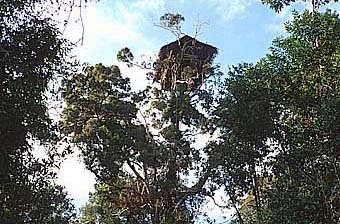
Korowai treehouse
The Korowai are hunter-gatherers and horticulturalists who practice shifting cultivation. They are skilled hunters and fishermen and have a few gender-specific activities, such as preparing sago and performing religious ceremonies, which only male adults participate in. Traditionally, the Korowai smoke tobacco but do not drink alcohol. They use a traditional smoking pipe called a depon nagel, which is made from bamboo with a diameter of 3–4 cm. Sago shoots, called fiop, are used as filters. [Source: Wikipedia]
The Korowai trade bananas and roasted sago for tobacco, salt, fishhooks and clothes. Pigs are a sign of wealth, generally reserved for dowries or settling disputes. Before feasts women sometimes have their heads shaved with the edge of split piece of bamboo by younger women. Many Korowai suffer from extremely painful and irritating tropical illness such as ringworm that causes the skin to peel away and give off an acidic smell. Most of them suffer needlessly as most of these diseases are easy to treat with modern medicine.
On his arrival in a Korowai village, Paul Raffaele wrote in Smithsonian Magazine: “ Korowai children with beads about their necks come running to point and giggle as I stagger into the village—several straw huts perched on stilts and overlooking the river. I notice there are no old people here. "The Korowai have hardly any medicine to combat the jungle diseases or cure battle wounds, and so the death rate is high," Kembaren explains. "People rarely live to middle age." As van Enk writes, Korowai routinely fall to interclan conflicts; diseases, including malaria, tuberculosis, elephantiasis and anemia, and what he calls "the khakhua complex." The Korowai have no knowledge of the deadly germs that infest their jungles, and so believe that mysterious deaths must be caused by khakhua, or witches who take on the form of men.” [Source: Paul Raffaele, Smithsonian Magazine, September 2006]
Since the early 1990s, some Korowai have earned a modest income by working with tour companies that sell tours to the Korowai region. Within the tourism industry, opportunities are limited to hosting tour groups in villages for tourist-sponsored sago feasts, carrying luggage, and performing traditional displays.
Korowai Clothes and Body Marking
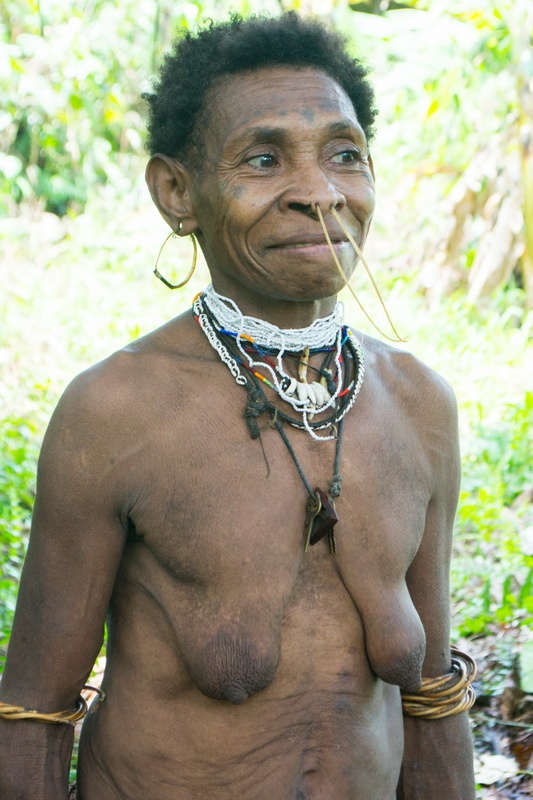
Korowai women go topless and wear grass skirts. Some have the thin bones of bat's wings sticking out of their nose. Like other people on New Guinea, they carry their children piglets and other items in net bags which are carried on the back with a strap attached to the forehead. Korowai men wear rattan strips around their waist and long hornbill beaks or penis gourds over their penises. Many carry bag on shoulder along with a bow and arrows. Many Korowai children go completely naked except for necklace of cowrie shells. [Source: Thomas O'Neill, National Geographic, February, 1996, ^^]
Some Korowai file their bottom teeth and have a circle of beauty mark scars on their stomach produced by burning the skin with hot wooden tongs. Paul Raffaele wrote in Smithsonian Magazine: “The young women have circular scars the size of large coins running the length of their arms, around the stomach and across their breasts. "The marks make them look more beautiful," Boas says. He explains how they are made, saying circular pieces of bark embers are placed on the skin. [Source: Paul Raffaele, Smithsonian Magazine, September 2006 \=]
In remote areas, the Korowai rarely wear clothes. While socializing with some Korowai who never seen outsiders before, Raffael wrote: “A youngster tries to yank my pants off, and he almost succeeds amid a gale of laughter. I join in the laughing but keep a tight grip on my modesty. The Rev. Johannes Veldhuizen had told me that Korowai he’d met had thought him a ghost-demon until they spied him bathing in a stream and saw that he came equipped with all the requisite parts of a yanop, or human being. Korowai seemed to have a hard time understanding clothing. They call it laleo-khal, "ghost-demon skin," and Veldhuizen told me they believed his shirt and pants to be a magical epidermis that he could don or remove at will.” \=\
Korowai Tree Houses
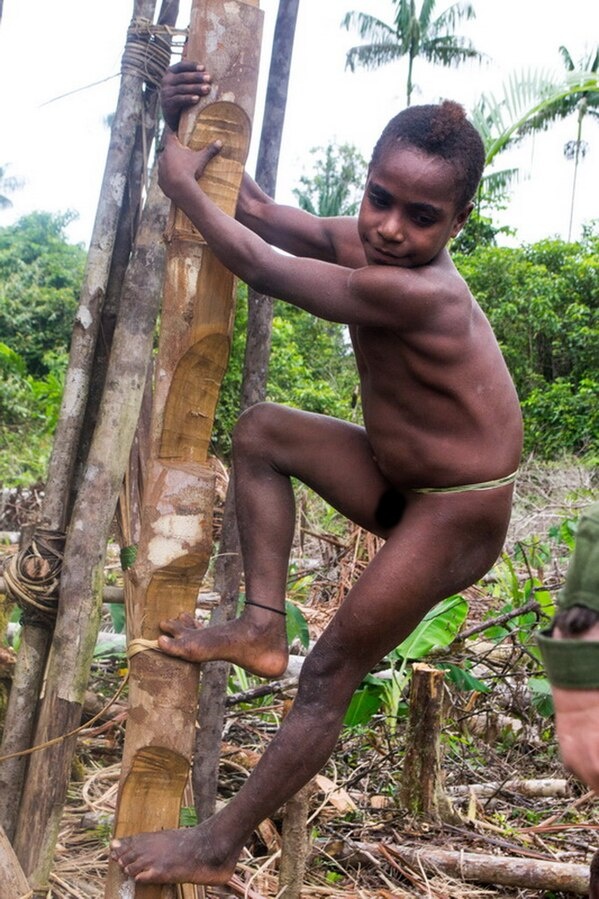
Some Korowai live in tree houses, known as Rumah Tinggi, that are built 45 meters (150 feet) off the ground. They are built of sticks and leaves, perched on a massive tree trunks and look like some kind of huge nest tucked into the forest canopy. The Korowai climb to their treehouses using flimsily notched poles. The roof and the walls of the treehouses are made from sago palm fronds. Fires are started by from rubbing wood with a rattan string are built on mud-covered rattan-strip lattices set over holes in the floor. If a fire gets out of hand it can quickly be cut away from the house, dropping to the ground. Bones and shells kept in the rafters are used for tools or kept as reminders of big feasts. [Source: George Steinmetz, National Geographic, February, 1996 ^^]
It was originally thought the Korowai built their treehouses as a form a protection against enemies but now some anthropologists believe they live there to stay dry during times of heavy flooding. Some parts of the Papua they inhabit receive over 450 centimeters of rain a year and most of it falls during a few months in the rainy season. When a tribesman was asked why he lived in a treehouse he told Steinmetz "to see the birds and mountains and to keep sorcerers from climbing my stairs." It has also been said the treehouses have been built to provide protection from mosquitoes, snakes, and ghosts. ^^
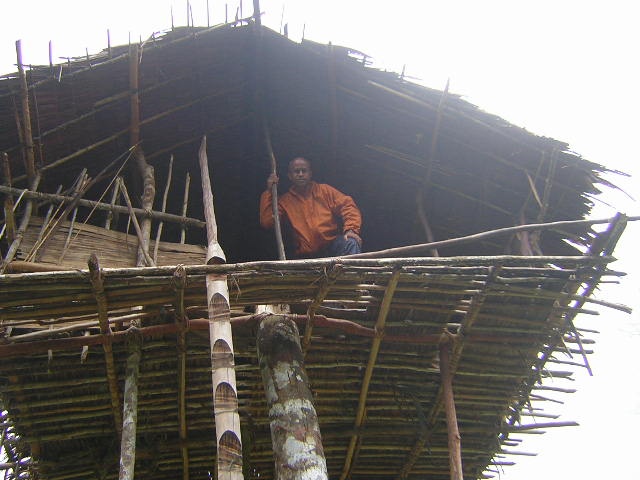
A Korowai man that O’Neill met said he lived in a tree house with two families made up comprising eight people. "Now the pigs live with us too," he said, "until we kill them for food. Maybe then we will move to another hunting ground and build a new house." [Source: Thomas O'Neill, National Geographic, February, 1996,☼]
Some clans that once shared a single home in the forest canopy have moved to separate lower homes in jungle clearings because tensions between clans have been reduced and it is safe enough for families to move out of their tree houses. Some live in villages formed around a longhouse, which is built around a sacred pole.
Korowai Food
The Korowai have traditionally been hunter-gatherers, with their diet consisting of sago, supplemented with other forest foods like young shoots, fruits, insects, and game. Korowai grow taro in jungle clearings along with tobacco, sweet potatos and bananas. Grubs, or scarab beetle larvae, found in sago palm logs are considered a delicacy. The sago palm pith, which is beaten into a pulp, moistened into dough and then roasted, is the main food source. They typically cook their food by wrapping it in leaves and cooking it on hot rocks in a leaf bundle.
Korowai hunters use specialized arrows for killing birds, fish, reptiles and humans.Paul Raffaele wrote in Smithsonian Magazine: “ Bailom shows me his arrows, each a yard-long shaft bound with vine to an arrowhead designed for a specific prey. Pig arrowheads, he says, are broad-bladed; those for birds, long and narrow. Fish arrowheads are pronged, while the arrowheads for humans are each a hand's span of cassowary bone with six or more barbs carved on each side—to ensure terrible damage when cut away from the victim's flesh. Dark bloodstains coat these arrowheads. [Source: Paul Raffaele, Smithsonian Magazine, September 2006 \=]
There is less large game in the forests of Papua than there are in the forest of Africa and Amazonia and consequently large animals or birds are rarely killed and insects are commonly eaten. Dogs are kept for hunting. One of the biggest animals they hunt is the ostrich-like cassowary. The Korowai use every part of the bird—the feathers, meat, bones and tissues—for something. [Source: George Steinmetz, National Geographic, February, 1996 ^^]
On the food he was served in deep in forest, Paul Raffaele wrote in Smithsonian Magazine: “Four Korowai women arrive at our hut carrying a squawking green frog, several locusts and a spider they say they just caught in the jungle. "They've brought your breakfast," Boas says, smiling as his gibe is translated. Two years in a Papuan town has taught him that we laleo wrinkle our noses at Korowai delicacies. [Source: Paul Raffaele, Smithsonian Magazine, September 2006 \=]
Korowai Feasts and Festivals
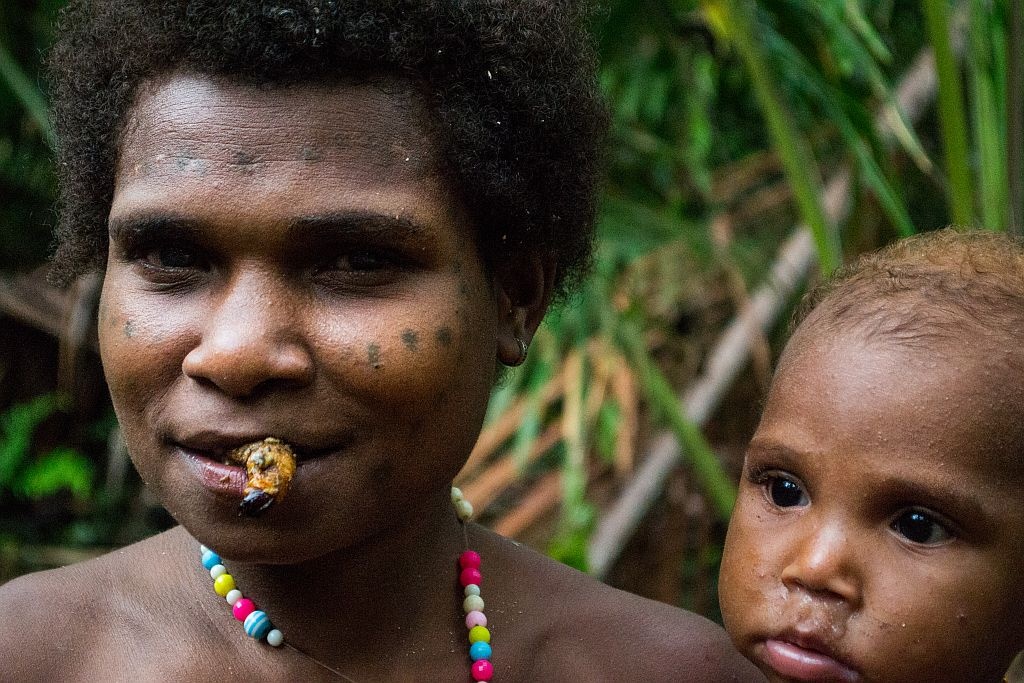
Sago grub festivals are planned months in advance and correspond with the phases of the moon. The grubs are harvested from logs which have been carefully cut, split and left to rot so the beetles can enter and lay their eggs. After two months the grubs are roasted and eaten. The feast itself includes dancing and chanting, which often lasts through the night. The morning after the feast fertility rituals for young boys and sago trees are sometimes performed. Composed of many stages of preparation, celebrations and rituals, such festivals help to ease tensions between clans and form alliances. ^^
On a feast in a treehouse, Paul Raffaele wrote in Smithsonian Magazine: “After an hour’s trek, I reach a clearing about the size of two football fields and planted with banana trees. Dominating it is a treehouse that soars about 75 feet into the sky. Its springy floor rests on several natural columns, tall trees cut off at the point where branches once flared out. Boas is waiting for us. Next to him stands his father, Khanduop, a middle-aged man clad in rattan strips about his waist and a leaf covering part of his penis. He grabs my hand and thanks me for bringing his son home. He has killed a large pig for the occasion, and Bailom, with what seems to me to be superhuman strength, carries it on his back up a notched pole into the treehouse. [Source: Paul Raffaele, Smithsonian Magazine, September 2006 \=]
“Inside, every nook and cranny is crammed with bones from previous feasts—spiky fish skeletons, blockbuster pig jaws, the skulls of flying foxes and rats. The bones dangle even from hooks strung along the ceiling, near bundles of many-colored parrot and cassowary feathers. The Korowai believe that the décor signals hospitality and prosperity. I meet Yakor, a tall, kindly eyed tribesman from a treehouse upriver, who squats by the fire with Khanduop, Bailom and Kilikili. Boas’ mother is dead, and Khanduop, a fierce man, has married Yakor's sister. When the talk turns to khakhua meals they have enjoyed, Khanduop's eyes light up. He's dined on many khakhua, he says, and the taste is the most delicious of any creature he's ever eaten. \=\
Visiting an Isolated Korowai Community
Describing an encounter with an isolated betul clan with a guide named Baleamale, Steinmetz wrote: "On the far side was a low tree house, where a group of men had gathered, including Balemale's brother. He clutched a bow and arrows in one hand and a massively barbed arrow in other, which was shaking uncontrollably. Gerrit tried to calm him. The man wanted to kill us, he said, but didn't want to damage relations with his brother. 'Why are you here," he demanded. "There is no food for you. It would have been better if you had kept far from here.'" [Source: George Steinmetz, National Geographic, February, 1996 ^^]
"We made a fast retreat," Steinmetz wrote, "nervously returning the next morning. Balemale's brother was less threatening on our second visit—and even let Johannes give his daughter an injection for her disfiguring skin disease—but soon he was again demanding that we leave. It was late in the day, he explained, and we might be attacked when it grew dark. He had been willing to listen to us, but he warned the upstream people would not be so hospitable. So we withdrew again as night fell, spending the tense hours until dawn at the camp we had pitched uncomfortably near the Korowai clearing." ^^

Paul Raffaele wrote in Smithsonian Magazine: “ For days I've been slogging through a rain-soaked jungle on a quest to visit members of the Korowai tribe. Soon after first light this morning I boarded a pirogue, a canoe hacked out of a tree trunk, for the last stage of the journey, along the twisting Ndeiram Kabur River. Now the four paddlers bend their backs with vigor, knowing we will soon make camp for the night. My guide, Kornelius Kembaren, has traveled among the Korowai for 13 years. But even he has never been this far upriver, because, he says, some Korowai threaten to kill outsiders who enter their territory. Some clans are said to fear those of us with pale skin, and Kembaren says many Korowai have never laid eyes on a white person. They call outsiders laleo ("ghost-demons"). [Source: Paul Raffaele, Smithsonian Magazine, September 2006 \=]
“Suddenly, screams erupt from around the bend. Moments later, I see a throng of naked men brandishing bows and arrows on the riverbank. Kembaren murmurs to the boatmen to stop paddling. "They're ordering us to come to their side of the river," he whispers to me. "It looks bad, but we can't escape. They'd quickly catch us if we tried." As the tribesmen's uproar bangs at my ears, our pirogue glides toward the far side of the river. "We don't want to hurt you," Kembaren shouts in Bahasa Indonesia, which one of our boatmen translates into Korowai. "We come in peace." Then two tribesmen slip into a pirogue and start paddling toward us. As they near, I see that their arrows are barbed. "Keep calm," Kembaren says softly.” \=\
Socializing in a Remote Korowai Treehouse
Paul Raffaele wrote in Smithsonian Magazine: “I can hear voices as I climb an almost vertical pole notched with footholds. The interior of the treehouse is wreathed in a haze of smoke rent by beams of sunlight. Young men are bunched on the floor near the entrance. Smoke from hearth fires has coated the bark walls and sago-leaf ceiling, giving the hut a sooty odor. A pair of stone axes, several bows and arrows and net bags are tucked into the leafy rafters. The floor creaks as I settle cross-legged onto it. Four women and two children sit at the rear of the treehouse, the women fashioning bags from vines and studiously ignoring me. "Men and women stay on different sides of the treehouse and have their own hearths," says Kembaren. Each hearth is made from strips of clay-coated rattan suspended over a hole in the floor so that it can be quickly hacked loose, to fall to the ground, if a fire starts to burn out of control. [Source: Paul Raffaele, Smithsonian Magazine, September 2006 \=]
“A middle-aged man with a hard-muscled body and a bulldog face straddles the gender dividing line. Speaking through Boas, Kembaren makes small talk about crops, the weather and past feasts. The man grips his bow and arrows and avoids my gaze. But now and then I catch him stealing glances in my direction. "That's Lepeadon, the clan's khen-mengga-abül, or 'fierce man,'" Kembaren says. The fierce man leads the clan in fights. Lepeadon looks up to the task. "A clan of six men, four women, three boys and two girls live here," Kembaren says. "The others have come from nearby treehouses to see their first laleo." \=\
“After an hour of talk, the fierce man moves closer to me and, still unsmiling, speaks. "I knew you were coming and expected to see a ghost, but now I see you're just like us, a human," he says, as Boas translates to Kembaren and Kembaren translates to me. "We shouldn't push the first meeting too long," Kembaren now tells me as he rises to leave. Lepeadon follows us to the ground and grabs both my hands. He begins bouncing up and down and chanting, "nemayokh" ("friend"). I keep up with him in what seems a ritual farewell, and he swiftly increases the pace until it is frenzied, before he suddenly stops, leaving me breathless. \=\
“Lepeadon tells Boas he wants me to stay longer, but I have to return to Yaniruma... As we board the pirogue, the fierce man squats by the riverside but refuses to look at me. When the boatmen push away, he leaps up, scowls, thrusts a cassowary-bone arrow across his bow, yanks on the rattan string and aims at me. After a few moments, he smiles and lowers the bow—a fierce man's way of saying goodbye.” \=\
Image Sources: Wikimedia Commons
Text Sources: New York Times, Washington Post, Los Angeles Times, Times of London, Lonely Planet Guides, Library of Congress, Compton’s Encyclopedia, The Guardian, National Geographic, Smithsonian magazine, The New Yorker, Time, Newsweek, Reuters, AP, AFP, Wall Street Journal, The Atlantic Monthly, The Economist, Global Viewpoint (Christian Science Monitor), Foreign Policy, Wikipedia, BBC, CNN, and various books, websites and other publications.
Last updated November 2025