
POLITICAL PARTIES IN MALAYSIA

Malaysian political parties are generally divided along ethnic lines first and ideological and religious lines next. Politics in Malaysia has traditionally been dominated by coalitions of political parties representing various ethnic groups. Malays and indigenous people make up 60 percent of Malaysia's population, while Chinese account for 25 percent and Indians 8 percent. Parties often draw much of their support from distinct ethnic or religious communities, and their electoral success appears to rely on an individual leader’s influence. Political parties often are characterized by factionalism, publicized internal disputes, and near cloak-and-dagger internal relations.
The Malay-rooted UMNO (United Malays National Organization) has traditionally dominated Malaysian politics but doesn't now. When it did it provided every prime minister and deputy prime minister and controlled all the important ministries. To gain enough seats in parliaments it often needed the help Chinese, and Indian parties — the Malaysian Chinese Association (MCA) and the Malaysian Indian Congress (MIC) — through its coalition. [Source: Diane K. Mau, Governments of the World: A Global Guide to Citizens' Rights and Responsibilities, Thomson Gale, 2006]
The UMNO, MCA, and MIC formed a governing coalition on the eve of independence, pledging to achieve independence by peaceful means. After bloody intercommunal riots between Malays and Chinese in 1969, it transformed into the National Front. The Malayan Communist Party (MCP), which gained influence by leading the resistance against the Japanese occupation during World War II, ran a militant campaign for independence. However, it did not receive widespread support, which led to the Malayan Emergency (1948–1960), a period of social and political unrest. The MCP was banned and has never played an active political role in independent Malaysia. [Source: Rafis Abazov, Worldmark Encyclopedia of National Economies, Gale Group Inc., 2002]
Multiethnic parties traditionally enjoyed little electoral success until the National Justice Party (PKR, Keadilan) came along, yet the country has been ruled by a coalition of ethnic parties since independence. The National Front coalition has always included the primary Malay, Chinese, and Indian parties.
RELATED ARTICLES:
POLITICS IN MALAYSIA: LEADERS, ETHNICITY, RELIGION, SYMBOLS, PROTESTS factsanddetails.com
POLITICS, ISLAM AND PAS (ISLAMIC PARTY OF MALAYSIA) factsanddetails.com
GOVERNMENT OF MALAYSIA: SYMBOLS, CONSTITUTION, LEADERSHIP factsanddetails.com
GOVERNMENT BRANCHES OF MALAYSIA, PRIME MINISTER AND LEGISLATURE factsanddetails.com
ELECTIONS IN MALAYSIA factsanddetails.com
MAHATHIR MOHAMAD: HIS LIFE, VIEWS, CHARACTERS, OUTRAGEOUS STATEMENTS factsanddetails.com
MALAYSIA UNDER MAHATHIR MOHAMAD factsanddetails.com
NAJIB RAZAK: LIFE, POLITICAL CAREER, SCANDALS factsanddetails.com
MALAYSIA UNDER PRIME MINISTER NAJIB RAZAK 2009-2018 factsanddetails.com
1MDB SCANDAL: BILLIONS, BIRKIN BAGS, CELEBRITIES, JHO LOW, JAILTIME FOR NAJIB factsanddetails.com
ANWAR IBRAHIM'S LIFE AND POLITICAL CAREER factsanddetails.com
ANWAR IBRAHIM'S TRIALS, LEGAL PROBLEMS AND TIME IN JAIL factsanddetails.com
ANWAR IBRAHIM FINALLY BECOMES PRIME MINISTER factsanddetails.com
History of Political Parties in Malaysia

Before World War II, political activity in Malaya was limited, but the Japanese occupation helped spark greater political awareness. After the war, parties pushed for independence despite Malay fears of domination by economically powerful minorities, particularly the Chinese. In 1952, the United Malays National Organisation (UMNO) joined with the Malaysian Chinese Association (MCA) to form the Alliance Party, later expanded with the Malaysian Indian Congress (MIC), becoming the country’s dominant political force. Meanwhile, the Malayan Communist Party gained strong influence in trade unions but was outlawed in 1948 after turning to armed struggle. [Source: Worldmark Encyclopedia of Nations, Thomson Gale, 2007]
The Alliance won a large parliamentary majority in 1964 but suffered major losses in the 1969 election, which was followed by deadly ethnic riots between Malays and Chinese. Parliament was suspended under a state of emergency and reconvened in 1971 after the Alliance regained a two-thirds majority through new partnerships. Although the coalition lost control of several state assemblies, leadership passed from Tunku Abdul Rahman to Tun Abdul Razak in 1970.
In 1973, the Alliance expanded into the broader National Front (Barisan Nasional), led by UMNO, which dominated elections from the 1970s through the 1980s. Mahathir Mohamad survived a leadership challenge in 1987, while opposition parties—mainly the Chinese-based Democratic Action Party (DAP) and the Islamic PAS—remained comparatively weak due in part to electoral arrangements favoring Malay voters. By the 2004 elections, UMNO’s dominance was stronger than ever, securing more than 90 percent support.
Opposition Parties in Malaysia
Major opposition parties in the 2010s included: People's Alliance (Pakatan Rakyat) or PR (opposition coalition) consists of the following parties: Democratic Action Party (Parti Tindakan Demokratik) or DAP; Islamic Party of Malaysia (Parti Islam se Malaysia) or PAS; People's Justice Party (Parti Keadilan Rakyat) or PKR; and the Sarawak National Party or SNAP. Among the the notable independent parties were the Sabah Progressive Party (Parti Progresif Sabah) or SAPP and State Reform Pary (Parti Reformasi Negeri) or STAR. Some are still around; other have morphed or merged with other parties. [Source: CIA World Factbook]
Malaysia’s opposition has traditionally included three main parties with different support bases. The Islamic Party of Malaysia (PAS) draws strong backing from voters in the northern peninsula, while the Chinese-led Democratic Action Party (DAP) has a loyal urban following and long served as the country’s main opposition party. The National Justice Party (PKR, Keadilan), a multiracial party linked to former deputy prime minister Anwar Ibrahim, emerged in the late 1990s after his dismissal from government. [Source: Thomas Fuller, New York Times, March 7, 2008; Eileen Ng, Associated Press, April 29 2013]
The three parties began cooperating in 2008, agreeing not to compete in the same electoral seats and later issuing a joint manifesto despite disagreements, particularly over PAS’s goal of establishing an Islamic state. Within the alliance, the parties operated as equals, unlike the larger, Malay-dominated ruling coalition.
DAP gradually increased its parliamentary representation in the late 1990s and early 2000s, while Keadilan initially struggled electorally after being founded by Anwar’s wife, Azizah Ismail, during his imprisonment. PAS remained a key opposition force due to its regional strength and conservative platform.
Over time PAS is becoming increasingly conservative and theocratic. It campaigns for Islamic law and the creation of an Islamic state, competing directly against UMNO. The DAP seeks more ethnic equality and democratization and competes primarily against the BN's Chinese and Indian parties. Neither party has been able to make much headway against the BN, which controls the entire political center by supporting civil law, religious moderation, political stability, and economic growth. [Source: Diane K. Mau, Governments of the World: A Global Guide to Citizens' Rights and Responsibilities, Thomson Gale, 2006]
Political Parties and Alliances in Malaysia and Their Leaders
National Front (Barisan Nasional) or BN led by Ahmad ZAHID Hamidi is an alliance comprised of:
All Malaysia Indian Progressive Front or IPF (Barisan Kemajuan India Se-Malaysia) or AMIPF led by LOGANATHAN Thoraisamy
Love Malaysia Party (Parti Cinta Malaysia) or PCM led by HUAN Cheng Guan
Malaysian Chinese Association (Persatuan Cina Malaysia) or MCA led by WEE Ka Siong
Malaysian Indian Congress (Kongres India Malaysia) or MIC led by VIGNESWARAN Sanasee
Malaysian Indian Muslim Congress (Kongres India Muslim Malaysia) or KIMMA led by Syed IMBRAHIM Kader
Malaysia Makkal Sakti Party (Parti Makkal Sakti Malaysia) or MMSP led by R.S. THANENTHIRAN
United Malays National Organization (Pertubuhan Kebansaan Melayu Bersatu) or UMNO led by Ahmad ZAHID Hamidi
United Sabah People's Party (Parti Bersatu Rakyat Sabah) or PBRS led by Arthur Joseph KURUP [Source: CIA World Factbook, December 2023]

Alliance of Hope (Pakatan Harapan) or PH led by ANWAR Ibrahim is an alliance comprised of::
Democratic Action Party (Parti Tindakan Demokratik) or DAP led by Anthony LOKE Siew Fook
Malaysian United Democratic Alliance (Ikatan Demokratik Malaysia) or MUDA led by Syed SADDIQ Syed Adbdul Rahman
National Trust Party (Parti Amanah Negara) or AMANAH led by MOHAMAD Sabu
People's Justice Party (Parti Keadilan Rakyat) or PKR led by ANWAR Ibrahim
United Progressive Kinabalu Organization (Pertubuhan Kinabalu Progresif Bersatu) or UPKO led by EWON Benedick
National Alliance (Perikatan Nasional) or PN led by MUHYIDDIN Yassin is an alliance comprised of::
Malaysian People's Movement Party (Parti Gerakan Rakyat Malaysia) or GERAKAN or PGRM led by LAU Hoe Chai
Malaysian United Indigenous Party (Parti Pribumi Bersatu Malaysia) or PPBM or BERSATU led by MUHYIDDIN Yassin
Pan-Malaysian Islamic Party (Parti Islam Se-Malaysia) or PAS led by Abdul HADI Awang
Sabah People's Alliance (Gabungan Rakya Sabah) or GRS led by HAJIJI Noor:
Homeland Solidarity Party (Parti Solidariti Tanah Airku) or STAR led by Jeffrey KITINGAN
Sabah People's Ideas Party (Parti Gagasan Rakyat Sabah) or GAGASAN or PGRS led by HAJIJI Noor
Sabah Progressive Party (Parti Maju Sabah) or SAPP led by Yong Teck Lee
United Sabah National Organization (Pertubuhan Kebangsaan Sabah Bersatu ((Baru)) or USNO (Baru) led by PANDIKAR Amin Mulia
United Sabah Party (Parti Bersatu Sabah) or PBS led by Maximus Johnity ONGKILI
Sarawak Parties Alliance (Gabungan Parti Sarawak) or GPS led by Abang Abdul Rahman Zohari Abang Openg or ABANG JOHARI or "Abang Jo" is an alliance comprised of:
Progressive Democratic Party (Parti Demokratik Progresif) or PDP led by TIONG King Sing
Sarawak People's Party (Parti Rakyat Sarawak) or PRS led by Joseph SALANG Gandum
Sarawak United People's Party (Parti Rakyat Bersatu Sarawak) or SUPP led by SIM Kui Hian
United Bumiputera Heritage Party (Parti Pesaka Bumiputera Bersata) or PBB led by Abang Abdul Rahman Zohari Abang Openg or ABANG JOHARI or "Abang Jo"
Other parties receiving votes in 2022 general election:
Malaysian Nation Party (Parti Bangsa Malaysia) or PBM led by Larry SNG Wei Shein
Heritage Party (Parti Warisan) or WARISAN led by SHAFIE Apdal
Social Democratic Harmony Party (Parti Kesejahteraan Demokratik Masyarakat) or KDM led by PETER Anthony
Malaysian United Democratic Alliance (Ikatan Demokratik Malaysia) or MUDA led by Syed SADDIQ
Performance of Malaysia’s Political Parties and Alliances

Results of the 2022 Election for the three main parties:
Leader— — Anwar Ibrahim— — Muhyiddin Yassin— — Ahmad Zahid Hamidie
Alliance— — Pakatan Harapan (BH) — — Perikatan Nasional (PN) — — Barisan Nasional (BN)
Party— —PKR— — BERSATU— — UMNO*
Leader's seat— — Tambun— — Pagoh— — Bagan Datuk
Seats won— — 82— — 74— — 30
Seat change— — Decrease 18— — Increase 42— — Decrease 28
Popular vote— — 5,931,519— — 4,701,906— — 3,653,069
Percentage— — 38.00 percent— — 30.12 percent— — 23.40 percent
Results in 2018 election— — 41.29 percent, 100 seats— — 24.07 percent, 32 seats— — 27.79 percent, 58 seats
Swing— — Decrease 3.83pp— — Increase 6.28pp— — Decrease 5.43pp
* 1) PKR (People's Justice Party, Malay: Parti Keadilan Rakyat, or KEADILAN); 2) BERSATU (Malaysian United Indigenous Party, Malay: Parti Pribumi Bersatu Malaysia; abbrev: or PPBM); 3) UMNO (United Malays National Organization)
[Source: Wikipedia]
Measured by the number of seats in the 2004 elections for the House of Representatives, the most supported political party was the UMNO, which won 109 of the 219 seats, followed by the MCA (31 seats), Democratic Action Party (12 seats), Parti Pesakea Bumiputera Bersatu (11 seats), and Parti Gerakan Rakyat Malaysia (10 seats). All other political parties won fewer than 10 seats. The BN coalition won 198 out of 219 seats in the 2004 elections. In the 12 general elections since 1955, the BN and its predecessor, the Alliance, have won at least 70 percent of seats, except in 1969 when they won only 51 percent of seats.
Historical Context of Malaysia’s Political Parties
From independence in 1957 to 2018, Malaysia was governed by the United Malays National Organization (UMNO), which ruled in coalition with other parties. The coalition’s share of the vote declined in the May 1969 national elections, after which riots erupted in Kuala Lumpur and other areas, primarily between Malays and ethnic Chinese. Hundreds were killed or injured, prompting the government to declare a state of emergency and suspend parliamentary activities. [Source: Countries of the World and Their Leaders Yearbook 2009, Gale 2008]
In the years that followed, Malaysia introduced policies that became central to its socioeconomic framework. The New Economic Policy (NEP), launched in 1971, established affirmative action programs intended to assist Malays and certain indigenous groups, collectively known as bumiputera (“sons of the soil”). Constitutional amendments restricted public debate on sensitive aspects of the social contract, and the government made intercommunal harmony an official objective. The earlier alliance of communally based parties was reorganized into the broader Barisan Nasional (BN), or National Front, which secured large majorities in the 1974 federal and state elections.
Mahathir Mohamad served as prime minister from 1981 to 2003, leading UMNO and the BN to repeated electoral victories. His administration prioritized economic growth, particularly through exports and major infrastructure projects. Mahathir credited the success of Asia’s “tiger economies” to what he described as strong “Asian values,” which he considered superior to Western approaches. During the Asian financial crisis of 1997–98, he sharply criticized the International Monetary Fund, international financiers such as George Soros, and Western governments, rejecting claims that the downturn stemmed from corruption or crony capitalism.
The final years of Mahathir’s tenure were overshadowed by a conflict with his deputy and expected successor, Anwar Ibrahim. In September 1998, Mahathir dismissed Anwar and accused him of corruption and immoral conduct. Although Anwar was convicted in 1999 and 2000, the trials were widely regarded as flawed. In September 2004, Malaysia’s Federal Court overturned the conviction for immoral conduct and ordered Anwar’s release.
Mahathir stepped down in October 2003 after 22 years in office, and Deputy Prime Minister Abdullah Ahmad Badawi succeeded him. Abdullah called elections in March 2004 and won a decisive victory, with Barisan Nasional capturing 199 of 219 seats in the lower house of Parliament; UMNO alone secured 110 seats. The Islamic opposition party PAS, which had gained ground in 1999, was reduced to six parliamentary seats and lost control of the state of Terengganu. The center-left Democratic Action Party (DAP), supported largely by urban ethnic Chinese voters, won 12 seats, and its chairman, Lim Kit Siang, became Leader of the Opposition.
After taking office, Abdullah — an Islamic scholar — promoted the concept of “Islam Hadhari,” or “civilizational Islam,” which emphasized education, social harmony, and economic development. Over time, however, his relationship with Mahathir deteriorated, and the former prime minister later expressed regret for having supported Abdullah as his successor.
Pakatan Harapan
Pakatan Harapan (PH), meaning “Alliance of Hope,” is a Malaysian political coalition of centre-left parties formed in 2015 to replace the earlier Pakatan Rakyat coalition. It led the federal government from May 2018 until February 2020 and has headed a broader coalition government since November 2022. [Source: Wikipedia]
PH is the largest coalition in the Dewan Rakyat, holding 79 seats. It participates in the governments of seven of Malaysia’s 13 states — Penang, Selangor, Negeri Sembilan, Perak, Pahang, Malacca, and Sabah — and provides support to the Barisan Nasional-led government in Johor. The coalition’s main member parties are the Democratic Action Party (DAP), the People’s Justice Party (PKR), and Parti Amanah Negara (AMANAH).
In the 2018 general election, Pakatan Harapan defeated the long-ruling Barisan Nasional coalition, ending more than six decades of uninterrupted rule since independence. However, the coalition lost power during the 2020 political crisis after Prime Minister Mahathir Mohamad resigned and his party, the Malaysian United Indigenous Party (BERSATU), withdrew from the alliance along with several PKR lawmakers.
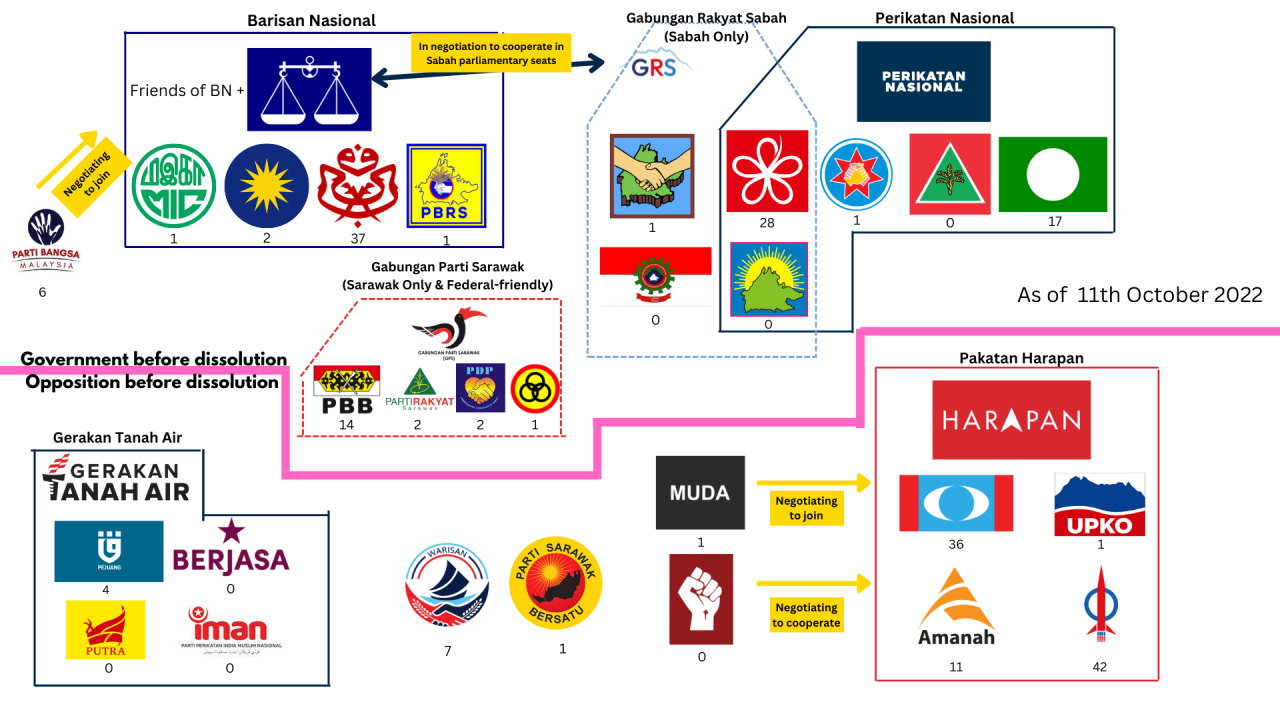
The 2022 general election produced a hung parliament, leading Pakatan Harapan to form a “national unity government” with several other coalitions and parties, including Barisan Nasional, Gabungan Parti Sarawak, Gabungan Rakyat Sabah, WARISAN, Parti Bangsa Malaysia, the Malaysian United Democratic Alliance, the Social Democratic Harmony Party, and independent members. PH chairman Anwar Ibrahim became prime minister.
Pakatan Harapan emerged from the breakup of Pakatan Rakyat, a three-party alliance composed of PKR, DAP, and (PAS). Persistent disagreements — particularly over the implementation of sharia law — caused the coalition to collapse in June 2015. Later that year, the remaining parties joined with a PAS splinter group, the National Trust Party, to establish the new coalition.
In 2016, another splinter party, the Malaysian United Indigenous Party (BERSATU), founded by former prime minister Mahathir Mohamad, announced its intention to join Pakatan Harapan. After forming an electoral pact in late 2016, BERSATU officially became a member in 2017, strengthening the coalition ahead of the 2018 election.
BERSATU
The Malaysian United Indigenous Party (BERSATU or PPBM) is a nationalist political party founded in 2016 by former members of the United Malays National Organisation (UMNO), including Muhyiddin Yassin and Mahathir Mohamad. Full membership is limited to bumiputera (indigenous Malaysians), while non-bumiputera may join only as non-voting associate members. The party later became a major component of the Perikatan Nasional coalition. [Source: Wikipedia]
BERSATU initially joined the Pakatan Harapan opposition alliance and helped it win the 2018 general election, which ended Barisan Nasional’s six-decade rule. Mahathir Mohamad became prime minister, and the party gained additional strength as several UMNO politicians defected.
The Pakatan Harapan government collapsed in 2020 after BERSATU withdrew from the coalition amid internal tensions. Party president Muhyiddin Yassin subsequently became prime minister and led the new Perikatan Nasional government. Political disputes followed, including expulsions of senior figures such as Mahathir.
Muhyiddin resigned in 2021 after losing his parliamentary majority, and BERSATU later moved into opposition following the 2022 election, which produced a hung parliament. Although the party made gains in some contests, it faced internal factional struggles, electoral setbacks, and questions about its long-term strength, including a major defeat in the 2025 Sabah state election.
Perikatan Nasional (PN),
Perikatan Nasional (PN), or National Alliance, is a Malaysian political coalition made up of right-wing parties. It is the second-largest bloc in the Dewan Rakyat, holding 74 seats, behind Pakatan Harapan. Core members include the Malaysian United Indigenous Party (BERSATU), the Malaysian Islamic Party (PAS), Parti Gerakan Rakyat Malaysia (GERAKAN), and the Malaysian Indian People’s Party (MIPP). [Source: Wikipedia]
The coalition emerged during the 2020–2022 Malaysian political crisis with the goal of replacing the Pakatan Harapan government. Its de facto leader, Muhyiddin Yassin, became Malaysia’s eighth prime minister in March 2020 after demonstrating majority support in parliament. PN governed from 2020 to 2022 in partnership with Barisan Nasional and several regional parties, and remained part of the administration even after Muhyiddin resigned in 2021.
After the 2022 general election, PN moved into opposition, with deputy chairman Hamzah Zainudin serving as Leader of the Opposition. Since its formation, the coalition has expanded to include additional parties and has competed in several state elections, although membership has shifted over time as some parties joined and others departed.
Barisan Nasional (BN)
The Barisan Nasional (BN, National Front) alliance included the United Malays National Organization (UMNO), representing the Malays; the Malaysian Chinese Association (MCA), representing the Chinese; and the Malaysian Indian Congress (MIC), representing the Indians; along with a few other political parties representing other ethnic groups in Sabah and Sarawak. [Source: P. Bala “Worldmark Encyclopedia of Cultures and Daily Life,” Cengage Learning, 2009]
From independence in 1957 to 2018, Malaysia was governed by the BN, which consisted of 14 political parties in the 2004 elections. UMNO has been the dominant party in both the BN and the country. MCA and MIC have also been influential in the BN. Significant opposition parties have included the Pan Malaysian Islamic Party (Parti Islam Se-Malaysia—PAS, now absorbed into a broader coalition) and the People’s Justice Party (Parti Keadilan Rakyat—Keadilan).
Each ethnicity is represented by a party in the National Front, a power-sharing arrangement designed to keep racial tensions at bay. In the election in March 2004, the National Front coalition took 198 (90 percent) of the 219 seats. The Chinese-dominated Malaysian Chinese Association and Gerakan parties are important in the BN coalition. Parties in Sarawak are also the coalition.
People’s Justice Party (PKR)
The People’s Justice Party (Malay: Parti Keadilan Rakyat, PKR or KEADILAN) is a multiracial, reform-oriented political party in Malaysia founded in 2003 through the merger of earlier parties linked to the Reformasi movement. The movement began after the 1998 dismissal and imprisonment of former Deputy Prime Minister Anwar Ibrahim, with his wife, Wan Azizah Wan Ismail, helping lead calls for political reform, social justice, and anti-corruption measures. [Source: Wikipedia]
PKR initially struggled electorally but gained strength in the 2008 election, becoming a major opposition force. As a founding member of the Pakatan Harapan coalition, it helped end Barisan Nasional’s six-decade rule in 2018, though the government collapsed in 2020 amid defections. After the 2022 election produced a hung parliament, PKR returned to power in a unity government led by Anwar Ibrahim as Malaysia’s tenth prime minister.
The PKR advocates institutional reform and economic fairness and draws strong support from urban and semi-urban areas, including Kuala Lumpur. PKR's constitution is rooted in liberal democracy and has as one of its core principles the establishment of "a just society and a democratic, progressive, and united nation." In practice, the party has primarily focused on promoting social and economic justice, eliminating political corruption, and addressing human rights issues within a non-ethnic framework. Analysts have also described the party as having socially conservative and Islamist reformist factions influenced by the Malaysian Islamic Youth Movement (ABIM). Anwar was once president of ABIM, which promotes Islamic values and maqasid syariah within its political platform.
UMNO (United Malays National Organization)
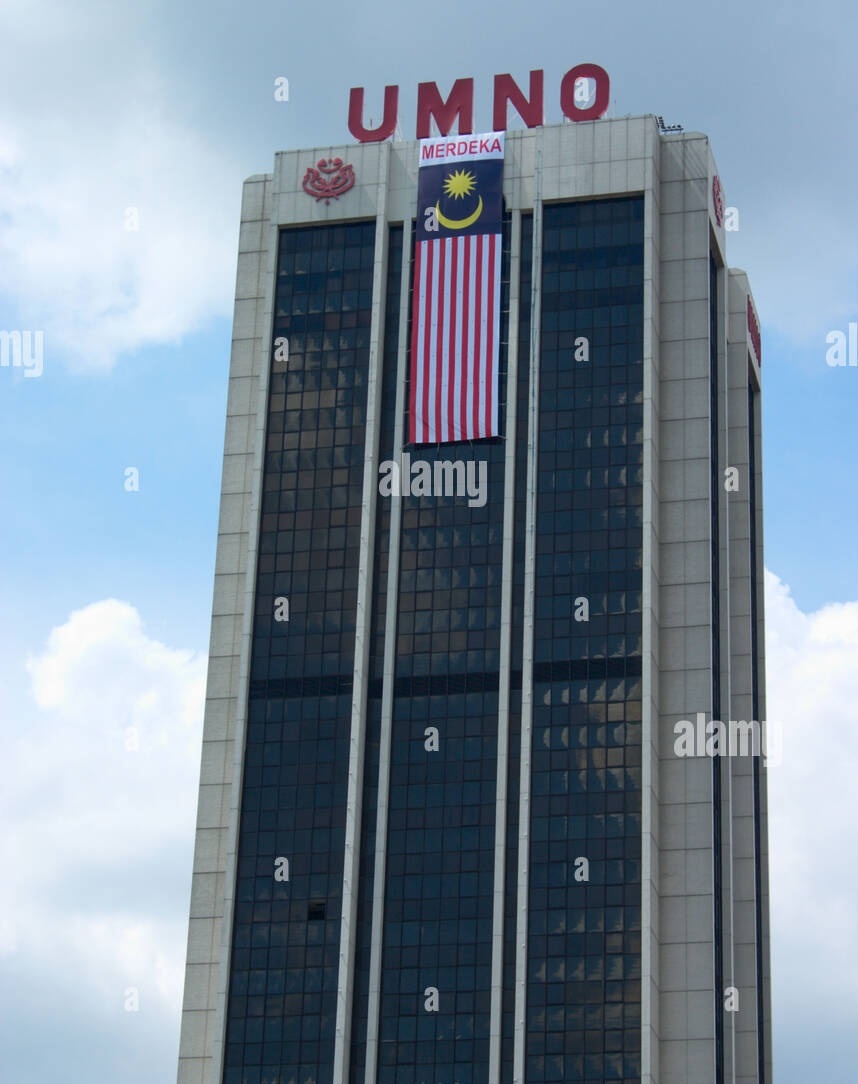
The United Malays National Organisation (UMNO) is a conservative, Malay nationalist political party founded in 1946 by Onn Jaafar. Often described as Malaysia’s “Grand Old Party,” it is the country’s oldest national political organization and a founding member of the Barisan Nasional (BN) coalition. Together with its predecessor, the Alliance Party, UMNO governed Malaysia from independence in 1957 until its defeat in the 2018 general election, during which every prime minister was also the party’s president.
UMNO advocates for Malay political and cultural interests, emphasizing Malay nationalism, the concept of Ketuanan Melayu (Malay primacy), the protection of Malay culture, and the promotion of Islam as the religion of the federation. These goals reflect its long-standing role as the main vehicle for Malay political representation.
The party emerged from widespread opposition to the British-backed Malayan Union, which many Malays believed threatened their sovereignty. After helping to establish the Federation of Malaya, UMNO shifted toward electoral politics and formed an alliance with the Malayan Chinese Association and later the Malayan Indian Congress. This coalition won decisive victories in the 1950s and pushed for independence, education reforms, and stronger local governance.
The UMNO was political party of Prime Minister Mahathir bin Mohamad who governed Malaysia for more than two decades in the 1980s and 90s and was the party of Prime Minister Najid Razak brought down by the 1MDB scandal in 2018. The UNMO and has traditionally been secular and the party of Malay nationalism. It has several million members and initially had a platform of opposing equal rights for Chinese and Indians. Coalitions with the UMNO at the helm ruled Malaysia from independence in 1957 to 2018. By some reckonings no political party in the world had been in power for longer than the UMNO.
The UMNO has traditionally been comprised of a dozen or so parties. For a long time it was made up of 14 parties. Despite losing power in 2018, UMNO has remained influential. It participated in governments formed during the 2020–2022 political crisis, and its vice president, Ismail Sabri Yaakob, served as prime minister from 2021 to 2022. Since 2022, party president Ahmad Zahid Hamidi has been deputy prime minister in a Pakatan Harapan–led administration, underscoring UMNO’s continued importance in Malaysian politics.
UMNO Politics and Vote Buying
UMNO party's rule in Malaysia has been aided by gerrymandered parliamentary districts that over-represent rural Malay constituencies. For a long time the UMNO president always becomes Malaysia's prime minister and the two thousand delegates at the biannual UMNO General Assembly were the country's real electoral force, as they choose the party leadership that leads the country. [Source: Thomas Williamson, Countries and Their Cultures, Gale Group Inc., 2001]
The UMNO has traditionally relied on pork barrel politics to remain in power. In rural areas the UMNO is a “one-stop shop,” offering everything from student loans to funeral arrangements. Local bureaucrats “educate” villages about the good things that the UMNO does. The UNMO and the BN coalition have been accused of routinely using tough laws to block challenges to its five decades in power. They are also behind longstanding paternalistic practices of a government that controls the mainstream media, bans most street protests, bars students from taking part in politics and jails political opponents without trial. [Source: Thomas Fuller, New York Times, March 9, 2008]
The UMNO is sharply divided along regional lines. There have also been disputes between old guard members and young Turks. The UNMO has a reputation for being corrupt and favoring the Malay eliteand leaving ordinary Malays behind, not to mention anti-Semitism. In 2003, it gave out copies of Henry Ford’s anti-Semitic book “The International Jew”.
Sabah and Sarawak, Malaysia’s two states on Borneo, have traditionally provided strong electoral support for the BN and UMNO. Their backing helped keep BN in power in 2008 despite rising opposition support elsewhere. In Sabah, Chief Minister Musa Aman played a key role in mobilizing votes and fundraising for UMNO, making him politically important to the coalition. In Sarawak, long-serving Chief Minister Taib Mahmud consistently delivered a large share of BN’s parliamentary seats, though he faced allegations of corruption related to major logging contracts. [Source: Niluksi Koswanage, Reuters, April 3, 2013; Jonathan Miller, Channel4.com, May 4, 2013]
Malaysia’s ruling United Malays National Organisation (UMNO) faced internal turmoil after a party investigation found a senior leader and several officials guilty of vote-buying ahead of leadership elections. The scandal exposed longstanding concerns about corruption within the party, especially after voter dissatisfaction weakened its decades-long grip on power. Disciplinary actions, including suspensions and a leadership ban, deepened divisions as the party prepared for a transition that would elevate Najib Razak to the premiership.[Source: Associated Press, March 18, 2009, Malaysia Today, November 10, 2011]
Admissions from a former UMNO minister later reinforced allegations that vote-buying had been common among governing coalition parties, often involving cash distributed shortly before elections. Reform advocates called for stricter electoral rules, neutral government machinery during campaigns, fair media access, and investigations into past abuses to ensure free and fair elections. Critics argued that such practices undermined public trust and reflected broader structural problems in Malaysia’s political system.
Image Sources: Wikimedia Commons
Text Sources: New York Times, Washington Post, Los Angeles Times, Times of London, Lonely Planet Guides, Library of Congress, Malaysia Tourism Promotion Board, Compton’s Encyclopedia, The Guardian, National Geographic, Smithsonian magazine, The New Yorker, Time, Newsweek, Reuters, AP, AFP, Wall Street Journal, The Atlantic Monthly, The Economist, Foreign Policy, Wikipedia, BBC, CNN, and various books, websites and other publications.
Last updated January 2026