
ELECTIONS IN MALAYSIA
General elections are held to elect members of the Dewan Rakyat — Malaysia’s parliament. These parliamentary elections must be held at least once every five years, but the government can call them earlier. When this happened it is usually only a matter of a few months. Parties with the most votes can form a government to rule the country. General elections decide the makeup of state assemblies as well as parliament. They are overseen by a nominally independent Election Commission. The last general election was in November 2022. Usually elections are in May.
Unless dissolved, the Parliament will proceed for five years from the date of the first proceeding session conducted after a general election. At the end of the five-year period, the Parliament is automatically dissolved, and within 60 days from the date of its dissolvement, a general election to elect representatives for the Dewan Rakyat has to be held, and the Parliament calls for a meeting at a date not later than 120 days from the date of dissolvement.
State elections are usually held at the same time as general elections. National elections have been held regularly in Malaysia since 1955. Despite significant obstacles for the opposition, such as severe campaign restrictions and limited media access, elections have generally been free of voter intimidation and ballot fraud. [Source: Diane K. Mau, Governments of the World: A Global Guide to Citizens' Rights and Responsibilities, Thomson Gale, 2006]
RELATED ARTICLES:
GOVERNMENT OF MALAYSIA: SYMBOLS, CONSTITUTION, LEADERSHIP factsanddetails.com
GOVERNMENT BRANCHES OF MALAYSIA, PRIME MINISTER AND LEGISLATURE factsanddetails.com
POLITICS IN MALAYSIA: LEADERS, ETHNICITY, RELIGION, SYMBOLS, PROTESTS factsanddetails.com
POLITICAL PARTIES IN MALAYSIA factsanddetails.com
POLITICS, ISLAM AND PAS (ISLAMIC PARTY OF MALAYSIA) factsanddetails.com
MAHATHIR MOHAMAD: HIS LIFE, VIEWS, CHARACTERS, OUTRAGEOUS STATEMENTS factsanddetails.com
MALAYSIA UNDER MAHATHIR MOHAMAD factsanddetails.com
NAJIB RAZAK: LIFE, POLITICAL CAREER, SCANDALS factsanddetails.com
MALAYSIA UNDER PRIME MINISTER NAJIB RAZAK 2009-2018 factsanddetails.com
1MDB SCANDAL: BILLIONS, BIRKIN BAGS, CELEBRITIES, JHO LOW, JAILTIME FOR NAJIB factsanddetails.com
ANWAR IBRAHIM'S LIFE AND POLITICAL CAREER factsanddetails.com
ANWAR IBRAHIM'S TRIALS, LEGAL PROBLEMS AND TIME IN JAIL factsanddetails.com
ANWAR IBRAHIM FINALLY BECOMES PRIME MINISTER factsanddetails.com
Voting in Malaysia

Malaysia has universal suffrage. The voting age is 18. It was 21. The 2022 election marked the first time 18- to 20-year-olds were eligible to participate after the voting age was lowered from 21 to 18. Automatic voter registration expanded the electorate by about six million people. Unlike past practice, most states did not hold elections at the same time, choosing instead to complete their terms after earlier instability had already disrupted electoral cycles in several states.
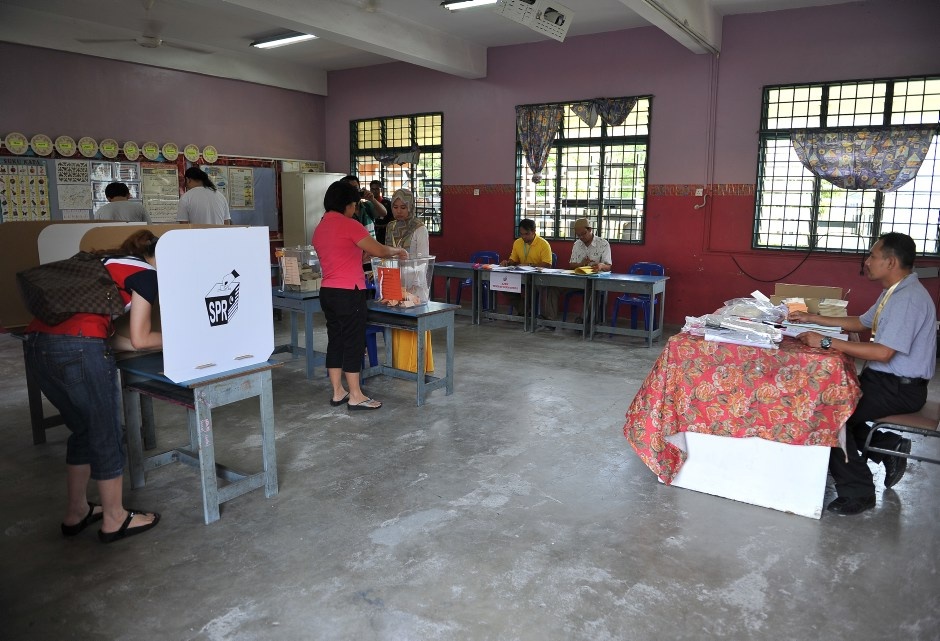
Elections are usually held on Saturday, with some extra time for voting in Sabah and Sarawak on Borneo island. The polls close at 5:00pm or 5:30pm, with results often determined between 8:00pm and midnight the same day. The final election results are usually announced on Tuesday. In 2008, about 70 percent of Malaysia’s 10.9 million eligible voters cast ballots. In an effort to curb violence, a ban on victory processions was put in place. Malaysia’s worst episode of violence, in 1969, was triggered by such a parade. In 2004, there were 10.3 million registered voters and 7,300 polling stations in Malaysia and 50,000 police backed by helicopters dogs and water cannons were deployed through out the country.
Relatively high voter participation in elections is partly due to the existence of strong party machinery. In 2004, for example, 72.77 percent of registered voters cast their ballots for the contested seats. However, there are numerous restrictions on participation. For example, the Societies Act requires all associations of seven or more members to be registered and approved, and this approval can be revoked. The government has tolerated, albeit ignored, most domestic non-governmental organizations, including those focusing on human rights. However, international non-governmental organizations have usually not been allowed to set up offices in Malaysia. [Source: Diane K. Mau, Governments of the World: A Global Guide to Citizens' Rights and Responsibilities, Thomson Gale, 2006]
Details and Logistics of Malaysian Elections
The Malaysian general election on March 8, 2008 was held in accordance with Malaysian laws for national elections, which states that a general election must be held no later than five years subsequent to the previous elections; the previous general election was held in 2004. Malaysia's Parliament was dissolved on February 13, 2008, and the following day, the Election Commission announced nominations would be held on February 24, with general polling set for March 8. State assemblies of all states other than Sarawak were also dissolved and their elections took place at the same time. [Source: Wikipedia]
Political parties were reported to have begun preparations for the polls as early as January 2008. As in 2004, the incumbent National Front coalition, the ruling political alliance since independence, as well as opposition parties represented primarily by Democratic Action Party (DAP), the Pan-Malaysian Islamic Party (PAS), and Parti Keadilan Rakyat (PKR) contested the election.
As with all preceding general elections following independence, the parliamentary election was won by BN, but yielded one of the worst results in the coalition's history. Opposition parties had won 82 seats (out of 222 seats in parliament) or 36.9 percent of parliamentary seats, while BN only managing to secure the remaining 140 seats or 63.1 percent. It marked also the first time since the 1969 election that the coalition did not win a two-thirds supermajority in the Malaysian Parliament required to pass amendments to the Malaysian Constitution. In addition, five of the twelve contested state legislatures were won by the opposition, compared with only one in the last election.
Political Campaigns
Campaigning for an election kicks off less than two weeks before the election. After parliament is dissolved the Election Commission takes a couple days to fix the days of the election which are usually about three weeks after parliament is dissolved. The campaign periods are relatively short, typically around eight or nine days, between the nomination deadline and the day before the vote. In 2004, the elections were called in early March, the campaign period began about a week later and the elections were held on March 21.
The opposition doesn’t like the system because the say they don’t get enough time to get across their message and incumbents have an advantage because their message is being relayed everyday in the state-supporting press. The system was put in place to prevent pre-election violence like the kind that occurred in 1969 when the campaign period was a month.
Malaysian election campaign can be very dirty and nasty and involve a lot of name calling and mudslinging. See Elections in 2008 and 2013 under History.
Describing campaigning by the prime minister before the 2008 elections, Associated Press reported: “Prime Minister Abdullah Ahmad Badawi was scheduled to meet with fishermen and visit a mosque in the northern state of Penang later Friday, making last-minute contact with his constituents before the end of campaigning at midnight. His deputy Najib Razak was to inaugurate a clinic and meet with schoolteachers and senior citizens in Pahang, another northern state. Unlike other parliamentary democracies, campaigning is low-key in Malaysia, largely because the weak opposition has little money to push through its message, and the ruling National Front has little need to prove its credentials. The National Front has won every election since independence in 1957, and is expected to win again.” [Source: AP, March 7, 2008]
Voter Irregularities in Malaysia
There have been reports of voting irregularities in Malaysia such as vote buying, bribery, stacking election rolls, placing wax on paper ballots so that voters can not mark the boxes for opposition candidates, counting phantom voters and not listing voters voter lists. After the 2008 general election, Human Rights Watch stated that irregularities in the electoral rolls and restrictions on media freedom made the vote “grossly unfair.” Malaysia’s election commission unexpectedly withdrew its plan to use indelible ink on voters’ fingers, a measure meant to prevent people from using the identity cards of deceased voters to cast multiple ballots. Opposition parties had long complained about “phantom” voters—dead individuals who remained on the rolls. [Source: Thomas Fuller, New York Times, March 7, 2008; Associated Press, March 10, 2008 ^^]
The commission reported that 8,666 registered voters were over 100 years old, including two listed as 128, an unlikely figure in a country where life expectancy was about 72. Bridget Welsh, a Malaysian politics specialist at Johns Hopkins University, told the New York Times that vote monitoring became harder after the commission allowed only one party representative in counting centers. “Changing of the rules at the last minute undermines faith in the electoral system,” she said.
The election was further clouded by allegations of vote-rigging. Human Rights Watch also accused authorities of manipulating the process through limits on free speech. After voting in his hometown of Kepala Batas, Abdullah said the opposition was raising fraud claims as an excuse in case it performed poorly.
The Associated Press reported that opposition leaders had long argued the system was tilted against them through gerrymandering, vote-buying, and bogus voters—charges the government repeatedly denied. Anwar Ibrahim, leader of Parti Keadilan Rakyat, said the opposition could win a third of parliamentary seats despite the “shenanigans.” “We will shake the government this time ... We will teach these cheaters a lesson,” he said after voting in a Penang seat held by his wife, Wan Azizah Wan Ismail.
PAS leader Nik Aziz Nik Mat also accused Barisan of cheating, saying supporters had found a member of the prime minister’s party carrying 28 identity cards. PAS controlled Kelantan, the only opposition-held state, and Barisan was making a strong effort to reclaim it after 18 years of PAS rule.
Race Issues in Malaysian Elections
In 2008, anger among ethnic Indians and Chinese over religious disputes and policies favoring Malays appeared to drive opposition gains. Large crowds, particularly from minority communities, attended opposition rallies, complaining of discrimination in education, jobs, financial aid, and religion. Abdullah warned that abandoning Barisan Nasional could lead to instability—often seen as a reference to racial tension. [Source: Associated Press, March 10, 2008; Vijay Joshi, Associated Press, March 8, 2008; Thomas Fuller, New York Times, March 9, 2008]
A major election issue was dissatisfaction with affirmative action programs that favored Muslim Malays. Though created in 1970 to help Malays close the wealth gap with Chinese Malaysians, minorities argued the policy persisted despite rising Malay living standards. After the 2008 election, Penang Chief Minister Lim Guan Eng pledged to scrap the New Economic Policy (NEP), arguing it encouraged cronyism, corruption, and inefficiency. Originally designed to reduce poverty by favoring Malays in jobs, education, and business, critics said it had mainly enriched a well-connected elite while many rural Malays remained poor. Opposition leader Anwar Ibrahim also called the policy obsolete, promising a merit-based economic agenda that would still protect Malays and disadvantaged groups while ending preferential treatment for cronies. The NEP had long been criticized by Chinese and Indian minorities and had complicated trade talks with the United States. Malaysia’s acting law minister confirmed that opposition-led states had the authority to abolish the policy within their jurisdictions. [Source: Associated Press, March 14 2008; Niluksi Koswanage, Reuters, March 11, 2008 ]
Voters also protested a crackdown on ethnic Indians by electing M. Manoharan, who was jailed without trial. Penang’s loss was especially damaging for Abdullah because it was an industrial hub and his political base. Several prominent ethnic Indian leaders in the government were defeated, raising doubts about the future of Malaysia’s race-based coalition, which opposition leaders pledged to reform.
Women and the Youth Vote in Malaysia
Women are fairl well represented in government in Malaysia. There are a number of female Mps in parliament. Women have served as attorney general and central bank governor. The Trade Minister for many years, Datuk Seri Rafidah Aziz, is a woman. But In some of the Islamic and conservative states women are discouraged from running for political office. An official in Kelantan said the state sought to protect women from exploitation, justifying policies that barred them from running for office and favored hiring less attractive, unmarried women for government jobs—remarks that drew attention for their bluntness. [Source: Siva Sithraputhran and Anuradha Raghu, Reuters, April 29, 2013]
Student leaders said Malaysia’s university system discouraged dissent and trained students to obey authority, highlighted by a viral video of a law student being shouted down at a campus event. While the opposition promised free university education, the ruling Barisan Nasional targeted young voters with book vouchers and smartphones. Despite claims of a strong economy, high graduate unemployment and financial worries left many young Malaysians unconvinced.
2022 Elections in Malaysia
General elections were held in Malaysia on November, 19 2022 amid a political crisis that had persisted since 2020. Coalition shifts, party defections, and the effects of the COVID-19 pandemic contributed to the resignation of two prime ministers and the collapse of successive governments after the 2018 elections. Although the 14th Parliament was scheduled to expire in July 2023, King Abdullah dissolved it in October 2022 at the request of Prime Minister Ismail Sabri Yaakob. Elections were constitutionally required within 60 days.
The vote marked the first time 18- to 20-year-olds were eligible to participate after the voting age was lowered from 21 to 18. Automatic voter registration expanded the electorate by about six million people. Unlike past practice, most states did not hold elections at the same time, choosing instead to complete their terms after earlier instability had already disrupted electoral cycles in several states.
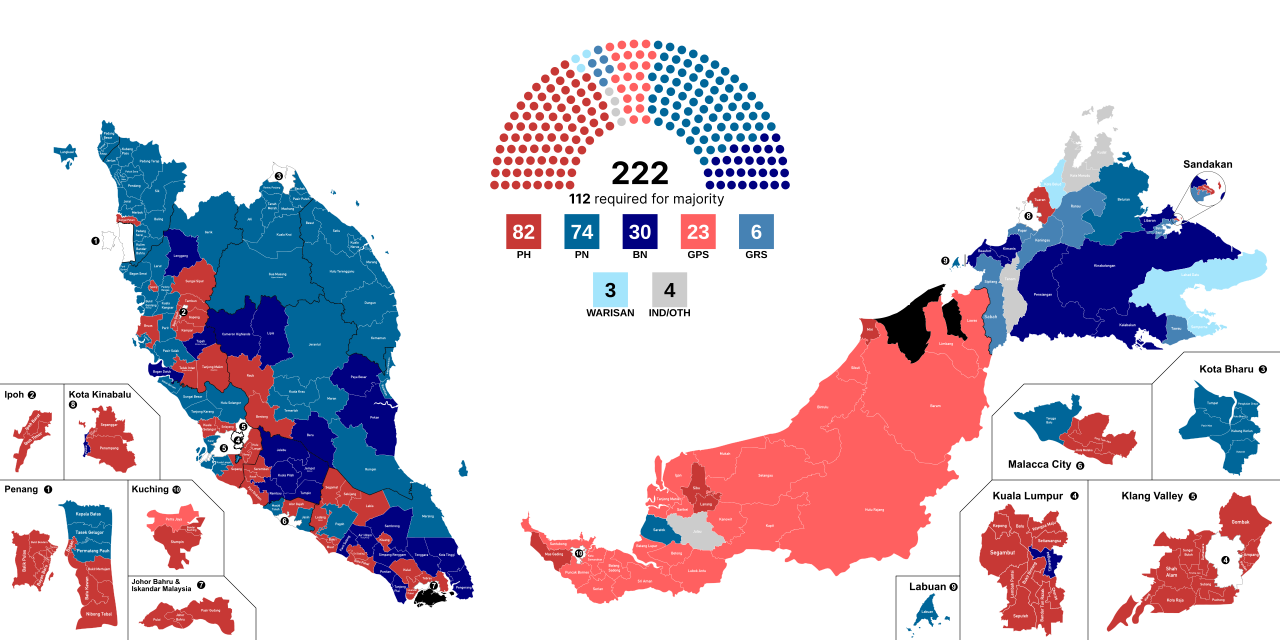
The Results announced on November 20 showed a hung parliament—the first in Malaysia’s history. Pakatan Harapan won the most seats but with reduced support, while Perikatan Nasional dominated the northern and east coast states in what became known as the “Green Wave.” The long-dominant Barisan Nasional fell to third place, and several prominent politicians, including former prime minister Mahathir Mohamad, lost their seats. After securing backing from Barisan Nasional, Gabungan Parti Sarawak, and other parties and independents, Pakatan Harapan leader Anwar Ibrahim was appointed prime minister and sworn in on 24 November 2022. Perikatan Nasional became the official opposition.
Results of the 2022 Election for the three main parties: 1) PKR (People's Justice Party, Malay: Parti Keadilan Rakyat, or KEADILAN); 2) BERSATU (Malaysian United Indigenous Party, Malay: Parti Pribumi Bersatu Malaysia; abbrev: or PPBM); 3) UMNO (United Malays National Organization)
Leader— — Anwar Ibrahim— — Muhyiddin Yassin— — Ahmad Zahid Hamidie
Party— —PKR— — BERSATU— — UMNO
Alliance— — Pakatan Harapan— — Perikatan Nasional— — Barisan Nasional
Leader's seat— — Tambun— — Pagoh— — Bagan Datuk
Seats won— — 82— — 74— — 30
Seat change— — Decrease 18— — Increase 42— — Decrease 28
Popular vote— — 5,931,519— — 4,701,906— — 3,653,069
Percentage— — 38.00 percent— — 30.12 percent— — 23.40 percent
Results in 2018 election— — 41.29 percent, 100 seats— — 24.07 percent, 32 seats— — 27.79 percent, 58 seats
Swing— — Decrease 3.83pp— — Increase 6.28pp— — Decrease 5.43pp [Source: Wikipedia]
See Separate Article: ANWAR IBRAHIM FINALLY BECOMES PRIME MINISTER factsanddetails.com
2018 Elections in Malaysia
General elections were held in Malaysia on May 9, 2018. All 222 seats in the Dewan Rakyat, the lower house of parliament, were up for grabs after Najib had dissolved parliament a month earlier. It it would have been automatically dissolved in June 2018, five years after previous election in 2013. [Source: Wikipedia]
In a historic upset, the opposition Pakatan Harapan (PH) coalition, together with the Sabah Heritage Party (WARISAN), won a majority by capturing 121 seats. This ended the Barisan Nasional (BN) coalition’s uninterrupted rule of over six decades since 1955. PH leader Mahathir, who had previously served as prime minister from 1981 to 2003 was sworn in again on May 10 at the age of 93, becoming the world’s oldest elected head of government. BN, led by Najib, retained 79 seats and became the opposition, alongside Gagasan Sejahtera (GS) with 18 seats. The United Sabah Alliance won one seat, and three seats went to independents.
In the state elections held at the same time, BN lost Negeri Sembilan, Malacca, Johor, Kedah, and Perak to PH. WARISAN captured Sabah, leaving BN with only Perlis and Pahang. After his defeat, Mr. Najib posted on Twitter: “I apologize for any shortcomings and mistakes” that “the best interests of Malaysia and its people will always be my first priority.”
See Separate Article: MALAYSIA UNDER PRIME MINISTER NAJIB RAZAK 2009-2018 factsanddetails.com
2013 Elections in Malaysia
In the May 2013 general elections, Prime Minister Najib Razak’s Barisan Nasional (BN, National Front) coalition retained control of Parliament but suffered its weakest mandate yet. BN won 133 of the 222 seats—enough for a simple majority but far short of the two-thirds majority it had sought—while Anwar Ibrahim’s three-party opposition alliance, Pakatan Rakyat, secured 89 seats. Although BN remained in power, it lost the popular vote to the opposition, underscoring a major shift in Malaysia’s political landscape. [Source: Stuart Grudgings and Al-Zaquan Amer Hamzah, Reuters, May 5, 2013; AFP, May 5, 2013; Columbia Encyclopedia, 6th ed., Columbia University Press]
The opposition rejected the outcome, alleging widespread fraud, gerrymandering, and unequal electoral boundaries that favored BN. Support patterns became increasingly polarized: BN continued to draw backing largely from poorer, rural, and Malay voters, while the opposition was strongest among urban, wealthier, and ethnic Chinese voters. Reuters described the result as BN’s worst electoral performance, extending its decades-long rule but exposing deepening racial and political divisions.
According to his own aides, Najib’ party secured victory in 2013 by distributing hundreds of millions of dollars to party leaders, who then gave the money to voters. But despite massive campaign spending and social handouts, Najib faced criticism from conservatives within his own party for failing to deliver a stronger mandate. After the election, his government moved away from earlier, tentative liberal reforms and instead reemphasized pro-Malay policies, tightened controls on dissent, and adopted more openly pro-Islamic positions, reflecting both internal party pressures and the increasingly polarized electorate.
See Separate Article: MALAYSIA UNDER PRIME MINISTER NAJIB RAZAK 2009-2018 factsanddetails.com
2008 Elections in Malaysia
In elections in 2008, Abdullah's National Front ruling coalition secured a fresh mandate but lost its two-thirds parliamentary majority, relinquished control of five of Malaysia's 13 states to the opposition and all but surrendered urban areas to the opposition. The opposition alliance now has 82 seats in the 222-member Parliament, a massive jump from its 19 seats in the outgoing house. The result was the coalition's worst electoral performance in the 51 years that it has governed Malaysia following independence from Britain in 1957. Scores of senior National Front officials lost their seats in the federal and state legislatures. [Source: Associated Press, March 10, 2008]
Opposition parties greatly expanded their presence in Parliament, quadrupling their seats and denying the ruling National Front its long-held two-thirds majority. The coalition lost control of several key states—including Penang, Selangor, Kedah, and Perak—and failed to retake Kelantan. Observers described the defeat in Penang as “like a tsunami coming in,” reflecting the scale of the upset. Without its supermajority, the government could no longer easily amend the Constitution, signaling what some analysts believed could be the emergence of a two-party system and the start of a new political era in Malaysia. [Source: Niluksi Koswanage, Reuters, March 11, 2008; Vijay Joshi, Associated Press, March 8, 2008]
The 2008 elections marked a turning point. Although barred from running, Anwar Ibrahim organized the opposition campaign, tapping into public frustration over unemployment, inequality, crime, and corruption. His criticism of policies seen as benefiting a small Malay elite resonated with voters. His People’s Justice Party won 31 seats, the most among opposition groups, while the Islamist PAS gained influence and helped govern several states. Analysts attributed the ruling coalition’s poor performance to racial tensions, income gaps, inflation, and anger at elite enrichment. Despite strong economic growth, many Malaysians felt the benefits had not reached ordinary citizens.
Malaysia’s opposition coalition rewarded voters in states it had recently won by canceling unpaid parking fines, offering free water, and sponsoring a soccer match. “How better to show them that we cared?” said PAS Secretary-General Kamarudin Jaffar. PAS, along with the Democratic Action Party (DAP) and the People’s Justice Party (PKR), won four state legislatures in the March 8 elections and retained Kelantan. Kamarudin said the benefits were introduced in Penang, Kedah, Perak, and Selangor. In Penang and Perak, fines for illegal parking and unlicensed street stalls were canceled to “thank the people for their support,” according to DAP’s Ngeh Koo Ham, who blamed many violations on failures by the previous government. Selangor considered lowering water bills and providing limited free water, while Kedah planned a free state-level soccer match. National Front lawmaker R. Perumal criticized the measures as a waste of state resources, asking, “Where are they going to get the income?” [Source: Julia Zappei, AP, March 20, 2008]
See Separate Article: ANWAR IBRAHIM'S LIFE AND POLITICAL CAREEER factsanddetails.com
Image Sources: Wikimedia Commons
Text Sources: New York Times, Washington Post, Los Angeles Times, Times of London, Lonely Planet Guides, Library of Congress, Malaysia Tourism Promotion Board, Compton’s Encyclopedia, The Guardian, National Geographic, Smithsonian magazine, The New Yorker, Time, Newsweek, Reuters, AP, AFP, Wall Street Journal, The Atlantic Monthly, The Economist, Foreign Policy, Wikipedia, BBC, CNN, and various books, websites and other publications.
Last updated January 2026