
NAJIB RAZAK
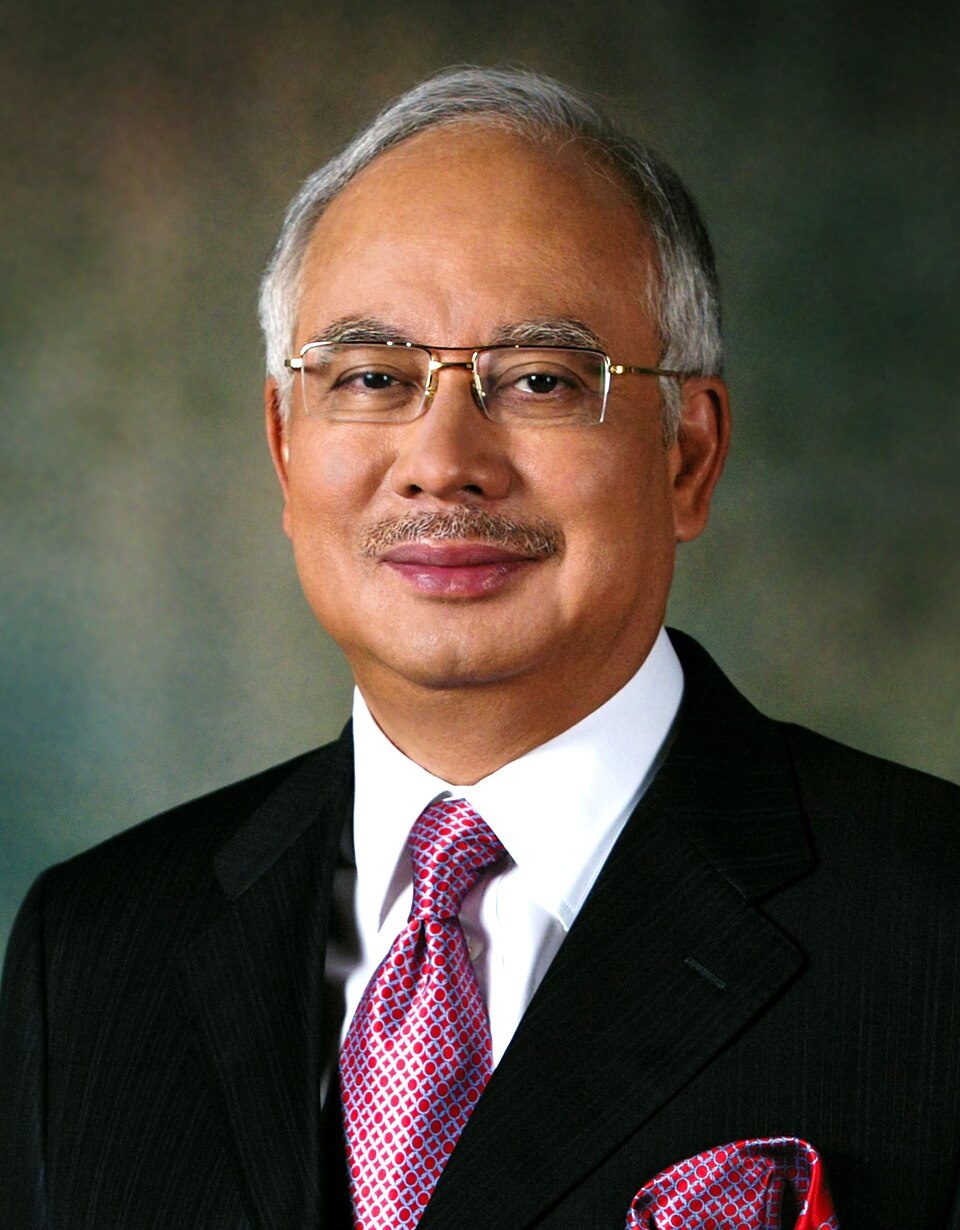
Mohammad Najib bin Abdul Razak was Malaysia's 6th Prime Minister. He is the eldest son of Malaysia's second prime minister, Abdul Razak, and the nephew of its third. He comes from a family of politicians. When he became prime minister in 2009, leading the party that had dominated Malaysian politics for half a century, it seemed he had taken his preordained role. An Anglophile, Najib attended the prestigious private school Malvern College in the UK before studying industrial economics at the University of Nottingham. His background and rhetoric about the importance of "moderate" Islam made him a natural fit with Western counterparts, including David Cameron and Barack Obama. [Source: By Heather Chen, Kevin Ponniah and Mayuri Mei Lin, BBC News, August 9, 2019]
Najib was first elected to Malaysia's Parliament in 1976 at the age of 23, replacing his deceased father in the seat of Pekan, which is located in the state of Pahang. That same year, he became the head of the Pekan branch of UMNO Youth and a member of its Executive Council. His tenure as prime minister from 2009 to 2018 was marked by economic liberalization measures, such as cuts to government subsidies, which were unpopular among the public. In 2020, he was convicted of corruption in the 1Malaysia Development Berhad scandal, one of the largest money laundering and embezzlement scandals in history. [Source: Wikipedia]
Najib’s rise to power was not without controversy. Allegations of corruption arose over the purchase of two French submarines in 2002, when he was defense minister. He denies any wrongdoing. There was an investigation in France. Additionally, his former aide was linked to a case involving the 2006 murder of a Mongolian national. The aide was acquitted in 2008. [Source: BBC, May 1, 2013]
RELATED ARTICLES:
MALAYSIA UNDER PRIME MINISTER NAJIB RAZAK 2009-2018 factsanddetails.com
1MDB SCANDAL: BILLIONS, BIRKIN BAGS, CELEBRITIES, JHO LOW, JAILTIME FOR NAJIB factsanddetails.com
MAHATHIR MOHAMAD: HIS LIFE, VIEWS, CHARACTERS, OUTRAGEOUS STATEMENTS factsanddetails.com
MALAYSIA UNDER MAHATHIR MOHAMAD factsanddetails.com
ASIAN FINANCIAL CRISIS OF 1997-98 IN MALAYSIA factsanddetails.com
ABDULLAH AHMAD BADAWI: MALAYSIA PRIME MINISTER (2003-2009) factsanddetails.com
ANWAR IBRAHIM'S LIFE AND POLITICAL CAREER factsanddetails.com
ANWAR IBRAHIM'S TRIALS, LEGAL PROBLEMS AND TIME IN JAIL factsanddetails.com
ANWAR IBRAHIM FINALLY BECOMES PRIME MINISTER factsanddetails.com
RISE OF MODERN MALAYSIA 1963-1990: DEVELOPMENT, ECONOMICS, POLITICS factsanddetails.com
MALAYSIAN INDEPENDENCE AND THE CREATION OF MALAYSIA factsanddetails.com
ELECTIONS IN MALAYSIA factsanddetails.com
POLITICS IN MALAYSIA: LEADERS, ETHNICITY, RELIGION, SYMBOLS, PROTESTS factsanddetails.com
POLITICAL PARTIES IN MALAYSIA factsanddetails.com
Najib Razak’s Life
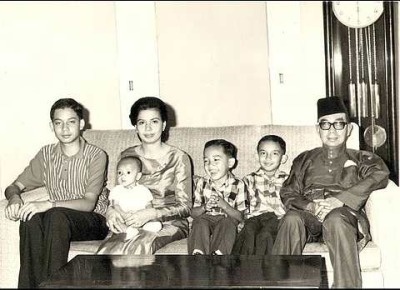
Najib was born on July 23, 1953 at the Pahang State Secretary official residence in Bukit Bius, Kuala Lipis, Pahang.. He is eldest of six son of Malaysia second Prime Minister, Tun Abdul Razak Hussein, credited with playing a part in securing independence from Britain in 1957. Najib's uncle, Hussein Onn, was the country's third prime minister. His younger brother, Dato' Seri Mohd Nazir Abdul Razak, runs the country's second-largest lender, Bumiputra-Commerce Holdings Bhd. Najib is also one of the Four Noblemen of the Pahang Darul Makmur (Royal Court) by virtue of his inherited title as Orang Kaya Indera Shahbandar. [Source: Wikipedia]
Najib received his primary and secondary education at one of the country's leading schools in the country, St John's Institution. He then continued his secondary education at the Malvern Boy's College, Worcestershire, England. Upon completion of his secondary education, Najib enrolled at the University of Nottingham and graduated in 1974 in industrial economics. [Source: Malaysian Government]
On his return to Malaysia in 1974, Najib joined the national oil company, Petronas, as an executive where he served for two years before taking the plunge into politics following the sudden demise of his father in 1976. He was the obvious choice of the ruling National Front coalition to contest the Pekan parliamentary seat vacated by his late father. The national outpouring of grief following Tun Razak's death and the respect for his father contributions toward Malaysia's development, saw Najib elected unopposed as Member of Parliament at the very young age of 23.
Najib Razak’s Personal Life, Wives and Interests
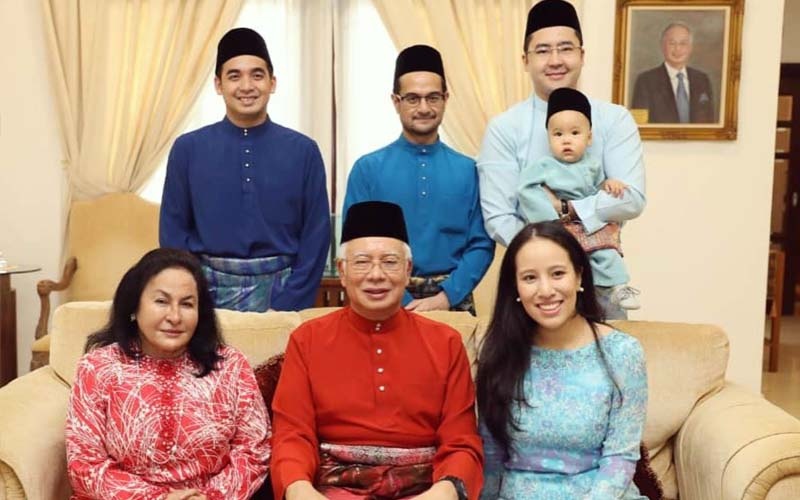
Najib is married to Datin Sri Rosmah Mansor, his second wife, and has five children. In 1976, Najib married Tengku Puteri Zainah Tengku Eskandar, also known as “Kui Yie.” The couple had three children: Mohd Nizar Najib (born 1978), Mohd Nazifuddin Najib, and Puteri Norlisa Najib. In 1987, Najib and Kui Yie divorced, and he later married Rosmah. They have two children together: Mohd Norashman Najib and Nooryana Najwa Najib. Notably, his daughter Nooryana is married to the nephew of former Kazakhstani President Nursultan Nazarbayev. Najib is also a cat enthusiast, owning four long-haired cats named Kiki, Leo, Tiger, and Simba. [Source: Wikipedia]
Najib’s lavish lifestyle drew considerable public attention and controversy during his tenure as Prime Minister. His wife Rosmah faced scrutiny for her high-end shopping habits, reportedly including luxury handbags, jewelry, and designer clothing. Investigations later led to the seizure of a large collection of designer handbags, some valued at millions of dollars. Najib himself was accused of using state funds for personal expenses, including credit card bills and luxury purchases—allegations that became central to the 1MDB scandal.
Fazley Yaakob, the husband of Najib’s stepdaughter, wrote on Instagram that Rosmah had hired a witch doctor to evaluate the suitability of the marriage. The witch doctor warned against the marriage because, unlike others, Mr. Fazley would be able to resist Ms. Rosmah’s supernatural powers. The pair married anyway. "All hell broke loose right after," wrote Mr. Fazley, though he did not detail exactly what happened. [Source: Hannah Beech, Richard C. Paddock and Alexandra Stevenson, New York Times, May 15, 2018]
Outside of politics, Najib is an avid golfer and has played with two U.S. Presidents, Barack Obama and Donald Trump, the latter calling him his “favorite prime minister.” Najib and Obama played golf in Hawaii while both leaders were coincidently were on vacation there. In a statement, the White House said: "The two leaders took the opportunity to discuss the growing and warming relationship between the United States and Malaysia. The president said he looked forward to working with Prime Minister Najib in 2015, during Malaysia's chair year of the Association of Southeast Asian Nations." Reporters were allowed onto the course briefly on the 18th hole. Obama missed a putt to the left of the hole and then tried to tap it in, but he picked the ball up before it could miss again, according to a pool report. Najib also missed a second putt, and Obama consoled him with a pat on the shoulder. [Source: David Nakamura, Washington Post, December 24, 2014]
Najib Razak Political Career
After earning an industrial economics degree from the University of Nottingham in the UK, Najib returned to Malaysia in 1974 and worked for state oil firm Petronas. His father's sudden death two years later left a parliamentary seat vacant and saw Mr Najib enter politics. At 23, he became the youngest MP in Malaysian history and quickly rose to prominence. He held numerous cabinet posts - including energy, telecommunications, education, finance and defence - before becoming deputy prime minister to Abdullah Badawi in 2004.[Source: BBC, May 1, 2013]
Najib has a long history of involvement in politics and government service. After winning a seat in Parliament unopposed in 1976, he was appointed Deputy Minister of Energy, Telecommunications, and Posts. He also served as Deputy Minister of Education and Deputy Minister of Finance. In the 1982 general election, he ran for the state seat of Bandar Pekan and was subsequently appointed Menteri Besar of Pahang until 1986. After re-contesting and winning the parliamentary seat of Pekan in the 1986 general elections, Najib was appointed Minister of Culture, Youth, and Sports. Under his leadership, Malaysia achieved its best-ever performance in the SEA Games, coming out on top in the medal tally for the first time in the event's history. Najib also introduced the National Sports Policy, which outlines the development of sports in Malaysia, and introduced monetary incentives for Malaysian athletes who won medals at the Olympic Games. .[Source: Malaysian Government]
Through his elite British schools education, Najib acquired a stylish English accent and a fondness for fine tailoring. According to the New York Times: Unlike his onetime mentor, Mr. Mahathir, he did not have an instant rapport with the rural Malay Muslim base, and early in his political career he struggled to speak Malay. Still, the legacies of Mr. Najib’s father, who was the second prime minister of Malaysia, and his uncle, who was the country’s third, helped make up for his lack of grass-roots appeal. In interviews, Mr. Najib was smooth, gracious and somewhat distant. Najib grew up thinking that leading the country was his birthright,” said Rafizi Ramli, a top strategist for the opposition that ousted Mr. Najib and the National Front coalition. “He doesn’t realize that you have to earn the people’s trust and maintain the people’s trust. He is completely removed from Malaysia, the real Malaysia.” [Source: Hannah Beech, Richard C. Paddock and Alexandra Stevenson, New York Times,, May 15, 2018]
Najib Razak in Senior Positions Under Mahathir and Badawi
In 1990, Najib was appointed Defence Minister by Prime Minister Dr. Mahathir Mohamad. In this senior role, he spearheaded the modernization of Malaysia’s Armed Forces, transforming it into a leaner, more capable force ready to respond to conventional threats. This modernization included acquiring advanced military assets such as Russian MiG-29 fighter jets, Boeing F/A-18 Super Hornets, F-2000 frigates, 155mm artillery guns, and upgrading the country’s air defense with a new radar system. He also prioritized the welfare of military personnel, improving housing facilities and allowances. [Source: Malaysian Government]
In 1995, Najib moved to a higher-profile position as Minister of Education. His tenure marked a major overhaul of the national education system, highlighted by the passage of six legislations, including the pivotal Education Act of 1996. These reforms introduced a more market-driven approach, allowing educational institutions to offer a broader range of courses, adopt new teaching methods, and implement diverse learning approaches.
The 1999 general elections brought a setback for Najib, as he narrowly retained the predominantly Malay Pekan parliamentary seat with a slim majority of 241 votes—a dramatic drop from the over 10,000-vote majority he had previously enjoyed. While shocking to many, the result reflected the broader political upheaval of the period. Following the election, he returned as Defence Minister.
By the 2004 general elections, shortly after his promotion to Deputy Prime Minister under Prime Minister Abdullah Ahmad Badawi , Najib regained strong voter support, winning his parliamentary seat with a remarkable majority of 22,922 votes—the highest increase of any candidate that year. He consolidated this performance in the 2008 elections, securing Pekan with a majority of 26,464, the largest for Barisan Nasional despite a nationwide dip in the coalition’s support. Najib remained Defence Minister until September 2008, when he succeeded Badawi as Finance Minister.
Scandals and Murder While Najib was Defense Minister
During his second tenure as Minister of Defence from 2000 to 2008, Najib oversaw several significant national and international initiatives. He coordinated Malaysia’s relief efforts following the 2004 Indian Ocean tsunami and assisted Indonesia in apprehending those responsible for the 2005 Bali bombings. In 2006, he also oversaw the deployment of Malaysian troops as part of a UN peacekeeping mission to help stabilize Lebanon following the 2006 Lebanon War.
In December 2003, Najib introduced compulsory military service, establishing the Program Latihan Khidmat Negara (PLKN, or Malaysian National Service). He stated that the program aimed to foster interaction and friendship among youth of different ethnic and religious backgrounds. During its first five years, over 339,000 Malaysian youth participated, with the program intended to promote tolerance, teamwork, and community engagement. However, the initiative faced significant challenges, including safety concerns and several deaths during or shortly after service. In response, Najib strengthened health screening protocols and reinforced government measures to hold negligent officials accountable.
Najib’s tenure as Defence Minister was also marked by controversy surrounding the 2002 purchase of two Scorpène-class submarines by the Malaysian Ministry of Defence. French authorities investigated allegations that Abdul Razak Baginda, an aide to Najib, received commission payments from the French submarine manufacturer DCNS. According to the New York Times: In 2006, when Najib was deputy prime minister, the Mongolian mistress of one of his advisers, Abdul Razak Baginda, was killed, blown up by military-grade explosives. Two of Mr. Najib’s bodyguards were eventually convicted in her murder. French investigators examined whether Najib, during his time as defense minister, might have personally profited from around $130 million in kickbacks related to a transaction for French submarines. Before she was killed, the Mongolian woman, Altantuya Shaariibuu, claimed she was owed half a million dollars for brokering that deal. [Source: Hannah Beech, Richard C. Paddock and Alexandra Stevenson, New York Times, May 15, 2018]
Shaariibuugiin Altantuyaa had served as a translator for the submarine deal. Reviewing the case years later, Tommy Thomas, Malaysia’s Attorney General from 2018 to 2020, wrote that the evidence “implicated not only Najib Razak as the person who gave [one of the bodyguards] the order to kill, but also his aide-de-camp, Musa Safri.”
Mahathir Becomes Najib’s Most Adamant Critic
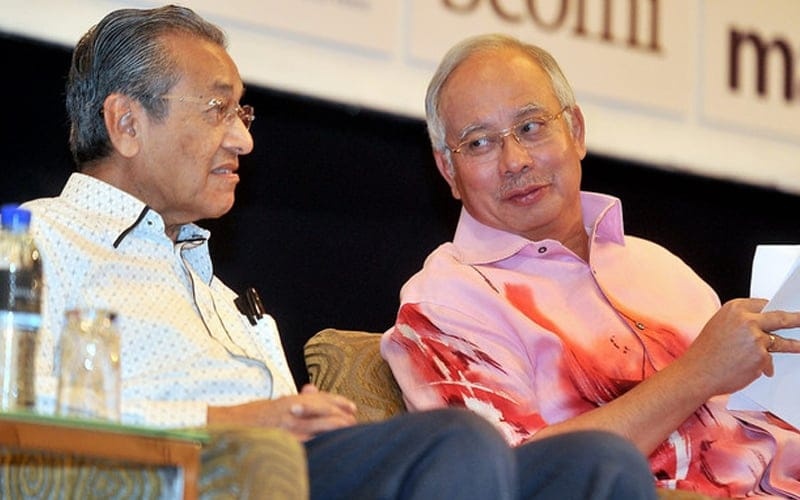
One of the main reasons former prime minister, Mahathir Mohamad returned to politics in 2015, at the age of 90 was to oust Najib as Prime Minister. He repeatedly called for Najib’s resignation over the 1MDB) scandal. In August 2015, Mahathir and his wife, Siti Hasmah, attended the Bersih 4 rally, a large public protest demanding clean governance and accountability.[Source: Wikipedia]
Al Jazeera reported: Mahathir sought to “save Malaysia” and remove Najib over allegations that he had mismanaged the economy, suppressed free speech, and allegedly received hundreds of millions of dollars in bribes—claims that Razak denied.The “Save Malaysia” movement, led by Mahathir and composed of opposition leaders from across the political spectrum, focused on a multimillion-dollar corruption scandal involving nearly $700 million found in Najib’s personal bank accounts, allegedly from the state-funded 1Malaysia Development Fund. Najib, however, maintained that the money was a campaign donation from Saudi Arabia, which he had since returned. [Source:Al Jazeera, June 25, 2016]
Mahathir, who had served as Malaysia’s prime minister for 22 years, stated that Najib had to “go” and that his leadership had “undermined” the country’s institutions. “He’s gone off track,” Mahathir said. “He has done a lot of things which were actually wrong, and as a result he has put the country in a very bad position.” Reflecting on Malaysia’s future, Mahathir added, “If Najib is there, this country will go to the dogs.”
Mahathir often blamed himself for not identifying that Najib was not fit to lead, telling the New York Times he had a falling out with Najib because of his protégé’s insistence that “cash is king,” both in politics and governance. "I [once] supported Najib; [now he] is giving me a headache." — Mahathir told TIME in 2016, noting that he expected Najib to be like his father, Abdul Razak Hussein. but found him to be "totally different"."He's a monster in the view of most people in Malaysia," according to ABC News post in 2018. "We expected Najib, the son of a previous hero... he would be the same as his father. But he's totally different." [Source: Google AI]
Image Sources: Wikimedia Commons
Text Sources: New York Times, Washington Post, Los Angeles Times, Times of London, The Guardian, National Geographic, Smithsonian magazine, The New Yorker, Time, Newsweek, Reuters, AP, AFP, Wall Street Journal, The Atlantic Monthly, The Economist, Foreign Policy, Wikipedia, BBC, CNN, and various books, websites and other publications.
Last updated January 2026