
GOVERNMENT BRANCHES OF MALAYSIA
Executive Branch includes the Yang di-Pertuan Agong, who is the head of state and is customarily referred to as the king. The Yang di-Pertuan Agong has ceremonial duties. The prime minister is the head of government and leads the cabinet. Executive power is vested in the cabinet, which is led by the prime minister. The Malaysian Constitution stipulates that the prime minister must be a member of the lower house of Parliament who commands a majority in Parliament, as determined by the Yang di-Pertuan Agong. The cabinet is chosen from members of both houses of parliament and is responsible to that body." [Source: Countries of the World and Their Leaders Yearbook 2009, Gale, 2008.]
Legislative Branch is a bicameral parliament consting of a powerful 222-member House of Representatives (Dewan Rakyat) and less powerful Senate (Dewan Negara).. The 222 members of the House of Representatives are elected from single-member districts to parliamentary terms lasting up to five years. Legislative power is divided between federal and state legislatures." The 70 members of Senate (Dewan Negara) is made up of 26 elected by the 13 state assemblies and 44 appointed by the king on the prime minister's recommendation. All 70 senators serve 3-year terms, which are usually extended for an additional 3 years.
Judicial Branch includes the Federal Court, the Court of Appeals, high courts, sessions courts, magistrate's courts, and juvenile courts. Sharia courts hear cases involving Muslims only. The Malaysian legal system is based on English common law. The Federal Court reviews decisions referred from the Court of Appeals and has original jurisdiction in constitutional matters and disputes between states or between the federal government and a state. Peninsular Malaysia and the East Malaysian states of Sabah and Sarawak each have a high court.
RELATED ARTICLES:
GOVERNMENT OF MALAYSIA: SYMBOLS, CONSTITUTION, LEADERSHIP factsanddetails.com
MONARCHY OF MALAYSIA: SULTANS, POWER, RELEVANCY factsanddetails.com
DUTIES, RESPONSIBILITIES, SELECTION AND CROWNING OF THE MALAYSIAN KING factsanddetails.com
ELECTIONS IN MALAYSIA factsanddetails.com
MAHATHIR MOHAMAD: HIS LIFE, VIEWS, CHARACTERS, OUTRAGEOUS STATEMENTS factsanddetails.com
MALAYSIA UNDER MAHATHIR MOHAMAD factsanddetails.com
POLITICS IN MALAYSIA: LEADERS, ETHNICITY, RELIGION, SYMBOLS, PROTESTS factsanddetails.com
POLITICAL PARTIES IN MALAYSIA factsanddetails.com
POLITICS, ISLAM AND PAS (ISLAMIC PARTY OF MALAYSIA) factsanddetails.com
Executive Branch and Head of State (King) of Malaysia

Malaysia has several bodies that can exercise executive power. The Conference of Rulers (Majlis Raja-Raja) is the supreme institution that is constitutionally empowered to select the king (Yang di-Pertuan Agong), approve appointed judges, rule on administrative policy changes, and deliberate on national policy questions. The king is the head of state and supreme commander of the armed forces, and he may authorize requests to dissolve parliament and approve parliamentary bills. However, the king actually has limited executive powers and may act only under the advice of the prime minister and cabinet.
Executive Authority, or the authority to rule, is vested in the Yang di-Pertuan Agong as provided for in Article 39 of the Federal Constitution, but it can be exercised by a Cabinet of Ministers headed by the Prime Minister. The Cabinet is directly responsible to the Yang di-Pertuan Agong. Every executive action is channelled to the King’s royal authority. However, in accordance with the principle of a democratic ruling system, the Prime Minister is the Chief Executive. [Source: Malaysian Government]
The Conference of Rulers is the supreme institution in the country and unique because it is the only such institution in the world today. When the country achieved independence, the Conference of Rulers was constituted under Article 38 of the Federal Constitution. Its functions are in accordance with the Fifth Schedule of the Constitution.
Chief of state: King - Tuanku Abdul Halim Mu'adzam Shah (selected on 13 December 2011; installed on 11 April 2012); the position of the king is primarily ceremonial. Kings are elected by and from the hereditary rulers of nine of the states for five-year terms; selection is based on the principle of rotation among rulers of states; elections were last held on 14 October 2011 (next to be held in 2016). Tuanku Abdul Halim Mu'adzam Shah elected king by fellow hereditary rulers of nine states.
Head of Government (Prime Minister) in Malaysia
The prime minister is leader of the party or party alliance that holds a plurality of seats in the House of Representatives ( (Dewan Ra'ayat, lower house of parliament), He or she is the head of government and exercises most executive power and must be a member and have the confidence of the House of Representatives. The prime minister appoints cabinet members with the king’s consent. Prime ministers are designated from among the members of the House of Representatives; following legislative elections, the leader who commands the support of the majority of members in the House becomes prime minister (from independence in 1963 to 2018 the prime minister was the leader of the UMNO party). [Source: Columbia Encyclopedia, 6th ed., Columbia University Press]
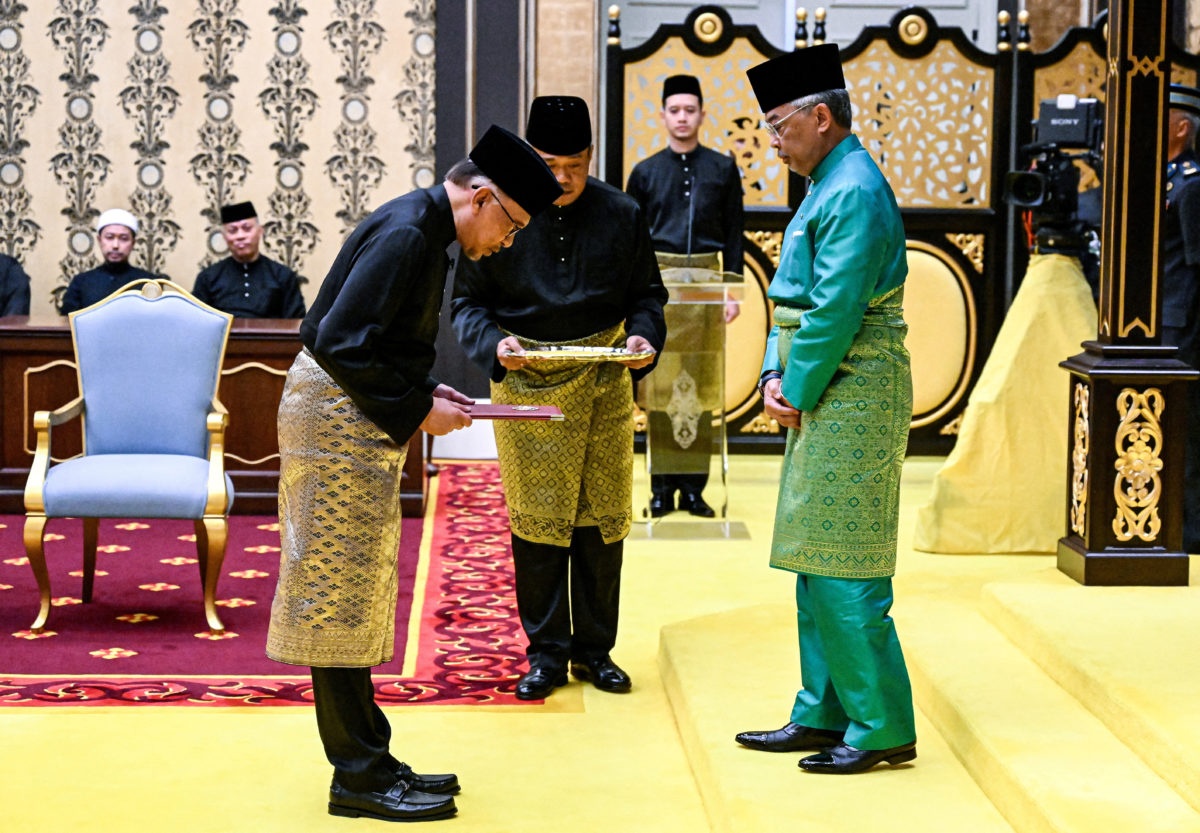
The prime minister must be a member of the lower house of parliament who, in the opinion of the Yang di-Pertuan Agong, commands a parliamentary majority. The prime minister’s residence in Putrajaya is huge $50 million pink stone monstrosity with a green onion dome. The prime minsters office is the size of a small gym. Outside there is a white staircase that leads through palm grove to an artificial lake. [Source: Malaysian Government]
Describing the swearing in ceremony of Prime Minister Abdullah in 2008, Vijay Joshi of Associated Press wrote: “Abdullah Ahmad Badawi was sworn in at 11:10 a.m. local time in front of King Mizan Zainal Abidin, the constitutional monarch, and dozens of government dignitaries in the national palace's glittering throne room. "I pledge to carry out my duties honestly and with all my abilities," Abdullah said, reading out the oath. "I pledge to protect and uphold the Constitution." Dressed in all-black Malay attire—cap, collarless shirt and loose pants with a swath of gold embroidered cloth wrapped around the waist—Abdullah arrived at the palace with his wife, Jeanne, for the simple ceremony which was nationally telecast. He smiled occasionally, mingling with guests after the ceremony, [Source: Vijay Joshi, AP, March 10, 2008]
Cabinet and Leaders of Malaysia
Malaysian political leaders expect a great deal of deference from the public. The Malay term for "government," kerajaan, refers to the raja who ruled from precolonial courts. High-ranking politicians are referred to as yang berhormat ("he who is honored") and remain in office for a long time. They remain in office for long periods of time because successful politicians are great patrons with considerable influence over the allocation of social benefits, such as scholarships, tenders, and permits. In return, clients show deference and provide appropriate electoral support. The mainstream press is also among the most consistent and important supporters of the ruling coalition's politicians. Despite the substantial power of the political elite, corruption remains informal, and one can navigate the lower levels of the state bureaucracy without paying bribes. However, there are endless stories of how appropriate payments can speed up the process. [Source: Thomas Williamson, Countries and Their Cultures, Gale Group Inc., 2001]
The Malaysian constitution stipulates that executive power is vested in the cabinet, which is led by the prime minister. The cabinet is chosen from members of both houses of Parliament and is responsible to Parliament. [Source: Countries of the World and Their Leaders Yearbook 2009, Gale 2008]
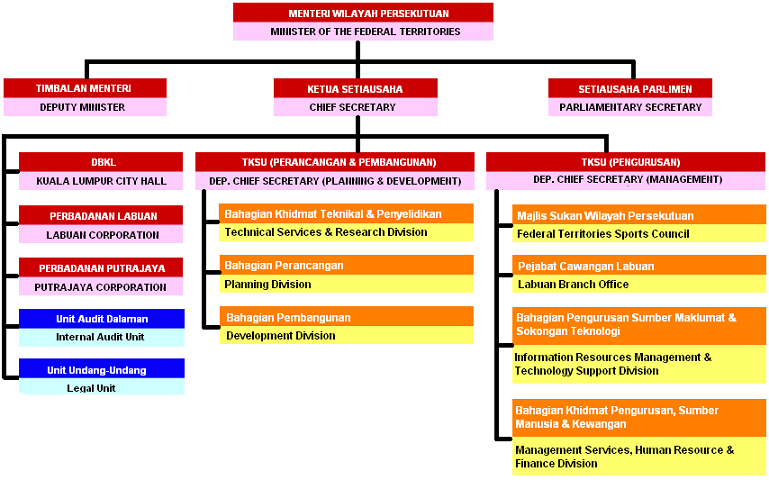
Cabinet appointed by the prime minister from among the members of Parliament with consent of the king. The ministry positions—lead by a cabinet member and minister are: Ministry of Agriculture and Agro-Based Industry, Ministry of Defence, Ministry of Domestic Trade, Cooperative And Consumerisme, Ministry of Education, Ministry of Energy, Green Technology and Water, Ministry of Federal Territories and Urban Wellbeing, Ministry of Finance, Malaysia, Ministry of Foreign Affairs, Ministry of Health, Malaysia, Ministry of Higher Education, Ministry of Home Affairs, Ministry of Housing and Local Government, Ministry of Human Resources, Ministry of Information, Communication and Culture, Ministry of International Trade and Industry (MITI), Malaysia, Ministry of Natural Resources and Environment, Ministry of Plantation Industries and Commodities, Ministry of Rural and Regional Development , Malaysia, Ministry of Science, Technology and Innovations, Malaysia, Ministry of Tourism, Ministry of Transport, Malaysia, Ministry of Women, Family and Community Development, Ministry of Works, Malaysia, Ministry of Youth and Sports.
Parliament of Malaysia
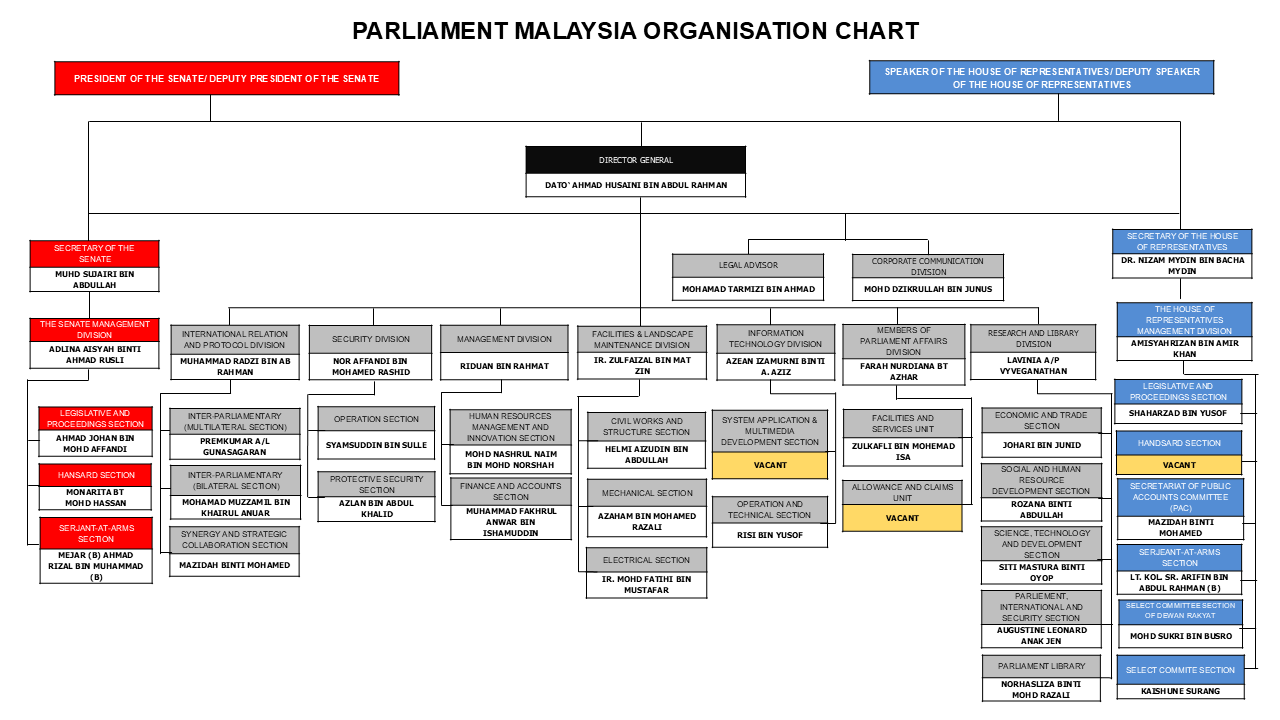
The legislature of Malaysia is bicameral Parliament or Parlimen with upper and lower houses. It operates much like the Indian parliament, after which it modeled. The House of Representatives (Dewan Rakya) is a parliamentary-style lower house made up of elective officials. It has 222 seats (it used to have 219 seats and before that 193 seats). 112 seats needed for a majority. The less powerful upper house, or Senate (Dewan Negara), is made up of both elected and appointed representatives.
The 222 members of the Dewan Rakyat serve five-year terms and are elected from single-member districts by universal suffrage. The parliament follows a multi-party system and the governing body is elected through first-past-the-post voting. First-past-the-post (FPTP)—also called choose-one, first-preference plurality (FPP), or simply plurality—is a single-winner voting rule. Each voter marks one candidate as their favorite, or first-preference, and the candidate with more first-preference votes than any other candidate (a plurality) is elected, even if they do not have more than half of votes (a majority).Parliament has a maximum mandate of five years by law. The Yang di-Pertuan Agong may dissolve parliament at any time and usually does so upon the advice of the Prime Minister. [Source: Wikipedia]
Senate members serve three-year terms with a two term limit. The Senate's 70 members are 26 selected by A) State Legislative Assemblies, who elects two members each and B) 44 members appointed by the King, four of whom are from the federal territories of Kuala Lumpur (2), Labuan, and Putrajaya. The Senate elects its president and deputy president from among its own members. [Source: CIA World Factbook]
Powers and Duties of the Parliament of Malaysia
Parliament introduces legislation, debates and approves new laws, and amends old ones. The majority party in parliament is responsible for choosing Malaysia’s prime minister, who is officially appointed by the king. The prime minister chooses cabinet ministers from among the majority party in parliament.
The Parliament, the legislative authority for Malaysia formulates laws applicable to the country as a whole. The Parliament passes Federal laws, makes amendments to existing federal laws, examines the government’s policies, approves the government’s expenditures and approves new taxes. It also serves as the forum for debate and deliberations; and the focus of public opinion on national affairs.At the State level, the power is vested in the respective State legislature, for which elections are held every five years.Some of the laws and provisions made by the Parliament are functions of the Cabinet ministers, foreign conventions, raising of taxes and approval of expenditures, among other things. [Source: Malaysian Government]
The Senate may initiate legislation, but only the House of Representatives can initiate legislation that involves the granting of funds. Both houses of parliament and the king must approve legislation for it to be enacted into law. The king has few other legislative powers, but he may dissolve the House of Representatives on the prime minister’s advice. A two third majority in the parliament gives the ruling party to pass amendments to the constitution.[Source: Library of Congress, 2006]
Insults, Chaos, Shouting and Foul Language in Malaysia’s Parliament
In the first session of Parliament after the Malaysia’s opposition performed well in 2008 election, opposition members disrupted the proceedings with noisy arguments as lawmakers from both sides traded insults and jeers. Associated Press reported: “The record 82 opposition lawmakers who were elected to the 222-member Parliament in the March 8 elections shouted down, in one voice, ruling National Front coalition lawmakers in an argument over a technicality.
Karpal Singh, from the opposition Democratic Action Party, called National Front member Bung Mokhtar Radin a “Bigfoot,” who retaliated by calling Singh a “Big Monkey.” “This is not meant to be a shouting match!” yelled Speaker Pandikan Amin Mulia, trying to calm the screaming rival partisans who rose up to vociferously support Singh or Bung Mokhtar. The chaotic scenes were shown live on national television, the first time proceedings are being broadcast, albeit only the first 30 minutes every day. The scenes looked more like the often-rambunctious parliament sessions of India or Taiwan rather than the sedate meetings that Malaysia has been used to for the last 51 years. [Source: AP, April 30, 2008]
Wong Chun Wai wrote in The Star, “Kinabatangan MP Datuk Bung Mokhtar Radin is notorious for using un-parliamentary language in the Dewan Rakyat. The loud Sabahan politician, known for his equally loud and tacky ties, created Malaysian parliamentary "history" when he uttered a four-letter word against a DAP woman MP in 2001. The microphones of all MPs were switched off by the Speaker in the heat of the debate, but the profanity was loud enough for other members and reporters to hear. [Source: Wong Chun Wai, The Star, February 6, 2005]
The Hansard, which records the House meetings in verbatim, has no record of the outburst during the debate on the Islamic state and things would probably have remained that way until the media approached Bung Mokhtar in the lobby and asked him why he had uttered the word. To their surprise, he admitted it but said in defence it was in the "heat of the moment" and that if there were chairs in the House, "they would have been sent flying in the direction" of Chong Eng, the Bukit Mertajam member.
A year before, Bung Mokhtar sparked a controversy when he uttered a sexist-tainted "boleh masuk sikit?" (can I come in a little?) remark in his attempt to seek clarification from Chong Eng. Back then, he had said he meant no harm and that the phrase was commonly used in Sabah. The matter was subsequently dropped, much to the chagrin of many Mps. So, it came as no surprise when Bung Mokhtar was quoted as saying that strong language (euphemism for foul language) was necessary to make sure the message was delivered. Utusan Malaysia quoted him as saying "there are times we become over-expressive in presenting our views in Parliament and this is when the language problem crops up".
Some opposition politicians, too, have a reputation for using bad language. DAP MP Karpal Singh has his share of such remarks. He has called his opponents binatang (animal) and makluk (alien). I remember once, during a meeting of the Penang State Assembly, the pencil he was holding went flying towards then Chief Minister Dr Lim Chong Eu who was seated directly across. I am not sure whether it was intentional but it resulted in a furore. Dr Lim seldom lost his cool when dealing with Karpal Singh and Lim Kit Siang. The Gerakan founder leader would close his eyes, as if taking a nap, and smile. Now and then, he would stand up and make curt replies, which infuriated the opposition members more. I don't recall the "old fox" - as Karpal Singh called him - ever shouting. The man had class.
Controversial Karpal, on one occasion during the 80s, had to be escorted out of the House by then George Town OCPD Mokhtar Daud after Karpal Singh refused to be led out by the Sergeant at Arms. At another time, Penang DAP assemblyman Seow Hun Khim even brought along a cucumber to emphasise a point. In more recent times, PAS MP Mahfuz Omar called another MP, Datuk Anifah Aman, jakun. The use of the word "Jakun" (an orang asli group) is considered derogatory because it is always associated with backwardness. Many MPs, especially those from Sabah and Sarawak, were particularly offended by that remark.
Malaysia Lawmaker Convicted of Biting Policeman
In October 2009, aMalaysian court convicted a prominent opposition lawmaker of biting a policeman at an illegal protest and sentenced him to six months in prison. News agencies reported: “Tian Chua was found guilty in the Kuala Lumpur Magistrate's Court on a charge of hurting a policeman who had tried to stop him from entering Parliament in December 2007 to protest a constitutional amendment. Magistrate Faizi Che Abu sentenced Chua to six months' jail and fined him 3,000 ringgit ($900), but put off the penalty until an appeal can be heard in a higher court. The fine means Chua could eventually lose his Parliament seat because legislators who are fined more than 2,000 ringgit ($600) or serve a year in prison must vacate their seats. [Source: Agencies, October 22, 2009]
Chua, a longtime ally of top opposition leader Anwar Ibrahim and a senior official in Anwar's People's Justice Party, has denied biting the policeman. "The charge is a malicious charge and politically motivated," Chua told reporters. "We'll continue to fight in a higher court. I maintain that I'm innocent." The policeman, Rosyaidi Anuar, accused Chua of biting his arm and spitting on him. His colleague testified that Rosyaidi had a red bruise on his arm after the incident. Faizi ruled that Chua's testimony had inconsistencies and was not credible. "I hope that this will send a strong message to the public" that such offenses are unacceptable, Faizi said.
Government lawyer Hanafiah Zakaria denied that Chua was unfairly prosecuted. "You can champion whatever cause you want, but you still have to respect the law," he said. At the time of Chua's alleged offense, he was not yet a lawmaker. Chua had sought to enter Parliament with other opposition activists to protest a constitutional amendment to electoral laws that they claimed would curtail civil rights. Months later, Chua, 46, won a Parliament seat in Kuala Lumpur, Malaysia's largest city, when a three-party opposition alliance wrested slightly more than one-third of the seats in Parliament in March 2008 general elections.
Judicial Branch of Malaysia
Malaysia’s judicial branch consists of several levels of courts, including the Federal Court, the Court of Appeal, the High Courts, Sessions Courts, Magistrates’ Courts, juvenile courts, and Sharia courts, which handle cases involving Muslims. The country’s legal system is based on English common law. [Source: Countries of the World and Their Leaders Yearbook 2009, Gale 2008]
At the top of the judiciary is the Federal Court, the highest court in Malaysia. It hears appeals from the Court of Appeal and holds original jurisdiction in constitutional matters as well as disputes between states or between a state and the federal government. Judges of the superior courts are appointed by the king on the advice of the prime minister.
Malaysia maintains two High Courts of equal status: the High Court of Malaya, which serves Peninsular Malaysia, and the High Court of Sabah and Sarawak, which covers the East Malaysian states. The judiciary is intended to operate independently of governmental or political influence. In addition to the civil court system, religious courts in some states have authority over matters related to Islamic law and custom.
Image Sources: Wikimedia Commons
Text Sources: New York Times, Washington Post, Los Angeles Times, Times of London, Lonely Planet Guides, Library of Congress, Malaysia Tourism Promotion Board, Compton’s Encyclopedia, The Guardian, National Geographic, Smithsonian magazine, The New Yorker, Time, Newsweek, Reuters, AP, AFP, Wall Street Journal, The Atlantic Monthly, The Economist, Foreign Policy, Wikipedia, BBC, CNN, and various books, websites and other publications.
Last updated January 2026