
CORONATION OF THE 13TH MALAYSIAN KING
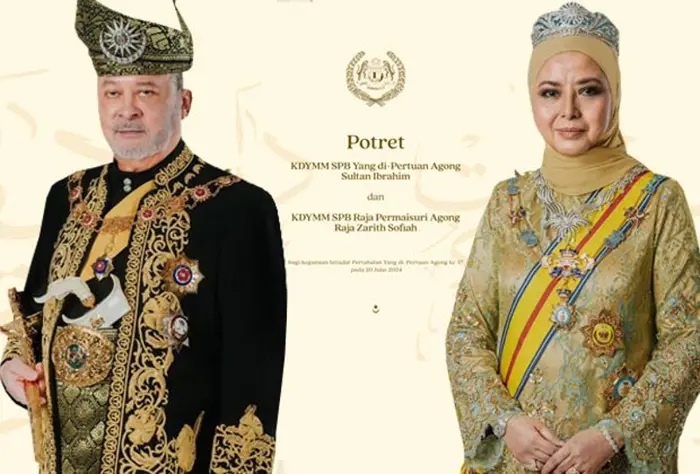
Yang di-Pertuan Agong XIII—the king of Malaysia from 2006 to 2011— was the Sultan of Terengganu. His name is Al-Wathiqu Billah Tuanku Mizan Zainal Abidin Ibni Al-Marhum Sultan Mahmud Al-Muktafi Billah Shah. On his coronation in April 2007, the BBC reported: Sultan Mizan Zainal Abidin lifted the ceremonial 'keris" (dagger) at the national palace in Kuala Lumpur, in a ceremony steeped in Malay tradition and was sworn in as Malaysia’s 13th king and one of Malaysia's youngest ever heads of state. [Source: BBC April 26, 2007]
News agencies reported: “The king formally took office at a ceremony in the throne room of the national palace. The sultan is the former ruler of the oil-rich Terengganu state, which sent a royal court orchestra to play traditional music during the ceremony. Sultan Mizan Zainal Abidin, 45, was sworn in to the post in December, as King Tuanku Syed Sirajuddin's five-year term as monarch ended. The stock market is closed and civil servants are having the day off.
The king - dressed in a black ceremonial robe embroidered in gold and royal headdress - and his queen, Nur Zahirah, were seated on the thrones. Prime Minister Abdullah Ahmad Badawi proclaimed Sultan Mizan the 13th king, before an audience of the country's other sultans and government ministers. Sultan Mizan was then presented with the royal long dagger - a symbol of power and authority - which the king drew and kissed. He pledged to rule fairly, uphold the Islamic faith and ensure just government. A 21-gun salute followed. Sultan Mizan is one of the youngest heads of state Malaysia has ever had - and he is already making changes: Royal functions will now finish by 2230, so people can get to bed early.
RELATED ARTICLES:
MONARCHY OF MALAYSIA: SULTANS, POWER, RELEVANCY factsanddetails.com
KINGS OF MALAYSIA: POWERS, SELECTION, RICH, OLD AND SCANDALOUS ONES factsanddetails.com
MALACCA SULTANATE: ORIGIN, HISTORY, PARAMESVARA factsanddetails.com
EARLY KINGDOMS, EMPIRES AND THE ARRIVAL OF ISLAM IN MALAYSIA factsanddetails.com
ROYAL CEREMONIES, REGALIA, PALACES AND ETIQUETTE IN MALAYSIA factsanddetails.com
SCANDALS AND GOSSIP INVOLVING MALAYSIA’S ROYAL FAMILIES factsanddetails.com
GOVERNMENT OF MALAYSIA: SYMBOLS, CONSTITUTION, LEADERSHIP factsanddetails.com
GOVERNMENT BRANCHES OF MALAYSIA, PRIME MINISTER AND LEGISLATURE factsanddetails.com
Installation of the Malaysian King
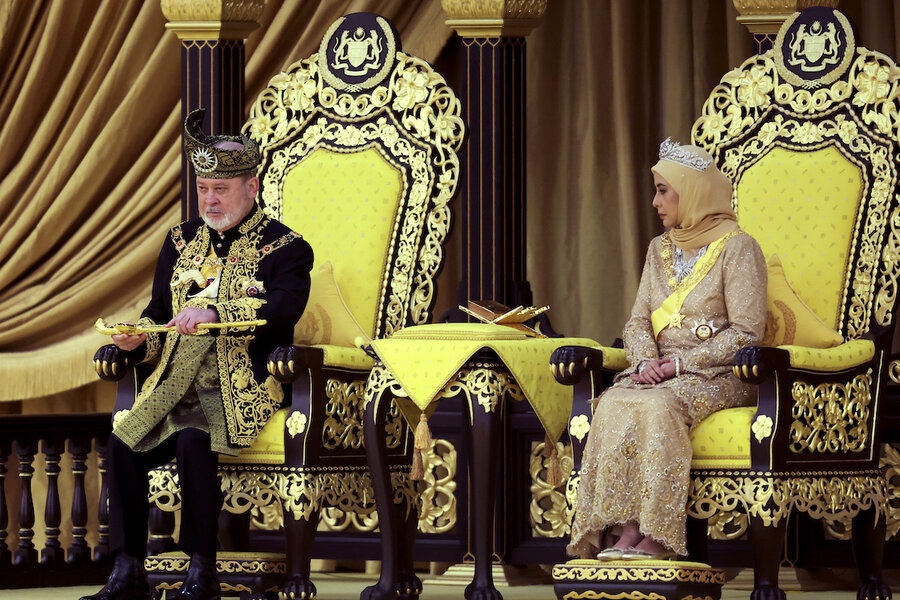
The installation ceremony of His Majesty the Yang di-Pertuan Agong has been held at the Throne Hall of Istana Negara since the reign of the seventh Yang di-Pertuan Agong. Earlier ceremonies took place at Dewan Tunku Abdul Rahman on Jalan Ampang, Kuala Lumpur. The installation day is designated a “Collar Day,” during which recipients of Orders with Collars are required to wear them. Only one Collar may be worn at a time, and it replaces the sash of the same Order, although a sash from a different Order may be worn. Collars are worn evenly over both shoulders with the badge resting at the centre of the chest, and in formal dress or uniform they are worn through the epaulettes. Collars are not worn at royal banquets. [Source: malaysianmonarchy.org ]
At 9.50 a.m., the Royal Spear Guard takes position at the entrance of the Throne Hall. At 9.57 a.m., the Datuk Paduka Maharaja Lela, accompanied by warriors bearing the Cogan Alam and Cogan Agama, the Aides-de-Camp, Dang Perwara, and bearers of the royal regalia—including the sword, kris, mace, sundang, and Tombak Berambu—enters the hall in preparation for the ceremony.
At exactly 10.00 a.m., His Majesty the Yang di-Pertuan Agong and Her Majesty the Raja Permaisuri Agong enter the Throne Hall. Their arrival is announced by the Master of Ceremonies and accompanied by the Nobat playing “Raja Berangkat,” prompting the audience to rise. After Their Majesties take their seats on the throne, the accompanying officials and bearers assume their designated positions.
The Datuk Paduka Maharaja Lela then seeks His Majesty’s consent to commence the ceremony. Upon receiving approval, he formally announces the beginning of the installation. He subsequently seeks permission to bring in the installation regalia. Once consent is granted, the regalia—comprising the Al-Quran Nul Karim, the Government Kris, the Letter of Declaration, and the Letter of Oath—are brought into the Throne Hall as the Nobat plays “Menjunjung Duli.”
Installation Ceremony of the Malaysian King

Upon reaching the throne, the Datuk Paduka Maharaja Lela presents the Al-Quran Nul Karim to His Majesty at the third step of the dais. His Majesty kisses the Quran and places it on the table between himself and Her Majesty. The remaining regalia are then placed on the table, and the bearers return to their seats. [Source: malaysianmonarchy.org ]
Next, the Datuk Paduka Maharaja Lela seeks consent to present the Prime Minister, who reads the Letter of Proclamation declaring the installation of His Majesty as Yang di-Pertuan Agong. After the proclamation is read, the Prime Minister bows and returns to his seat.
The Government Kris is then presented. His Majesty receives it, draws it, and kisses it as a symbol of authority before it is returned. This is followed by the presentation of the Letter of Oath. Upon the Master of Ceremonies’ instruction, the audience stands as His Majesty reads the Oath of Office, pledging to uphold the Constitution, administer the nation justly, protect Islam, and maintain law and order.
Following the oath, the Nobat plays “Raja Bertabal.” The Datuk Paduka Maharaja Lela proclaims “Daulat Tuanku” three times, echoed by the audience. A 21-gun salute is fired as the national anthem, “Negaraku,” is played. His Majesty then resumes his seat on the throne.
The Prime Minister is next invited to deliver a congratulatory address and the oath of allegiance on behalf of the government and people of Malaysia. This is followed by the presentation of the Royal Address. His Majesty delivers his speech, expressing gratitude to Allah and appreciation to the Malay Rulers for their trust, and affirming his commitment to serve the nation faithfully.
After the Royal Address, a Religious Officer recites the Doa Selamat to bless the occasion. The Datuk Paduka Maharaja Lela then receives the Quran from His Majesty and, with royal consent, formally announces the conclusion of the installation ceremony.
The Master of Ceremonies announces the departure of Their Majesties. As the Nobat plays “Raja Berangkat,” the audience rises. His Majesty the Yang di-Pertuan Agong and Her Majesty the Raja Permaisuri Agong leave the Throne Hall in ceremonial procession, led by the Datuk Paduka Maharaja Lela and accompanied by the bearers of the royal regalia, royal escorts, and Dang Perwara. The Nobat ceases once Their Majesties reach the main entrance and proceed to the adjoining chamber.
Selection and Oath of the Malaysian King (Yang di-Pertuan Agong)
The Yang di-Pertuan Agong must be one of the hereditary sultans. The king is chosen in a closed meeting of the Conference of Rulers, made up of the nine sultans. How is the new king selected? The nine are given a ballot with one name on it, usually that of the sultan from the next state in line. They then anonymously indicate whether they think the sultan is suitable for the role. To be the next king, a ruler must secure a five-vote majority. If he does not receive enough votes or declines the position, the election process is repeated with the name of the next state's sultan. To ensure anonymity, the nine rulers are given unnumbered ballots and identical pens and ink. His accession is marked by an investiture at Istana Negara, complete with a 21-gun salute and Muslim prayers. If a reigning king dies in office, he is accorded a grand state funeral and buried in the royal mausoleum in Klang.
In a rare historical exception, Sultan Abdul Halim Mu‘adzam Shah served twice as king, first in 1970 and again in his 80s, becoming both Malaysia’s 14th monarch and its oldest up to that time. Constitutionally titled Seri Paduka Baginda Yang di-Pertuan Agong, the king serves as supreme head of state, Islamic religious head for several states and federal territories, and supreme commander of the armed forces, carrying out his duties on the advice of the prime minister and cabinet.
In 1957, the Conference of Rulers agreed to use the title Yang di-Pertuan Agong for Malaya’s head of state and to elect the king from among the Malay rulers, based on seniority of reign. The longest-reigning sultan, Sultan Ibrahim of Johor, declined due to age, as did the next in line, the Sultan of Pahang. As a result, Tuanku Abdul Rahman of Negeri Sembilan was unanimously chosen as Malaysia’s first Yang di-Pertuan Agong. [Source: Malaysian Government]
Malaysia’s monarchy is unique because the king is elected, not hereditary. The election is held by the Conference of Rulers through a secret ballot, following rules set out in the Federal Constitution. Only the rulers and a few officials take part; governors do not vote. Ballots are anonymous, counted by designated rulers, and destroyed immediately after the result is announced. A nominee must receive a majority of five votes and accept the position. If he declines or fails to gain enough support, voting moves to the next most senior ruler. Once elected, the king serves a five-year term. The results are formally announced by the prime minister, and the king assumes office only after taking an oath before the Conference of Rulers.
Oath Of Office of the Malaysian King: In accordance with Article 37 (1) of the Federal Constitution, the Yang di-Pertuan Agong shall before exercising his functions take and subscribe to the oath of office. The oath of office shall be subscribed before the Conference of Rulers and in the presence of the Chief Justice of the Federal Court. If the Chief Justice of the Federal Court is not available, the next senior judge of the Federal Court shall be present for the occasion. The oath of office shall be attested by two Rulers appointed for the purpose by the Conference of Rulers.
We........................................... Ibni........................................... Yang di-Pertuan Agong of Malaysia do hereby swear: Wallahi; Wabillahi; Watallahi; and by virtue of that oath do solemnly and truly declare that We shall justly and faithfully perform (carry out) our duties in the administration of Malaysia in accordance with its laws and constitution which have been promulgated or which may be promulgated from time to time in the future. Further We do solemnly and truly declare that We shall at all times protect the Religion of Islam and uphold the rules of law and order in the Country.
Conference Of Rulers In Malaysia
The Conference of Rulers was formally established in 1948, replacing the earlier Council of Rulers of the Federated Malay States, also known as the Durbar. The Durbar was first held in 1897 in Kuala Kangsar and included the rulers of Perak, Selangor, Negeri Sembilan, and Pahang, with the British High Commissioner as chairman. The term Durbar comes from the Urdu-Persian word darbar, meaning a king’s palace, and was also used for royal meetings in British India. The Conference of Rulers met for the first time on 31 August–1 September 1948, and for the first time included all nine Malay rulers. [Source: malaysianmonarchy.org ]
When national policies are discussed, the Yang di-Pertuan Agong is accompanied by the Prime Minister, while other rulers and state governors attend with their Menteri Besar or Chief Ministers. No law affecting the rights, status, or dignity of the rulers can be passed without the Conference’s consent. The Conference must also be consulted on changes to policies under Article 153, which concerns the special position of Malays and natives and the rights of other communities.
All Malay rulers and state governors are members of the Conference. The chairmanship rotates among the nine Malay rulers. The Conference normally meets three times a year, but special meetings may be called by the Keeper of the Rulers’ Seal at the request of the Yang di-Pertuan Agong. Meetings are usually held at Istana Negara, though other venues may be used with the Conference’s approval.
Powers of the Malaysian King
The Agong is commander in chief of the armed forces and has the power to appoint judges to the Federal Court and High Courts based on the prime minister's recommendation. As is the case in many other constitutional monarchies, the king’s signature is required for all new laws to take affect. Until January 1984, the paramount ruler had the right to veto legislation by withholding his assent. This right was lost in a constitutional compromise that granted the paramount ruler the ability to delay new laws for up to 60 days, while also stipulating that a bill may become law after six months without his signature if passed by a two-thirds majority. [Source: Worldmark Encyclopedia of Nations, Thomson Gale, 2007]
The Malaysian king does not participate in daily governance. The position is largely ceremonial, with most government power in the hands of parliament and the prime minister. But the king is not powerless and he has exerted significant political influence. He is in charge of major appointments like that of the role of prime minister and head of Islam in Malaysia. In 2020, the king appointed a new prime minister after a government coalition broke up and Prime Minister Mahathir resigned. He king also has the power to grant pardons which is what the previous king did for former opposition leader Anwar Ibrahim after his coalition's shock victory during last year's general elections. Mr Anwar was pardoned from a conviction for sodomy which was widely seen as politically motivated. [Source: BBC, January 24, 2019]
Article 32(1) of the Federal Constitution states that Malaysia shall have a Supreme Head of the Federation, known as the Yang di-Pertuan Agong. He holds the highest position in the country and takes precedence over all other persons. The Yang di-Pertuan Agong cannot be sued or prosecuted in any court, except in the Special Court established under Part XV (Articles 182 and 183). The Constitution also provides that the Raja Permaisuri Agong, as the King’s consort, ranks immediately after the Yang di-Pertuan Agong. [Source: malaysianmonarchy.org ]
Articles 182 and 183 establish the Special Court, which is chaired by the Chief Justice of the Federal Court and includes the Chief Judges of the High Courts and two other senior judges appointed by the Conference of Rulers. Any civil or criminal case involving the Yang di-Pertuan Agong or a State Ruler in their personal capacity must be heard exclusively by this court. The Special Court has the same powers as other Malaysian courts and is based in Kuala Lumpur.
The Yang di-Pertuan Agong is Malaysia’s Supreme Commander of the Armed Forces under Article 41 of the Federal Constitution. Under Article 42, he also has the power to grant pardons, reprieves, and commutations for offences tried by court-martial and for offences committed in the Federal Territories, while similar powers in the states are exercised by the respective Rulers or Governors.
Another important responsibility of the Yang di-Pertuan Agong is to protect the special position of the Malays and the natives of Sabah and Sarawak, while at the same time safeguarding the legitimate interests of other communities, as set out in Article 153. The Yang di-Pertuan Agong also serves as a symbol of national honour and dignity. He confers awards and honours, carries out key diplomatic duties such as appointing Malaysian diplomats and receiving foreign envoys, and presides over major official and ceremonial occasions.
Functions of the Malaysian King
Executive Functions of the Malaysian King: Under Article 39 of the Federal Constitution, executive authority is vested in the Yang di-Pertuan Agong, but it is normally exercised on the advice of the Cabinet or the Prime Minister. In practice, most executive powers are carried out by the government, although Parliament may assign executive functions to others by law. The King is also entitled to request and receive information on government affairs from the Cabinet. [Source: malaysianmonarchy.org ]
The Yang di-Pertuan Agong may act in his own discretion in only three matters: appointing the Prime Minister, deciding whether to grant or refuse a request to dissolve Parliament, and calling a meeting of the Conference of Rulers on issues affecting royal privileges and dignity. The Prime Minister must be a Member of Parliament who commands the confidence of a majority in the House of Representatives, while Cabinet ministers and deputy ministers are appointed on the Prime Minister’s advice.
Legislative Functions of the Malaysian King: Legislative authority is vested in Parliament, which consists of the Yang di-Pertuan Agong, the Dewan Negara (Senate), and the Dewan Rakyat (House of Representatives). As part of Parliament, the King summons, prorogues, and dissolves Parliament, delivers the royal address, and gives royal assent to bills before they become law.
The Yang di-Pertuan Agong also appoints members of the Senate, including senators for the Federal Territories and forty appointed senators. These appointees are usually individuals who have made significant contributions to public service or achieved distinction in fields such as the professions, business, culture, social service, or who represent minority and indigenous communities.
Judicial Functions of the Malaysian King: The Yang di-Pertuan Agong plays an important role in judicial appointments. On the advice of the Prime Minister and after consultation with the Conference of Rulers, he appoints the Chief Justice, senior judges, and other judges of the superior courts. He may also appoint Judicial Commissioners and extend a judge’s service for up to six months after the retirement age of 65.
Judges may resign by writing to the Yang di-Pertuan Agong. A judge can only be removed following a formal process: the Prime Minister or the Chief Justice makes representations, a tribunal is appointed, and removal occurs only on the tribunal’s recommendation. The King cannot remove judges on his own initiative, though he may accept or reject the tribunal’s recommendation.
Proclamation of Emergency by the Malaysian King
Under Article 150 of the Federal Constitution, the Yang di-Pertuan Agong may proclaim a state of emergency if he is satisfied that a serious threat exists to security, economic life, public order, or safety in the Federation or any part of it. An emergency may also be proclaimed in advance if such a threat is considered imminent. [Source: malaysianmonarchy.org ]
While a Proclamation of Emergency is in force, the Yang di-Pertuan Agong may issue emergency ordinances when Parliament is not sitting, if immediate action is required. These ordinances have the same force as Acts of Parliament and remain in effect until they are revoked, annulled by Parliament, or lapse under the Constitution.
Any proclamation or ordinance must be presented to both Houses of Parliament and can be cancelled if both Houses pass resolutions to annul them. During an emergency, the executive authority of the Federation may extend into areas normally under state jurisdiction, and Parliament may pass laws on any matter it considers necessary because of the emergency.
However, emergency powers have limits. They cannot override constitutional provisions relating to religion, citizenship, language, Islamic law, or the native customs of Sabah and Sarawak.
Malaysian King as Head of Islam in Malaysia
According to Article 3 of the Federal Constitution, the state constitutions of Malacca, Penang, Sabah, and Sarawak must provide for the conferral of the position of head of Islam in the states to the Yang di-Pertuan Agong. His Majesty is also the head of Islam in the federal territories of Kuala Lumpur, Putrajaya, and Labuan, as well as in his own state. With the advice of the Council of the religion of Islam in these states, he may appoint individuals to certain posts in Penang, Malacca, and the Federal Territories. The power to appoint such persons in the states of Sabah and Sarawak has been delegated by the Yang di-Pertuan Agong to the Yang di-Pertua Negeri. [Source: malaysianmonarchy.org].
Article 3 of the Federal Constitution on the Religion of the Federation provides that: "Islam is the religion of the Federation, but other religions may be practiced in peace and harmony anywhere in the Federation." In every state, except those without a ruler, the position of the ruler as head of the religion of Islam in his state, as acknowledged and declared by the constitution of that state and subject to that constitution, remains unaffected and unimpaired. However, in any acts, observances, or ceremonies agreed upon by the Conference of Rulers to extend to the federation as a whole, each other ruler, in his capacity as head of the religion of Islam, shall authorize the Yang di-Pertuan Agong to represent him."
Image Sources: Wikimedia Commons
Text Sources: New York Times, Washington Post, Los Angeles Times, Times of London, Lonely Planet Guides, Library of Congress, Malaysia Tourism Promotion Board, Compton’s Encyclopedia, The Guardian, National Geographic, Smithsonian magazine, The New Yorker, Time, Newsweek, Reuters, AP, AFP, Wall Street Journal, The Atlantic Monthly, The Economist, Foreign Policy, Wikipedia, BBC, CNN, and various books, websites and other publications.
Last updated January 2026