
FEUDS OVER SUCCESSION AND A BENTLEY IN KELANTAN

In September 2010, a prince in the northern Malaysian state of Kelantan took the throne there allegedly against the wishes of his bedridden father who wanted the prince’s brother to succeed him. Associated Press reported: Tengku Muhammad Faris Petra was proclaimed the new sultan of northern Kelantan state following a decision by the Council of Succession, which determines who ascends to the throne, palace official Abdul Halim Hamad said. Faris has been embroiled in a public dispute with his brother, Tengku Muhammad Fakhry, since their father, Tengku Ismail Petra, fell ill more than a year ago. The feud has embarrassed one of the country's most prominent royal households by exposing their previously little-known rivalries. [Source: Associated Press. September 13, 2010]
Faris' ascension to the throne is unlikely to end the power struggle. Ismail's lawyer Rashid Zulkifli said in a statement issued Sunday that the father would challenge Faris' installation as being unlawful. Ismail has been ill with heart problems since mid-2009. Last September, Faris removed Fakhry, his brother, from the state's powerful Council of Succession. Earlier this year, assailants shot a palace guard under mysterious circumstances. He later died.
A royal dispute over a RM1.6-million ($500,000) Bentley Brooklands was amicably resolved after Kelantan prince Tengku Muhammad Fakhry Sultan Ismail Petra withdrew his lawsuit against his elder brother and Kelantan Regent, Tengku Muhammad Faris. Judicial Commissioner Datin Zahariah Yusof struck out the suit and ordered Tengku Muhammad Fakhry to pay RM5,000 in costs. [Source: Bernama, June 9, 2010 /*]
The High Court had been scheduled to hear Tengku Muhammad Faris’s application to strike out the suit. He was represented by Tan Sri Cecil Abraham and Sunil Abraham, while Datuk Mohd Haaziq Pillay and P. Vadivu appeared for Tengku Muhammad Fakhry. Mohd Haaziq said his client withdrew the suit after the car, previously at the Regent’s official residence, Istana Telipot in Kota Baru, was returned to Istana Mahkota in Kubang Kerian.
Tengku Muhammad Fakhry had filed the suit on September 9, 2009, seeking a declaration that the blue Bentley DBG 1—purchased through Malayan Motors—was his and that Tengku Muhammad Faris’s possession was unlawful. He stated the car had been delivered on September 24, 2008, registered under the Sultan’s name, and used exclusively by him at Istana Mahkota and his Kuala Lumpur residence. On July 18, 2009, while abroad, the Regent allegedly moved the car without his knowledge, placing it at Istana Telipot.
RELATED ARTICLES:
MONARCHY OF MALAYSIA: SULTANS, POWER, RELEVANCY factsanddetails.com
DUTIES, RESPONSIBILITIES, SELECTION AND CROWNING OF THE MALAYSIAN KING factsanddetails.com
KINGS OF MALAYSIA: POWERS, SELECTION, RICH, OLD AND SCANDALOUS ONES factsanddetails.com
ROYAL CEREMONIES, REGALIA, PALACES AND ETIQUETTE IN MALAYSIA factsanddetails.com
GOVERNMENT OF MALAYSIA: SYMBOLS, CONSTITUTION, LEADERSHIP factsanddetails.com
GOVERNMENT BRANCHES OF MALAYSIA, PRIME MINISTER AND LEGISLATURE factsanddetails.com
Politics of Royal Wedding between a Malaysian Prince and Thai Princess
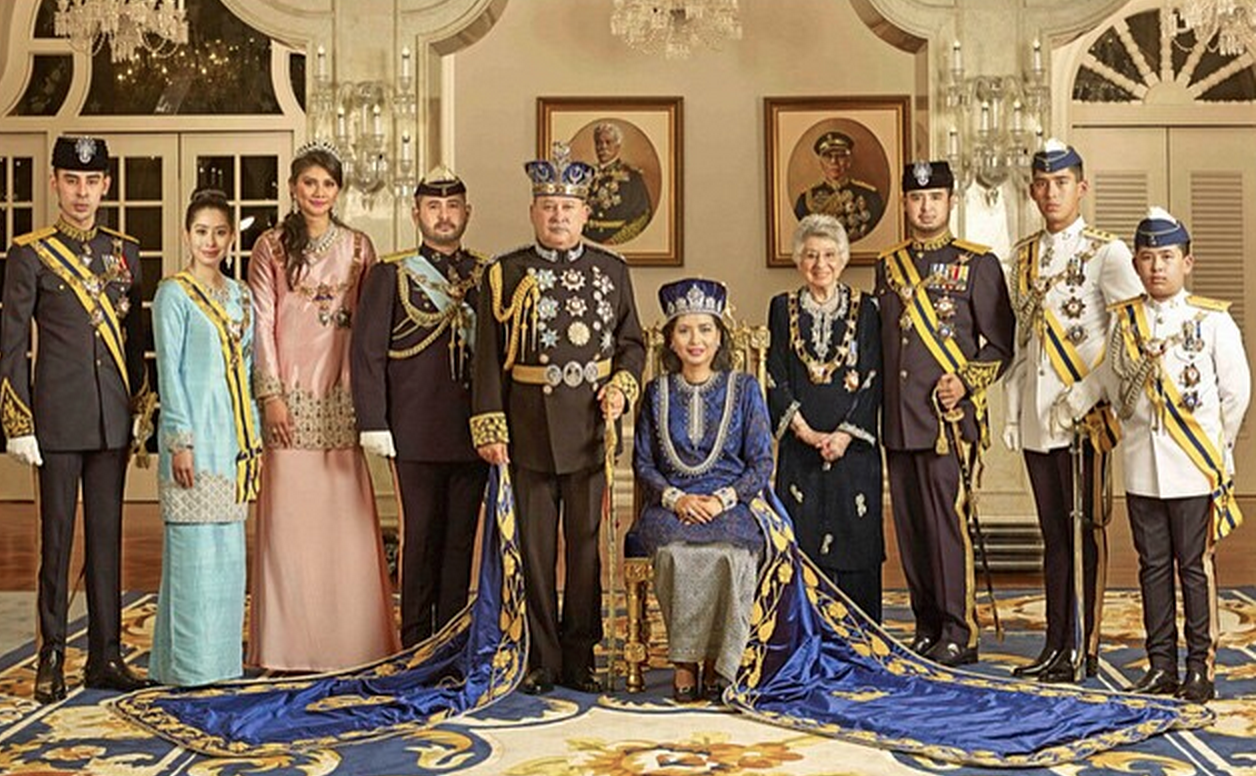
In December 2004, the lavish wedding of Kelantan Crown Prince Muhammad Faris Petra to his Thai bride became politically significant. The union linked two Malay royal houses—Kelantan in Malaysia and Pattani in Thailand—at a time of renewed violence in Thailand’s Muslim-majority southern provinces. Queen Sirikhit of Thailand attended, officially as a friend, but also to support peace efforts and meet officials, including Foreign Minister Surakiart Sathirathai, amid Thai concerns about Kelantan’s Islamic Party allegedly backing separatists, which Kelantan denies. [Source: Michael Vatikiotis, International Herald Tribune, December 14, 2004]
Michael Vatikiotis wrote in the International Herald Tribune,“Despite all the efforts made by the royal family of the Malaysian state of Kelantan to keep the wedding of the 35-year-old Crown Prince Muhammad Faris Petra to his Thai bride a private affair, the lavish wedding feast laid in the state capital of Kota Baharu last month turned into an event of some political significance. This was a union of two old Malay royal houses — Kelantan and Pattani. Kelantan, on the east coast of Malaysia, abuts the Thai province of Pattani, whose population is also Malay and Muslim. In the past two years there has been a resurgence of violence in Thailand's three Muslim-majority provinces, which comprise most of the old Pattani kingdom on the Thai side of the border. The wedding was therefore a golden (literally) opportunity to mend fences between the Buddhist Thai and the Muslim Malay communities that straddle the border.
At the palace banquet, Malays and Thais mingled seamlessly—switching languages and cultural cues—reflecting deep historical and familial ties. The bride’s father, part of the old Pattani royal line, symbolized these cross-border links. While Kelantan historically supports Pattani’s autonomy, no Thai separatist group has verifiable roots in Malaysia. A Thai businessman at the wedding noted the event boosted confidence despite ongoing regional tensions. Queen Sirikhit and the Sultana of Kelantan displayed warm personal friendship, highlighting the intertwined nature of the communities.
Sultan of Johor and the Showgirl
In 1940, Cissie Hill, the lover of one of the world’s richest men, was killed in a German air raid. At the time, the dancer’s relationship with the Sultan of Johor was among the most closely watched romances in the world — a scandal that fascinated the public. She was a British showgirl of modest origins; he was a ruler born to immense privilege and wealth. Their affair began in the luxury of London’s Grosvenor House hotel in the 1930s and continued to attract attention even after World War II broke out.[Source: BBC, October 31, 2015
Cissie had left her hometown of Herne Bay in Kent for the West End in 1934, securing a prestigious cabaret role at the Grosvenor House. Performers there were expected to excel at singing, acting, and dancing. It was at the hotel that she caught the eye of Ibrahim, the fabulously wealthy Sultan of Johor, then in his 60s.
Born in 1873, the Anglophile ruler maintained close ties with Britain and had amassed great wealth through rubber sales to the automobile industry. Author Colin Smith described him as one of the richest men in the world — a headstrong monarch whose passions included tiger hunting, horse racing, and women. During one of his global tours, he became smitten with Cissie, though he was still married.
As a Muslim, the sultan could legally have up to four wives and ultimately married six women from varied backgrounds, including one born in Glasgow. He kept the affair from his wife but lavished Cissie with gifts, among them valuable jewels and a large Art Deco seaside home in Herne Bay called Mayfair Court.
Despite efforts to remain discreet, the romance became public after a burglary at Mayfair Court in which £5,000 worth of jewels — about £290,000 today — were stolen. Several pieces bore the sultan’s initials, triggering a media frenzy. Soon the global press followed the pair closely. In 1938, Cissie was photographed wearing what appeared to be an engagement ring, though no announcement was ever made.
The relationship placed the sultan under heavy political pressure from both the British government and Johor. The British community in Malaysia and Singapore was reportedly outraged. After initially retaliating — even dismissing British employees — he eventually broke off the engagement, though he clearly adored her.
Tragedy struck in October 1940 when German bombers targeted Canterbury while Cissie was shopping for a fur coat. She was killed instantly, and her body was identified by the jewellery she wore; the sultan and her mother confirmed her identity.
Grief-stricken, the sultan built a tomb for her on a hill overlooking Herne Bay and later said his greatest sorrow was that they never married. Yet less than a month after her death, he wed a Romanian woman, Marcella Mendl. Asked about the sudden marriage, he replied, “It is for the future that I want to live. Let’s not refer to anything else.”
The sultan died at 85 on May 8, 1959, in a suite at the Grosvenor House hotel. Time magazine noted that he spent his final years quietly — watching television, attending the theatre, and enjoying the company of his sixth wife, Sultana Marcella, and his young daughter, Princess Meriam.
Fairy Tale Romance Between Malaysian Prince and the Indonesian Model Goes Bad
According to Los Angeles Times Manohara was only 14 years old when she met her prince. Fakhry, the son of the ruler of one of Malaysia's nine sultanates, approached her at a party in Jakarta while she was sitting with her older sister. Manohara says that within days, she didn't even recall him. But Fakhry remembered her. "You have two lovely daughters," Fajarina recalled him telling her. "I would like to keep in touch with them." [AFP, May 2009; John M. Glionna, Los Angeles Times, April 13, 2010].
Once named among Indonesia’s “100 Precious Women,” Manohara is known by her first name, meaning “thief of hearts” in Sanskrit. John M. Glionna wrote in the Los Angeles Times: “Manohara is viewed here as a tragic heroine mistreated by an obsessed suitor. ‘It was torture, mentally and physically,’ she says softly, her eyes tearing”
For years, the prince met with Manohara, with Fajarina always by her side. However, on one cruise, Manohara alleged in an article in the Jakarta Globe that Fakhry raped her while her mother was in an adjoining cabin. In his successful defamation lawsuit, the prince denied the charges. Manohara, who was 16 at the time, didn't tell her mother what happened. 'I was in denial,' she says. "I knew if I changed my behavior, my mom would find out. I was embarrassed." Her mother says she was blind to the prince's obsession. "I didn't see the signs," she says. "I thought he was charming."
Manohara soon returned to Jakarta to pursue her modeling career. However, she says that Fakhry called to apologize for the circumstances of their marriage. They agreed to meet in Mecca, Saudi Arabia, for prayer and pilgrimage. Fajarina accompanied her daughter, but when it was time to fly home, Manohara says she was forced onto a private jet. 'They left me on the tarmac,' Fajarina recalled. "She was running after me," Manohara said. "I could see her from the window."
For the next nine months, Manohara alleges she was injected with tranquilizers and threatened if she did not appear happy while attending functions with the prince. Manohara claims the prince also cut her chest several times with a razor. Manohara says she was able to hide her BlackBerry and charger. She sent emails to her mother, who then went to the Indonesian press with her daughter's allegations. At a press conference last June, Manohara showed photos of the alleged razor wounds that were taken with a cell phone camera at the time. The wounds are are now gone, she said.”
Allegations of Rape, Torture and Abuse at the Hands of a Malaysian Prince
In May 2009, when she was 17, Manohara escaped Malaysia with the help of Singapore police, returning to her family in Indonesia with allegations of abuse, rape, and torture by Malaysian prince Tengku Temenggong Mohammad Fakhry of Kelantan. AFP reported that she said she was treated like a sex slave after their 2008 marriage [Presi Mandari, AFP, June 1, 2009].
Her mother, Daisy Fajarina, vowed to press charges and accused the Malaysian and Indonesian governments of covering up the abuse. “Manohara has suffered physical abuse. She’s got several razor cuts on her chest,” Fajarina said, adding that Malaysia had blocked her access while the Indonesian embassy falsely claimed Manohara was fine. Manohara described a “daily routine” of sexual abuse, torture, and drug injections, and said she was forced to appear happy at events under threat of punishment [The Jakarta Globe].
AFP reported that Manohara secretly contacted Singaporean police while in the city, pleading for help as Fakhry’s family accompanied his father for medical treatment. She escaped by pressing a hotel elevator emergency button, knowing security cameras would deter her guards. She criticized the Indonesian embassy for lying about her welfare [Presi Mandari, AFP, June 1, 2009].
John M. Glionna wrote in the Los Angeles Times that Manohara slipped a note to businessman Dato Kadar Shah asking for help. Shah alerted her mother, who arrived in Singapore just before Manohara outwitted the prince’s guards and escaped. U.S. Embassy officials assisted her [John M. Glionna, Los Angeles Times, April 13, 2010].
In March 2010, Fakhry sued Manohara and her mother for defamation, winning a $1.8-million judgment in Kuala Lumpur. His lawyer, Haaziq Pillay, dismissed her claims, saying there was no evidence of rape, torture, or razor cuts. Manohara insists she will never pay and has filed a police report in Indonesia for domestic violence, warning Fakhry would be arrested if he returned. Dato Kadar Shah said the prince remains obsessed with Manohara, believing he can restore their marriage and silence her criticisms [John M. Glionna, Los Angeles Times, April 13, 2010].
Media Brouhaha Over the Malaysian Prince and the Indonesian Model
Capitalizing on a saga that has transfixed Indonesians much as Tiger Woods’ fall from grace captivated Americans, Manohara reinvented herself as a media sensation. She starred in a popular television drama about a young wife abused by her philandering husband and commanded hefty fees for public appearances. Viewers were riveted by the striking model—born to an American father and Indonesian mother—who emerged as a cat-eyed Indonesian counterpart to Paris Hilton. Jakarta television repeatedly aired a half-hour documentary on her alleged ordeal, “at times almost a continuous loop,” according to Asia Sentinel. [Source: John M. Glionna, Los Angeles Times, April 13, 2010 ]
The tabloid press eagerly amplified the drama. “Fairy Tale of a Prince and His Bride Turns to Nightmare,” blared one headline. “Manohara says she was held as sex slave by her prince,” declared another. The Jakarta Post proclaimed: “Manohara: I Was Drugged and Abused.” Public anger spilled into the streets, with protests demanding her return. One demonstration outside the Malaysian Embassy in Jakarta turned violent, prompting Malaysian officials to accuse Indonesia’s sensationalist media of inflaming passions.
Not everyone was enthralled. “This is a freak show in a freak-loving country full of two-headed goats and Islamic hard-liners,” said Wimar Witoelar, a prominent talk-show host. “It just shows how people with cheap tastes get titillated by cheap stories. That’s Manohara.”
Even a year after the scandal erupted, public fascination showed little sign of fading. “It’s a universal fairy tale—a love story gone wrong,” said television news anchor Dalton Tanonaka. “A young, poor girl meets a prince. The prince turns into a frog in her eyes. The truth lies somewhere in the middle, but the story remains perfect fodder for gossip programs and rumor mills.”
For Manohara, television ratings for her soap opera remained strong, and she began launching a cosmetics line. As for love and marriage, she said she was taking time to heal. “People want to know about my life,” she said. “They ask, ‘Who is Manohara dating?’ The answer is no one. I’ve got plenty of time for that.”
Murders Involving Malaysian Royals
In March 2002, a member of the royal family of Malaysia’s northern state of Kedah was beaten to death in a brawl outside a pub. Bernama reported: “Hazlin Hamid, 24, was stabbed, beaten and kicked by 10 people in Kuala Lumpur, following a misunderstanding. Police were seeking one of the attackers who apparently was known to Hazlin, Bernama reported. Hazlin, a member of the Kedah family, was not in the line of direct succession. [Source: New Agencies, March 7, 2002]
In October 2002, the first wife of a sultan (raja) was questioning but not charged in the death of his second wife. Associated Press reported: “When the young and beautiful second wife of a raja who is second in line to the throne of Perak state was found dead and bound at the foot of a waterfall, the case had a whiff of royal intrigue. The mystery erupted into full-blown royal scandal after police detained the royal's older first wife, Raja Nor Mahani, for questioning about the slaying this month. Malaysian newspapers splashed photographs of Raja Nor being led from court by police after being remanded into custody. About the same time she was detained, five suspects in another court were charged with murder or assisting in murder in the death of Hazliza Ishak. [Source: Associated Press, October 26, 2002]
Hazliza, a 26-year-old former model and aspiring actress, married Raja Jaafar Raja Muda Musa in January in southern Thailand, becoming the Perak royal's second wife after Raja Nor, 60, a former schoolteacher. Raja Jaafar, 62, is second in line to become Perak's sultan under Malaysia's complicated ascension process. Nine of Malaysia's 13 states have a sultan, a position that carries no lawmaking power but great wealth and reverence.
Hazliza's body was found, with hands and feet tied. Police said they believed she had been strangled before being thrown from a bridge. Charged with murder were Mat Saad Mat Isa, a farmer; Sabarudin Non, a carpenter, and fisherman J. Manimaran. An employee at Raja Jaafar's palace, Aristonsjah Tengku Mohamad Ansany, and Rahim Ismail, who is unemployed, were charged with abetting murder. The suspects face the death penalty if convicted.
Malaysian Blogger Held over Alleged Royalty Insult
The Agong holds considerable prestige, especially among the Malay Muslim majority. They viewed the king as a guardian of Malay and Islamic traditions. Criticism deemed to incite contempt for the monarch can result in jail time. Online vigilantes reportedly policed social media, publishing the personal details of individuals accused of criticizing the monarchy. According to the local news site Malay Mail, a Facebook page listed eight individuals, at least three of whom were investigated under Malaysia’s Sedition Act. Four others were fired, suspended, or resigned from their jobs. [Source: BBC, January 24, 2019]
In June 2012, AFP reported: "Malaysian authorities have detained a blogger for allegedly insulting one of the country's royals," police said. Syed Abdullah Syed Hussein Al-Attas was detained at a toll station in central Negeri Sembilan state after police reports were filed against him for allegedly insulting the Sultan of the southern Johor state in his online posts. Although Malaysia's royals have mostly ceremonial roles, they are widely revered, especially among the Muslim Malay majority, and insulting them is a crime. [Source: AFP, June 7, 2012]."
Johor police said in a statement that Syed Abdullah, who was detained with a 26-year-old woman, is being investigated under the Official Secrets Act for revealing secret information." Police obtained a court order to hold him until Sunday and may seek to extend the detention, an official said Friday without elaborating. The offense carries a maximum penalty of seven years in prison.
Syed Abdullah, 46, blogs under the name "Uncle Seekers" and is reportedly a paranormal practitioner. The rights group Reporters Without Borders has condemned Syed Abdullah's arrest, saying it is "very disturbed" by it. "Syed Abdullah's arrest is unacceptable," the Paris-based group said in a statement. "Government officials should not, under any circumstances, be able to use state secrets as a pretext for putting themselves above the law and flouting the fundamental right to information," the group added.
Malaysian Police Arrest Artist for Allegedly Insulting Queen with Spotify Playlist
In April 2021, police detained a Malaysian artist late Friday for allegedly insulting the queen by creating a Spotify playlist that mocked comments on her Instagram account, an arrest rights groups condemned as a clampdown on free speech. Reuters reported that Police said graphic artist Fahmi Reza uploaded a playlist featuring songs containing the word “jealousy,” along with a photo of Queen Tunku Azizah Aminah Maimunah Iskandariah. He was investigated under sedition and communications laws and had also shared the playlist link on Facebook, criminal investigations director Huzir Mohamed said. [Source: Reuters April 24, 2021]
The posts followed a reported reply on the queen’s Instagram account after a follower asked whether palace chefs were vaccinated. Local media said the account responded by asking if the follower was jealous, sparking an uproar on social media. The account was briefly deactivated and later restored without the remarks. A palace spokesman did not immediately respond to a Reuters query about the comment or Fahmi’s arrest.
Fahmi was released on police bail Saturday evening, his lawyer Yohendra Nadarajah told Reuters, adding it was unclear whether or when he would be charged. Investigation papers would be sent to the Attorney General’s Chambers, the lawyer said. Fahmi had previously been jailed for portraying former prime minister Najib Razak as a clown, though the sentence was later commuted. His detention came amid growing concern from rights groups about a crackdown on dissent under Prime Minister Muhyiddin Yassin.
Amnesty International Malaysia said satirical works should not be treated as crimes. “Time and again, the draconian Sedition Act and CMA are used by authorities to silence critical voices and dissent. This needs to stop,” Amnesty said on Twitter, referring to the Sedition Act and Communications and Multimedia Act. Malaysia fell 18 places on Reporters Without Borders’ 2021 World Press Freedom Index — the steepest decline among all countries that year.
Image Sources: Wikimedia Commons
Text Sources: New York Times, Washington Post, Los Angeles Times, Times of London, Lonely Planet Guides, Library of Congress, Malaysia Tourism Promotion Board, Compton’s Encyclopedia, The Guardian, National Geographic, Smithsonian magazine, The New Yorker, Time, Newsweek, Reuters, AP, AFP, Wall Street Journal, The Atlantic Monthly, The Economist, Foreign Policy, Wikipedia, BBC, CNN, and various books, websites and other publications.
Last updated January 2026