
ROYAL REGALIA OF MALAYSIA
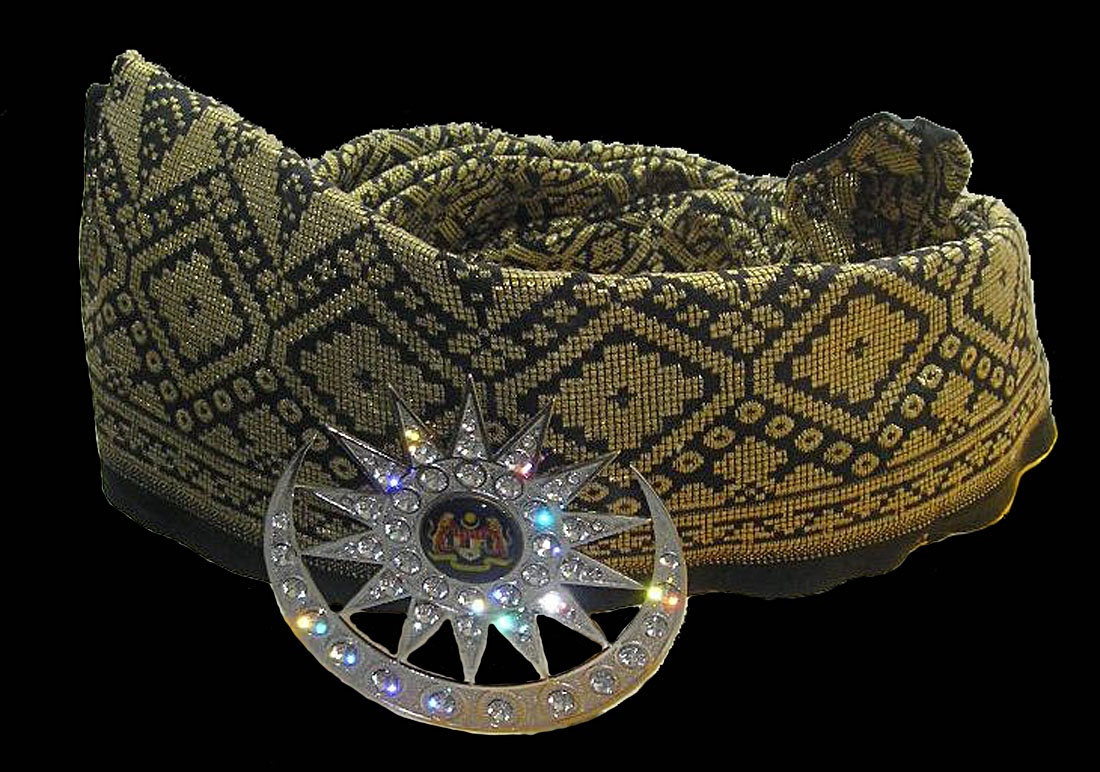
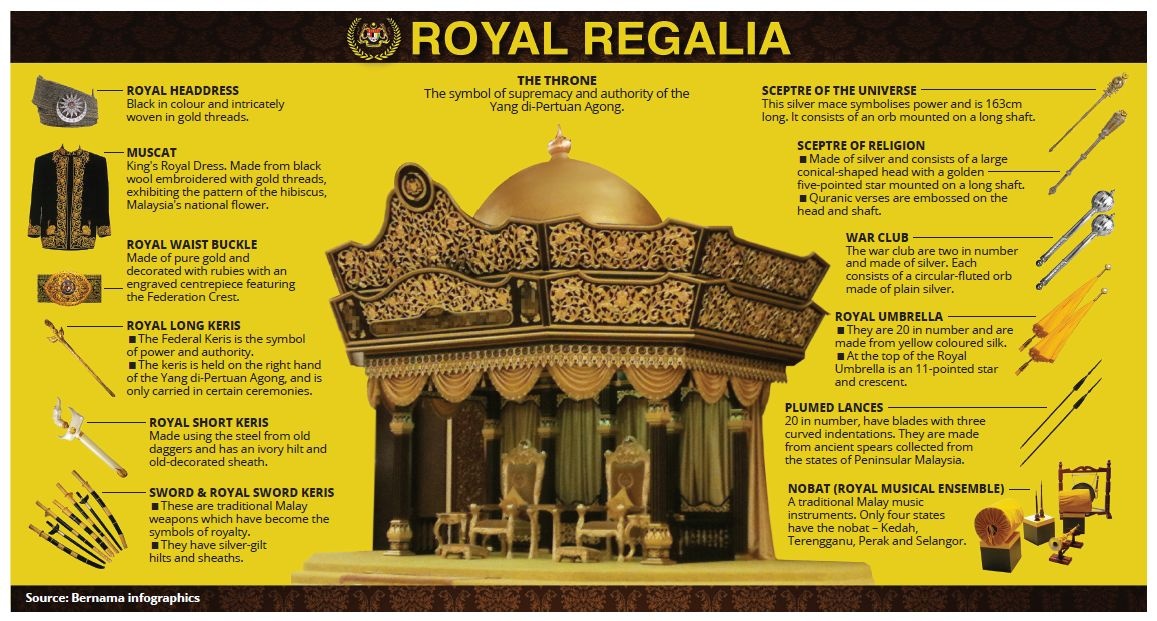
Tengkolok Diraja (Royal Headdress): For centuries, Malay Rulers have worn a folded silk headdress as part of their royal regalia. The folding style, known as solek, varies by state and includes designs such as Anak Gajah Menyusu, Lang Menyusur Angin, and Dendam Tak Sudah. During the installation ceremony, the Yang di-Pertuan Agong wears a black, gold-embroidered tengkolok folded in the Dendam Tak Sudah style from Negeri Sembilan. It is adorned with a crescent and star bearing the Malaysian national crest. [Source: malaysianmonarchy.org ]
Muskat (Robe of Office) is the official ceremonial robe of the Yang di-Pertuan Agong. Originating from Muscat and adapted from Kedah court dress, it was first worn in 1960. Made of black wool with gold embroidery, featuring traditional awan larat patterns and hibiscus motifs, it is worn with embroidered trousers and a head-dress during royal ceremonies, official visits, and the opening of Parliament.
Pending Diraja (Royal Waist Buckle) is a waist buckle made of 24-carat gold, decorated with eleven rubies and the Federal Government crest. It is worn with a gold-embroidered waistband.
Payung Ubur-Ubur Kuning (Yellow Royal Umbrellas): Twenty yellow silk umbrellas form part of the royal regalia. Yellow is the royal colour of the Malays, and each umbrella is topped with a crescent and star.
Gandik Diraja (Royal Tiara) is worn by the Raja Permaisuri Agong. Made of platinum and diamonds in the awan larat design, it features a crescent and star at the centre. It is worn at royal ceremonies and can be dismantled into a locket and brooches. The tiara was gazetted as National Heritage in 2009.
Kalung Diraja (Royal Necklace) is a platinum and diamond necklace worn by the Raja Permaisuri Agong during royal ceremonies. It can be converted into earrings and brooches and was also gazetted as National Heritage in 2009.
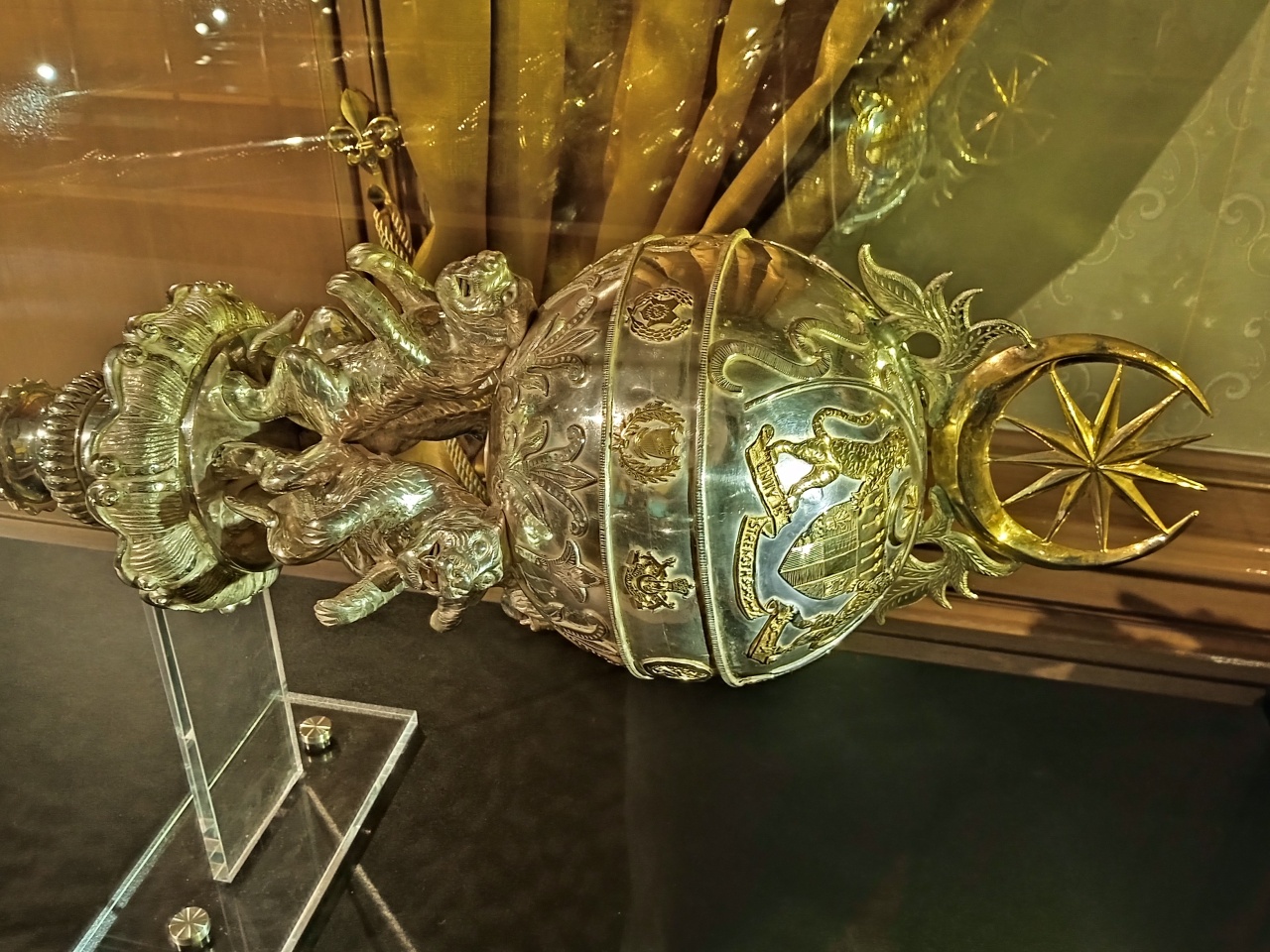
Cogan Alam (Sceptre of the World) symbolizes royal authority. Made of silver, it is topped with an orb crowned by a gold crescent and star. The orb bears the crests of the eleven states and is supported by tiger figures, while the shaft is decorated with golden paddy ears.
Cogan Agama (Sceptre of Religion): represents the religious authority of the monarchy. Made of silver, it has a conical head topped with a gold crescent and star. Verses from the Quran are engraved on its head and shaft.
RELATED ARTICLES:
MONARCHY OF MALAYSIA: SULTANS, POWER, RELEVANCY factsanddetails.com
DUTIES, RESPONSIBILITIES, SELECTION AND CROWNING OF THE MALAYSIAN KING factsanddetails.com
KINGS OF MALAYSIA: POWERS, SELECTION, RICH, OLD AND SCANDALOUS ONES factsanddetails.com
MALACCA SULTANATE: ORIGIN, HISTORY, PARAMESVARA factsanddetails.com
EARLY KINGDOMS, EMPIRES AND THE ARRIVAL OF ISLAM IN MALAYSIA factsanddetails.com
SCANDALS AND GOSSIP INVOLVING MALAYSIA’S ROYAL FAMILIES factsanddetails.com
GOVERNMENT OF MALAYSIA: SYMBOLS, CONSTITUTION, LEADERSHIP factsanddetails.com
GOVERNMENT BRANCHES OF MALAYSIA, PRIME MINISTER AND LEGISLATURE factsanddetails.com
Royal Swords and Weapons of Malaysia
Cokmar (Royal Maces) are a pair of silver maces that symbolize royal authority in Malaysia. Each mace is about 81 centimeters long and shaped as a traditional weapon, with a short shaft and a dome-shaped head. [Source: malaysianmonarchy.org ]
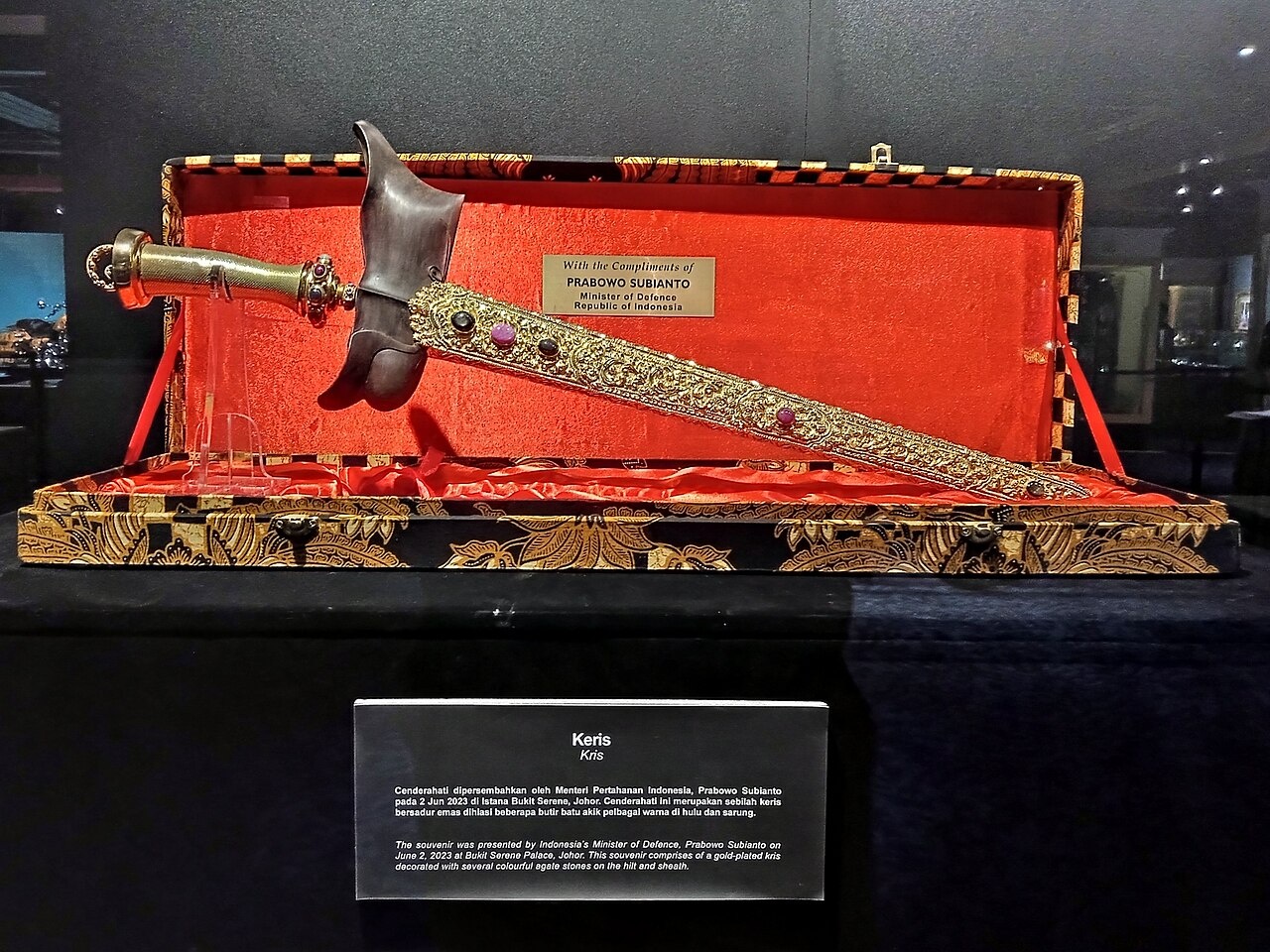
Pedang, Keris Panjang and Sundang (Sword and Traditional Daggers) refer to three ancient Malay weapons that form part of the royal regalia. Their blades date back to early times, while the keris panjang and sundang are silver-coated and decorated with carved hilts and sheaths.
Tombak Berambu (Fringed-Collared Spears): Twenty spears with curved blades form part of the regalia. Their blades were forged from ancient spears from the eleven states of Peninsular Malaysia.
Keris Panjang Diraja (Royal Long Keris): is the most important symbol of royal authority and is worn during installation ceremonies. Its hilt and sheath are covered in gold, and its blade was forged from steel taken from keris from the eleven states. The crosspiece bears the crests of the Federal Government and the eleven states. The hilt resembles a horse’s hoof decorated with jering fruit motifs. It is worn only by the Yang di-Pertuan Agong on special occasions.
Keris Pendek Diraja (Royal Short Keris) was made from antique keris blades. Its ivory hilt and sheath are inlaid with gold, and the hilt, known as Hulu Pekaka, is shaped like a Garuda head. The crosspiece bears the Federal Government crest. Like the Royal Long Keris, it may be carried only by the Yang di-Pertuan Agong.
Nobats (Royal Orchestras) of the Malaysian King and Sultans
The word nobat comes from the Persian naubat, meaning a set of royal instruments. The Nobat is a traditional royal orchestra that has been used for centuries in Malay states, especially during royal installations and major ceremonies. Its main instruments include drums (gendang), the nafiri (long trumpet), serunai (flute), and a gong. Only four Malaysian states maintain a Nobat tradition today: Perak, Kedah, Selangor, and Terengganu. [Source: malaysianmonarchy.org ]
The Nobat is regarded as sacred and may only be played for royal purposes, usually by musicians from specific hereditary families known as the Kalur. The most respected instrument is the Gendang Nobat, which is reserved exclusively for royal use.
Nobat of Perak: In Perak, a ruler is not considered fully installed until the Nobat is played. The Perak Nobat uses five main instruments: the Gendang Nobat, Nafiri, Gendang Nenghara, Serunai, and Gendang Penengkah. Traditionally, the drums were made from special woods and animal skins. The Nobat is performed during royal installations, birthdays, weddings, funerals, Ramadan, Eid celebrations, state ceremonies, and important royal rituals. During the installation of the Yang di-Pertuan Agong, specific Nobat songs are played to mark the arrival of the royal couple, the presentation of regalia, the royal oath, and their departure.
Nobat of Kedah includes drums, a silver nafiri, a gong, and a royal mace. The leader of the orchestra, known as the Mahaguru, holds the royal mace. The Nobat may only be played on the Sultan’s orders, during events such as installations, royal weddings, funerals, Friday prayers, Eid celebrations, and the reception of foreign dignitaries. According to tradition, the Nobat in Kedah symbolizes royal greatness and authority. Several ceremonial songs are performed depending on the occasion, including those for royal processions, bathing rituals, and installations.
Nobat of Selangor originated from Perak’s tradition and is used for royal installations, weddings, official ceremonies, and funerals. Its instruments are similar to those used in Perak, with the Gendang Nobat being the most revered. During the installation of the Yang di-Pertuan Agong, selected Nobat songs are played to accompany the entrance of the royal couple, the presentation of regalia, the royal oath, and their exit from the Throne Room.
Nobat of Terengganu is believed to have originated from Riau and has long been part of the state’s royal customs. Its instruments include several drums, a silver nafiri, small cymbals, and a flute. The Nobat repertoire consists of thirteen traditional songs, though only three are commonly played in major throne room ceremonies. The Terengganu Nobat is performed during royal weddings, palace rituals, Ramadan, Eid celebrations, and weekly palace ceremonies. Notably, the Terengganu Nobat has never been used during the installation of the Yang di-Pertuan Agong.
Royal Ceremonies and the Royal Flag in Malaysia
Major royal ceremonies in Malaysia include:
1) The Oath of Office and signing of the Declaration of Office by the Yang di-Pertuan Agong and the Timbalan Yang di-Pertuan Agong;
2) Audience ceremonies and the investiture of national awards, decorations, and medals;
3) Oath of Office, Oath of Allegiance, and Oath of Secrecy ceremonies for the Prime Minister, Ministers, and Deputy Ministers after a new Cabinet is formed;
4) Ceremonies for receiving certificates of appointment by State Governors;
5) Ceremonies for receiving certificates of appointment by the Lord President of the Federal Court;
6) Ceremonies for the appointment of senior judges, including the President of the Court of Appeal, Chief Justice of Malaya, Chief Justice of Sabah and Sarawak, and judges of the Federal, Appeal, and High Courts’
7) Ceremonies for receiving certificates of appointment as Malaysian ambassadors and high commissioners abroad;
8) Ceremonies for receiving letters of commission by foreign ambassadors and high commissioners to Malaysia. [Source: malaysianmonarchy.org ]
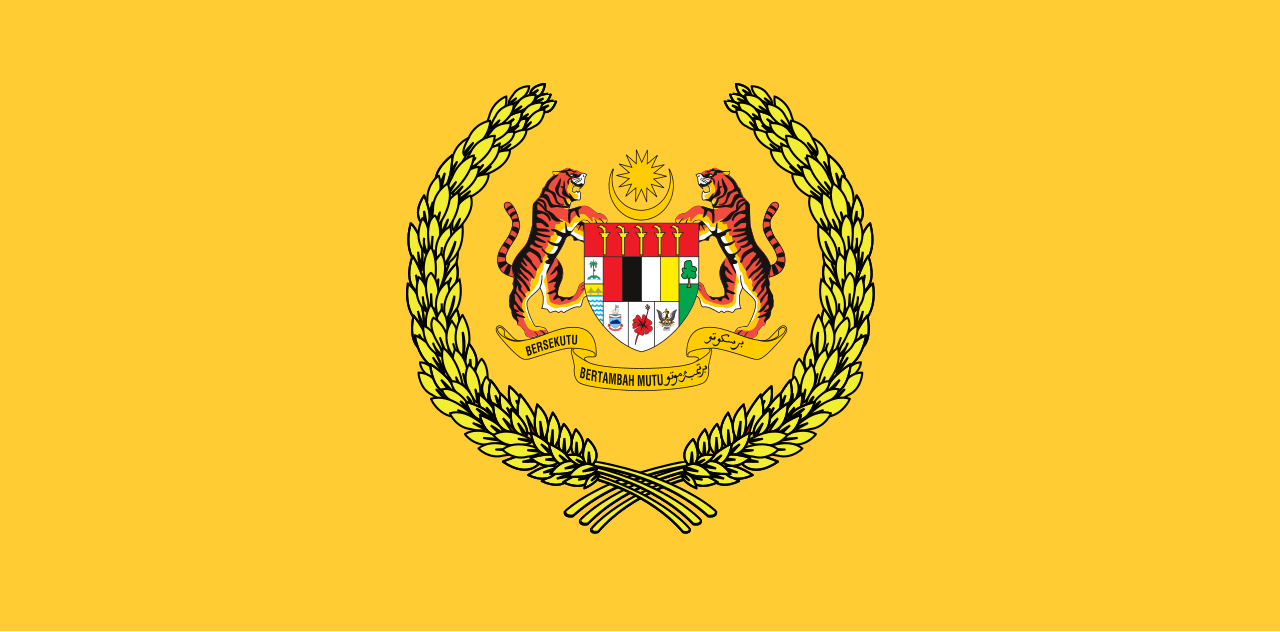
Panji-Panji Diraja (Royal Flag) is royal yellow and bears the Malaysian Coat of Arms at its centre, flanked by two golden sheaves of paddy. The paddy symbolises abundance and prosperity. As Head of State, the Yang di-Pertuan Agong represents national loyalty to the Constitution and the rule of law. The royal flag symbolises the authority and continuity of the monarchy. The Panji-Panji Diraja is raised when the Yang di-Pertuan Agong attends important events such as the opening of Parliament, official visits, or state ceremonies. It is hoisted upon his arrival and lowered when he departs. The flag is flown at half-mast only upon the death of the Yang di-Pertuan Agong.
Coat of Arms of Malaysia features a 14-pointed star, representing the 13 states and the Federal Government. The star and crescent together symbolise Islam as the official religion. Five keris represent the former Unfederated Malay States: Johor, Kedah, Perlis, Kelantan, and Terengganu. The shield includes symbols of Penang and Malacca, reflecting their history as part of the former Straits Settlements. The four central panels represent the original Federated Malay States: Pahang, Selangor, Perak, and Negeri Sembilan, each shown through their state colours. Below these are symbols for Sabah and Sarawak, with the hibiscus, Malaysia’s national flower, at the centre. The shield is supported by two tigers, a symbol carried over from earlier Malay state emblems.
Flag of the Raja Permaisuri Agong holds a special status as the consort of the Yang di-Pertuan Agong and has her own royal flag. The design is similar to the King’s flag but features a light green background instead of royal yellow. This flag indicates Her Majesty’s presence at official ceremonies when she attends without the Yang di-Pertuan Agong.
Royal Palace Customs and Etiquette
When presented to His Majesty the Yang di-Pertuan Agong and Her Majesty the Raja Permaisuri Agong, stand upright with both feet together and your hands straight at your sides. Bow once respectfully, without bowing too deeply. Walk slowly towards His Majesty and stop at a distance of about two to three feet. Bow again. Muslims should greet with “Assalamualaikum Tuanku”, while non-Muslims may say “Selamat Pagi Tuanku” or “Good Morning, Your Majesty.” Take about three steps backward, bow once more, and then leave. If His Majesty or Her Majesty is seated on the throne, stand with your feet together and bow respectfully while standing still. Then approach, kneel, and kiss His Majesty’s hand if permitted. Afterward, step back three paces, bow again, and turn to leave. [Source: malaysianmonarchy.org ]
Presenting Gifts: When presenting a gift such as a letter, souvenir, or flowers at a formal function, prepare two trays lined with yellow cloth. One tray holds the gift, while the other is for the aide assigned to receive it. Bow, step forward about three paces, and bow again before presenting the gift. Stand upright briefly and bow once more. If His Majesty offers his hand, bow and kiss it. Then step back three paces, bow again, and return to your seat or position. If His Majesty is seated, bow and move forward until you are directly facing him or positioned to his right or left. Bow again, then bend until nearly kneeling with your left knee touching the floor to present the gift. If offered, receive and kiss His Majesty’s hand. Stand, bow, step back three paces, and return to your place.
Proper Conduct While Seated: When seated in the presence of His Majesty, sit upright and composed. Do not cross your legs, stretch them out, raise your knees, or point the soles of your feet toward His Majesty. Avoid slouching, resting your chin in your hands, or folding your arms. During meals, place your hands on your thighs and do not rest your elbows on the table; only your wrists may touch the table if necessary. Avoid unnecessary conversation during formal functions. If speaking is required, do so softly and politely. When His Majesty passes in front of or near you, stand, turn toward him, and bow as a mark of respect.
Sitting on the Floor: Women seated on the floor should sit with their legs drawn to the right and close to the body, with the left arm resting on the ground, and ensure their legs are covered by their garments. Men should sit cross-legged in a respectful manner, without stretching their legs or raising their knees. Smoking is strictly prohibited.
Royal Palace Dining Customs and Etiquette
Etiquette at the dining table of a royal family members: 1) Do not eat or drink before His Majesty has done so; 2) Avoid opening your mouth widely when putting food into your mouth. When chewing your food, your mouth should be closed. Do not talk when your mouth is full; 3) Make sure that the cutlery is used correctly and do not make too much noise. Leftovers should not be left on the tablecloth; 5) After eating, the cutlery should be arranged neatly and not scattered about;
6) If food is stuck in your teeth, avoid picking at it with your fingers. Use a napkin to cover your mouth when you remove it; 7) Cover your mouth with a napkin when you are coughing or sneezing; 8) Avoid yawning or belching loudly; 9) Do not pick your ears, scratch your body, stretch yourself, and crack your knuckle, during the dinner; 10) Do not raise your head or rest both elbows on the table; 11) For women, when seated at the dining table, the handbag should be hanged using a handbag holder and not placed on the table even if it is a small handbag. [Source: malaysianmonarchy.org ]
On speaking at the dining table with royal family members: 1) When His Majesty speaks, you should answer "Tuanku" instead of "Ya". 2) Use "Ampun Tuanku" or "Tuanku" at the beginning or end of a sentence when speaking to His Majesty. 3) When talking about both Their Majesties, you should use "Tuanku Yang di-Pertuan Agong and Tuanku Permaisuri Agong". 4) Avoid using short and simple phrases such as: "The King wants a drink" or "The Queen is leaving". Instead use: "His Majesty would be pleased to have some coffee" or “Her Majesty has consented to depart".
5) When His Majesty points with his index finger, do not do the same; you should instead point with your thumb over the fist and say "Ampun Tuanku" or "Tuanku". 6) Men should bow and women should curtsy when presented to the Prince/Princess. When speaking, use "Tengku", "Mohon Tengku" or "Ampun Tengku", where appropriate. 7) When speaking in English, you should always use the Royal Vocabulary or Royal Language or Royal Term. Avoid using English words when speaking in Malay unless you have a complete mastery of the Royal Language in English. If necessary, you should use the following words: "His Majesty" for Seri Paduka Baginda Yang di-Pertuan Agong; "Her Majesty" for Seri Paduka Baginda Raja Permaisuri Agong.; "Your Majesty" for "Tuanku" not "You" or "Your" or "Yours"; Use "Patik" instead of "I" even if you answer in English unless you are using the Royal Vocabulary in full.
When escorting His Majesty, you should walk slightly behind His Majesty and do not at any time walk in line with His Majesty (on the left or right). If it is necessary to pass in front or behind His Majesty, you should bow respectfully while saying "patik pohon lalu Tuanku". You should bow when His Majesty passes in front of you (for men). If His Majesty passes behind you, turn around and face His Majesty and bow. When you are standing in front of His Majesty/Royalties, avoid folding your arms, or with your arms akimbo, or with your hands in your pockets or with your hands crossed behind your back. For women, do not carry a shoulder handbag.
Although the Royal language is seldom used these days, it is worth noting that some words have been used in speech for a long time. Check malaysianmonarchy.org.
Dressing For Royal Ceremonies And Functions
If a Function specifies a dress code we should dress accordingly: A) Formal National Dress: 1) Tanjak (Head-dress); 2) Black Baju Melayu (“Cekak Musang” Collar); Black Samping; 3) Black Bengkong; Black Socks; and 4) Black Leather Shoes (without the kris for evening functions). B) National Dress, Non-formal: 1) Black Songkok; Baju Melayu (“Cekak Musang” Collar); 2) Black Songket Samping; Black Socks; 3) Black Leather Shoes. [Source: malaysianmonarchy.org ]
C) Western Dress: 1) Dark Lounge Suit; 2) White collared shirt; 3) Dark tie; 4) Black socks; 5) Black leather shoes, with Songkok for Muslims. D) Tie (Evening Dress) or Tail Coat: 1) Black long Tail Coat; 2) White Waist Coat; 3) Stiff (starched) white shirt; 4) Wing Collar; 5) White Bow Tie; 6) Black Trousers; 7) Black Socks; 8) Black Leather Shoes. E) Dinner Jacket 'Black Tie' or 'Smoking'” 1) Black Jacket with Silk-faced lapels or white Shell Jacket (tuxedo); 2) Stiff (starched) white shirt; 3) Soft Collar; Black Bow Tie; 4) Black Cummerbund or White Waist Coat; 5) Black Trousers with Silk Stripe; Black Socks; 6) Black Leather Shoes. F) Morning Dress: 1) Black Tail Coat; 2) Black Waist Coat; 3) White Shirt; Plain (Stiff Turndown) Collar; 4) Grey Tie; 5) Stripe Black Trousers; 6) Black Socks; 7) Black Leather Shoes, (Black Silk Hat is worn for Official Functions),
Prohibited Dresses for Ladies: 1) White Kebaya, 2) Sam Fu. For other dresses, the following rules should be adhered to: 1) The kebaya hemline must be below the knee. 2) The sarong of the kebaya must not have a slit either on the side or back. 3) The Coli (sari blouse) must not expose the belly and it should have sleeves. 4) The Cheong Sum must be ankle-length, with sleeves and the slit should only be up to the knee. 5) The hemline for skirts (western dress) must be below the knee.
Royal Banquet and High Tea with the Malaysian King
The Royal Banquet held in conjunction with the installation of His Majesty the Yang di-Pertuan Agong takes place at the Banquet Hall of Istana Negara. The banquet is attended by all the Malay Rulers, State Governors, and other distinguished guests. At 8.50 p.m., guests are seated in the Banquet Hall. The arrival of His Majesty the Yang di-Pertuan Agong and Her Majesty the Raja Permaisuri Agong is led by the Datuk Paduka Maharaja Lela. The Malay Rulers and their consorts, State Governors and their spouses, the Prime Minister and Deputy Prime Minister with their spouses enter simultaneously. [Source: malaysianmonarchy.org ]
When the Master of Ceremonies announces the arrival of His Majesty, the nafiri is sounded and all guests rise. Upon reaching the Royal Table, His Majesty pauses until all Rulers and consorts are seated. The National Anthem is then played, marking the start of the banquet. Throughout the evening, guests are entertained by instrumental music performed by the RTM Orchestra.
Ten minutes after coffee is served at the Royal Table, the music ceases and the Master of Ceremonies announces the recitation of the Doa Selamat by the Istana Negara Religious Officer. Following the prayer, the Master of Ceremonies announces the departure of Their Majesties. The audience stands, the National Anthem is played, followed by the sounding of the nafiri, and Their Majesties depart led by the Datuk Paduka Maharaja Lela. The Malay Rulers and their consorts, together with the State Governors and their spouses, then proceed to the Special Hall to depart Istana Negara.
Royal High Tea held in conjunction with the installation of His Majesty the Yang di-Pertuan Agong takes place on the grounds of Istana Negara. The prescribed dress for this event is national attire or a lounge suit. At 4.30 p.m., the Master of Ceremonies announces the arrival of His Majesty the Yang di-Pertuan Agong and Her Majesty the Raja Permaisuri Agong. The nafiri is played and guests rise. Upon Their Majesties’ arrival at the Royal Table, the National Anthem is played, after which Their Majesties take their seats. The Istana Negara Religious Officer then seeks permission to recite the Doa Selamat, and upon approval, the prayer is recited.
After the prayer, the Chairman of the Installation Central Committee seeks His Majesty’s consent to proceed with the high tea. Once permission is granted, the Master of Ceremonies announces the commencement of the event. The high tea lasts approximately 45 minutes and is accompanied by instrumental music performed by the PDRM Combo, along with performances by local artistes.
After the tea, and upon receiving a signal from the Deputy Datuk Paduka Maharaja Lela, the Chairman again seeks permission from His Majesty to proceed with the next segment of the ceremony. His Majesty the Yang di-Pertuan Agong and Her Majesty the Raja Permaisuri Agong, accompanied by the Prime Minister, Deputy Prime Minister, and the Chairman of the Installation Central Committee with their spouses, proceed to meet the guests.
Following this interaction, Their Majesties and accompanying dignitaries return to their seats and the music ceases. The Chairman then informs His Majesty that the high tea has concluded. The Master of Ceremonies announces the departure of Their Majesties, and the National Anthem is played. His Majesty the Yang di-Pertuan Agong and Her Majesty the Raja Permaisuri Agong depart, accompanied by the Prime Minister, Deputy Prime Minister, and the Chairman of the Installation Central Committee with their spouses. The remaining dignitaries and guests then take their leave from Istana Negara.
Palaces of the Malaysia’s King
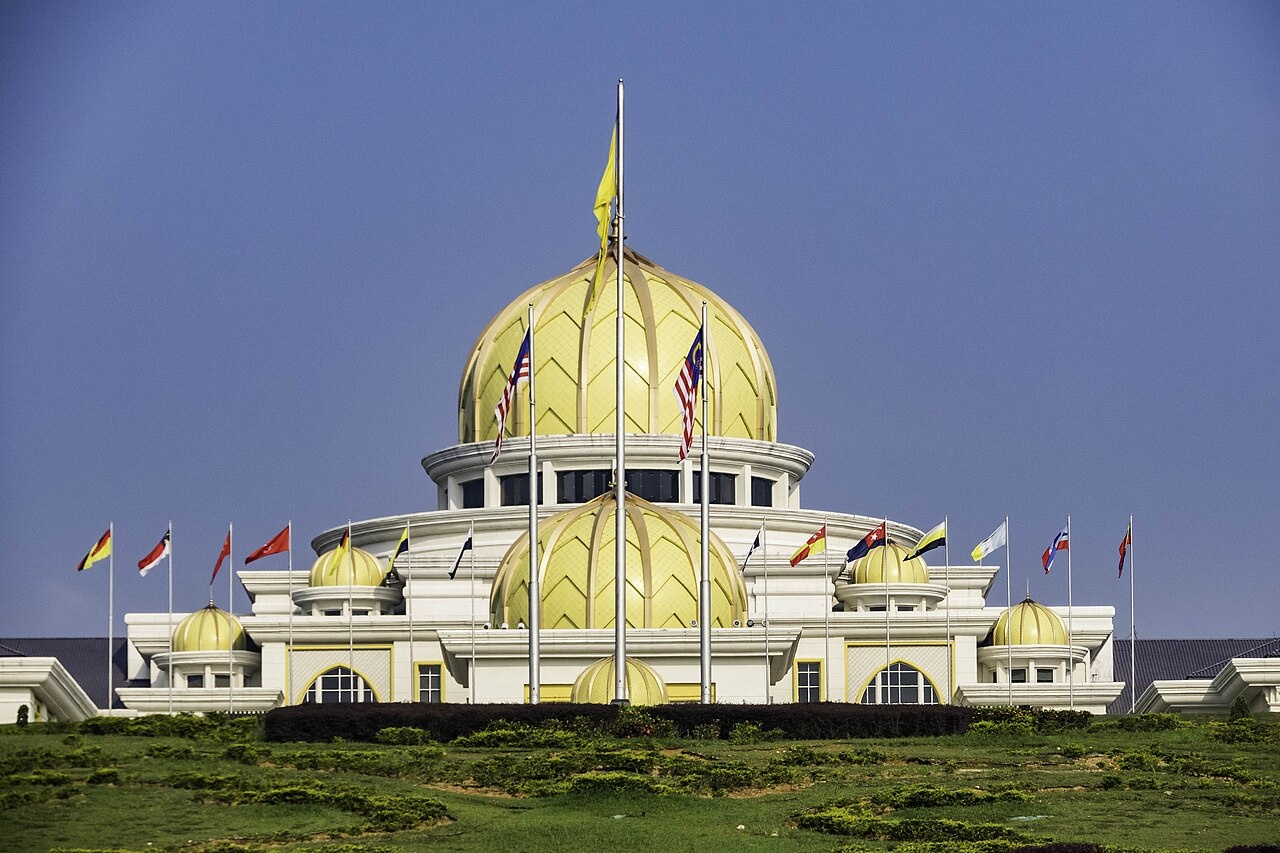
Istana Negara is the official residence of His Majesty Seri Paduka Baginda Yang di-Pertuan Agong and Her Majesty Seri Paduka Baginda Raja Permaisuri Agong. Built in 1928, the building was originally the private residence of a wealthy businessman, Mr. Chan Wing. During the Japanese Occupation from 1942 to 1945, it was used as a mess for Japanese officers. After Japan’s surrender, the Selangor State Government purchased the building and, following renovations, it served as the palace of His Majesty the Sultan of Selangor until 1957. [Source: malaysianmonarchy.org ]
In 1957, the Federal Government acquired the palace and converted it into Istana Negara. Since then, it has undergone several renovations and extensions. The most extensive upgrading took place in 1980, as Istana Negara was chosen for the first time as the venue for the Installation Ceremony of His Majesty Seri Paduka Baginda Yang di-Pertuan Agong. Prior to this, such ceremonies were held at Tunku Abdul Rahman Hall on Jalan Ampang, Kuala Lumpur.
The majestic palace stands within a tranquil 11.34-hectare compound adorned with a wide variety of plants and flowers, and equipped with facilities such as a swimming pool and an indoor badminton hall. Located along Syed Putra Road in the heart of Kuala Lumpur, the building contains several halls designed for specific functions. Among the most important are the Throne Hall (Balairong Seri) and the Audience Hall (Dewan Mengadap), both situated on the ground floor.
The entire palace compound is enclosed by a fence, with the Royal Insignia of His Majesty mounted on each steel bar between the pillars. At the front of Istana Negara stands the main entrance, designed in the form of an elegant arch. Flanking the arch are two guard posts sheltering members of the cavalry dressed in full ceremonial uniform, similar to those seen at Buckingham Palace in London. Although the palace grounds are not open to the public, the main entrance remains a popular spot for tourists to take photographs.
Melawati Palace, located in Precinct 1, Putrajaya, serves as a retreat for the Yang di-Pertuan Agong and is designed with a resort-style concept. The name “Melawati” literally means “guard’s tower.” Designed by YM Raja Datuk Kamarul Bahrin, the palace comprises four main components: the Royal Wing, Arrival Wing, Meetings Wing, and Administration Block. Three guard towers form a prominent architectural feature at the side and centre of the palace. Inside the Meetings Wing, a Melawati structure made of cengal wood and crowned with a golden roof stands at the main staircase.
The Royal Wing includes several key facilities, namely the Royal Bedroom, Royal Resting Room, Royal Banquet Room, the Office of His Majesty the Yang di-Pertuan Agong, the Office of Her Majesty the Raja Permaisuri Agong, a Royal Bath or swimming pool, the Royal Kitchen, Royal Guest House, Royal Gallery, and the Main Meeting Room.
Image Sources: Wikimedia Commons
Text Sources: New York Times, Washington Post, Los Angeles Times, Times of London, Lonely Planet Guides, Library of Congress, Malaysia Tourism Promotion Board, Compton’s Encyclopedia, The Guardian, National Geographic, Smithsonian magazine, The New Yorker, Time, Newsweek, Reuters, AP, AFP, Wall Street Journal, The Atlantic Monthly, The Economist, Foreign Policy, Wikipedia, BBC, CNN, and various books, websites and other publications.
Last updated January 2026