
RANTEPAO
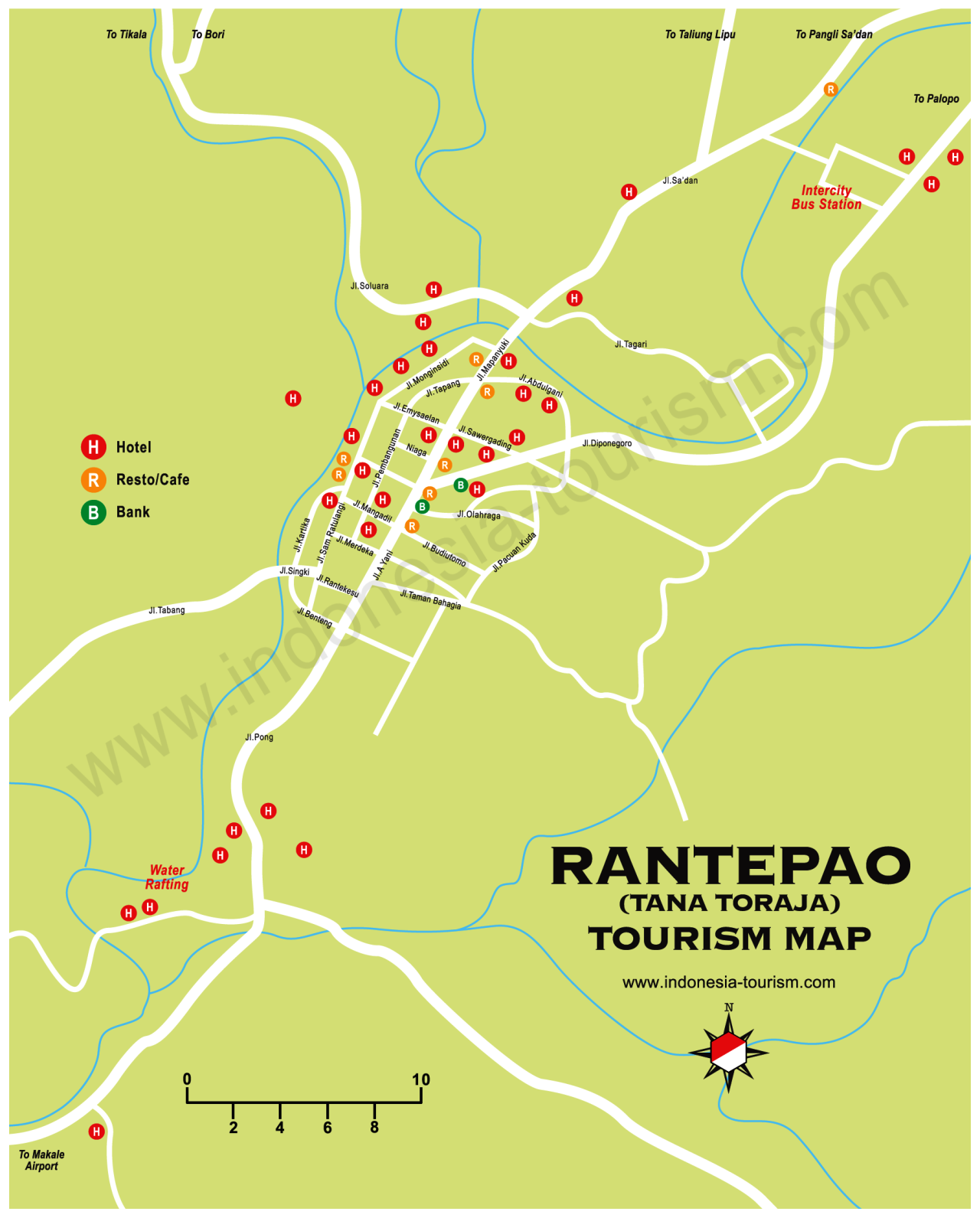
Rantepao (350 kilometers from Makassar by road) is where most visitors to Toraja stay. It has a busy main street and a number of small hotels, restaurants and arts and crafts stores. Many visitors stop by the Bamboo Music School to watch children do dances and play bamboo flutes. A large and colorful market is held every six days. Particularly interesting are the fighting cock, water buffalo and pig markets. You can also load up on fresh rice-paddy-raised eels and freshly ground coffee.
The biggest attractions of Rantepao are the countryside and the Torajan villages around it. There are interesting places to explore in all directions. One day and two day rafting trips are available on the Sadan River. There are nice hikes between Tikala, about seven kilometers north of Rantepao, and Batuumonga. Funerals are usually held after the rice harvest, from September to December, when people have money to pay for the expensive events. Small funerals are held year round. Visitors who show up for the funerals are advised to dress in respectable clothes — preferably black — and bring a gift of sugar or clove cigarettes.
Guides are available for between $15 and $25 a day. They will make their presence known to you when you stroll around town. To hit the main attraction is easy enough with public transportation and a good map. The tourist office offers pretty good information. The nice hotels are the Hotel Indra II ($40 for a double) and the Marunnu City resort ($70 for a double). Cheaper budget digs are available. Vehicles with a driver and guide can be hired for about $60 a day. Bicycles and motorbikes can also be rented.
RELATED ARTICLES:
TANA TORAJA TRAVEL: HOTELS, TRANSPORT, GETTING THERE, RAFTING factsanddetails.com
TORAJA: HISTORY, LANGUAGE, DEMOGRAPHICS, GROUPS factsanddetails.com
TORAJA RELIGION: AFTERLIFE, PRACTITIONERS, CHRISTIANITY, TRADITIONAL BELIEFS factsanddetails.com
TORAJA FUNERALS: RITUALS, BELIEFS, COSTS, EVENTS factsanddetails.com
TORAJA BURIALS: TOMBS, TAU TAUS AND THE WALKING DEAD factsanddetails.com
TORAJA SOCIETY AND LIFE: FAMILIES, FOOD, HOUSES, WORK factsanddetails.com
TORAJA CULTURE: ART, TEXTILES, MUSIC, ARCHITECTURE factsanddetails.com
SULAWESI factsanddetails.com
SOUTHERN SULAWESI: HISTORY, GEOGRAPHY, RELIGION factsanddetails.com
Londa: Burial Caves, Tau Taus and Hanging Graves
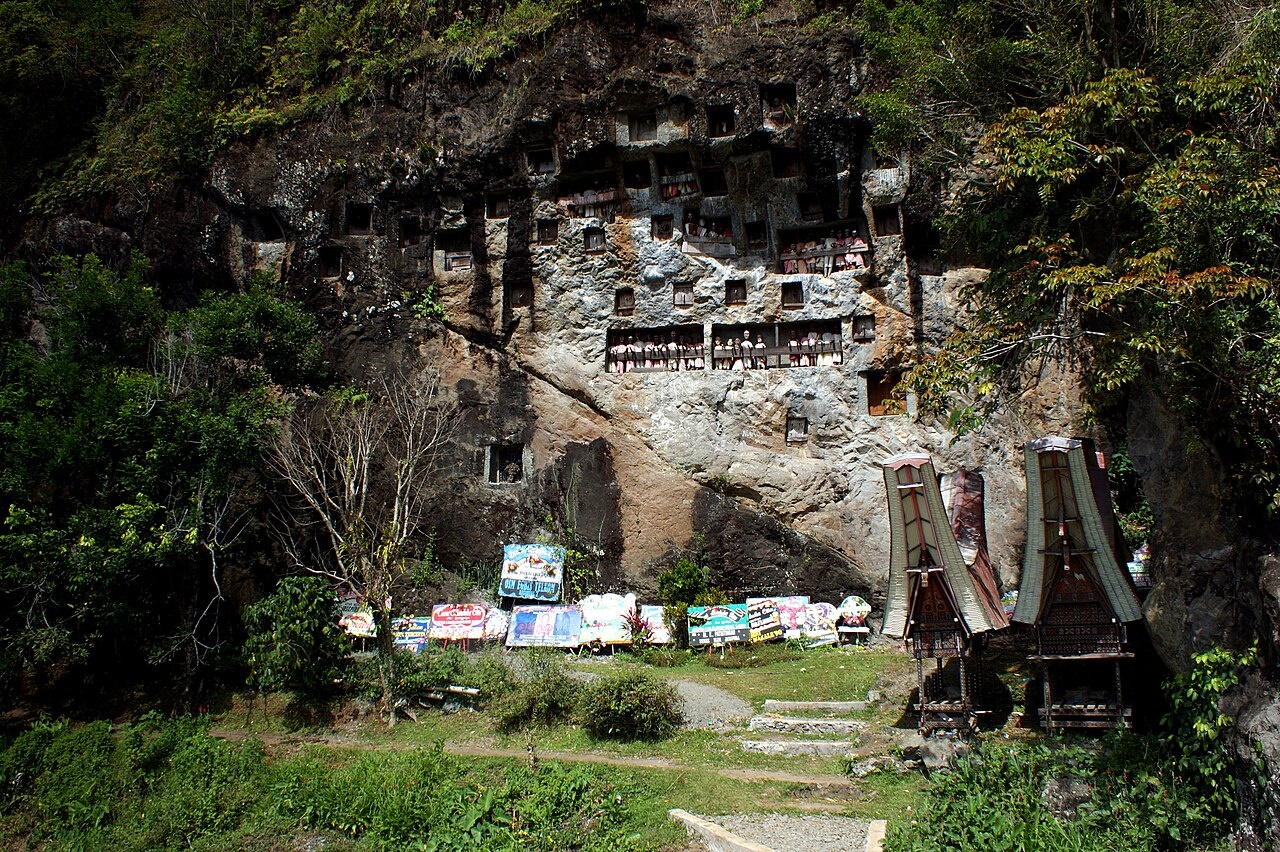
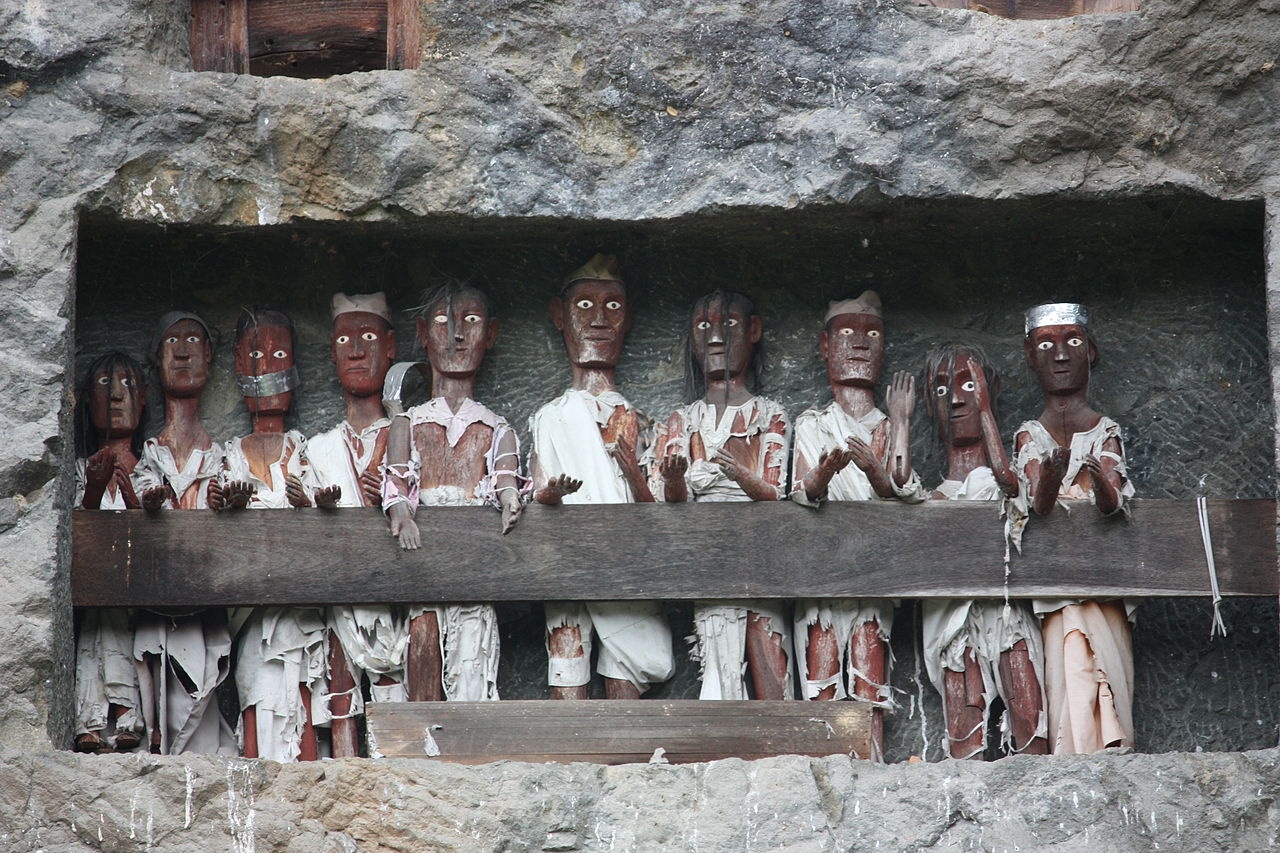
Londa (six kilometers north of Rantepao off the main road between Rantepao and Makale) contains hanging graves that belonged to ancient nobles that are filled with effigies to the dead. There are coffins shaped like boats and coffins shaped like pigs. Some of them hang high up on the cliffs. Inside the caves are more coffins as well as skulls and bones. A row of about a dozen and half tat tau are arranged on a terrace. Guides with kerosene lamps can be hired to take you inside the graves to see the skeletons and old coffins.
According to a report submitted to UNESCO: “Londa Site is a grave site where two methods of burial are customary. Here, the coffins of ordinary people are placed in caves and crevices at the foot of the hill, while the remains of persons of higher rank rest in burial chambers carved from the wall of the limestone cliff. The latter are accompanied by Tau-tau, placed close to the chamber. The higher the status of the deceased, the higher the chamber, which can be situated as far as 50 meters from the ground.” [Source: Ministry of Culture and Tourism of the Republic of Indonesia]
“On the walls of a steep hill, coffins hang from cracks in the rocky face. Lifelike wooden sculptures or effigies complete with clothes, stand in neat rows in cracks hollowed out in the cliff faces, very much like the windows & balconies of a house. These represent the dead who are buried there.. Not far from this hanging grave hides a burial cave many hundreds of years old.”
On the walls of the cliffs around the cave, rows of wooden statues called Tau-taus can be seen in the chiseled stone cliffs. Usually made from jackfruit wood, a tau-tau is a carved effigy meant to look like person whose body is buried nearby. The wood used for this carving tends to yellow with age, often attaining a color not so different than that of human skin. Some tau-taus are carefully carved with special attention given to details such as wrinkles on the face, or sagging skin on the neck due to aging.
Close to the rows of tau-tau, wooden coffins are firmly secured to the cliff walls by wooden beams. These coffins or caskets (erong) are said to indicate the level of honour or nobility of the person buried there. The higher the casket or coffin is located on the cliff walls, the higher the status of the persons buried there. The Torajans believe that the dead can take their wealth with them into the afterlife. One reason why they bury the coffins in high places is to protect the buried treasure from thieves. They also believe that the higher the coffin lies the shorter the journey is for the deceased to enter into Heaven.
Around the caves, you might see bones scattered here and there. These bones fell from a cliff-hanging coffin that broke off at some time because its wooden holds and supports were damaged or rotted with time. The fallen skulls and bones may once again be placed in a new coffin. However, expensive ceremonies have to be performed once again, similar to when the deceased was buried in its first coffin.
This customary funeral ceremony known as Rambu Solo, is an age-old tradition for deceased noblemen of Toraja. In order to carry out this ceremony, surviving relatives of the deceased sacrifice approximately 24 to 100 buffaloes (for the nobility) or approximately 8 buffaloes and 50 pigs (for the middle class). It is not unusual for the surviving relatives to take many months or even years to save up for enough all that is needed to carry out the Rambu Solo ceremony. While waiting for this ceremony to take place, the corpse is not considered completely dead yet. Therefore, the dead body is stored in a traditional vernacular house (tongkonan) and treated as a living person, for example, by giving his or her favorite foods, cigarettes, and more. Other objects are also placed beside the coffin as offerings. Before the corpse is stored it is embalmed to avoid stench and odor.
Visiting Londa Hanging Graves
Londa’s burial caves are found in the village of Sandan Uai, in the Sanggalangi District. It is easy to get there by bemo (minivan), ojek (motorcycle taxi) or rental car. To get to the tomb caves of Londa, one must descend a number of stairs but just before you do, you will be approached by a member of the local community offering you lanterns for rent costing about Rp. 20,000. You will need a light to find your way into and around the cave. Aside from renting a lantern, you may also bring your own flashlight to light your way, or ask your tour guide to provide one for you. Special Londa Tour guides for the tomb caves do not normally have a fixed rate so you may bargain for a good deal.
From a distance the cliff sides appear lush & green with the forest trees. If you are observant, however, you will notice colorful coffins tucked into crevices of the cliff walls. At the foot of this lushgreen cliff lies a cave which is used as a tomb. As you explore the cave you will find more skulls and bones scattered here and there. In some places, the coffins may appear to be arranged in a particular manner. These were appropriately arranged according to lineage or family ancestry. Aside from the coffins, you will also notice clothing or cigarettes deliberately placed there by relatives of the deceased. Reportedly, some of these bones in the cave are hundreds, maybe even thousands, of years old.
The natural tomb caves of Londa may be up to 1000 meters deep. In exploring the contours of the tomb cave filled with stalagmites and stalactites, one needs to be very careful. Some parts of the cave are only a meter high so you will have to hunched over or crawl. Be sure that you do not move or even consider taking with you any of the bones, skulls or other artifacts you see lying within the tomb area as it a great offense to the Torajans and breaks the trust that allows visitors to enter the caves. Ask permission before entering the cave and bring a gift such as betel nut as an expression of gratitude. If parts of a cliff naturally give way and a coffin originally placed there falls off, the spilled skulls, bones & any other objects may not be moved without customary approval and a series of traditional ceremonies of the Torajans.
Torajan Sites
Lemo (10 kilometers north of Rantepao off the main road between Rantepao and Makale) contains burial chambers are cut out of rock and adorned with balconies that contain tau taus. There used to be more tau taus but many were stolen and other were hidden away so they wouldn’t be stolen. Sometimes workers are here digging out new graves.“Lemo Site is also a cliff burial site with galleries of ancestor statues. In contrast to Londa, coffins here are not deposited in caves or crevices at the foot of the hill. To the north lies a compound of four granaries and one Tongkonan.”
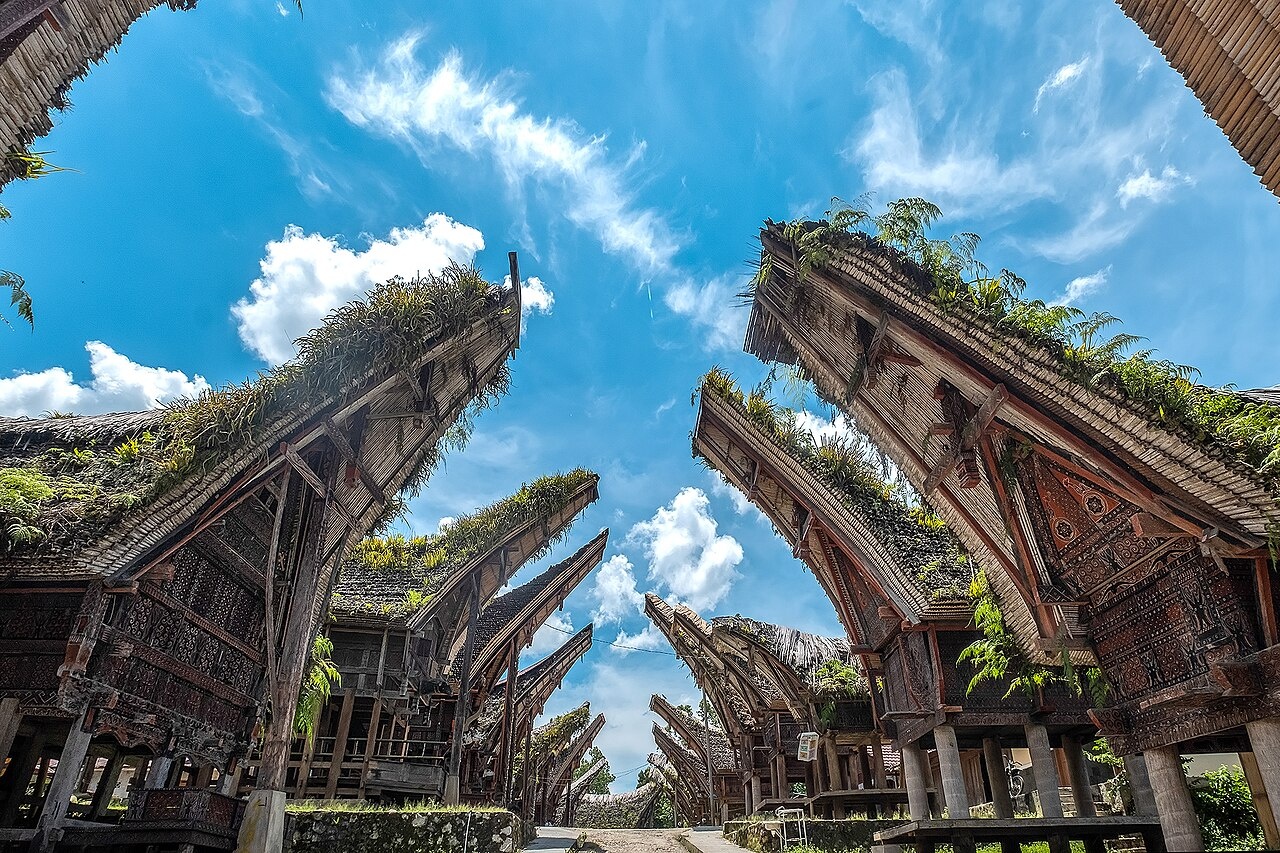
Palawa (10 kilometers north of Rantepao) is a good place to see Tongkonan (boat-shaped houses). In one place there are several tongkonan built facing each other with each facing a rice barn built like a boat-shaped house. According to a report submitted to UNESCO: The “Pallawa Site is a compound of houses and granaries. In total there are 11 houses and 15 granaries. Like many Torajan compounds, the Pallawa houses and granaries are arranged in two parallel rows aligned east-west direction. The houses face north, while the granaries face south. The entrance is situated in the western side of the compound. The ceremonial ground lies about 350 meters to the east.” The town sits on a hill with a burial place nearby, where festivals and celebrations are held. There is also a wood handicraft center in Palawa. West from Palawa towards Batutumonga there are several tongkonam supported on pillars covered with water buffalo horns. [Source: Ministry of Culture and Tourism of the Republic of Indonesia]
Mamasa Valley (west of Tana Toraja) is a more isolated and less visited area that is stunning in its beauty and somewhat similar to Tana Toraja. It has 40 places where one can see coffins and graves. These places can only be visited by trekking. It is possible to hike between Tana Toraja and the Mamasa Valley. Traditional houses in he Mamasa Valley are somewhat similar to those in Toraja but they have heavier and less graceful and curved. Mamasa is 12 hours by bus or three days by foot from Rantepao, or 10 hours by bus from Makassar.
Makale and Place Near It
Makale (320 kilometers from Makassar, 16 kilometers from Rantapao) is the capital of Torajaland. Centered around an artificial lake, it is slightly larger than Rantepao and also has a number of hotels and a market held every six days. . Makale is on the southern side of Torajaland and has access to many interesting spots but is not as centrally located at Rantapao.
Sights Between Rantepao and Makale include Karasi, with traditional Torajan houses arranged around megaliths; Kete Kesu, with hanging grave and life-size tau tau statues guarding over the grave site; and Palatokke, where cliffside graves are surrounded by lush rice fields. Sangalla is a famous mummy of a child. Kanuruan is a village in Torajaland, where funerals are often held.
Tampangalla (about 10 kilometers from meters Makale near the village of Suaya) is a vertical limestone cliff with carved effigies. Inside a cave you can see tau tau perched on a ledge and piles of skulls. Nearby in Kembria village there are several baby graves for children who died before their soul appeared. The graves consist of hollowed-out sections of tree which are covered up with fibers from sugar palms.
Torajan Sites Around Batutumonga
Batutumonga (20 kilometers north of Rantepao) is beautiful-situated on the slopes of Mt. Seasan. There are lovely views of the region, traditionally Torajan houses and easy access to other Torajan Villages, There are some cheap homestays here and surprisingly nice guest houses, Many organized trips stop here for lunch.
From Batutumonga one can hike to Lokomata, with cave graves; Pana, with ancient hanging graves; and Deri with traditional houses, funeral sites and cliff graves; There are splendid views of the area and hundreds of rice paddies from Mt. Seasan near Batutumonga and the road between Deri and Batu Tumonga. . The climb to the top of 2150-meter-high Mt. Sesean takes about five hours there and back.
Sights between Rantepao and Batuumonga include the Stonehenge-like megaliths and a huge boulder cave at Bori; and ikat wall hangings in Sadan. There is a wonderful weekly market at Bolu with women in huge straw hats haggling over bananas, pineapples, watermelon, rice, eggplants, chili peppers, coriander and ginger.
Torajan Sites Components
Tana Toraja Traditional Settlement was nominated to become a UNESCO World Heritage Site in 2009. According to a report submitted to UNESCO: “Tana Toraja Traditional Settlement is a series of 10 traditional settlements or constituents of them, such as burial or ceremonial grounds. The properties are scattered within Tana Toraja Regency in the Province of South Sulawesi, Indonesia. Tana-Toraja occupies about 3.205 square kilometers of a relatively hilly terrain with plateaus rising from 300 to 2,800 meters above sea level. [Source: Ministry of Culture and Tourism of the Republic of Indonesia]
The nominated Tana Toraja Traditional Settlement consists of 10 sites which are dispersed in the Tana Toraja Regency (see part I). Traditionally, a Toraja settlement consists of a compound of houses (tongkonan) and granaries (alangs), burials (liang), ceremonial grounds with menhirs (rante), rice-fields, bamboo forests, and grazing ground or pasture for buffalo and pigs. However, not all the nominated sites possess all the settlement components, on account of developmental changes in each site. A brief description of the nominated sites is provided in part I Identification of the Property. The following descriptions present some complementary information about each site.The properties of the proposed Tana Toraja Traditional Settlement can be briefly described as follows: [Source: UNESCO]
1) Pallawa Site is a compound of houses and granaries. In total there are 11 houses and 15 granaries. Like many Toraja compounds, the Pallawa houses and granaries are arranged in two parallel rows aligned east-west direction. The houses face north, while the granaries face south. The entrance is situated in the western side of the compound. The ceremonial ground lies about 350 meters to the east.
2) Bori Parinding Site is a combination of ceremonial grounds and burials. The ceremonial ground is an open space used for traditional ceremonies, including rituals for the dead and thanksgiving. More than a hundred menhirs stand on the ceremonial ground, each representing a feast of merit performed in the past by a person of high status. Human remains are placed in stone chambers carved out of huge stone boulders, which lies scattered around the ceremonial ground. There are five tongkonan compound spread around the area. Bamboo is now planted in some places around the ceremonial ground to replace the extinct bamboo forest of the traditional settlement.
3) Kande Api Site consists of a compound of houses and granaries, ceremonial ground and burial places. There are 4 houses and 11 granaries within the compound. The houses and granaries stand respectively in the southeast and northwest, facing each other. An open space of about 20 meters wide runs the length of the compound, separating the houses and granaries. The ceremonial ground is an elevated piece of land lying about 75 meters southwest of the compound. A church has been built in the north-eastern corner, surrounded by a considerable number of standing menhirs. Towering limestone cliffs lie some 25-50 meters north of the compound. In the past, the foot of these hills served as a burial site for the Kande Api people.
4) Nanggala Site is principally a compound of 2 houses (tongkonan) and 16 granaries (alang), arranged in rows and aligned east-west. The houses and granaries lie respectively on the southern and northern ends of the compound, facing each other. Between them, an open space is used for social interaction and family gatherings. The compound is surrounded by a low stone wall with an entrance on the western side. To the east lies the ceremonial ground (rante) and graveyard, where several wooden coffin houses (patane) are placed.
5a) Buntu Pune Site: Formerly, the sites of Buntu Pune and Rante Karassik belonged to one integrated settlement. Buntu Pune was the dwelling compound and Rante Karassik was the ceremonial ground. Although these sites are now separated due to recent development, the sites still function as they did in the past. In this nomination, therefore, both sites are considered as a single unit of traditional settlement and numbered 5a and 5b respectively.
5b) Rante Karassik Site is a ceremonial ground on a sloping hill. As mentioned above, this site is actually a part of the Buntu Pune traditional settlement. Until today, the Buntu Pune people still use the ground for certain ceremonies, in particular those connected with death. Since Rante Karassik is situated quite far from the Buntu Pune compound, the two sites appear to be quite separate. Uniting them is no longer possible, since recent development has resulted in a dense population of the area in between.
6) Ke'te Kesu' Site is compound with 6 Tongkonan houses and 12 granaries. The houses and granaries are laid out in the traditional arrangement and one of the houses serves as a museum. To the north, at a distance of about 50 meters, lies the ceremonial ground, displaying more than 20 menhirs. Among the nominated sites, Ke'te' Kesu' is the most complete settlement. The site consists of a compound of houses and granaries, burial place, ceremonial ground, ricefields and water-buffalo pasture. The cultural landscape around Ke'te' Kesu' makes this area one of the most beautiful places in Tana Toraja.
7) Pala' Toke' Site is principally a burial place located on a towering limestone hill, from where a rice field extends to the north, east and west. A compound of 4 houses and 5 granaries, as well as a ceremonial ground displaying menhirs, lies about 200 meters north of the burial place.
8) Londa Site is a grave site where two methods of burial are customary. Here, the coffins of ordinary people are placed in caves and crevices at the foot of the hill, while the remains of persons of higher rank rest in burial chambers carved from the wall of the limestone cliff. The latter are accompanied by Tau-tau, placed close to the chamber. The higher the status of the deceased, the higher the chamber, which can be situated as far as 50 meters from the ground.
9) Lemo Site is also a cliff burial site with galleries of ancestor statues. In contrast to Londa, coffins here are not deposited in caves or crevices at the foot of the hill. To the north lies a compound of four granaries and one Tongkonan.
10) Tumakke Site displays a distinctive traditional house built on a raised terrace. Although its construction is no different to the common Torajan dwelling, the saddle-like roof of the Tumakke house is covered with stone slabs measuring 50-60cm long, 30-40cm wide and 5-10cm thick. On the north-eastern side of the house, at a distance of some 5 meters, stands a small granary.”
The Tana Toraja sites are important because: 1) They “still retain the characteristics of early Austronesian culture. These can be demonstrated by Torajan cosmology, ceremonies, settlement arrangement, houses, decorations, and the role of water buffalo. In this regard, the heritage has an indispensable scientific value as a source of analogy to study the past. 2) They are “part of living tradition. It is a manifestation of Aluk Todolo, the Torajan belief system which governs the life of the society. It is related to various ceremonies and customs within the Torajan cultural system. Indeed, it has emotional ties with the society. The nominated heritage has a strong identity as well as social values not only for Toraja people but also for Austronesian ethnic groups which makes up the majority of the Indonesian population.
Kete Kesu Village
Ke’te Kesu (half hour drive from Rantepao) is a compound with six Tongkonan houses and 12 granaries. According to a report submitted to UNESCO: : “The houses and granaries are laid out in the traditional arrangement and one of the houses serves as a museum. To the north, at a distance of about 50 meters, lies the ceremonial ground, displaying more than 20 menhirs. Among the nominated sites, Ke'te' Kesu' is the most complete settlement. The site consists of a compound of houses and granaries, burial place, ceremonial ground, ricefields and water-buffalo pasture. The cultural landscape around Ke'te' Kesu' makes this area one of the most beautiful places in Tana Toraja.” [Source: Ministry of Culture and Tourism of the Republic of Indonesia]
Kete Kesu sits amidst a vast expanse of rice fields, and is the oldest village in the Sanggalangi district. Over 400 years old, and said to have changed little in that time, it functions as a sort of living museum, where one can experience first-hand the culture and traditions of the ancient Torajan people. At Kete Kesu one can see extravagant funeral ceremonies, hanging graves and decorative burial sites. The Ke’te Kesu’ are said to have the most well-preserved megalithic culture and death-celebrating traditions in all of Toraja.
Kete Kesu is home to about 20 families. It is comprised of eight “Tongkonan”, set in rows facing each other, complete with connected rice barns. The walls of the Tongkonan are adorned with beautiful carvings and buffalo horns, which serve as a mark of the homeowner’s status. A Tongkonan is the traditional house of the Torajan people, distinguished by its oversized boat-shaped roof. The construction of Tongkonan is a laborious task, and usually requires the help of all family members. In the original Torajan Society, only those of noble blood were given the right to build Tongkonan, while the common people lived in smaller, less elaborate houses.
Not far behind the Tongkonan, menhirs rise from the rice fields, marking the way to the eerie hill of Bukit Buntu Ke’su. Bukit Buntu Ke’su is an ancient burial site, estimated at over 700 years old. The rocky hillside is scattered with human skulls and bones, some piled high into large canoe-shaped vessels. The face of the cliff is hollowed with caves, which are ancient crypts. The caves were carved by masters of their skill, and take many months to make.
According to tradition, those of noble status were buried in higher holes, while commoners rested at the foot of the hill. Torajans believe that the higher one is buried, the easier the pathway to Paradise. Haunting, life size tau-tau, which are effigies of the dead, perch high across face of the cliff. Built to resemble the deceased, they stand watch outside each tomb, as symbols of each cave’s “inhabitants.”Some of the tombs are secured with iron bars to prevent the theft of these. Coffins also hang from the walls of the hill, shaped in various forms of dragons, pigs, and buffalo. The wooden crates were engraved with great accuracy and beauty, but are now crumbling with age.
Visiting Kete Kesu Village During the Funeral Season
The best time to visit Ke’te Kesu’, and experience the “full cultural tour” is from June to December. “Rambo Solok” is usually held during these months, and can last up to a week. Rambo Solok is an elaborate, traditional funeral, and is the most important ceremony in Torajan High Funeral season is between July and October.
Tens to hundreds of buffalo are slaughtered during the ceremony, as Torajans believe that animal spirits are a vehicle for the soul to reach Nirvana. Buffalo are also a symbol of wealth and power; the number of animals sacrificed signifying the status of the individual. For the middle class, 8 buffalo and 50 pigs are required for the ceremony, while nobility may require up to 100 buffalo. The buffalo horns and jaws are accumulated over generations, and are used to decorate the Tongkonan, boasting the number of animals sacrificed at the funerals.
Rambo Solok is an extremely expensive ceremony and can be postponed for many months or even years, in order to meet with the detailed rules and extensive preparation. During this time, the bodies are stowed in a chamber in the home, and should not be buried on the hill. According to tradition, those buried in secret without ceremony and sacrifice, will bring shame to their ancestors in paradise as well as their descendants on earth. Tadibaa Bongi is a term for those whose death is not celebrated, and is used to express cowardice and dishonour to the family.
After the slaughtering of the beasts, the last rites are held in the community church — the majority Torajans being Christians. Then the coffin is carried in procession to the burial site. Crowds trail behind, clapping, laughing and cheering, as is custom to scare the evil spirits. Painstakingly, the men carry the coffin up a long, bamboo ladder, and into its allotted grave. At last, the coffin is positioned in its final resting place, and the people say their last goodbyes.
The people of Ke’te Kesu’ are renowned as highly skilled craftsmen. Unique ornaments of bamboo and stone are carved in abstract and geometric patterns, seemingly without the use of mathematical calculations. Many souvenirs can be bought in and around the Ke’te Kesu’ village including coasters, jewellery, wall hangings, tau-tau, and even traditional weapons. Coasters, bracelets and necklaces are sold for a few thousand rupiah, while intricate wall hangings and engraved paintings can be priced at a few million rupiah.
One of the Tongkonan has been converted into a museum, displaying strange, historic objects of ancient customs. Chinese ceramics, sculptures, daggers and machetes, and even a flag, said to be the first flag flown in Toraja. The Museum also conducts bamboo craft workshops for those who would like to try their hand at this skill.
Image Sources: Wikimedia Commons, Indonesia Tourism website, Wikpedia
Text Sources: Indonesia Tourism website (indonesia.travel), Indonesia government websites, UNESCO, Wikipedia, Lonely Planet guides, New York Times, Washington Post, Los Angeles Times, National Geographic, The New Yorker, Bloomberg, Reuters, Associated Press, AFP, Japan News, Yomiuri Shimbun, and various books and other publications.
Last updated in January 2026