
TORAJAN TOMBS
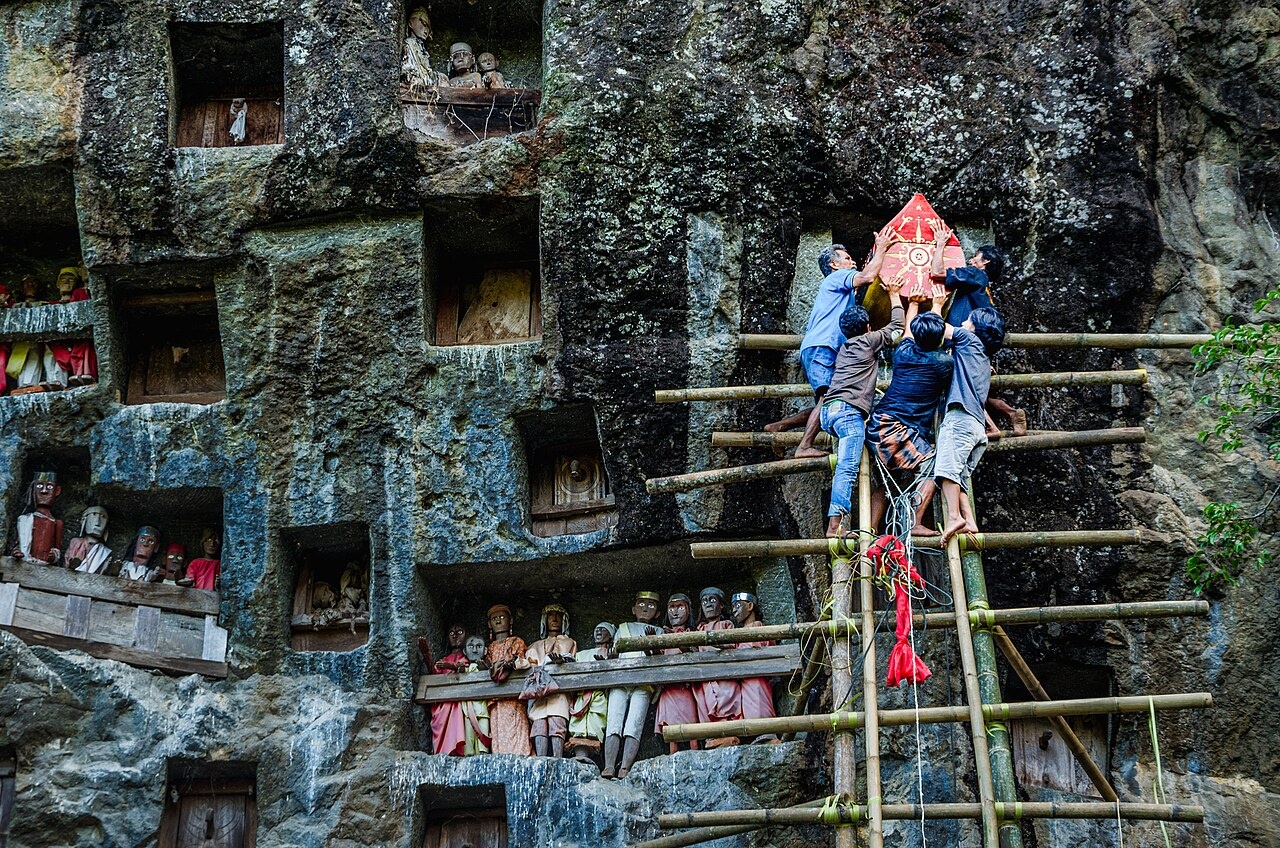
Torajan burial customs have changed over time, particularly following the Bugis invasion of Tana Toraja from the south in the 17th century. Prior to that time, human remains and valuable burial gifts were stored in intricately carved wooden coffins. During the invasion, many of these coffins and gifts were destroyed. In the past, monumental graves in parts of the region rivaled those of Sumba in scale and grandeur, featuring large carved figures mounted on elephants or lions. Hewn from stone quarries and dragged to burial sites, these monuments served as powerful statements of the wealth, status, and authority of the deceased’s family. UNESCO]
Since the Bugis invasion, Torajans have made less decorative coffins and placed them in vaults high on cliffs. They reserve more intricate carvings for tomb doors and portrait statues of the deceased called tau-tau (See Below). Recently, bamboo forests have been replaced with cash crops.[Source:
In parts of Toraja Land in Sulawesi, miniature tongkonan are used to mark burial sites, reflecting the belief that the dead must be housed in ways similar to the living. Among the Saʾdan Toraja—named after the nearby Saʾdan River—the most famous graves have traditionally been caves carved into steep hillsides. These caves serve as tombs for the deceased, whose bodies are wrapped in layers of ikat and silk textiles, and are often accompanied by a carved wooden effigy placed at the entrance. [Source: “Culture and Customs of Indonesia” by Jill Forshee, Greenwood Press, 2006]
Some cave tombs are sealed with elaborately carved wooden doors, frequently decorated with images of the water buffalo, a symbol of wealth and ritual importance. Many of these burial caves are located high on cliff faces, and transporting both the body and the effigy to such elevated sites requires great physical effort and careful coordination by large groups.
RELATED ARTICLES:
TORAJAN FUNERALS: RITUALS, BELIEFS, COSTS, EVENTS factsanddetails.com
TORAJAN RELIGION: AFTERLIFE, PRACTITIONERS, CHRISTIANITY, TRADITIONAL BELIEFS factsanddetails.com
TORAJANS: HISTORY, LANGUAGE, DEMOGRAPHICS, GROUPS factsanddetails.com
TORAJAN SOCIETY AND LIFE: FAMILIES, FOOD, HOUSES, WORK factsanddetails.com
TORAJAN CULTURE: ART, TEXTILES, MUSIC, ARCHITECTURE factsanddetails.com
TANA TORAJA TRAVEL: HOTELS, TRANSPORT, GETTING THERE, RAFTING factsanddetails.com
TANA TORAJA SIGHTS: TRADITIONAL VILLAGES, HOUSES, CLIFFSIDE GRAVES, FUNERAL SITES factsanddetails.com
SULAWESI factsanddetails.com
SOUTHERN SULAWESI: HISTORY, GEOGRAPHY, RELIGION factsanddetails.com
Torajan Burial Practices
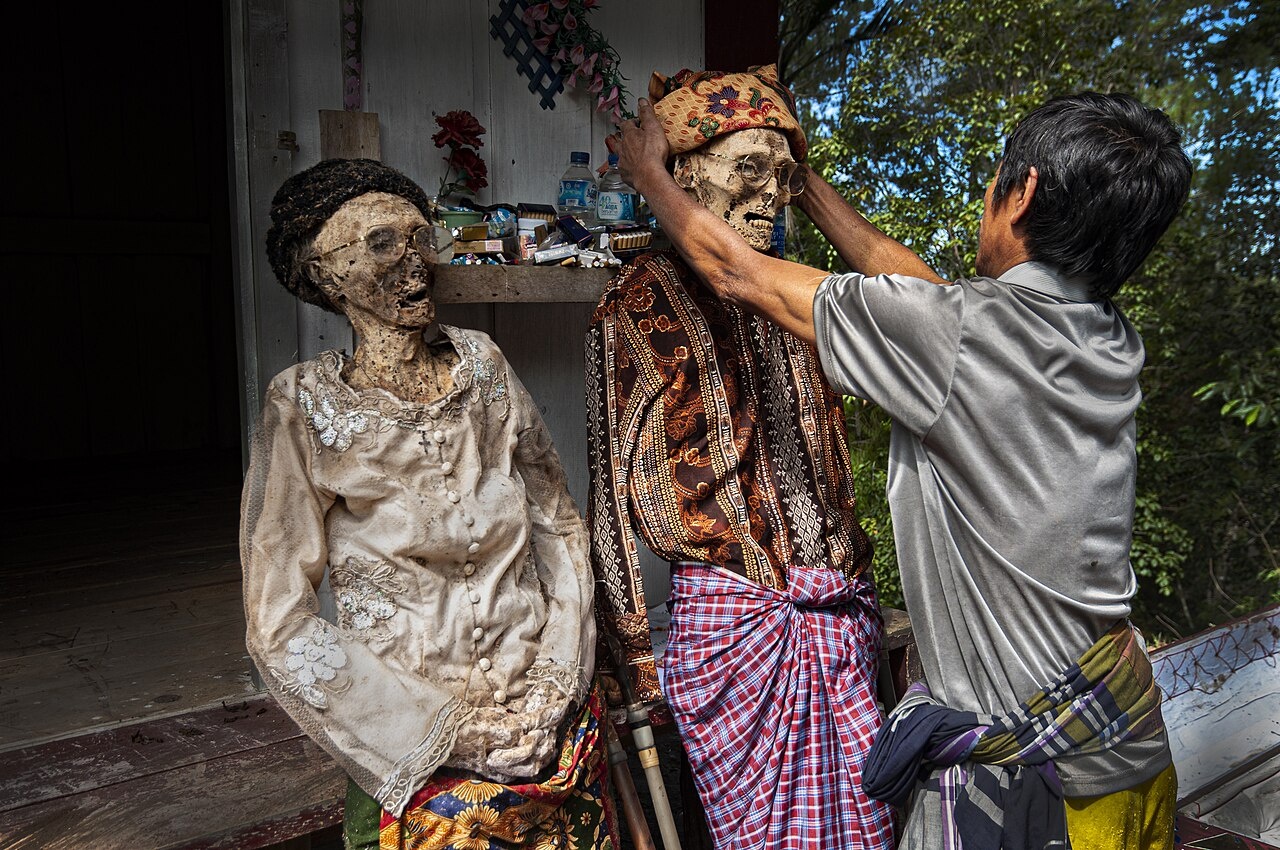
Torajan burial practices include placement of coffins in caves, carved stone graves, or coffins suspended from cliffs. Wealthy individuals are commonly buried in stone graves carved into cliff faces. Wooden effigies known as tau-tau are often placed near the graves. Infants may be buried in living trees. The Ma’Nene ritual involves the periodic exhumation, cleaning, and redressing of the deceased. [Source: Wikipedia]
With the exception of certain groups in the Palu River valley that had adopted Islamic burial practices, Eastern Toraja groups observed two funerals: one held shortly after death and a second, usually communal ceremony held one or two years later. Final disposal of the body took place only after the second ceremony. After death, the corpse was laid out under a canopy for one or two days, then placed in a coffin made from a hollowed log split lengthwise. The coffin was carried away and either buried in the ground or set on a raised platform outside the village. [Source: John Beierle and Martin J. Malone,e Human Relations Area Files (eHRAF) World Cultures, Yale University, September 1996]
At the second funeral, the body was prepared for final disposal. The coffin was removed from the platform or exhumed, the bones were cleaned, wrapped in bark-cloth bundles, and carried back to the village in baskets. The ensuing ceremony, known as mompemate or tengke, involved the ritual “leading” of the souls of the deceased—believed to be multiple tanaona—to the land of the dead through litanies chanted by tadu priestesses. Before this rite, the souls were thought to wander between the earth and wayu wune, an antechamber to the spirit world. After the mompemate rites, the bones were placed in small coffins called sosoronga and either buried or deposited in caves. Common slaves, stillborn children, and individuals who died of smallpox or leprosy were not placed in coffins but were wrapped in tree bark and buried.
Ma’nene’ — Toraja Technique and Ceremony of Preserving the Dead
Putu Sayoga wrote in the New York Times: Sobbing beside her family’s grave in the mountainous subdistrict of Rindingalo, Odiya Sulu, 38, clutched a photograph of her mother and spoke haltingly about how much she missed her. Her mother, Elis Sulu, had died in 2015 at age 65. But a year later, in 2016, when her coffin was carried outside and opened by relatives, her body was remarkably intact — the results of local preservation techniques. [Source: Putu Sayoga, New York Times, December 14, 2020]
“Still weeping, Ms. Sulu stroked her deceased mother’s face. Her brother placed his hand gently on one shoulder. The daughter soon felt calmer — calm enough, at least, to fetch a broom and begin cleaning the grave while her mother’s body lay in the sun.
“When I visited North Toraja for the first time, in August 2016, the Sulu family was performing a ritual called ma’nene’, during which the bodies of deceased family members — long after their elaborate funerals were held — are exhumed, cleaned and left in the sun to dry before being dressed in new clothes.
“For Torajans, death is a gradual — and social — process. The bodies of people who have recently died are kept at home and preserved by their families, sometimes for years, until the family has enough money to pay for a funeral. The spirit of the dead is believed to linger in the world before the death ceremony is held. Afterward, the soul will begin its journey to Puya, the land of the spirits. The longer the deceased person remains at home, the more the family can save for the funeral — and the bigger and more expensive the ceremony can be.
Ma’nene’ is carried out every one, two or three years (or more, depending on the family’s agreement), is meant to be a way to honor deceased relatives. According to the belief, performing the rite will result in a better harvest in the following year. According to local legend, the ritual of ma’nene’ is rooted in the story of a hunter named Pong Rumasek, who, hundreds of years ago, found an abandoned corpse in the Torajan jungle. Moved by the stranger’s misfortune, Rumasek took care of the dead body and dressed it up in his clothes. From then on, he was said to be endowed with good luck and bountiful harvests. Locally, though, that origin story is often considered apocryphal. “Nobody knows when, where and how exactly the tradition was first invented,” Endy Allorante, a photographer from Toraja who has documented Torajan death rites since 2006, told me.
“Once Elis Sulu’s grave house, or patane, was clean, her relatives removed her body from its coffin and redressed it in new clothes — but not before taking pictures with the dead body.After completing the ceremony, the family headed back to Odiya Sulu’s home to share a meal of traditional Torajan food that had been prepared earlier in the morning. The meal signaled the end of the rite. “I’m longing for my mother so much,” Ms. Sulu said. “Seeing her body heals my heart, but after this, I have to wait for two years to see her again, on the next ma’nene’.”
Torajan King Waiting to Be Buried
Paul Watson wrote in the Los Angeles Times, “The last king of Toraja was 93 when he took his final breath in July 2003. Five years later, he's still part of the family, quietly residing in a small room in his former palace, shaded by two red parasols decorated with colored beads and gold fringe. By Torajan tradition, he isn't really dead. He's just sick. The late monarch won't be gone for good until he has been laid to rest with traditional rites featuring the slaughter of scores of water buffaloes, at least one of them a rare spotted specimen. [Source: Paul Watson, Los Angeles Times, August 14, 2008 ==]
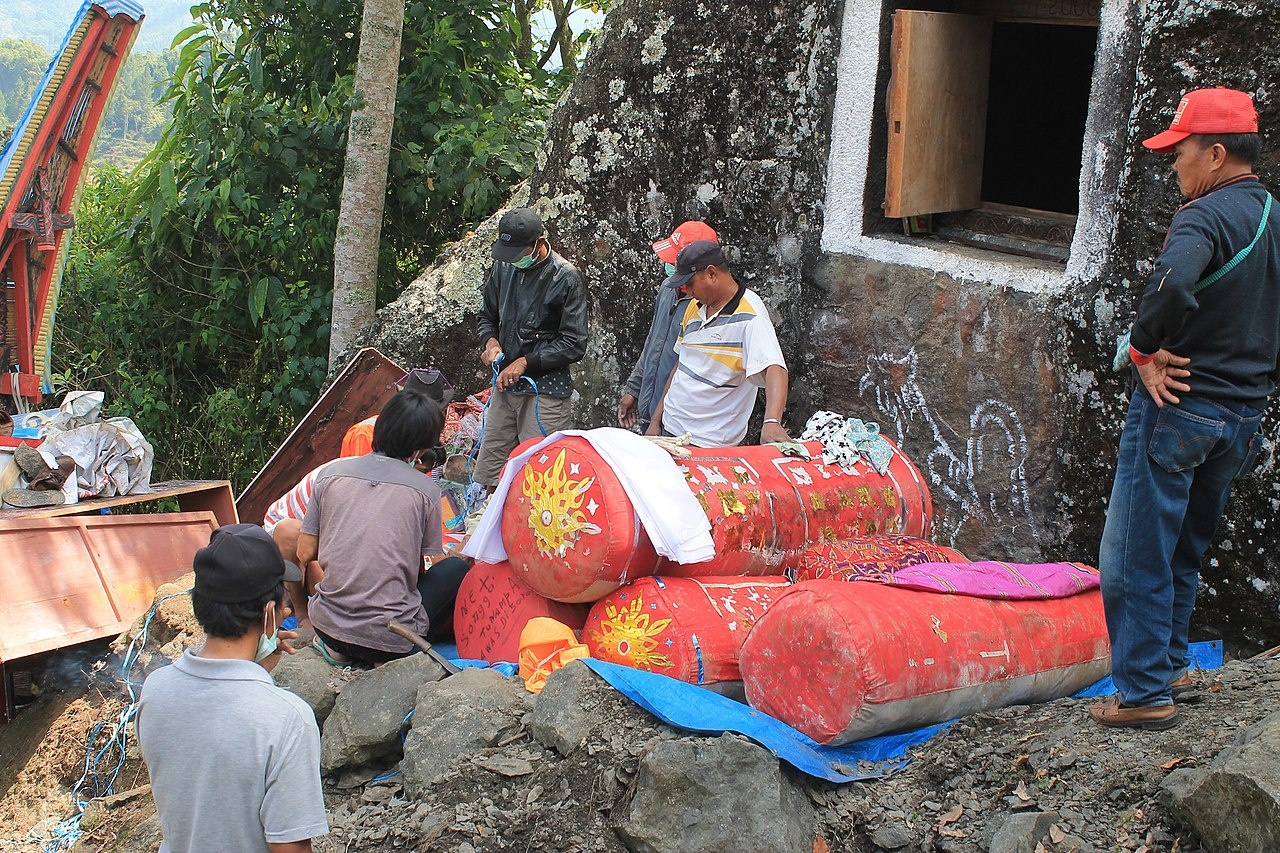
“A village mortician schooled in the old ways gave the late king's body the royal treatment with natural preservatives. It took more than 320 yards of cloth to wrap his mummy, a simple task compared with the long negotiations and complex preparations for his funeral. "Torajans are very sensitive about this because the funeral is our last honor," said Eddy Sambolinggi, the youngest son of the last king, Puang Sambolinggi. "Everything has to be carefully planned." ==
“It has taken his family five years to agree on a send-off befitting Puang Sambolinggi, which is now planned for October. The farewell is shaping up to be the last grand funeral in Torajan history, the final chapter of a royal history that dates back centuries. Sambolinggi's reign saw the death of an ancient dynasty in Tana Toraja, or the Land of Toraja. He held the throne for only a year until, just days after Japan surrendered in August 1945, Indonesia declared independence from the Dutch and abolished tribal monarchies. But tribal tradition lives on.” ==
"We have to wait until the whole family is ready," Sambolinggi said. "For instance, there's me and my siblings. Perhaps I am able to contribute a number of buffaloes, while my siblings still have to wait and save some money. We all have to agree, because for this funeral the number we're talking about isn't small." Up to 80 buffaloes will be sacrificed in front of tens of thousands of mourners. Just counting relatives, Sambolinggi said, there will be 100,000 guests, many of whom will journey hundreds of miles. ==
“Family members have also dickered over whether the body will be buried next to the late king's father or mother, Sambolinggi added. Until the plans are settled, and relatives bid their final farewells, the late king, wrapped in cloth and encased in a wooden coffin, lies in repose just up the stairs from his youngest son's private museum of old spears, beaded dresses and other tribal artifacts. Sambolinggi regularly talks to his father, not in a way anyone else could hear, he said, but silently, from his heart. "For the past five years, he's been with us, sleeping upstairs," Sambolinggi said. "We still prepare his place at the dining table. And for instance, if we go to the capital city, we have a big feast, and we save some for him." ==
Preparing the Body of a Dead Torajan King Be Buried
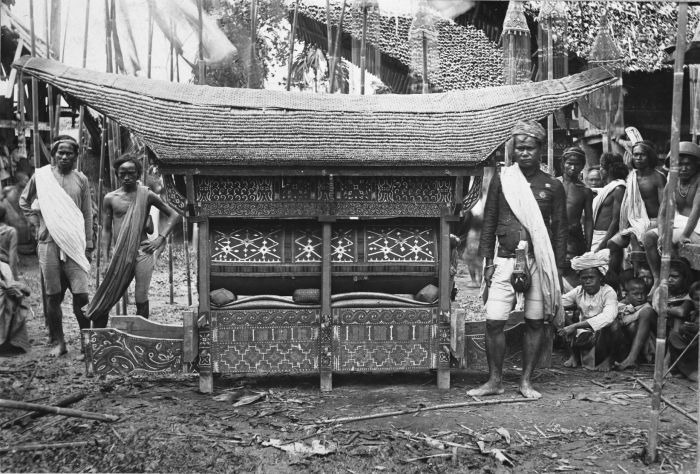
Paul Watson wrote in the Los Angeles Times, When the king died, in the normal sense of the word, his son called in an undertaker to make a mummy of him the old-fashioned way, without embalming fluid. The mortician died soon after, taking some of the secrets of Torajan mummification to his grave. But Sambolinggi watched him closely at work, and his memory preserves a vivid remnant of a centuries-old ritual. His father's corpse was cleansed with tea mixed with warm water and soap chopped into little pieces. Then the mortician poured about three bottles of vinegar, a little at a time, down the late king's throat. [Source: Paul Watson, Los Angeles Times, August 14, 2008 ==]
“A small rope, used to tie a water buffalo by the nose, was retrieved from the ground where it had fallen in the animal's pen, cut into pieces and sprinkled on the body so that the tether could go with him to heaven. Then the corpse was wrapped in cloth, tightly bound in three places with coconut fronds. "After that, there was a little magic," Sambolinggi said. "The man who performed the ritual put a black stone pot, like a cooking pot, in the corner of the room. He told us not to touch it, and warned that if we did, the body would be damaged." ==
“A week later, Sambolinggi smelled a foul odor, which he suspected was wafting from his father's body. He quickly summoned the undertaker. "He checked and said that it was not the body that smelled bad, but there were many other dead persons' spirits around," Sambolinggi recalled. "He asked me if I'd heard any banging sounds on the door lately, and I said yes. " Spirits had come knocking, the mortician said, and his magic chased them off. The smell, and apparently the ghosts, never came back. Any lingering doubts Sambolinggi had about the wisdom of Torajan tradition vanished with them. ==
Torajan Cliffside Burials
During Torajan burials the deceased is buried in a hollowed out cliffside grave that sometimes are as high as 30 meters off the ground. The caves have traditionally been hollowed by specialists who were paid in buffalos. The price is very high and generally only the rich can afford it. Sometimes the graves have intentionally been placed in difficult to reach places to discourage grave robbing.
To get the body to the grave the remains of the body, still wrapped in blanket, are placed into a bag. The bag is then hoisted over the shoulder of a man who climbs a long bamboo pole by placing his feet into notches carved into the pole. He is followed by several men who make sure the pole doesn't get twisted. The body its then placed in an open cave. If the dead person is rich a balcony is constructed outside the grave.
In some cases coffins are hung from cliffs rather than placed in caves or niches. Some coffins are shaped like pigs. Older ones are built to resemble ships. Babies who have died before teething are placed in hollowed sections of living trees. The graves consist of hollowed-out sections of tree which are covered up with fibers from sugar palms.
Tau Taus
Positioned on the balconies of the cliffside graves where Torajans are buried are spooky-looking life-size wooden statues called tau taus which are fully clothed and have human hair. Effigies of the deceased who are buried behind them, they are usually carved from jackfruit wood and every effort is made to make sure the physical details resemble those of the deceased.
Tau taus are respected by both Christian and animist Torajans. Women tau taus have pierced ears and men have turbans. Every couple of years after person dies the clothes on the tau taus are changed and children are sent to the cliffside graves to dust of the skulls and other remains of dead relatives. ♂
The custom of making tau taus is thought to have originated in the late 19th century. In the old days they were quite basic and primitive -looking and stylized. Now some are quite realistic looking. The ones made today can be quite elaborate and detailed. They are made with great skill and capture the dead as they liked when the died rather than when they were wee young. Not so many tau taus are visible. In recent years many have been stolen and found there way to the international art market. Today many Torajans keep them in their homes.
Describing the resting place of Torajan royals before a king was buried there, Paul Watson wrote in the Los Angeles Times, “His father's remains probably will be sealed in a royal tomb carved out of the nearby Suaya cliff, where his brother-in-law's coffin was laid to rest, just as dozens of royals have been through the centuries, including the late king's ancestors. Like wide-eyed marionettes gathering dust on a puppeteer's shelf, life-size wooden dolls representing the dead stare down from balconies outside their tombs. Relatives look up to greet them when they bring offerings, such as cigarettes, palm wine or bottled water, that they set at the base of the cliff. [Source: Paul Watson, Los Angeles Times, August 14, 2008 ==]
Torajan Walking Dead
Dave Marks wrote in Research Notes, World Beliefs: “The real-life story of the “walking dead” of Tana Toraja, Indonesia began with some misinformation regarding a photo that had been circulating around the internet for quite some time. The photo was described as a “Rolang” – which literally means “the corpse who stands up.” It was suggested that it was a photo taken of a funeral ritual in which the body of a dead person was mystically revived (by a shaman), so that they may walk on their own steam, back to their place of birth, and be “buried” there. [Source: Dave Marks in Research Notes, World Beliefs +++]
“Additionally, information included that the walking corpse was also accompanied by a handler who would generally use specific paths where there would be little traffic. These paths were generally more or less straight– and the walking corpse would walk purposefully on his or her course. Should he or she and the handler encounter another person on their way, the person was to make no effort to touch or communicate with the deceased. Should that occur, the body was said to collapse (or disappear). +++
“All of this, of course sounds pretty incredible, and once again, from any scientific point of view, pretty unbelievable. As it turns out, I was able to uncover the truth behind this belief. My investigation uncovered another funeral ritual performed on the dead by the Torajan people that makes a lot more sense, and I have also managed to track down a video of this ritual. +++
Explanation for Torajan Walking Dead
Dave Marks wrote in Research Notes, World Beliefs: “When the people of Tana Toraja die, they are often placed in boxes which are then placed in tombs carved out of solid rock, high up on limestone cliffs. So they are, in fact, generally not buried in the ground. This is what makes the following ceremony possible. The ceremony is called Ma ‘Nene’ (The Ceremony of Cleaning Corpses). Out of tremendous respect for their dead and afterlife, the boxes are removed from the tombs (every few years), the corpses are removed from the boxes, and are cleaned and re-dressed. Damaged boxes are fixed or replaced. [Source: Dave Marks in Research Notes, World Beliefs +++]
In Torajan society, death rituals (funerals) are more important than life rituals (births and marriages). So the funeral ritual is a most elaborate and expensive event than even a marriage. The richer and more powerful the individual, the more expensive the funeral. And in this animism belief system, only nobles have the inherent right to have an extensive death feast (which can include the ritual slaughter of many buffaloes). As this ritual is so important, it can take, in some cases months or even years for the family to save enough funds to pay for the elaborate ritual. The deceased are wrapped in cloth and preserved (in their “sleeping stage”), usually using formalin (essentially formaldehyde)– though a variation of leaves was used historically. When the dead are eventually laid to rest, they are placed in a cave or in a carved stone grave, or hung on a cliff or mountain/hill. Why a cliff Because that’s where the Hyang is found (more on the Hyang below). Suffice it to say, it is a powerful supernatural spirit. +++
“This brings us to the spiritual connection of the “walking dead.” First, let me say that I in no way believe that there are corpses walking between villages and towns in Tana Toraja. Sorry– that might disappoint some people, but ZRS is not a sensationalist organization– we do aim to investigate and educate. I do believe that the “walking dead of Tana Toraja” is a melding of two traditions or rituals. It’s easy to see how this could happen when a few language and cultural barriers are crossed. +++
“The actual transportation of the deceased between villages, etc, along what can be described as “corpse roads” (in English tradition — also explained further down) to their places of birth (as is Tana Toraja tradition) was likely engulfed in spirituality and superstition. I can not imagine it would make sense to carry the dead upright (as if they were standing) and made to appear to walk. Horizontal transportation makes the most sense. I could see that touching the dead could cause consternation for the superstitious people though. +++
The actual “walking” part of the dead appears to happen during the ritual of Ma ‘Nene’ (The Ceremony of Cleaning Corpses). Out of respect for their dead and afterlife, the boxes containing the dead are removed from the tombs (every few years), the corpses are removed from the boxes, and are cleaned and re-dressed. Damaged boxes are fixed or replaced. In videos I have seen the dead seem to be exhibited and paraded around, as if they they were alive.
Image Sources: Wikimedia Commons
Text Sources: “Encyclopedia of World Cultures Volume 5: East/Southeast Asia:” edited by Paul Hockings, 1993; National Geographic; New York Times, Washington Post, Los Angeles Times, Lonely Planet Guides, Library of Congress, Smithsonian magazine, The New Yorker, Time, Reuters, AP, AFP, Wikipedia, BBC, CNN, and various books and other publications.
Last Updated January 2026