
TANA TORAJA
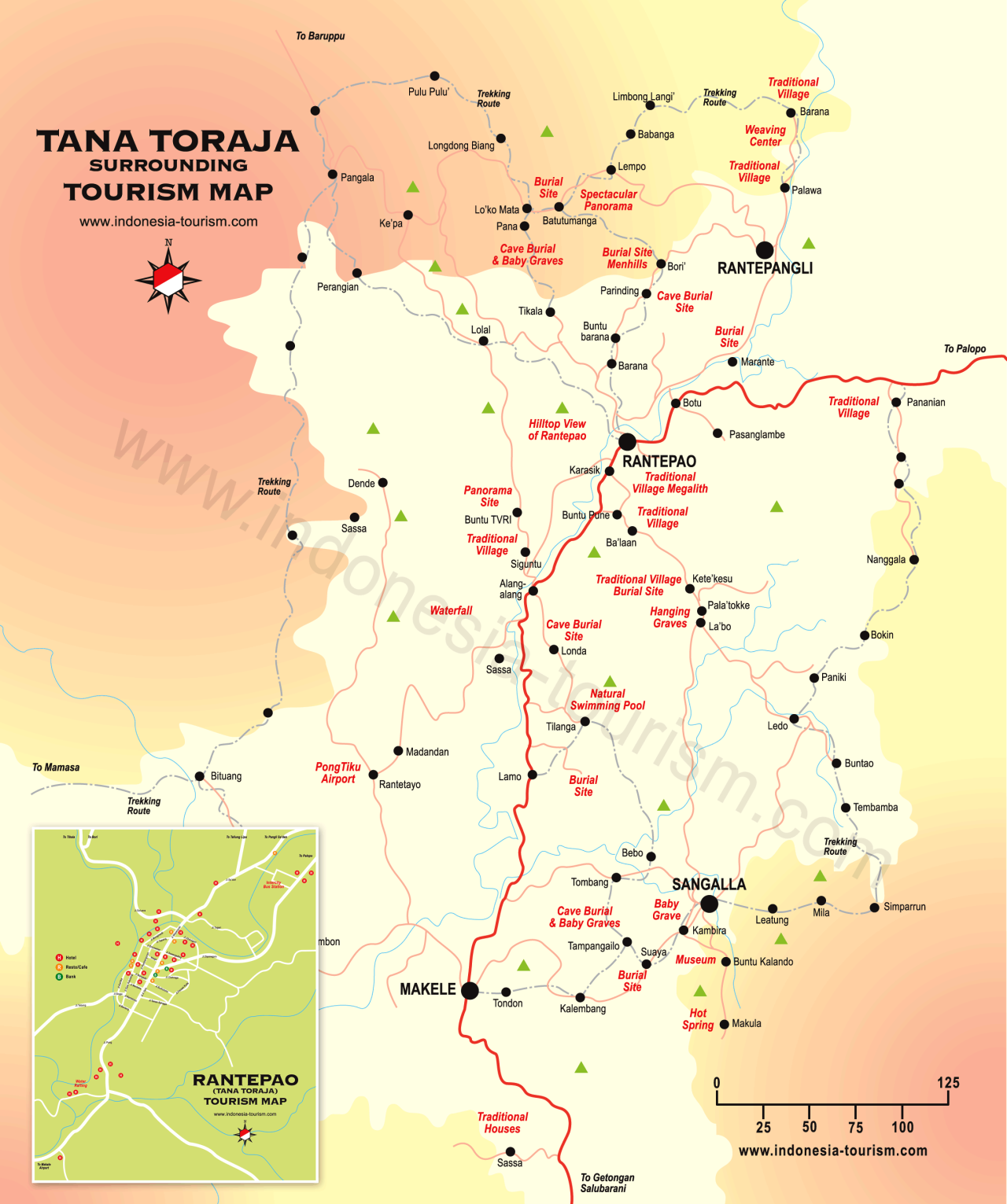
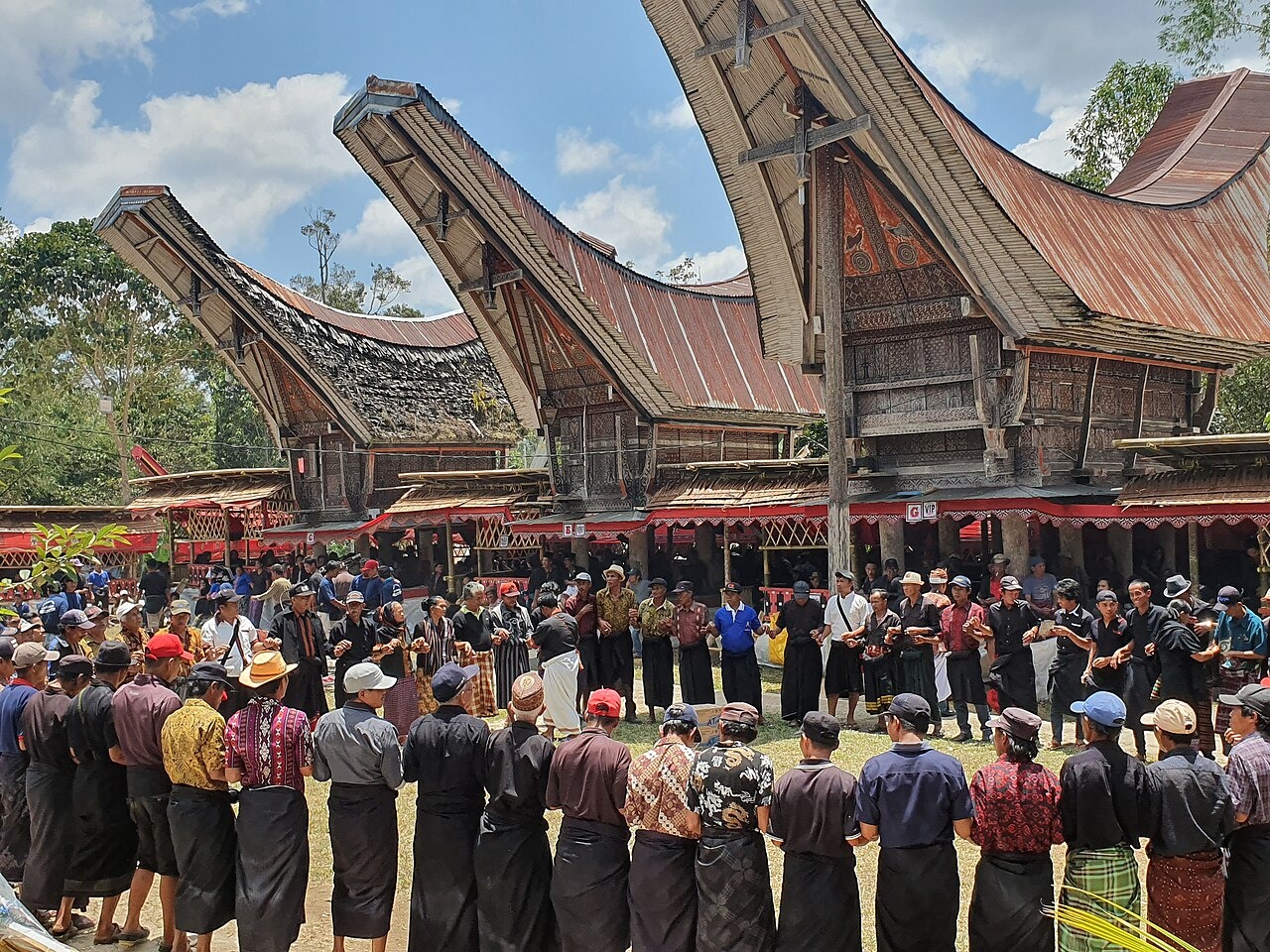
Tana Toraja (320 kilometers north of Makassar) is the home of the Toraja people and is a rugged and beautiful highland area of lush river valleys, rice terraces, bamboo groves, fir trees, tropical rain forests, coffee plantations, jagged limestone cliffs, and limestone and granite outcrops. There are more than 300 Torajan villages in the area with traditional” tongkonan,” or family dwellings, and rice barns with high upturned roofs." Some of have grave sites. Each site is different and you may be able to see a Torajan funeral, the ultimate expression of Torajan culture.
A special bell shaped gate marks the entrance to the region. After the gate the road passes Kandora and Gandang which are according to Torajan legend are the mountains onto which their first ancestors descended. One knows that one has arrived to Torajaland when one see the "Most Holy Penis," a 300-meter-high rounded pinnacle of granite, and the "Most Sacred Vagina," which the Blair brothers wrote in the book “Ring of Fire” is an "exfoliated fissure, fringed with forest, about three football fields long." It was here among the clear streams, rice paddies, granite cliffs and virgin rain rainforest that the Torajans believe their ancestors descended in starships.
There are approximately 1.1 million Torajans, of which about 450,000 people live in the Torajan area. The number of visitors to the region has increased from 97,500 (12,500 foreign and 84,000 Indonesian) in 1984 to 255,000 (55,000 foreign and 200,000 Indonesian) in 1994 to 581,000 (30,000 foreign and 550,000 Indonesian) in 2016. The dry season is from April to October and peak tourist season is from June to September, particularly July and August when funerals are in full swing, when many of the hotels are fully booked and many people end up sleeping in hotel lobbies. Many Torajans expect to be paid for photographs.
RELATED ARTICLES:
TANA TORAJA SIGHTS: TRADITIONAL VILLAGES, HOUSES, CLIFFSIDE GRAVES, FUNERAL SITES factsanddetails.com
TORAJANS: HISTORY, LANGUAGE, DEMOGRAPHICS, GROUPS factsanddetails.com
TORAJAN SOCIETY AND LIFE: FAMILIES, FOOD, HOUSES, WORK factsanddetails.com
TORAJAN CULTURE: ART, TEXTILES, MUSIC, ARCHITECTURE factsanddetails.com
TORAJAN RELIGION: AFTERLIFE, PRACTITIONERS, CHRISTIANITY, TRADITIONAL BELIEFS factsanddetails.com
TORAJAN FUNERALS: RITUALS, BELIEFS, COSTS, EVENTS factsanddetails.com
TORAJAN BURIALS: TOMBS, TAU TAUS AND THE WALKING DEAD factsanddetails.com
SULAWESI factsanddetails.com
SOUTHERN SULAWESI: HISTORY, GEOGRAPHY, RELIGION factsanddetails.com
Tana Toraja Sights and Activities
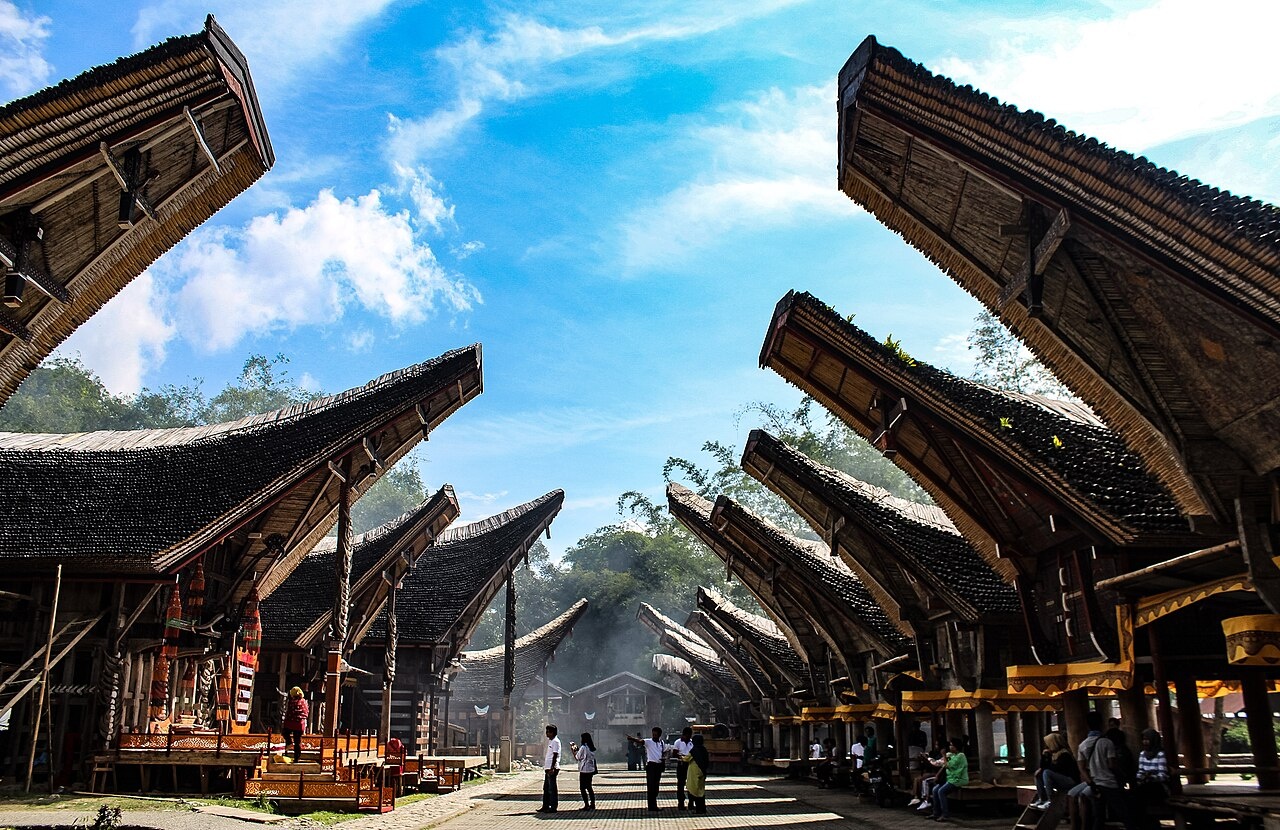
Rantepao is the main tourist town in Tana Toraja. Around the town are many villages with traditional Torajan houses. It is place to walk or bicycle on the back roads to see the villages and the lovely countryside they are set in. In the town you can explore the colorful traditional ‘Pasar Bolu’ market where you can get top end Torajan coffee beans. At the weekly market you can see water buffaloes and pigs are being auctioned. Palawa the Torajans’ main weaving center and an excellent village to see traditional Torajan houses. Enrekang and Makale in the Torajan Highlands are surrounded by rocky volcanic cliffs. Do not miss these.
Ke’te Kesu’ contains a model Torajan village, with a row of beautifully decorated Tongkonan — or ancestral homes — and rice barns. The Tongkonan are the typical Torajan saddle-shaped roofed houses, reminiscent of buffalo horns. The walls of the houses are beautifully decorated with abstract and geometrical patterns in natural black, red and white. Ke’te Kesu’ is also known for its bamboo carvings and traditional handicrafts.
At Lemo are the “hanging graves” of the nobility, where crypts are carved high into steep rock cliffs, and wooden effigies of the deceased — called tau-tau — stand in a row on a balcony staring unseeingly over the green rice fields below. At Londa are caves piled up coffins that extend deep into the interior. At Suaya are the king’s family graves, while at nearby Sangala are the tree-graves of babies. The ancient Torajan believe that dead babies and children must be buried into a tree, where the tree will grow around the dead body.
On the slope of Sesean mountain (25 kilometers. from Rantepao) you can see the Batu Tumonga Plateau — the stone that faces the sky. From here you will find a spectacular panorama of terraced rice fields in the valley below shimmering like a patchwork in gradual hues of green, scattered with huge megalithic boulders. A number of these have been turned into grave caverns. Visit coffee plantations and enjoy walks through villages.
Sa’dan To’Barana’ (16 kilometers north of Rantepao) is a traditional plait center, located in the district of Sesean. This area is known for its traditional Torajan ‘ikat’ weaving.
Tourism in Tana Toraja
Many of the tourists that come to Tana Toraja, morbidly enough, come to check out the Torajan people’s unique culture and rituals, most of which are mostly centered around graves and death ceremonies. You can go to the tourist office and find out if and where funerals are taking place and then show up and watch the events, which typically involves the sacrificing of several or many water buffalo and pigs. There is often an area where tourist can observe the proceeding and generally they are welcome to eat the cooked meat from the sacrificed animals. If you are not into watching funerals there are plent of other things to do such as walking through the spectacular Torajan countryside, visiting remote villages, rafting on the Sa’dan river.
There are many good hotels in Makale, Ranteapo and other places and numerous travel agents and guides to take you around. You can get around by walking or cycling. Several hotels and places in Rantepao rent bicycles although they are not so great and it is difficult to get one with a high enough seat if you are tall. Bemos — small minibuses — are used by locals but you may have to wait a while for one to show up and get enough people to leave. If you want to see a lot of scattered around places it best to hire a vehicle (a taxi, minibus or SUV) with or without driver.
Tips: 1) Visitors are expected to respect to local customs and dress properly and to bring a token present, such as cigarettes or coffee when entering a Tongkonan, the Torajan traditional house. 2) As roads are not always paved, it is necessary to use a jeep or walk, even when the weather is good (between May and October). 3) Watch your head whenever going inside a Tongkonan, since passageways are low. 4) Tana Toraja is near the Equator but 700 meters above sea level. Days can be hot, but not super hot. and nights can be cool so bring appropriate clothing. 5) Things to Buy: There are souvenirs shops in Rantepao where you can buy everything specific from Tana Toraja. There are clothes, bags, wallets and other handicrafts.
Accommodation and Restaurants
Visitors who wish to stay in the heart of Tana Toraja have many choices since there are many large and small hotels available, however, only few have their own website. Others may be booked through hotel reservation systems or travel agents. Or if you have an adventurous soul, you can sleep in villages on the way. For information on hotels and tours check: sulawesi-experience.com
Restaurants: Most of the time, you will not find restaurants near tourist sites; however warungs and restaurants appear along the road. Best bring your own lunch box. When taking a tour, your travel agent will take the group to a restaurant or provide lunch boxes in the bus.
The Toraja Heritage Hotel and the Toraja Prince Hotel are three star hotels located in Rantepao. Sallebayu Bungalows & Restaurant - Bonoran - Ke'te'/Kesu' - Rantepao - Tana Toraja, which operates 8 bungalows complete with air conditioning and all amenities, Tel/fax : +62 423 23469, E.mail : nicorstt@indosat.net.id.
Others include: 1) the one star Misiliana Toraja Hotel at Jalan Jurusan Makale, Rantepao; 2) The Marante Toraja Hotel at Jalan Jurusan Palopo, P.O Box 52, Rantepao; 3) The Marannu Hotel Toraja at Jalan Pongtiku 116-118, Makale, Tana Toraja; 4) The Indra Toraja Hotel at Jalan Landorundun 63, Rantepao
Toraja Heritage Hotel is built in the style of traditional Tongkonan houses. The 160 rooms and suites come with standard amenities, and have balconies facing the rice fields. Facilities include an outdoor pool, overlooking the mountains, mountain bikes available for rent, two restaurants, spa, fitness center, and Jacuzzi. Toraja Heritage Hotel, Jl. Kete Kesu, P.O. Box 80, South Sulawesi, Tel: 62 — 4232 1192, E mail: info@torajaheritage.com, Sales_marketing@torajaheritage.com, Website: torajaheritage.com
Hotel MaranteToraja provides spacious guest rooms with private terraces overlooking the Torajan landscape. Tranditional Tongkonan Cottages offer a choice of two levels, and are tastefully furnished and equipped according to international standards. Room rates range from USD 100 — 300, and are valid for single or double occupancy. Hotel MaranteToraja, Jurusan Palopo, P.O. Box 52, Rantepao, North Toraja, South Sulawesi, Tel. 62 — 4232 1616, E mail: info@marantetoraja.com, Website: marantetoraja.com
Toraja Misiliana Hotel has been owned and run by a local Torajan family since 1980, providing a warm family atmosphere, and a “home away from home.” The hotel is just 12 kilometers from Pongtiku airport, and is easily accessible by public transport. 101 Spacious rooms combine traditional Torajan culture with Western design, and are all complete with private shower, mini-bar, in house movies and satellite TV. Facilities include room service, laundry service, tennis court, swimming pool, conference and meeting rooms, ballroom with 750 person occupancy, and shopping arcade. Room rates from IDR 700,000 — 2,500,000. Toraja Misiliana Hotel, Jl. Pontiku No. 2, Rantepao, Tana Toraja, South Sulawesi, Tel. 62 — 4232 1212 / 62 - 4232 1575, Website: torajamisiliana.com
Getting to Tana Toraja
To reach Toraja take a plane to Makassar. Sultan Hasanuddin airport in Makassar is an airline hub for East Indonesia and there are many airlines flying to Makassar from Jakarta, Bali, Manado and other cities There are daily flights from Jakarta and Bali and regular flights from Kuala Lumpur Malaysia.
Most people cover the 350 kilometers from Makassar to Rantapao by bus, which takes between 8 and 10 hours. Some take the night bus. Others go by boat to Pare-Pare and travel three hours to Rantepao by bus. There are or were flights on small 17-seat and 25-seat Cessna-style planes from Makassar to Rantepao with DAS airlines. The runway at the Rantepao airports is too small to accommodate larger planes.If you decide to fly, you will arrive at Pong Tiku Airport in Rantetayo, TanaToraja, within 55 minutes. The plane flies only twice a week : Tuesdays & Fridays at 10:00a.m.
From Makassar there are many buses everyday to Ranteapo, the main tourist town in Tana Toraja. The journey takes around 8 hours and includes a meal stop. Tickets must be bought in Makassar city but coaches actually leave from Daya bus terminal, 20 minutes out of town by bemo. Coaches typically leave in the morning (7 am ), around noon ( 1 pm ) and in the evening (at 7 pm). Often you can make arrangements with hotels for these buses. The buses stop at some hotels on the main road. The night buses are kind of uncomfortable to sleep in but they deposit you in Ranteapo in the morning so you can enjoy a full day there.
Several companies in Rantepao run buses back to Makassar. The number of buses each day depends on the number of passengers. It is best and easiest to contact an experienced travel agent to arrange and take care of your full itinerary to the Torajan highlands. You may rent a car for about Rp.850,000 to Rp. 1,200,000 one-way.
The road from Makassar to Toraja runs along the coast for about 130 kilometers and then hits the mountains. After the entrance to Tana Toraja at the market village of Mebali one enters a majestic landscape of giant, gray granites and stones and blue mountains afar that form a sharp contrast with the lively green of the fertile, rain-fed terraces and the rusty red of the tropical soil.
Rafting on Toraja’s Sa’dan River
One day and two day rafting trips are available on the Sadan River, The one day trip cost $45. The rapids are not too difficult. Rafter pass through traditional Torajan villages and see lots of iguanas. The Sa’dan river which follows the road as one travels from Makale to Rantepao in the highlands of Toraja, is the lifeblood of the people of Toraja, as its waters are used to irrigate the surrounding fertile ricefields and provides water for both humans and cattle in this largely agricultural land.
The Sa’dan river has its source in the mountains north of Rantepao and is one of the longest rivers on the island of Sulawesi, flowing a distance of 182 kilometers, measuring 80 meters at its widest point. Along this long route, the river sometimes moves slowly over flat terrains, but often rushes swiftly over big boulders down slopes.
Rafting much of the Sa’dan river can be done in two days, offering challenges from grade 3 to grade 5, passing picturesque ricefields, quaint traditional villages, steep gorges and high rocky mountains. The rapids at Puru are grade three, the Seba Rapids are grade 4, with the fastest being the Fitri rapids at grade 5 challenges. It us better to have some rafting experience before tackling this river. The Sa’dan has some difficult stretches. Be careful of the long stretches of rapids, strong currents, dangerous rocks and places with whirlpool. The conditions can be especially dangerous after heavy rains and trips can be cancelled.
The start of rafting is at the hanging bridge of Buah Kayu, north of Rantepao, a 3.5 hours ride by four-wheel drive vehicle, and finishes at the Pappi bridge at Enrekang. Participants do not need to worry about accommodation, since there are many homes along the river to stay the night.
There are a number of operators, professionals in handling white water rafting tours on the Sa’dan river. You can’t do this trip by yourself and make sure you don’t use some fly-by-night operations. Hotels and travel agencies in Rantepao can set you up. You can also try: 1) Mountain Travel Sobek, pioneers of white water rafting in Sumatra, Bali and Toraja: mtsobek.com; 2) Sella Indo Expedition: sellatours.com
West Sulawesi
West Sulawesi Province covers 16,787.18 square kilometers. Its population rose from 1,158,651 in 2010 to 1,284,620 in 2014. Its population density is 76.5 people per square kilometer. Several kingdoms used to exist here, fourteen to be exacts: Balanipa, Banggae, Bambang, Binuang, Pamboang, Sendana, Tappalang, Mamuju, Rante Bulahan, Aralie, Mambi, Tabulahan, Matangga and Tabang. Today, West Sulawesi is known for its cocoa, coffee (robusta and arabica), clove and coconut. Gold, coal and oil mining also help to make this province more prosperous. West Sulawesi became a separate province in 2004. It used to be a part of South Sulawesi.
Mamuju as the capital of West Sulawesi. Administratively, the province is divided into five regencies. Geographically, the province is located between the golden Triangle of South Sulawesi, East Kalimantan and Central Sulawesi as well as directly faces national and international sailing route of Makassar straits. The province embraces ocean coastline, lowlands and highlands. There is a lot of fertile land. Climate is generally tropical.
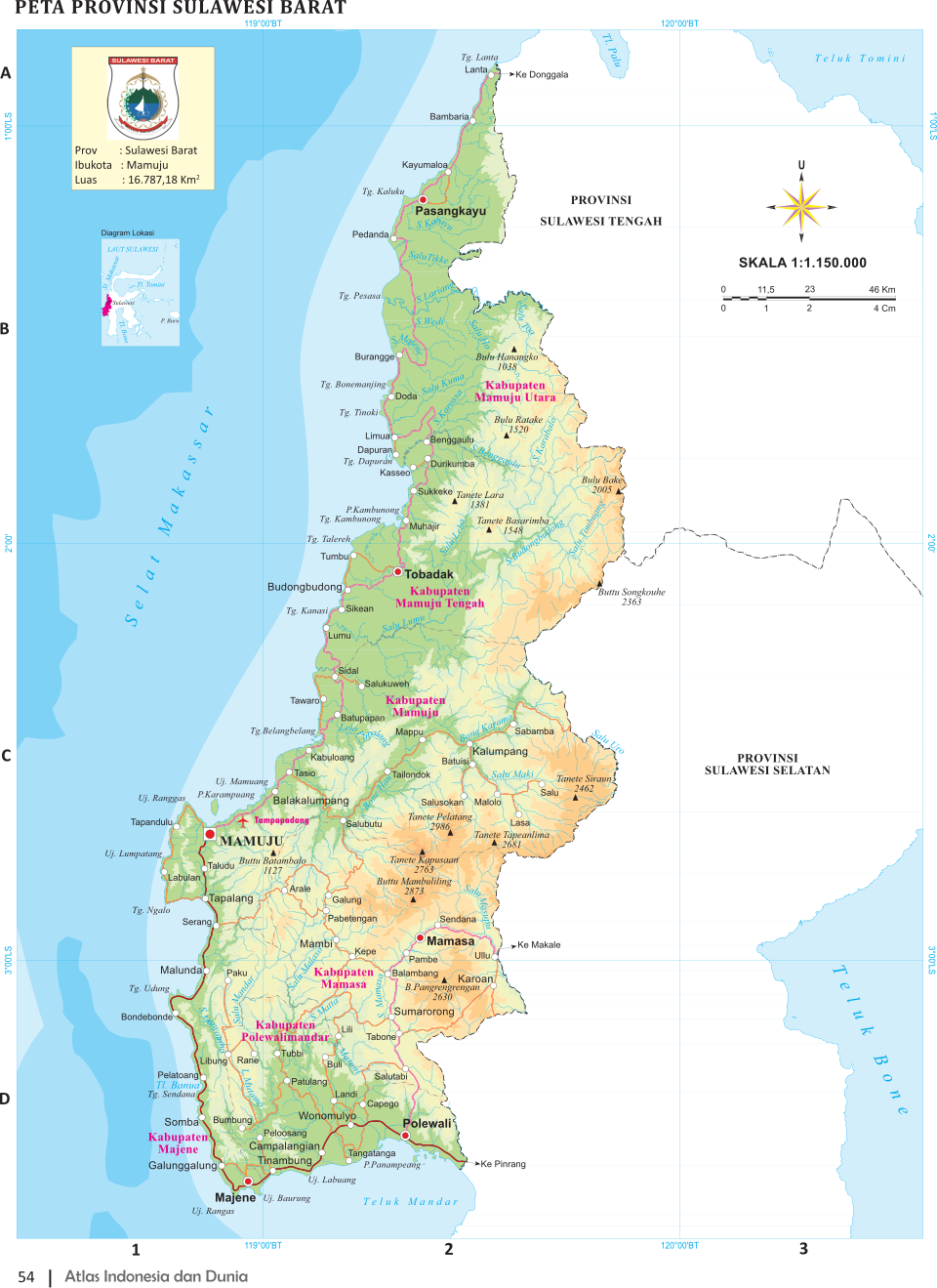
Tampa Padang Airport 27 kilometers from Mamuju capital city. At the Belang-Belang Bakengkeng Harbor in Mamuju District the Ferry Simboro Mamuju Harbor connects to Mamuju-Balikpapan, Batulicin, Surabaya, Ujung Polewali Mandar, Palippi natural harbor in Majene;,Manakara Harbor in Mamuju.
West Sulawesi is the home of the Mandar people, who hav e been known for centuries for their seafaring abilities. They are dominant group in this area, but you can also find Toraja, Bugis, Makassarese, Javanese and others here. Using their traditional sandeq boats, Mandar people cruise to all over Indonesia and reached as far as present-day Malaysia and Australia. People who live in mountainous areas have a culture similar to that of the Torajans, especially in terms of house architecture, language, clothes and traditional ceremonies.
Being close to the sea, seafood is one of the specialties of West Sulawesi. Flying fish eggs are considered a delicacy and if you're offered some, be grateful because it they are greatly treasured and are usually only served during special occasions. You can also find it in certain hotels or restaurants. Pupu and fried tuna fish cakes should also be tried. Generally West Sulawesi dishes are spicy, a bit sour but still delicious. Tourism Office: Dinas Kebudayaan dan Pariwisata Prov. Sulawesi Barat, Jl. Ahmad Kirang, Mamuju Sulawesi Barat, Tel. (62-426) 21092
Image Sources: Wikimedia Commons, Indonesia Tourism website, Wikpedia
Text Sources: Indonesia Tourism website (indonesia.travel), Indonesia government websites, UNESCO, Wikipedia, Lonely Planet guides, New York Times, Washington Post, Los Angeles Times, National Geographic, The New Yorker, Bloomberg, Reuters, Associated Press, AFP, Japan News, Yomiuri Shimbun, and various books and other publications.
Last updated in January 2026