
BALINESE CALENDAR
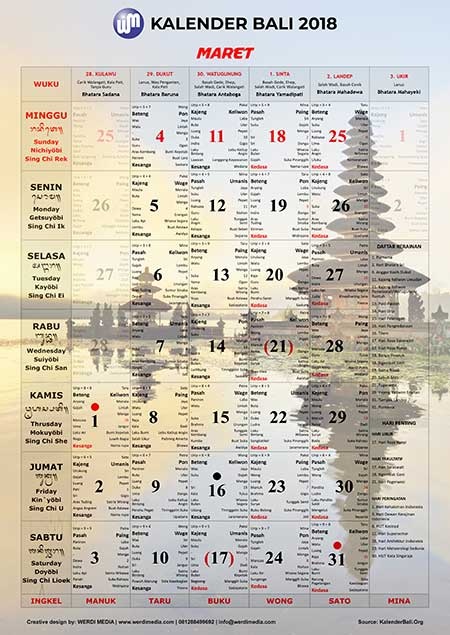
The Balinese use three calendars: the western one based on the sun, the 210-day Pawukon or uku calendar, and the Sasih, the “saka”, or Hindu calendar, which is divided into 12 lunar months of 29 to 30 days; The cycles of life on Bali are governed by the two non-Western calendars.
The Balinese calendar — Saka-Wuku — is a combination of: 1) the Saka, the Hindu solar-lunar year of 12 moons; and 2) the Javanese-Balinese Wuku calendar of 210 days which is divided into weeks. The combination of these two calendars and the many names for the different weeks and days make the Balinese calendar a complicated puzzle to solve. Experts in the field consult special charts and tables to determine days for the various religious festivals and significant days.
The Balinese calendar is used to determine birthdays (oton), anniversaries of temples (odalan), and the many festivals and the days that are so important in the everyday life of the Balinese. It is also used by rural Balinese to determine good days for the planting of crops. The calendar is determined by the phases of the moon, the most important days being each full moon (purnama) and new moon (tilem).
Saka Calendar used in Bali is a Hindu calendar, which is divided into 12 lunar months of 29 to 30 days. This calendar determines when harvest festivals, some temple festivals and the Balinese New Year are celebrated. Every 30 months an additional month is added to keep the saka calendar in sync with the solar year. For the year 2012 New Year’s Day was on March 23rd. For 2013, it was on March 11th.
The “uku”, or ancient Javano-Balinese calendar year is made up of 30 seven day weeks which add up to a 210 day year. The uku calendar is also broken down into cycles of three, five and six cycles. The conjunction of certain cycles creates unlucky days, sort of like Friday the 13th. The only difference is that on Bali these days occur every two weeks or so. This calendar is also consulted to determine the best days for funerals and cremations and special rites. Not coincidently, 210 days is the length of time between rice plantings. [Source: "Man on Earth" by John Reader, Perennial Libraries, Harper and Row]
Bali's 210 day calendar revolves around the growing season of rice. Nature, time and the rhythm of Balinese life have traditionally flowed harmoniously through it. New strains of rice which can be harvested after several months have messed it up. The six month cycle is very important to Balinese. Every six months there are island-wide ceremonies. Each temples has an anniversary ritual very six months.
RELATED ARTICLES:
BALINESE HOLIDAYS, FESTIVALS, RITUALS, CEREMONIES AND OFFERINGS factsanddetails.com
BALINESE RELIGION: HINDUISM, SPIRITS, TEMPLE LIFE, PRIESTS factsanddetails.com
FUNERALS AND DEATH IN BALI factsanddetails.com
BALINESE CULTURE AND ARTS factsanddetails.com
BALINESE: LANGUAGE, CUSTOMS, BEHAVIOR factsanddetails.com
BALINESE SOCIETY: GROUPS, CASTE, THE SUBAK SYSTEM factsanddetails.com
BALINESE FAMILY: MARRIAGE, WOMEN, RITES OF PASSAGE factsanddetails.com
LIFE IN BALI: VILLAGES, FOOD, CLOTHES, WORK, AGRICULTURE factsanddetails.com
BALI: GEOGRAPHY, LIFESTYLE, REPUTATION, GETTING THERE factsanddetails.com
HISTORY OF BALI: ORIGIN, KINGDOMS, MASS ROYAL SUICIDES factsanddetails.com
MODERN HISTORY OF BALI: VOLCANIC ERUPTIONS, TERRORISM, RECOVERY factsanddetails.com
Pawukon (210-Day Balinese-Hindu Calendar)
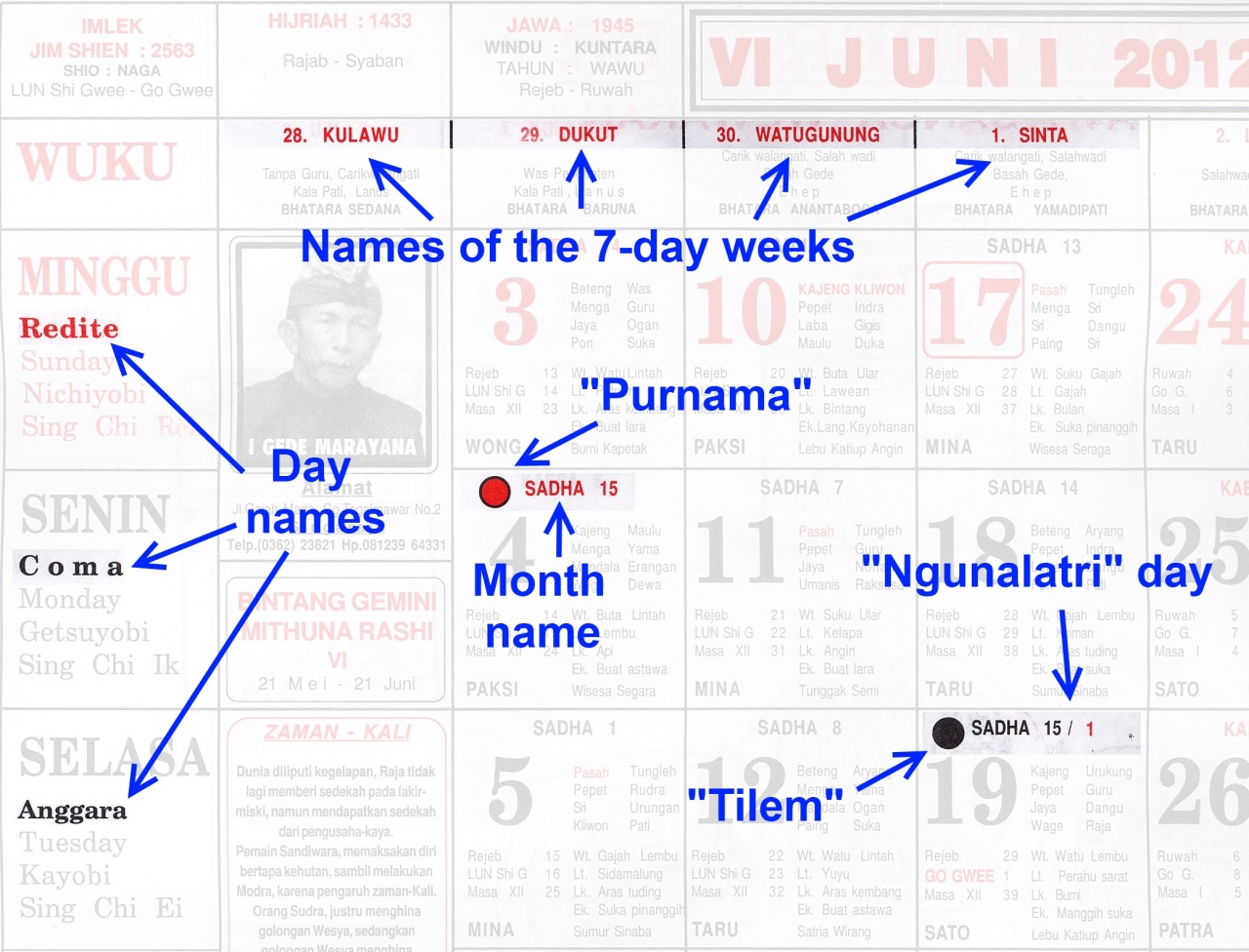
The Balinese Pawukon is complicated calendar used in Bali and elsewhere in Indonesia.
Though most associated with Bali, it is still used in Java for special purposes. According to blog the abysmal: “In essence, it is a 210-day market calendar, that combines market weeks of 1, 2, 3, 4, 5, 6, 7, 8, 9, and 10 days. As 4, 8, and 9 don’t divide evenly into 210, there are special rules to make it all work. Also, the 1-day market “week” is irregular, and follows a special schedule. got all that? good. One 210 day cycle began on June 17, 2012 the next began on January 13, 2013. This calendar doesn’t align itself to other calendars, and as far as I’ve been able to gather, runs 210-days consecutively over and over, without a leap year or similar consideration. [Source: theabysmal.wordpress.com, July 7, 2012 ^+^]
The seven-day week is not the same as the seven-day week on the pawukon. Each day is given a different name with different significance. So it appears that there are two cycles of 7-days, one of which has two names. The 7-day week runs concurrently with a 5-day week (not the same as the one on the pawukon either), and the two form a 35-day cycle of days. The seven days are: Minggu – Sunday; Senin – Monday; Selasa – Tuesday; Rebo – Wednesday; Kemis – Thursday; Jemuah – Friday; Setu – Saturday. The five days are: 1) Kliwon, 2) Legi, 3) Paing, 4) Pon and 5) Wage. Each of these days has two names, here is only the informal name. ^+^
Weekday Significance: Each of the seven weekdays is associated with the motion of the moon toward the earth: 1) Sunday – standstill: 2) Monday – forward; 3) Tuesday – backward; 4) Wednesday – left; 5) Thursday – right; 6) Friday – up; 7) Saturday – down. Each of the five days of the other market week represent the positions of the moon: 1) Kliwon – stand-up; 3) Legi – retreat; 3) Paing – in front of; 4) Pon – sleep; 5) Wage – sit down. ^+^
The Pawukon is the market calendar par excellence. It combines concurrent market weeks of 1, 2, 3, 4, 5, 6, 7, 8, 9, and 10 days. The Pawukon is 210 days. Observant readers will have noticed that 210 cannot be evenly divided by 4, 8 or 9. Those weeks are adjusted with extra days. 52 x 4 and 26 x 8 = 208, and 23 x 9 = 207. For the 4- and 8-day weeks, the 2 extra days are added at second last day of the week that would normally end on the 72nd day. For the 9-day week, the first day of the week is repeated three times at the start of the Pawukon. Apart from these exceptions, the 3-, 4-, 5-, 6-, 7-, 8-, and 9-day cycles repeat themselves throughout the calendar. The rest should be easy, right? 1, 2 and 10 all divide easily into 210. They do, but they do not repeat themselves the way other weeks do. ^+^
Pawukon Cycles
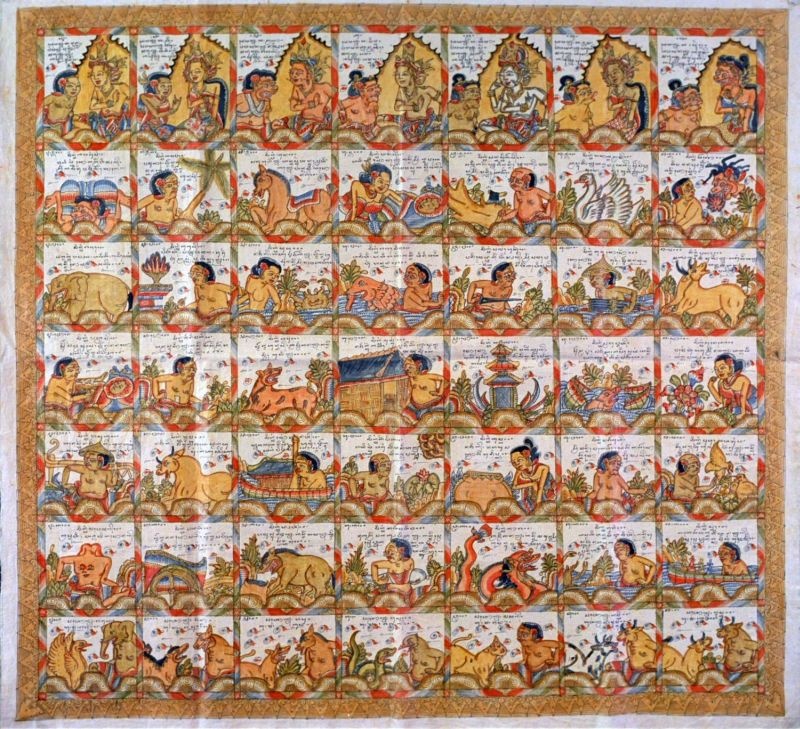
For timekeeping, days are numbered within the lunar month (wulan) as is common in other calendar systems. The date indicates the change in the moon, and symbolizes the life of a human in the world. This process of revolving life is known as cakra manggilingan or heru cakra. On the first day of the month, when the moon is small, it is compared to a newborn baby. The 14th day, called Purnama Sidhi (full moon), represents a married adult. The next day, called Purnama, occurs as the moon begins to wane. The 20th day, Panglong, symbolizes the point at which people begin to lose their memory. The 25th day, Sumurup, represents the point at which the adult requires care like when they were young. The 26th day, Manjing, represents the return of the human to his or her origin.[Source: Wikipedia +]
The solar year is divided into twelve periods (mangsa) of unequal length. Its origin lies in agriculture practice in Java. The names of the first ten months are simply the ordinal numbers from 1 to 10 in Javanese language, although the names of the 11th and 12th months are unclear. The cycle begins near the summer solstice, around the middle of the dry season in Java. +
In the 19th century, the solar month system or pranata mangsa was much better known among Javanese than the civil or religious year. The cycle is clearly of Javanese origin, since the specific application to their climate does not match other territories in the Indonesian archipelago, as well as the usage of Javanese names for the months. Although the cycle matches the weather pattern well, it is still clearly somewhat arbitrary, as can be seen in the lengths of the months. In astrology, the pranata mangsa is used to predict personality traits in a similar manner to sun signs in Western astrology. It is not widely used anymore for divination, but some practitioners use it as well as the other cycles in their divination. +
The cycle of months is considered metaphorically to represent the cycle of human life. The first nine months represent gestation before birth, while the tenth month represents the human in the world, the eleventh the end of his or her existence, and the twelfth the return to where he or she came from. The cycle thus goes from one spark or conception (rijal) to another, traversing through the void (suwung). +
Pawukon Solar and Lunar Months
The Solar months (Pranata mangsa) (Starting day, Name, Length of days, Description) are: 1) Jun 23, Mangsa Kaso, 41, The dry season; leaves are falling from the trees; the ground is withered and arid, bereft of water "like a jewel that has come free of its setting." 2) Aug 3, Mangsa Karo, 23, The dry season; parched earth lies in hard clumps; the mango and cotton trees begin to bloom. 3) Aug 26, Mangsa Katelu, 24, The dry season; spice roots are harvested; the gadung tree begins to bear fruit. 4) Sep 19, Mangsa Kapat, 25, Rain begins to fall, as "tears well up in the soul", marking the end of the dry season; birds are singing and busily constructing nests.
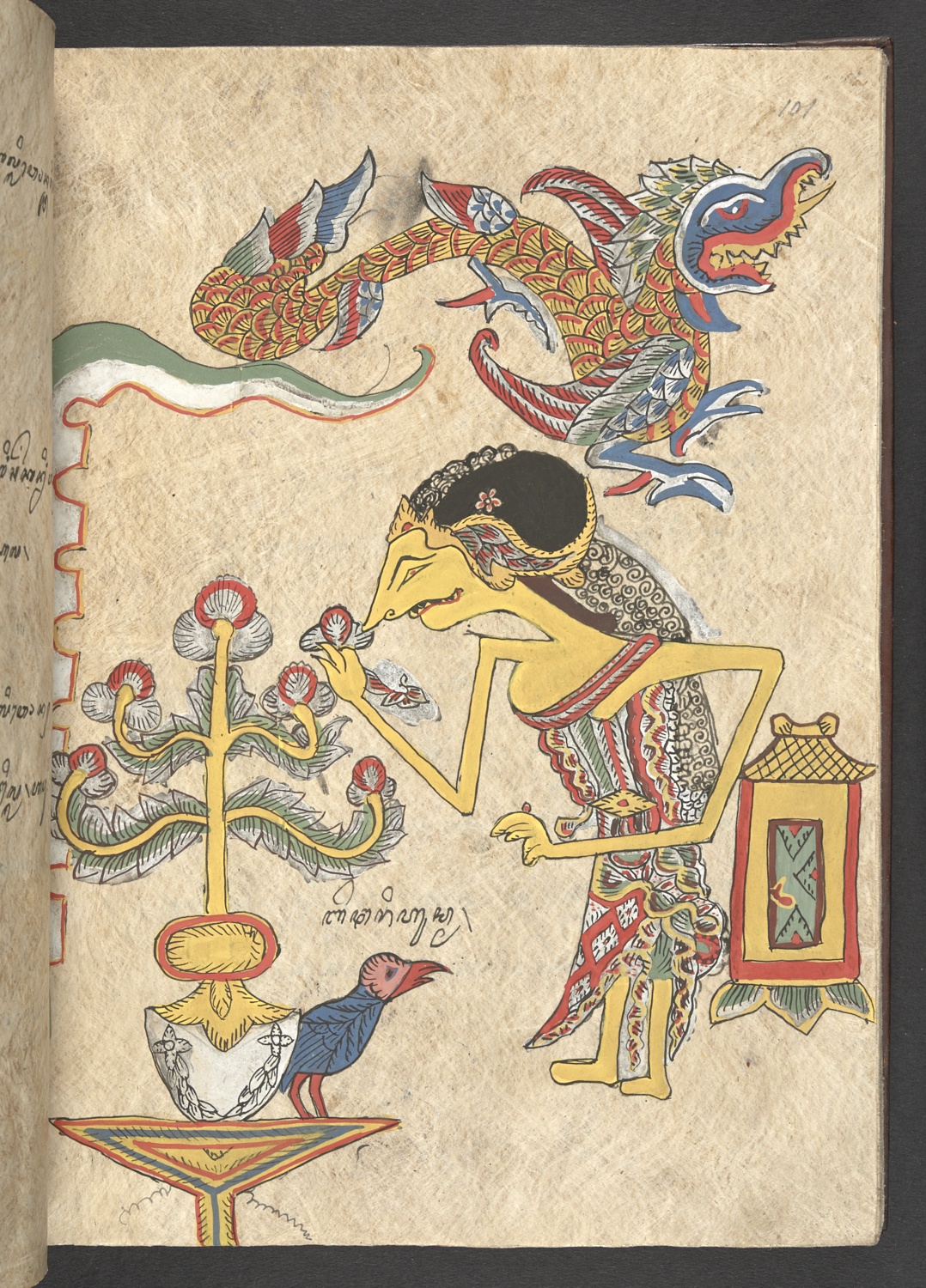
The Labuh Season is at hand. 5) Oct 14, Mangsa Kalima, 27, The rainy season, sometimes with fierce winds and flooding; mangoes are ripe; snakes are driven from their nests; "a fountain of gold falls across the earth". 6) Nov 11, Mangsa Kanem, 43, The rainy season; lightning strikes and there are landslides; but it is also the season of many fruit. 7) Dec 23, Mangsa Kapitu, 43, The rainy season is at its peak; birds are hard pressed to find food, and in many areas there is severe flooding. 8) Feb 4/5, Mangsa Kawolu, 27, The rainy season; rice fields are growing and the cat is looking for his mate; grubs and larvae abound.
9) Mar 2, Mangsa Kasanga, 25, The rainy season; rice fields are turning yellow; "happy news is spreading"; water is stored within the earth, the wind blows in one direction, and many fruits are ripe. 10) Mar 27, Mangsa Kasadasa, 24, Rain yet falls, but is diminishing; the wind rustles and blows hard; the air is still chilly. The Mareng Season is at hand. 11) Apr 20, Mangsa Desta, 23, The dry season has begun; farmers are harvesting the rice fields; birds tend their young with affection, as if they were "jewels of the heart". 12) May 13, Mangsa Saddha, 41, The dry season; water begins to recede, "vanishing from its many places". [Source: Wikipedia +]
Each lunar year (tahun) is divided into a series of twelve wulan or lunar months. Each consisted of 29 or 30 days. This is adapted from the use of months in the Islamic calendar. The Javanese lunar months (Krama (formal), Ngoko (informal), Arabic names, Length of days): 1) Warana, Sura, Muharram, 30; 2) Wadana, Sapar, Safar ), 29; 3) Wijanga, Mulud, Rabi al-awwal, 30; 4) Wiyana, Bakda Mulud, Rabi al-thani, 29; 5) Widada, Jumadil Awal, Jumada al-awwal, 30; 6) Widarpa, Jumadil Akhir, Jumada al-thani, 29; 7) Wilarpa, Rejeb, Rajab ), 30; 8) Wahana, Ruwah, Sha'aban, 29; 9) Wanana, Pasa, Ramadhan, 30; 10) Wurana, Sawal, Shawwal, 29; 11) Wujana, Sela, Dhu al-Qi'dah, 30; 12) Wujala, Besar, Dhu al-Hijjah, 29 or 30. +
Pawukon Yearly Cycles
The Shalivahana era, which started in A.D. CE and continues to be used on Bali, was used in Hindu times on Java, and for well over a century after the appearance of Islam on Java. When Sultan Agung adopted the Islamic lunar calendar in A.D. 1633, he did not adopt the Anno Hegirae to designate those years, but instead continued the count of the Shalivahana era, which was 1555 at the time. [Source: Wikipedia +]
Eight tahun makes up a windu. A single windu lasts for 81 repetitions of the wetonan cycle, or 2,835 days (about 7 years 9 months in the Gregorian calendar). Note that the tahun are lunar years, and of shorter length than Gregorian years. The names of the years in the cycle of windu are as follows (in krama/ngoko): 1) Purwana/Alip (354 days); 2) Karyana/Ehé (354 days); 3) Anama/Jemawal (355 days); 4) Lalana/Jé (354 days); 5) Ngawanga/Dal (355 days); 6) Pawaka/Bé (354 days); 7) Wasana/Wawu (354 days); 8) Swasana/Jimakir (355 days).
The windu are then grouped into a cycle of four: 1) Windu Adi; 2) Windu Kunthara; 3) Windu Sengara; 4) Windu Sancaya. The cycles of wulan, tahun, and windu are derived from the Saka calendar. Windu' are no longer used much in horoscopy, but there is evidence that it was previously used by court officials to predict trends. The passing of a windu is often seen as a milestone and deserving a slametan ritual feast). +
Dino Mulyo (literally "noble days") are celebrated by worshipping Gusti, the creator of life and the universe. Practitioners of traditional Javanese spiritual teachings have preserved several noble days: 1) Satu Suro, the first of Sura, the New Year; 2) Hanggara Aish : Tuesday Kliwon; 3) Dino Purnomo: Jemuah Legi/Sukra Manis (Friday Legi). +
Image Sources: Wikimedia Commons, Indonesia Tourism website
Text Sources: “Encyclopedia of World Cultures Volume 5: East/Southeast Asia:” edited by Paul Hockings, 1993; Wikipedia; National Geographic, Live Science, Metropolitan Museum of Art, Natural History magazine, New York Times, Washington Post, Los Angeles Times, Smithsonian magazine, Encyclopedia.com, Library of Congress, The Conversation, The New Yorker, Time, BBC, CNN, Reuters, Associated Press, AFP, Lonely Planet Guides, Google AI, The Guardian and various websites, books and other publications.
Last updated January 2026