
BALINESE RELIGION
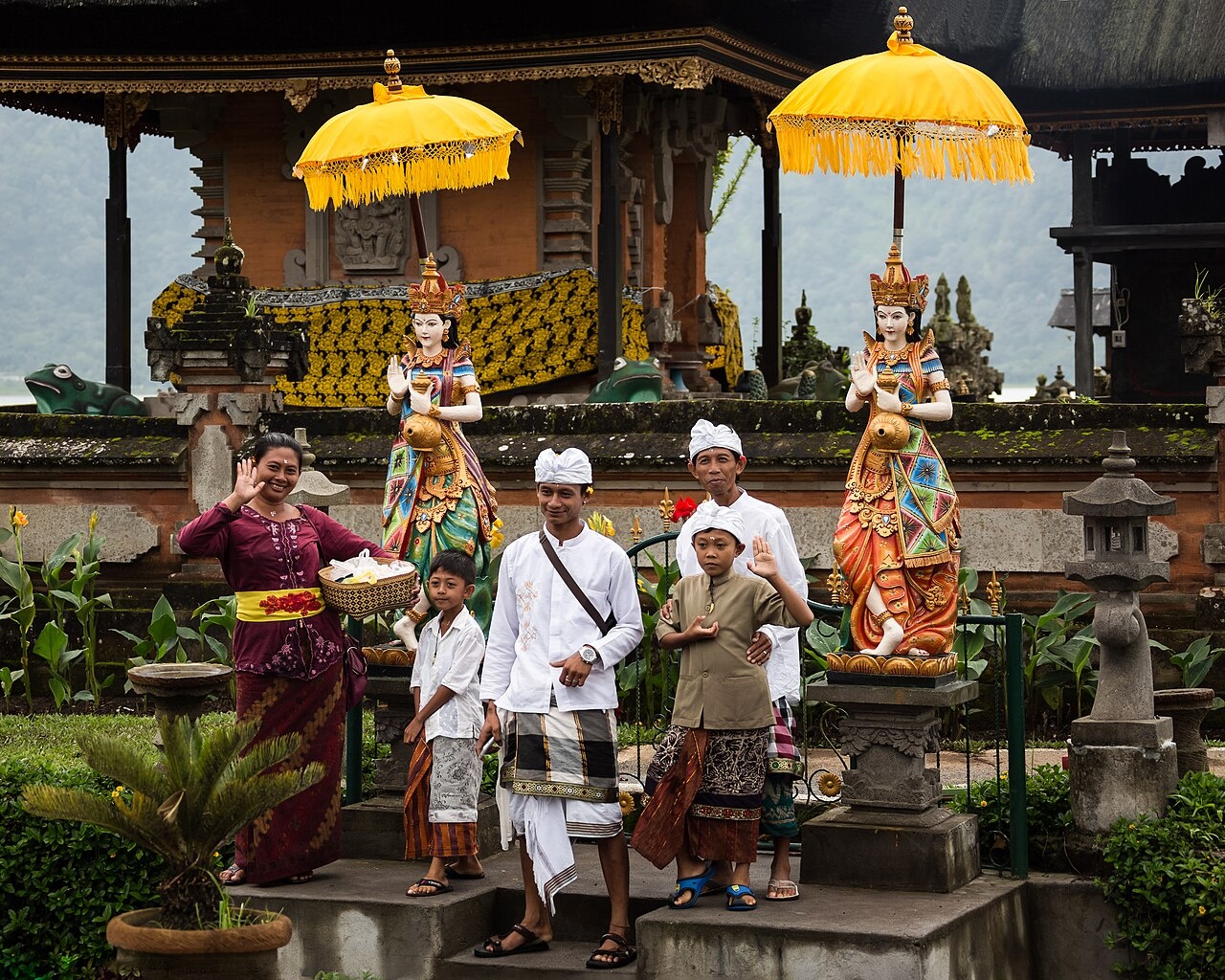
Unlike the vast majority of Indonesians, most Balinese are Hindus not Muslims.. Bali is the only Hindu island on Indonesia. About 93 percent of Balinese are Hindu. There are some churches and mosques on Bali but they are mainly hidden away. Bali and Nepal are the only places outside India, where Hindus dominate. There are few enclaves of Hindus left on Java, notably the Tengger people living around Mt. Bromo.
The Balinese call their religion Agama Tirta ("Science of the Holy Water"), which is actually an interpretation of religious ideas from China, India, and Java. Agama Tirta is much closer to the earth and more animist than Hinduism proper; the two sects as different from each other as Ethiopian Christianity from Episcopalian Christianity. If an ultra orthodox Hindu Brahman from Varanasi ever visited Bali, he'd think them savages.
The basic tenet of Balinese religion is the belief that the island is owned by the supreme god Sanghyang Widhi, and has been handed down to the people in sacred trust. Thus the Balinese seem to devote most of their waking hours to an endless series of physically and financially exhausting offerings, exorcisms, purifications, processions, and temple ceremonies. Festivals are dedicated to woodcarving, transport vehicles, the birth of a goddess, and percussion instruments; there are temple festivals, fasting and retreat rituals, parades to the sea, full moon ceremonies, celebrations of wealth and learning. They go on and on. [Source: Indonesia-fascination.blogspot.jp]
The Balinese believe that deities are symbols of forces. Of particularly importance to Balinese are the Hindu God Wisnut and the mythical bird Garuda. Arjuna, is another important Hindu god to the Balinese. The Balinese traditionally believed that their gods were defied human beings. Ancestors are said to present in the spiritual world and worldly world and no one knows for sure exactly when they descended to earth and when ancestors are gods. Each family line, the Balinese say, was founded by a distinct god, which helps explain why there are so many temples. Generations of marriages between families who worship different gods has created a unique family tree of gods for each individual family, each of these gods must be presented with offerings which adds even more duties and obligations to a family's spiritual life. [Source: "Man on Earth" by John Reader, Perennial Libraries, Harper and Row]
In the 1960s the Indonesia government attempted to clamp down on animism by abolishing all religions except for Islam, Hinduism, Buddhism and Christianity. Later it added Hindu-Balinese and lawyers for the Toraja and other argued that their religion was no different than Hindu-Balinese. ♧
RELATED ARTICLES:
FUNERALS AND DEATH IN BALI factsanddetails.com
BALINESE CALENDAR factsanddetails.com
BALINESE HOLIDAYS, FESTIVALS, RITUALS, CEREMONIES AND OFFERINGS factsanddetails.com
BALINESE CULTURE AND ARTS factsanddetails.com
BALINESE: LANGUAGE, CUSTOMS, BEHAVIOR factsanddetails.com
BALINESE SOCIETY: GROUPS, CASTE, THE SUBAK SYSTEM factsanddetails.com
BALINESE FAMILY: MARRIAGE, WOMEN, RITES OF PASSAGE factsanddetails.com
LIFE IN BALI: VILLAGES, FOOD, CLOTHES, WORK, AGRICULTURE factsanddetails.com
BALI: GEOGRAPHY, LIFESTYLE, REPUTATION, GETTING THERE factsanddetails.com
HISTORY OF BALI: ORIGIN, KINGDOMS, MASS ROYAL SUICIDES factsanddetails.com
MODERN HISTORY OF BALI: VOLCANIC ERUPTIONS, TERRORISM, RECOVERY factsanddetails.com
BALI BOMBING IN 2002 factsanddetails.com
TOURISM IN BALI: CELEBRITIES, RESILIENCE AND ITS RISE FROM A 1930s SOCIALITE ARTIST COLONY factsanddetails.com
NEGATIVE SIDE OF TOURISM IN BALI: OVERDEVELOPMENT, BAD BEHAVIOR DONALD TRUMP factsanddetails.com
Balinese Hinduism
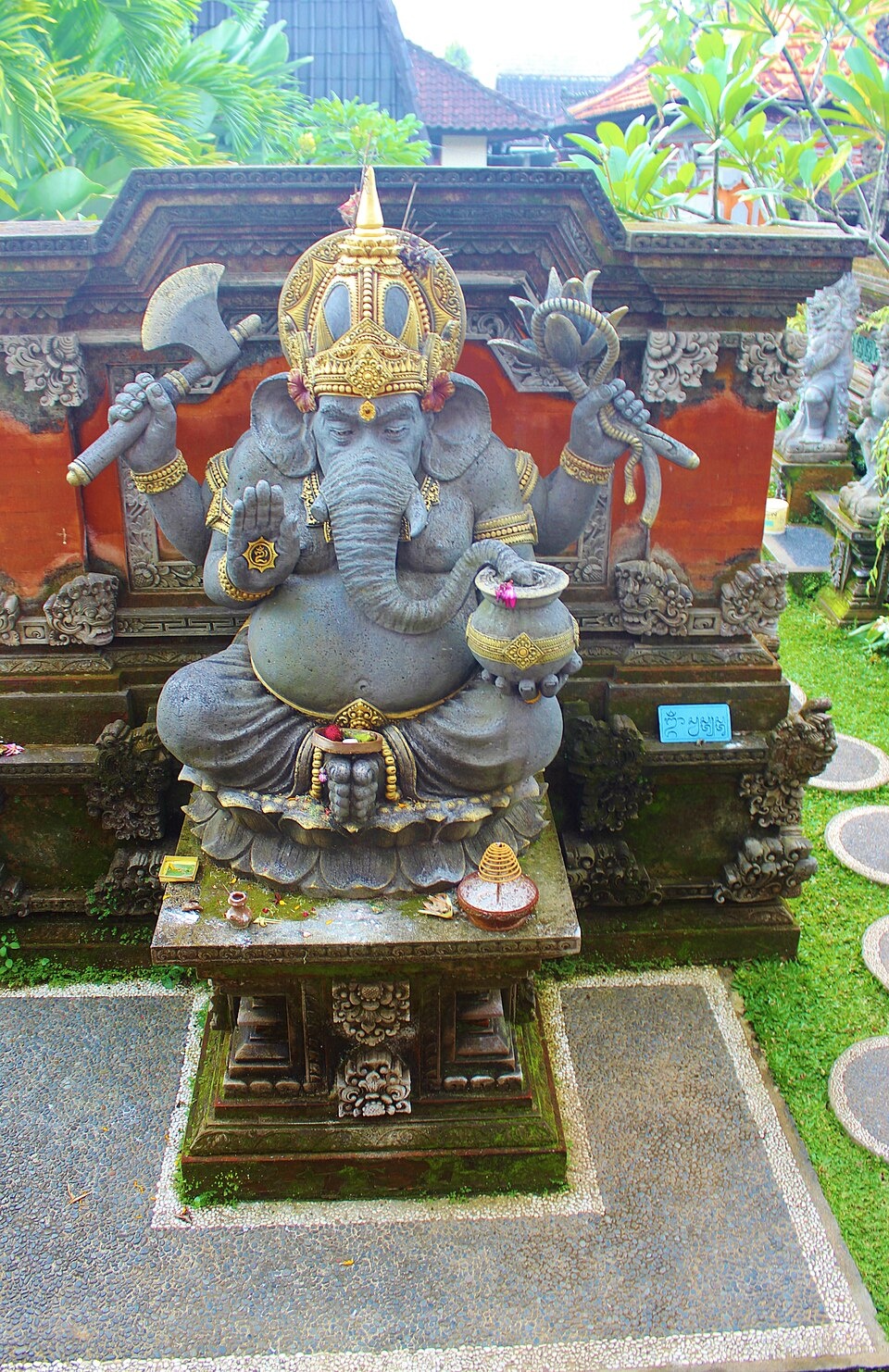
Balinese Hinduism blends Hinduism with animistic traditions. It has been described as “disarmingly convivial and trusting in the peaceful stewardship of gods.” The holy trinity—Shiva, Vishnu and Brahma—are worshiped as they are in India but are not seen and instead are suggested by an empty throne or empty temple. Shivaism has generally been strongest in Indonesia perhaps because it similarities to fertility cults. Vishnu’s incarnation Krishna and Rama and the story of Ramayana have traditionally been given a high place in Indonesian Hinduism. Karma phala is a guiding principal on Bali.
Anjan Chakraborty, an Indian Hindu, wrote in The Statesman: Balinese Hinduism is deeply interwoven with art and rituals, and less preoccupied with scripture, law and belief than Islam in Indonesia. The epics Mahabharata and Ramayana are storehouses of tradition, expressed in shadow puppet (referred to as wayang) and dance performances. Balinese Hinduism lacks the traditional Hindu emphasis on cycles of rebirth and reincarnation, instead it is concerned with ancestral spirits. As with kebatinan (a Javanese belief which involves a metaphysical search for harmony within one’s self, connection with the universe, and with the Almighty), these deities, it’s believed, cause harm.Balinese place great emphasis on dramatic and aesthetically satisfying acts of ritual propitiation of these spirits at temples. [Source: Anjan Chakraborty The Statesman, October 2008]
Hinduism came relatively late to Bali and was superimposed in a on a traditional system of beliefs that were very strong and were not going to be easily displaced. Balinese Hinduism is a blend of Hinduism, traditional Javanese religion and traditional Balinese beliefs. It incorporates elements of animism and ancestor worship, draws few distinctions between secular, religious and supernatural life; and makes no real distinction between the living and dead. One man told the New York Times that the Balinese "live in a magic world of people, spirits, gods and demons."
Contrary to popular belief that Hinduism is not a monotheistic belief all Hindus worship one God—the Balinese god “Sangyang Tunggul”. The deities that people evoke and make offerings to are manifestation of this one God. These manifestations are determined by the social position of the worshiper, his geographical location, and what he is worshiping. The Balinese don't just believe that gods dwell in volcanoes and heaven, rather they feel their gods are around them all the time. [Source: "Man on Earth" by John Reader, Perennial Libraries, Harper and Row]
Balinese Hinduism Versus Indian Hinduism
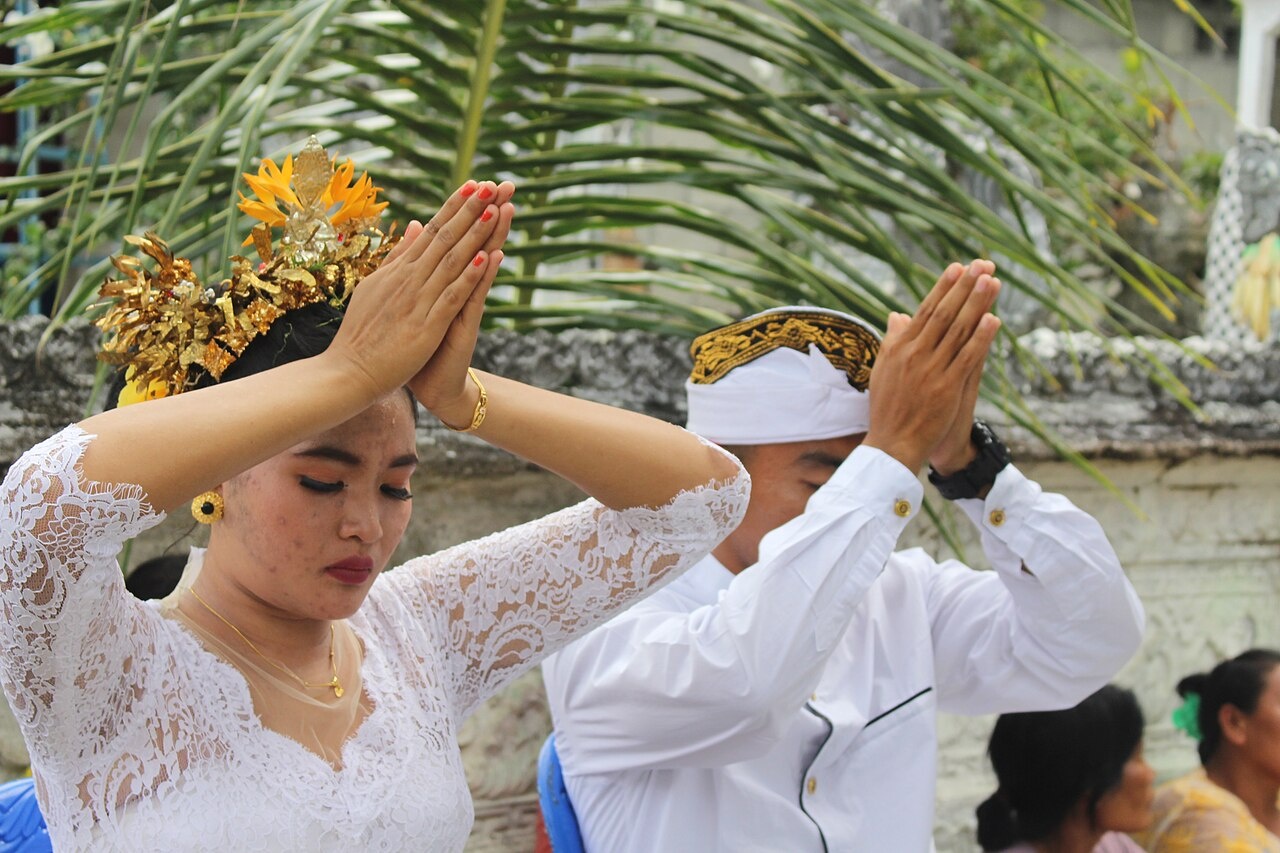
Hinduism in Bali bears only slight resemblance to the religion as it is practiced in India as the tenets of the faith first brought to Bali from the 14th century Majapahit Kingdom of East Java, did not supplant the already existing strong religious beliefs and rich cultural life of the Balinese. Instead, Hinduism was blended with indigenous traditions and beliefs such as animism and ancestor worship to form a new and unique faith. In Bali religion is a very important part of everyday life and the people perform daily offerings to the gods and actively participate in the numerous temple festivals and rituals. Balinese Hindus also make offerings and perform temple rituals to placate demons that they believe personify the destructive forces of nature. On the day before Nyepi major offerings are made to the demons at village crossroads, where evil spirits are believed to loiter. Before every ceremony a cleaning ceremony or mecaru must be held to drive out the devils and spiritually clean the place. [Source: Library of Congress *]
Bali is the furthest reach of the Hindu empire. On Bali, Hinduism has developed along lines all its own. In fact, the manner in which the Balinese practice their frontier Hinduism is still their greatest art. Hinduism is at least 3,000 years old and dates from the creation of the Vedas, compilations of prayers, hymns, and other religious writings. Hinduism doesn't have a single founder or prophet. There is only one God, though its many different manifestations are named and classified in great detail. *
Although the Hindu epics are well known and form the basis of all the favorite Balinese dances, the deities worshipped in India are here considered too aloof and aristocratic. Often the Balinese don't even know their names. The Balinese have their own trinity of supreme gods, the Shrine of the Three Forces. Because of the caste system, 200 million people are shunned in India. On Bali only the older people still believe in the caste system; the young ignore it. In India a Hindu must be cremated at once in order to enter heaven; because of the expense, on Bali, sometimes a whole village will temporarily bury its dead and later stage a mass, cremation. In India widows must not remarry but on Bali they can - here, even high priests marry. In India, worship at home is all-important but on Bali group worship is preferred. *
Balinese Animism
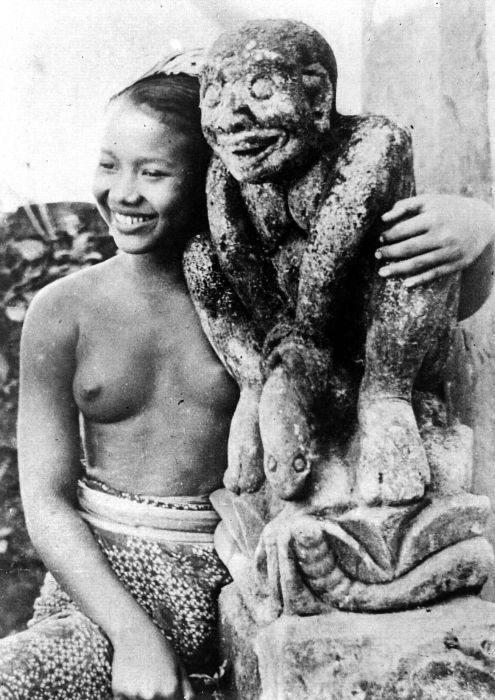
Balinese believe spirits are everywhere and that a family member return every five generation, with each new reincarnated from ideally closer to a divine state. Life is seen as a cycle that begins in a holy state as an infant. As one grows older one moves away from this state of holiness and returns to it at death. The Balinese believe that good spirits reside in the mountains and evils ones live in the sea or water and that people live between. Mountains are the highest and holiest of all places. Houses are oriented towards the mountains and beds are positioned so head is closest to them. People on Bali sleep with their head pointed to sacred Mt. Agung. The volcanoes on Bali run from east to west and instructions are given in terms of direction orientation to these mountains instead of left and right. The rivers and coastal areas are the lowest and unholiest of places—where the demons dwell. Hills and other natural features are classified in term of their evaluation: the higher the holier. [Source: "Man on Earth" by John Reader, Perennial Libraries, Harper and Row]
Mount Agung is regarded as the dwelling place of the gods. Building and villages have traditionally been oriented towards it. Because the sea is regarded as the dwelling place of spirits, many of them malevolent, buildings and villages are oriented away from it. Every morning offerings are placed in places off the ground to pay homages to the good spirits and discreetly left on the ground to placate the evil ones.
According to the Balinese creation myth the seven celestial sisters of the Pleiades descended to earth on wing-like sarongs. While they bathed a prince stole the sarong of one of the sisters and told her he would not return it until she bore him a child. The goddess gave in and gave birth to the first human being, but said, "You may have this child for his brief life on earth, but after that remember, he returns to me." Even today mothers take their crying children outside and point to the stars, saying "That is the place we all come from and where we all return, and there is no need to weep." [Source: "Ring of Fire" by Lawrence and Lorne Blair, Bantam Books, New York]
Balinese Temple Life
Balinese Temples are found everywhere in Bali which reflects their importance in the spiritual lives of Balinese. They are places for communicating with spirits through offerings and prayers. Holy days and festivals are a time when the spirits come descend from heaven to inhabit the temples. Whole communities will come to the temples then with offerings of fruit and flowers. On most days temples are deserted. They come life at temple festivals when it is believed that ancestors and spirits descend to earth to visit their worshipers. The events are celebrated with events such as dramas and dances and feasting and the making of offerings. Each temple has at least one festival a year, often on different days than others, which explains why there are so many festivals in Bali.

It is said that in rural Bali more than half of a family’s income is spent on temple ceremonies Much of village life revolves around the village temples known as “pura”, a Sansktit word meaning “a space surrounded by a wall.” Although they are regarded as Hindu temples there are many animist elements to them. For example, they are aligned towards the mountains to honor the spirits there. The temples of Bali are very special. They serve as centers for spiritual communication with Hindu deities, but are also involved in the control the of flow of water to Bali's complex irrigation system through their ritual calendar.
Anjan Chakraborty wrote in The Statesman: Balinese place great emphasis on dramatic and aesthetically satisfying acts of ritual propitiation of these spirits at temple sites scattered across the countryside. Each of these temples has, a more or less, fixed membership; each Hindu Balinese belongs to a temple by virtue of descent, residence, or some mystical revelation of affiliation. Some temples are associated with compounds in houses (also called banjar in Bali), others are associated with rice fields, and still others with key geographic sites. [Source: Anjan Chakraborty The Statesman, October 2008]
To visit temples in Bali, a few rules need to be observed. Always wear a sarong. Some temples, especially those that receive visitors in large amounts, provide sarongs at the entrance. Sarong is meant to cover the ‘unholy’ parts of our body, especially waist down. Dress ‘properly’, that is, cover every bit of skin. Women who are having periods and people whose relatives have recently passed away and are observing a period of mourning are not permitted.
See Separate Article: BALINESE HOUSES, TEMPLES AND ARCHITECTURE factsanddetails.com
Religion and Balinese Daily Life
Religion is woven into every aspect of daily life. Some anthropologist have said the Balinese have no secular culture. "From the Balinese point of view," says anthropologist John reader, "the entire universe is an expression of enormous spiritual capability. Everything owes its existence to the power of overriding spiritual forces; everyone must at all times remain aware of their of their debt to these forces...its demands have produced a society in which everyone knows their place—in all senses of the term. [Source: "Man on Earth" by John Reader, Perennial Libraries, Harper and Row]
The Balinese make offerings every day. Typically small clumps of rice are placed on a banana leaf and placed around a family's house and land. Flowers and fruit inside neatly folded palm leaf boxes are left on the ground to appease evil spirits. Temples offerings consist of beautifully-arranged stacked pyramids of flowers and food.
Offerings for Brahma, the god of the hearth, are left at the fireplace; another for, Dewi Sri, the rice goddess is left by the granary; and still another is deposited by the cistern for Wisnu, the god of water. Sometimes flowers are added to these offerings, and on special days women weave little baskets and add sandalwood oil and fruit to offerings of rice. [Source: "Man on Earth" by John Reader, Perennial Libraries, Harper and Row]
In addition to these daily offering, rice and flowers are also left at roadside shrines on special days. On any given day there is festival at a temple somewhere and it can't hurt to leave an offering at as many of these as possible.
Balinese Religious Practitioners
Religious specialists include balian, who are considered "shamans" and include masseuses, healers, augurs, spirit mediums, and "literate" balian who use palm-leaf manuscripts called lontar in their magic. Shaman also consult astrological charts, the Balinese calendar, amulets and brochures in Bahasa Indonesian with titles like How to Stop the Rain." Young girl dancers are used to welcome the gods to the temples.
Large ceremonies are presided over by Brahmin priests. Lower caste priests care for temples and perform local ceremonies. In general, priests are not affiliated to temples but act as spiritual leaders and adviser to families in villages scattered over the island. During celebrations Balinese wear headdresses and colorful head scarves tied around their head. During processions women carry trays of fruit and flowers on their head. .
If there is problem the Balinese consult a pedanda, a high caste Brahmin priest. If there is a problem with shrine, for example, the pedanda goes into a trance and transfers the ancestral spirits of a shrine to temporary bamboo shrines until new permanent shrines are built and the spirits can be transferred there on an astrologically auspicious day. The pedanda often has long hair tied in a knot at the top of his head. After one ceremony that appeared not to work one pedanda told the New York Times, "The spirits continually remind us we are fighting an eternal battle between good and evil.”
Mystics, healers and artists are just as essential to a typical Balinese community as farmers and merchants. Those who have money share it with those that don't and land is owned by the gods who are benevolent enough to lend it to human beings for temporary use. The Balinese spend about half their day taking care of chores for food and shelter, and the half is devoted to festivals, processions, art making, dance and drama. Time is reckoned from the rhythms of nature and the stars rather than watches and clocks. [Source: "Ring of Fire" by Lawrence and Lorne Blair, Bantam Books, New York]
Superstitions and Folk Beliefs in Bali
The line between superstition, religion, culture and everyday life are often unclear in Bali. Hilded Greetz wrote in Natural History magazine, "Encounters with demons and sorcerers, miraculous cures, strange deaths and mysterious visions in the night are the stuff of daily hushed conversations, as unexpected prosperity or sudden poverty. Any disaster or sudden good fortune immediately becomes food for speculation about its cause. A chronic, wasting lung disease is thought to be the work of mean-hearted neighbors, helped by a sorcerer who pretended to be kindly healers. An unusually rich harvest might be explained by the prior discovery of a ring in a rice field, placed there perhaps by a benevolent spirit. A Western notion of 'fairy tales' as merely delightful or scary fictions about never-never lands where the impossible can happen would be very strange to most Balinese."
Many Balinese care a mantra with them to ward off evil spirits. The Balinese have a great fear of sorcery and regard many events that occur in everyday life as the will of gods and spirits. The concept of sakti” is held in high regard. It is the ability to fend off sorcery or "the ability to prevent anyone form defeating you." The Balinese believe that sakti often dwells in a weak part of the body such as under the tongue. If an enemy finds it he or she can defeat you.
People who lose things consult with a “balian”, a fortuneteller, who tells them where to look. “Balian”, it is believed, can also communicate with the spirits of deceased relatives, interpret dreams and go into trances to cure the sick. In Bali, men in trances have picked up burning hot cannonballs from fires and carried them down the road. Dreams are considered very import in Bali: “My dreams are more delicious when I sleep in the old house,” a Balinese man told the BBC.
Balinese Gods, Spirits and Leyaks
The Balinese recognize a wide variety of supernatural beings, including demons, ancestral spirits, and divinities such as the sun god Surya (a manifestation of the Hindu deity Siwa, or Shiva), and the rice goddess Dewi Sri. Since the Indonesian state philosophy, Pancasila, emphasizes monotheism, the organization Parisada Hindu Dharma (founded in 1959) has promoted the worship of Sang Hyang Widhi Wasa, a supreme being of which all the other deities are lesser manifestations. This "reform" has not altered everyday practices other than installing Sang Hyang Widhi Wasa's shrine, an empty lotus seat, in every temple. [Source: A. J. Abalahin,“Worldmark Encyclopedia of Cultures and Daily Life,” Cengage Learning, 2009]
Witches and nocturnal spirits called leyaks are blamed for many of life's misfortunes on Bali. Most Balinese believe that leyaks are living people who practice black magic and transform themselves into spirits—monkeys, snakes, birds and even headless bodies. Many people wear amulets and place offerings at shrines to ward them off. The Balinese believe that leyaks only attack Hindus and thus Moslems are sometimes hired to protect buildings infested with leyaks. Foreign visitors have asked the Balinese if they have ever seen a leyak. The Balinese usually say the haven't but they offer advise on how to attract them. One way is to stand naked near a cemetery and bend over and peer backwards through your legs. [Source: Donna Grosvenor, National Geographic, November 1969]
Leyaks, Balinese believe, appear as ordinary people by day but leave their bodies at night, assuming many possible forms. They may transform into animals such as monkeys, birds, pigs, or tigers, appear as ghostly lights, or manifest as a disembodied human head with internal organs hanging beneath it. Leyak are said to haunt cemeteries and crossroads, where they can spread disease, cause crop failure, poison food, or insert foreign objects into a victim’s body. Protection against them is sought through amulets or mantras obtained from priests or shamans. A person who dies suddenly and without an obvious cause is sometimes believed to have been a leyak whose spirit failed to return to the body after a night of wandering. [Source: A. J. Abalahin,“Worldmark Encyclopedia of Cultures and Daily Life,” Cengage Learning, 2009 and lagodaxnian]
According to Balinese tradition, leyak are visible at night only to shamans or specialized leyak hunters. During the day, they appear entirely human. At night, they roam cemeteries in search of human organs, which are used to create powerful magical potions. These potions are believed to enable shapeshifting and are sometimes said to be made from the organs of living people. One of the most feared forms of the leyak is the flying head, which travels through the darkness in search of pregnant women, from whom it is said to draw blood while the child is still in the womb.
Balinese belief recognizes several types of leyak, commonly described as two female and one male. Leyak associated with black magic are said to require the blood of fetuses to survive. Their true form is often described as having sharp teeth and a long tongue, even when they take other shapes such as animals or balls of fire. It is also believed that leyak exist only on the island of Bali and that their powers function only there.
Certain methods are said to defeat a leyak. If the flying head is attacked and stabbed from below the neck while separated from its body, it cannot rejoin with the body. If this separation lasts long enough, the leyak is believed to die. Today, fearsome representations of leyak—characterized by bulging eyes, long tongues, and sharp teeth—are sometimes carved as masks and displayed as house decorations in Bali, reflecting both the enduring power of the legend and its place in Balinese visual culture.
Tourism and Balinese Superstitions
During the construction of a new luxury hotel on Bali, the hotel manager hired Muslim security guards because they are said to be not affected by leyaks; a penanda was consulted over the disruption of holy shrines; and a shaman was hired to move rain that threatened important events such as weddings and fashion shoots. At some hotels incense fills the accounting office and employees put offerings next to their computers in hopes of earning a promotion. The hotel manager told Danna Rosenthal of the New York Times, "I've learned we can't use a bulldozer until the pedanda chooses the right day to bless it. When I see a carpenter chanting a mantra in front of a tree, it means he's trying to placate the spirits." [Source: New York Times]
A Balinese landscape architect told Rosenthal, Balinese craftspeople "believe hotels are living things with a complex cosmological order. When we erect a pillar made from a tree trunk, for instance, the end where the roots were must always face downward because trees are the homes of spirits...Sometimes we have to wait weeks for a propitious day to begin thatching roofs. And then, because the wild grass is sacred, it must be tied to the rafters with bamboo string as thick as an angel's eyebrow. The manager told Rosenthal that he had to hire a balien (shaman) when snakes (reportedly sent over from a competing hotel) were seen at his hotel, "Our balien went into a self-induced trance, tackled the snakes and rerouted them. When we opened the resort, the snakes disappeared."
Describing the problem-plagued construction of a new hotel, another manager said: "the generator repeatedly failed and a worker spotted ghost on the area. We solved it by hiring a penanda, who sealed off the property with energy lines and sent away negative spirits from the magically charged spots." At the spot defined as negatively charged because a bulldozer kept stalling there, a temple was built and consecrated with chicken blood to placate the spirits there.
Many hotels have their own temples and lay priest whose job includes sprinkling holy water on shrines, dressing guardian statues in white checkered cloth (a symbol of balance between negative and positive forces), and blessing imported items such as pizza ovens before they are used. The hotels also sometimes hire part time offering makers.
Image Sources: Wikimedia Commons, Indonesia Tourism website
Text Sources: “Encyclopedia of World Cultures Volume 5: East/Southeast Asia:” edited by Paul Hockings, 1993; Wikipedia; National Geographic, Live Science, Metropolitan Museum of Art, Natural History magazine, New York Times, Washington Post, Los Angeles Times, Smithsonian magazine, Encyclopedia.com, Library of Congress, The Conversation, The New Yorker, Time, BBC, CNN, Reuters, Associated Press, AFP, Lonely Planet Guides, Google AI, The Guardian and various websites, books and other publications.
Last updated January 2026