
BALINESE ARCHITECTURE
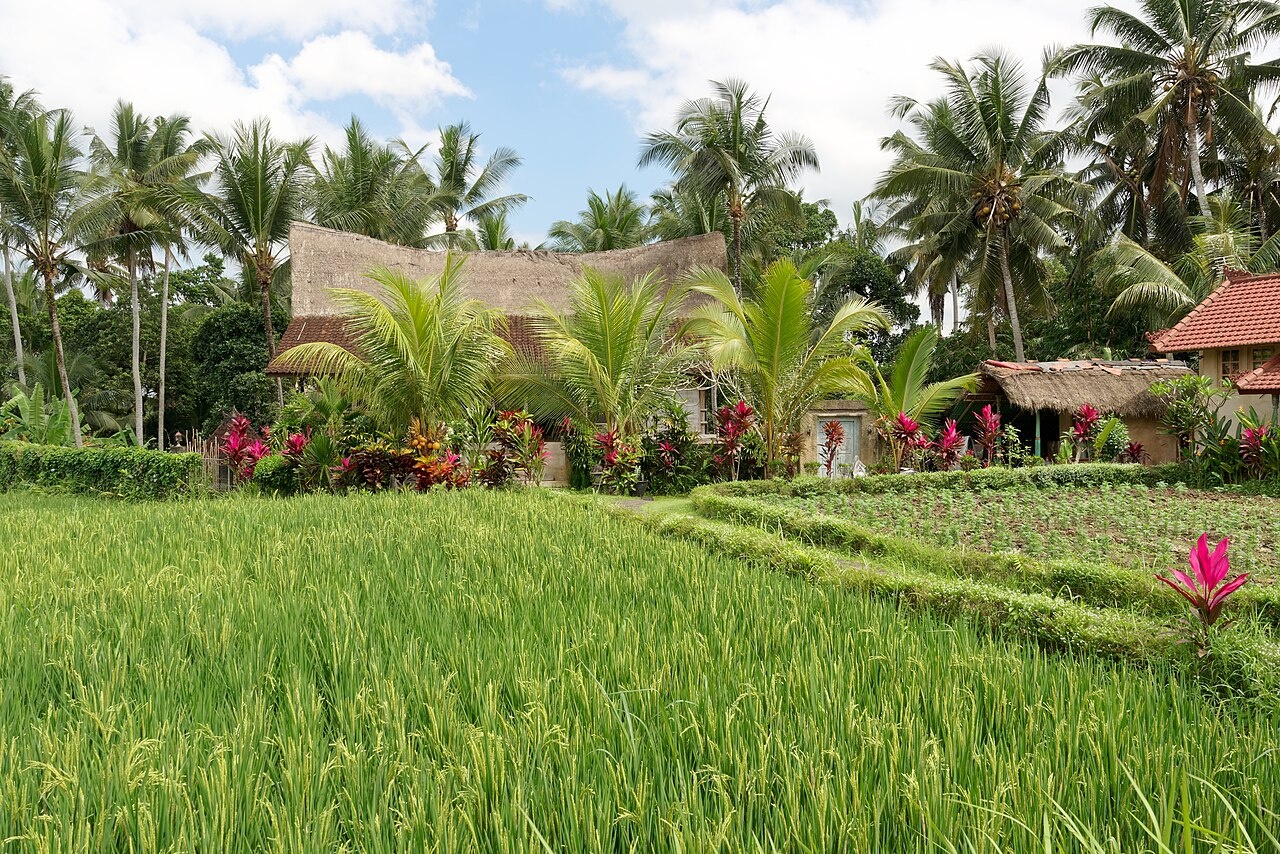
Traditional Balinese Architecture is a combination of a balance relation between Bhuwana Agung (universe, the bigger world,) and Bhuwana Alit (human, the smaller miniature). This traditional architecture is a mix influence of the Hindu culture, Chinese Buddhist, and Megalithic culture. In several parts of Bali European style can also be found. These days traditional architecture is combined with the more modern design. [Source: Bali A Traveler’s Companion and Bali Tourism Information Book 2008]
Typical Balinese decorations include door guards (usually representations of The Mahabartha hero Arjuna) beside gateways, the monstrous face of Kala above the entrance with her hands ready to catch evil spirits; and images of the witch Rangda in front of temples dedicated to the dead.
Tenganan and Trunyan are two traditional villages, each with its own unique architecture. Both villages are of old Balinese origin, Bali Aga, which preceded the migration of Javanese royals from the Majapahit Empire to Bali in the 15th century. The Bali Aga do not follow modern Balinese Hinduism and have moved to their inner enclosures to stay away from the ‘foreign’ Javanese influences. Unlike the common nine-building concept of Balinese house architecture, traditional houses in Tenganan and Trunyan consist of two main buildings only: 1) a large building which consists of some bed rooms, kitchen, terrace and 2) a family temple. All the bedrooms, kitchen, terrace are built in on a piece, large building. The village temple is built from big stones with relatively few relief carvings.
RELATED ARTICLES:
BALINESE CULTURE AND ARTS factsanddetails.com
HOUSES IN INDONESIA factsanddetails.com
INDONESIAN ARCHITECTURE factsanddetails.com
ART AND CRAFTS IN BALI factsanddetails.com
BALINESE MUSIC factsanddetails.com
BALINESE DANCE: HISTORY, TYPES, STORIES. CHARACTERS factsanddetails.com
FAMOUS BALINESE DANCES: LEGONG, BARIS AND MONKEY AND TRANCE DANCES factsanddetails.com
BALINESE THEATER AND SHADOW PUPPETS factsanddetails.com
HISTORY OF BALI: ORIGIN, KINGDOMS, MASS ROYAL SUICIDES factsanddetails.com
BALINESE: LANGUAGE, CUSTOMS, BEHAVIOUR factsanddetails.com
BALINESE SOCIETY: GROUPS, CASTE, THE SUBAK SYSTEM factsanddetails.com
LIFE IN BALI: VILLAGES, FOOD, CLOTHES, WORK, AGRICULTURE factsanddetails.com
BALINESE RELIGION: HINDUISM, SPIRITS, TEMPLE LIFE, PRIESTS factsanddetails.com
Balinese Buildings
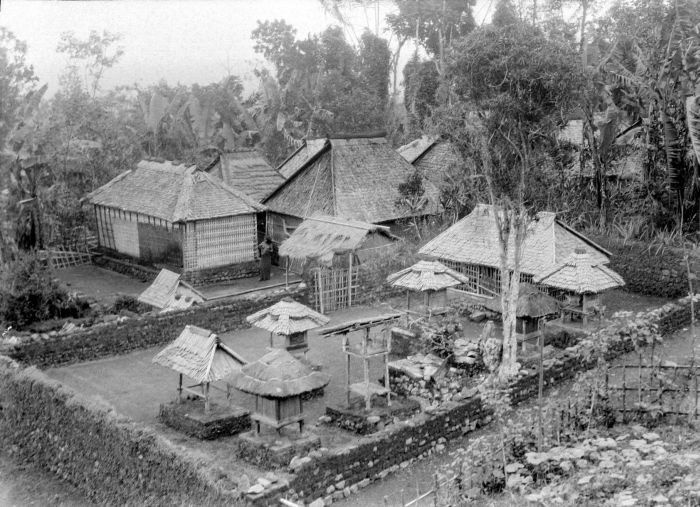
The basic building in Bali is the “bale”, an open air temple with a steeply-pitched palm-thatch roof. A typical family compound consists of a number of bales, each with a particular function. The “bale banjar” is a large pavilion used for meetings or gatherings. Restaurants at hotels are often made as a bale.
“Meru” is the name is the name given to tiered-roof shrines, They have traditionally been made with the black thatch of sugar palms, which is used only for making temples. Major temples usually include multi-floored pagodas called “merus”. They are named after Mt. Meru, the Hindu god Shiva’s mountain paradise. The number of roofs if almost always an odd number with ones having 11 roofs being the holiest, The inner courtyard may also contain a throne of local god or less important gods. You do no see images of major Hindu gods like you do in Hindu temples in India.
Balinese homes have traditionally been simple structures that were not elaborately decorated while temples were often built with wood carvings and sculpture being the primary means of decoration. Sculpture, religion and architecture have traditionally gone hand and hand. A gate or an entrance way has traditionally served as a vehicle to make elaborate sculptures or carvings that generally have religious significance. Often sculpture and carving and added on to a structure long after it has been built as the money for such things become available.
Traditional Balinese Houses
Traditional Balinese houses resemble luxurious thatch roof treehouses. They are supported by bamboo beams and coconut tree-trunk stilts, which are placed upside-down so that water absorbed from the roof is drawn to the ground. There are no doors, windows, or walls, and the elephant grass roof is erected by the whole community in few hours in return for a festival with palm wine that everyone can drink. During a violent storm reed blinds can be drawn from the floor to keep rain from coming in the sides of the house. [Source: "Ring of Fire" by Lawrence and Lorne Blair, Bantam Books, New York ==]
Homes and family compounds are often surrounded by a high wall and have a entrance way backed by a small wall called an “aling aling”. The purpose of this set up is to create a sense of privacy and keep evil spirits out. Spirits are believed to travel mainly in straight lines and have difficult getting around corners. The main purpose of the “aling aling” is to make it difficult for these spirits to take an easy direct route. For the same reason family members often live in buildings that not in a direct line from the entrance.
Balinese see themselves as microcosms of the Hindu–Balinese universe, a view that extends to houses, compounds, and villages. All are organized according to a tripartite order: the upper world of the gods, the middle world of humans, and the lower world. In human terms, this becomes head, body, and feet, with the head always dominant. Architectural measurements within a compound are based on the proportions of the owner’s body, using units such as arm span, forearm length, hand positions, and foot length. These measurements are marked on sticks and used to determine building size and spacing, ensuring that each compound reflects the physical and spiritual identity of its inhabitants while remaining distinct within the neighborhood. [Source: “Culture and Customs of Indonesia” by Jill Forshee, Greenwood Press, 2006]
Paths within compounds wind and change direction abruptly, forming a maze-like layout intended to confuse wandering spirits. This mirrors the practice in cremation processions of making sudden turns to prevent spirits from following the living. More broadly, the Balinese house is understood as a living, animate entity. Drawing on animist concepts, different parts of the compound correspond to parts of the human body. As Miguel Covarrubias observed in 1937, the family shrine is the head, sleeping quarters and social pavilions are the arms, the courtyard is the navel, the gate represents the sexual organs, the kitchen and granary are the legs and feet, and the refuse pit at the back is the anus.
See Separate Article: BALINESE LIFE: VILLAGES, FOOD, CLOTHES factsanddetails.com
Design and Layout of a Traditional Balinese House
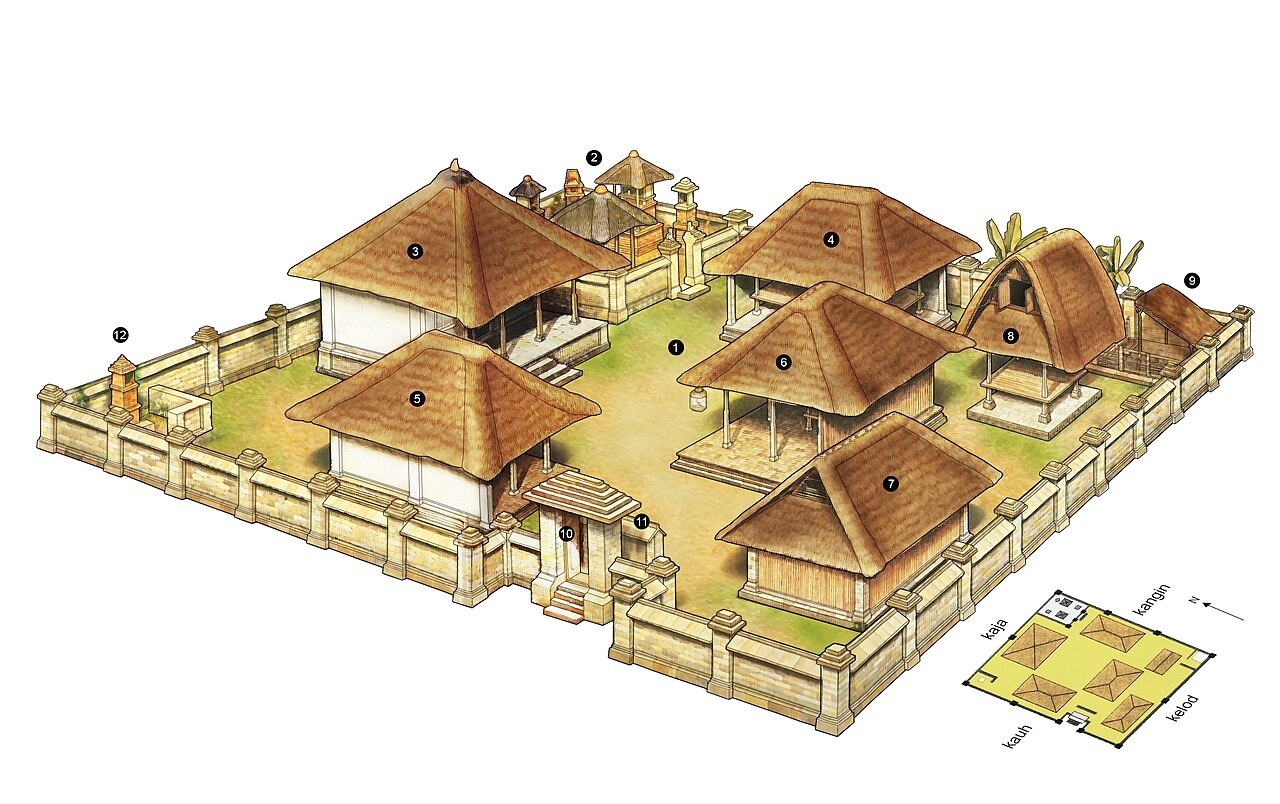
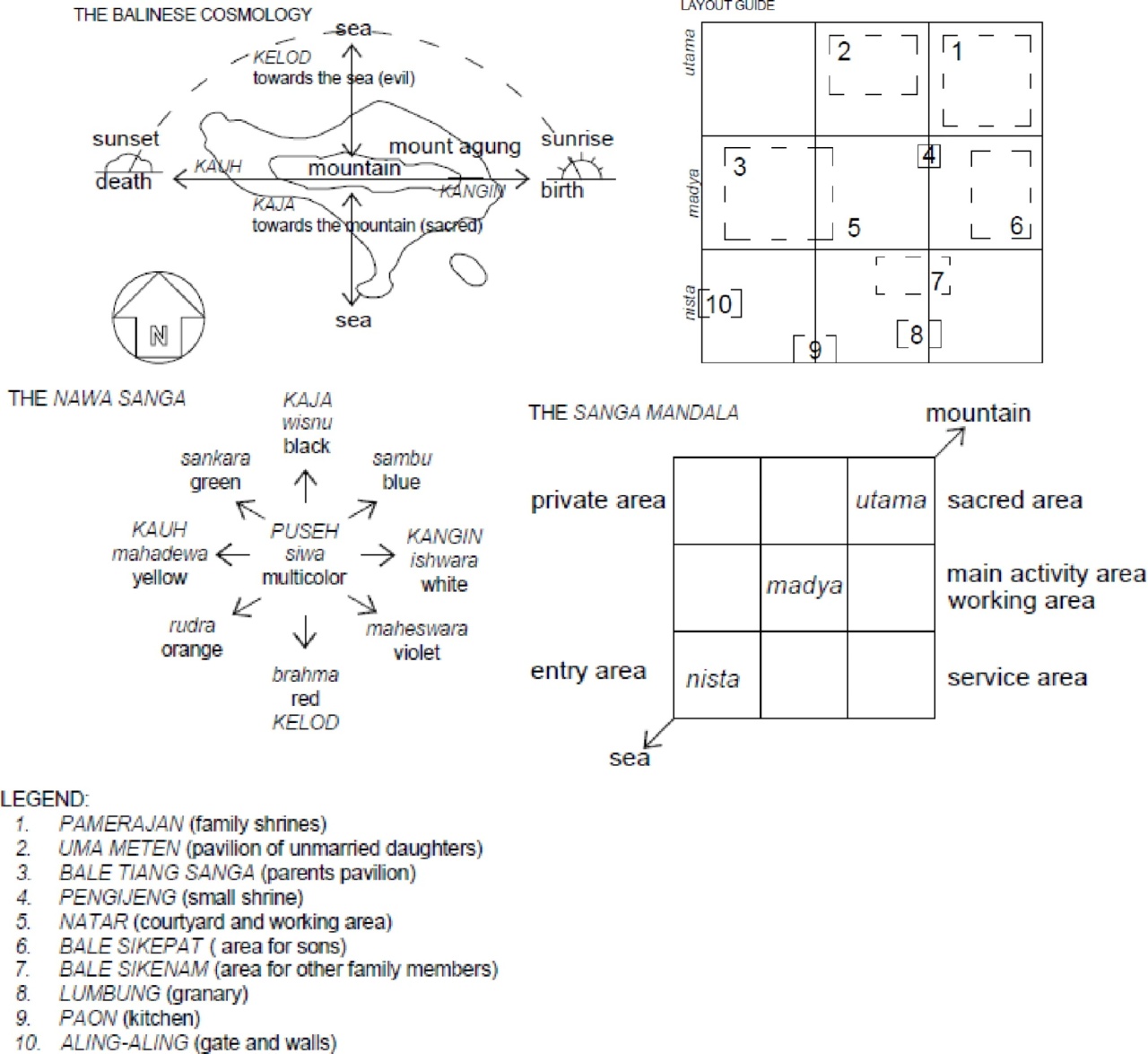
Balinese households continue to preserve the integrity of their traditional compound design. A typical home consists of a walled enclosure containing several small, separate buildings arranged according to strict spatial rules. These layouts are governed by the principle of kaja–kelod, a directional system that shapes all aspects of domestic life. Kaja points toward the inland mountains—especially the sacred Gunung Agung—while kelod leads toward the sea and is considered “downward” in spatial terms. People sleep with their heads facing kaja, and the head of the household occupies the most kaja building in the compound. Functions associated with impurity, such as kitchens, toilets, pig pens, and rubbish areas, are placed toward kelod. Although kelod implies movement away from the sacred mountain, it does not signify an impure destination, since the sea itself is a powerful source of purification. Many rituals are performed there, and cremation ashes are ultimately cast into its waters. [Source: “Culture and Customs of Indonesia” by Jill Forshee, Greenwood Press, 2006]
A family compound generally includes at least five distinct elements: an arched entrance gate, one or more sleeping pavilions with front verandas, a kitchen, a bathroom, and a rice granary. Some buildings may be partially open, facing gardens or courtyards. The size, materials, and complexity of a compound often reflect the wealth and caste of its occupants. While Balinese houses are not raised high off the ground, they commonly sit on low masonry bases and have tiled floors, a feature likely influenced by Indian architectural traditions. Courtyards are swept daily and planted with flowering trees and shrubs. The northeast corner, where the family temple stands, is the most auspicious, while the southeast corner is often left empty, as it may attract malevolent forces—though these associations can vary by region.
Unlike many Indonesian houses, Balinese kitchens are often located near the front entrance, usually on the right side, with large windows that allow passersby to see inside. Neighbors frequently stop by to chat with women as they cook. Brick is a common building material, often coated with cement, a practice that can be traced back to the influence of the Majapahit kingdom of Java. Entranceways are especially elaborate, featuring richly carved, painted, and sometimes gilded doors framed by wood or volcanic stone. Decorative lintels depicting flowers, animals, or protective spirits often crown these gates, which can be so ornate that they function almost as freestanding structures. Sacred buildings must have meru-style roofs—tiered forms symbolizing Mount Meru—while more ordinary structures clearly have simpler hip roofs covered with grass or tiles.
Balinese House Architecture
An old Hindu’s manuscript called Lontar Asta Kosala Kosali is the chief guide to build a proper Balinese house. There are also other manuscripts, such as Lontar Asta Bumi (containing size of land and location a good house), Lontar Asta Dewa & Lontar Wisma Karma (containing the name, shape, and function of each a building), and Lontar Dewa Tattwa (containing clearance ceremony before a house is built). In many aspects of life, those guidance books have been developed depending on the surrounding, local topography. [Source: Bali A Traveler’s Companion and Bali Tourism Information Book 2008]
Based on the philosophy, a traditional Balinese house has some strength aspects. The strength points that are: 1) Good Ventilation System: Balinese traditional houses give full attention on air circulation, by maximizing the use of big windows (more than two in one house) and a free space between the roof and the wall. 2) Strong Foundation: Based on Tri Loka concept, a building is considered the same like a human body which consist of three main parts; foot, body, and head. Therefore, the foundation part (foot) of traditional Balinese house is made the strongest to keep the other parts; main building (body), roof (head). 3) Massive Yard: The backyard in Balinese traditional house has the same function as in a Japanese traditional house, according to Ashihara (1970).
The back garden occupies as house interior where the interaction between human (Bhuwana Alit) and nature (Bhuwana Agung) go on. It is purposely built as an oxygen supplier, a space for planting the greens. 4) Guarding Wall: A traditional house naturally has a high wall surrounding it like a castle. This wall purposes as a guard, separating the house yard from public environment. The wall keeps one’s privacy and is believed to be able to protect the house from black magic. 5) Land Size: A traditional Balinese house requires a necessary spacious land, about 300 square meters, usually consisting of nine buildings, enough to shelter a big family members. In many big cities where land is expensive, that can pose a serious problem.
6) Time to Build: A traditional house is longer to complete than a modern, minimalist house. Building a traditional Balinese house is a wearisome work requiring the advice of a special architect called Undagi. An undagi is usually also a sculpture who carves relief in several parts of the house. A relief usually shows traditional stories containing moral obligations. Sizes are not in meters or feet, but using traditional dimension called depa (furthest distance between tips of one’s hands), a lengkat (knuckle).
7) Maintenance: A traditional Balinese house requires a special treatment, because most of parts are made from stone and dry grass. This bits and pieces should be checked regularly, for example the dry grass roof should be renewed every five years. 8) Long time ago Balinese built such a toilet near a river or spring. Therefore, they only prepared very simple facilities inside their house enough for bathing and provided water to drink.
Traditional Balinese concept adopts Hinduism and Chinese Buddhism. The chief ingredient, a Hindu’s concept called Tri Mandala, conveys an integrated three areas; Nista, Mandala, Utama. Nista is an area for the dirty aspects (real or abstract). Nista area is on the southern side of a house or a temple. The southern side belongs to sea, the neutral agent where bad auras will be dilluted. Mandala is the neutral area. Mandala is located between the south and north side. Utama is holy area. It is located on the northeastern side. The north belongs to mountain, the holy area according to Hinduism.
Buildings in a Traditional Balinese House
From the out side, a Balinese traditional house looks like a small castle surrounded by red brick walls. This small castle extends from north to south like a long square. A traditional Balinese house consists of nine buildings which have different function. Those building are: 1) Sanggah/ Merajan, 2) Meten/ Bale Daja, 3) Bali Dangin/ Bale Gede, 4) Bale Dauh, 5) Sake Enem, 6) Paon/ Pewaregan, 7) Jineng, 8) Angkul-angkul, and 9) Aling-aling.. [Source: Bali A Traveler’s Companion and Bali Tourism Information Book 2008]
1) Sanggah/ Merajan is a shrine dedicated for praying to God and family ancestors. Sanggah is located in Utama area (northeast side) of the house, as told on the Tri Mandala concept. The Chinese culture seamlessly is seen in the form of two guarding statues on right and left side of entrance door, as seen in the many Chinese temples. Sanggah usually hosts historical relief which contain moral messages on the outer wall.
2) Meten/ Bale Daja is building for the oldest family member. Meten consist of one bedroom and a terrace. This building is located on Utama area (north side of the house), because the older family member is usually a respected priest for the family temple. In this building especially on the door and windows, you will see some peacock relief or Balinese ox. Ox is one of holy animals and used as symbol for honorable person, as also seen in the Indian culture. Meanwhile, peacock is a symbol of honorable person in Chinese culture.
3) Bale Dauh is a building for all family members, except the oldest, located on Madya area (west side of the house). Bale Dauh consists of several bedrooms and one terrace. Bale Dauh is usually bigger than the other. The relief of plants can be found in many parts of this building symbolizing prosperous and unity of the family unit.
4) Bale Dangin is an open air building in Madya area (east side), with a single wall on the back side. On the east side of this building is one big wood bed for Manusa Yadnya, a ritual ceremony dedicated for human rites aiming at cleansing the soul. The building also keeps various ceremonial equipments. On the front of the main post which props up the roof, there is a Garuda statue —it has an eagle’s head and wings, but the body is human—or a lion with two wings. Those animals are believed as the guardians from black magic, especially when the family runs a Manusa Yadnya.
5) Sake Enem is a building for guests. Similar to Bale Dangin, this is an open air structure with a single wall on the south side. Sake Enem also has a big wooden bed on the center. In certain part of the island, the family doesn’t build a wooden bed, so guests instead simply sit above a plaited mat on the floor. Sake Enem is located in Nista area (south side), considering that they no idea whether the guest bring good or bad auras. So if they bring bad atmosphere, it can be neutralized soon.
6) Jineng/Lumbung is a rice barn. This warehouse is located behind Sake Enem, near the kitchen paon. Jineng/ Lumbung is positioned higher than other buildings. It has a post on every corner that looks like a big pigeon house with a door. Usually a non-permanent wooden stair Jan/ Gerejak is provided to take collect the rice.
7) The kitchen, Paon/ Pewaregan is located on the south side of the house belonging to Nista area, because it is a place where the family keeps the equipment for slaughtering animals and cutting trees, including knife, axe, etc. Paon could also mean fire, and located so because the god of fire has the authority on south. Paon consists of two parts, the first open air section Jalikan is the true cooking area with wood fire oven. The second part is a room where food and other cooking apparatus are kept.
8) Angkul-Angkul is a traditional gate comprised of a pair of two red brick blocks in a row position with a wooden door in between. Angkul-angkul has a pyramid roof made from dry grass. Angkul-angkul is normally higher than the wall surrounding the house. On the right and left side of this gate there are guardian statues in scary expression. Often they are a male and female with both palm of hand in front of their breast. This pose is a welcoming gesture of Balinese people which is followed by saying Om Swastiastu (welcome greeting).
Aling-Aling: Balinese people are very friendly in a sense that they always welcome guests. Naturally they never close the gate. To keep their privacy, Balinese people build a small wall between Angkul-angkul (gate) and the house yard, called Aling-aling. Aling-aling makes someone outside can not see their the people inside.
Balinese Temples
Balinese Temples are found everywhere in Bali which reflects their importance in the spiritual lives of Balinese. They are places for communicating with spirits through offerings and prayers. Holy days and festivals are a time when the spirits come descend from heaven to inhabit the temples. Whole communities will come to the temples then with offerings of fruit and flowers.
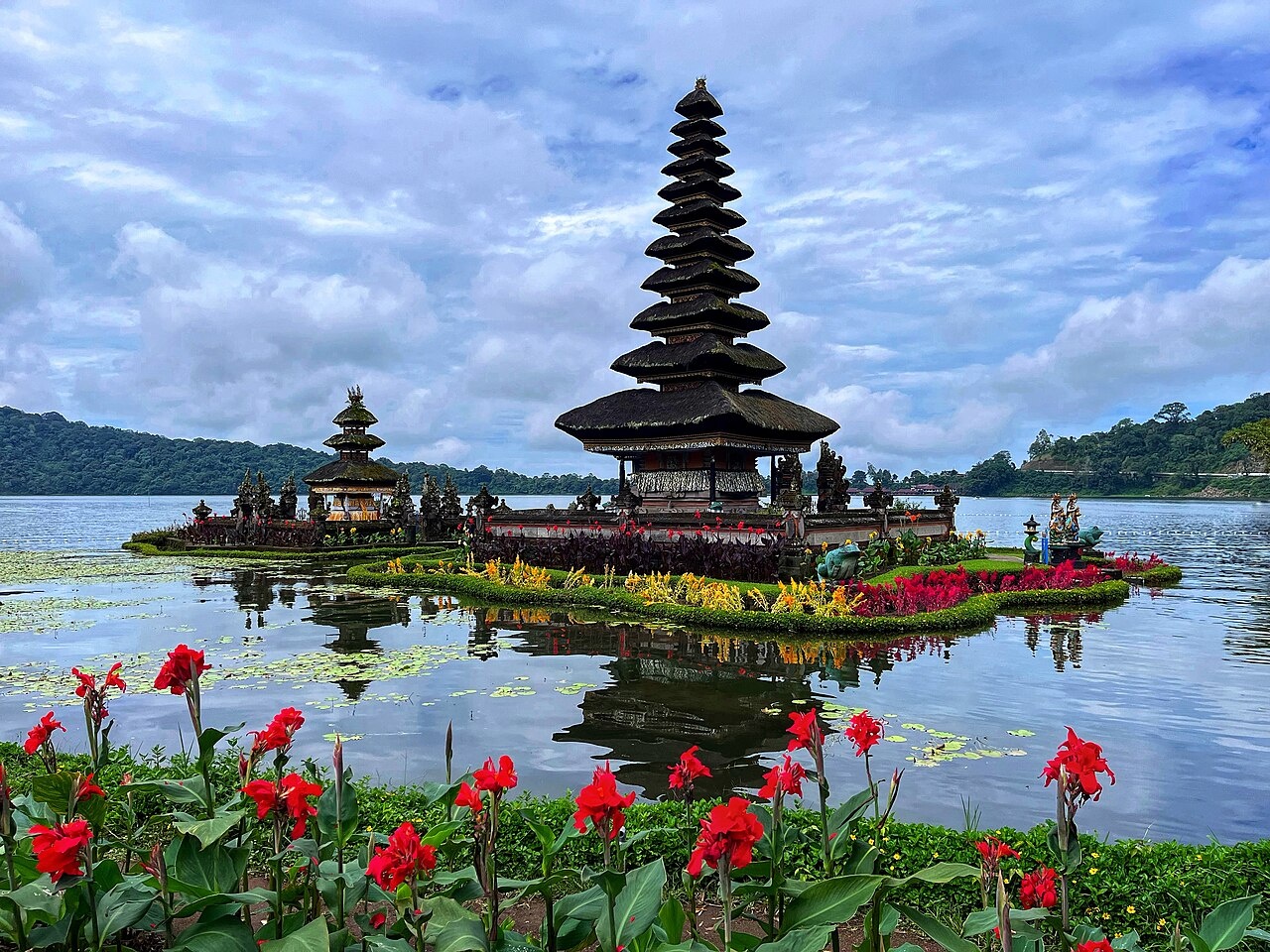
Anjan Chakraborty wrote in The Statesman: Each temples has, a more or less, fixed membership; each Hindu Balinese belongs to a temple by virtue of descent, residence, or some mystical revelation of affiliation. Some temples are associated with compounds in houses (also called banjar in Bali), others are associated with rice fields, and still others with key geographic sites. [Source: Anjan Chakraborty The Statesman, October 2008]
There are over 20,000 temple on Bali. Each village has at least three, usually located separately and aligned symbolically: 1) a “pura puseh”, dedicated to the village founders; 2) a “para desa”, dedicated to the spirits that protect the village; and 3) a “para dalem”, the temple of the dead. The most kaja temple, the pura puseh, is associated with the god Wisnu and purified ancestors. At the center stands the pura bale agung or pura desa, dedicated to Brahma. The most kelod temple is the pura dalem, linked to Siwa and the spirits of the not-yet-purified dead. [Source: A. J. Abalahin,“Worldmark Encyclopedia of Cultures and Daily Life,” Cengage Learning, 2009]
Many villages have several dozen temples. Each Balinese belong to six temple congregations: three in their village and others scattered around the island. Families honor their ancestors in family and clan temples. The other temples include farming temples, water temples, caste temple and so on. Some large temples such as Pura Besakih on the slopes of Guning Agung are regarded as sacred by everyone on Bali.
See Separate Article: See Balinese Temple Life Under BALINESE RELIGION factsanddetails.com and BALINESE HOLIDAYS, FESTIVALS, RITUALS, CEREMONIES AND OFFERINGS factsanddetails.com
Balinese Temple Features
Balinese temples typically consist of a series of courtyards entered through the ocean side. Large temples usually have a split gate like those found in the ancient Hindu temples in Java. These gates are comprised of a tower that has been cut in half and separated. The structures in the center of the temple are used for the most important ceremonies. Those further out are used for progressively less important ones.
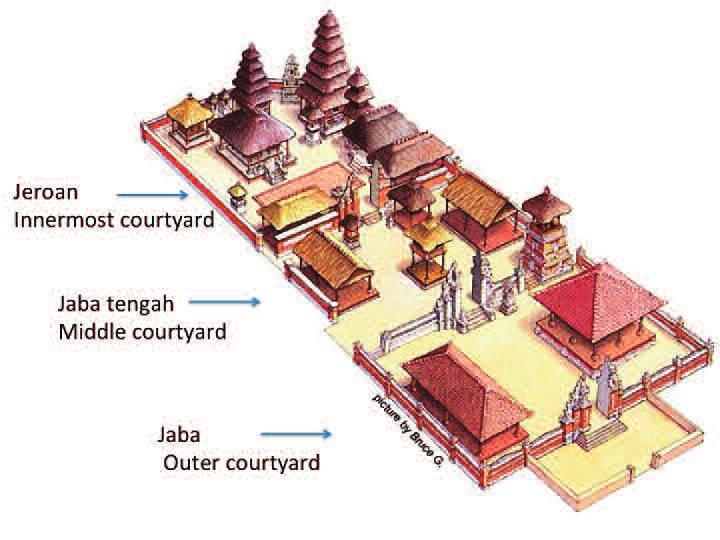
Large temples have traditionally been located at a water source and smaller ones are found intervals downstream. In addition to these temples there are simple shrines everywhere in rice fields, next to sacred trees. What distinguishes them from a temple is that they don’t have a wall around them.
The outer courtyard typically has a “kaikal” (alarm drum) and a number of open air pavilions for functions such as preparing food and holding meetings, There is often a banyan or frangipani tree. The innermost courtyard is entered through another separated gateway. The passage symbolizes a holy mountain and is flanked by guardian spirits or protective shrines. Generally, inside the innermost courtyard are two rows of shrines: one row oriented towards the mountains and the other oriented toward the sunrise.
In major temples the shrines usually include multi-floored pagodas. These are called “merus” and are identified with Mt. Meru, the Hindu god Shiva’s mountain paradise. The number of roofs if almost always an odd number with ones having 11 roofs being the holiest, The inner courtyard may also contain a throne of local god or less important gods. You do no see images of major Hindu gods like you do in Hindu temples in India.
World’s Largest Bamboo Building — a Chocolate Factory in Bali
On the quieter side of Bali, beyond a towering banyan tree and beside an ancient Hindu temple, an unusual structure has been rising: what is set to become the world’s largest commercial bamboo building—a chocolate factory. The three-story, 23,000-square-foot structure, built from more than 3,000 flexible bamboo poles, features a sweeping, cathedral-like roof soaring nearly 50 feet high. Its co-owner, Frederick Schilling, aptly calls it a “bamboo cathedral.” [Source: Michael Holtz, Associated Press, November 2, 2011]
Bamboo, long appreciated in the West for furniture and flooring, is increasingly being promoted as a sustainable construction material. In Bali, it has sparked a creative movement, drawing architects, designers, and builders from around the world. The island has become a hub for bamboo innovation, with projects ranging from schools and villas to luxury eco-resorts.
One reason for bamboo’s appeal is its remarkable growth and strength. Found across tropical regions, it can grow up to four feet in a single day and reach full height within months. It is inexpensive to cultivate, highly flexible, and strong enough for structural use within a few years. For advocates, these qualities make it one of the most sustainable building materials available. As Schilling notes, it is not only environmentally friendly but also visually striking.
Bali’s bamboo-building boom began with the creation of the Green School, an international campus that inspired a wave of similar projects. Developments such as Green Village along the Ayung River and the nearby Fivelements Retreat showcase how bamboo can be used for high-end, sustainable design. These projects bring together international entrepreneurs and local craftsmen, blending innovation with traditional skills.
Designing with bamboo, however, requires a fundamentally different mindset. As architect Elora Hardy explains, modern architecture is accustomed to straight lines, while bamboo naturally curves and bends. Builders must carefully anticipate how each pole will arc and align as it rises, making the process both creatively exciting and technically complex.
Despite its promise, bamboo construction still faces challenges. Strict building regulations in Europe and the United States make large-scale adoption difficult, and the lack of standardized certification for raw bamboo structures raises concerns. Some experts argue that bamboo’s greatest potential lies in tropical regions, where it grows abundantly and performs best. Countries such as Colombia, Vietnam, and China are also exploring its possibilities.
In Indonesia itself, however, bamboo carries mixed perceptions. While international designers celebrate it, many locals still associate bamboo with temporary scaffolding or low-status materials. Architects like Effan Adhiwira are working to change this view, promoting bamboo as a viable and innovative material through education and design projects, even in cities like Jakarta, where concrete and steel dominate.
For pioneers like Schilling and his partner Ben Ripple, the bamboo chocolate factory represents more than just a building—it is proof of an overlooked resource’s potential. As Ripple puts it, bamboo has always been there; what is happening now is less a revolution than a rediscovery of knowledge long familiar to Indonesians.
Image Sources: Wikimedia Commons, Indonesia Tourism website
Text Sources: “Encyclopedia of World Cultures Volume 5: East/Southeast Asia:” edited by Paul Hockings, 1993; Wikipedia; National Geographic, Live Science, Metropolitan Museum of Art, Natural History magazine, New York Times, Washington Post, Los Angeles Times, Smithsonian magazine, Encyclopedia.com, Library of Congress, The Conversation, The New Yorker, Time, BBC, CNN, Reuters, Associated Press, AFP, Lonely Planet Guides, Google AI, The Guardian and various websites, books and other publications.
Last updated April 2026