
TERNATAN AND TIDORESE
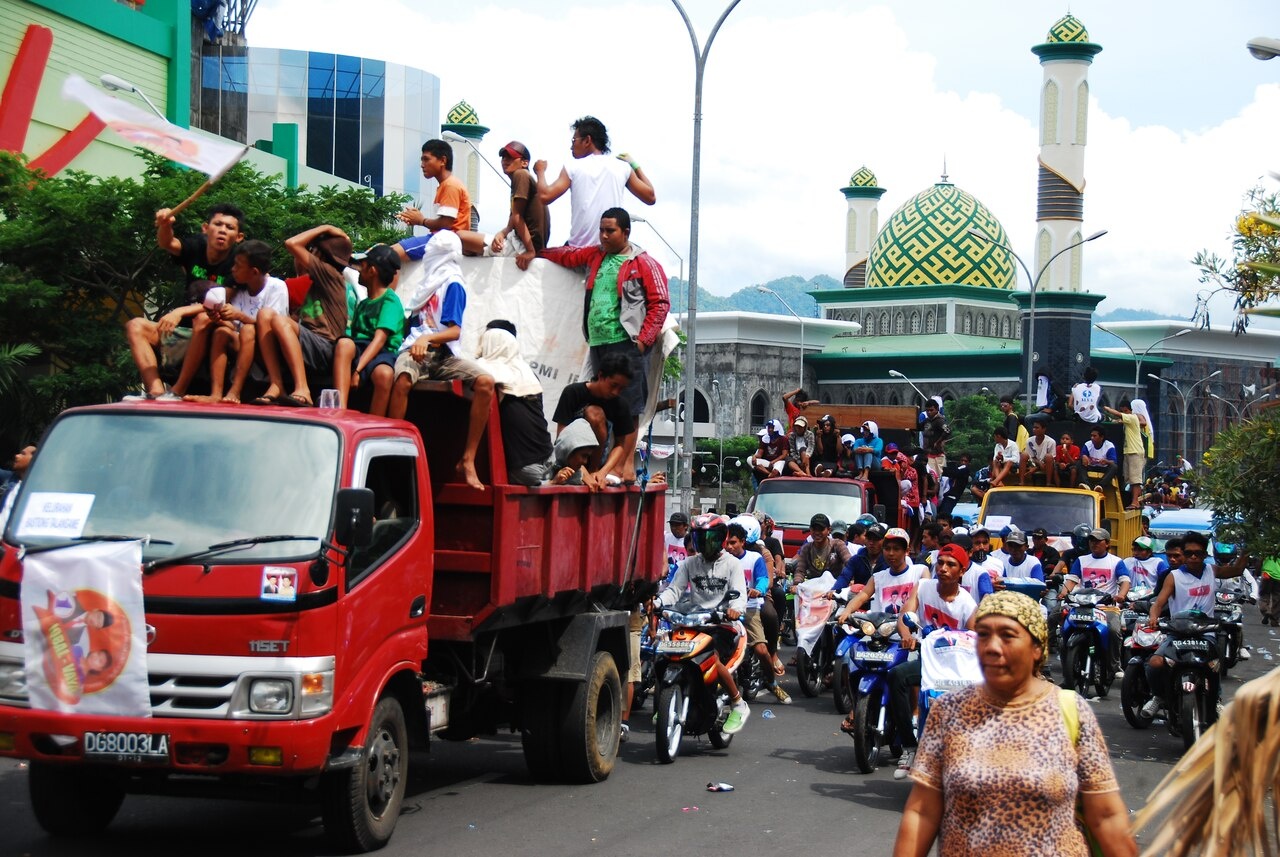
The Ternatan and Tidorese live on two small islands in the North Moluccas: Ternate and Tidore. Also known as Orang Ternate, Orang Tidore, Suku Ternate and Suku Tidore, they distinguish themselves from the islanders around them by the use of the Ternatan and Tidorese languages and their link to historical kingdoms. The Ternatan and Tidorese are closely linked culturally but neither likes to be confused with the other. [Source: CH. F. van Fraasen, “Encyclopedia of World Cultures Volume 5: East/Southeast Asia:” edited by Paul Hockings, 1993]
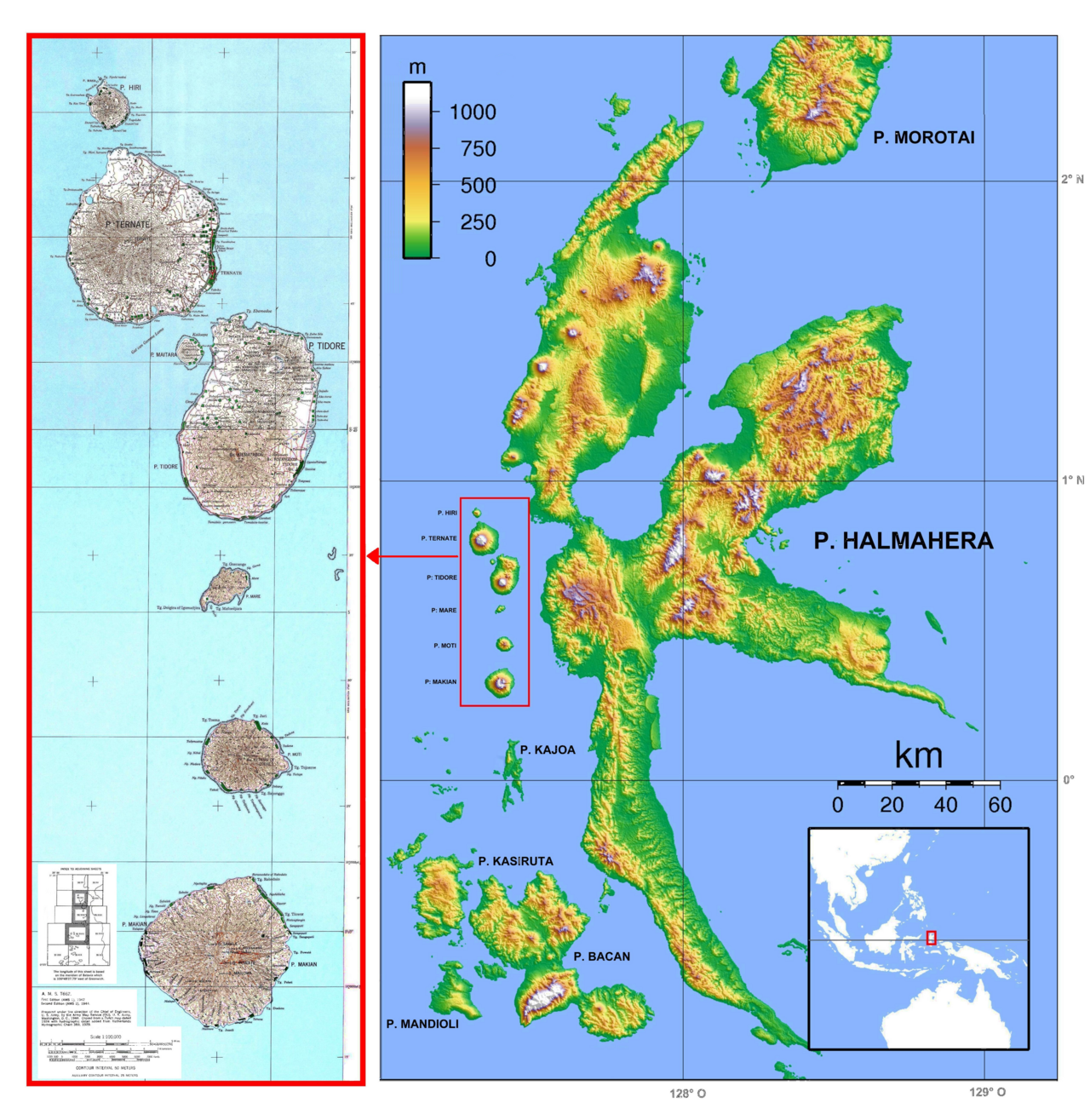
Ternate and Tidore are volcanic islands. They are very close to each other and to the equator, are located off the west coast of the large island of Halmahera in the northern part of the Moluccas in Maluku province of Indonesia. They are situated at 1° N and 127° E, and their peaks are over 1,700 meters high. Both Ternate and Tidore exceed 40 kilometers in circumference. Ternate's volcano is active, while Tidore's has not shown any signs of activity for a long time. The islands have a healthy climate.
The Ternatan have long been in closer contact with people from the western parts of the Indonesian archipelago than with the Tidorese. As a result, the Tidorese are generally less educated and less cultured than the Ternatan. The Tidorese are considered more industrious, but also more boorish, than the Ternatan. ~
Ternate and Tidore each have their own capital: Ternate City and Soa Siu, respectively. These towns developed from neighborhoods that emerged near the residences of the sultans. However, most Ternatan and Tidorese people live in villages scattered along the islands' coast. These villages have populations ranging from 200 to 5,000 people. Most villages on Ternate and Tidore are located along the coastal road, though some are situated off the road on the lower slopes of the volcano. The latter can only be accessed via footpaths. A village usually consists of several houses belonging to farmers and fishermen without a particular layout and with a mosque located more or less in the center.
RELATED ARTICLES:
PEOPLE OF THE MOLUCCAS factsanddetails.com
AMBONESE: HISTORY, IDENTITY, LANGUAGE, RELIGION factsanddetails.com
AMBONESE: LIFE, SOCIETY, FAMILY, FOOD factsanddetails.com
TANIMBARESE factsanddetails.com
NORTH MALUKA (NORTH MOLUCCAS) factsanddetails.com
MALUKA (CENTRAL MOLUCCAS) factsanddetails.com
BANDA ISLANDS factsanddetails.com
MOLUCCAS: GEOGRAPHY, ISLANDS, WILDLIFE factsanddetails.com
HISTORY OF THE MOLUCCAS factsanddetails.com
SPICES AND THE SPICE ISLANDS factsanddetails.com;
CLOVES, MACE AND NUTMEG: THE SPICE ISLANDS SPICES factsanddetails.com
DUTCH AND THE SPICE TRADE factsanddetails.com
Ternate and Tidore Populations and Languages
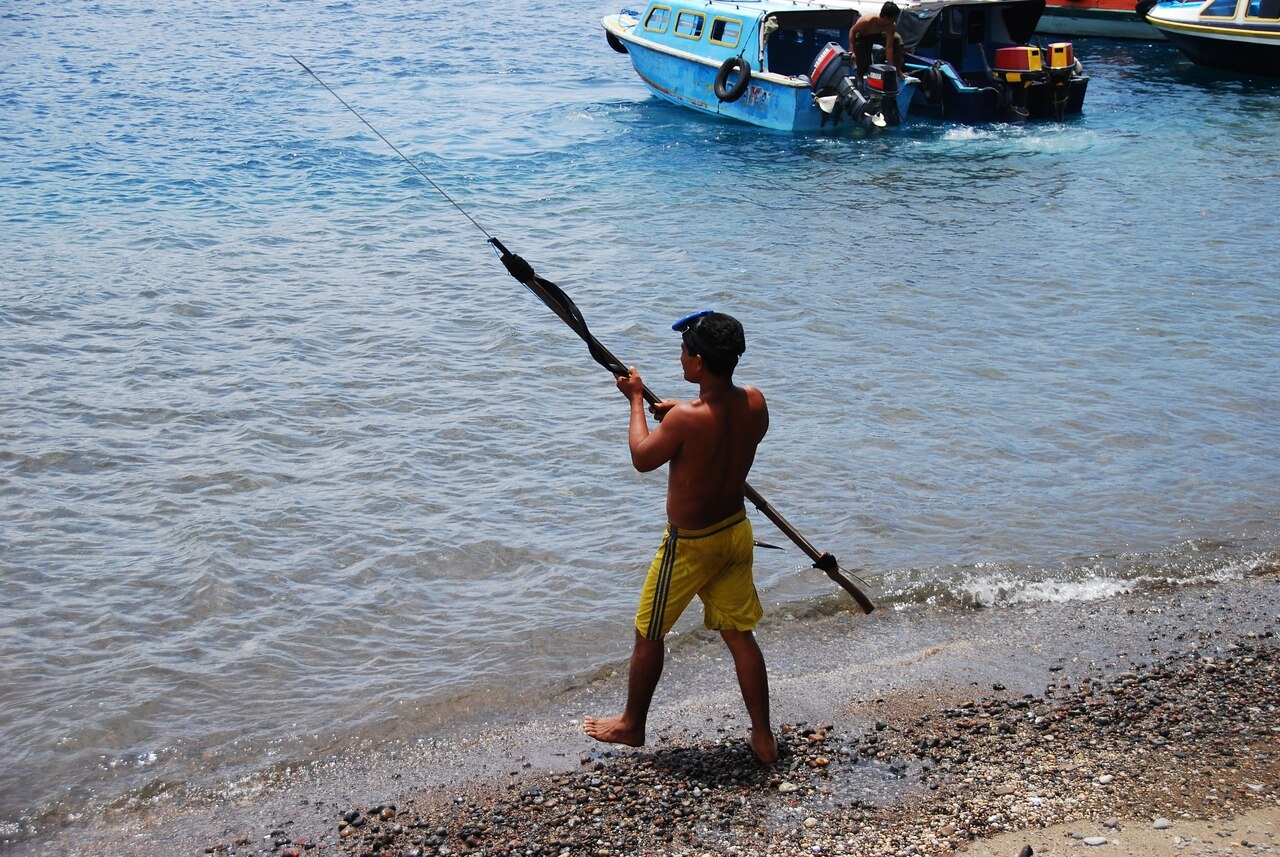
According to the Christian group Joshua Project there are 140,000 Ternatan, with 99.9 percent being Muslims, and 90,000 Tidorese, with 98 percent being Muslims. About half of each live on their home islands. By one estimate the number of Ternatan in the early 1990s, was is about 35,000, with approximately half of them living on Ternate Island; and the number of Tidorese at the same time was about 70,000, with approximately half of them living on Tidore Island. [Source: Joshua Project, ~]
Ternate and Tidore languages are regarded as dialects of a single language, Ternate–Tidore, one of four closely related languages spoken across northern Halmahera and the offshore islands to its north and west. Together they form a non-Austronesian enclave within an otherwise Austronesian-speaking region. Linguistically, these languages are linked to those of the Bird’s Head Peninsula of the Indonesian side of New Guinea and belong to the wider West Papuan phylum.
Today, Bahasa Indonesia is the medium of instruction in schools, and Ternate–Tidore has been reduced to a language of everyday speech, no longer used in writing and of diminished social status. Before World War II, however, it served as the official language of the courts of Ternate and Tidore and was written in Arabic script.
Ternatan and Tidorese History
Ternate and Tidore are the original Spice Islands than were the goal of Columbus, Magellan and other figures from the Age of Exploration. These two island and Halmahera and some other nearby islands are the original homeland of cloves, and until the sixteenth century clove cultivation was confined to this region. When the Portuguese arrived in the Moluccas in 1512, four sultanates dominated the area—Ternate, Tidore, Bacan, and Jailolo. [Source: CH. F. van Fraasen, “Encyclopedia of World Cultures Volume 5: East/Southeast Asia:” edited by Paul Hockings, 1993]
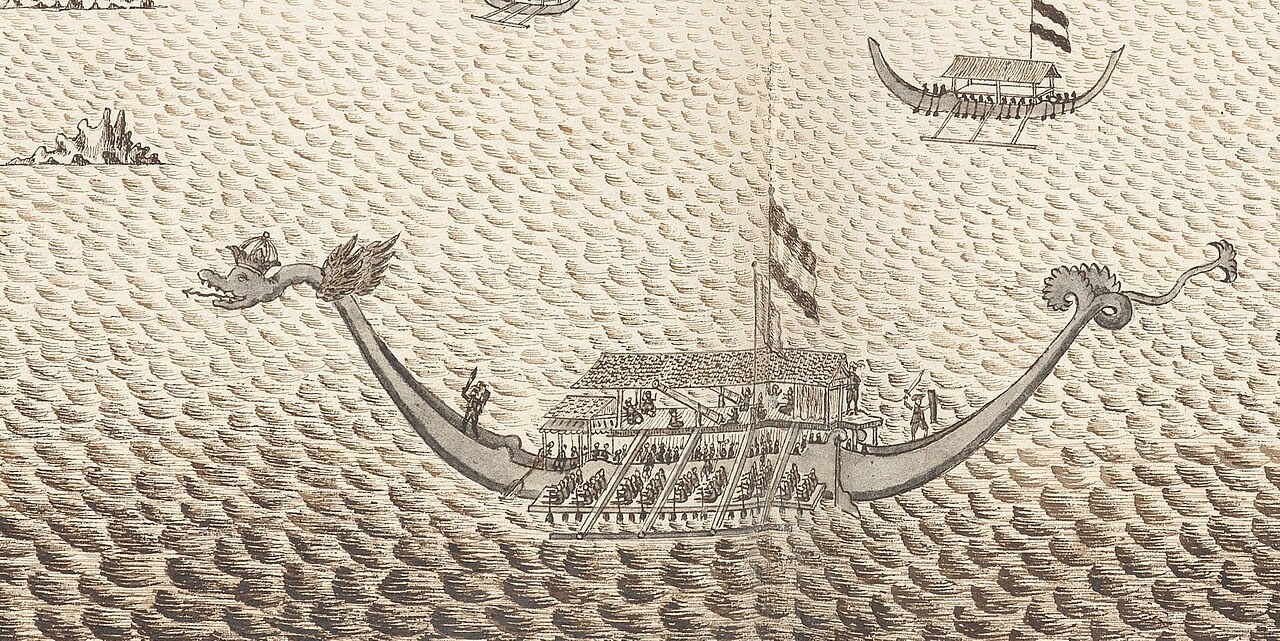
Ternate and Tidore islands were rivals and the home of the most powerful Muslim sultanates in pre-European times. Together, these sultanates controlled the entire world supply of cloves, and their power and prestige rested on regulating sales to foreign, and later European, traders. Their influence at one time extended to the Philippines, Sulawesi and New Guinea. They controlled the clove trade until the arrival of Europeans in the 16th century and held their own in battles against the Portuguese and Spanish in the 1500s, but were eventually defeated by the Dutch and came under colonial rule.
During the 15th and 16th centuries, when Ternate and Tidore expanded their military reach and political and cultural influence across surrounding regions, Ternate focused its expansion on northern Halmahera, the islands south of Ternate, and the east coast of Sulawesi, while Tidore extended its authority over southern Halmahera, the Raja Ampat Islands, the adjacent coast of New Guinea and eastern Ceram.
Ternatan and Tidorese Under the Dutch
The Portuguese were able to establish themselves in Ternate but they tried without success to establish a clove monopoly. When the Dutch took over the islands they were successful in achieving this goal. They restricted the cultivation of cloves to Ambon in the central Moluccas and a few islands near there, producing only enough to meet global demand. The cultivation of cloves in any other place was strictly forbidden. In return for their cooperation the sultans of Ternate and Tidore were provided with an annual allowance. The monopoly was maintained under this system until the 19th century.
Under Dutch protection Ternate and Tidore remained semi-autonomous states into Indonesian independence in 1949. Even with the annual allowances to the sultans of Ternate and Tidore and their leading officials, prohibition caused severe economic decline, fostered dependence on Dutch support, and led to cultural isolation and political stagnation. When the ban was lifted in the nineteenth century, little changed: clove prices had fallen too low to make cultivation profitable, and the allowance system continued.
Over the centuries, Ternate and Tidore were shaped by influences from the Islamic northeast coast of Java, as well as by Portuguese and Dutch rule. At the same time, their political centers exerted a strong and lasting cultural influence on the surrounding islands. After Indonesian independence in 1949 the Indonesian government pursued full integration of Ternate and Tidoree, gradually absorbing the internal administrations of the sultanates into the provincial structure of the Moluccas. Today, the sultanates have effectively ceased to exist, and now now exists only in stories.
RELATED ARTICLES:
SPICES AND THE SPICE ISLANDS factsanddetails.com;
CLOVES, MACE AND NUTMEG: THE SPICE ISLANDS SPICES factsanddetails.com
DUTCH AND THE SPICE TRADE factsanddetails.com
Ternatan and Tidorese Islam
Ternatans and Tidorese are devout Muslims, a commitment expressed in rituals surrounding circumcision, marriage, and death; in strict observance of the Ramadan fast; in the celebration of holy days; and in the high esteem accorded to the pilgrimage to Mecca. At the same time, they maintain many local traditions that diverge from orthodox Islam, including the veneration of shrines visited for healing and other practical concerns. Belief in guardian spirits is also widespread, with shamanistic rituals performed to seek their protection and assistance. Concepts of death and the afterlife, however, are drawn entirely from Islam. [Source: CH. F. van Fraasen, “Encyclopedia of World Cultures Volume 5: East/Southeast Asia:” edited by Paul Hockings, 1993]
Most Ternatans and Tidorese religious practice fall in line with proscribed tenets of Islam. In the past, Arabs often served as religious teachers, and the sultan appointed imams and khatibs, acting as both political ruler and head of the religious community (ummat). This arrangement changed after World War II, when Indonesia established a nationwide system for training religious teachers.
Today, local offices of the Department of Religion on Ternate and Tidore appoint imams and khatibs and oversee religious affairs, as elsewhere in the country. The traditional role of Arab religious teachers has thus been greatly diminished. Modern religious officials, trained in this system, tend to be more orthodox and are inclined to eliminate practices seen as incompatible with Islam, although leaders of shamanistic rituals continue to be tolerated for customary reasons.
Ternate and Tidore Society
Ternatans and Tidorese traditionally identified themselves through descent from a soa, a named unit of sociopolitical organization. Although the term soa literally means “ward,” “quarter,” or “hamlet,” it was not a territorial grouping: membership depended on descent rather than residence and was transmitted patrilineally. At the same time, a soa was neither a clan nor a lineage, since its members did not claim descent from a single ancestor and kinship organization was cognatic rather than strictly unilineal. Each soa was headed by a chief appointed by the sultan. With the abolition of the sultanates, however, soa lost their political significance: they are no longer recognized as administrative units, play no role in kinship organization, and their chiefs have been replaced by democratically elected village heads. ~[Source: CH. F. van Fraasen, “Encyclopedia of World Cultures Volume 5: East/Southeast Asia:” edited by Paul Hockings, 1993]
Ternatans and Tidorese are generally non-aggressive and tend to avoid conflict rather than confront it directly. People of foreign origin are readily incorporated into society, provided they are Muslim. Social control operates mainly through family members, neighbors, and fellow villagers. Minor violations of accepted norms are usually tolerated if they remain discreet, but once a transgression becomes public, swift action is expected. Thus, young people caught engaging in extramarital sex are typically compelled to marry immediately, often following severe physical punishment. ~
Ternatan and Tidorese Family, Marriage and Kinship
A typical Ternatan and Tidorese household consists of a married couple and their children, often sharing residence with one or both sets of parents. In regards to inheritance, property is generally divided more or less equally among the children. In practice, however, the outcome reflects family negotiations and power dynamics, since inheritance is arranged informally within the family without outside mediation. [Source: CH. F. van Fraasen, “Encyclopedia of World Cultures Volume 5: East/Southeast Asia:” edited by Paul Hockings, 1993]
The Ternatan and Tidorese have a tradition of prearranged and child marriages to protect and enhance family status and honor and to prevent unsuitable matches;. Full membership in society and community is attained only through marriage. In upper-class families, young people were compelled to marry against their wishes and marriages often ended in divorce. . Overall, however, arranged marriages have become less common.
In accordance with Islamic law, marriages between relatives—such as parallel or cross cousins—are permitted and do occur. Polygyny is practiced. Newly married couples commonly live for a period with their parents, sometimes with the husband’s family but more often with the wife’s. When they establish their own household, it is usually located near the parents of one spouse, most often the wife. ~
Children are raised primarily by parents, grandparents, and siblings, with aunts and uncles also playing a role. Play and learning are closely intertwined, with no sharp boundary between them. Boys are generally spoiled and regarded as the pride of the family. They are often allowed to laze around and indulge themselves while girls are put to work and expected to prove their suitability for marriage. Only after marriage are boys expected to assume the full seriousness of adult responsibilities.
Because descent is cognatic, with descent traced through either the male or female line, there are no sharply defined kin groups. Nonetheless, closer examination reveals unnamed lineages or descent groups tracing back to remembered ancestors who once held important offices. These groups derive their identity and status from offices occupied by their members in state or religious institutions. They are neither exogamous nor endogamous, and succession and inheritance of rights tend to favor, but do not require, the male line. Individuals primarily belong to their father’s household but also maintain ties and rights in their mother’s household. ~
Formerly, sago was the principal staple food, even though it grows only in negligible quantities on Ternate and Tidore and had to be imported mainly from Halmahera, Morotai, Bacan, and Sula. Today, cassava and maize, which are locally cultivated, have replaced sago as the primary staples. Cassava is prepared in much the same way as sago, as popéda: boiling water is poured over the flour to produce a paste, usually eaten with a fish sauce.
Ternate or Tidore Agriculture, Work and Economic Activity
Most Ternatan and Tidorese.are subsistence farmers or fishermen. Only a few people are involved in commercial fishing. Staple foods include cassava, maize, bananas and taro. They are often eaten with dried and salted, smoke-dried or fresh fish. Some dry-rice cultivation existed and still exists on both islands, but never at a level sufficient to make rice the main food. People rarely eat vegetables or meat. Alongside gardening and fishing, villagers keep small numbers of chickens, ducks, goats, and similar animals. In towns, most people work as government employees, for Chinese employers, or as small retailers in the marketplace. ~[Source: CH. F. van Fraasen, “Encyclopedia of World Cultures Volume 5: East/Southeast Asia:” edited by Paul Hockings, 1993]
Artisans are almost absent from the villages of Ternate. On Tidore, however, a traditional division of labor exists among villages: Gurabati is known for makers of atap (traditional roofing), Toloa for blacksmiths and boat builders, and the small island of Mare for commercial pottery production. ~
Most trade and commerce are dominated by Chinese merchants. Shops in Ternate City and Soa Siu, like businesses more generally, are almost entirely owned by Chinese, with a few Arabs. Ternatan and Tidorese themselves play only a limited role in the trade of fruits, vegetables, and fish; surplus produce and fish are brought from villages to town markets either directly or through wholesalers. ~
In most villages there is still sufficient land for nearly every family. Those who lack enough land for gardens can move to Halmahera, where they clear new fields in sparsely populated areas. Men perform the heavier, occasional tasks in the gardens, such as tree felling, do some fishing, and are responsible for building and maintaining houses. Women carry out the daily garden work, cooking, and childcare, and contribute to household income by selling garden produce and fish. ~
Image Sources: Wikimedia Commons
Text Sources: “Encyclopedia of World Cultures Volume 5: East/Southeast Asia:” edited by Paul Hockings, 1993; National Geographic; New York Times, Washington Post, Los Angeles Times, Lonely Planet Guides, Library of Congress, Smithsonian magazine, The New Yorker, Time, Reuters, AP, AFP, Wikipedia, BBC, CNN, and various books and other publications.
Last Updated January 2026