
SOUTH SULAWESI ETIQUETTE, FAMILY AND WOMEN
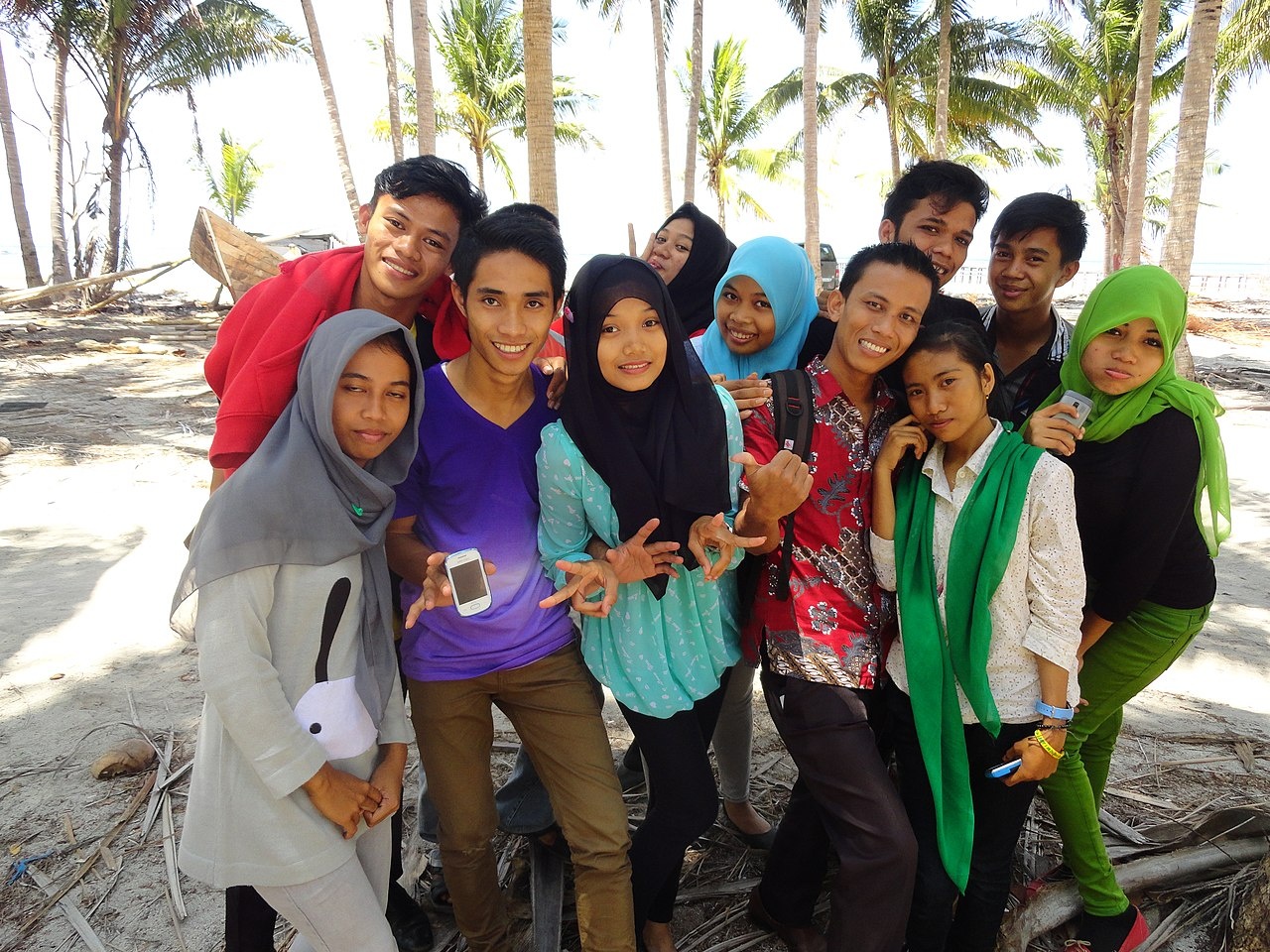
The central value governing interpersonal relations is siri’, a powerful sense of personal and collective honor. Siri’ obliges individuals and groups to strive relentlessly for prestige and to defend their dignity at all costs, even to the extent of risking or sacrificing life in violent retaliation against those who cause grave offense. [Source: A. J. Abalahin, “Worldmark Encyclopedia of Cultures and Daily Life,” Cengage Learning, 2009]
A household typically consists of a nuclear family that may include grandparents and unmarried adult children. In wealthier urban families, relatives from rural areas often reside for extended periods, contributing to domestic work. Traditionally, spouses address one another not by personal names but as “Father of [the child’s name]” and “Mother of [the child’s name]. Preferred, though not mandatory, marriage partners are cousins of the first, second, or third degree, while unions with siblings, nieces or nephews, or grandchildren are strictly prohibited.
Women are not viewed as inherently weaker or more fragile than men; some tasks identified as women’s work, such as pounding rice, require considerable physical strength. During the early years of marriage, a husband commonly resides in his wife’s parental household, a pattern that tends to discourage male dominance within the relationship. Although the household is considered the wife’s domain, this does not imply economic dependence. On the contrary, women play a central role in sustaining the family economy by assisting with agriculture, weaving, small-scale trade, and other income-generating activities. In fishing households in particular, wives often provide the primary economic support while husbands are at sea, as the men’s earnings largely cover their own subsistence during voyages, with any surplus contributing only marginally to household income.
RELATED ARTICLES:
ETHNIC GROUPS ON SOUTHERN SULAWESI factsanddetails.com
SOUTHERN SULAWESI: HISTORY, GEOGRAPHY, RELIGION factsanddetails.com
SOUTH SULAWESI factsanddetails.com
SOUTH EAST SULAWESI factsanddetails.com
SULAWESI factsanddetails.com
MAKASSAR HISTORY, GOWA, TRADE, RELIGION AND SIRI (HONOR) factsanddetails.com
MAKASSAR PEOPLE: LIFE, SOCIETY, CULTURE factsanddetails.com
MAKASSAR CITY AND REGION factsanddetails.com
BUGIS: LANGUAGE, HISTORY, RELIGION. ECONOMIC ACTIVITY factsanddetails.com
BUGIS LIFE AND CULTURE: SOCIETY, FAMILY, FIVE-GENDERS factsanddetails.com
BUGIS SAILING TRADITIONS: SHIPS, PIRACY, WHALE SHARKS factsanddetails.com
TORAJA: HISTORY, LANGUAGE, DEMOGRAPHICS, GROUPS factsanddetails.com
South Sulawesi Villages, Houses and Food
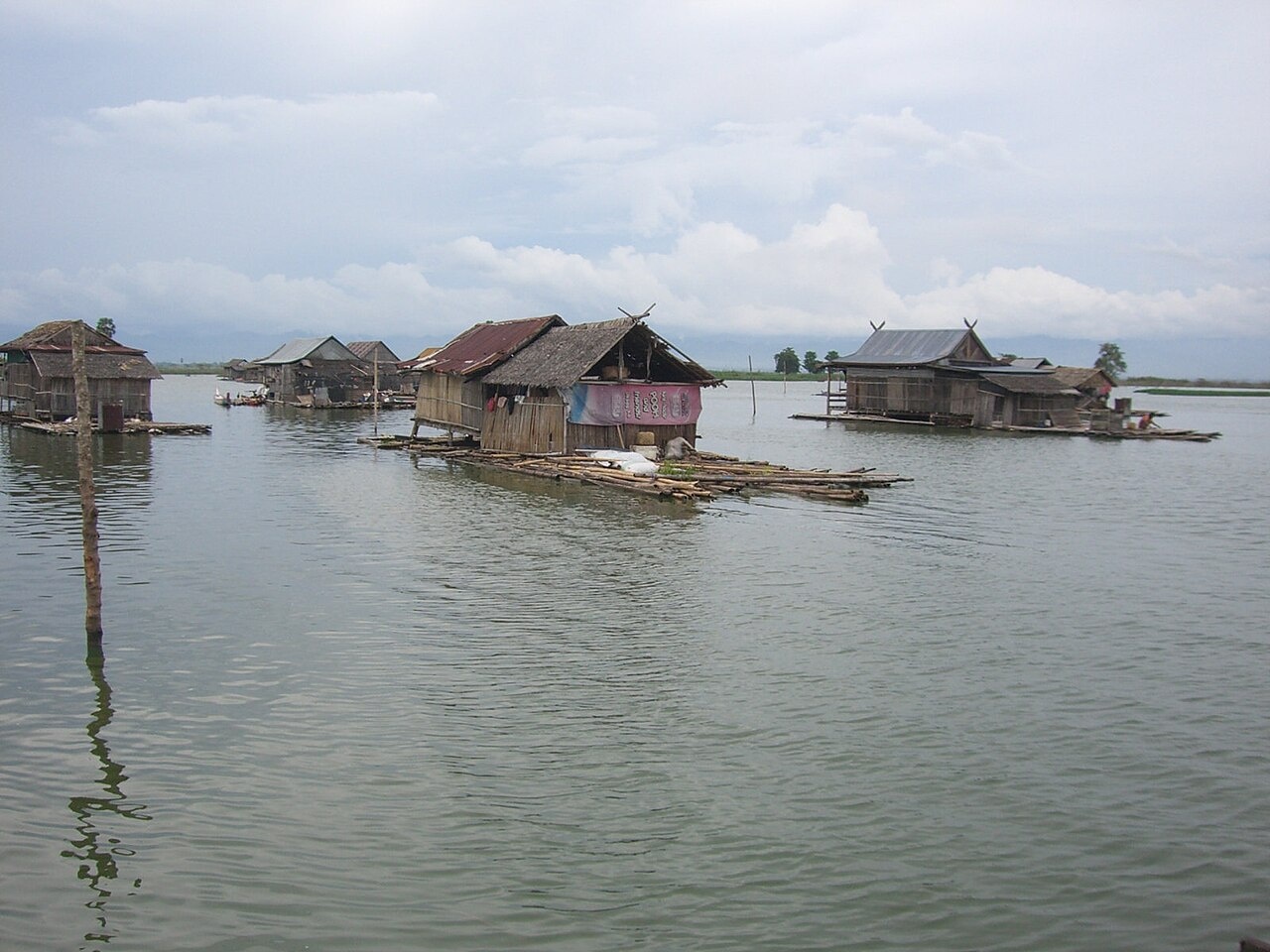
Villages in southwestern Sulawesi typically comprise between ten and two hundred houses, oriented to face south or west, or aligned along a river when one is present. At the village center usually stand a banyan tree and a mosque or prayer house. Traditional houses are wooden-frame structures raised on stilts about 1.5 to 2 meters high. Wealthier households use wooden floors and walls with zinc roofing, while poorer families rely on bamboo construction with roofs made of leaf fibers. [Source: A. J. Abalahin, “Worldmark Encyclopedia of Cultures and Daily Life,” Cengage Learning, 2009]
Architecturally, the house is divided vertically into three symbolic levels: the upper space beneath the roof, believed to be inhabited by spirits; the central living area for humans; and the space beneath the floor, used for storing tools and housing livestock. Horizontally, beginning at the front facing the road, the house consists of an open veranda; a vestibule where family members gather and guests wait before being invited inside; a second room used for eating that contains heirloom weapons and the central house pillar, regarded as the dwelling place of the household’s protective spirit; and a sleeping area, divided into a front section for the parents and a rear section for daughters. Sons typically sleep on the front veranda or at the village mosque. Commoner houses usually have a lower roof over the vestibule and a higher roof over the main living area, while aristocratic houses may feature multiple tiered roofs.
Daily meals consist primarily of rice accompanied by fish, vegetable soups, pickled vegetables, and chili sauces. Grilled fish, shrimp, and other seafood served with dipping sauces are popular, as are curries and meats stewed in coconut milk. The region is also well known for its sweets and cakes, as well as signature dishes such as konro Makassar, a beef-rib soup, and coto Makassar, made from water-buffalo lungs, intestines, liver, and tripe and eaten with rice steamed in palm-leaf packets. Men customarily eat first in the front room, followed by women, who eat either there or in the kitchen. Folk belief holds that doors and windows should be closed during meals.
South Sulawesi Clothes
Everyday clothing for boys consists of shorts, with or without a shirt, while girls wear a shirt and a knee-length skirt. Adult men typically wear a plaid sarong, sometimes paired with a sleeveless undershirt, while adult women wear a batik sarong with a kebaya blouse or a short-sleeved shirt. Unlike in many other parts of Indonesia, both men and women wear the same type of tubular sarong; traditionally, men secured it with a knot, while women draped the edge over the right forearm.
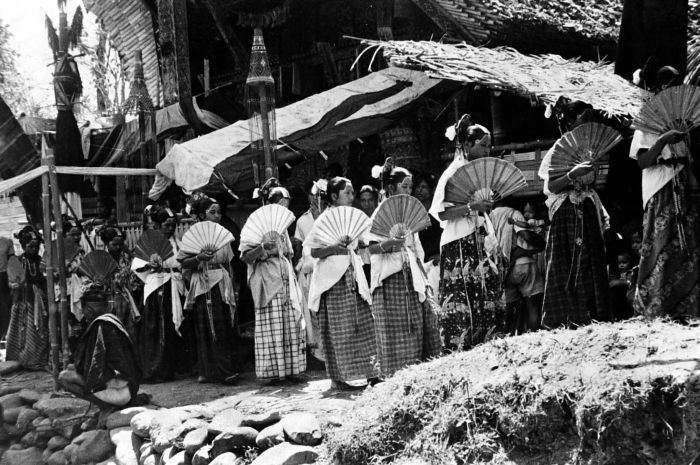
For street wear, men commonly wear Western-style trousers and shirts or a sarong paired with a long- or short-sleeved shirt. Appearing in public without a head covering is considered impolite; these include black velvet caps, white hajji caps, or the now-rare sangkok rucca, a brimless, flat-topped cap woven from palm-leaf fibers. For ceremonial occasions, men add a buttoned jacket—often of silk—to the shirt and sarong.
Women’s street attire consists of the sarong-and-blouse combination or modest Western dress. Traditional female clothing, now largely reserved for ceremonial use, includes a silk sarong worn with a baju bodo, a blouse with wide, short sleeves worn over an undershirt. Prior to Indonesian independence, the color of the baju bodo strictly indicated age and social status: light red for teenage girls and childless married women; dark red for married women with children; green for daughters of the aristocracy; purple for widows; white for nursemaids; and black for elderly women.
Culture, Art and Boats in Southwestern Sulawesi
Until the early 20th century, South Sulawesi exported silk and cotton, and weaving still provides supplementary income for village women. The two best-known styles are the sarong Mandar, a finely woven cloth with checkered patterns in subdued colors that was widely traded in the archipelago, and the sarong Bugis, a brilliantly colored silk cloth with large patterns reminiscent of Thai fabrics. Other highly developed crafts include blacksmithing, which now uses scrap metal rather than freshly mined ore; gold and silversmithing, with a specialty in fine filigree work; and mat and basket weaving.
The Bugis and Makassar peoples possess rich literary traditions written in their own script, aksara lontara’, named after the lontar palm leaves traditionally used as writing material. The script was standardized in the 16th century during the reign of the Gowa king Daeng Pamatte. Lontara literature includes customary laws, divination manuals (particularly related to agriculture), genealogies, myths of dynastic origins, historical chronicles, and court diaries, the latter two being unique within Indonesia. Religious literature written in Arabic-derived letters called "aksara serang" was presumably introduced via Seram in the Moluccas. Local literary works were also composed in Malay. The most famous of these is the Sya'ir Perang Mangkasara, which recounts the defense of Makassar against the Dutch.
Among traditional sports, paraga is especially well known. In this game, boys or young men attempt to keep a woven rattan ball airborne using only their feet, accompanied by the sounds of drums and the pui-pui.
South Sulawesi Music and Dance
Traditional music is performed either solo or in small ensembles and features a range of indigenous instruments. These include drums and gongs, the kesokeso (a two-string vertical fiddle with a rounded soundbox), a boat-shaped zither known as kecapi among the Bugis and kacaping among the Makassar, the pui-pui (a high-pitched, oboe-like wind instrument), and the Mandarese jarumbing, made from pronged bamboo. In addition to these forms, popular songs influenced by national and international styles are widely sung in local languages, including those classified as lagu Makassar. [Source: A. J. Abalahin, “Worldmark Encyclopedia of Cultures and Daily Life,” Cengage Learning, 2009]
Traditional dance can be broadly divided into court and folk styles. Court dances include the Bugis Pajaga, performed by twelve aristocratic girls; the Makassar Pakarena, danced by twelve girls and twelve boys; and the Mandarese Pattudu, performed by six to eight girls. These dances are characterized by controlled, graceful movements set against vigorous drumming. A similar aesthetic appears in certain wedding dances, where the bride remains composed and expressionless while two older male dancers playfully taunt her. Folk dances are more dynamic and include martial dances accompanied by the rebana drum, Pattenung depicting weaving, Mappuka imitating fishing, the Bugis Mappadendang harvest dance—often marked by playful behavior among young men—and Ganrang Bulo, a highly rhythmic Makassar dance in which boys strike bamboo rods.
Boats of Southwestern Sulawesi
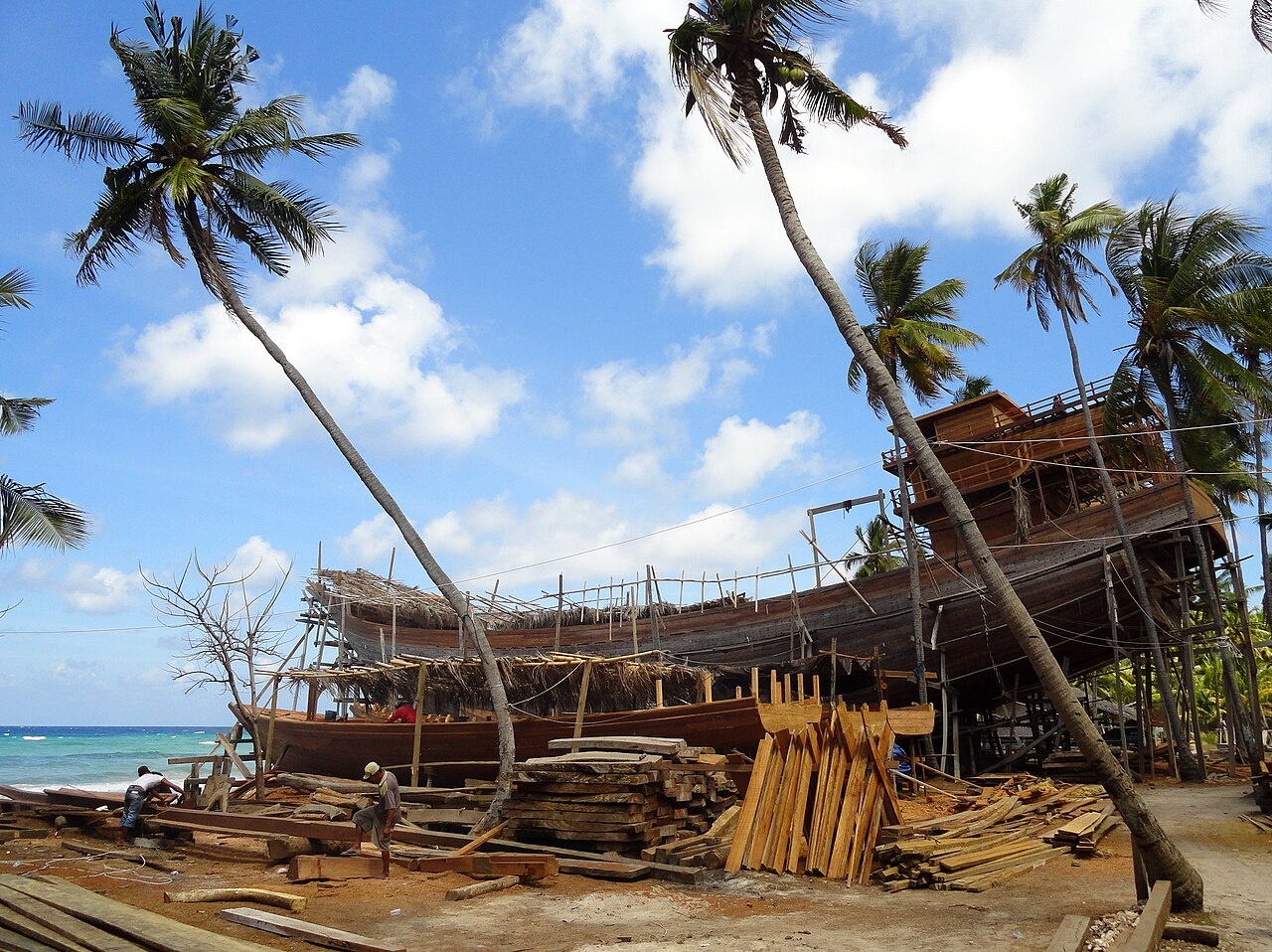
Southern Sulawesi is famous for its iconic wooden boats, especially the UNESCO-recognized Pinisi-rigged schooners — a tall-masted trading vessel built with intricate joinery, and its ancestral form, the Palari. Other notable craft include the speedy, single-masted Patorani fishing boat and the simpler Lepa used by sea nomads. These boats, built with traditional techniques using native woods like ironwood, are central to the region's identity, economy (especially around Tana Beru), and maritime heritage, now also serving as tourist attractions. Key Boats of South Sulawesi.
Boatbuilding centers including Tana Beru, Bira, and Batu Licin. Ships are typically constructed by hand from locally sourced, durable woods (teak, ironwood, bitti), using traditional joinery without many metal fasteners, a skill passed down through generations.Early European travelers admired the region's boat builders. The premier center was Bira, located at the southwestern tip of the peninsula, which had access to the ironwood of Bulukumba and Selayar. Bira boat-building teams travel all over the peninsula, as well as to Kalimantan and Java, to sell their skills. Boats are built from memory, without written designs, using the simplest tools: a vertical saw, a hand drill, an adze, and a plane. No nails are used. Only bolts are used to secure the ribs to the hull. Traditional boat types include the large, elegant pinisi and the smaller, outriggered lepa-lepa and sande. Today, the largest boats are motorized and weigh up to 500 tons. [Source: A. J. Abalahin, “Worldmark Encyclopedia of Cultures and Daily Life,” Cengage Learning, 2009 ^^]
Pinisi (Phinisi) refers to rigging on the most famous, a large, traditionally rigged sailing vessel (often a ketch) known for its powerful sails and distinctive stern, now often motorized but hand-built in the classic style.
Palari (Makkunarai) refers to an older, hull-design ancestor of the modern Pinisi schooner, built without engines, embodying the original form.
Lambo (Lamba) is a type of smaller, more compact Pinisi-rigged boat, built mainly by the Konjo people, used for trade.
Patorani is a fast, sloop-rigged fishing boat used mainly by Bugis, with a flat bottom, perfect for catching flying fish in shallow coastal waters.
Lepas are often simple home-boats used by sea nomads, featuring a small shelter (palau) for sun and rain protection,
Pinisi — UNESCO-Recognized South Sulawesi Shipbuilding
Pinisi— a type of rigging (the configuration of masts, sails and ropes or 'lines') of southern Sulawesi sailing vessels used by Bugis and Makassar people — was inscribed in 2017 on the UNESCO List of the Intangible Cultural Heritage of Humanity. Today, the word 'pinisi' is often used indiscriminately as a name for many types of wooden ships of Indonesia. But, technically, a pinisi has seven to eight sails on two masts, arranged like a gaff-ketch with what is called 'standing gaffs'. A gaff-ketch has a "gaff rig" — fore-and-aft sails extended by a diagonal spar (pole) called a gaff, with the forward mast (mainmast) being taller than the aft mast (mizzen mast). Pinisi-rigged ships were mainly built by the Konjo-speaking people of Ara, a village in the district of Bontobahari, Bulukumba regency, South Sulawesi, and widely used by Buginese and Makassarese seafarers as a cargo vessel.
According to UNESCO: Pinisi, or the Art of Boatbuilding in South Sulawesi, refers to the rig and sail of the famed ‘Sulawesi schooner’. The construction and deployment of such vessels stand in the millennia-long tradition of Austronesian boatbuilding and navigation that has brought forth a broad variety of sophisticated watercrafts. For both the Indonesian and the international public, Pinisi has become the epitome of the Archipelago’s indigenous sailing craft. Today, the centres of boatbuilding are located at Tana Beru, Bira and Batu Licin, where about 70 per cent of the population make a living through work related to boatbuilding and navigation.
Shipbuilding and sailing are not only the communities’ economic mainstay, however, but also the central focus of daily life and identity. The reciprocal cooperation between the communities of shipwrights and their relations with their customers strengthen mutual understanding between the parties involved. Knowledge and skills related to the element are passed down from generation to generation within the family circle, as well as to individuals outside of the family through the division of labour. The communities, groups and individuals concerned are actively involved in safeguarding efforts, for example through marketing initiatives and the publication of books on the subject.
Pinisi-Rigged Boats
The pinisi rig uses two masts and carries seven or eight sails. At the bow, three foresails are set on a long bowsprit. The main mast carries a large main sail and a topsail, while the smaller mast at the stern carries a mizzen sail and a mizzen topsail. Older vessels may also have an extra staysail between the two masts. When fully rigged, a pinisi looks similar to a gaff ketch or schooner in Western sailing terms, with all sails set fore-and-aft and the rear mast shorter than the main mast.[Source: Wikipedia]
Unlike most Western rigs, the pinisi gaffs are not raised and lowered with the sails. Instead, they are fixed near the mast and the sails are hoisted and lowered along a line, moving much like curtains. The main sail has no boom, while the mizzen sail uses a light spar. The gaffs are controlled by lines that pull them forward and downward.
Older pinisi vessels used tripod masts with simple wooden steps for climbing, while newer ones use two-pole masts with wooden ladders tied to the rigging. The masts are usually mounted in hinged bases, and the bowsprit is supported by wooden planks and crossbeams rather than ropes.
Originally designed for sailing without engines, traditional pinisi ships had much taller masts than those seen on many modern tourist or charter vessels. These taller masts were carefully proportioned to the length of the ship and designed so the upper mast sections could be raised by hand from the deck.
History of Pinisi Rigging
In the 19th century, sailors from Sulawesi began blending the traditional tanja sail with fore-and-aft rigs borrowed from Western ships operating in the archipelago. From this experimentation, the pinisi developed, evolving from the padewakang hull fitted with Western-style sails into a distinct vessel type with its own hull form and indigenous “pinisi rig.” During this period, Indonesian sailors and shipbuilders adapted and modified elements of the Western schooner to suit local conditions. The first true Sulawesi pinisi is generally believed to have been built in 1906 by shipbuilders from Ara and Lemo-Lemo for a skipper from Bira. [Source: Wikipedia]
Initially, schooner rigs were mounted on padewakang hulls, but sailors later favored the faster palari hull. Most of the hull space was used for cargo, with only a small cabin at the stern for the captain, while crew members slept on deck or in the cargo hold. The traditional double quarter rudder was retained.
From the 1930s onward, pinisi vessels adopted a new sail type known as the nade sail, influenced by cutters and sloops used by Western pearl divers and small traders in eastern Indonesia. In the 1970s, engines were increasingly installed, leading to the adoption of the lambo-type hull. As sails became secondary to engine power, many vessels removed their sails entirely, though some kept their masts. These hybrid vessels became known as Perahu Layar Motor (PLM), or motorized sailing boats.
In later decades, the cargo capacity of pinisi ships increased to an average of around 300 tons. Medium-sized vessels commonly used nade sails, while larger ships retained the pinisi rig. However, because engines allowed for shorter masts, sails were increasingly used only when wind conditions were favorable.
Image Sources: Wikimedia Commons
Text Sources: “Encyclopedia of World Cultures Volume 5: East/Southeast Asia:” edited by Paul Hockings, 1993; National Geographic; New York Times, Washington Post, Los Angeles Times, Lonely Planet Guides, Library of Congress, Smithsonian magazine, The New Yorker, Time, Reuters, AP, AFP, Wikipedia, BBC, CNN, and various books and other publications.
Last Updated January 2026