
MOOSE BEHAVIOR

Moose are generally placid, easy going and solitary and avoid trouble expect in the rutting season when males cane be quite aggressive. Cows with calves can also be very aggressive. Moose enjoying wading in swamps and marshes. In the summer when mosquitos and biting flies are particularly fierce, their often submerge themselves so that only their noses stick up above the water. Except during the mating season, moose stay in relatively small territories.
Moose are cursorial (with limbs adapted to running), terricolous (live on the ground), diurnal (active during the daytime), crepuscular (active at dawn and dusk), motile (move around as opposed to being stationary), natatorial (equipped for swimming),migratory (make seasonal movements between regions, such as between breeding and wintering grounds), sedentary (remain in the same area), solitary and have dominance hierarchies (ranking systems or pecking orders among members of a long-term social group, where dominance status affects access to resources or mates). [Source: Daniel De Bord, Tanya Dewey; Anne Bartalucci; Bret Weinstein, Animal Diversity Web (ADW) |=|]
The home range size of moose varies between 3.6 to 92 square kilometers. In North America Moose home ranges average five to 10 square kilometers. During their first year of life, young moose occupy the same home range as their mother and do not establish their own home range until the age of two. Home range size of males tend to be larger than females. Some moose migrate seasonally, up to 179 kilometers in North America and 300 kilometers in northeastern Europe. |=|
Moose are most active around sunrise and sunset. Despite their ungainly appearance, they are able to run silently through dense forests. Maximum speeds of 56 kilomters per hour and sustained speeds at 9.6 kilometers per hour have been recorded. Moose are also strong swimmers. They have been documented swimming up to 20 kilometers in distance and at speeds up to 9.5 kilometers per hour. Most of their time centers around feeding and avoiding trouble. They spend their time eating and resting while always being wary of nearby predators, which include bears, wolves and cougars. Their daily pattern includes traveling to a new feeding site,browsing on plants, standing, and lying down to ruminate their food. Moose mainly stay in the same general area, though some populations migrate between sites favorable at different times of the year.
RELATED ARTICLES:
MOOSE (ELK): CHARACTERISTICS, SIZE, HABITAT, SUBSPECIES factsanddetails.com
MOOSE (ELK) AND HUMANS: ATTACKS, RAMPAGES, CAR CRASH TESTS factsanddetails.com
RED DEER: CHARACTERISTICS, BEHAVIOR AND REPRODUCTION factsanddetails.com
ELK: CHARACTERISTICS, BEHAVIOR AND REPRODUCTION factsanddetails.com
DEER (CERVIDS): CHARACTERISTICS, ANTLERS, HISTORY, ECOSYSTEM ROLE, HUMANS factsanddetails.com ;
DEER (CERVID) BEHAVIOR, FEEDING AND REPRODUCTION factsanddetails.com
ROE DEER: SPECIES, CHARACTERISTICS, BEHAVIOR AND REPRODUCTION factsanddetails.com
SIKA DEER: CHARACTERISTICS, BEHAVIOR, SUBSPECIES factsanddetails.com
MUSK DEER: CHARACTERISTICS, BEHAVIOR, PERFUME, MEDICINE, FARMS factsanddetails.com ;
DEER ATTACKS factsanddetails.com
REINDEER AND CARIBOU: CHARACTERISTICS, FEEDING, CONSERVATION factsanddetails.com
REINDEER AND CARIBOU BEHAVIOR: MIGRATIONS, REPRODUCTION, PREDATORS factsanddetails.com
REINDEER AND PEOPLE factsanddetails.com
Moose Social Behavior and Aggression
Moose are the least social species among cervids, remaining fairly solitary except during the mating season. They are not territorial. Outside of the rutting period, males and females are sexually segregated: males and females are separated spatially, temporally, and/or by habitat. It has been hypothesized that this is due to the differences in nutritional needs of the sexes due to body size differences. Also, cows with calves at heel seclude themselves from members of their own species to reduce the risk of being singled out by predators.[Source: Daniel De Bord, Animal Diversity Web (ADW) |=|]
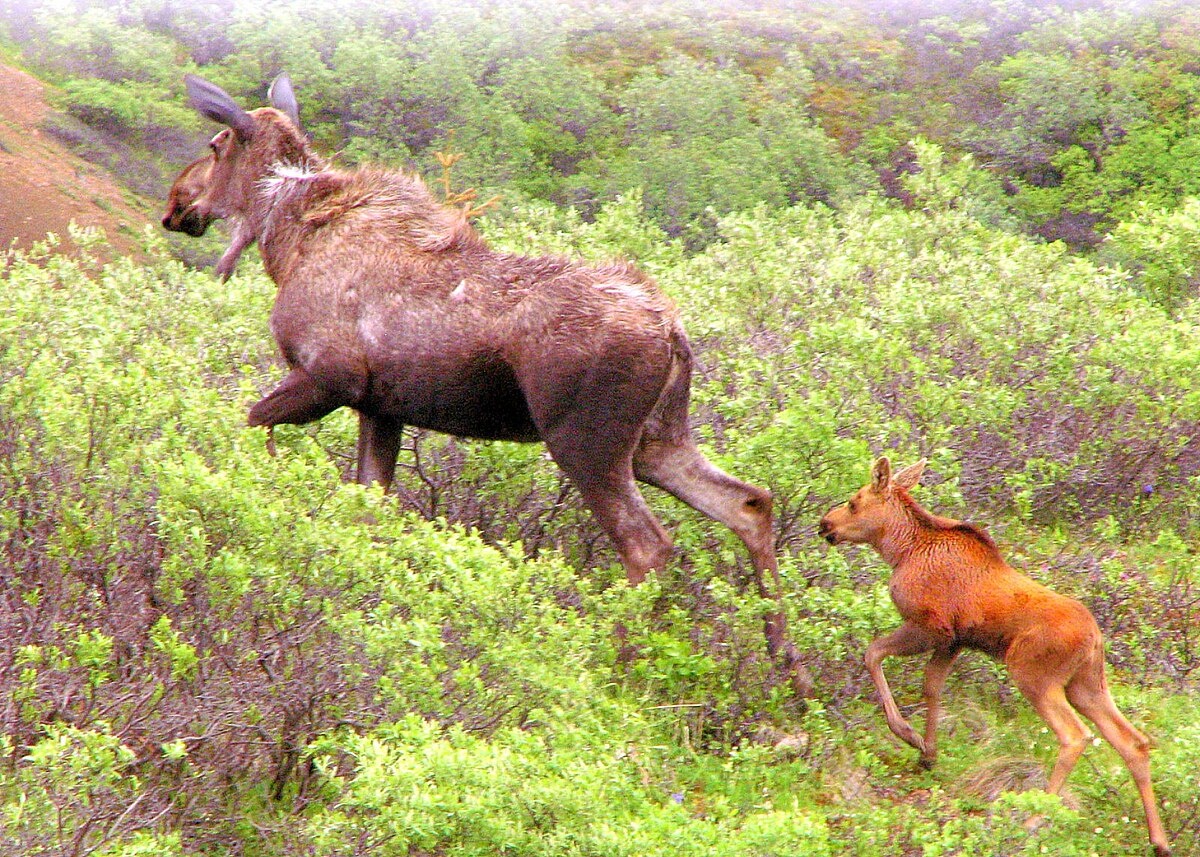
Sometimes two individual moose can be found feeding along the same stream. The strongest social bond is between the mother and the calf. Mothers are very protective of their calves, frequently charging people if they get too close and using their sharp hooves to strike at attackers. Moose gather in larger groups during the mating season in alpine and tundra habitats. During mating season in Alaska, some dominant male moose herd a group of females together to create a "harem herd." Other males will fight the leader of the herd for the right to mate with the females. [Source: Alina Bradford, Live Science, November 13, 2014]
When cornered moose fight back fiercely with their front feet and antlers. A single blow from powerful moose hooves can kill or cripple a human, a bear or a wolf. While on hunting trip Theodore Roosevelt was charged by a bull moose. He wrote afterward it came at him "at a slashing trot, shaking his head, his ears back, the hair on his withers bristling." Roosevelt shot it when it was "not 30 feet off." Describing his encounter with a seven-foot female moose, Colorado Rep. Bob Scahffer said, "She had a look in her eyes saying, 'I don't know who you are, but I'm going to kill you.'"
Moose Diet
Moose are primarily herbivores (eat plants or plants parts) and are recognized as folivores (eat leaves). Among the plant foods they eat are twigs, leaves, roots, tubers, wood, bark, stems, and the shoots of woody plants, especially willows, maples and aspens. In the warm months, moose feed on water plants, water lilies, pondweed, horsetails, bladderworts, and bur-reed. In winter, they browse on conifers, such as balsam fir, and eat their needle-like leaves.[Source: Tanya Dewey; Anne Bartalucci; Bret Weinstein, Animal Diversity Web (ADW) |=|]
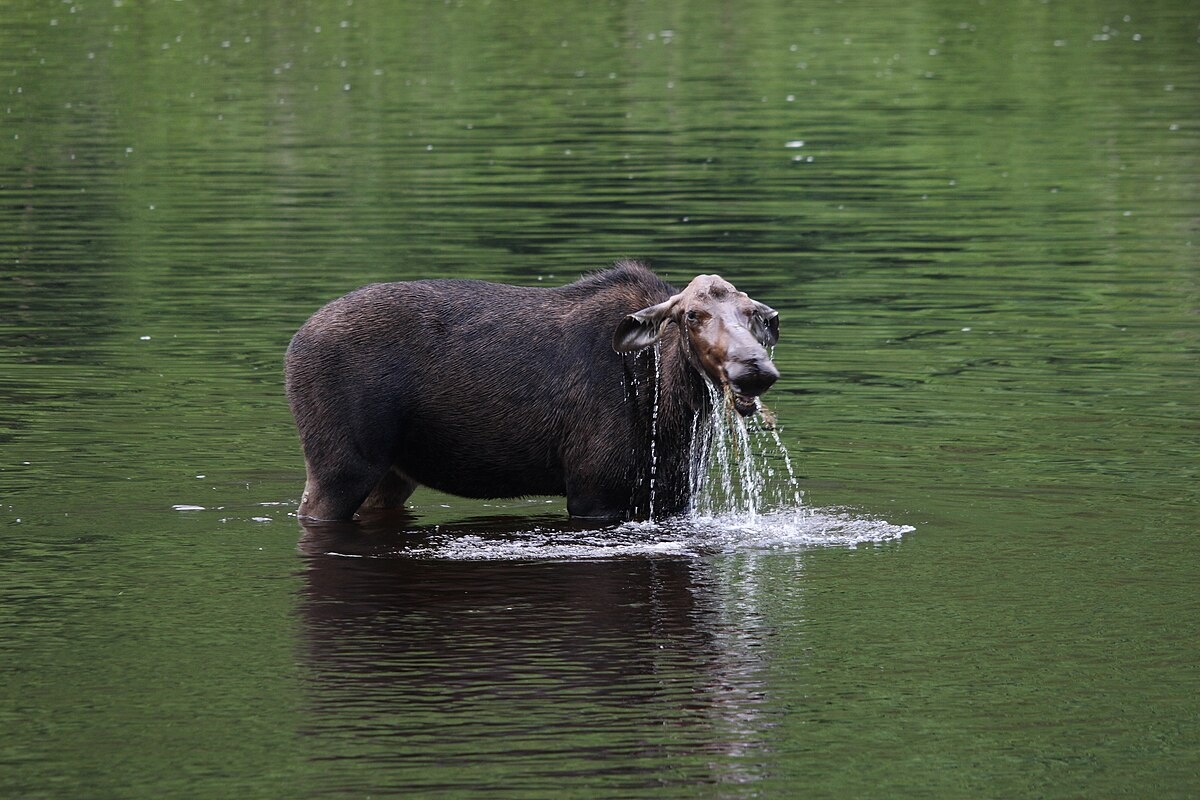
Moose feed on branches, various evergreens, pine cones, and buds of trees and shrubs. They seem love succulent aquatic plants such as water lilies best. They are often seen wading in ponds and marshes, periodically dipping their head on the water to bring up plants. Often they emerge with plants hanging from their antlers too. Aquatic plants are easy digest and abundant in some areas but they don't contain a lot of nutrients though. It is now believed that one reason moose eat them is to get enough salt, which is necessary for good health but isn't found in great quantities in terrestrial plants.
The word “moose” come from Algonquin tribe for “twig eater” as we said before. It is an appropriate name because moose primarily browse upon the stems and twigs of woody plants in the winter and the leaves and shoots of deciduous plants in the summer. For moose in Poland, 87 percent of their diet consisted of trees and shrubs with the most important species being pine (Pinus silvestris), which represented 52 percent of their diet. In North America, moose have been observed to consume as many as 221 plant species and genera, and in Russia 355, although only a select few comprise a significant portion of their diet. Willows (Salix spp.) are the most preferred forage where available. In interior Alaska willows accounted for 94 percent of the biomass consumed in the winter. Other species that are consumed are paper birch (Betula papyrifera), quaking aspen (Populus tremuloides), and balsam fir (Abies balsamea). [Source: Daniel De Bord, Animal Diversity Web (ADW) |=|]
Moose Feeding Behavior
Adult moose consumer 23 to 27 kilograms (50 to 60 pounds) of food a day. The stomach of an adult moose has a 112-pound capacity. Like other ruminants, or cud chewer, moose have a four chamber stomach and regurgitate partially digested food and "chew their cud". Food is fermented in the first chamber, and nutrients are extracted in the next three (See Below). The word moose is derived from the Algonquian Indian word for twig eater. Moose don't usually graze. When they do their legs are so long they sometimes have get down on their knees to reach the ground.
Moose use their bottom incisors as chisels to scrape upwards and strip the bark off trees.. Evidence of a moose in the area is include plants and trees snipped off at a height of two meters Penned moose in Alaska are fed a mixture of aspen sawdust, ground corn, oats and barely, cane molasses, soybean meal and added vitamins and minerals. The sawdust is a good substitute for the woody material that moose usually eat.
Moose require 20 kilograms of food per day. Their stomachs, when full, can weigh up to 65 kilograms. Most of a moose's time is spent eating. This is also true with other very large herbivores such as elephants. Deer, cattle, sheep, goats, yaks, buffalo, antelopes, giraffes, and their relatives are ruminants — cud-chewing mammals that have a distinctive digestive system designed to obtain nutrients from large amounts of nutrient-poor grass. Ruminants evolved about 20 million years ago in North America and migrated from there to Europe and Asia and to a lesser extent South America, where they never became widespread.
Because they eat and defacate so much and trample shrubs moose can have dramatic effects on the composition of plant communities in their home range. One researcher estimated that the Swedish moose population contributed 300,000 metric tons of feces each year to the land. This equals about 5,600 tons of nitrogen, which is essential for plant growth. Moose can affect the rate of nutrient cycling, floral composition, rate of forest succession, and biological diversity of a forest. For this reason, they are considered to be a keystone species. |=|
See Ruminants Under MAMMALS: HAIR, HIBERNATION AND RUMINANTS factsanddetails.com
Moose Senses and Communication
Moose sense and communicate with vision, touch, sound and chemicals usually detected by smelling. Moose have poor sight but their hearing and sense of smell are excellent. Their sense of smell is exceptional due to the large surface area of their nasal cavities, which are lined with millions of sent-smelling cells. Their large ears can be rotated 180 degrees and their keen noses find food below deep snow. Their vision seems to serve them best to detect moving objects. Moose have very acute hearing due in part to the large external surface area of their ears. Their ears are capable of rotating independently, giving them stereophonic hearing.[Source: Tanya Dewey; Anne Bartalucci; Bret Weinstein, Daniel De Bord, Animal Diversity Web (ADW) |=|]
Moose are not as vocal as other members of the deer family, such as red deer, but they produce a surprisingly wide variety of noises. Bulls "bellow," "croak" and "bark." Younger animals "cry" and whine to their mothers. Cows wail and moan in the rutting season and can be heard a mile away. Most of their vocalizations occur during the rut (mating season). Both sexes are capable of making a loud, guttural “roaring” sound as a threat.
Moose employ pheromones (chemicals released into air or water that are detected by and responded to by other animals of the same species) and scent marks produced by special glands and placed so others can smell and taste them. When communicating chemically by scent-marking, moose strip trees and shrubs of their bark and rub their foreheads and preorbital glands in front of the eye sockets into the bare spot to advertise their presence to the opposite sex.
Moose Mating and Reproduction
Moose are polygynous (males have more than one female as a mate at one time) and engage in seasonal breeding. Moose breed annually, usually in September and October. The female estrus cycle lasts 24 to 25 days, with the length of the heat being 15 to 26 hours. If the female does not bred in that time, she may go through estrus again about three weeks later. The number of offspring ranges from one to two, with the average number of offspring being one. The average gestation period is 7.5 months. [Source: Daniel De Bord, Animal Diversity Web (ADW) |=|]
Males and females attract each other by making vocalizations and scent marking trees. Females make a long, quavering moaning call when in estrus, which attracts males and can be heard up to 3.2 kilometers away. Males make a grunt to court females or challenge other bulls.After much bellowing bulls and cows meet and mate. A dominant bull may mate with several cows in a single season. Large males often intimidate small rivals by simply showing off their huge racks. They may crash through the underbrush and battle one another with their huge antlers. When two large males decide to fight it a serious and sometimes deadly. Sometime both combatants die when they lock racks in the water and get stuck and drown.
According to Animal Diversity Web: Moose exhibit two different types of breeding strategies: tundra moose in Alaska form harems and taiga moose form transient pair bonds. In the harem mating system, the largest, most dominant male attempts to herd a group of females together, which he defends from all other males. Other bulls challenge the harem master for the right to mate. Young bulls with smaller antlers typically retreat from the dominant bull, whereas evenly sized bulls will fight. Bulls will engage their antlers, pushing and twisting, while attempting to gore each other. In the pair bonding system, a dominant bull stays with and defends just one cow until he can mate with her. Afterward, he searches for other females who have not yet been bred by other bulls. |=|
Moose Calves and Parenting
Moose young are precocial. This means they are relatively well-developed when born. Parental care is provided exclusively by females. Males are not involved in raising offspring. The average weaning age is five months and the average time to independence is one year. Young inherit the territory of their mother. The position of the mother in a dominance hierarchy may affect the status of young. On average females reach sexual or reproductive maturity between 16 to 28 months; males do so between two to five years. Full growth potential isn't reached until four or five years of age. At that age females are at their reproductive peak and males have the largest antlers. [Source: Daniel De Bord, Animal Diversity Web (ADW) |=|]
Females generally give birth in May or early June and take care of their young for about one year until the next young are born. They seek secluded sites to give birth and remain isolated until the calves are weaned. Calves weigh 11 to 16 kilograms at birth. They are born weak and knobby kneed but within their first day of life they can stand up on their own. Within a few days they are strong enough to get around.
Females give birth synchronously in the spring. Young lack the spots that are characteristic of most cervid offspring. Calves gain about one kilogram per day while they are nursing. They can browse and follow their mother at three weeks of age. By summer they are swimming with their mothers. When they get tired they hang their legs on their mother back and get pulled along. The calves grow quickly but remain dependent on their mothers. In the spring mothers often have to shoo away their calves so the they can prepare to give birth to new offspring. Around 50 percent of calves die due to bear or wolf attacks before they are six weeks old. Once they are adults, they have a survival rate of up to 95 percent.
Moose, Wolves and Predators
In Eurasia, gray wolves, brown bears and Siberian tigers are known to prey on moose. In North America wolves, grizzly bears, black bears, coyotes and cougars are threats, especially for calves. It is a matter of debate how much predators impact moose populations. Predation by bears tends to be the highest in the spring when calves are the most vulnerable. Predation by wolves is higher in the winter when snow depths are high enough to slow the movement of moose. Moose aggressively defend themselves and their young with their antlers and sharp hooves.[Source: Daniel De Bord, Animal Diversity Web (ADW) |=|]
Because of their large size healthy adult moose are not highly susceptible to predation. Most moose are preyed on as calves or when they are ill or elderly. Up to half of all calves fall to predators during their first year. Average annual adult mortality is 10 to 15 percent.
Brown bears have been observed pulling down adult moose and both brown bears and black bears prey on calves. When cornered moose fight back fiercely with their front feet and antlers. A single blow from powerful moose hooves can kill or cripple a human, a bear or a wolf. In North America, about a third of calves are killed by predators. When a mother and calf are under attack, the mother usually keeps the calf in front of her and mounts a rear guard and lashes out with her front and hind hooves.
David Mech a research biologist for the U.S. Fish and Wildlife Service once observed a pack of 15 wolves bring down a 600-pound moose and eat half the carcass in three hours. Describing an attack on a moose and calf, Mech wrote in National Geographic: "Most of the wolves were worrying the cow while two pursued its bolting offspring. After about 150 yards, one wolf lunged at the rump of the calf and held on: the other clamped onto its throat. The calf stopped and began trampling the front wolf into the snow. Still the wolf managed to hold one before relinquishing its throat hold." [Source: David Mech, National Geographic, October 1977]
"The other wolf, however remained tugging on the calf's rump. The front wolf then dived under the running moose and again fastened onto its throat...Then two more wolves reinforced the attack. One grasped the calf by the nose, and other by its right flank. The struggling moose pulled all four wolves through the snow, then finally collapsed in a heap. A few minutes later the moose's flesh was being converted into wolf's meat."
See Wolves and Moose at Isle Royale, Michigan Under WOLF FOOD: DIET, HUNTING: PREY, TACTICS, FEEDING HABITS factsanddetails.com
Drunken Moose on the Loose in Russia
In May 2014, a drunken moose, named Monty, was spotted running trough Semenov, Russia, after eating a pile of fermented berries. The drunken animal was caught on camera running through the streets, before plunging into a pond in the middle of the city. The pond's concrete sides made it impossible for Monty to climb back out, but he was saved from drowning after police took to the water with a rope. [Source: Sophie Jane Evans, Daily Mail Online, June 11, 2014]
Sophie Jane Evans of the Daily Mail wrote: Monty was spotted on the loose in Semenov, near Russia's Volga River, after chomping his way through on a pile of fermented berries. Semenov police officer Pavel Mihachkov said that moose - which can reach almost 7ft tall and weigh up to 1,500lbs - tend to gravitate towards the first fruit falls at this time of year. Apples, cherries, apricots and other assorted fruits fall from trees during storms, ferment on the ground and become an intoxicating brew for such creatures, he said. 'He was so sozzled he could barely stand. He obviously found a bunch of fermenting berries or something and really went for it'
Mr Michachkov said Monty had appeared 'bonkers on booze', adding: 'It was a magnificent specimen but he was so sozzled he could barely stand. 'He obviously found a bunch of fermenting berries or something and really went for it. 'We managed to rope him and get him transported to an animal shelter for the night where he slept it off. 'Vets said the moose had the mother and father of all hangovers the next day but he will soon be ok. 'He will be tranquillised and driven out to a remote spot where it is hoped he won't find his way back to the big city any time soon.' Despite Monty's plight, it is unlikely he will learn his lesson. Experts calculate moose like him get 'drunk' around 50 times in their lives.
Drunk Moose Alert Issued in Southern Norway
November 2002, a drunken moose alert was issued in southern Norway.According to a report from the Newspapers' News Bureau (ANB), the reason behind the warning is this year's early snowfall. A warm summer has led to an unusual bounty from the region's fruit trees. The sudden and early snowfall has left some fruit under snowy cover, while still more remains on the branch. This fruit is fermenting, and also a readily available and tempting source of food for the region's moose. [Source: Newspapers' News Bureau (ANB), November 29, 2002]
"This is the first time I have heard that moose are getting drunk. But I assume that they react the same way people do to intoxication - some become harmless while others are the exact opposite," said district veterinarian Paul Stamberg in Kristiansand. Martin Kolberg, head of the local animal committee in Telemark, warns people to beware of drunken moose. "Be careful when you approach moose that have been munching apples for days. Their behavior can alter and they can become frighteningly aggressive. Clap and see how it reacts. If it doesn't retreat but instead comes even closer, by all means stay vigilant. It can be intoxicated and attack," Kolberg told newspaper Faedrelandsvennen.
Earthweek reported in November 2006: In northern Sweden, near the town of Lulea, a female moose drowned after treading on thin ice after eating fermenting apples on a frozen inlet. A spokesman for the Lulea police said: “The moose appears ro have eaten too many fermented apples and become confused out n the ice. Efforts to rescue the animal when it was floundering in the ice were unsuccessful. Residents had warned police of moose’s behavior. [Source: Earthweek, December 2006]
Image Sources: Wikimedia Commons
Text Sources: Animal Diversity Web animaldiversity.org ; National Geographic, Live Science, Natural History magazine, David Attenborough books, New York Times, Washington Post, Los Angeles Times, Smithsonian magazine, Discover magazine, The New Yorker, Time, BBC, CNN, Reuters, Associated Press, AFP, Lonely Planet Guides, Wikipedia, The Guardian, Top Secret Animal Attack Files website and various books and other publications.
Last updated May 2025