
ROE DEER
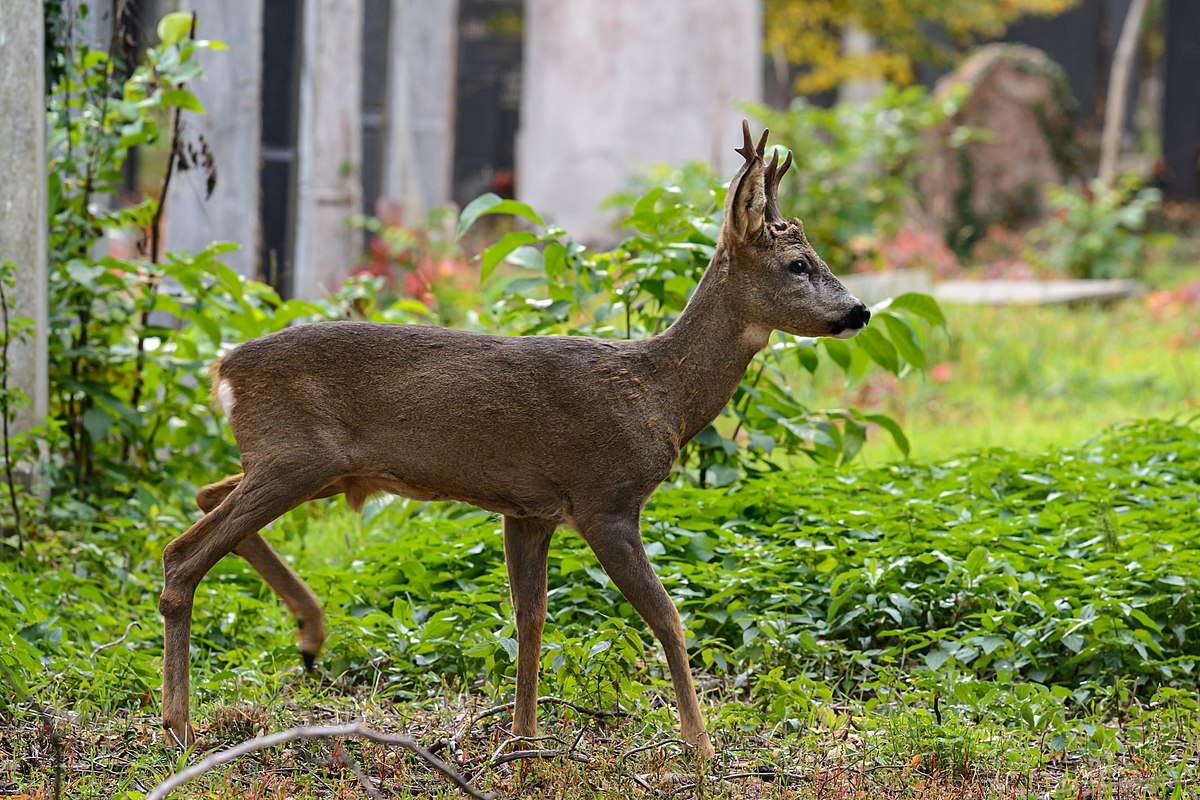
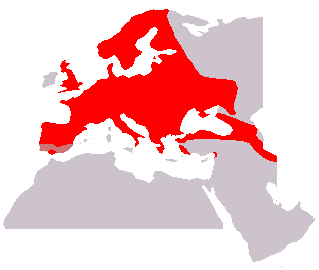
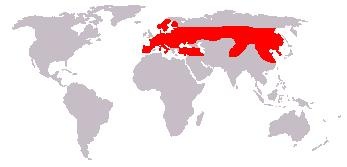
Roe deer (Capreolus capreolus)are also known as European roe deer and Western roe deer. They are small deer, reddish and grey-brown in color, and well-adapted to cold environments. The species is widespread in Europe, from the Mediterranean to Scandinavia, from Scotland to the Caucasus, and east as far as northern Iran. There is a different species, the Siberian roe deer, that lives in Russia, Siberia and eastern Asia. Males are sometimes referred to as a roebuck. Females may be called does. [Source: Wikipedia]
Roe deer live in tundra area, savannas, grasslands and forests. They prefer forest steppe, small insular forests among croplands, high-grass meadows with some shrubs and burns and cutovers in forestlands and croplands that serve the purpose of revegetation. Human modifications in the form of felled trees and creation of agricultural land and meadows, as well as intensive agricultural methods, have historically been beneficial to these deer in regions with little snow. [Source: Kristi Jacques, Animal Diversity Web (ADW) |=|]
Roe deer are not endangered. They are the most abundant wild ungulate species in Europe, and their populations in some places are large enough that are considered pests. They are designated as a species of least concern on the International Union for Conservation of Nature (IUCN) Red List and have no special status on according to the Convention on International Trade in Endangered Species (CITES).
Roe deer are important game animals and have been the subject of several scientific study in part because of their widespread distribution and high numbers. They can have an negative impact on humans in the form of motor vehicle accidents and damaging crops and ecosystems. Game management is often necessary. Conservation and game management of the roe deer has been credited with increasing their in numbers in places they were scare and extending their range.
RELATED ARTICLES:
DEER (CERVIDS): CHARACTERISTICS, ANTLERS, HISTORY, ECOSYSTEM ROLE, HUMANS factsanddetails.com ;
DEER (CERVID) BEHAVIOR, FEEDING AND REPRODUCTION factsanddetails.com
SIKA DEER: CHARACTERISTICS, BEHAVIOR, SUBSPECIES factsanddetails.com
MUSK DEER: CHARACTERISTICS, BEHAVIOR, PERFUME, MEDICINE, FARMS factsanddetails.com ;
RED DEER: CHARACTERISTICS, BEHAVIOR AND REPRODUCTION factsanddetails.com
ELK: CHARACTERISTICS, BEHAVIOR AND REPRODUCTION factsanddetails.com
DEER ATTACKS factsanddetails.com
REINDEER AND CARIBOU: CHARACTERISTICS, FEEDING, CONSERVATION factsanddetails.com
REINDEER AND CARIBOU BEHAVIOR: MIGRATIONS, REPRODUCTION, PREDATORS factsanddetails.com
REINDEER AND PEOPLE factsanddetails.com
MOOSE (ELK): CHARACTERISTICS, SIZE, HABITAT, SUBSPECIES factsanddetails.com
MOOSE (ELK) BEHAVIOR: FEEDING, REPRODUCTION, PREDATORS, DRUNKENESS factsanddetails.com
MOOSE (ELK) AND HUMANS: ATTACKS, RAMPAGES, CAR CRASH TESTS factsanddetails.com
Roe Deer Species — European and Siberian Ones
Siberian roe deer (Capreolus pygargus) were once considered to be the same species as the roe deer (Capreolus capreolus) but are now considered to be a separate species.

Roe deer — European roe deer and Western roe deer — are found throughout Europe and Asia Minor, except in the islands of Corsica and Sardinia, Lebanon, Isreal, Ireland and the eastern margin of eastern Europe. Their distribution has been reduced and fragmented as a result of hunting and other types of human disturbances mainly in the late 19th and early 20th centuries. [Source: Kristi Jacques, Animal Diversity Web (ADW) |=|]
Siberian roe deer are also known as eastern roe deer and Asian roe deer. They are found in northeastern Asia — in Siberia, Mongolia, Kazakhstan, the Tian Shan Mountains of Kyrgyzstan, eastern Tibet, the Korean Peninsula and forested regions of northern China. The scientific name pygargus, means "white-rumped". Siberian roe deer have relatively long antlers. [Source: Wikipedia]
The main differences between roe deer and Siberian roe deer are their size, physical characteristics and geographic range. Siberian roe deer are generally larger, heavier, and have thicker, rougher winter coats compared to their European counterparts, according to Russian Hunting Agency. The Siberian roe deer also has larger antlers, with a wider "V" shape and less likely to have touching coronets. Siberian roe deer males reach up to 1.43 meters (4.7 feet) in length and weigh 60 kilograms (130 pound), while females are slightly smaller. European roe deer typically have a head and body length ranging from one to 1.3 meters (3.5 to 4.1 feet) and weigh up to 30 kilograms (66 pounds). [Source: Google AI]
Siberian roe deer antlers, averaging around 700 grams in weight. European roe deer antlers are smaller, and their coronets sometimes coalesce. Siberian roe deer are found in Siberia and parts of Asia, while European roe deer are more widespread in Europe. Siberian roe deer have a karyotype of 2n = 70 plus additional B-chromosomes, which varies across their range, while European roe deer have a karyotype of 2n = 70. While hybridization between the two species is possible, it is often not successful and may lead to stillbirths or infertility in hybrid offspring.
Roe Deer Size, Characteristics and Antlers
Roe deer are relatively small deer. They range in weight from 22 to 30 kilograms (48.5 to 66 pounds) and have a head and body length ranging from one to 1.3 meters (3.5 to 4.1 feet) and stand 66 to 86 centimeters (26 to 34 inches) at the shoulder. Their average basal metabolic rate is 46.347 watts. Their average lifespan in the wild is 15.0 years. Sexual Dimorphism (differences between males and females) is present: Males are larger than females. Ornamentation is different. Only males have antlers.[Source: Kristi Jacques, Animal Diversity Web (ADW) |=|]
Roe deer hooves are narrow and short with lateral, well-developed digits. Roe deer are classified as telemetacarpalian. “Telemetacarpal" refers to a specific type of foot structure found in certain deer, particularly those in the Capreolinae subfamily (often called New World deer). These deer have lost the distal (end) parts of the second and fifth metacarpal bones in their front feet, leaving only the proximal (closer to the body) portions. The term is used to distinguish them from the plesiometacarpal deer (Cervinae, or Old World deer), which have a different metacarpal structure.
Roe deer have a long neck minus a mane, relatively large ears (12-14 centimeters), a small tail (2-3 centimeters) and no preorbital glands in front of the eye sockets. In the winter their coloration ranges from grayish-brown to dark brown. In summer, they are reddish to red-brown. A large white caudal patch is present in the summer is either absent or less pronounced than in the winter. The top of the head is gray or brown and the metatarsal glands are brown or dark brown. Roe deer molt twice a year in spring and in autumn. The kids of this species are spotted. |=|
Males have tuberculate, three tined antlers. The basal rosettes are well-defined. Antlers are not present in females and are shed annually in October and November by males. They regrow immediately afterwards. Males develop a thickened skin on their head, neck and anterior portion of the trunk. The skull is small but somewhat elongated. An analysis of 11 different populations maximum skull length of 191-212.2 millimeters and maximum skull width of 84.3-91.5 millimeters.
Roe deer antlers are up to 25 centimeters (10 inches) in length. Unlike most cervids, roe deer begin regrowing antlers almost immediately after they are shed. In rare cases, some bucks possess only a single antler branch, the result of a genetic defect. Siberian rose deer have larger antlers with more branches than those of European roe deer.
Roe Deer Diet, Eating Behavior and Predators
Roe deer are herbivores (eat plants or plants parts) and also recognized as folivores (eat leaves). They consume apporximately 1,000 plant species. Of these 25 percent are woody plants, 54 percent are herbaceous dicotyledons and 16 percent are monocotyledons. They also eat the needles of coniferous trees, but usually only do so in winter when all other food sources are scarce. They are selective feeders, with a preference for energy-rich foods that are soft and contain large amounts of water. Due to their small stomach size and rapid digestion process, they require frequent food intake. They normally have between five and eleven separate feeding periods in a day. They may feed at hour intervals during periods of optimal food availability. [Source: Kristi Jacques, Animal Diversity Web (ADW) |=|]
Plant types and individual species vary with the seasons and habit and their range. One study indicated that variations in diet composition were more closely correlated with habitat than season. Forage reserves decline in the winter and their diet becomes less diverse. Consequently, metabolic rate and food consumption decrease. In the spring, metabolic rate, energy requirements and the process of digestion all increase. Roe deer prefer concentrated foods (seeds and fruits) in autumn. |=|
Roe deer are important sources for food for many predators. They are mainly preyed upon by gray wolves, Eurasian lynxes and foxes. Fox mainly prey on fawns. Siberian roe deer are preyed upon by the Amur leopards, snow leopards, and Siberian tigers as well as the species mentioned above.
European roe deer feed mainly on grass, leaves, berries, and young shoots. They are particularly fond of very young, tender grass with a high moisture content, such as grass that has received rain the day before. Roe deer generally not venture into fields that have or have had livestock in them. The diet of the Siberian roe deer consists of over 600 species of plants – mostly herbaceous dicotyledons (58 percent), monocotyledons (16 percent), and woody species. In summer they increase their sodium intake and visit natural salt licks. Water is usually obtained through moisture-rich foods as opposed to directly from a water source. [Source: Wikipedia]
Roe Deer Behavior and Communication
Roe deer are motile (move around as opposed to being stationary), crepuscular (active at dawn and dusk), nocturnal (active at night), and social (associates with others of its species; forms social groups). In order to reduce the risk of being taken by predators, they hide in cover much of the day. They are likelier to venture into more open habitats at night and during dawn and disk when there is less ambient activity. Roe deer are territorial. The territories of males and females may overlap, but those of the same sex generally do not unless they are the female's offspring of that year. Roe deer scrape leaf litter off the ground to make a 'bed'. It is said Siberian roe deer can jump distances up to 15 meters (49 feet). [Source: Wikipedia, Kristi Jacques, Animal Diversity Web (ADW) |=|]
The basis for roe deer social organization is the family group. Roe deer are either solitary or live in family groups, usually females with their offspring, in the summer months. In the winter, almost all males and females live in family groups, with large groups compsed of several family groups. Some Siberian roe deer perform mass migrations.
The composition of large groups changes; they may have 40 to 90 members in open ecosystems or have only ten to 15 members in forest ecosystems. The organization of the population depends on the abundance and distribution of food resources and cover. In the summer, deer are dispersed throughout the territory, and in winter they concentrate in their foraging areas. The right to hold territory by male deer results in fights every year, usually between an adult male in one territory and a young male that wants the neighboring territory. |
Rose deer sense using touch and chemicals usually detected with smell.Siberian roe deer mark their territory with olfactory marks, using secretion glands on their head, which they rub against trees, shrubs, and high grasses., or with visual marks by fraying trees with their antlers. Siberian roe deer make six distinct vocalizations; squeaking or whistling, rasping, barking, whining, screaming, and nonvocal sounds.
When alarmed European roe deer make a barking a sound much like a dog’s and flash out their white rump patch. Rump patches differ between the sexes, with the white rump patches heart-shaped on females and kidney-shaped on males. Males may also bark or make a low grunting noise. Females make high-pitched "pheep" whines to attract males during the breeding season. See Below
Roe Deer Mating, Reproduction and Offspring
Male roe deer become sexually mature by the end of their first year but generally do not begin breeding until their third year of life. They are physiologically capable of reproduction from March to October, but the rutting season is largely restricted from June to August. Only in a few individuals does it occur earlier or later. Breeding activity in females begins when they are 14 months old. They are monestrous, and the duration of estrus is typically 36 hours. Females make high-pitched "pheep" whines to attract males during the breeding season.in July and August. Initially the female goes looking for a mate and commonly lures the buck back into her territory before mating. The average number of offspring being 1.6. The average gestation period is 10 months. [Source: Kristi Jacques, Animal Diversity Web (ADW) |=|]
Roe deer engage in delayed implantation (a condition in which a fertilized egg reaches the uterus but delays its implantation in the uterine lining, sometimes for several months) According to Animal Diversity Web: Roe deer are the only ungulate that has a latent period of pregnancy, and consequently their reproductive cycle differs from those of even closely related species. Implantation of the embryo usually occurs in January. The fertilized ovum at morula stage penetrates into the uterus where it divides. This is followed by a 4-5 month period with minimal miotic activity. Delayed implantation is not a function of photoperiod, as in weasels. It is controlled by the development of the blastocyst (developmental stage of an embryo, typically reached about 5-6 days after fertilization).
Fawns are born between April and July. There are usually two fawns, possibly one or three. They weigh 1 to 1.7 kilograms, have their eyes open and are furred. They are relatively helpless during the first few days of life and are easy prey for predators. Fawns are nursed by their mother five to nine times a day during the first month and two to four times in the second month and one to two in the months afterward. Lactation declines in August and stops completely in early autumn, but sometimes occurs through December. Fawns feed completely on vegetation after they weaned. Fawn growth is rapid. They double their birth weight at two weeks of age. By autumn they weigh 60 to 70 percent what adults weigh.
Siberian roe deer mating occurs in August and September. Embryonic implantation takes place in January and gestation lasts a total of 280–300 days. Females usually give birth to two young at a time, which are weaned after four to five months. Females reach sexual maturity in their first year of age but usually do not breed until their second. Males usually mate in their third year of life.
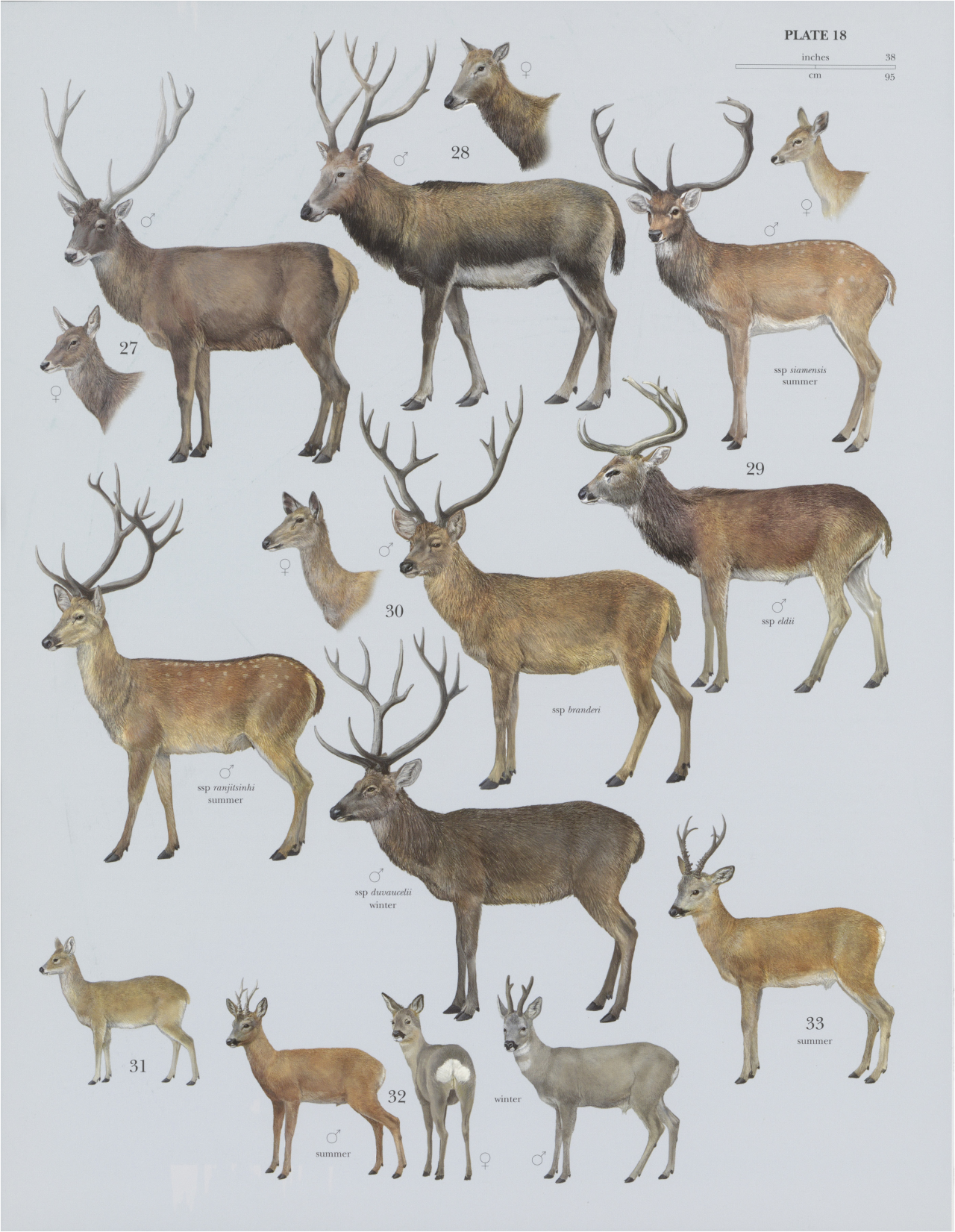
Some deer species: 30 Barasıngha (Huoervus duvıuoelıı) 31 Chınose Water Deer (Hydroporos ınermısl 32 Western Roe Deer (Capreolus aıpmolus), 33 Eastern Roe Deer (Capraolus pyyaryus)
Image Sources: Wikimedia Commons
Text Sources: Animal Diversity Web animaldiversity.org ; National Geographic, Live Science, Natural History magazine, CNTO (China National Tourism Administration) David Attenborough books, New York Times, Washington Post, Los Angeles Times, Smithsonian magazine, Discover magazine, The New Yorker, Time, BBC, CNN, Reuters, Associated Press, AFP, Lonely Planet Guides, Wikipedia, The Guardian, Top Secret Animal Attack Files website and various books and other publications.
Last updated May 2025