
ELKS

Elk (Cervus canadensis) are the second largest member of the deer family after the moose. The European elk is almost identical to a moose. Thus when Europeans talk about an elk they are usually referring to what Americans call a moose. Efforts to end the confusion by using the term "wapati" (the Shawnee Indian name for elk) in the United States have failed. Elk are called wapati in Asia and Russia though.
Elk are are similar to red deer (Cervus elaphus) but are different — although closely related — species. They can interbreed and produce fertile offspring but they are considered distinct species due to genetic evidence. Elk are native to North America, while red deer are found in parts if Asia and North America. In North America, elk have a close association with white-tailed deer, sharing similar environments and similar habitats.
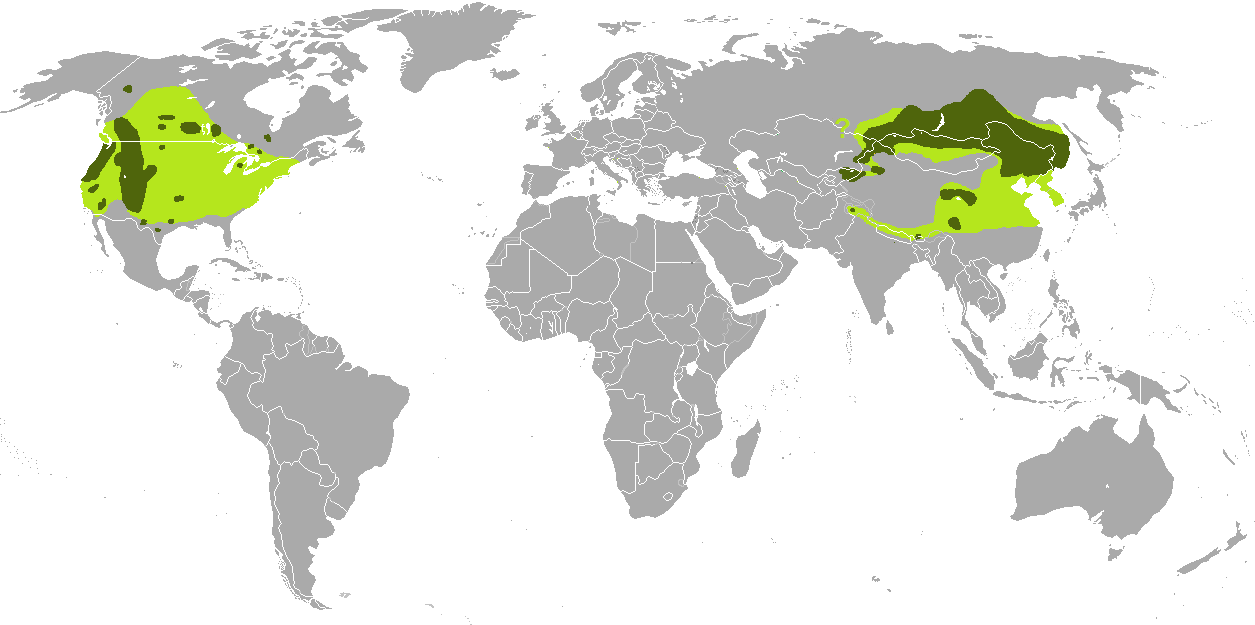
Elk live in temperate areas and colder areas in the northern U.S. Canada, Russia, Mongolia, northern China and northern Central Asia in taiga, forest and mountains and sometimes in savannas, grasslands, suburbs, agricultural areas and areas near rivers and streams. They prefer open woodlands and avoid dense unbroken forests and are often found in coniferous swamps, clear cut forested areas, aspen-hardwood forests, and coniferous-hardwood forests. They are found through a wide range of elevations, typically from sea level to 3000 meters (9843 feet), although they can also occur at higher elevations.
Males elks are often called bulls; and females, cows. Elk often live in relatively large herds. They are highly adaptable in terms of habitat and diet and thrive in many places that they were introduced. But like moose, they have a hard time living in places with white tail deer, which carry a snail-bourne meningeal worm that is relatively harmless to white tails but eats away at the brain of caribou, moose, elk and other kinds of deer. In the western United States elk can carry and contract chronic wasting disease, a spongiform encephalopathy similar to bovine spongiform encephalopathy (mad cow disease).
RELATED ARTICLES:
RED DEER: CHARACTERISTICS, BEHAVIOR AND REPRODUCTION factsanddetails.com
DEER (CERVIDS): CHARACTERISTICS, ANTLERS, HISTORY, ECOSYSTEM ROLE, HUMANS factsanddetails.com ;
DEER (CERVID) BEHAVIOR, FEEDING AND REPRODUCTION factsanddetails.com
ROE DEER: SPECIES, CHARACTERISTICS, BEHAVIOR AND REPRODUCTION factsanddetails.com
SIKA DEER: CHARACTERISTICS, BEHAVIOR, SUBSPECIES factsanddetails.com
MUSK DEER: CHARACTERISTICS, BEHAVIOR, PERFUME, MEDICINE, FARMS factsanddetails.com ;
DEER ATTACKS factsanddetails.com
REINDEER AND CARIBOU: CHARACTERISTICS, FEEDING, CONSERVATION factsanddetails.com
REINDEER AND CARIBOU BEHAVIOR: MIGRATIONS, REPRODUCTION, PREDATORS factsanddetails.com
REINDEER AND PEOPLE factsanddetails.com
MOOSE (ELK): CHARACTERISTICS, SIZE, HABITAT, SUBSPECIES factsanddetails.com
MOOSE (ELK) BEHAVIOR: FEEDING, REPRODUCTION, PREDATORS, DRUNKENESS factsanddetails.com
MOOSE (ELK) AND HUMANS: ATTACKS, RAMPAGES, CAR CRASH TESTS factsanddetails.com
Elk Subspecies and Range

Elk once roamed all over Canada, the United States and much of northern Asia. Now they live mostly in the Rocky Mountain region and a, Central, East and North Asia. Extensive hunting and habitat destruction reduced their populations to a fraction of their former range. Elk populations in eastern North America were extirpated largely as a result of overhunting. Today large populations are found only in the western United States and Canada through the Eastern Rockies to New Mexico, and in a small region of the northern lower peninsula of Michigan. Elk were reestablished in the eastern United States, including Michigan, with three transplantations throughout the 1900s. There is a fairly large elk population at Yellowstone National Park in Wyoming. [Source: Rachel Lesley Senseman, Animal Diversity Web (ADW) |=|]
There are numerous subspecies of elk, with four living ones from North America and four from Asia widely recognized. Different pnes are characterized by antler shape and size, body size, coloration and mating behavior. DNA investigations of the Eurasian subspecies revealed that phenotypic variation in antlers, mane and rump patch development are based on "climatic-related lifestyle factors". [Source: Wikipedia]
The four widely-recognized subspecies of elk in North America are: 1) the Roosevelt elk (C. canadensis roosevelti), 2) the Tule elk (C. c. nannodes), 3) the Manitoban elk (C. c. manitobensis) and 4) the Rocky Mountain elk (C. c. nelsoni). The eastern elk (C. c. canadensis) and Merriam's elk (C. c. merriami) subspecies have been extinct for at least a century.
The four subspecies from the Asian continent include 1) the Altai wapiti (C. c. sibiricus), 2) the Tianshan wapiti (C. c. songaricus), 3) the Manchurian wapiti (C. c. xanthopygus) and 4) the Alashan wapiti (C. c. alashanicus). The latter two live in China, Mongolia, the Korean Peninsula and Siberia. Manchurian elk are darker, and more reddish, in coloration than other populations. The Alashan wapiti of northern Central China is the smallest of all the subspecies, has the lightest coloration, and is one of the least-studied.
Elk Characteristics
Elk are very large animals with thick bodies, slender legs and short tails. Adults range in weight from 171 to 497 kilograms (377 to 1095 pounds), with their average weight being 154 kilograms (340 pounds). They stand 0.75–1.5 meters (2.5 to 4.9 feet), with a head and body length of 1.6 to 2.7 meters (5.25 to 8.86 feet). Their average basal metabolic rate is 112.43 watts. Sexual Dimorphism (differences between males and females) is present: Males are larger than females. Ornamentation is different. Males weigh 178–497 kilograms (392 to 1,095 pounds) while females weigh 171 to 292 kilograms (377 to 644 pounds). [Source: Wikipedia, Rachel Lesley Senseman, Animal Diversity Web (ADW) |=|]
Bull (male) elk have a large set of backward sweeping antlers that can reach a length of 1.5 meters (five feet) and usually have five to seven points on each antler. Cows (female) have no antlers. Males loose their antlers in March. Antlers are made of bone can grow at a rate of 2.5 centimeters (one inch) per day. While actively growing, a soft layer of highly vascularized skin known as velvet covers and protects them. This is shed in the summer when the antlers have fully developed. Siberian and North American elk have the largest antlers while the Altai wapiti has the smallest. Roosevelt bull antlers can weigh 18 kilograms (40 pounds). The formation and retention of antlers are testosterone-driven In late winter and early spring, the testosterone level drops, which causes the antlers to shed. [Source: Wikipedia]
The head, neck and chest of elk are dark brown; the rump is white and the rest of the body is brown. The tail is a short stub.Elk are reddish brown during the summer, sometimes with dark markings along their neck and back and patch on their flanks. During the winter they are dull brown in color. During the fall, elk grow a thicker coat of hair, which helps to insulate them during the winter. Both male and female North American elk grow thin neck manes; females of other subspecies may not. By early summer, the heavy winter coat has been shed. Elk are known to rub against trees and other objects to help remove hair from their bodies. Subspecies living in arid climates tend to have lighter colored coats than do those living in forests. Calves are born spotted, as is common with many deer species, and lose them by the end of summer. Adult Manchurian wapiti may retain a few orange spots on the back of their summer coats until they are older.
Elk Food and Eating Behavior
Elk are herbivores (eat plants or plants parts) and are also recognized as folivores (eat leaves). Among the plant foods they eat are leaves, roots, tubers, wood, bark, stems, bryophytes (mosses) and lichens. They also eat fungus. Elk are browsers feeding mainly on grasses, sedges, and forbs in summer and woody growth (cedar, wintergreen, eastern hemlock, sumac, jack pine, red maple, staghorn, and basswood) in the winter months. Favorites of the elk include dandelions, aster, hawkweed, violets, clover, and the occasional mushroom. Elk are important in shaping the plant communities in which they live through their browsing. [Source: Rachel Lesley Senseman, Animal Diversity Web (ADW) |=|]
In some places, elk are so plentiful they have overstretched their food supply, overgrazed some areas and become pests. Many elk starve in the winter. Sometimes they are fed hay paid for by the U.S. government.
Elk are ruminants. Ruminants chew a cud and have unique stomachs with four sections. They do no digest food as we do, with enzymes in the stomach breaking down the food into proteins, carbohydrates and fats that are absorbed in the intestines. Instead plant compounds are broken down into usable compounds by fermentation, mostly with bacteria transmitted from mother to young.
The cub-chewing process begins when an animal half chews its food (mostly grass) just enough to swallow it. The food goes into the first stomach called the rumen, where the food is softened with special liquids and the cellulose in the plant material is broken down by bacteria and protozoa. After several hours, the half-digested plant material is separated into lumps by a muscular pouch alongside the rumen. Each lump, or cud, is regurgitated. When the food is swallowed for the second time it by passes through the first two chambers and arrives at the third chamber, the "true" stomach, where it is digested.
As the chewed food moves through this chamber microbes multiply and produce fatty acids that provide energy and use nitrogen in the food to synthesize protein that eventually becomes amino acids. Vitamins, amino acids and nutrients created through chemical recombination then move in the intestine and pass through linings in the gut into the bloodstream.
Elk Behavior
Elk are cursorial (with limbs adapted to running), terricolous (live on the ground), crepuscular (active at dawn and dusk), motile (move around as opposed to being stationary), migratory (make seasonal movements between regions, such as between breeding and wintering grounds), territorial (defend an area within the home range) and social (associates with others of its species; forms social groups). Elk have a home range of about 1,554 square kilometers (600 square miles). [Source: Rachel Lesley Senseman, Animal Diversity Web (ADW) |=|]
Elk are social animals; They travel in herds and migrate from highland feeding areas in the summer to valleys and woodlands in the winter. Summer herds can have as many as 400 individuals. Females form matriarchal herds led by a dominant female. Males associate in smaller bands that are separate from females except during the during fall season.
As the fall mating season approaches, bulls form harems, which they defend with their large size and aggressive nature. In spring, the sexes separate; females leave to give birth, while bulls form their own separate summer herds. After birth, cows and their calves form nursery groups until calves are ready to join the herd. Bulls are only territorial during the mating season and are otherwise not aggressive toward other elk. |=|
Elk browse in the early morning and late evening. They are inactive during the day and the middle of the night, when they spend most of their time chewing their cud. They sense and communicate with vision, touch, sound and chemicals usually detected by smelling. Elk have keen senses of smell, hearing, and vision. Elk are known as the noisiest of all cervids. Newborns bleat and squeal, females bark, grunt and squeal, and males are known for their characteristic low pitched bellow or roar, known as bugling. Bugling is used to attract mates and advertise territories during the fall rutting season and can be heard for long distances. |=|
Elk Predators and Attacks by Wolves
Elk are important prey sources for some large predators such as brown bears, mountain lions, gray wolves, and even Siberian tigers. Calves are sometimes taken by to lynx or coyotes. Healthy adults are rarely preyed on. Elk deer protect themselves from predators through their herding behavior and large size. They may also use their antlers and sharp hooves to protect themselves.
Adult elks are large and strong enough to defend themselves against predators such as wolves, but sometimes calves are taken. For protection against wolves, animals like deer and elk group together, seeking safety in numbers. Describing a wolf attack on a herd of elk, Douglas Chadwick wrote in National Geographic, "The wolf pack before us moved from on elk band to the next, taking their measure. Sometimes the elk outran the wolves. One bull elk whirled so fast on a pursuer that a loose antler flew right off his head. Other drew together and stood their ground, warding off incursions with violent kicks."
"As an elk foreleg could easily smash ribs or dent a skull, the wolves tried bluff rushes, looking to cause a band member to panic and bolt. We could sense a battle momentum seesawing second by second, the outcome never preordained but rather a summation of each animal's skill, determination, and experience, plus a little old fashioned luck...One morning I watched a n elk disappear over the brow of a ridge with a wolf hanging on each shoulder. Three minutes later it reappeared—seemingly uninjured—and was soon grazing while the wolf pair loped off."
Elk Mating, Fighting and Reproduction
Elk are polygynous (males have more than one female as a mate at one time) and engage in seasonal breeding. Breeding occurs each year when nutrition is adequate, usually in late September or early October. The gestation period ranges from eight to 8.7 months. The number of offspring is usually one sometimes two. [Source: Rachel Lesley Senseman, Animal Diversity Web (ADW) |=|]
Shortly before the fall rut (mating season), male elk lose the velvet on their antlers and begin to compete for access to females. Dominant males are able to maintain larger harems of females and restrict access to them. Harems are usually made up of one bull and six females with their yearling calves and are seasonal. They defend a kind of "moving territory" around the harem. Males advertise their status, claim their harems and territory and attract females through bugling — loud, bellowing roars — sometimes 3,000 a day. Their defensive calls also attract uncommited females who interpret the call as invitations to join the herd and bringng them into heat.
Female elk have a short estrus cycle of only a day or two, and matings usually involve a dozen or more attempts. Reproduction is most common when females weigh at least 200 kilograms (440 pounds. Dominant bulls follow groups of cows during the rut from August into early winter. Bulls defend harems of 20 cows or more from competing bulls and predators. Bulls also dig holes in the ground called wallows, in which they urinate and roll their bodies to cover themselves with scent. A male elk's urethra points upward so that urine is sprayed almost at a right angle to the penis. The urine soaks into their hair and gives them a distinct smell which attracts cows. [Source: Wikipedia]
During the rutting season, males challenge one another with "bugle calls" that begin with a high-pitched trumpet noise and descend down the scale to a loud roar. The contests are part display and part physical confrontation. The males roar and bellow, thrash their antlers against bushes and trees and walk parallel to one another, as they size each other up. When they face off they begin about six meters (20 feet) apart and charge and crash antlers together. They often lock antlers and push and shove and twist their heads. Bellowing with rage they continue battling unto one bull backs off. The winner claims the female herd. The loser is generally not seriously hurt but fights between dominant males and intruders can be intense and result in injury, exhaustion, or death.
Males interacts with cows in their harem in two ways: herding and courtship. When herding, if a female wanders too far away from the harem's range, the bull rush ahead of her, block her path and aggressively rush her back to the haremwith a stretched out and lowered neck and the antlers laid back. Bulls sometimes get violent and hit the females with their antlers. During courtship, the bull is more peaceful and approaches her with his head and antlers raised. The male signals his intention to test the female for sexual receptivity by flicking his tongue. If not ready, a cow will lower her head and weave from side to side while opening and closing her mouth. The bull then stops so as not to scare her. If the female is ready, the bull licks the female and mount her.
Younger, less dominant bulls, known as "spike bulls", because their antlers have not yet forked, harass unguarded cows. These bulls are impatient and do not perform any courtship rituals and pursue females even when they signal the males to stop. As a result spike bulls do not have much reproductive successful, and females often stay close to herd-leading bulls to avoid harassment. Dominant bulls are intolerant of spike bulls and chase them away from their harems.
Elk Offspring and Parenting
Female elk usually give birth in May to one or rarely two spotted calves. Young are precocial. This means they are relatively well-developed when born. Females nurse and protect their young through their first year of life. Male elk are not involved in the care of their young. Pre-weaning provisioning and protecting are done by females. Pre-independence protection is provided by females.
When females are near giving birth, they tend to isolate themselves from the main herd, and remain isolated until the calf is large enough to escape predators. At birth, calves weigh around 15 to 16 kilograms and have creamy spots on their back and sides. Their hooves are soft. Just after birth, a cow and her calf will live alone for several weeks. Female elk protect their calves by hiding them in a secluded area during their first few weeks of life. At 16 days the calf is able to join the herd.
All elk calves are born spotted, as is common with many deer species, and lose their spots by the end of summer. However, as in many species of Old World deer, some adults do retain a few spots on the backs of their summer coats. The average weaning age is two months. On average females and males reach sexual or reproductive maturity at 16 months although young males do not usually mate until they are a few year old and can compete with more mature males.
Elk, Humans and Conservation
Elk are not endangered. They are designated as a species of least concern on the International Union for Conservation of Nature (IUCN) Red List and have no special status on according to the Convention on International Trade in Endangered Species (CITES). [Source: Rachel Lesley Senseman, Animal Diversity Web (ADW) |=|]
Elk have traditionally been valued as a food source and for their fur, teeth, hides, and antlers. Today elk are they are mainly valued for ecotourism, hunting, and their antlers which are are widely used in Japanese and Korean medicine. Elk are regarded as pests by many farmers. Overbrowsing can damage fruit and nut trees and agricultural crops. Elk also may spread diseases to livestock, such as bovine tuberculosis and meningeal worms. |=|
Most populations of elk were nearly extirpated in the 19th century. They were extirpated from New York by 1847, Pennsylvania by 1867, Ohio by 1838, and Indiana by 1830. A subspecies of elk found in eastern U.S. is now extinct.
Elk have no special conservation status, but excessive hunting and habitat modification have lead to declines in their distribution and populations in some places. Recently, conservation measures by private citizens and Departments of Natural Resources have led to large increases in elk populations, putting C. elaphus out of danger. Elk are generally subject to limited, legal sport hunting and are farmed for meat in some western states. |=|
Image Sources: Wikimedia Commons
Text Sources: Animal Diversity Web animaldiversity.org ; National Geographic, Live Science, Natural History magazine, David Attenborough books, New York Times, Washington Post, Los Angeles Times, Smithsonian magazine, Discover magazine, The New Yorker, Time, BBC, CNN, Reuters, Associated Press, AFP, Lonely Planet Guides, Wikipedia, The Guardian, Top Secret Animal Attack Files website and various books and other publications.
Last updated May 2025