
BEARS AND HUMANS
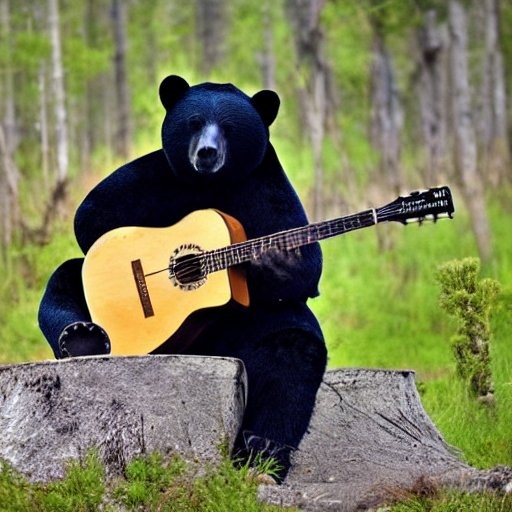
Bears have been hunted at least since the Neanderthal era by humans and hominids for their meat, fat, and fur. A variety of body have been used is traditional Chinese medicine and other folk pharmacopias. In the 18th and 19th centuries, hunters took the cubs of bears they had killed, presuming they “could serve as droll counterparts to their children.” Research on the metabolic processes of hibernating is being conducted for treatments for osteoporosis, kidney failure, gallstones and severe burns as well as increasing human lifespans and improving the quality of life in space,
Over the years bears have supplied humans with a number of products. Jason Urbanus wrote in Archaeology magazine: The site of a future convention center in Christchurch, New Zealand is shedding light on the lives of the city’s first European settlers. Apparently, even back then, men were concerned with hair loss. Among the hundreds of artifacts found at the site in rubbish pits and deposits dating to the mid-19th century was a container of Russian Bears Grease. The quirky pharmaceutical product purportedly aided hair growth and prevented baldness — the underlying theory being that because bears were hairy, their fat could stimulate hair growth for humans. [Source: Jason Urbanus Archaeology magazine, July-August 2017]
Bears are often blamed for preying on livestock, although their impact on livestock populations is often over-stated and feed primarily on berries and vegetation. This is particularly true of spectacled bears in South America. which have been killed as livestock killers despite being primarily frugivorous. Bears periodically attack and kill humans for various reasons. Females accompanied by their young can be especially aggressive, Bear attacks that seem at first to be unprovoked, often prove to be inadvertently provoked when investigated. Bears that live near humans, or have become habituated to humans, cause damage by breaking into homes, food stores, and garbage. Some bear species damage crops, such as manioc and corn. [Source: Tanya Dewey and Phil Myers, Animal Diversity Web (ADW) /=]
The International Union for Conservation of Nature (IUCN) Red List ranks sun bears, Asiatic black bears, Andean bears (spectacled bears) sloth bears polar bears and giant pandas as vulnerable. Brown bears and North American black bears are species of least concern. Several brown bear subspecies — including European brown bears (U. arctos arctos) and Tibetan brown bears or horse bears (U. arctos pruinosus) — are listed as endangered under the United States Endangered Species Act: Baluchistan bears (Ursus thibetanus gedrosianus) are also considered endangered. Mexican grizzly bears (Ursus arctos nelsoni) are extinct.
RELATED ARTICLES:
POLAR BEARS, HUMANS. CONSERVATION: CLIMATE CHANGE, POLLUTION, TOURISM factsanddetails.com
BROWN BEARS: CHARACTERISTICS, HISTORY, SIZE factsanddetails.com
BROWN BEAR FEEDING: DIET, HABITS, HUNTING, SALMON factsanddetails.com
BROWN BEAR BEHAVIOR: SENSES, HIBERNATION, REPRODUCTION factsanddetails.com
BROWN BEAR SUBSPECIES: BIG, RARE ONES AND WHERE THEY LIVE factsanddetails.com
BROWN BEARS IN EUROPE: LOCAL VARIANTS, WHERE THEY LIVE, REWILDING, ISSUES factsanddetails.com
BEARS: HISTORY, EVOLUTION, HABITAT, HUMANS, PIZZLIES factsanddetails.com
BEAR CHARACTERISTICS: PHYSIOLOGY, DIET, LIFESPAN factsanddetails.com
BEAR HIBERNATION, REPRODUCTION, CUBS factsanddetails.com
BEAR BEHAVIOR: TERRITORIALITY, HABITUATED TO HUMANS, OPENING CARS factsanddetails.com
BROWN BEAR ATTACKS factsanddetails.com
BEAR ATTACKS IN ALASKA factsanddetails.com
BEAR ATTACKS IN RUSSIA factsanddetails.com
BROWN BEARS ATTACKS IN JAPAN: VICTIMS, HOKKAIDO, SANKEBETSU factsanddetails.com
POLAR BEARS ATTACKS: CIRCUMSTANCES AND BEHAVIOR OF THE BEARS AND HUMANS factsanddetails.com
POLAR BEARS ATTACKS REPORTED IN THE MEDIA factsanddetails.com
Brown Bears and Humans
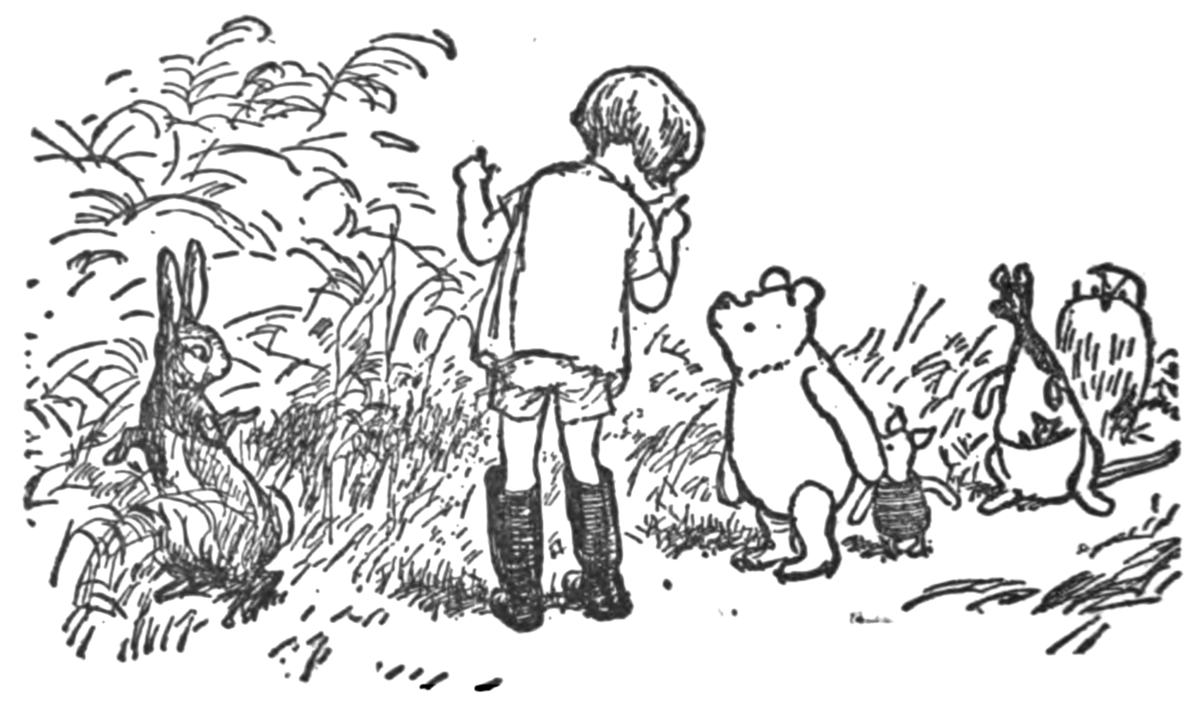
Illustration by Ernest Howard Shepard from Winnie-the-Pooh (1926), by A A Milne
Brown bears have been long considered the most dangerous animal in North America, although real danger of attack from this animal is often exaggerated. In general, brown bears attempt to avoid human contact and will not attack unless startled at close quarters with young or engrossed in a search for food. They are unpredictable in temperament, however, and often exhibit impulsive and petulant behavior. Brown bears have been persecuted extensively as predators of domestic livestock, especially cattle and sheep, although their actual impact on the livestock industry is probably negligible. [Source: Tanya Dewey and Liz Ballenger, Animal Diversity Web (ADW) |=|]
Dru Sefton of the Newhouse News Service wrote: “Protecting people and their property from bears is a politically sensitive issue. "Bears have become an icon that represent all things bad mankind has done to nature," bear researcher Gary Shelton said. New Jersey recently canceled a black-bear hunt after public protest. In the last year officials there have documented 25 bear attacks on livestock and 40 on household pets. Shelton, who lives in the remote Bella Coola Valley of British Columbia, began his career as a conservationist. He came to think that bears were becoming "overprotected" - that populations were growing too large - so he "shifted gears" to study what people can do to avoid or minimize bear attacks. */ [Source: Dru Sefton, Newhouse News Service, Cleveland Plain Dealer, October 1, 2000]
Brown bears have been widely sought as big game trophies and are currently subject to regulated sport hunting throughout much of their range. Once brown bears were used for their meat and hides but these products are not currently in high commercial demand. Some bear body parts (such as gall bladders) bring high prices on the traditional Asian medicine market. Currently, brown bears help to fuel an ecotourism industry, especially in areas such as Yellowstone National Park, Wyoming and parts of Alaska. [Source: Tanya Dewey and Liz Ballenger, Animal Diversity Web (ADW) |=|]
As a rule brown bears don't bother people. Grizzly bears have let people touch their teeth and stick their hands in their mouth. Well-fed bears generally present less problems than hungry ones. Brown bears appear to dislike the taste and smell of human beings. Alaskan Bear researcher Larry Aumiller told Smithsonian magazine, "Bears, especially young ones, will occasionally try to push people around. They're always testing each other for dominance and sometimes they'll come up to us to see if they can intimidate these strange hairless bipeds. We have to let them know this is not acceptable behavior. But, at the same time, I don't want to overly intimidate them. Every interaction between bears and people...is essentially, a training session." Aumiller disciplined one troublesome young bear who started making bluff-charges against groups of tourist by launching a preemptive bluff-charge of his own. He said that the same act could prove fatal with different, larger bear that could perceive it as a "challenge to his supremacy."
Goldilocks and Winnie the Pooh
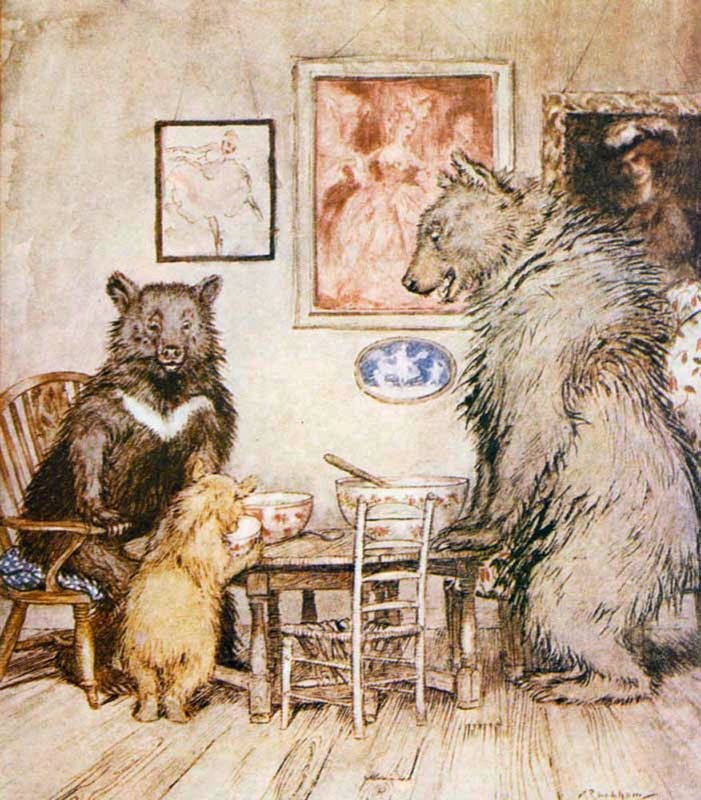
The "Goldilocks and the Three Bears" story, as we know it today, originated in 19th-century England, with the tale evolving from an oral tradition into written versions over time. The original story, first recorded in 1831 by Eleanor Mure, featured an old woman, not a young girl named Goldilocks. Robert Southey published the first printed version in 1837, further developing the story. The character Goldilocks, as we know her, and the focus on a young girl were introduced later by Joseph Cundall in 1849.
The story existed as a folk tale before being written down, likely with variations in the character of the intruder and the bears' reactions. Eleanor Mure's version (1831) — the first recorded version — features an old woman who intrudes on the bears' home. Robert Southey (1837) published a printed version, adding details and character development, but still with an older woman as the intruder. Folklorist Joseph Jacobs suggested a potential earlier version called "Scrapefoot," where a fox named Scrapefoot intrudes on the bears' home, which may have influenced Southey's version. Joseph Cundall's Version (1849) introduced the character Goldilocks, a young girl, and made several other changes to bring the story closer to what is recognized today.
A.A.Milne (1882-1956) wrote “Winnie the Pooh” in 1925. The Winnie the Poohs books are based on stories that Milne wrote about his son Christopher Robin and his stuffed toys — Pooh, Tigger, Kanga, Roo, Eeyore and Piglet. All of the original stuffed toys expect for Roo are now inside a glass case at the New York City Library. Roo was apparently lost decades ago by Christopher Robin in an English field. The stuffed toys are housed in the New York library because Milne allowed his American publisher, E.P. Dutton, to donate them to the library in 1926. Many Britons are upset that Winnie the Pooh's "kidnapping. One British MP said, "just as the Greeks want their Elgin Marbles back—so we want our Winnie the Pooh back along with this splendid friends."
The Winnie the Pooh stories are set in Ashdown Forest, a real place in East Sussex about 50 kilometers (32 miles) south of London. Winnie the Pooh was inspired by a real bear that lived in London Zoo, which was visited by Milne and son Christopher Robin. Christopher Robin named his stuffed animal "Winnie" after the bear at London Zoo. Milne left partial rights to Winnie the Pooh to the Garrick, a London club, and the Royal Literary Fund. Disney and other pays millions for the rights to the Pooh characters. Much of Milne’s estate money goes to the Westminster school.
Studying Bears
Scientists identify individual bears based on size, markings, scars, misshapen ears and the like. They determine the age of bears by counting rings in their teeth. Like rings in trees, bears form rings every winter on the bonelike coverings on their teeth roots. Bears that are studied up close are trapped or shot with tranquilizer darts (often a muscle reliant such as succinycloline chloride) are weighed, examined, tagged and sometimes given radio collars. Bears traps used by scientists are usually comprised of two oil drums welded together with one end closed off and the other end fixed with a trap door that closes when a bear enter it. These traps are often baited with beef or bacon.
Scientists track the movement and territories of animals with radio collars. They attach the collars after the animals have been trapped or subdued with tranquilizer darts. After some time the batteries in the collars wear out and have to be replaced and the animals have to be trapped, tranquilized and re-collared. Each battery powered radio collar emits a distinctive signal that can be picked up with a directional antennae. Some scientists study radio-collared bears when they are hibernating. When the collars are replaced the bears are located at their dens, injected with a tranquilizer, weighed and examined. The collars are adjusted for size and outfit with new batteries.
Biologists working for Katmai National Park carefully and consistently maintain records of the identifying characteristics of individual bears every year, and each bear identified is assigned a unique identification number. Bears are not tagged or collared. Coat color, claw color, scars, body size and shape, ear size and shape, sex, facial features, and disposition are all used to identify bears. The age class of each bear is also recorded. Age classification is a subjective determination, based primarily on size and behavior (and often on the documented identification history of the bear). Sex is determined by observation of urination posture, genitalia, or presence of offspring. Photo records are maintained for as many different individuals as possible. Photo records are an important aspect of recognizing individual bears across seasons and years, particularly when several biologists are involved in data collection. Life history profiles and identifying characteristics of the most frequently seen bear at Brooks Camp can be found in the ebook, Brown Bears of Brooks Camp. Individual bears are difficult to identify, especially the first few times you see them, but with practice anyone can identify the most commonly seen bears along the Brooks River. [Source: U.S. National Park Service, September 30, 2016]
Brown Bear Conservation
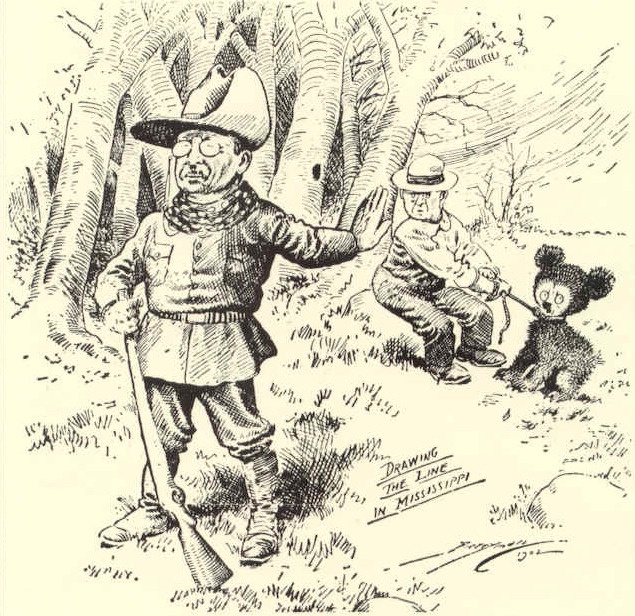
1902 political cartoon in The Washington Post that spawned the teddy bear name: The cartoon made fun of President Theodore Roosevelt when he went on a bear hunting trip in Mississippi in November 1902 in which a small black bear was cornered, clubbed, and tied to a tree; The hunters offered to let Roosevelt shoot it, but he refused — saying it was unsportsmanlike; Roosevelt did ask that the bear be killed to end its suffering; In November 1902, Post political cartoonist Clifford Berryman drew the image above aimed at poking fun of Roosevelt's over-the-top hunting, fishing, and camping lifestyle
Brown bears are threatened by humans who have hunted them for sport, for furs and as pests and livestock killers. Their ability to recover from seeming fatal wounds made many indigenous people believe they had supernatural powers. A study of grizzly bears at Banff National Park found that the bears reproductive rate is slow and doesn’t keep up with the rate in which they are killed off by humans.
Brown bears are not endangered globally. They are listed as a species of Least Concern on the International Union for Conservation of Nature (IUCN) Red List local but populations are becoming increasingly scarce. As the IUCN acknowledges: "Least Concern does not always mean that species are not at risk. There are declining species that are evaluated as Least Concern." . On the US Federal List they are caregorized as Endangered.. In CITES (Convention on International Trade in Endangered Species of Wild) they are in Appendix I, which lists species that are the most endangered among CITES-listed animals and plants.
The conservation status of brown bears depends on the population. Some populations are healthy; other are clearly endangered. Brown bear numbers have dropped dramatically since the early 1900s when settlers and livestock poured in their home territory. Logging, mining, road construction, resorts, subdivisions, golf courses, etc. have all encroached on suitable bear habitat, resulting in a decrease in bear numbers. [Source: Tanya Dewey and Liz Ballenger, Animal Diversity Web (ADW) |=|]
Brown bears now cover just two percent of their former habitat, numbering some 200,000. Half are in Russia, 30,000 in North America and 17,000 in Europe. Brown bear numbers were estimated at 100,000 in the continental United States in the early 1900s, but there are only a few thousand now. Brown bears are still fairly common in the mountainous regions of western Canada and Alaska.. |=|
Avoiding Trouble with Brown Bears
Hikers in bear country are encouraged to keep their distance, especially with a mother and her cubs, and wear bells or some other noise maker so they don't accidentally startle a bear. When in the presence of bear people are told to speak calmly and reassuringly, and not run because bears sometime see that as opportunity to run in pursuit. One Russian guide told the New York Times, "Never look the bear on the eyes. And don't move. Just yell Russia swear words at it." Flares are sometimes used to scare bears away. Pepper spray may work in a close encounter.
Alaskan bear expert Aumiller, who spends much of time escorting tourist around bears, told Smithsonian, "Sometimes it can get a little complicated depending on things like how many people we have, how loud or aggressive they are, which bears are present that day and how they're getting along with each other. If we seem to be making a bear nervous, I get the group to act more submissive. We may move closer together, which make the group's size appear less formidable. We stop making noise, we may sit down, we say even slowly move away. If, on the other hand, a bear starts acting assertive, we may do the opposite—spread out and stand up on logs or rocks, talk loudly, maybe even wave our arms around. Every interaction is different and it's up to us to read the people and the bears, and respond appropriately to each other."
If you surprise and are attacked by a brown bear some advise you to play dead since most of the time the bear is defending itself. If it stalks you fight back and don’t make yourself easy pray. In some places hikers carry red pepper spray to ward off bears. The jury is out on whether this really works. Some say red pepper spray may actually attract bears. If sprayed at a campsite bears can get a whiff of it a quarter of a mile away.
Troublesome grizzly bears are driven away by loud yelling, firing shotgun blanks, throwing bean bags, or firing rubber bullets. Other measures employed to keep bears away include electric fencing around garbage sites, replacing conventional trash cans with bear-proof models and educating people on how to keep their trash stored out of harms way. In the United States, troublesome grizzly bears are driven away by chasing them with specially trained Finnish dogs and dealt with using the three-strikes-your-out policy in which troublemakers are caught and taken to a wilderness area. If they show up two more times and cause trouble they are killed.
Doubts About the Conventional Wisdom on Avoiding Bear Attacks
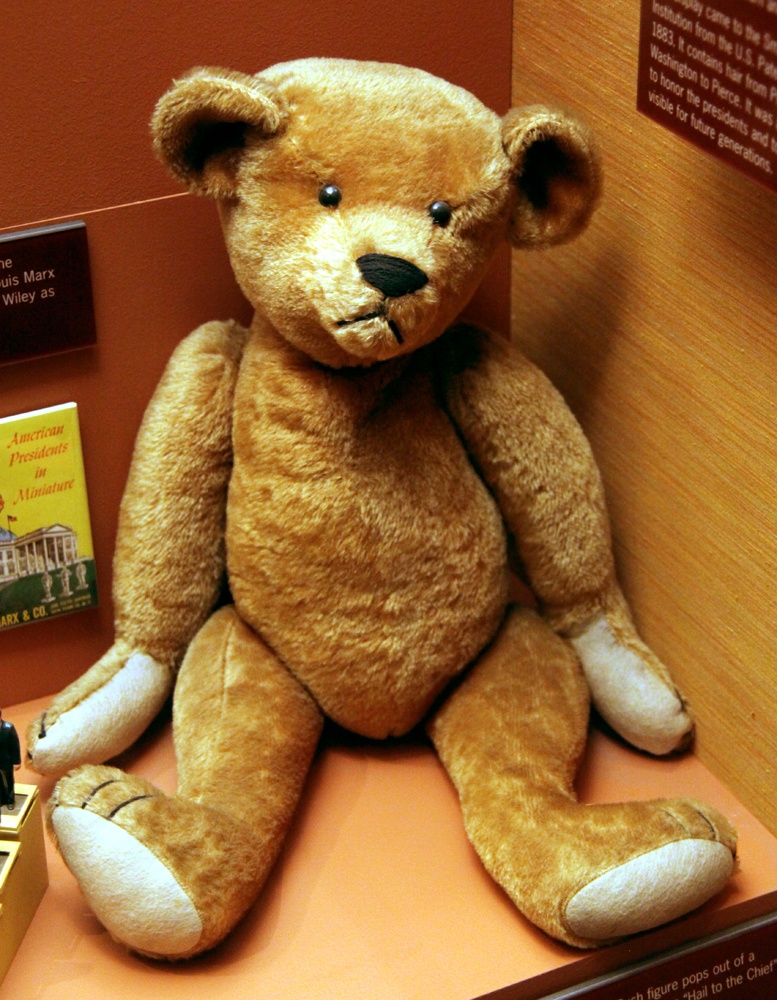
An original "Teddy Bear" from 1903, manufactured by Michton; this bear was owned by Theodore Roosevelt's grandson, Kermit; Morris Michtom, owner of a New York City toy store, saw the cartoon above; He created a small stuffed bear cub toy, and sent it to Roosevelt; He asked the president's permission to use the name "Teddy", and Roosevelt said okay; The toys were an immediate success; By 1906, ladies carried "Teddy bears" with them everywhere, children were photographed with them, and Roosevelt used one as a mascot in his re-election campaign; Michtom used his profits to found the Ideal Toy Co; Early teddy bears were made to look like real bears, with snouts and beady eyes
Dru Sefton of the Newhouse News Service wrote: “When the grizzly charged, Patricia Van Tighem did what hikers have always been told to do. First, she scampered up a tree. The bear batted her down. Then she lay still on the ground, playing dead. The bear began gnawing on her face, ripping skin and muscle from her skull. Van Tighem finally did something she wasn’t supposed to do: She reached up and poked the bear in the nose. The bear retreated. "Staying still didn’t work," said Van Tighem, whose new book, "The Bear’s Embrace," details the grueling 20-year physical and mental aftermath of the attack on her and her husband. "If I kept playing dead, I would have BEEN dead." [Source: Dru Sefton, Newhouse News Service, Cleveland Plain Dealer, October 1, 2000 */]
“The common advice always has been - and still is - that if you’re threatened by a grizzly, play dead; if you’re threatened by a black bear, fight back. But a summer of attacks involving not only fierce grizzlies but also normally docile black bears has some experts questioning those approaches. The issue becomes more important as bear populations increase and human-bear conflicts, the term that researchers use for these sometimes violent interactions, become less rare. */
"Conflict is increasing all over," said Gary Shelton, who has studied bears for 35 years and written two books considered to be the seminal works on bear aggression. "What’s happening is bear attacks are taking place where they haven’t before, there’s a higher level of fatalities, and there are more deadly attacks by black bears."
“If people want to learn how to co-exist with bears, "it is incumbent upon us to figure out how they think," said Tom Smith, a research wildlife biologist with the U.S. Geological Survey in Alaska and an expert on bear-human interaction. Smith is studying grizzly bear responses to smells, sights and sounds associated with human outdoor activities. He travels through the wilderness displaying different colored tent materials and playing voice recordings, noting bear reactions. Avoidance remains the best defense, yet some people are naive about keeping bears at bay, Smith said. "Campers put papaya-guava-honey shampoo on their heads and then wonder why bears are paying attention to them," he said. "Come on, people, this is stupid." To a bear, that’s about as inviting as "bacon and egg shampoo" would smell to a hungry hiker, Smith noted. */
“Much of Smith’s research runs counter to accepted bear-avoidance tactics. He has discovered that pepper spray, a common deterrent, actually may attract bears if used incorrectly - that is, applied to tents, containers or clothing as opposed to sprayed directly at a bear. Smith also published a study on the use of "bear bells," which hikers hang from walking sticks, belts or backpacks on the theory that a noisy approach will keep them from catching a bear off guard. He hung a row of the noisy bells on a bush. Over time, 15 grizzly bears wandered past the bells as he rang them; the beasts "didn’t even twitch an ear." "Some things that are taught as standard safety messages, I think, Why in the world do we do that? " he said. */
"The overwhelming majority of bears have no desire to deal with people," Smith said. However, "there are those Jeffrey Dahmer and Ted Kaczynski bears," like the human murderers, that set out to kill. Shelton delivered a paper for the International Bear Association conference that details his theory: Black bears, in certain circumstances, will indeed prey on humans. "There’s going to be a slow, steady increase of predatory black bear attacks that will catch bear managers off guard," he predicted. Shelton pointed out that because black bears and grizzlies evolved from a common ancestor, a "true predator," each species is capable of predatory attacks. */
“So the common advice to fight a black bear but play dead for a grizzly may not hold true, particularly if the bear has targeted a human as prey. After conducting in-depth interviews with 40 survivors of attack by bears, both black and grizzly, Shelton now takes "a strong position against playing dead." "If the bear is deciding if you’re prey, and you play dead, that’s exactly what happens to you," he said. He devotes a chapter in his upcoming book to the topic. So what is the best way to protect yourself in bear country? Shelton said to carry pepper spray and use it correctly - shoot it directly at the bear, then leave the area immediately, as the bear will be temporarily stunned by the burning sensation. "Even though the spray success rate runs at about 75 percent, it is a far better strategy than the play dead/fight back concept," Shelton said.” */
Dealing with Pesky Bears in Japan
In 2004, the year of a high number of bear attacks, people became very scared. Rural people began wearing bells and other noisemakers. Children were escorted to schools. Elderly people traveled in groups. After numerous bear sightings in 2010, Hiromasa Takeda and Takahiro Komazaki wrote in the Yomiuri Shimbun, “Patrols have been organized and other precautions taken in areas frequented by bears.".The city government of Uozu has issued an emergency warning about wild bears, and the town government of Iidemachi has advised residents to refrain from going outdoors in the morning and evening, when bear sightings have been most common. The Iidemachi government has given all local primary and middle schools loud bells to drive away bears, and some primary schools have asked parents to transport their children to and from school by car." [Source: Hiromasa Takeda and Takahiro Komazaki, Yomiuri Shimbun, October 24, 2010]
“Sakue Ono, 60, who cultivates apples in Numata, Gunma Prefecture, sets off flares every morning to scare away any bears that might be near his property. He also installed electric fences, but even that has failed to stop bears from intruding in his field." "I'm afraid the bears might have learned how to get around the fences. For example, maybe they push a fence over by using their hip, so the thick fur protects it from electric shock," he told the Yomiuri Shimbun.
“A local government in Kyoto Prefecture has set up buffer zones between forests and residential communities by clearing undergrowth at the foot of mountains, where wild animals sometimes hide, so that people can easily spot them. While many such trial-and-error efforts are continuing across the nation, none have been successful in totally preventing bears from approaching areas where humans live." An official of the local government in Kyoto Prefecture said: "We're dealing with wild animals. All we can do is try every possible option, one by one."
In Hyogo Prefecture black bears have been trained to fear humans. Pesky bears that have frequently showed up in residential areas have been caught and frightened with firecrackers and pepper spray and other means and then released with transmitters so their movements could be monitored. After being released 75 percent of the bears avoided residential areas. Of these 62 percent did not go within two kilometers of residential areas and 12 percent came near residential area but did not enter them.
The Fukui government spent $800,000 to outfit four bears with radio collars and GPS device to monitor their progress. In Tochigi Prefecture their travel patterns are observed using a satellite designed to check the migratory patterns of whales.
See Separate Article: DEALING WITH BEARS IN JAPAN: CONTROL, ROBOTS, DEFENSES, KILLING THEM factsanddetails.com
Circuses and Training Brown Bears
Bears have been taught to wrestle, box, dance, play a trumpet, ride a bicycle and slide on a toboggan. They have been fixture of circuses and outdoor entertainment since the Middle Ages. Russians have along tradition of catching bears an training them to perform tricks. Brown bears have traditionally been fixtures of Russian circuses.
The brown bear is the symbol of Russia and bears still perform in circuses there such as the Bolshoi State St. Petersburg Circus. As of 2019, three performing bears, usually muzzled and chained, under trainer, Grant Ibragimov, are trained to walk on two legs by , trainers may keep them in a standing position, tethered by their necks to a wall. Bears no longer dance in Russian streets for tips, but that practice continues in some places. Circuses bears remain a popular form of entertainment in Russia. Old photographs show bears balancing on balls. [Source: Natasha Daly, National Geographic, June 2019]
Gypsies often wandered from town to town with bears on a chain and gave people the opportunity to wrestle them. In Istanbul men walk the streets with large muzzled brown bears. For centuries bears have been captured by Qalanders, an itinerant group of performers in India, and taken from village to village to performer for handouts from villagers. The bears are trained to do tricks as well as dance. To keep them under control the bears often have a ring through bones of the animal's nose, mouth and muzzle. The original dancing bear reportedly began dancing after eating fermented Mohwa tree flowers. Today a pull on the rope is all that is necessary to get a bear to "dance" in pain.
Hunting Brown Bears and and Reintroducing Them to the Wild
The easiest and perhaps safest way to hunt a bears is with a helicopter. Large males are preferred as trophies. In some places it is illegal to hunt females and cubs.
Bear hunters in Siberia teach their dogs to immobilize bears by biting its haunches. The dogs practice on a chained bear and dog owners pay up to a $100 a session for their dogs to learn the practice. Describing it, Richard Paddock wrote in the Los Angeles Times, "Pavelenko and Guz take the bear to a clearing in the forest and chain it to a cable strung between two trees. Using the bear's dung, they will make a simulated trail through the woods for the dogs to discover. "One at a time," Paddock wrote, "the dogs will be released to 'track' the bear. The key moment will come when the dog has found he bear and the owner can see how it reacts. The best dog is the one that bites the bear on the backside so its sits down," Pavlenko told him. "The dog keeps the bear that way so the hunter can approach the bear and shoot it."
Russian hunters have traditionally rousted hibernating bears from their winter dens, shooting them for their pelts and meat, and leaving the cubs to starve or freeze to death. According to Associated Press: But Valentin Pazhetnov has a method of keeping the little ones alive and returning them to nature. The secret, the Russian biologist says, is minimal contact with humans, so that the cubs learn to fend for themselves. "Bear cubs shouldn't get used to the smell of humans, to human houses … the human voice," he told AP Television. "They must avoid people, fear them. This is the only way they can survive in the wild." The bears are brought in by volunteers, hunters or people who stumble upon them by chance, and are sheltered at the Bear Rescue and Rehabilitation Program at Bubonitsy, a village 220 miles northwest of Moscow. The program is funded by the U.S.-based International Fund for Animal Welfare. [Source: Associated Press. August 7 2012]
Charles Russell and Maureen Enns, two Canadians that lived among bears on the Kamchatka Peninsula, taught bears by orphaned by poachers how live in the wilderness. Russell and Enns taught the bears how to fish but had more difficulty preparing them to hibernate.
Grizzly Man
Werner Herzog’s “Grizzly Man “is a film about a man—Malibu resident Timothy Treadwell— who lived among grizzlies as was ultimately eaten by them. Herzog said the story shows that the world is not about peace and harmony but rather “chaos, hostility and murder,” adding “And what haunts me, is that in all the faces of all the bears that Treadwell ever filmed, I discover no kinship, no understanding, no mercy. I see only the overwhelming indifference of nature. To me, there is no such thing as a secret world of the bears. And this blank stare speaks only of a half-bored interest in food. But for Timothy Treadwell, this bear was a friend, a savior.”
For thirteen consecutive summers, Treadwell moved to Katmai in the Alaskan Peninsula to live among the grizzly bears, with the pretext of studying and protecting them. In 2003, he and his girlfriend Amie Huguenard were surprisingly attacked one the bears he thought he had “befriended.” He event was captured in a tape recording (See Brown Bear Attacks). [Source: IMDb -]
Pieced together from Timothy Treadwell's actual video footage, Werner Herzog's remarkable documentary examines the calling that drove Treadwell to live among a tribe of wild grizzly bears on an Alaskan reserve. A devoted conservationist with a passion for adventure, Timothy believed he had bridged the gap between human and beast. When one of the bears he loved and protected tragically turns on him, the footage he shot serves as a window into our understanding of nature and its grim realities. [Source: Google]
In one scene Treadwell says: “I'm out in the prime cut of big green. Behind me is Ed and Rowdy, members of an up-and-coming sub-adult gang. They're challenging everything, including me. Goes with the territory. If I show weakness, if I retreat, I may be hurt, I may be killed. I must hold my own if I'm gonna stay within this land. For once there is weakness they will exploit it, they will take me out, they will decapitate me, they will chop me into bits and pieces. I'm dead. But so far, I persevere. Persevere. -
The film does not air the recording of the attack that killed Treadwell and his girlfriend. Viewers do, however, see Werner Herzog listening to the tape, but Herzog decided not to feature the recording in the film. According to IMDb: “During the attack which claims the life of Timothy Treadwell and his girlfriend, a videocamera was left running. While the lens cap was left on the camera does record the last moments of their lives. The tape is now in possession of one of Treadwell's friends, who has never listened to it. Out of respect for Timothy Treadwell and Annie Huguenard, and out of basic human decency, Herzog does not include the recording in the film, although there is a scene of him listening to it. It should be pointed out that since the manner of Treadwell and Huguenard's deaths are known from forensic evidence, including the audio tape would have no instructive value to the film and would only serve to feed the morbid curiosity of many people.” -
Cocaine Bear
The 2023 film “Cocaine Bear” — about a bear that consumes a huge amount of cocaine dropped from a drug-smuggling plane and goes berserk, gruesomely killing a bunch of people — is based very, very loosely on the following true story: On September 11, 1985, former police officer turned drug smuggler Andrew C. Thornton II was trafficking cocaine into the United States. After dropping off a shipment in Blairsville, Georgia, Thornton and an accomplice, Bill Leonard, departed in a self-piloted Cessna 404 Titan. En route, they dropped a load of 40 plastic containers of cocaine into the wilderness before abandoning the plane above Knoxville, Tennessee. Allegedly, Thornton was killed when his parachute failed to open. According to the FBI, Thornton dumped his cargo because the load of two men, in addition to the cocaine, was too heavy for the plane to carry.
On December 23, the Georgia Bureau of Investigation reported finding a dead black bear that had eaten a large amount of the cocaine from the jettisoned containers and suffered a drug overdose. The containers had held about 34 kilograms (75 pounds) of cocaine, valued at $20 million at the time. Government authorities said all of the containers had been ripped open, with their contents scattered. The chief medical examiner from the Georgia State Crime Lab, Dr. Kenneth Alonso, stated that her stomach was "literally packed to the brim with cocaine", although he estimated she had absorbed only 3 to 4 grams into her bloodstream at the time of her death.
Image Sources: Wikimedia Commons
Text Sources: Animal Diversity Web animaldiversity.org ; National Geographic, Live Science, Natural History magazine, CNTO (China National Tourism Administration) David Attenborough books, New York Times, Washington Post, Los Angeles Times, Smithsonian magazine, Discover magazine, The New Yorker, Time, BBC, CNN, Reuters, Associated Press, AFP, Lonely Planet Guides, Wikipedia, The Guardian, Top Secret Animal Attack Files website and various books and other publications.
Last updated May 2025