
BROWN BEAR SUBSPECIES
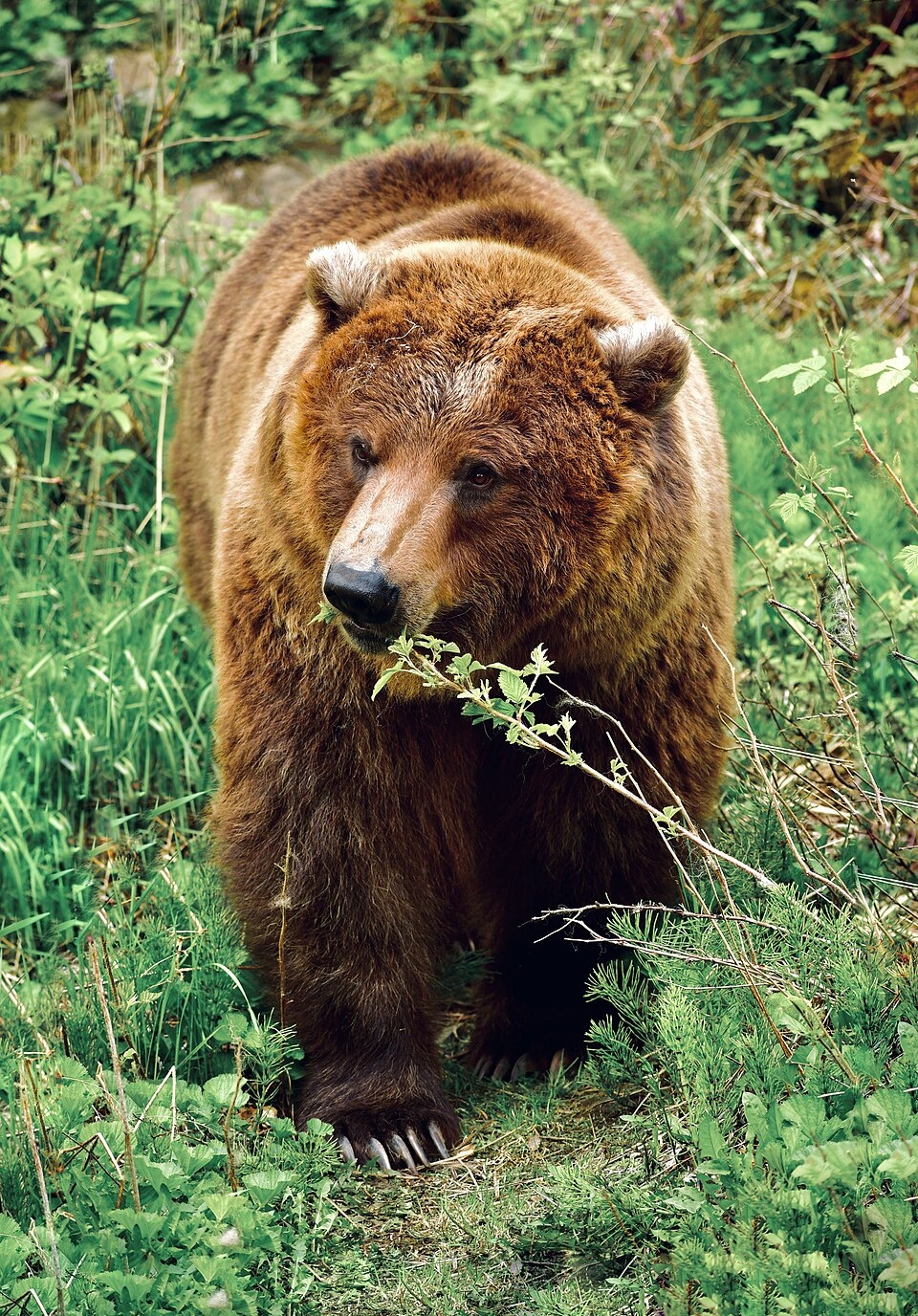
Brown bears are found in Spain, Italy, Scandinavia, the Himalayas, Russia, some of the former Soviet Republics, Romania, Japan's Hokkaido island, Mongolia, Turkey, Iran, India, Canada and the United States. All brown bear are members of the species “Ursus arctos”. Among the dozen or so brown bear subspecies are the grizzly, Kodiak and Kamchatka brown bears. There are different reckoning of brown bear subspecies. Some of the generally accepted and better known ones with their scientific names are:
1)Eurasian brown bear (Ursus arctos arctos)
2) Ussuri brown bear (Ursus arctos lasiotus)
3) Kamchatka brown bear (Ursus arctos beringianus)
4) East Siberian brown bear (Ursus arctos collaris)
5) Himalayan brown bear (Ursus arctos isabellinus)
6) Syrian brown bear (Ursus arctos syriacus)
7) Tibetan blue bear (Ursus arctos pruinosus)
8) Gobi bear (Ursus arctos gobiensis)
9) Grizzly bear (Ursus arctos horribilis),
10)Kodiak bear (Ursus arctos middendorffi)
11) Alaska Peninsula brown bear (Ursus arctos gyas)
12)Marsican brown bear (Ursus arctos marsicanus)
13) Cantabrian brown bear (Ursus arctos pyrenaicus).
Marsican brown bears and Cantabrian brown bears are now often considered to be variants of Eurasian brown bear. Alaska Peninsula brown bears are often considered to be variants of Kodiak bears.
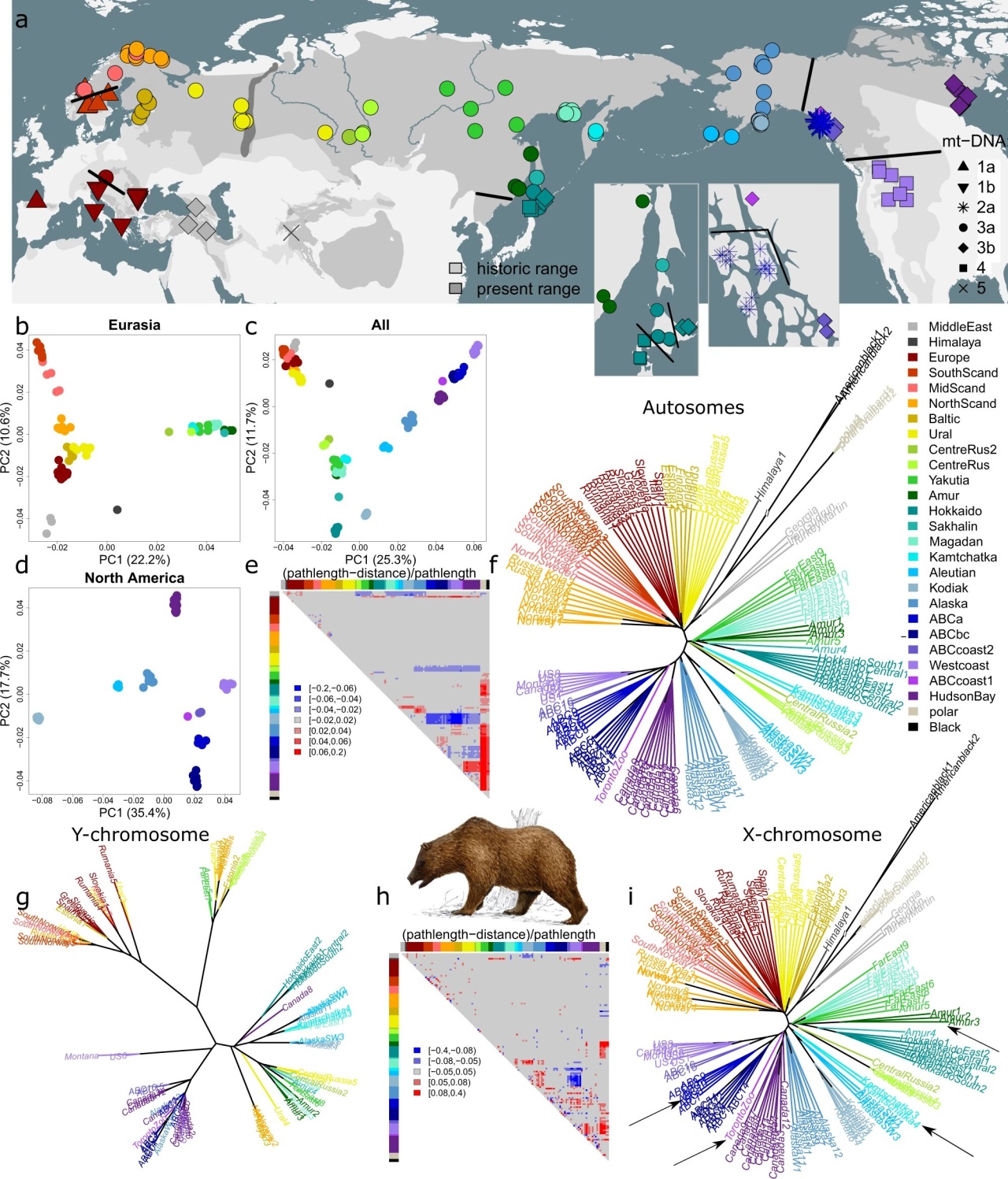
The genetic diversity of brown bears has been extensively studied and appears to be geographically structured into five main clades based upon analysis of the mtDNA. In Eurasia, outside Europe and Russia, clades of brown bear persist in small, isolated, and for the most part highly threatened populations in Iran, Afghanistan, Pakistan, parts of northwest India and central China. Terry Domico and Mark Newman wrote in “Bears of the World”: “A brown bear's fur is shaggy and comes in many color --- black, cinnamon, red, blonde or a mixture of these colors or a mixture of these clors. In fact, this species is so variable in size and coloration that it confused the late 19th-century naturalists who described them. Many of these biolgist thought each variation was new species, and the resulting list of new bear ‘species’ became so lengthy that nearly every mountain range could claim to have its own species of brown bear. [Source:“Bears of the World” by Terry Domico and Mark Newman, 1988]
The work of Dr. C. Hart Meriam, who was an authority on brown bears, typifies what happened. In 1918, he described no fewer than 86 species and subspcies of brown/grizzly bears of North America, ‘one third of them in Alaska. Merriam lived in the age of ‘splitters,’ when minor variations in skull, size, hair, color and other differences were used to describe a new species. Had he been classifying people, I wonder how many species of humans he would have come up with. Scientists are now going the other ways, generally lumping the highly variable borwn bear into just one species, Ursa arctos, Nine or ten subspecies are stiil recognized and argued about, but most of the weed out
RELATED ARTICLES:
BROWN BEARS: CHARACTERISTICS, HISTORY, SIZE factsanddetails.com
BROWN BEAR FEEDING: DIET, HABITS, HUNTING, SALMON factsanddetails.com
BROWN BEAR BEHAVIOR: SENSES, HIBERNATION, REPRODUCTION factsanddetails.com
BROWN BEARS IN EUROPE: LOCAL VARIANTS, WHERE THEY LIVE, REWILDING, ISSUES factsanddetails.com
BROWN BEARS AND HUMANS factsanddetails.com
BEARS: HISTORY, EVOLUTION, HABITAT, HUMANS, PIZZLIES factsanddetails.com
BEAR CHARACTERISTICS: PHYSIOLOGY, DIET, LIFESPAN factsanddetails.com
BEAR HIBERNATION, REPRODUCTION, CUBS factsanddetails.com
BEAR BEHAVIOR: TERRITORIALITY, HABITUATED TO HUMANS, OPENING CARS factsanddetails.com
BROWN BEAR ATTACKS factsanddetails.com
BEAR ATTACKS IN ALASKA factsanddetails.com
BEAR ATTACKS IN RUSSIA factsanddetails.com
BROWN BEARS ATTACKS IN JAPAN: VICTIMS, HOKKAIDO, SANKEBETSU factsanddetails.com
Grizzly Bears
Brown bears in the Rocky Mountains have long hairs along the shoulders and back which are frosted with white, giving a grizzled appearance, hence the common name grizzly bear ((Ursus arctos horribilis) in that region. Brown bears found inland in North America are often called grizzlies. Grizzlies have a more pronounced muzzle and a more dish-shaped face than other brown bears. They get their name from the 'grizzly" silver-tipped fur on the upper parts of their body. Grizzly bears have an average life span of around 25 years. A grizzly bear in captivity has lived to the age of 40. Studies of grizzlies at Yellowstone National park indicate that male cubs outnumber female cubs two to one. At the age of three and four males and females are equally numerous. Among adults female predominate.
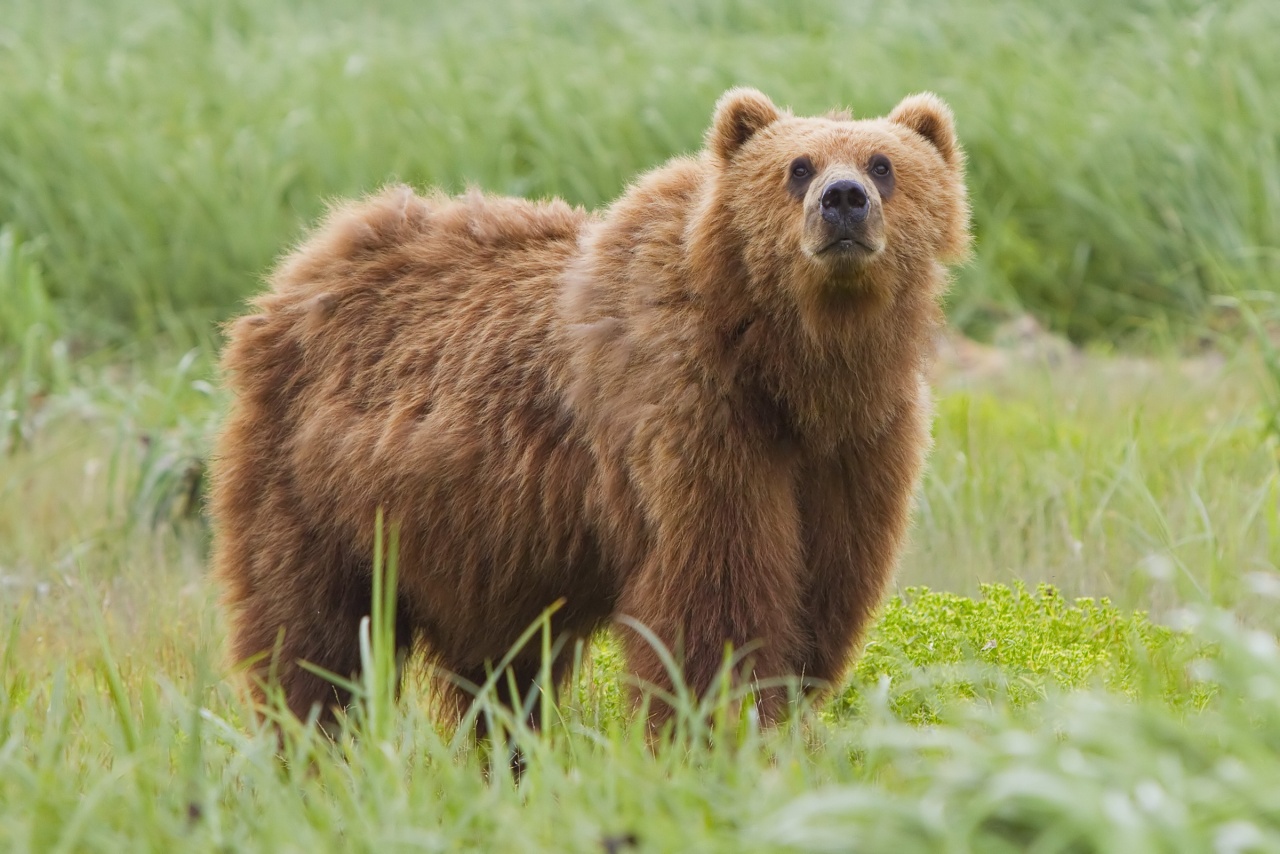
What is the difference between brown bears and grizzly bears? All grizzly bears are brown bears, but not all brown bears are grizzly bears. Grizzly bears and brown bears are the same species (Brown bears), but grizzly bears are currently considered to be a separate subspecies (U. a. horribilis). Due to a few morphological differences, Kodiak bears are also considered to be a distinct subspecies of brown bear (U. a. middendorfii), but are very similar to Katmai’s brown bears in diet and habits. [Source: U.S. National Park Service, September 30, 2016]
Even though grizzlies are considered to be a subspecies of brown bear, the difference between a grizzly bear and a brown bear is fairly arbitrary. In North America, brown bears are generally considered to be those of the species that have access to coastal food resources like salmon. Grizzly bears live further inland and typically do not have access to marine-derived food resources.
Besides habitat and diet, there are physical and (arguably) temperamental differences between brown and grizzly bears. There have been no documented cases of grizzly bears weighing over 408 kilograms (900 pounds) in Yellowstone. Additionally, grizzly bears seem to react to humans at greater distances than brown bears.
Grizzly numbers are hard to track, as the bears are elusive. The U.S. Fish and Wildlife Service estimates that 1,200 grizzlies are spread throughout Montana, Idaho, Washington and Wyoming, and 30,000 live in Alaska. University of Calgary environmental scientist Stephen Herrero, a bear expert, estimates that 60,000 brown bears, the species that includes grizzlies, live throughout North America. [Source: Dru Sefton, Newhouse News Service, Cleveland Plain Dealer, October 1, 2000]
Alaska Hunter Bags World Record Grizzly Bear
In Alaska, hunting brown bears is still allowed. Fox News reported: Larry Fitzgerald and a pal were moose hunting near Fairbanks, Alaska, when they came across fresh bear tracks in the snow. Three hours later, the auto body man had taken down the grizzly that left the prints, an enormous bruin that stood nearly 9 feet tall and earned Fitzgerald a place in the record books. [Source: Fox News, May 6, 2014]
Although Fitzgerald shot the bear last September, Boone and Crockett, which certifies hunting records, has only now determined the grizzly, with a skull measuring 27 and 6/16ths inches, is the biggest ever taken down by a hunter, and the second largest grizzly ever documented. Only a grizzly skull found by an Alaska taxidermist in 1976 was bigger than that of the bear Fitzgerald bagged. "I'm not really a trophy hunter, or anything," Fitzgerald, 35, told FoxNews.com. "But I guess it is kind of cool."
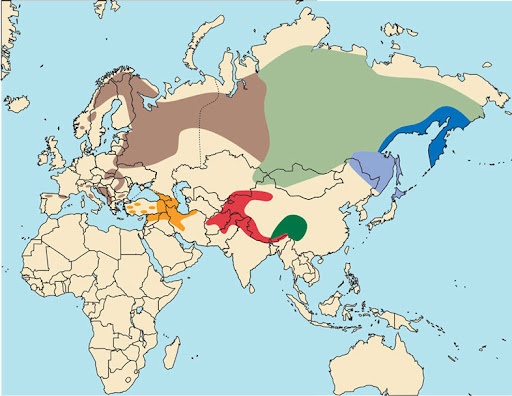
brown bear subspecies distribution In Eurasia:
1) Eurasian brown bear (U a arctos) (dark grey)
2) Ussuri brown bear (Ursus arctos lasiotus) (light blue)
3) Kamchatka brown bear (U a beringianus) (dark blue)
4) East Siberian brown bear (U a collaris) (light grey)
5) Himalayan brown bear (U a isabellinus) (red)
6) Syrian brown bear (Ursus arctos syriacus) (orange)
7) Tibetan blue bear (U a pruinosus) (olive green)
8) Gobi bear (Ursus arctos gobiensis)
Fitzgerald brought down the bear from 20 yards, with one shot to the neck from his Sako 300 rifle. He said he and hunting buddy Justin Powell knew from the tracks he was on the trail of a massive grizzly, but only learned this week that he held a world record. "We knew it was big," he said. "It was a rush."
Bears are scored based on skull length and width measurements, and Missouloa, Mont.-based Boone and Crockett trophy data is generally recognized as the standard. Conservationists use the data to monitor habitat, sustainable harvest objectives and adherence to fair-chase hunting rules. Richard Hale, chairman of the Boone and Crockett Club's Records of North American Big Game committee, said it was unusual that such a massive grizzly would be taken near a a city. "One would think that a relatively accessible area, with liberal bear-hunting regulations to keep populations in line with available habitat and food, would be the last place to find one of the largest grizzly bears on record," said Hale.
The Alaska Department of Fish and Game instituted grizzly hunting regulations to help balance and control the bears' preying on moose. Although baiting is allowed under the regulations, Fitzgerald stalked his trophy. Grizzlies are currently federally protected in the Lower 48 states under the Endangered Species Act, but thriving populations have prompted regulators to consider de-listing them, said Hale.
Kodiak Bears and Large Bears in Southern Alaska
Brown bears living along the coast in Alaska and British Columbia and nearby islands are the largest brown bears. Large male brown bears in Katmai in southern Alaska can routinely weigh over 454 kilograms (1000 pounds) in the fall. In contrast, grizzly bears in Yellowstone National Park weigh far less on average. On the southern Alaska males average 389 kilograms (858 pounds) and females average 207 kilograms, (456 pounds) though some males have been weighed at as much as 780 kilograms 1720 pounds),. Size rapidly declines to the north and east, with individuals in southwestern Yukon weighing only 140 kilograms (309 pounds) on average
Kodiak bears (Ursus arctos middendorffi), from Kodiak island Island Alaska are considered the largest brown bears. They often weigh over 700 kilograms (1,500 pounds) and can stand three meters (nine feet) tall. They main reason they are bigger than other bears is they that have abundant supplies of protein and food: namely in the form of salmon and carcasses of animals that wash up on the cold water beaches where they live.
Whether or not Kodiak bears are a subspecies is a matter of debate. The largest widely documented brown bear was a wild Kodiak bear killed in English Bay, Kodiak Island in 1894. This bear weighed 751 kilograms (1,656 pounds) and was measured and verified by the Guinness Book of World Records. A captive Kodiak bear named Clyde, which lived at the Dakota Zoo is estimated to have weighed close to 1,088 kilograms (2,400) lbs a year before his death in 1987. While there are claims of even larger brown bears, these are often poorly documented or based on dubious hunter claims. [Source: Google AI]
Alaska Peninsula brown bears (Ursus arctos gyas) in Katmai in southern Alaska near Kodiak Island are some of the largest bears in the world. They can stand 0.9 to 1.5 meters (3 to 5 feet) at the shoulder and measure 2.1 to 3 meters (7 to 10 feet) in length. Most adult males typically weigh 272 to 408 kilograms (600 to 900 pounds) in mid-summer. By October and November, large adult males can weigh well over 454 kilograms (1000 pounds). Adult females average about a third less in weight than adult males. [Source: U.S. National Park Service, September 30, 2016]
Eurasian Brown Bears
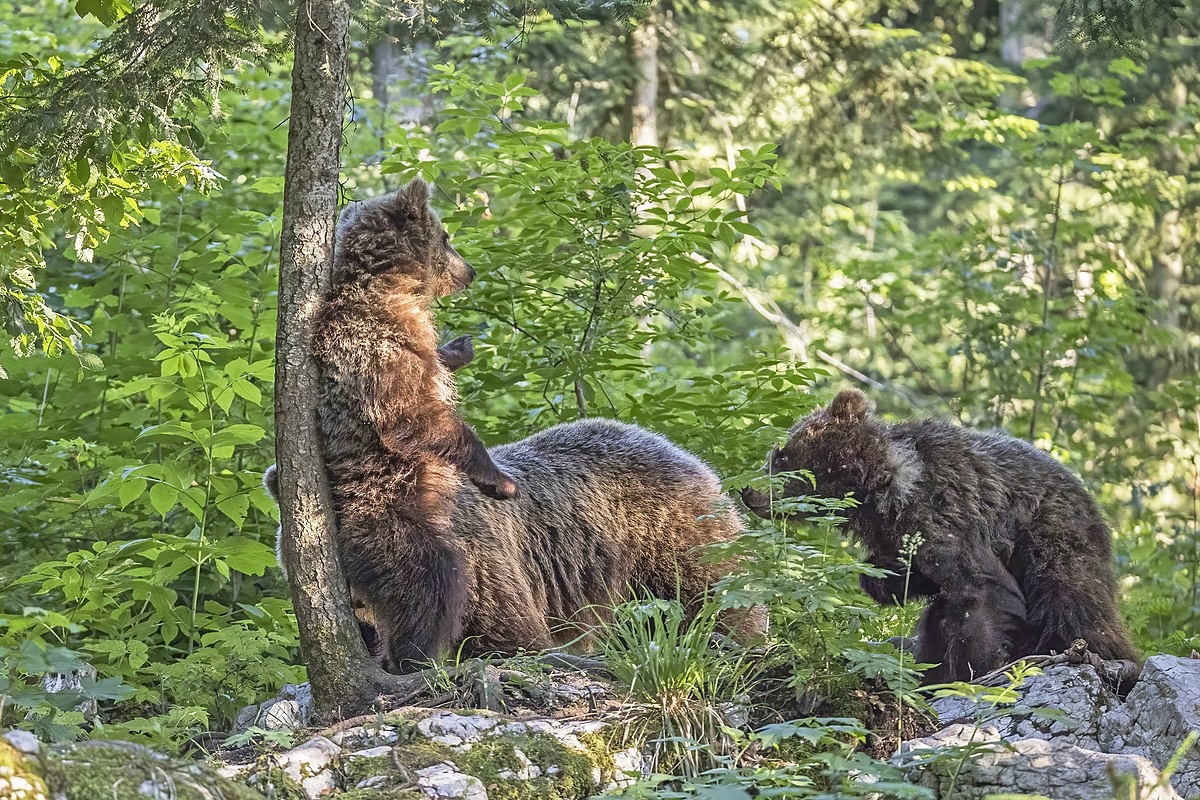
Eurasian brown bears (Ursus arctos arctos) are also known as European brown bears. They are the most widespread subspecies in Europe, and their range extends into in Western Russia and the Caucasus. They may be found as far east in Russia as the Yenisei River in Yamalo-Nenets Autonomous Okrug to Novosibirsk Oblast in the south, where their habitat merges with that of East Siberian brown bears (U. a. collaris). Eurasian brown bears are predominantly dark, richly brown colored in color. Light-colored individuals are rare. They are moderately sized and have dark claws. Eurasian brown bears in Russia are larger than those in Europe perhaps because they have been hunted less.[Source: Wikipedia]
Eurasian brown bears were used in Ancient Rome for fighting in arenas. The strongest bears were said to have come from Caledonia (Scotland) and Dalmatia (Croatia area). In ancient times, Eurasian brown bears were largely carnivorous, with 80 percent of their diet consisting of animal matter. However, as its habitat increasingly diminished, the portion of meat in its diet decreased with it until by the late Middle Ages, meat consisted of only 40 percent of their dietary intake. Today, meat makes up little more than 10 to 15 percent of their diet. Whenever possible, brown bear do eat consume sheep.[
The largest brown bear population in Europe is in Russia, where there are an estimated 100,000 to 130,000 brown bears in three species. In Europe, there are almost 3,000 bears in Sweden, 2,000 in Finland, 1,100 in Estonia, around 100 in Norway, 6,000 in Romania, 2,500 in Slovakia, 1,200 in Bosnia and Herzegovina and Croatia, 1,100 in Slovenia (1,100), and around 4,000 in North Macedonia, Bulgaria, Poland and Turkey. Small but still significant populations can also be found in Spain, Austria, Albania, Greece, Serbia and Montenegro and Ukraine. There is a small but growing population of at least 70 bears in the Pyrenees, on the border between Spain and France, which was once on the edge of extinction. There are also around 100 bears in the Abruzzo, South Tyrol and Trentino regions of Italy.
See Separate Article: BROWN BEARS IN EUROPE: LOCAL VARIANTS, WHERE THEY LIVE, REWILDING factsanddetails.com
Bears in Russia
Russia has the largest brown bear population in the world, with an estimated population of at least 125,000 animals. There are four brown bear subspecies in Russia: 1) European brown bears (Ursus arctos arctos), 2) Kamchatkan brown bears (Ursus arctos beringianus), 3) East Siberian brown bear (Ursus arctos collaris) and 4) Ussuri brown bear (Ursus arctos lasiotus).
Brown bears are still a common game species in most areas of Russia. European Russia experienced a considerable increase in numbers and range in the late 1970s and 1980s. In the late 1990s, however, the populations in Kola and Karelia decreased. The range of brown bears are expected to remain stable in Asian Russia, although extensive poaching in the Far East will likely cause regional declines. Humans are the most significant source of mortality for adult brown bears. Hunting, human-bear conflicts, and poaching can become significant problems. This is especially true in areas where the human presence is increasing and bears begin to associate humans with garbage and other sources of food. Habitat fragmentation and loss from industrial and other development contributes substantially to overall brown bear mortality. In a few areas, brown bear populations have been reduced to increase the populations of other animals, such as moose. Although the global population of brown bears are in good shape today, the combination of these and other impacts such as climate change are threats to the species in many areas. [Source: barentsinfo.org]
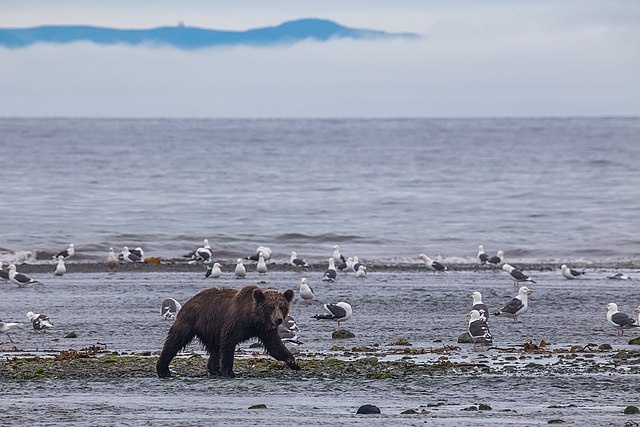
The bear is both a symbol of Russia and a characterization of both the positive and negative image of the country. They are also fixtures of Russian circuses. There are relatively few black bears in Russia and they live in the Far East. The Ussuri black bear (Ursus thibetanus ussuricus), also known as the Manchurian black bear, is a large subspecies of the Asian black bear native to the Russian Far East, Northeast China and the Korean Peninsula. Ussuri Taiga in the Far East is the home of Asian black bears. Wrangell Island is a prime breeding area for polar bears. But the the bear associated most with Russia are brown bears.
East Siberian brown bears (Ursus arctos collaris) occupy a large range, including the majority of Siberia from the Yenisei River to as far south as the Altai Mountains in northern Mongolia, northernmost Xinjiang and northeastern Kazakhstan. They ranges as far north as the southwestern Taymyr Peninsula and the Anabar River and as far east as the coast of the Bering Strait. Their range overlaps with that of Eurasian brown bears in west-central Russia. East Siberian brown bears are fairly dark, but some are as pale as grizzly bears. They are intermediate in size with a proportionately larger skull than other subspecies. In the sub-Arctic region of Yakutia, bears are reportedly quite small compared to other regions.
On the brown bears found in the Russian Far East, the Russian naturalists Yury Dunishenko and Alexander Kulikov wrote: "The brown bear is mostly an herbivore, and its problem is that our winters are long. If a bear can’t store up enough fat for five long winter months, it might as well not bother to hibernate. You can’t just suck nourishment out of your paw! When the taiga was wild and Korean pine forests and walnut groves provided stable harvests, bears encountered fewer problems. Now a bear is sometimes forced, before sacking out, and during the spring famine, to go for higher calorie victims. And so it begins to sneak up on wild boar, red Manchurian deer, and elk; it attacks the helpless newborns. [Source: “The Amur Tiger” by Yury Dunishenko and Alexander Kulikov, The Wildlife Foundation, 1999 ~~]
See Separate Article BEARS AND BEAR ATTACKS IN RUSSIA factsanddetails.com
Kamchatka Brown Bears
Kamchatkan brown bears (Ursus arctos beringianus) are also called Far Eastern brown bears. They live in Kamchatka, a very large peninsula in the Russian Far East, and coastal areas along the Sea of Okhotsk organization the Shantar Islands, Kolyma, areas around the Shelikhov Gulf and Paramushir Island. Kamchatkan brown bears are thought to be the ancestors of polar bears, Kodiak bear, and the peninsular brown bears of Alaska.
Kamchatkan brown bears are very large bear with a broad muzzle. They are not quite as big as Kodiak bears and southern Alaskan bears but are regarded as the next largest bears after these. Some Kamchatkan brown bears reach weights of between 500 and 685 kilograms (1,102 to 1,510 pound). Overall these bears are dark in color, with some individuals being almost blackish-brown but often with a paler patch at the top of their back.
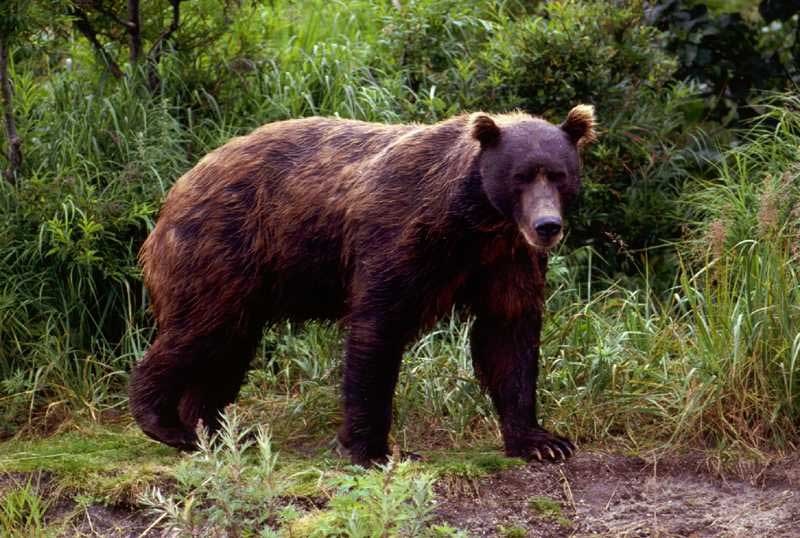
The Kamchatka peninsula — which juts south from eastern Russia into the sea of north of Japan — is the home to between 10,000 and 20,000 brown, one of the largest populations of brown bears in the world. The brown bears found in Kamchatka are slightly larger than American grizzly bears. They grow fat on eating the plentiful supplies of char and salmon and berries that grow in the tundra meadows.
Large numbers of bear live around Kambalnoya Lake in South Kamchatka Sanctuary. A Canadian named Charlie Russell had a cabin in the area and became quite friendly with the about 20 bears in area, raising three orphaned bears himself and writing a popular book about them, “Grizzly Heart”. One spring he returned and found none of the bears but found a bear gall bladder pinned up in side his cabin. He suspects the bears were killed by poachers. It wasn’t clear whether the gall bladder was a message or an oversight. Russell worried that being friendly with the bears might lead to their demise (the bears might have been too trustful of humans and allowed the poachers to approach them).
Giant and Dangerous Kamchatka Brown Bears
During the spring the bears around Kurilskoye Lake emerge from hibernation "hungry, sex-starved and irritable" and wander through settlements on the lake as they approach the shore to fish. They often tear up gardens and root through garbage, Over the years more than 100 problem bears have been killed. In the summer of 1993 one pulled a camper from a tent and mauled him. Local residents later tracked and shot the bear. In 1996, the Japanese-American bear photographer Michio Hoshimo was pulled form his tent and eaten by a bear at Kronotsky Nature Reserve.
There are native legends in Kamchatka of a giant race of black-colored bears, some of which weighed more than 1,134 kilograms (2,500 pounds). The first evidence that such a brown bear realy existed was presented during the 1950s in a report by Dr. Stan Bergman of the State Museum of Natural History at Stockholm, who spent two years on the Kamchatka Peninsula. Apparently the bears were either hard to approach or very scarce because Dr. Bergman never saw a living specimen. He was, however, able to photograph a bear's footprint in the snow. It left a track 15 inches (38 centimeters) long and 10 inches (25 centimeters) wide. Based on his measurements, this bear would have been much bigger than the largest known Kodiak bears living just across the Bearing Strait.
Photographer Steve Winter had some close encounters with bears in Kamchatka. While camped in a basic cabin in the Kronotsky Reserve’s Valley of the Geysers, according to National Geographic, Steve got nervous when a female bear began hanging around. “She came up the steps to the balcony of my room, and the lock on the door was not very good. At night I jammed a ski pole and chair under the door handle. I could grab the flare and pepper spray that I kept by my bed. If she got in, I would need to jump out the window.” Near Kurilskoye Lake he was charged by the mother of three cubs while attempting to take a “dream shot” of mother and cubs. “She raced straight towards him. When she was two strides away, she veered off into the woods. Steve turned and saw a park warden with a raised shotgun, He said: “one second, dead. I don’t know if he meant the bear or me.” [Source: National Geographic]
Ussuri Brown Bears (Japanese Brown Bears)
The brown bears found on Hokkaido in Japan and the Russian Far East are regarded as the same species —Ussuri brown bears (Ursus arctos lasiotus), also known as Amur brown bears, Ezo brown bear, Japanese brown bears, Manchurian grizzly bear, and black grizzly bears. In addition to be found in Hokkaido, these bears are found in Russia the southern Kuril Islands, Sakhalin, the Maritime Territory and the Ussuri/Amur River region south of the Stanovoy Range. Elsewhere they may reside in Heilongjiang, China (part of Manchuria) and North Korea. [Source: Wikipedia]
Ussuri brown bears vary a great deal in size. Skull dimensions from mainland Russia — Primorsky and the Khabarovsk — indicate they can rival Kamchatkan brown bears in size. By contrast, the population found in Hokkaido is one of the smallest northern forms of the brown bear. Nonetheless, individuals from Hokkaido can reportedly get larger than expected and have reached 400 to 550 kilograms (880 to 1,210 pounds) by feeding on cultivated crops.
Ussuri brown bears are believed to be the ancestor of grizzly bears. They are perhaps the darkest-colored brown bears with some individuals almost completely black in colour, although lighter brown and intermediate forms are known, people in Japan. Due to their dark coloring, Ussuri brown bears have been informally called "black grizzly bears".
RELATED ARTICLES:
BROWN BEARS ATTACKS IN JAPAN: VICTIMS, HOKKAIDO, SANKEBETSU factsanddetails.com
BEARS IN JAPAN: CHARACTERISTICS, BEHAVIOR, SPECIES, HUMANS factsanddetails.com
DEALING WITH BEARS IN JAPAN: CONTROL, ROBOTS, DEFENSES, KILLING THEM factsanddetails.com
Tibetan Blue Bear
Tibetan blue bears (Ursus arctos pruinosus) are also called Tibetan bears, Tibetan brown bears, horse bears and Himalayan blue bears They are a subspecies of the brown bear found in the eastern Tibetan plateau. Some bears found in the Himalayas, sometimes called Bears called Himalayan snow bears, are not Himalayan brown bears but are from a robust population of Tibetan blue bears. In Tibetan Tibetan blue bears are known as Dom gyamuk. One of the rarest subspecies of bear in the world, the blue bear is rarely sighted in the wild. They are known in the west only through a small number of fur and bone samples. They were first classified in 1854. [Source: Wikipedia]
Tibetan blue bears are moderately-sized with long, shaggy fur. Both dark-colored and light-colored variants are encountered, with colors in between being the most common. Tibetan blue bears often have a yellow-brown or whitish cape forming a saddle-shaped marking across the shoulders. The yellowish-brown fur around the neck, chest and shoulders looks sort of like a collar. No other brown bear subspecies possesses this in a mature state. Like the Himalayan brown bear, the ears are relatively prominent. The skull is distinguished by its relatively flattened choanae, an arch-like curve of the molar row and large teeth, probably in correlation to its particularly carnivorous habits.
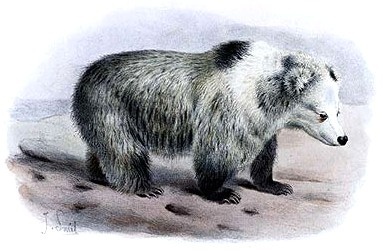
illustration of a Tibetan blue bear made in 1892
The blue bear is notable for having been suggested as one possible inspiration for sightings associated with the legend of the yeti. A 1960 expedition to search for evidence of the yeti, led by Sir Edmund Hillary, returned with two scraps of fur that had been identified by locals as 'yeti fur' that were later scientifically identified as being portions of the pelt of a blue bear. While it is unlikely that the blue bear generally occupies the high mountain peaks and snow fields where the yeti is sometimes sighted, it is possible that the occasional specimen might be observed traveling through these regions during times of reduced food supply, or in search of a mate. However, the limited information available about the habits and range of the blue bear makes such speculation difficult to confirm.
Tibetan blue bears are much feared in regions where they are found. According to some Chinese sources, 1,500 people are killed a year by these bears, a figure that seems to be too large to be true, but some say is credible and caused by the clearing of new farm land in the bear’s habitat. Becasue few local people have guns the bears often have te upper hand in confrontations. [Source: the book “Bears of the World”by Terry Domico]
The exact conservation status of the blue bear is unknown, due to limited information. However, in the United States trade in blue bear specimens or products is restricted by the Endangered Species Act. It is also listed in Appendix I of the Convention on International Trade in Endangered Species (CITES) as a protected species. It is threatened by the use of bear bile in traditional Chinese medicine and habitat encroachment. [Source: Wikipedia]
The Gobi brown bear is sometimes classified as being of the same subspecies as the Tibetan blue bear; this is based on morphological similarities, and the belief that the desert-dwelling Gobi bear represents a relict population of the blue bear. However, the Gobi bear is sometimes classified as its own subspecies, and closely resembles other Asian brown bears.
Himalayan Brown Bears
Himalayan brown bears (Ursus arctos isabellinus) are also known as red bears and isabelline bears. They live in northern Nepal, North India and Northern Pakistan, with many in the contested region of Jammu and Kashmir. They are quite distinctive physically form other brown bears in that have a reddish-brown or sandy-brown coat color with silver-tipped hairs and relatively large ears. These bears are smaller than most other brown bears. They prefer high altitude forests and alpine meadows. [Source: Wikipedia]
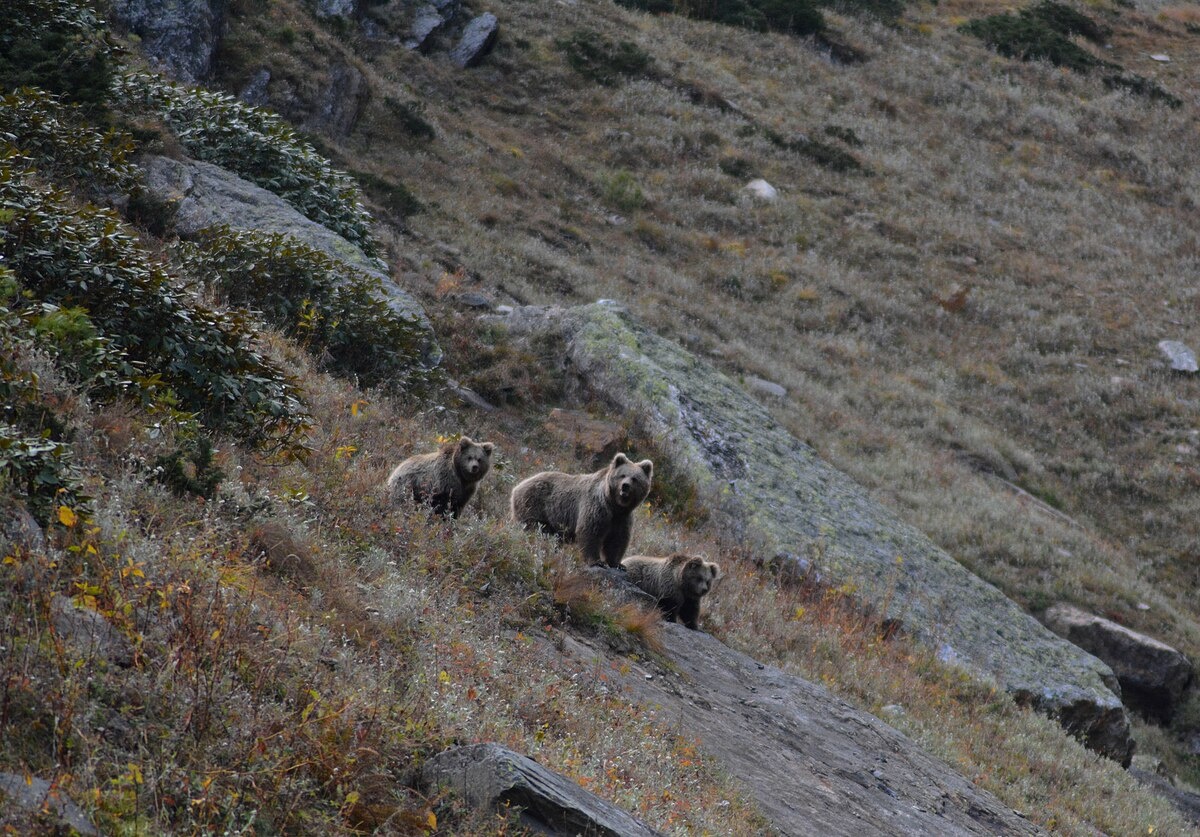
Himalayan brown bears are Critically Endangered. About the size of a grizzly, Himalayan brown bear males range from 1.5 to 2.2 meters (4. 9 to 7.3 feet) in length, while females are 1.4 to 1.8 meters (4.5 in to 6 feet) in) long. They mainly live above tree tree line and feeds on grasses, roots and occasionally mountain sheep killed in avalanches. Herders used to sometimes kill the mothers and capture the cubs which were sold to itinerate entertainers for use as dancing bears. [Source: the book “Bears of the World”by Terry Domico]
Himalayan brown bears are the largest mammal in the Himalayas. They are omnivorous and hibernate in dens during the winter. The bears go into hibernation around October and emerge during April and May. Hibernation usually occurs in a den or cave made by the bear. Himalayan brown bears eat grasses, roots, fruits, berries and other plants as well as insects and small mammals. They have been observed eating sheep and goats and occasionally take animals from villagers. [Source: Wikipedia]
One of the last strongholds of Himalayan brown bears is the Deosai Plains, 32 kilometers south of Skardu in northern Pakistan, not far from K2, and China. At an average elevation of 4000 meters, Deosai is the home of Deosai National Park, on of the world’s highest national parks. With Nanga Parbat mountain in the background, the park features crystal streams, unique fauna and flora, including 150 species of medicinal plants. On this rolling grassland there are no trees and the area is covered in snow for seven months of the year. Spring comes to Deosai in August when millions of wild flowers bloom. The park covers 3,5840 square kilometers. [Source: Pakistan Tourism Development Corporation. tourism.gov.pk ]
See Separate Article: WILD ANIMALS IN PAKISTAN: factsanddetails.com
Gobi Bear
Gobi bears (Ursus arctos gobiensis, known in Mongolian as the mazaalai) are desert-dwelling brown bear that live in the Gobi Desert of Mongolia. Extremely rare, these bears have adapted to desert life, dwelling in oases and rocky outcrops. They are similar to Tibetan blue bears and rather small and pale and but appears to lack the whitish collar characteristic of Tibetan blue bears. Based on morphological similarities, it is sometimes classified as being of the same subspecies as the Tibetan blue bear and is believed by some to represent a relict population of Tibetan blue bears. Phylogenetic analysis suggests they represent a relict population of the Himalayan brown bear. At one time, Gobi bears probably overlapped and possibly interbred with Tibetan blue bears in western China, but the bears are now extinct in this area. These days Gobi bear are generally classified as their own subspecies, but they closely resembles other Asian brown bears.
Gobi Bear are perhaps the most endangered bear species. There are only about 50 of them. They live in a corner of the Gobi desert. According to the Gobi Bear Project Team: Gobi bears are listed as Critically Endangered in the Mongolian Redbook of Endangered Species and by. by the Zoological Society of London using IUCN standards, This assessment was based on estimates that the population included less than 50 adult animals, and were separated by enough distance from other closely genetically-related populations that immigration/emigration would not reasonably be expected to occur. It is included as an Appendix I species (critically threatened with extinction) under the Convention on International Trade in Endangered Species (CITES), to which Mongolia is a signatory country. No Gobi bears are known to exist in captivity anywhere in the world. [Source:Gobi Bear Project Team , Ulaanbaatar Mongolia, July 2010]
Gobi bears persist as a unique ecotype in the Gobi Desert of southwestern Mongolia. They are superbly adapted to low food availability and harsh environment of the Gobi Desert, where annual temperature may vary between 46̊C in summer to -34̊C in winter. Also known as “Mazaalai” and regarded as a national treasure by Mongolians, Gobi bears occupy three main areas, or oasis complexes, within the 45,784-km2 Great Gobi Strictly Protected Area (GGSPA, Zone “A”): Atas Bogd Mountain, Shar Khuls Oasis, and Tsagaan Bogd Mountain. Each oasis complex is comprised of seven or more springs of various sizes, separated by about 70-100 km from the adjacent complex.
See Separate Article: SNOW LEOPARDS, BEARS AND WOLVES IN MONGOLIA factsanddetails.com
Syrian Brown Bears
Syrian brown bears (Ursus arctos syriacus) are found in the Caucasus (Transcaucasia), Iraq, Turkey (Asia Minor), Iran, Turkmenistan, western Afghanistan, eastern Lebanon, Pakistan, western Himalayas and the Pamir-Alay and Tian Shan Mountains. Despite their name they are long found in Syria, or in Israel. [Source: Wikipedia]
Syrian brown bears are moderate- to small-sized subspecies. They tend to be a whitish-blond in color, with less noticeable black-based hairs than grizzly bears have. Lighter-colored Syrian brown bears are usually appear at higher altitudes. Their legs are commonly darker than the rest of their body. They are is the only known bear in the world to have white claws. Adult males have skulls measuring approximately 30–40 centimeters (12–16 inches). They weighs up to 500 kilograms (1,102 pounds) and measures from one to 1.4 meters (3.3 to 4.6 feet) from nose to tail.
Syrian brown bears were the bear mentioned in the Bible. The protectiveness of a mother bear towards her cubs is cited proverbially three times (2 Sam. 17:8; Hos. 13:8; Prov. 17:12) in the Hebrew Bible. The Syrian brown bear is also mentioned in 2 Kings 2:23-25 mauling 42 young men who were threatening Elisha.
Syrian brown bear populations are healthiest in the Caucasus region. In the Middle East they are rarely seen. In Turkey, they are threatened by large-scale forest fragmentation, habitat degradation, and persecution in areas where they damage beehives and livestock. Local people in the Black Sea region hunt bears illegally for bear fat, which is thought to have medicinal value. Occasionally, bears are killed during hunts for wild boar using dogs, and by poisoned baits and snares set illegally for red deer, roe deer, wolf, or lynx.
Pizzly Bears and Grolars
When a polar bear (Ursus maritimus) and a grizzly bear (Brown bears horribilis) mate, they can create hybrids called "pizzly" or "grolar" bears. According to Live Science: Although rare in nature, these pizzly bear hybrids are starting to spread across the Arctic due to climate change. Starving polar bears are heading farther south to find more food, while the warming world is allowing adaptable grizzlies to expand northward. This movement is leading to more interactions between the two species and more mating. [Source: Patrick Pester, Live Science, October 25, 2023]
In 2006, Roger Kuptana, an Inuit tracker from the Northwest Territories, Canada guided an American hunter who shot a pizzly == the first documented case of a grizzly-polar hybrid in the wild. Associated Press reported: Territorial officials seized the bear’s body and a DNA test from Wildlife Genetics International, a lab in British Columbia, confirmed the hybrid was born of a polar bear mother and grizzly father. “It’s something we’ve all known was theoretically possible because their habitats overlap a little bit and their breeding seasons overlap a little bit,” said Ian Stirling, a biologist with the Canadian Wildlife Service in Edmonton, Alberta. “It’s the first time it’s known to have happened in the wild.” He said the first person to realize something was different about the bear — shot and killed last month on the southern end of Banks Island in the Beaufort Sea — was Kuptana. “These guides know their animals and they recognized that there were a number of things that didn’t look quite right for a polar bear,” Stirling told The Associated Press. The bear’s eyes were ringed with black, its face was slightly indented, it had a mild hump to its back and long claws. Stirling said polar bears and grizzlies have been successfully paired in zoos and that their offspring are fertile, but there had been no documented case in the wild. [Source: Beth Duff-Brown, Associated Press, May 12, 2006]
Adam Popescu wrote in Washington Post: Textbooks say these two species aren’t supposed to inhabit the same environments. Polar bears are marine mammals; grizzlies are terrestrial. But as the Arctic warms, sea ice is shrinking and the tundra is expanding. And the bears’ disparate populations are meeting, mating and creating a new breed that’s capable of reproducing. Bears sharing both species’ DNA have been recorded several times over the past decade. So why are these two species linking up? It’s called flexible mate choice: The bears are mating with the best possible partners as opposed to not mating at all, and they’re mating because they share relatively close territories and the same branches of the same evolutionary tree. [Source: Adam Popescu, Washington Post, May 23, 2016]
See Separate Article: BEARS: HISTORY, EVOLUTION, HABITAT, HUMANS factsanddetails.com
Image Sources: Wikimedia Commons
Text Sources: Animal Diversity Web animaldiversity.org ; National Geographic, Live Science, Natural History magazine, CNTO (China National Tourism Administration) David Attenborough books, New York Times, Washington Post, Los Angeles Times, Smithsonian magazine, Discover magazine, The New Yorker, Time, BBC, CNN, Reuters, Associated Press, AFP, Lonely Planet Guides, Wikipedia, The Guardian, Top Secret Animal Attack Files website and various books and other publications.
Last updated May 2025