
BROWN BEAR BEHAVIOR
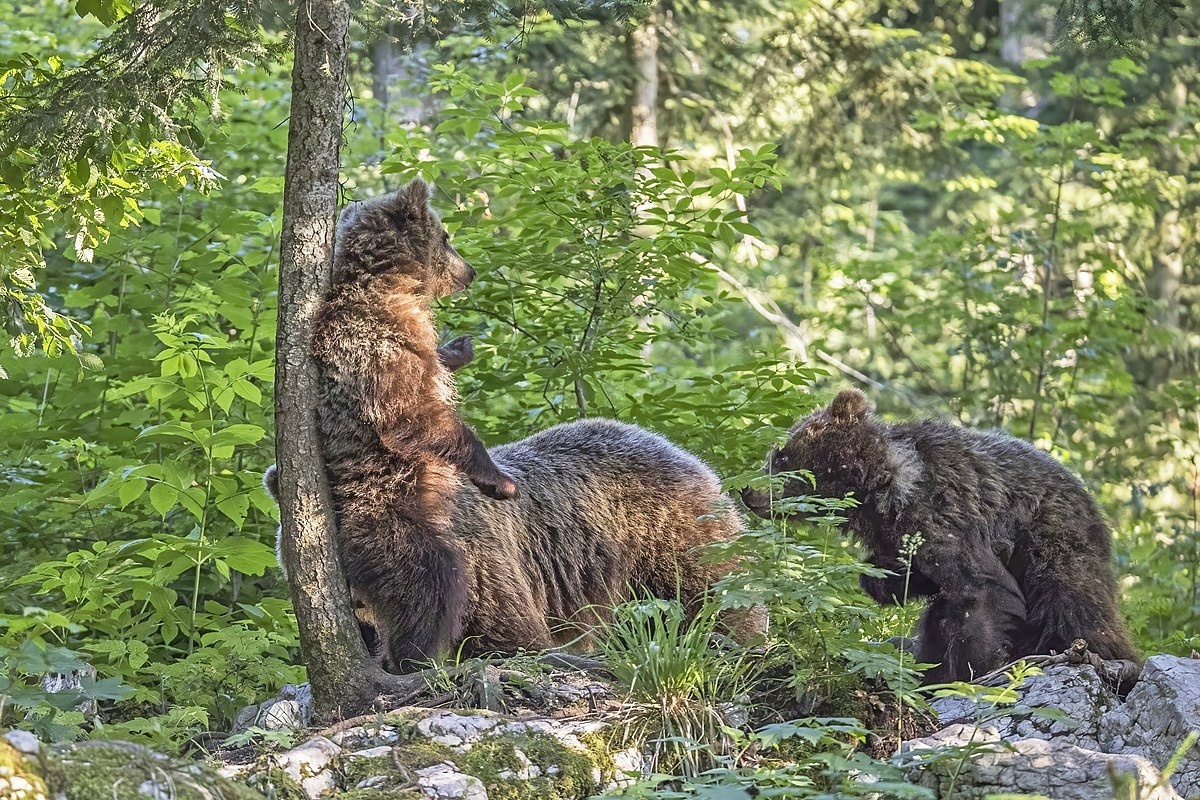
Brown bears are terricolous (live on the ground), crepuscular (active at dawn and dusk), motile (move around as opposed to being stationary), nomadic (move from place to place, generally within a well-defined range), migratory (make seasonal movements between regions, such as between breeding and wintering grounds), hibernation (the state that some animals enter during winter in which normal physiological processes are significantly reduced, thus lowering the animal’s energy requirements), territorial (defend an area within the home range) and solitary Home ranges can be as large as 2,600 square kilometers, but are on average between 73 and 414 square kilometers, with male ranges nearly seven times greater than female ranges. Home ranges overlap extensively and there is no evidence of territorial defense. Egbert and Stokes (1976) sometimes observed more than 30 bears together at one time. [Source: Tanya Dewey and Liz Ballenger, Animal Diversity Web (ADW) |=|]
Some biologists believe highly adaptable brown bearss are intelligent enough to be ranked with primates like monkeys and baboons. Many survival skills are passed from mother to cub. Brown bears have even been known to make a brown paste from spit and osha root which can soothe insect bites. Doug Seus, a Hollywood animal trainer told National Geographic, "I train black bears, wolves and cougars for film work...My grizzlies and Kodiaks are the hardest to tame, but the easiest to train; generally you only have to teach them something once. They can also be the most affectionate." Some brown bears can pick up a heavy object and spin it on their claws like spinning basketball on a finger. [Source: “Bears of the World” by Terry Domico and Mark Newman, 1988]
Brown bears individuals may be active at any time of the day, but generally forage in the morning and evening and rest in dense cover by day. Brown bears may excavate shallow depressions in which to lie. Seasonal movements of Brown bears have been observed, with individuals sometimes traveling hundreds of kilometers during the autumn to reach areas of favorable food supplies, such as salmon streams and areas of high berry production. Home ranges overlap extensively and there is no evidence of territorial (defend an area within the home range), defense, although bears are generally solitary. [Source: Tanya Dewey and Liz Ballenger, Animal Diversity Web (ADW) |=|]
Brown bears wander large distances—up to 80 kilometers (50 miles)—each day. Males cover perhaps twice to three times as much ground as sows. Most often, brown bears dig their own dens and make a bed out of dry vegetation. Burrows are usually located on a sheltered slope, either under a large stone or among the roots of a mature tree. Dens are sometimes used repeatedly year after year. |=|
RELATED ARTICLES:
BROWN BEARS: CHARACTERISTICS, HISTORY, SIZE factsanddetails.com
BROWN BEAR FEEDING: DIET, HABITS, HUNTING, SALMON factsanddetails.com
BROWN BEAR SUBSPECIES: BIG, RARE ONES AND WHERE THEY LIVE factsanddetails.com
BROWN BEARS IN EUROPE: LOCAL VARIANTS, WHERE THEY LIVE, REWILDING, ISSUES factsanddetails.com
BROWN BEARS AND HUMANS factsanddetails.com
BEARS: HISTORY, EVOLUTION, HABITAT, HUMANS, PIZZLIES factsanddetails.com
BEAR CHARACTERISTICS: PHYSIOLOGY, DIET, LIFESPAN factsanddetails.com
BEAR HIBERNATION, REPRODUCTION, CUBS factsanddetails.com
BEAR BEHAVIOR: TERRITORIALITY, HABITUATED TO HUMANS, OPENING CARS factsanddetails.com
BROWN BEAR ATTACKS factsanddetails.com
BEAR ATTACKS IN ALASKA factsanddetails.com
BEAR ATTACKS IN RUSSIA factsanddetails.com
BROWN BEARS ATTACKS IN JAPAN: VICTIMS, HOKKAIDO, SANKEBETSU factsanddetails.com
Brown Bear Social Behavior and Hierarchies
Brown bears are largely solitary animals Males are often solitary while sows often hang out with their cubs. Because they cover large distances in the search of food, brown bears are less territorial than other large carnivores. Home ranges of different bears often overlap. When bears come in contact with one another they usually keep their distance and don’t fight with one another. Young brown bears like to play. Even adults have been observed sliding down snowy hills, toying with fish by tossing them around, play wrestling in water holes, scratching their backs on trees, and playing tag with ravens. They have also been observed shadowboxing with their own breath and making snowballs.
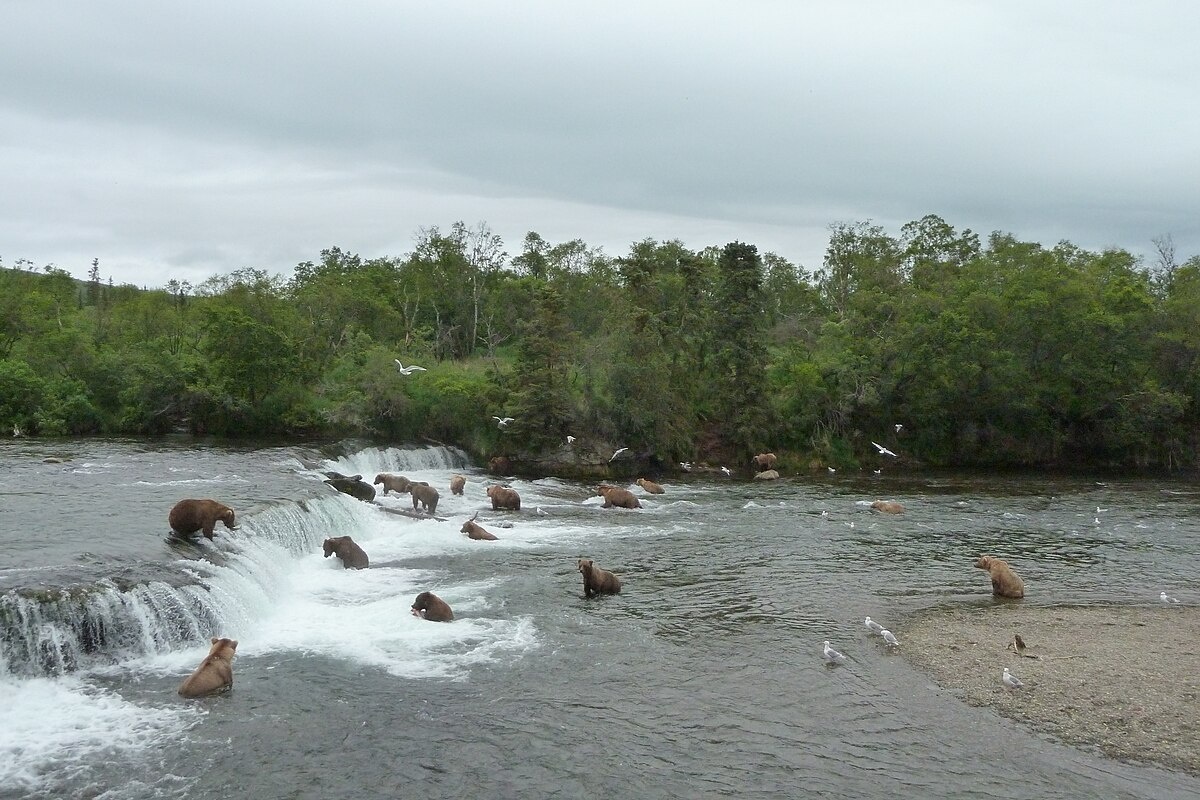
Occasionally, bears may gather in large numbers at major food sources and form family foraging groups with more than one age class of young. Size and aggressiveness often determines pecking order and bear behavior. At the top of the hierarchy are large males. After them are females, willing to fight aggressively for their cubs. Further down the ladder are young males. Dominant bears often get the best territory and the choicest feeding areas. When a group of bears gather together, usually in prime fish areas, sometimes they compete for dominance but generally tolerate each other. Bears that travel together usually walk in single file in the same order. Under these conditions, dominance hierarchies are usually formed and maintained with aggression. Highest-ranking individuals are large adult males, although the most aggressive bears are females with young. Least aggressive and lowest-ranking are adolescents. The only social bonds formed are between females and young. [Source: Tanya Dewey and Liz Ballenger, Animal Diversity Web (ADW) |=|]
At the salmon feeding area on the Brooks River in Katmai National Park in Alaska bears establish a hierarchy which allows them to interact with each other without violence (usually). It is based on a system of social interactions communicated through body posturing, scent, and vocalizations. In the hierarchy, subordinate bears typically yield space and/or resources to more dominant bears. In general large and mature males are most dominant, followed by females with cubs, other adult males and females, and subadults. A bear’s place in the hierarchy is based on its health, age, size, and disposition. The hierarchy is fluid and the rank of a bear can change from year to year or even season to season. In 2015, bears like 747, 814, and 856 were the most dominant bears observed along the river. [Source: U.S. National Park Service, September 30, 2016]
Brown Bear Aggression and Grumpiness
Bears are armed with tremendous strength, large claws, and teeth. They can inflict severe injuries to each other. For this reason bears avoid fighting in most cases.Alerted bears sometimes stand on their hind legs, salivate a lot and make a woofing noise. Most charges are bluffs. If a bear charges with its ears erect that generally means it’s a bluff. If the ears are folded back and you can hear their teeth popping then the charge is for real.
To avoid physical conflicts, bears use a series of vocalizations and body posturing to express temperament and dominance. Less dominant bears (typically smaller subadult bears and females) yield space, like fishing spots, and resources, like a dead salmon, to more dominant bears (larger bears and adult males). Through the establishment of a fluid hierarchy, bears have evolved a social adaptation that allows them to avoid fighting in most instances. [Source: U.S. National Park Service, September 30, 2016]
Brown bears are often in a bad mood when they wake up from hibernation especially if they are woken up early. In 2002, Ananova reported: Grumpy bears are pestering tourists in central Europe after being woken from hibernation by a mild winter. The brown bears normally sleep for up to seven months, but are beginning to wake up after just a month. Officials in Poland have had to scatter tonnes of food in the forests to keep them away from holidaymakers. Local authorities in Slovakia, Bulgaria, Hungary, Austria and Bulgaria have also issued safety warnings. Forest rangers and conservation experts have warned people to stay away from the animals, as they are likely to be in a "confused state", reports the Daily Express. [Source: Ananova, February 2, 2002]
Bears have been pestering hotel guests in Brezno, Slovakia. Miloslava Kicova said: "They come round to the hotel late at night, fighting with each other and looking for food." In Bulgaria a brown bear is believed to have eaten 50 sheep in the mountain resort of Narechenski. Tadeusz Zajac, a forest ranger in Poland, said: "The extraordinarily mild winter has meant that many bears were only able to hibernate for a month. "We have already scattered about 50 tonnes of food in the forests to give them plenty to eat and stop them becoming a danger to people."
Brown Bear Senses and Communication
Brown bears sense and communicate with touch, sound and chemicals usually detected by smelling. Bears have keen senses of smell and hearing. Contrary to the popular myth, brown bears have very good eyesight. They are especially adept at detecting movements at long distances. They are very short sighted. Their sense of smell rivals a bloodhound’s. they are able to follow the scent of a rotting carcass for more than three kilometers (two miles). [Source: Tanya Dewey and Liz Ballenger, Animal Diversity Web (ADW) |=|]
Studies have shown that the eyesight of bears is quite good. It is probably equal to human vision and there is increasing evidence that bears have color vision. A brown bear’s hearing is likely equivalent to human hearing. More than anything else, however, the nose of a bear is its key to its surroundings. Smell is the fundamental and most important sense a bear has. No other mammal seems to have a more acute sense of smell. [Source: U.S. National Park Service, September 30, 2016]
Brown bears communicate primarily through smells and sounds. They can be heard making moaning noises sometimes while they are foraging. Bears use scent to communicate everything from dominance to their presence in an area to receptivity to mating. Bears rely on their sense of smell like humans rely on eyesight. They scratch and rub on trees and other landmarks to communicate territorial boundaries and reproductive status.
Brown Bear Hibernation
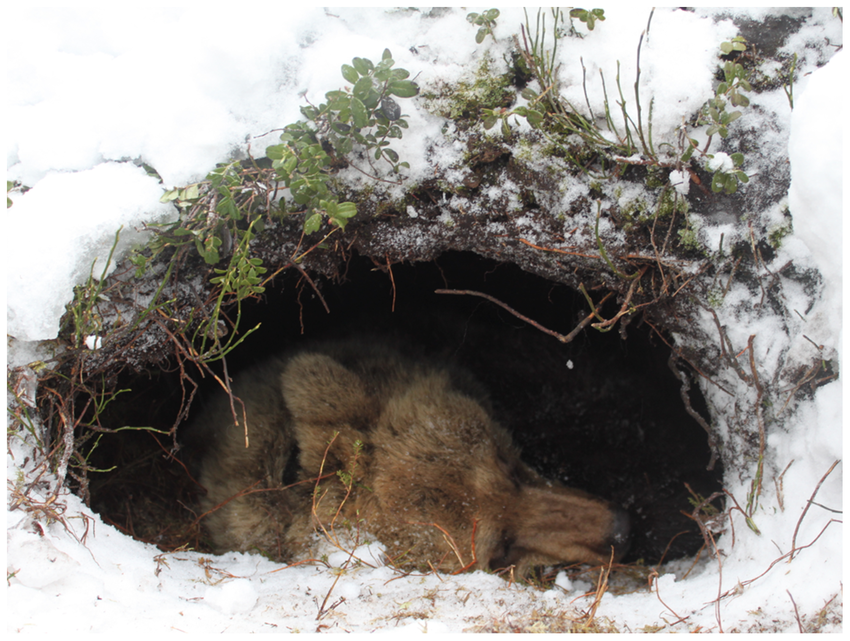
Brown bears hibernate like other non-tropical bears. Their period of inactivity usually begin in October to Decembe and ends in March to May, with the exact period dependent on the location, weather, and condition of the individual. In southern areas, this period of inactivity is relatively brief or may not occur at all. In northern areas it can be seven months or more. Brown bear hibernation is marked by a deep sleep in which the bears’ body temperature drop by a few degrees but their metabolism slows down considerably. Bears can generally be easily roused from hibernation. [Source: Tanya Dewey and Liz Ballenger, Animal Diversity Web (ADW) |=|]
David Attenborough wrote: “A big animal has such a big appetite. That is one of the disadvantages of size and even such an unfussy omnivore as a grizzly finds it hard to get enough to eat. So grizzlies forage alone. When winter comes and the land is covered with a blanket of snow, even the enterprising and open-minded grizzly cannot find sufficient food to sustain itself, It solves the problem by going to sleep. Each bear, by itself, finds a cave or a hollow tree and settle down for slumber. Its bodily processes begin to slow, Its temperature drops several degrees and its pulse drops to about 10 bears a minute. It becomes very drowsy, For the next five months it fuels it body from its fat reserves and does not or drink, defecate or urinate. This is not...hibernation like that of marmots, ground squirrels, squirrels and other rodents, whose heart-beats at such times slows to almost imperceptible levels and whose temperature falls to within a degree or so of freezing, Such hibernation takes considerable time to return to full activity. But it could be a serious mistake to suppose that sleeping bears in winter would behave in the same way. They can, if disturbed, rouse themselves instantly.” [Source: “Life of Mammals” by David Attenborough]
Terry Domico and Mark Newman wrote in “Bears of the World”: In all parts of their range, except perhaps in eastern turkey and Iran, brown bears spend the winter months hibernating in dens. In the more northern parts of their range, brown bears will sometimes den as early as the middle of September. Farther south, denning may be as late as October or November. When he bears emerge in April or may, they head for the nearest place where they might expect to find food. At the beginning of the denning season, they may have 6 to 10 inches (15 to 25 centimeters) of fat under their skin. Den sites are usually remote, isolated from human activity and development. Noise from machinery and aircraft is disturbing and may force some bears to avoid the area for future denning. In Russia, brown bears that have not found a denning site are considered particularly dangerous. Rock caves and hollows excavated under large trees or dug horizontally into hillsides are the commonest types of dens. Often they contain a short tunnel leading to the sleeping chamber. Depending upon the size of the bear, a sleeping chamber can measure over 7 feet wide and 3 feet high (2 meter by 1 meter). Some dens have been used for century by numerous generations of bears. [Source: “Bears of the World” by Terry Domico and Mark Newman, 1988]
In the 1970s, radio collaring observations discovered that some of the bears using the Brooks River at Katmai National Park in southern in September and October made dens on nearby mountains—Dumpling, La Gorce, Katolinat, and Kelez. Most dens were between 152-457 meters (500-1500 feet) in elevation. Dens are usually located on steep, heavily vegetated slopes. In Katmai, bears are not known to use the same den for two or more winters. Most dens that rangers and biologist have examined are partially collapsed by mid to late summer preventing reuse. Katmai’s bears are not known to den in sites like tree cavities, rock crevasses, or caves that would be more stable. Bears in Katmai usually enter their dens in October and November. In general, pregnant females and females with cubs enter dens earlier than single females and subadult bears. Adult males usually are the last to enter their dens and some bears can be active into December. [Source: U.S. National Park Service, September 30, 2016]
One grizzly bear den in Idaho had a spectacular view and even featured a ceiling vent for easy breathing. Grizzly bears might move a ton of earth to excavate dens comfortable enough to support them during the winter. Depending on the weather, they typically begin preparing for hibernation in late November. Male grizzlies are first to emerge from their dens in the spring, usually beginning in March. Females with cubs emerge in April or early May. [Source: Pete Thomas, FTW Outdoors October 16, 2022]
Mild Siberian Winter Making Bears Awake Early from Hibernation
In April 2015, the Siberian Times reported: “Unusually warm weather is prompting bears to awake from hibernation early with warnings that they could attack people as they forage for food. A number of sightings of the animals has been made in parts of Siberia and the Far East in recent days, much earlier than normal. Immediately following their hibernation period bears are more dangerous than normal because they are foraging for food. They tend not to wake up until the first half of April but the mild winter has brought this forward. [Source: Siberian Times, April 2, 2015]
In the southern Siberian region of Tuva — where about 3,500 bears live — two men were savagely attacked, suffering serious head and arm injuries, with one of them losing an eye. And at the weekend the tracks of a mother bear and two cubs were found in the Gorny Vozdukh ski resort near to Yuzhno-Sakhalinsk in the Far East. Game wardens are now talking about the possibility of having to kill the animals if they do not move away from the slopes.
Officials in the Sakhalin Region say that bears are waking up early because of recent rains and the warmer winter. On March 11, hunters from the Teguldetsky district, in the Tomsk region, shot the first bear of the year after it approached a dump near the dining room of a timber plant. Sergei Bazykin, a local expert, said: 'Most likely, he was just hungry when climbed into his den in the autumn or maybe someone scared it and he awakened. When that happened, of course he needed food.' Two weeks later military personnel responsible for the protection of the closed city of Seversk, 15 kilometers north of Tomsk, noticed a bear and called in hunters. Also in the Tomsk region, residents in the Kargasok district are being asked to be careful and not let their children walk into the forest. Anyone who sees a bear on the boundary of their village is also being urged to notify hunters immediately. Spring bear hunting started around the same time in Tomsk with the limit set on 311 bears.
Fighting Brown Bears
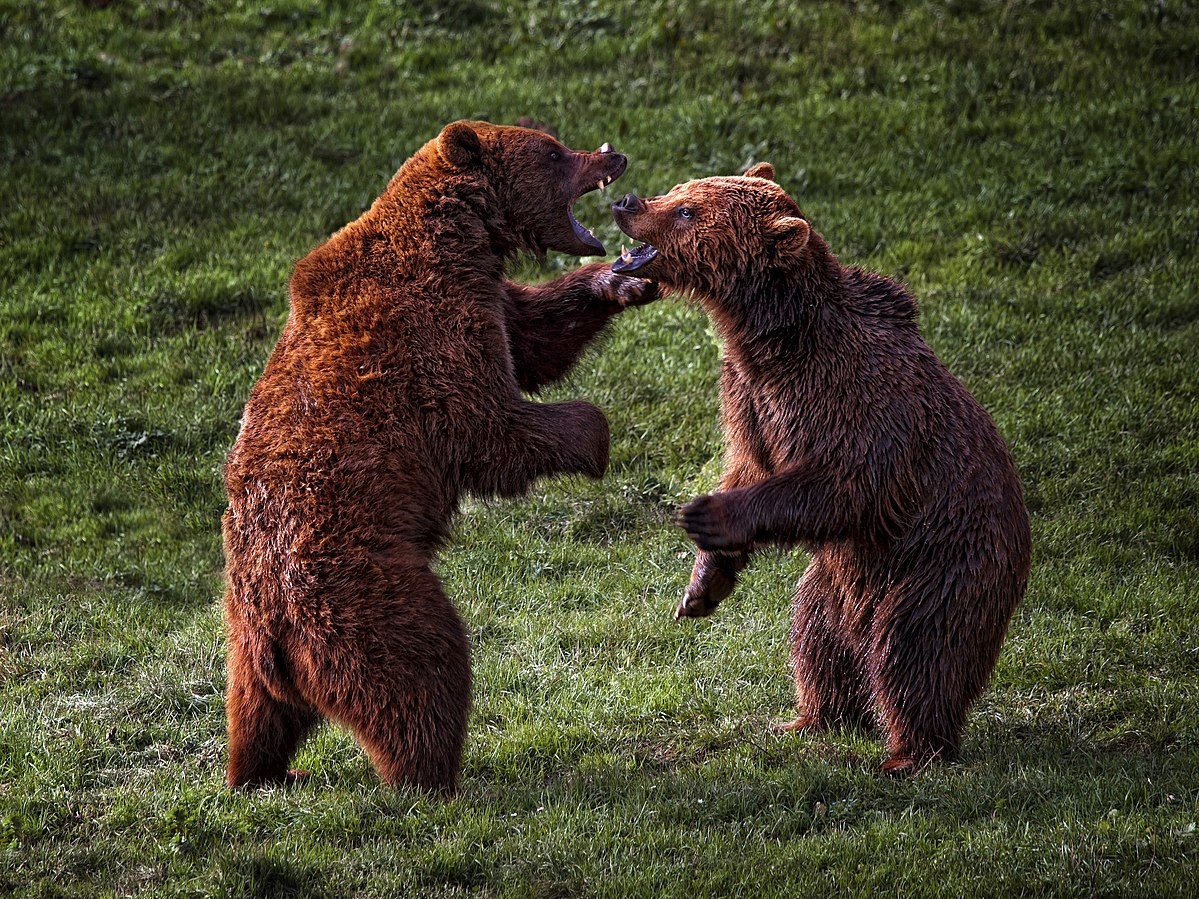
Many fights between bears are between females, often with a young female entering to close to an older female’s and cubs. Most of these fights consists of aggressive posturing and a few swats and little else and ends with a retreating bear.
Describing a pair of fighting males, James and Frank Craighead wrote in National Geographic, "What a battle! Inge rushed his adversary and sank his canine deep in 88s rump. the momentum carried him over his opponent. But Inge recovered, seized 88's right thigh, and shook the 700-pound beast as a terrier shakes a rat...Eighty-eight broke away, and his huge jaws clamped on Inge's jowls. The boss bear roared, reared back to full heights, and fought free. A great red gash marred his face."
"The stood on hind legs, face to face, jaws agape, parrying like monstrous boxers. Then they locked jaws, each leveraging to throw the other to the ground. Inge slapped his adversary across the shoulder with a lightning-fast swipe from the right paw, then lunged for 88s throat. Eighty-eight staggered back, now bleeding from several deep wounds, but gave back bite for bite and blow for blow. The combatant’s roars could be heard half a mile away.” At the end: “Both silvetips dropped to all fours. Then 88 bowed his head and looked aside. Inge read this sign of submission and deliberately turned his back, moving to claim his sow.”
Why Do Bears Scratch Their Backs on Trees
Bears rub their backs against trees for several reasons, including communication, cleaning, and tick prevention. By rubbing against trees, bears leave scent marks that other bears can detect. This helps them communicate about their presence, social status, and even potential mating opportunities. The rough bark of trees helps bears groom themselves by removing loose fur, dirt, and parasites like ticks. Some studies suggest that the sap from certain trees may have natural tick repellent properties, according to outdoors.com. [Source: Google AI]
Research suggests that bears that rub trees more frequently may have more reproductive success, indicating that rubbing trees could be a form of advertising for potential mates. In some cases, bears also mark their territory by scratching and biting the bark of trees, in addition to scent marking.
In 2013, Buckrail published images showing a grizzly bear standing while rubbing its back against a telephone pole in Grand Teton National Park. Pete Thomas wrote in FTW Outdoors: Buckrail explained that this is more about scent marking than scratching. Marking is a means of communication and the higher a bear can place its scent the larger it’ll appear to other grizzly bears. The publication describes this as a spring phenomenon, but the photos are reminiscent of trail-cam footage captured in August 2021 in Canada’s Yukon Territory. The Yukon Wildlife Cams footage shows a giant grizzly bear rubbing against a tree before charging toward the camera in slow motion. Please note the thoroughness with which this bear marks the tree, but also the remarkable perspective afforded by the camera as the bear runs past in slow motion. You might agree with trail-cam operator David Troup, who exclaimed via Facebook: “Look at those claws!” [Source: Pete Thomas, FTW Outdoors, May 19, 2023]
Brown Bear Reproduction
Brown bears can live longer than thirty years and can reproduce for most of their lives. Bears have been known to live and reproduce in Yellowstone Park at 25 years of age, and potential lifespan in captivity is as great as 50 years. A female at the Leipzig Zoo bore 54 young in 19 litters. However, generally brown bears have slow reproductive rates. Female grizzlies sometimes don’t reproduce until they are eight years old and then have litters of one or two cubs every four or five years. A study of grizzly bears at Banff National Park in the 1990s found that the bears reproductive rate is slow and doesn’t keep up with the rate in which they are killed off by humans.
Brown bears engage in seasonal breeding and employ delayed implantation (a condition in which a fertilized egg reaches the uterus but delays its implantation in the uterine lining, sometimes for several months). Females typically breed every two to four years. Breeding occurs from May to July. The number of offspring can be as high as four, with the average number of being two. The gestation period ranges from 180 to 266 days. [Source: Tanya Dewey and Liz Ballenger, Animal Diversity Web (ADW) |=|]
Females brown bears generally reach sexual or reproductive maturity at four to six years — with some ready as early as their third or fourth spring after birth. Although the breeding season is in late spring or early summer the egg does not implant into the womb until the fall. Only about a third of the available females breed. The others are mostly taking care of cubs. In Hokkaido, Japan brown bears give birth after 222 to 229 days after copulation, However because of delayed implantation, the actual fetal growth takes only about 60 days. A one-month embryo is about the size of a mouse.
According to Animal Diversity Web: Fertilized eggs develop to the blastocyst stage, after which implantation in the uterus is delayed. The blastocyst becomes implanted approximately five months after mating, usually in November when the female has entered her winter sleep. A six to eight week gestation follows, with births occurring from January to March (usually while the female is still in hibernation. Total gestation time, including pre-implantation, ranges from 180 to 266 days. Females remain in estrus throughout the breeding season until mating occurs and do not ovulate again for at least two (usually three or 4) years after giving birth. |=|
Brown Bear Mating
Brown bears are polygynandrous (promiscuous), with both males and females having multiple partners. Bears in Katmai have been observed mating from May through early August, but June is the peak of the bear’s mating season. Male bears sometimes pursue females for a week or more before mating occurs.
Female brown bears copulate with multiple males during estrus, which lasts 10 to 30 days. Males may fight over females and guard them for one to three weeks. Female receptivity is probably communicated by scent marking throughout her territory.[Source: Tanya Dewey and Liz Ballenger, Animal Diversity Web (ADW) |=|]
During the breeding season males are ill tempered and frothing beasts. The significantly smaller females are often afraid of the aggressive males. Females bears killed from a bite crushing their windpipe—presumably from a male bear—and part of their shoulder eaten away have been found. Most fights between bears are between males fighting over receptive females. Many male bears have nasty scars from such fights.
Brown Bear Newborns and Parenting
Brown bear females give birth to one to four blind, naked, squirrel-size, one-pound cubs. Triplets occur frequently. The average litter size is 2.2 cubs. Brown bear young are altricial, meaning they are relatively underdeveloped at birth. During the pre-birth, pre-weaning and pre-independence stages of development provisioning and protecting are done by females. There is an extended period of juvenile learning. Most of the cubs survive until April or May when they emerge from their dens. Until they are weaned, young cubs follow their mothers everywhere and are nourished on milk that is as much as 33 percent fat. Cubs make a buzzing sound like a swarm of bees when they nurse.
Females give birth to their cubs in their dens in the winter. David Attenborough wrote: “One, or more, usually two, slip from her body. They are no bigger than rats, extraordinarily small compared with her huge bulk. A new-born human baby weights about one fifteenth as much as its mother. A new-born grizzly is only about one hundredth. It is smaller in proportion to the size of its mother, than the young of any placental mammal.. But its tiny stature and total helplessness matters little, for here in a den in the middle of winter, in the furry embrace of its gigantic and powerful mother, nothing is likely to harm it. For four or five months, the cubs remain with her in the darkness of the den, nourished by her milk and steadily growing. As the weeks pass. Their eyes open, their fur appears and they grow bigger. Outside, the snow melts. And then, as spring arrives, the mother and her young emerge into the sunlight. [Source: “Life of Mammals” by David Attenborough]
Terry Domico and Mark Newman wrote in “Bears of the World”: In Japan the average litter is two, although as many as four may be born, particularly in places with abundant food supplies. Newborns quickly gain weight, nourished on their’s milk that is about a third fat. Mothers and cubs form a deep bond. The female aggressively protects her young but still many are lost (10 to 40 percent) especially during the first year and half of life. Deaths are often the result of encounters with males that sometimes result in the mother also being killed. Wolves sometimes prey on bear cubs. Cubs den with their mother for two winters and are chased off in the spring when the mothers hoes into estrus again. Every third years she may produce another set of cubs. If for some reason a mother does not mater a family may dens together for a third winter, Female offspring tend to stay in the mother’s territory while males move on to a different area. [Source: “Bears of the World” by Terry Domico and Mark Newman, 1988]
Brown Bear Cubs
Most brown bear cubs stay with their mothers for two to three years, hibernating together in the same den in the winter. Adult males play no role in the cub rearing process. The attrition rate among young cubs is very high. Around 40 percent never make to their second birthday. Many are swept up by rivers, die from hunger or are taken by other bears. The age in which young are weaned ranges from 18 to 30 months and the age in which they become independent ranges from two to three years. Brown bears mature sexually between four and six years of age, but continue growing. Males in southern Alaska may not reach full size until they are 10 or 11 years old. [Source: Tanya Dewey and Liz Ballenger, Animal Diversity Web (ADW) |=|]
Young weigh only 340 to 680 grams at birth . By three months old cubs weigh about 15 kilograms,by six months weight averages 25 kilograms. Lactation continues for 18 to 30 months, although the cubs are eating a wide variety of foods by about five months of age. Cubs remain with the mother until at least their second spring of life (usually until the third or fourth).[Source: Tanya Dewey and Liz Ballenger, Animal Diversity Web (ADW) |=|]
On how cubs feed after they are weened, David Attenborough wrote: “At first, there is only green leaves and buds to eat, but as spring proceeds and temperature rise, new foods appear. Even intelligent and inquisitive young have to be taught about what can be found where, what is good and what should be avoided. As each new crop appears, the mother grizzly brings here cubs to it, So they learn a precise sequence for their foraging. After being with her for another year or even two and going through whole sequence again. After that the are o their wm. [Source: “Life of Mammals” by David Attenborough]
In Katmai, cubs will generally stay with their mothers for 2.5 years. During a cub’s first year of life they are considered cubs-of-the-year (COYs) or spring cubs. In their second year they are generally called yearlings and will den with their mother for at least one more winter. Subadults are young brown bears typically between 2.5 and 5.5 years old. They are independent of their mothers but have not reached sexual maturity. Katmai’s bears generally separate from their cubs in May or June of a cub’s third summer. The female probably uses threats or aggression to cause the young to disperse. Some females, however, will keep their cubs through a third summer before pushing them away the next spring. Katmai’s biologists classify bears as adults once they are 5-6 years old. The distinction between a subadult and an adult bear is somewhat arbitrary, but like many other organisms adulthood is defined by reaching sexual maturity. Like in humans, there is no set age when this happens, but it generally occurs around the bear’s sixth year. [Source: U.S. National Park Service, September 30, 2016]
Golden Eagle Carries off Brown Bear Cub
In 2004, Norwegian park rangers observed a golden eagle snatch a small bear brown cub from its mother and fly off. Earthweek reported: Two park rangers on a weekend patrol in the Lierne region of central Norway saw the eagle swoop down on the cub as it trotted along behind its mother and carry it away, one of the rangers told public broadcaster NRK. [Source: Steve Newman, Earthweek, April 29, 2004]
A golden eagle normally weighs about six kilogrammes (13 pounds), while the bear cub was said to have weighed about half that. Experts have until now believed that bears had no predators in the animal world. Mothers are also highly protective of their young.
Torgeir Nygaard, a researcher at the Norwegian Institute for Nature Research, said the likelihood of an eagle snatching a bear was about as rare as "finding snow in the Sahara". "There has never before been such an observation," he said. Biologist Ole Jacob Soerensen, a bear specialist, said he had not heard of such an incident before either."It will certainly be another 100 years before that is seen again," he said.
Image Sources: Wikimedia Commons
Text Sources: Animal Diversity Web animaldiversity.org ; National Geographic, Live Science, Natural History magazine, CNTO (China National Tourism Administration) David Attenborough books, New York Times, Washington Post, Los Angeles Times, Smithsonian magazine, Discover magazine, The New Yorker, Time, BBC, CNN, Reuters, Associated Press, AFP, Lonely Planet Guides, Wikipedia, The Guardian, Top Secret Animal Attack Files website and various books and other publications.
Last updated May 2025