
BROWN BEAR EATING HABITS
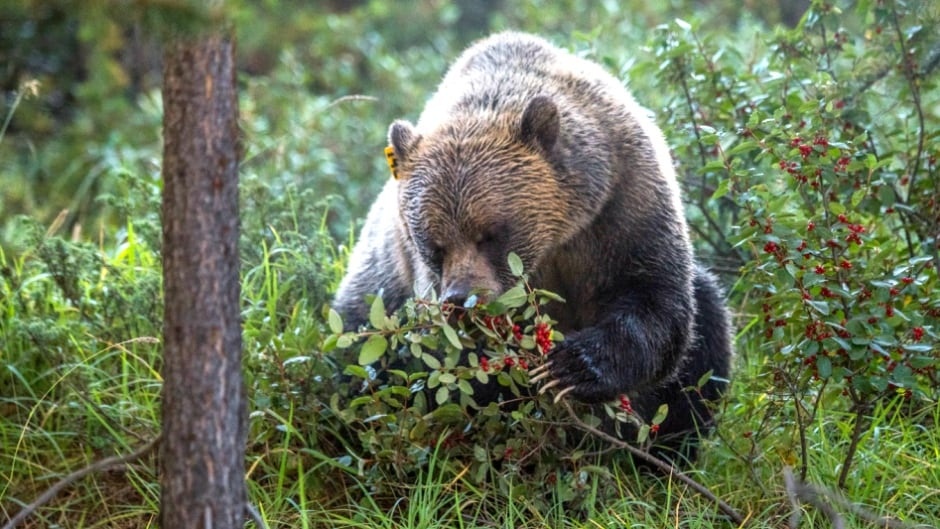
Brown bears are omnivores (eat a variety of things, including plants and animals). Animal foods include mammals, fish, carrion and insects. Among the plant foods they eat are on blue berries, soapberries, glacier lily bulbs, cow parsnip, huckleberries, pine nuts, sedges (protein-rich plants), leaves, roots, , grasses, bulbs. tubers, seeds, grains, nuts, fruit and bryophytes (mosses). They also eat fungus. Grizzlies are fond of berries and white-bark pines nuts.[Source: Tanya Dewey and Liz Ballenger, Animal Diversity Web (ADW) |=|]
Brown bears eating almost anything with nutritional value. The naturalist John Muir wrote, "To him almost everything is food except granite." Their diet changes with seasonal availability of different food sources. They eat a wide variety of plant foods. Fruits, nuts, berries, bulbs, and tubers are eaten extensively during summer and early autumn when the bears put on weight in prepartion for hibernation. They consume insects, fungi, and roots at all times of the year and also dig mice, ground squirrels, marmots, and other burrowing animals out of their burrows. Moth larvae have been shown to be especially important sources of protein and fat when brown bears are putting on fat in the fall.
Brown bears thrive in alpine meadows and pine, cedar and fir forests. Those that live in tundra regions are less well fed and live more of a feast or famine existence. Brown bears eat things like grasses, roots and parsnips in the spring, fish in the summer and berries in the late summer and fall. Bear traps are typically baited with a mixture of bacon, honey and pineapple juice.
RELATED ARTICLES:
BROWN BEARS: CHARACTERISTICS, HISTORY, SIZE factsanddetails.com
BROWN BEAR BEHAVIOR: SENSES, HIBERNATION, REPRODUCTION factsanddetails.com
BROWN BEAR SUBSPECIES: BIG, RARE ONES AND WHERE THEY LIVE factsanddetails.com
BROWN BEARS IN EUROPE: LOCAL VARIANTS, WHERE THEY LIVE, REWILDING, ISSUES factsanddetails.com
BROWN BEARS AND HUMANS factsanddetails.com
BEARS: HISTORY, EVOLUTION, HABITAT, HUMANS, PIZZLIES factsanddetails.com
BEAR CHARACTERISTICS: PHYSIOLOGY, DIET, LIFESPAN factsanddetails.com
BEAR HIBERNATION, REPRODUCTION, CUBS factsanddetails.com
BEAR BEHAVIOR: TERRITORIALITY, HABITUATED TO HUMANS, OPENING CARS factsanddetails.com
BROWN BEAR ATTACKS factsanddetails.com
BEAR ATTACKS IN ALASKA factsanddetails.com
BEAR ATTACKS IN RUSSIA factsanddetails.com
BROWN BEARS ATTACKS IN JAPAN: VICTIMS, HOKKAIDO, SANKEBETSU factsanddetails.com
Brown Bears Opportunistic Feeding
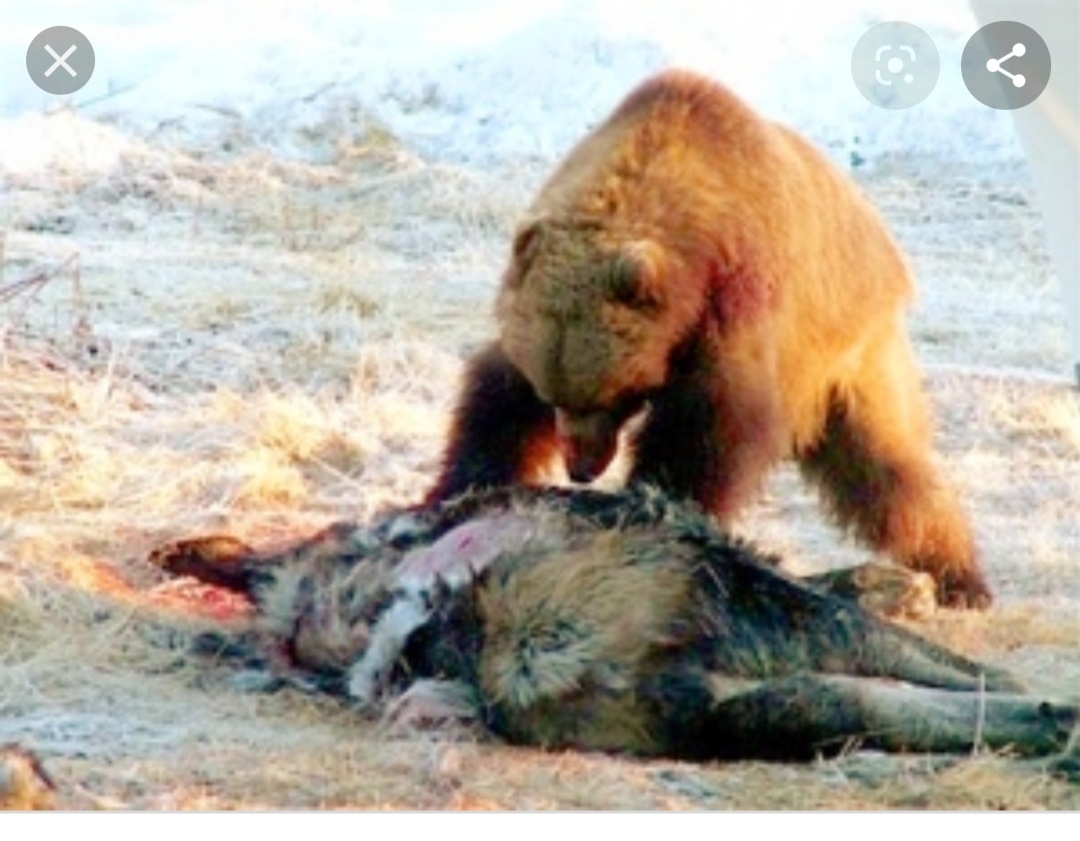
Brown bears are opportunistic feeders that feed on salmon, char, trout and other fish, birds, mice, gophers, elk, and rodents and even insects. They have been observed feasting on masses of moths. They also scavenge dead animals. Bears in coastal areas often feed on walrus, seal and whale carcasses that wash ashore. Some brown bears bury their uneaten carcasses. Their keen sense of smell enables them to locate carcasses a long distance away. Adult males sometimes attack and eat cubs. Males have been observed attacking young females and eating part of them.
Terry Domico and Mark Newman wrote in “Bears of the World” Practically anything edible is grist to the brown bear's meal. To fuel such a large body, the bears must consume a lot of calories up to 80 or 90 pounds (36 to 41 kg) of food a day during the peak of the season. By eating this much food, a big bear can gain from 3 to 6 pounds (1.25 to 2.75 kg) of fat in a 24 hour period. Physiologically, they are driven to gain at this rapid rate, because the time of summer abundance is very short and the winters long. Although the mainstay of the brown bears' diet is mostly plant material. they eagerly seek out animal matter because its food value is much more concentrated. Whatever the bears are eating at any given time of the year, you can bet they are consuming the most nutritional food available. [Source: “Bears of the World” by Terry Domico and Mark Newman, 1988]
David Attenborough wrote : The grizzly is immense. A big male can weigh over half a ton. It is also extremely fast and can easily out-run a man. Such stature, strength and speed make it a formidable hunter and grizzlies will kill mountain sheep and moose, the biggest of all deer. But prey of any kind can be energy consuming to find and kill, so meat is by no means the major element in their diet, In spring they eat all kinds of vegetation — grass. Horsetails, skunk cabbage and lily roots. They wander down to the sea-shore and they scoop up molluscs from the sand. In the summer they dine on elderberries and cranberries, They also dig out mice, squirrels and marmots from their burrows. [Source: “Life of Mammals” by David Attenborough]
“When the salmon start to migrate in Alaska’s rivers, the bears gather beside falls and rapids, often in groups of a dozen or more, in places where they know that the salmon will have to leap in order to continue up-river and reach their spawning grounds. There, with great dexterity and perfect timing, the grizzlies snatch the jumping fish from the air. The rewards can be so great that in those special places where th fish leap in great numbers, dozens of bears that normally avoid each one another will gather together besides the falls and catch fish in their jaws without even moving.
“The bears that live in Yellowstone have discovered a particular delicacy. In July, cutworm moths appear in thousands to feed at night on the summer flowers, During they day, they hid under the rocks but the bears have discovered them and regularly climb up to altitudes of 10,000 feet in order to feast on them. A single bear in a single day will lick up to 30,000.
Animals Killed by Grizzly Bears
Brown bears are skilled hunters. Brown bears occasionally catch moose or caribou caves, but very rarely, and sometimes dig up rodents. They have been observed digging up squirrel and fox dens but usually with little success. They have more success with ants taken from giant ant hills and ground squirrels that are still hibernating under the snow when the bears emerge from their dens. One scientist observed a bear bring down a caribou that had been severely wounded by wolves.
In the Canadian Rockies and other areas, grizzly bears can be especially carnivorous, hunting moose, elk, mountain sheep, and mountain goats. Occasionally black bears are preyed upon. In Alaska, brown bears have been observed to eat carrion and occasionally capture young calves of caribou and moose. Brown bears have observed in a number of places feeding on breeding salmon in the summer. [Source: Tanya Dewey and Liz Ballenger, Animal Diversity Web (ADW) |=|]
Anne Gunn and Frank L. Miller wrote: "The destruction of the facial area was also the mode of attack of a barren-ground grizzly bear killing a caribou cow whose carcass we found on the Beverly caribou herd’s calving ground, northeast of the Thelon Game Sanctuary, in June 1981. Griffel and Basile (1981) described puncture wounds in the frontal or jugal bones of 109 of 332 bear-killed sheep (Ovis aires) in Idaho. The facial area is richly innervated, and Mystervd (1975) in Griffel and Basile (1981) suggested that unconsciousness and hypoxic asphyxiation would follow severe and sudden injury to that area. [Source: Anne Gunn and Frank L. Miller, Muskox Bull Killed by a Barren-Ground Grizzly Bear, Thelon Game Sanctuary, N.W.T. ARCTIC, Vol 35, No 4 (1982).
Muskox Killed by a Grizzly Bear
Anne Gunn and Frank L. Miller wrote: Muskoxen and barren-ground grizzly bears are relatively common along the banks of the Thelon River in the Thelon Game Sanctuary [in Northwest Territory, Canada]. In June 1981 we were flying a helicopter search of the Thelon River area during a study of water crossings used by barren-ground caribou. . In the early afternoon of 23 June we were flying eastward when we spotted a grizzly bear standing on its hind legs among willow bushes in a clearing surrounded by black spruce on the north shore. As there were two gulls in attendance, indicating the possibility of a kill, we circled closer and could then see a dead muskox on the ground near the bear. The grizzly bear alternately reared up and dropped onto all fours as we came close and when the helicopter was about 100-150 m away, the bear galloped away. [Source: Anne Gunn and Frank L. Miller, Muskox Bull Killed by a Barren-Ground Grizzly Bear, Thelon Game Sanctuary, N.W.T. ARCTIC, Vol 35, No 4 (1982).
We landed near the carcass of an adult muskox bull lying on its left side. The carcass was intact except for some exposed flesh and head wounds. The nose was tom away and the nasal turbinal bones were crushed and the cartilage torn. The right ear was split and torn away at the base where there was a penetrating wound into the skull. Traumatized areas were hemorrhagic, indicating that the wounds were inflicted on a living animal. The hide and musculature had been removed in the lumbar and thoracic areas, exposing the vertebrae and the right scapula. The internal organs were still intact and warm to touch. Subsequent histological examination of the dental annuli of a first incisor indicated that the muskox bull was 9-10 years old.
The greening sedges immediately around the carcass were trampled and we backtracked along a disturbed path to a heavily trampled area of 5 meters in diameter about 15 meters away. The willow bushes peripheral to that trampled area were flecked with blood clots and clumps of blood-stained muskox wool...The ground cover was beaten down and the ground surface disturbed in many places with footprints pushed 10-15 centimeters or more into wet soil. We suggest that the grizzly bear surprised the muskox bull while it was grazing on sedge (indicated by rumen contents). The bear most likely grabbed the bull above the muzzle. In response, the bull must have braced its front legs and tried to dislodge the bear, suggested by front-foot hoof prints driven deep (15 centimeters) into the churned-up ground. Either the bull collapsed or the bear swung him off balance. At that point, the bear probably transferred its bite to just below the back of the bull’s horn boss..The seizing of the muskox bull’s muzzle would reduce chances of the muskox using its horns to gore the bear and increase the bear’s chances of throwing the muskox off its feet."
After making the kill, the bear dragged the carcass to where we found it, and had begun feeding when we interrupted. We returned about 48 hours later and found a light grey wolf (Canis lupus) and a grizzly bear whose coloring suggested it was not the bear that had made the kill. The carcass was dismembered and had settled into the wet ground. Most of the muscle masses and the internal organs had been consumed and the limb bones were scattered around the hide. The rumen had been pulled from the carcass but had not been fed on."
Muskoxen Killed by a Grizzly Bear
Anne Gunn and Frank L. Miller wrote: Solitary muskox bulls usually seem particularly alert, and their speed of response, size, strength, thick coat and horns must combine to make them a formidable quarry even for a grizzly bear. The location of this kill, at the edge of a small clearing where ambush by rushing from nearby cover was possible, suggests that the kill was opportunistic. The muskox bull was probably so intent on foraging on the new growth of sedges 10-20 centimeters high that he was not aware of his attacker until it was too late. The femoral marrow fat was pinkish-white and firm, suggesting good nutritional status, and we did not observe any obvious infirmities that would have made the bull particularly vulnerable. [Source: Anne Gunn and Frank L. Miller, Muskox Bull Killed by a Barren-Ground Grizzly Bear, Thelon Game Sanctuary, N.W.T. ARCTIC, Vol 35, No 4 (1982).
Tener (1965) summarized predation on muskoxen and noted that Pederson’s report of a possible kill by a polar bear (Ursus rnaririrnus) may be the only reported instance of bear predation. He further commented that predation by barren-ground grizzly bears is rare, since up to 1965 only Hornby (1934) had observed bears feeding on muskoxen on the banks of the Thelon River. In the late 1970s A.M. Hall observed grizzly bears feeding on muskox carcasses along the banks of the Thelon River . In 1978, on the banks of the Thelon, Hall observed three muskox carcasses on which grizzlies had fed, but he could not determine whether the bears had killed or were scavenging the muskoxen.
Hall believes that grizzly bear predation on muskoxen is high, especially on solitary bulls along the Thelon River, probably because the dense willow stands favour surprise ambushes. In June and July 1981, we saw only solitary bull muskoxen feeding in the willow stands, which leads us to the same supposition. Within 40 kilometers of the carcass described in this paper, during the same flight, we observed five other grizzlies on the north shore. Pegau (1973) briefly described an apparent kill of a 2- or 3-year- old muskox by a bear but the carcass was almost completely consumed, so scavenging could not be ruled out. The carcass was found on the Seward Peninsula, Alaska, where Grauvogel (1979) speculated that the slow rate of increase of the transplanted muskox herd might be partially attributed to grizzly bear predation on muskox calves, though no evidence was cited. Our account of an apparently healthy, prime adult muskox bull that was killed by a grizzly bear is the first documentation of such an event.
Salmon-Fishing Brown Bears
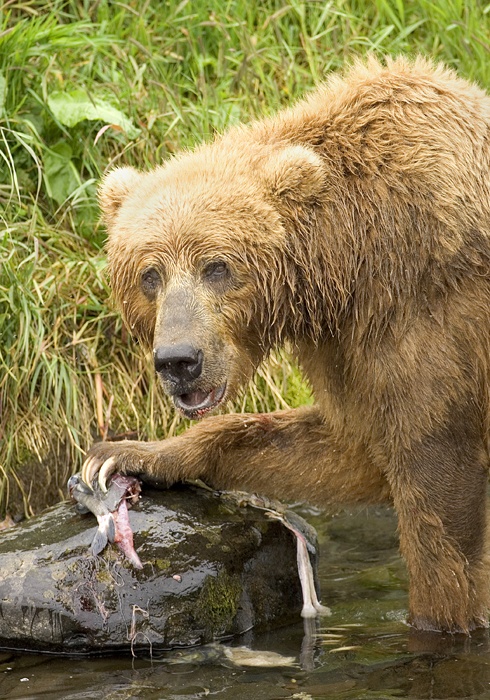
Brown bears are famous for feasting on salmon during the annual runs up rivers and streams. A 450 pound bear may consume 45 pounds of salmon a day. When the fish are scarce, bears often fight over prime spots. When fish are abundant, fighting is rare. The bears feed on salmon in the late summer and fall when the salmon enter coastal streams from the sea to spawn. The timing of this if perfect for the bears. They need to gain as much fat as possible before they hibernate. Females need extra fat if they are pregnant so they can get through the birth and produce milk for their cubs.
In Alaska, Russia and Japan brown bears feast on salmon during their summertime upstream migrations.Terry Domico and Mark Newman wrote in “Bears of the World” During the peak of the run, the bear lives almost exclusively on fish. Before the salmon run some graze on sedge grasses in tidal flay. Researchers have found that these plants are particularly rich in protein in the months before the salmon run. Where brown bears do not have access to salmon, they will eat spawning trout and other fish, Bears with access to the seashore will scrounge through the beach drift, eating seaweed, mollusks, crabs, and washed up bodies of sea mammals. Inland bears will eat moose calves, deer, elk and caribou, The remains of a carcass too big to consume in a single meal may be buried and carefully guarded for future meals. [Source: “Bears of the World” by Terry Domico and Mark Newman, 1988]
Bears that have access to salmon streams tend to be larger and have more offspring than other bears. The bears also give something back. The carcasses they leave behind are fed on by eagles, martens, ravens, gulls, beetles and fly larvae, even deer and squirrels. In places where bears feed on salmon there are sometimes very large trees. These are the result of the fertilizing affect of the nitrogen-rich salmon carcasses left behind and the nitrogen-rich feces and urine left by the bears.
Techniques Used by Salmon-Fishing Brown Bears
Bears use a number of techniques to catch fish. Some bears chase the fish onto the shore. Others stand at the tops of small waterfalls and catch the salmon as they leap upwards. The best technique seems to be pinning the fish to a rock on the bottom of a river with the forepaws and grabbing it with the mouth then crushing the fish in the bear’s jaws. Mother do not teach they cubs how to fish. Instead they let them flounder around in the water and develop their own methods of catching fish.
Some brown bears swat and garb the fish. A few have been observed belly flopping in a river off of a rock. One caught two salmon in 15 minutes by pinning the fish to the bottom of the river bed with its large paws. Salmon are more pallid at night and easier to catch. Some bears have a special taste for salmon brains. Other eat the entire fish save the testicles. Bears tend to eat the fattiest parts of the fish and are particularly fond of the eggs, which are mostly oil or fat.
Terry Domico and Mark Newman wrote in “Bears of the World” When there are lots of fish for the taking, brown bears will often only eat their favorite part of the fish such as the calorie-rich brain and eggs and skin and leave the rest such as the stomach and intestines behind. Some bears have been observed caching and partly eating 20 fish an hour. A number of species gulls and foxes snatch up leftovers left behind by the bears as well as by bears that aren’t so adept at caching fish. . [Source: “Bears of the World” by Terry Domico and Mark Newman, 1988]
“Bears don’t like to get their ears wet, I have seen them often cruising through quiet water like some furry submarine, with only their ears protruding above the surface . When a bear comes up with a fish in its mouth , the first thing it will do is shake its ears. Perhaps waterlogged ears reduce the bear’s ability to detect intruders. Most bears spend a great deal of time evaluating and avoiding the threat posed by the presence of other bears near a salmon stream. But accidental encounter do occur; I once saw two intently snorkeling bemas bump into each other, nose to nose...I had never heard a bear roar underwater before.
Salmon-Fishing Bears at Katmai National Park
Brooks Falls in Katmai National Park, southern Alaska is one of the best places in the world to watch brown bears because it is one of the first streams in the region where energetic and pre-spawned salmon are available to bears. In July, sockeye salmon are moving through large rivers and lakes where bears cannot successfully fish. Early in the salmon run, Brooks Falls creates a temporary barrier to migrating salmon. This results in a particularly successful fishing spot for bears. Once salmon stop migrating in large numbers, Brooks Falls is no longer a good place to fish and bears quickly abandon that spot for better fishing elsewhere. [Source: U.S. National Park Service, September 30, 2016]
Late June through the end of July and early September through mid October is when bear numbers are greatest along the Brooks River. The brown bears of Katmai are eating machines. A Katmai bear must eat a full year’s worth of food in 6 months to ensure its survival. Katmai’s bears predictably congregate around rich and concentrated sources of food.
Katmai’s brown bears are mostly diurnal so they are active throughout the day. However, bears that are not habituated to the presence of people can be more active at dawn and dusk. During the peak of the salmon migration in July, bears will fish for salmon all along the Brooks River, but bears will be especially concentrated at Brooks Falls. The falls give some bears the opportunity to catch many fish with little effort. Typically, the largest and most dominant bears along the river fish at Brooks Falls. In July, many of the bears that cannot compete for fishing spots at Brooks Falls will fish the lower half of the Brooks River. Females with cubs are usually easiest to see near the mouth of the Brooks River, but some will also fish at Brooks Falls.
After the salmon begin to spawn and die in late summer, bear activity is concentrated in the lower half of the Brooks River. In some years a few bears may still fish at Brooks Falls and the upper Brooks River in September and October, but most will patrol the slower moving waters of the lower Brooks River as they search for dead and dying salmon that collect near the river mouth and bridge.
Strategies Used by Salmon-Fishing Bears at Katmai National Park
Fishing styles are often learned behaviors. Many bears use the same techniques as their mother, plus others that they learn on their own. Some bears have mastered many styles, while other bears stick with the one that works. At Brooks River, you can observe many different types of fishing styles including:
Stand and Wait: Bears will stand on top of Brooks Falls and wait for sockeye salmon to jump close enough to catch in their mouths. This fishing technique is generally used by adult bears that can defend this fishing spot, but it is also used by some younger bears when space is available. This is a good technique to use when many salmon are jumping at Brooks Falls, but when no salmon are jumping this spot is quickly abandoned. Standing on top of the falls is precarious, however. Bears sometimes fall off so they rarely shift position once they have established a place to stand. [Source: U.S. National Park Service, September 30, 2016]
Sit and Wait: Bears will sit just underneath Brooks Falls in several places, like the plunge pool or “jacuzzi,” and wait for salmon to swim to them. Bears in the jacuzzi simply sit and wait for fish to swim into them. When they feel a fish in the water, they quickly pin it to the stream bottom or against their body with their paws, bite it, and begin to eat. The plunge pools below the falls are the most coveted fishing spots and are typically occupied by the most dominant bears.
How many fish can a bear catch and eat? A lot! On days when many salmon are migrating in the river, a large and dominant male bear will sometimes catch and eat more than 30 fish per day. Smaller bears that cannot compete for the best fishing spots, or bears that are less skilled at fishing, may catch and eat considerably less fish.
Why do the bears only eat part of the fish? If you see bears only eating the skin, brains, and eggs of a salmon, they are practicing good energy economics. At these times, a bear’s profit margin in calories is so high that it can ignore some excess fish. As a bear fills up on salmon, it can “afford” to not eat certain parts of the fish. This behavior has been nicknamed “high-grading.” Like miners looking for high-grade ore, bears try to consume high grade fat.
Dash and Grab: Bears often chase fish and attempt to pin them to the river bottom with their paws. This is commonly used early in the salmon run, but because this technique is energetically costly it is quickly abandoned when the salmon run begins to thin. Snorkeling: Bears that snorkel are simply looking for fish under the water. This technique is used almost universally by bears throughout the summer, but it is especially common and useful in the fall when many dead and dying salmon are in the Brooks River and Naknek Lake.
Pirating: Pirating bears steal fish from other bears. Pirating is more common early in the salmon run, but is not often observed in September or October. The threat of piracy will cause certain bears (like smaller subadults) to run with their fish away from the river and into the forest where they are less likely to have their fish stolen.
Diving: This is a fishing technique that most bears do not use. However, at the mouth of the Brooks River or even in the jacuzzi at Brooks Falls, you might see a bear completely submerge seeking fish. Diving is used more frequently in the fall with dead salmon littering the river bottom. In the 1980s and 1990s, the bear nicknamed Diver was a master at this technique. More recently bears #402 and #489 have been seen diving.
Begging: Bears do not share food with other bears, but some bears will still attempt to beg from others. This interaction occurs between bears that are highly tolerant of each other. Begging bears approach another (usually more dominant) bear eating fish and often position themselves inches away from the other bear. If a begging bear gets any fish, it is usually leftover scraps (gill plates, mandibles, and entrails) that the other bear doesn’t want. Begging bears often vocalize loudly, making noise reminiscent of a bawling cub. Begging is not a common behavior.
Eating Habits of the Salmon-Fishing Bears at Katmai National Park
Do the same bears return to Brooks River in the autumn that were here in July? Yes and no. Not every bear that uses the Brooks River in July returns to fish in autumn. Likewise, some bears will use the river only in autumn. Where the Brooks River bears go when they are not using the river is not well known. [Source: U.S. National Park Service, September 30, 2016]
Do bears share food with other bears? No, although it sometimes appears like they do. Some bears tolerate the close proximity of other bears. These tolerant bears will often let subordinate bears approach them, even when they are eating fish. The approaching bear may attempt to beg fish, but the tolerant and more dominant bear won’t share. It just leaves unwanted fish parts behind and the other bears pick up the leftovers. The compassion to share is believed to lie outside a bear’s capacities.
Salmon are a high calorie meal for a bear. A sockeye salmon contains about 4500 calories, but the fattiest parts of the fish contain the most calories proportionally. Bears know this and prefer to eat the skin, brain, and eggs—the fattiest parts of a salmon—when fish are in abundance. This is an ephemeral behavior, however. When salmon are not abundant or hard to catch then bears will not be as selective and will most often eat the whole fish. Watch a video of a bear high-grading fish at Brooks Falls.
Why don’t the bears fish for rainbow trout? They aren’t easy enough to catch. Rainbow trout may be abundant in the Brooks River, but they are not abundant enough for bears to fish for them successfully. In contrast, migrating salmon reach very high densities in the Brooks River, and late in the season these same salmon die en masse. High densities of fish and/or many dead and dying fish equal good fishing conditions for bears. Rainbow trout never really provide an easy meal like salmon do.
Changing in Eating Habits of Kodiak Bears
Niki Wilson wrote in Natural History magazine: In many places, warm spring temperatures now arrive earlier in the year — due to climate change — prompting some species to forward shift the timing of important lifecycle events. The effect of such shifts in the Karluk watershed of Kodiak Island, Alaska has been found to alter the feeding behavior of Kodiak brown bears, which could have potentially serious consequences for the island’s ecosystem. [Source: Niki Wilson, Natural History magazine, December, 2017, January 2018]
Omnivorous brown bears take nourishment from foods as they become seasonally available. On Kodiak Island, they typically consume salmon during spawning season, then turn to elderberries that ripen as the spawning season ends. A team of ecologists, led by William Deacy and Jonathan Armstrong of Oregon State University, investigated whether the early ripening of elderberries, caused by anomalously high spring temperatures, changed what Kodiak bears eat. Aerial surveys, time-lapse cameras, and GPS collars provided location information for the bears over time, while fecal analyses provided information on what bears were eating. Salmon abundance and spawning timing were estimated using time-lapse photos and historic salmon data, and elderberry ripening dates were estimated using time-lapse photos and a model drawing upon decades of historic air temperature data.
In the seasons when elderberries ripened early, there was a greater overlap in berry and salmon availability. The researchers found that, during these overlaps, the Kodiak bears switched from eating salmon to eating berries on adjacent hillsides. Though Deacy says that the bears will not likely be affected by this food switching, the behavior disrupts an important ecological link. Kodiak bears can kill 25 to 75 percent of spawning salmon. They move salmon nutrients from water to land, making carcasses available to animals that don’t go in the water. As abandoned carcasses rot, and as salmon passes through the bears’ digestive systems, salmon-derived nutrients are taken up in the soil, which increases plant productivity.
If this salmon/elderberry overlap continues, species that depend on bear-killed salmon may become less productive. Deacy notes, “Shifts in timing caused by warming may have more potential to change ecosystems than the warming itself.” (Proceedings of the National Academy of Sciences)
Image Sources: Wikimedia Commons
Text Sources: Animal Diversity Web animaldiversity.org ; National Geographic, Live Science, Natural History magazine, CNTO (China National Tourism Administration) David Attenborough books, New York Times, Washington Post, Los Angeles Times, Smithsonian magazine, Discover magazine, The New Yorker, Time, BBC, CNN, Reuters, Associated Press, AFP, Lonely Planet Guides, Wikipedia, The Guardian, Top Secret Animal Attack Files website and various books and other publications.
Last updated May 2025