
POLAR BEARS ATTACKS
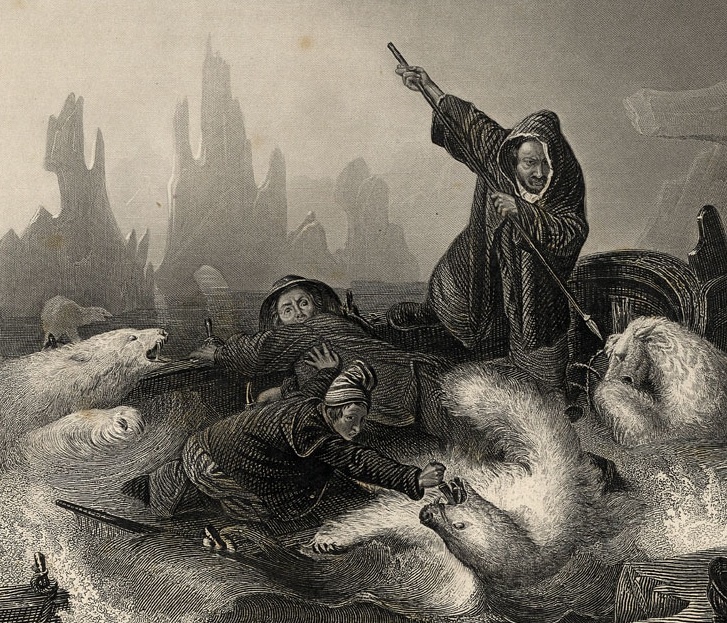
Polar Bears are regarded as most dangerous of all bears, especially when they are hungry. They are strong enough to take off a man’s arm with single swipe from their paw and unlike other bears seek out humans after picking up their scents.
Oil workers and villagers in Alaska and tourists visiting northern Norway have been killed by polar bears. Neil Syson wrote in the Sun: Polar bears are opportunistic eaters whose territory in the Arctic is being eroded by global warming. If they are hungry they go looking for food — so they are inevitably drawn to human camps. These sites take precautions with trip wires and flares. But bears become accustomed to such things. And if they are suddenly confronted by humans and get panicked or frightened they will lash out. It takes only one swipe from their enormous paws to kill, never mind those teeth and powerful jaws. When we venture into their terrain, we do so at our own risk. But bears do not deliberately seek to kill humans. [Source: Neil Syson, The Sun, August 7, 2011]
It is not recommended to play dead before a polar bear as many attacks are predatory. But sometimes it works. Edward Nelson wrote in Smithsonian magazine in 1982, "One of the men heard a bear approaching over the frosty snow, and having no weapon but a small knife, the bear being between him and the shore, he threw himself upon his back on the ice and waited. The bear came up, smelled about the man from head to foot, finally pressed his cold nose against the man's lips and nose and sniffed several times' each time, the terrified Eskimo held his breath until, as he afterwards said, his lungs nearly burst."
In June 2000, a girl lost her leg in polar bear attack at a zoo in Kazakhstan. Associated Press reported: “A polar bear bit off an 11-year-old girl's leg as she fed it dried apricots at a zoo in southern Kazakhstan, a news report said. The bear, possibly agitated by temperatures that reached 104 degrees, attacked the girl when her leg got stuck between the bars of its cage, Khabar state television said. The girl was not identified in the report. She was hospitalized and underwent surgery, but her life was apparently not in danger, the report said. It said she talked to doctors afterward. The girl said she had often fed the polar bears at the zoo, located in the southern Kazak city of Chimkent, and had never felt threatened by them. [Source: Associated Press, June 27, 2000]
RELATED ARTICLES:
POLAR BEARS ATTACKS: CIRCUMSTANCES AND BEHAVIOR OF THE BEARS AND HUMANS factsanddetails.com
POLAR BEARS ATTACKS IN CANADA factsanddetails.com
POLAR BEARS: CHARACTERISTICS, BEHAVIOR AND REPRODUCTION factsanddetails.com
POLAR BEARS, HUMANS. CONSERVATION: CLIMATE CHANGE, POLLUTION, TOURISM factsanddetails.com
BEAR BEHAVIOR: TERRITORIALITY, HABITUATED TO HUMANS, OPENING CARS factsanddetails.com
BROWN BEAR ATTACKS factsanddetails.com
BEAR ATTACKS IN ALASKA factsanddetails.com
BEAR ATTACKS IN RUSSIA factsanddetails.com
BROWN BEARS ATTACKS IN JAPAN: VICTIMS, HOKKAIDO, SANKEBETSU factsanddetails.com
Polar Bear Attacks in Norway
In the mid 1990s two people, neither of them tourists, were killed by polar bears. An unarmed woman was killed while hiking near Longyearbyen in Svalbard, Norway and few months later a Norwegian was killed and Swede badly mauled by a bear that had been shot. A woman was trapped in an outhouse by a bear until her boyfriend chased it off and group of college student drove off a bear after banging it on the head with a heavy cooking pot.
Svalbard has experienced a number of polar bear attacks. There were four reported deaths from attacks in the region between 1995 and 2011. The 3,000 population of Longyearbyen routinely carry rifles for protection. One local told Sky news in 2011: “Last summer a man was attacked by a polar bear but survived. He was taken in the mouth of the bear and his friend shot it. “The problem is, when the ice goes, the bears cannot catch food. “People don’t really know how dangerous they are.”[Source: Sky News]

Road sign in Longyearbyen warning of the presence of polar bears; The Norwegian text translates to "Applies to all of Svalbard"
In 1994, a Norwegian woman was mauled to death by a polar bear and two other people were killed in 1995. Other non-fatal attacks have also occurred. Since 1996, tourists visiting the region have received a brochure warning them of polar bears and the governor's office advises tourists to carry a rifle and a signal pistol.
In 1998, The Telegraph reported: “A polar bear has been shot dead after it attacked a camp housing 17 tourists and glacier researchers off Norway's northern coast. The three-year-old animal, weighing 128 kilograms (282 pounds), first appeared at the camp in the Hornsund national park in southern Spitsbergen in the evening but was scared off by warning shots. It reappeared in the early hours of the next morning, scavenging for food in the mess tent. Two camp members fired warning shots but the bear rushed at one of them. Both men fired at it, killing it instantly. Rune Hansen, the region's acting district governor, said: "It was very thin. You have to be careful with such a hungry young male. It had just been abandoned by its mother and had not yet learned to fear people." Polar bears are protected in the region and it is illegal to shoot them unless lives are in immediate danger. [Source: The Telegraph, August 19, 1998]
In March 2015, a polar bear dragged a Czech tourist out of his tent as he slept on Svalbard, clawing his back before being driven away by gunshots, as a huge number of tourists descnded on the island before a solar eclipse there. “It was going for my head. I used my hands to protect my head,” Jakub Moravec told the Associated Press from his hospital bed in the Svalbard archipelago’s main town. He turned over to reveal shallow gashes on his back. [Source: Associated Press, March 19, 2015]
Associated Press reported: Moravec was among a group of six on a combined ski and snow scooter trip on the remote islands. The group was camping north of Longyearbyen. No one else was injured in the attack. Zuzana Hakova, a member of the group sleeping in a different tent, told local newspaper Svalbardposten that her mother shot three times at the bear, prompting the animal to flee. The bear was eventually found and killed by authorities, said police spokesman Vidar Arnesen. Aksel Bilicz, manager of the Longyearbyen hospital, said, “I think there’s been a tendency, even before the eclipse, that a lot of people come here and they don’t know where they’re going. Both the weather conditions and the bears can be very dangerous.” Lodging on Svalbard has been sold out for years ahead of the eclipse. Visitors who choose to sleep outdoors receive stern warnings from authorities that people must carry firearms while moving outside of settlements.
British Teenager Killed in a Polar Bear Attack on Spitsbergen
In August 2011, a British schoolboy was killed in a polar bear attack on Spitsbergen island, Norway. Neil Syson wrote in the Sun: “Eton schoolboy Horatio Chapple, 17, of Salisbury, Wilts, died after the beast clawed its way into his tent as he slept. Four other young people on a British Schools Exploring Society expedition were injured in the attack on Spitsbergen island. The bear was shot dead by a trip leader. It emerged last night schoolboy Patrick Flinders saved himself by punching the 40-stone creature on the nose. [Source: Neil Syson, The Sun, August 7, 2011]
Thirteen young people were in four tents at Von Postbreen, Spitsbergen — an island 600 miles from the North Pole in the Svalbard archipelago — when the bear attacked. They were taking part in a British Schools Exploring Society adventure holiday.The injured survivors, who all have head wounds, were named as trip leaders Michael “Spike” Reid, 29, and Andrew Ruck, 27, and students Patrick and Scott Smith, 17. The huge male bear struck at the unsuspecting camp at 7.25am. Youngsters aged 16 to their early twenties scattered as the beast rampaged after a warning tripwire system failed. One of the two older group leaders managed to shoot the bear dead — but not before being badly injured.
Two air ambulance medical teams including neurosurgeons were scrambled from Tromso on the mainland. Survivors were taken to the town of Longyearbyen, 25 miles away, and then on to University Hospital in Tromso. Remote Von Postbreen can only be reached by snowmobile or by air in winter, although boats sail from Longyearbyen in summer.
The British Schools Exploring Society was founded in 1932 by a member of Captain Scott’s final Antarctic expedition of 1910-13. Patrons and honorary members include Sir David Attenborough and David Cameron. The students were part of a larger group of 80 aged between 16 and 25 who each paid £2,900 to join the expedition, which began on July 23 and was scheduled to run until August 28. The students studied geology, hydrology, meteorology & snow science. Survivor Spike Reid has been leading expeditions for seven years. BSES, a charity based in West London, provides a number of extreme tours for young people and sends many on the Duke of Edinburgh Award Scheme. The trips are aimed at “the development of young people through the challenge of living and working in remote and testing areas”.
Accounts of the Spitsbergen Polar Bear Attack
Svalbard Islands Governor Lars Erik Alfheim said: “There were 13 young people staying at the camp – boys and girls – and they were all in their tents when the animal struck. The young man who died had severe head wounds. The four injured males also had head wounds but their injuries are not believed to be life-threatening...It is not unusual to have polar bear attacks in the area.” In the autumn of 2010 “two people were badly mauled but they survived. The polar bear may have travelled up towards the camp on drift ice. It may have been hungry, we do not know. The people were asleep in their tents and were taken by surprise. It is always daylight here in summer, so it was not a case of them being attacked in the dark.” [Source: David Pilditch, The Express, August 6 2011]
Terry Flinders, the dad of Patrick, 16, said last night: “According to the doctor, Patrick was trying to fend off the polar bear by hitting it on the nose. “The bear attacked him with its right paw across his face and his head and his arm. It grabbed hold of the other boy and just killed him. Perhaps he was the closest one.” [Source: Neil Syson, The Sun, August 7, 2011]
Mr Flinders, of Jersey, went on: “The bear got into the tent where Patrick was. If he’d looked at Patrick, he was the chubbiest one — he probably had more meat on him, bless him. 'Patrick was probably in the middle, because it grabbed hold of his head next, and then his arm. I don’t know how Patrick got out to be honest — unless it was when the guy came in and shot the bear with a rifle. But the young lad was already dead. The leader who killed the bear was mauled and he’s really, really bad.” Police were alerted using a satellite phone and arrived by helicopter to a scene of carnage.
Eric Nygaard, a local official, said the British party had been staying near Hampus Mountains. He said: “The bear attacked while they were all inside. It ignored traps placed around the canvases to scare it off. “The bear was shot by one of the survivors and it slumped dead between two of the tents.” Polar explorer Tom Avery said: “Maybe the bear caught them unawares and they did not have a chance to see it coming and frighten it away. You are constantly aware of the threat, or scouting the terrain. Svalbard is very remote. It has the largest concentration of bears in the world.”
Kyle Gouveia, 17, who was on the expedition but came home early with frostbite, said the group was given shooting practice on the second day of the trip in case a polar bear attacked. They also had “bear watches” at their base camp in Svalbard and practised using “bear flares”.
Polar Bear Attacks Submarine
In May, 2003, a plar bear attacked an American submarine that broke hrough the ice near Prudoe Bay, Alaska during a training exercise. George Gordon wrote in the Daily Mail, “To a peckish polar bear padding along in search of a meal, it looked like lunch was about to be served from the chill cabinet. There, suddenly emerging out of the icecap, was what you might call the world's biggest submarine sandwich. [Source: George Gordon, Daily Mail, May 29 , 2003]
“Wasting no time, the furry giant - standing some 71/2ft tall on its hind legs - clamped its paws around the tempting shape and sank its teeth into it. Unfortunately for the bear, this was no super-sized snack, but a real submarine - and the bit that it was biting was the hardened steel rudder. So as it chomped away, its only reward was a sore jaw. The rudder belonged to the USS Connecticut, one of the world's most powerful submarines, which had broken through the ice in Prudhoe Bay, off north Alaska, during an American naval exercise.
“The first parts of the $1.2 billion nuclear-powered attack vessel to surface were the rudder, at the back, and the sail - the raised forward section containing the conning tower. When the periscope went up, its inbuilt camera captured the remarkable images of the bear making a meal of the vessel. Eventually, the animal abandoned its metallic munching and padded off across the ice ridges in search of a tastier snack of seal. The navy later reported that damage to the 353ft-long Connecticut - which has a crew of more than 120 and is armed with Tomahawk cruise missiles and torpedos - was minimal.”
Polar Bear Killed Mother and Her On-Year-Old Child in Alaska
In January 2023, a polar bear killed a woman and her one-year-old child in Wales Alaska, a small, predominantly Inupiaq town of about 150 people, just south of the Arctic Circle and over 100 miles (161 kilometers) northwest of Nome. Alaska. It was the first fatal polar bear attack recorded in the U.S. since 1990. When a polar bear killed a man farther north of Wales in the village of Point Lay. [Source: Associated Press, January 18, 2023]
Biologists later said the animal showed signs of starvation, the Anchorage Daily News reported. Harry Baker wrote in Live Science: Experts analyzed the animal's tissues, which revealed that the male bear was in poor physical shape and likely elderly. However, it's unknown exactly what triggered the polar bear's aggressive behavior. [Source: Harry Baker, Live Science, published February 14, 2023]
Summer Myomick, 24, and her infant son, Clyde Ongtowasruk, were mauled to death in the coastal town of Wales, the westernmost city on the mainland of North America. The pair were leaving a school when a polar bear attacked them in the middle of the street: A heavy snowstorm at the time meant that Myomick did not see the bear coming until it was too late. School staff attempted to stop the bear by hitting it with shovels, but the bear turned on the staff and forced them to retreat back into the school, which was full of pupils at the time. The school remained in lockdown until a village resident arrived with a gun and shot the polar bear dead, AP News reported. "Polar bear attacks on people are extremely rare," Lindsey Mangipane, a wildlife biologist with the U.S. Fish and Wildlife Service's Polar Bear Program in Alaska, told Live Science in an email. The last U.S. attack happened in 1993, and the last fatality occurred in 1990, in Point Lay, Alaska, she added.
Dr. Kimberlee Beckmen, a vet with the Alaska Department of Fish and Game's Division of Wildlife Conservation (DWC), conducted tests on tissue samples collected from the dead polar bear to learn more about why the animal behaved so aggressively. At the time of the attack, there was speculation in the media that the bear may have had a brain-altering disease, such as rabies, toxoplasmosis, distemper or bird flu. "These conditions could impact bear behavior," Mangipane said, "but because we don't generally encounter affected bears in [the] wild, we are unsure how symptoms would impact the way bears interact with people."
However, the tests carried out by Beckmen came back negative for any brain-altering pathogens. Instead, the bear's sex and physical condition were likely to be the "key factors" that influenced the attack, Mangipane said. The bear in the Wales attack was an adult male in "poor body condition" and was likely elderly, according to DWC. (A tooth was sent for a separate analysis to determine the bear's age).
There was "no definitive explanation as to why the bear was in poor body condition," DWC representatives wrote in the statement. But it is possible that human-caused climate change played a role. "Sea ice loss is resulting in polar bears having less access to their primary prey," such as seals, Mangipane said. "This means that polar bears may increasingly be in poor body condition, especially when encountered on land."
Account of the 2023 Alaskan Polar Bear Attack
Mark Thiessen of Associated Press wrote: Summer Myomick bundled her baby against the freezing winds whipping off the Bering Sea and stepped outside into a blur of blowing snow. It was a short walk from the school where she had visited relatives to the health clinic about 150 yards (137 meters) away, but the young mother could hardly have seen where she was going — or the terror that was approaching. [Source: Mark Thiessen, Associated Press, January 20, 2023]
As the attack unfolded, the principal ordered a lockdown and closed the blinds so the children couldn’t see what was happening outside the entrance. Several employees and community members left the safety of the building and tried to scare away the bear with shovels. The mauling stopped temporarily, but only when the animal turned on them, and they rushed back inside. Principal Dawn Hendrickson slammed the door in the face of the charging bear, possibly saving lives, according to Susan Nedza, chief administrator of the Bering Strait School District. “The polar bear was chasing them and tried to get in as well,” said Nedza, who received frantic calls about the attack in Unalakleet, about 250 miles (400 kilometers) away. “Just horrific.... Something you never think you would ever experience.”
There is no law enforcement in Wales, so with the bear still outside, a call went out to community members for help. A person who has not been identified showed up with a gun and killed the bear as it continued to maul Myomick and her son. It appears the mother and toddler had no idea what was coming because of low visibility, Alaska State Troopers spokesperson Austin McDaniel told The Associated Press on Thursday.
Wales, a whaling community, is the westernmost point on the North American mainland — just 50 miles (80 kilometers) from Russia across the Bering Strait. It's accessible by plane and boat, including barges that deliver household goods. Winter trails provide snowmobile access to other communities and subsistence hunting grounds.
Kingikmiut School, like other schools in many rural Alaska Native communities, doubles as a community center. The view from its front, where the attack occurred, is an endless expanse of frozen snow and ice to the horizon. Nedza, the school district chief administrator, said she received a call from a distraught Hendrickson just after two p.m. She said the students were locked down and safe.
The snowstorm that camouflaged the bear, along with a lack of runway lights at Wales’ gravel air strip, prevented Alaska State Troopers from flying in an officer and a state wildlife official from Nome to investigate. School was cancelled so students could be with their families, and the school district flew counselors to Wales. The school planned soft openings soon with no classes but opportunities for students to meet with counselors, get a meal or play a game, Nedza said.
Image Sources: Wikimedia Commons
Text Sources: Animal Diversity Web animaldiversity.org ; National Geographic, Live Science, Natural History magazine, David Attenborough books, New York Times, Washington Post, Los Angeles Times, Smithsonian magazine, Discover magazine, The New Yorker, Time, BBC, CNN, Reuters, Associated Press, AFP, Lonely Planet Guides, Wikipedia, The Guardian, Top Secret Animal Attack Files website and various books and other publications.
Last updated June 2025