
SOUTH COAST OF BALI

South Coast of Bali is known for it rugged coats, cliffs and superb surfing spots. The Uluwatu area is regarded as Bali’s premier surfing spot. the waves are pretty consistent but often crowded. Uluwatu has been featured in a number f surfing films. From the cliffs it is possible to check out the best surfing spots. On the way to Uluwatu, is Garuda Kencana Cultural park, a huge classical-Greece-like facility with an amphitheater and towering columns that is being built in a limestone quarry and is expected to take at least 10 years ro complete.
Many of Bali’s most renowned surfing beaches are along the Bukit Peninsula at the southern end of Bali. They include the Uluwatu Beach, Bingin Beach, Padang-padang Beach, Dreamland Beach, Impossible Beach and Balangan Beach. Uluwatu is the most famous wave of Bali. There is always some swell here so it's also always crowded. The spot offers several waves which are working with different swells and tides. Suluban Beach is known as a place where world-class thrilling waves meet jaw-dropping scenery. Located not too far from the picturesque Uluwatu Temple, this beach is the actual site of the famous Uluwatu surf break. This beach extends right up and joins the Uluwatu Beach. Together they are the Mecca for wave chasing junkees who come to Bali.
The other popular name for Suluban Beach is Blue Point Beach and this is not without reason since if you want to reach the beach you will have to pass the Blue Point Bay villas and spas. Luxury ocean front villas located in the Southern Peninsula of Bali, right on Uluwatu and Suluban Beach facing the Indian Ocean, offer the perfect accommodation if you want to spend your time on Suluban Beach or at the Bukit Peninsula. Aside from the Blue Point Bay Villas and spas there are also several other accommodation options that you can find near the Suluban Beach. Here are some of the accommodation options available around Suluban Beach:
RELATED ARTICLES:
BALI: GEOGRAPHY, LIFESTYLE, REPUTATION, GETTING THERE factsanddetails.com
HISTORY OF BALI: ORIGIN, KINGDOMS, MASS ROYAL SUICIDES factsanddetails.com
MODERN HISTORY OF BALI: VOLCANIC ERUPTIONS, TERRORISM, RECOVERY factsanddetails.com
TOURISM IN BALI: CELEBRITIES, RESILIENCE AND ITS RISE FROM A 1930s SOCIALITE ARTIST COLONY factsanddetails.com
BALI BOMBING IN 2002 factsanddetails.com
NEGATIVE SIDE OF TOURISM IN BALI: OVERDEVELOPMENT, BAD BEHAVIOR DONALD TRUMP factsanddetails.com
ACTIVITIES IN BALI factsanddetails.com
DENPASAR AND KUTA factsanddetails.com
SANUR AND THE MAIN RESORT AREAS OF BALI factsanddetails.com
UBUD: SIGHTS, MONKEYS, FOOD factsanddetails.com
EAST BALI: MT. AGUNG AND BESALIK TEMPLE factsanddetails.com
NORTH BALI: MT BATUR AND SUBAK WATER TEMPLES factsanddetails.com
WEST BALI AND ITS NATIONAL PARK factsanddetails.com
BEACHES AND DIVING IN NORTH AND WEST BALI factsanddetails.com
Uluwatu Temple
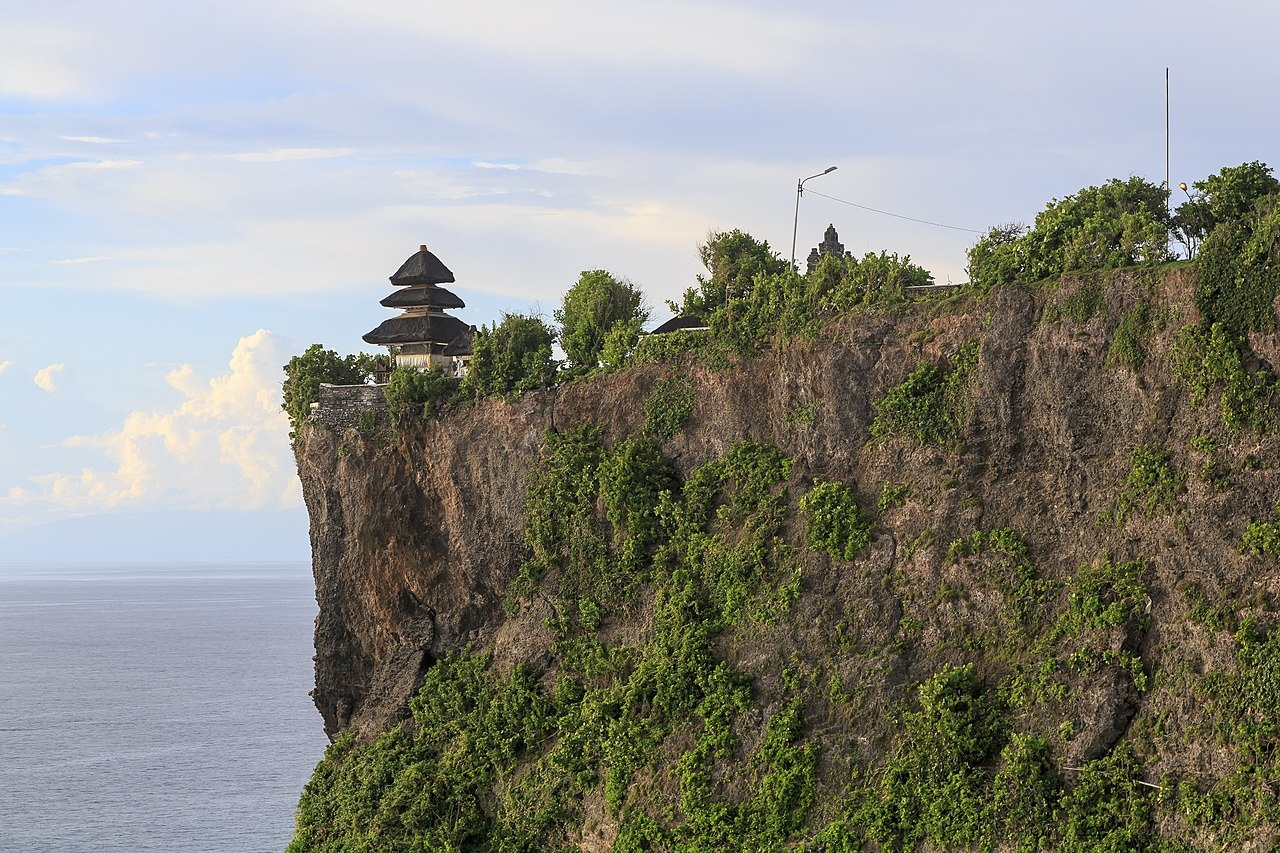
Uluwatu Temple (southwestern tip of the Bukit Peninsula) is a Hindu temple dedicated to Sang Hyang Widhi Wasa in his manifestation as Rudra. It is unique among Bali’s sea temples (pura segara) in that it is also one of the nine directional temples known collectively as Pura Kahyangan Jagat (or Pura Kahyangan Padma Bhuwana). [Source: Wikipedia]
Uluwatu Temple stands dramatically on the edge of a 70-meter-high (230-foot) cliff or rock (watu) that juts out into the Indian Ocean. According to local folklore, this rock is believed to be part of the petrified barque of the goddess Dewi Danu.
Although a small shrine is said to have existed earlier, the temple complex was significantly expanded in the 11th century by the Javanese sage Empu Kuturan. Another influential religious figure, Dang Hyang Nirartha from East Java, is credited in the early 16th century with introducing the padmasana shrine. Local tradition holds that he attained moksha at this site, an event known as ngeluhur (“to go up”), from which the temple derives its epithet Luhur, meaning “height” or “elevation.”
In 2009, Bali Provincial Regulation No. 16, a 20-year spatial planning regulation extending to 2029, established a protected zone with a radius of 5 kilometers measured from the outer wall of Uluwatu Temple. Within this zone, all construction was prohibited except for buildings directly related to Hindu religious and spiritual activities, effectively banning residential and tourism development. This regulation conflicted with the customary laws (awig-awig) of the Pecatu village community, which defined the sacred area of Uluwatu Temple as the surrounding forest. Under customary law, the forest within a radius of approximately 350 meters from the temple was strictly protected. Applying the provincial regulation retroactively would have required the demolition of numerous pre-existing structures and would have displaced many residents or deprived them of their livelihoods. At least seven lawsuits were filed by individuals, groups, and customary law communities from Pecatu, reaching as far as the Supreme Court. These appeals were rejected in decisions issued in 2010 and 2013.
Bartering Monkeys at Uluwatu Temple were the subject of a David Attenborough BBC piece. The large numbers of long-tailed macaques (Macaca fascicularis), at the temple are notorious for snatching visitors’ belongings such as sunglasses, cameras, and flip-flops. These monkeys can often be induced to return stolen items in exchange for food such as fruit, nuts, or sweets, though this practice tends to reinforce their thieving behavior. Researchers studying primate behavior have documented that these macaques exhibit learned bartering behavior, which is passed down to younger generations. Newly introduced monkey groups in the area quickly adopt this behavior by observing the resident macaques.
Kecak (Monkey Dance) performances based on episodes from the Ramayana are staged daily at Uluwatu Temple at 6:00pm. The open-air performance takes place on a cliff overlooking the sea, with the sunset providing a dramatic natural backdrop.
Uluwatu Surfing
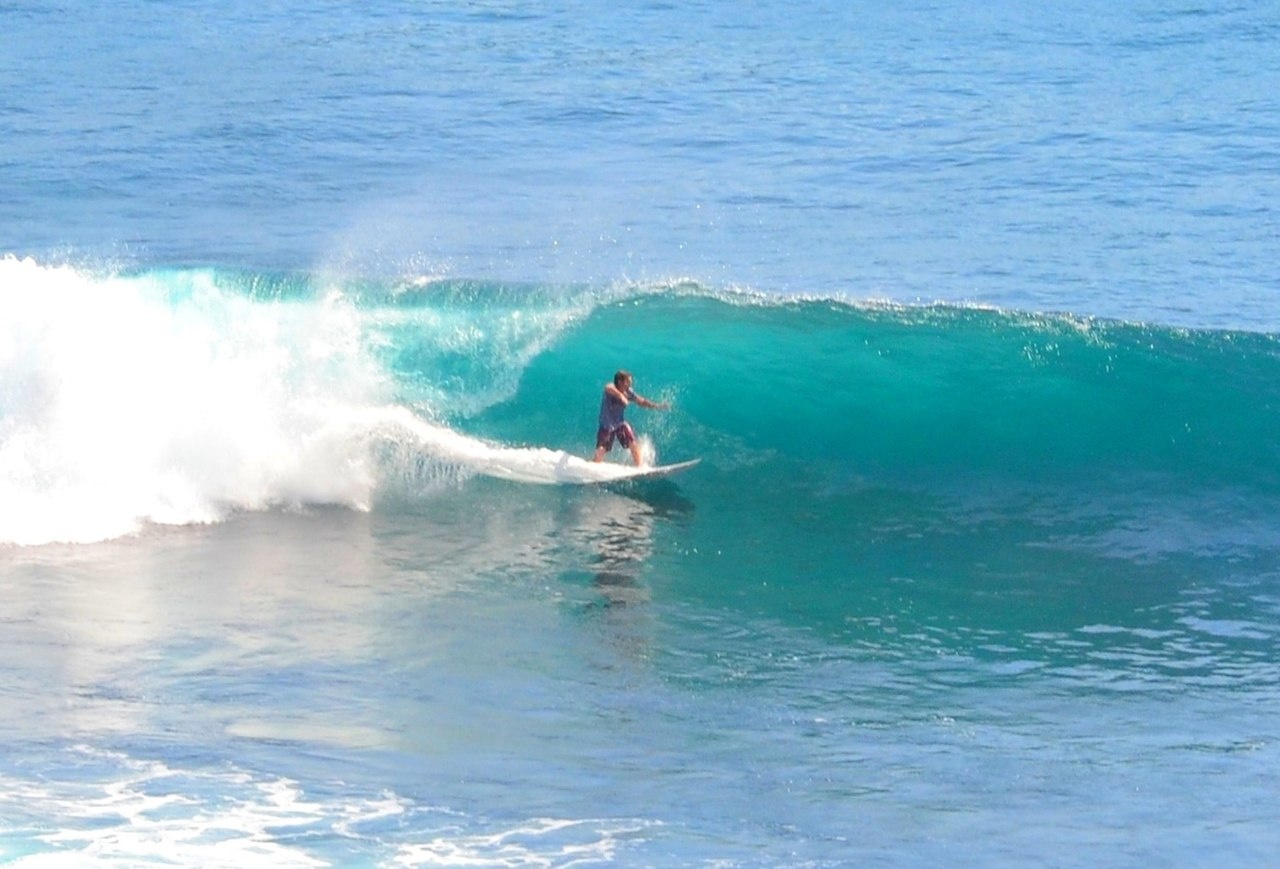
Uluwatu (one hour drive from the Ngurah Rai International Airport) is the most famous surfing spot of Bali. There is always some swell here so it's also always crowded. The spot offers several waves which are working with different swells and tides: 1) The Peak: best at mid and high tide. Closes out at low tide. In front of the cave. it's the most consistant. Short and powerful waves, tubes. The take off is moving. It works from 1ft to 8ft. The most crowded. One of the sections closes more than the others. 2) Racetracks: 100 meters further. fast wave, a lot of sections with easy tubes. Best at low tide and at 6ft. Can hold bigger swell. On the right tide and the right swell, "The Peak" connects with "Racetraks" (you need to be a good tuberider). Over 10ft, Racetracks breaks until "The Corner".
3) Inside Corner: best at mid and low tide with a 6ft swell. At first, it's a fun wave and the final bowl is a tube. Don't do a cutback just before the bowl! Take plenty of speed, stay high in the face and trim. You will pass the tube. 4) Outside Corner: the REAL Uluwatu. Works only with big swells (more than 8 feet) and at low tide. The lower is the tide, the better is the wave. Take at least a 7' board. It is a succession of long walls good for carving and, sometimes, a beautifu l final tube. The length is around 300 meters. 5) Temple: less surfed. Two waves in fact ("Outside temple" and "The Bombies"). Only for experts because the water is very shallow. For them, it is a incredible tube when it works.
Spot information for surfing at Uluwatu: 1) Type of break: reef break; 2) Type of wave: hollow barreling wave; 3) Direction: left hand; 4) Bottom: coral; 5) Average lenght of ride: long; 6) Suitable for : expert level. Detailed information: 1) Crowd level: a big crowd; 2) Best tide: mid; 3) Ideal board size: 6'8-7'4 Mini gun; 4) Ideal wind direction: south-east; 5) Wavesize & wetsuit: Spring - Summer - Autumn - Winter Overhead: 6'- 8' - Ok : 2'- 4' - Overhead: 6'- 8' - Overhead: 6'- 8', Boardshorts - Boardshorts - Boardshorts - Boardshorts. [Source: globalsurfer.com]
You can use a taxi from the airport. Or you can go to Denpasar and to find a travel agent or auto rental. Many rentals also provide motorcycles. There are many accommodations from warung (warung is a traditional cafe), motels, hotels to villas. The prices range from $5 to $2000 for a day. If you stay in a warung you just need to pay for the meals. You'll find better accommodations like starred hotels near resorts. Various restaurants and cafes throughout Uluwatu, from cheap food stalls to luxury restaurants.
Suluban Beach
Suluban Beach (at Uluwatu) is a is where World-class thrilling waves meet jaw-dropping scenery. paradise of Suluban Beach. Located not too far from the picturesque Uluwatu Temple, this beach is the actual site of the famous Uluwatu surf break. This beach extends right up and joins the Uluwatu Beach.
Located at the Pecatu Village, in the South Kuta sub-district, Badung Regency, Suluban is beach is blessed with a breathtaking cliff-top views of the Indian Ocean. Approaching the area, visitors will be greeted by white rock cliffs that stretch as far as the eyes can see. Descending some 50 meters down to the shore, a vast white sandy beach kissed by turquoise blue waters and pounding waves.
The character of waves at Suluban Beach is similar to those at Uluwatu Beach: powerful, long swells and consistent barrels. Here waves can reach to between one and four meters feet with the average wave size being one and two meters, feet, perfect for advanced and professional surfers. The best season for surfing at Suluban Beach is during the dry session (April to August) when the wind blows from east to west creating the perfect waves for surfing.
The word Suluban comes from the Balinese language “mesulub” which translated means: to bow down. It is suggested that the name was adopted since visitors must first crouch or bow down when they pass the crevice between boulders that resembles a cave, before reaching the beach below the rocky cliff. The Beach is also known by many people as the Blue Point Beach since it is closely associated with the Blue Point Bay Villa located on the top of the cliff which shade Suluban Beach.
Accommodation, Restaurants and Transport at Suluban Beach
The other popular name for Suluban Beach is Blue Point Beach and this is not without reason since if you want to reach the beach you will have to pass the Blue Point Bay villas and spas. Luxury ocean front villas located in the Southern Peninsula of Bali, right on Uluwatu and Suluban Beach facing the Indian Ocean, offer the perfect accommodation if you want to spend your time on Suluban Beach or at the Bukit Peninsula.
Aside from the Blue Point Bay Villas and spas there are also several other accommodation options that you can find near the Suluban Beach. Here are some of the accommodation options available around Suluban Beach: 1) Blue Point BayVillas & Spa, Jl. Labuansait - Uluwatu, Pecatu, Bali 80364, Indonesia, Tel. +62 361 769 888, 3009729 ~ 31 (Hunting),, fax: +62 361 769 889, 3009728, E mail: info@bluepointbayvillas.com, Website: bluepointbayvillas.com; 2) Gong, Jl Pantai Suluban, Uluwatu (on the main road to Uluwatu Temple about 500 meters before the temple gates), Tel. +62 361 769976, E mail: thegongacc@yahoo.com; 3) Sandat Mas Cottages, Jl Pantai Suluban, Uluwatu, Tel. +62 361 769965, E mail: info@sandatmas.com; 4) Suluban Cliff Bali Villa, Jalan Pantai Suluban No.9, Pecatu, Uluwatu, E mail: info@sulubancliffbali.com, Website: sulubancliffbali.com.
Restaurants: Despite its secluded location, eating facilities around Suluban Beach are not hard to find. Restaurants and cafes serving international, Indonesian, and typical Balinese food can be easily found on the path leading down to the shoreline of the beach. Some of these restaurants and cafes have astounding views on the ocean, making it a perfect relaxing place after an exhausting surfing adventure.
Getting There: Located at the Bukit Peninsula, Suluban Beach is connected to Kuta and Denpasar through Jimbaran by the busy Jalan Bypass Nusa Dua and this is the only route in. Approximately 34 Kilometers from Denpasar, the beach is about 30 minutes’ drive from the I Gusti Ngurah Rai Airport or about 45 minutes from the tourist resorts of Kuta-Legian.
From Denpasar or Kuta, Take the main road (Jalan Bypass Nusa Dua) south to the junction with Jalan Uluwatu II (the famous McDonald's junction), turn west towards Jimbaran Bay, continue about 2 kilometers and at the four road junction make a sharp left up the hill (signposted for Uluwatu). Follow the road southward until you reach the outer post of Uluwatu Temple where you will find a signpost to Suluban Beach to the right. Follow that road until you reach the Beach.
A taxi from Kuta to Suluban or Uluwatu will take approximately 30 to 40 minutes over winding roads and will cost about Rp 120,000 one-way. If you are just visiting for the day, consider asking the driver to wait for your home trip as it can be difficult to find transport back. Figure on paying the taxi driver Rp 20,000/hour to wait. Joining a tour can be a cheaper way of getting to the area as this destination is very widely offered by tour operators all over the island.
Balangan Beach
Balangan Beach (10 kilometers from the Ngurah Rai Airport or 45 minutes from Denpasar) is famous for and its long left-hander surf breaks. Ranked 1st in CNN Go’s “Bali's best 5 hidden beaches”, this beach lies just a little to the north of nearby Dreamland Beach. Flanked between two rock cliffs, the coastline of Balangan Beach stretches for about one kilometer and has mixture of white and black sands and unique green and dark brown stones.
For surfers, this is where one of Bali’s longest left-hander breaks are found and, when the swell is big enough, there may well be one or two tube sections. The sheer length of this wave means that it has several starting points, as well as varied sections — in a word, everything the surfer’s heart desires: whether steep or simple drops, sharp faces or smooth longboard sections, there’s something for everyone. Even advanced surfers can learn something here. With the best waves size averaging from 4 to 8ft, Balangan features very classy waves, meaning, surfers will be challenged by the fast waves on some good days with smaller swell during dead low tide days. From April to November constant south-west swells and off-shore winds ensure perfect waves, and loads of point breaks and tubes.
Accommodation around Balangan Beach includes: 1) Balangan Sea View Bungalow Address: Balangan Beach 2 Cengiling, Jimbaran-Bali, Tel. +62 361 7800 499 Mobile: +6281 236 792 12, E mail: info@balanganseaviewbungalow.com, Website: balanganseaviewbungalow.com; 2) La Joya Villa & Bungallow, Jalan Uluwatu Pantai Balangan - Pecatu Kuta, Badung, Tel. +62 361 7450501, +62 818 565 839, E mail: informations@La-Joya.com, Website: la-joya.com/index3.php; 3) Indah Balangan Villas, Jalan Pantai Balangan, Tel. + 62 857 372 43219, E mail: bookings@indahbalanganvillas.com, Website: indahbalanganvillas.com; 4) Flowerbud Bungalow, Address : Balangan Beach Street Jimbaran Bali Indonesia., Tel. +62 361 8572062. Mobile : +62 8164722310, E mail: wellehnick@yahoo.com, Website: flowerbudbalangan.com.
Getting There: To go to Balangan from Kuta or Denpasar take the South Bypass Ngurah Rai route to Nusa Dua until you arrive at Bukit Peninsula, Uluwatu. Pass through the Garuda Wisnu Kencana complex until you find a small intersection where you should take the right small road until you find the sign “To Balangan”. Follow the road until you find the metal fence to the beach parking lot. The Trip from Kuta will take roughly 30 to 40 minutes, and from Denpasar it will take about 40-50 minutes depending on the traffic conditions.
Image Sources: Wikimedia Commons, Indonesia Tourism website
Text Sources: Indonesia Tourism website (indonesia.travel), Indonesia government websites, UNESCO, Wikipedia, Lonely Planet guides, New York Times, Washington Post, Los Angeles Times, National Geographic, The New Yorker, Bloomberg, Reuters, Associated Press, AFP, Japan News, Yomiuri Shimbun and various books and other publications.
Last updated in January 2026