
WEST BALI
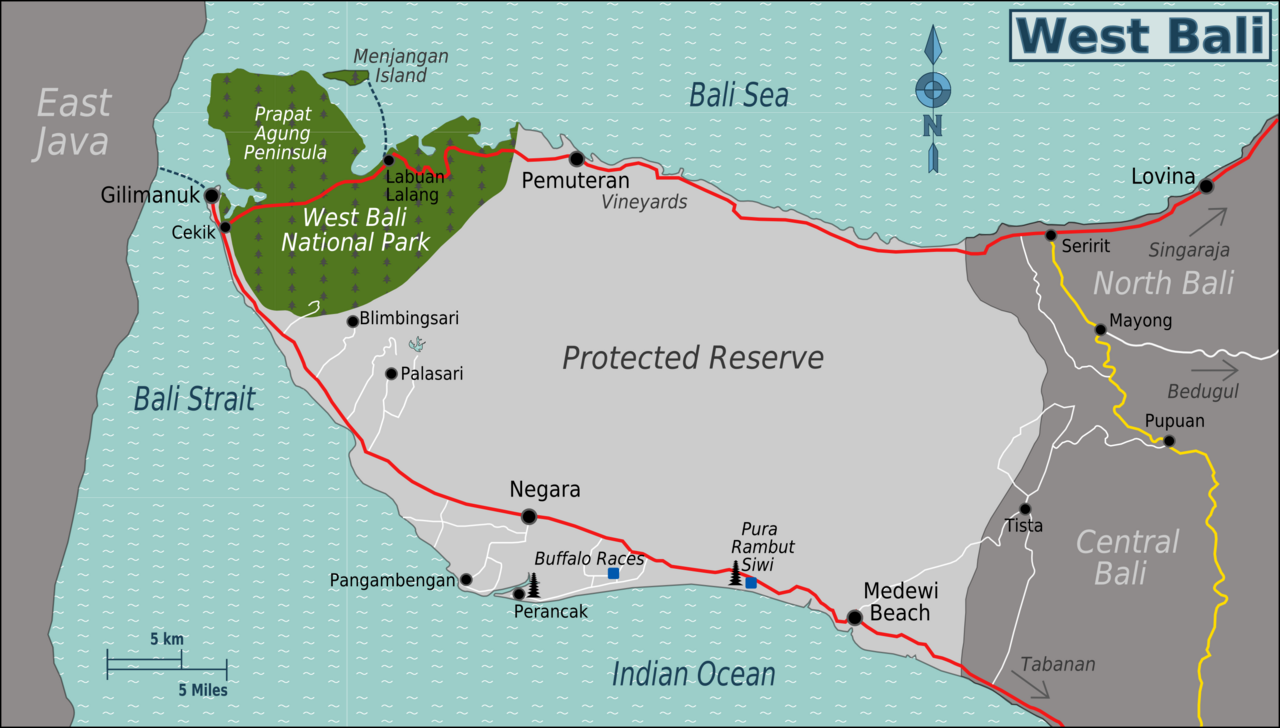
West Bali is still relatively undeveloped. A large portion of it is occupied by West Bali National Park and the Mt. Batur area. There are still large untouched forests here, It was the last redoubt of the Balinese tiger. There are many fishing villages that are only accessible by boat or tracks through the jungle.
Tanah Lot Temple (15 kilometers west of Denpasar) is Bali's most beautiful sea temple. Perhaps Bali’s most photographed site, it is built a top a rock and surrounded by sea. Poisonous sea snakes found at the base of the temple are believed to guard the temple from evil spirits. The best time to see the temple is in the late afternoon when sun shines from the island toward the sea. At sunset it is often swarms with large crowds of tourists, who make the temple the final stop before heading back for dinner. The islet on which the temple is perched is accessible at low tide. The area around the viewpoint is surrounded by tacky souvenir shops.
Sangeh (20 kilometers west of Denpasar) is known for its nutmeg trees and moneky-filled forests. The forest here is sacred which means you can't chop down trees, nor can you harm the monkeys, for they are sacred as well. They monkeys have a bad reputation.. They sometimes jump on people and have been known to steal their glasses and shoes.
Danau Bratan is scenic highland area. It offers some excellent hiking around lakes and a botanical garden, with 500 species of orchid, and it lack the touts and tourist of the Mt, Batur area.
RELATED ARTICLES:
ACTIVITIES IN BALI factsanddetails.com
DENPASAR AND KUTA factsanddetails.com
SANUR AND THE MAIN RESORT AREAS OF BALI factsanddetails.com
UBUD: SIGHTS, MONKEYS, FOOD factsanddetails.com
EAST BALI: MT. AGUNG AND BESALIK TEMPLE factsanddetails.com
NORTH BALI: MT BATUR AND SUBAK WATER TEMPLES factsanddetails.com
BEACHES AND DIVING IN NORTH AND WEST BALI factsanddetails.com
BALI: GEOGRAPHY, LIFESTYLE, REPUTATION, GETTING THERE factsanddetails.com
HISTORY OF BALI: ORIGIN, KINGDOMS, MASS ROYAL SUICIDES factsanddetails.com
MODERN HISTORY OF BALI: VOLCANIC ERUPTIONS, TERRORISM, RECOVERY factsanddetails.com
TOURISM IN BALI: CELEBRITIES, RESILIENCE AND ITS RISE FROM A 1930s SOCIALITE ARTIST COLONY factsanddetails.com
BALI BOMBING IN 2002 factsanddetails.com
NEGATIVE SIDE OF TOURISM IN BALI: OVERDEVELOPMENT, BAD BEHAVIOR DONALD TRUMP factsanddetails.com
Taman Nasional Bali Barat (West Bali National Park)

Taman Nasional Bali Barat (far western tip of Bali, 100 kilometers from Denpasar) is the Balinese name for West Bali National Park. Covering 150 square kilometers of land park, and 50 square kilometers of marine park, it embraces coastal savannahs, lowland forests, acacia scrubs, montane forests in the higher region, black sand beaches and coral reefs. There are also some pockets of dense mangrove forests. In the north of the park is an obvious north jutting peninsula called Prapat Agung. Around this peninsula are long stretches of protected beach and offshore coral reefs as well as a small offshore island called Menjangan. The latter is a very popular diving destination.
Animals found there include black monkeys, leaf monkeys, macaques, sambar deer, barking deer, wild pigs, iguanas, rusa deer, mouse deer, leopards, civets, and green snakes. More than 160 species of bird have been recorded in the 76,312-hectare park. There are a number of trekking opportunities.
Bali Barat National Park West Bali National Park includes the whole area of the Prapat Agung Peninsula, and large swathes of land around the towns of Gilimanuk, Cekik and Banyuwedang which lie in the regencies of Jembrana and Buleleng. The park is approximately 50 kilometers west of the northern city of Singaraja, capital of Buleleng regency. Entrance is at the Jembrana side is at Melaya off the Denpasar-Gilimanuk highway. The Park offers pristine tropical nature, and is the last home of the most endangered Bali starling with only some one hundred remaining. These are very pretty white birds, with black wing tips and a brilliant blue streak around their eyes. Here is also the endangered wild Javan buffalo or banteng, with only 30 to 40 left living deep in the forest.
Visitors to Bali Barat must first obtain a permit available free of charge at Cekik, at Labuhan Lalang or at the Forestry Ministry office at Renon, Denpasar. Although shelters are available, trekkers must bring their own bedding, mosquito protection, food, water and utensils. There are simple hotels at Labuhan Lalang or at Gilimanuk and Negara. For permit and information please contact: West Bali National Park Head Office: Balai Taman Nasional Bali Barat, Jl. Raya Cekik-Gilimanuk Jembrana, BALI 82253, Tel. +62365 61060, fax: +62365 61479, E-mail: tnbb09@gmail.com, Website: tnbalibarat.com
Wildlife and Plants in Taman Nasional Bali Barat
One hundred and sixty species of birds have been recorded in the park, including the near extinct Bali Starling (Leucopsar rothschildi), Bali's only endemic vertebrate species,the fauna icon of Bali. It was the key reason why this national park was created in 1941. By 2001, it was estimated that as few as only six individual starlings were thought to have survived in the wild, all of them in this park. Since then, captive breeding and re-introduction efforts have continued apace, but poaching pressures remain a large problem. With that in mind, a second re-introduction program was started in the remote regions of Nusa Penida, off the coast of Sanur Beach in 2004. In June 2011, West Bali National Park received 60 endangered Bali Starling for release, 40 from the Surabaya Zoo and 20 from Taman Safari Indonesia. Keen birdwatchers can find a checklist of likely species and their status here.
West Bali National Park: Sanctuary of the Exotic White Bali StarlingAmong some other fauna found in the National park are: the Wild Bull (Banteng), Barn Swallow, Black-naped Oriole, Black Racket-tailed Treepie, Crested Serpent-eagle, Crested Treeswift, Dollarbird, Hawksbill Turtle, Indian Muntjac, Java Sparrow, Javan macaque (Lutung), Large Flying Fox, Leopard Cat, Lesser Adjutant, Long-tailed Shrike, Milky Stork, Pacific Swallow, Red-rumped Swallow, Menjangan Wild Deer, Sacred Kingfisher, Savanna Nightjar, Stork-billed Kingfisher, Water Monitor, Wild Boar, Yellow-vented Bulbul, and many more.
The national park is also the home of several endangered species of flora such as: Pterospermum diversifolium, Antidesma bunius, Lagerstroemia speciosa, Steleochocarpus burahol, Santalum album, Aleuritas moluccana, Sterculia foetida, Schleichera oleosa, Dipterocarpus hasseltii, Garcinia dulcis, Alstonia scholaris, Manilkara kauki, Dalbergia latifolia and Cassia fistula.
The Marine reserve includes the cape shores and several sanctuary islands with many seabirds in the bay of Gilimanuk, on the island of Menjangan and the excellent coral reefs surrounding it. The good drop-offs on Menjangan's south side are only surpassed by the particularly superb reefs on its northern shores. The island is a popular spot for locals and tourists wishing to dive for a variety of fish and coral reef exploration. There are no dangerous currents to contend with in this area.
West Bali Barat National Park also shows high bio-diversity in a relatively small marine area. At the end of the last century, 110 species of corals belonging to 18 families were recorded, of which 22 species were of the mushroom coral family (there are only 29 species of mushroom corals recorded worldwide), and there were at least 27 species of Acropora coral found in a relatively small area of only 2 hectares.
Hiking, Birdwatching, Boating and Diving in West Bali National Park
The official park trails should be explored with a guide recommended by the office of the national park. This is actually a rule but it is sometimes 'quietly' ignored. Please do not do this nor encourage the practice, despite the very irresponsible advice given in some printed travel guides to do so.
The Tegal Blunder Trail is most popular with birdwatchers, and it is an easy two hour walk. The ranger checkpoint is at the village of Slumber Klampok about 20 minutes west of Cekik. From the same checkpoint you can take the more strenuous Gunung Klatakan Trail to the south east. This is tougher walking for about five hours, but it takes you through some memorable rainforests. There are other trails and opportunities for interesting hikes, but these are the two most popular and the easiest. Ask guides about other opportunities, particularly those involving hiking deeper into the Prapat Agung Peninsula.
The uninhabited Menjangan Island is a must-do for any visitor to Bali interested in marine life, snorkelling or diving. Boats leave from the beach at Labuan Lalang at the northern edge of Teluk Terima bay, and can be chartered on the day. Groups of tourists often club together at Labuan Lalang in the mornings for that very purpose. Any boat charter must be accompanied by a guide, and you must purchase a permit (Rp 25,000 per person) from the national park office in the main Labuhan Lalang car park. Many of Bali's dive operators based in the southern tourist regions offer dive excursions specifically to Menjangan. The snorkelling here is probably the best on Bali with good clear water and calm seas.
Gilimanuk Bay snakes into the south western tip of the Prapat Agung peninsula, and the park office can arrange a guided boat trip for you in a traditional outrigger. Expect to pay about Rp 300,000 per hour including guide fees. The bay is quiet and supports a rich diverstity of marine life. There are some notable areas of mangrove forest fringing the bay, and these act as a natural nursery for the diverse fish life in the area.
Accommodation and Getting to Taman Nasional Bali Barat
There is one official high end resort inside the boundaries of the national park on the Prapat Agung peninsula called The Menjangan and serves as the main accommodation for those who wish to visit West Bali National Park. Other nearby accommodations include Waka Shorea and Mimpi Menjangan Resort, here are the details: 1) The Menjangan, West Bali National Park, Jl. Raya Gilimanuk, Singaraja kilometers. 17 Pajarakan Village, Buleleng 81155 Bali - Indonesia, Tel. +62 362 94700, fax: +62 362 94708 E-mail: bliss@themenjangan.com, Website: themenjangan.com; 2) Waka Shorea, Pemuteran, Bali 81151, Tel. +62 361 484085, E mail: info@wakaexperience.com, Website: wakashorea.com ; 3) Mimpi Resort Menjangan, Banyuwedang, Northwest Bali - Indonesia, Phn. +62 362 94497 - Fax. +62 362 94498, E-mail : menjangan@mimpi.com, Website: mimpi.com/menjangan-the-resort.asp
There is no other accommodation inside the park. Visitors on a lower budget day trip to the park from Gilimanuk, Pemuteran or Lovina should find accommodation in these towns where there are a range of accommodation to suit all budgets. Camping is not permitted inside the national park, but there is a basic campsite at the park headquarters in Cekik. Facilities are limited but do include passable toilets and bathrooms. Bring your own camping gear.
Getting There: Most visitors to the park arrive along the north coast road from Lovina (about 90 minutes) or Pemuteran (about 15 minutes). Others come from the south via Gilimanuk harbor which is the main port that connects Java with Bali (about 15 minutes). From the capital city of Denpasar, the trip will take roughly about 4 to 5 hours along the main west road that connects Denpasar to Gilimanuk.
All visitors should check in at one of the two park offices (PHPA) for information, and to obtain permits and arrange guides. The headquarters is at the village of Cekik just south of Gilimanuk in the west. The other is at Labuan Lalang on the north coast from where boats to Menjangan Island depart. The main ranger station is on the road between the two offices at Sumber Klampok.
Image Sources: Wikimedia Commons, Indonesia Tourism website
Text Sources: Indonesia Tourism website (indonesia.travel), Indonesia government websites, UNESCO, Wikipedia, Lonely Planet guides, New York Times, Washington Post, Los Angeles Times, National Geographic, The New Yorker, Bloomberg, Reuters, Associated Press, AFP, Japan News, Yomiuri Shimbun and various books and other publications.
Last updated in January 2026