
ACEHNESE CULTURE
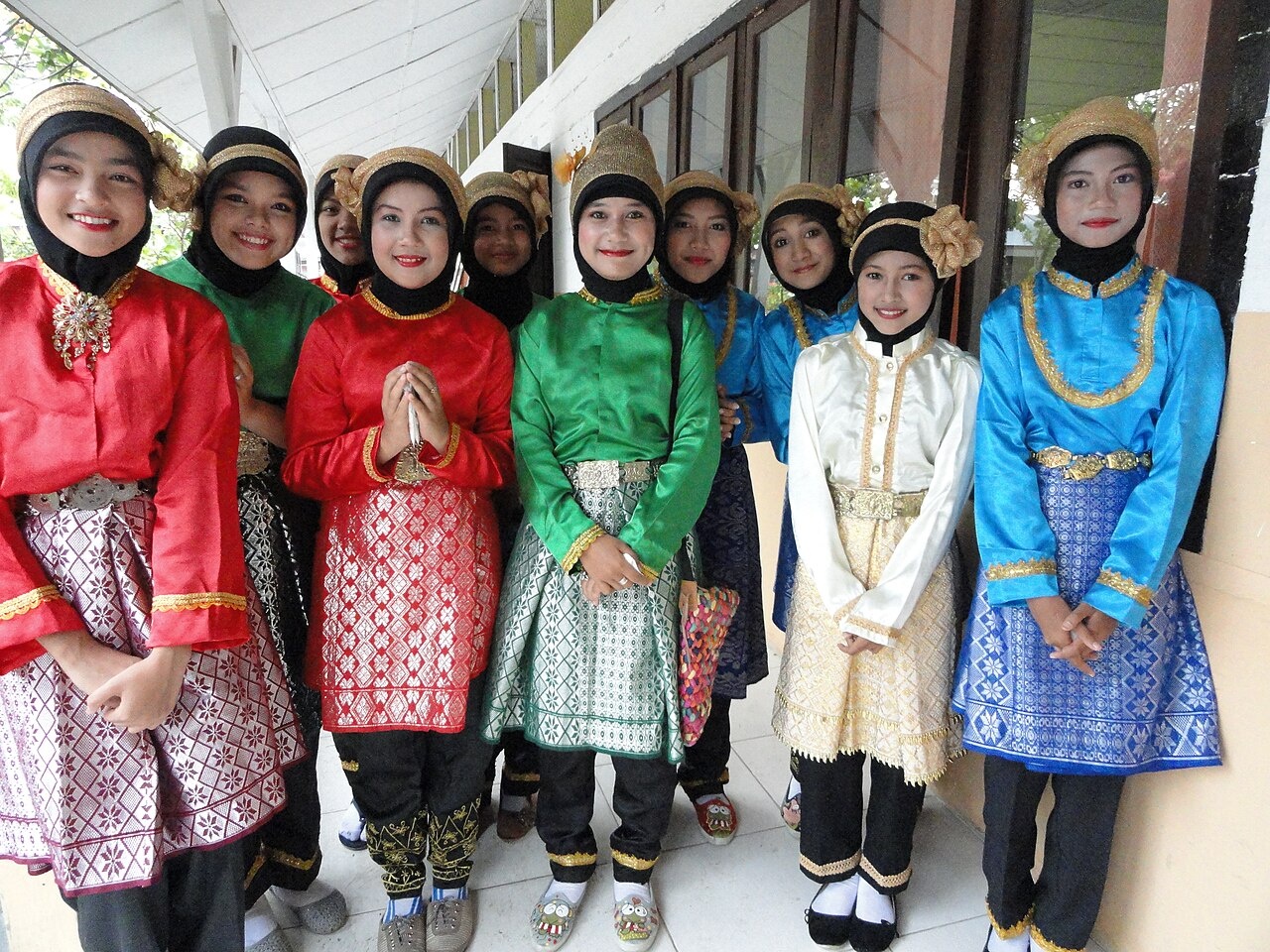
Aceh is often called Serambi Mekkah (“the Verandah of Mecca”) because of its strong Islamic identity. Even though the vast majority of Aceh’s population is Muslim, Christian, Buddhist, and Hindu minorities are also present and examples of their culture can still be found in Aceh and the Acehnese have historically shown tolerance toward other faiths, with churches and temples found in urban centers. Pencak silat, a Malay martial art distinguished by its graceful, dance-like movements, is widely practiced in Aceh and remains popular among both men and women.
Islam profoundly shapes daily life, social values, education, and artistic expression. Religious leaders known as teungku play a central role in transmitting moral and spiritual teachings, especially to children. Songs and dances commonly express Islamic devotional themes. In the past, dances were performed in royal courts for sultans and their guests or in villages as communal entertainment after agricultural labor. Many descriptions of Acehnese culture—particularly architecture, crafts, and adat (customary) ceremonies—primarily reflect the traditions of coastal Acehnese communities.
Traditional Acehnese Music features string, wind, and percussion instruments. While many show external influences, the arbab is considered indigenous. It is a three-stringed zither made from jackfruit wood, with strings fashioned from bamboo, rattan, or horsehair. Wind instruments include the seurunee kalee, a single-reed woodwind with one rear hole and seven front holes, as well as bamboo flutes such as the buloh peurindu, bansi, and suling.
Percussion instruments include gongs made from brass or dried goatskin, played with padded wooden hammers. These gongs come in three sizes, known as gong, canang, and mong-mong. Tambourines called rapai or rapai Pasai, introduced during the Samudra Pasai period, were traditionally used to summon communities. Another instrument, the tak tok, is made of bamboo and resembles the Javanese angklung. Traditionally, men play most instruments, while women sing and perform with tambourines. A typical ensemble consists of a leader, four or five musicians, and one or two boy sopranos.
RELATED ARTICLES:
ACEH: GEOGRAPHY, POPULATION, GOVERMENT, RESOURCES factsanddetails.com
ACEH HISTORY: TRADE, ISLAM, KINGDOMS, ESCAPING COLONIALISM factsanddetails.com
ACEH INSURGENCY: GRIEVANCES, GAM, FIGHTING, PEACE factsanddetails.com
ACEHNESE: RELIGION, LANGUAGE, POPULATION, ORIGINS factsanddetails.com
ACEHNESE SOCIETY: FAMILY, MARRIAGE, WOMEN factsanddetails.com
ACEHNESE LIFE: VILLAGES, CUSTOMS, FOOD, CANNABIS factsanddetails.com
ACEH TRAVEL: BANDA ACEH, BEACHES, HIGHLANDS, SIGHTS factsanddetails.com
DECEMBER 2004 TSUNAMI IN INDONESIA: DAMAGE, VICTIMS AND SURVIVOR STORIES factsanddetails.com
RELIEF AND REBUILDING AFTER THE 2004 TSUNAMI IN INDONESIA factsanddetails.com
SHARIA IN ACEH factsanddetails.com
Acehnese Literature and Folklore

Aceh was a major center of classical Malay literature. Important works produced in Acehnese cities include the royal chronicle Hikayat Raja-Raja Pasai; the mystical and controversial poetry of Hamzah Fansuri; and Nuruddin ar-Raniri’s Bustan as-Salatin (“The Garden of Kings”), an encyclopedic treatise on history and politics. Written prose and poetry in the Acehnese language emerged in the 17th century, with notable works such as the Hikayat Perang Sabil, which recounts the holy war against Dutch colonial forces.
Acehnese Folklore holds that spirits inhabit forests, swamps, river mouths, and banyan trees. The jen aphui is a fire spirit that appears as a light at night, while the sibujang itam is a frightening but magically powerful being believed to be enlisted for harmful purposes. The geunteut is described as a giant that presses down on sleeping people. Other spirits include the burong, women who died in childbirth and appear dressed in white with unnaturally long fingernails, and the burong tujuh, seven sister spirits said to threaten women during childbirth.
Tapaktuan is called the “Dragon City” because of a local legend about a pair of banished dragons who lived in its bay. Unable to have offspring, the dragons found and raised a baby girl lost at sea. Years later, a king recognized the girl as his long-lost daughter and demanded her return. When the dragons refused, a conflict broke out and was stopped by a hermit named Tuan Tapa, who ultimately defeated the dragons and returned the girl to her parents. The family then settled along the coast, and their settlement is believed to mark the origin of Tapaktuan.
See Tapaktuan Under ACEH TRAVEL: BANDA ACEH, BEACHES, HIGHLANDS, SIGHTS factsanddetails.com
Acehnese Daggers and Swords
Rencong is a distinctive Acehnese dagger that played a crucial role during the Acehnese wars. Today, it is worn as an essential element of traditional dress and is also widely valued as a cultural souvenir from Aceh. The blade is made of metal, while the hilt and scabbard are traditionally crafted from ivory, scented wood (kayu kemuning), or buffalo horn. Pattern-welded steel is commonly used for blades fitted with buffalo-horn hilts and scabbards, whereas brass alloys are often used for examples mounted with ivory or scented wood. In addition to horn, wood, and ivory, silver and gold may also be used for decorative fittings.
The form of the rencong is symbolically derived from the Islamic invocation Bismillāhirra mānirra īm (“In the name of God, the Most Merciful, the Most Compassionate”). The component parts of the rencong have been likened to individual letters of the Arabic script of phrase 'Bismillah' as follows :
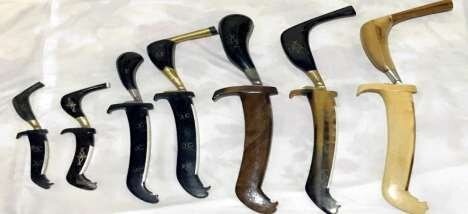
The hilt of the rencong is in the shape of 'ba'
The decorationat the base of the hilt is 'sin'
The shape of the blade is 'mim'
The shape of the metal parts at the top of the blade is 'lam'
The base of scabbard takes the shape of 'ha'
Together ba, sin, mim, lam, and ha make up the word 'Bismillah'
Siwah is another important Acehnese blade, primarily regarded as a ceremonial dagger. Historically, it was used by sultans and members of the elite. It differs from the rencong in its more bulbous hilt and its generally richer ornamentation. Siwah scabbards are often elaborately decorated with precious stones, ivory, and intricate gold filigree, especially near the mouth of the sheath. While some siwah blades are straighter than those of the rencong, both weapons share a single-edged blade that tapers to a sharp point.
Peudeung is a long sword that was widely used during the Acehnese wars and remains an important symbol of martial tradition. Each peudeung is named according to the shape of its hilt, with designs described as resembling a cat’s tail (gagang ekor kucing), crocodile’s mouth (gagang mulut buaya), deer’s horn (gagang tanduk rusa), horse’s leg (gagang kaki kuda), or duck’s tail (gagang ekor bebek). The hilt is typically adorned with a tampok, a smaller version of the star-shaped ornament worn on traditional royal Acehnese headgear. The history of the peudeung may be traced back to at least the 17th century. An Acehnese illustration from that period depicts a man wearing a shoulder strap from which two long peudeung swords protrude, attesting to their prominence in both warfare and ceremonial display.
Acehnese Clothing
Men's everyday attire consists of a shirt, sarong, and peci cap. For ceremonies, men wear a collared jacket, cekak musang pants, a pendua sarong over the pants, a makutup peci cap, and a rencong knife tucked in the front. The groom wraps a head cloth around the peci and places a kulah kama in the front.[Source: A. J. Abalahin,“Worldmark Encyclopedia of Cultures and Daily Life,” Cengage Learning, 2009]
Standard traditional Acehnese men's clothing includes full-cut black trousers and a black top with long, narrow sleeves and one button at the neck. A silk cloth (kain songket) is tied around the waist, and a rencong is tucked into the belt. A kupiah meukeutob, topped with a gold star-shaped ornament (tampok kupiah), is worn on the head. This is bound with a square of woven silk.
Most women wear a long-sleeved shirt and a sarong with a sash over the shoulder. Some women wear black, Acehnese-style pants and a short-sleeved shirt called a baju tukok. For formal and ceremonial occasions, women adorn themselves with a cekak musang and a silk pendua woven on a traditional pok teumpeun loom, a hip-length shirt, a waist sash (pending). Many women wear gold-embroidered black trousers that are narrow at the ankle and very broad at the waist. The blouse is embroidered and yellow, green, or red. The sarong is a piece of silk fabric decorated with gold or silver thread (kain songket). It is held in place by a large gold belt.
Women's jewelry includes necklaces, bracelets, and anklets. The head is adorned with an array of golden flowers called Bungong Ok, Patam Dho, or Kulah Kama. Necklaces cascade from the neck to the waist. The arms are adorned with bracelets, and rings grace the fingers. A bride wears a kulah kama crown adorned with golden hairpins and flower blossoms.
Acehnese Dance
All dances are usually performed by groups and involve dynamic movements such as stepping, chest beating, and hip and shoulder movements. They are usually performed at special government functions, but local dancing traditions and groups continue the heritage in many areas. Each region of Aceh has its own versions of dances, some of which are indigenous. The costumes are typically long-sleeved tops and sarongs wrapped around the waist, and the colors are often brilliant. Women usually wear headpieces, and the use of jewelry depends on the aspect of life depicted by the dance. All Acehnese dances have certain characteristics in common. Islamic values are often spread through these dances in Aceh. The dances depict daily social activities.
Saman is the most famous Acehnese dance and is widely known internationally as the “Thousand Hands” dance. Originating among the Alas ethnic group, it is traditionally performed to commemorate the birthday of the Prophet Muhammad and other important occasions. Eight to twenty male dancers kneel in a single row, executing tightly synchronized torso movements, hand clapping, chest slapping, and rhythmic chanting. The performance begins slowly, gradually accelerates to remarkable speed, and ends abruptly. The chants consist of praises to Allah and religious prayers, and many regional variations of Saman exist across Aceh.
Saman Inong is a female version of the Saman dance, preserving its seated formation, rhythmic body movements, and devotional themes while adapting them for women performers. Meuseukat closely resembles Saman but is performed exclusively by women and originates from western and southern Aceh. Like Saman, it features synchronized seated movements, clapping, and chanting, but reflects regional stylistic variations. Rapai Geleng is a dance created specifically for performance with the rapai tambourine. Eleven to twenty male dancers each hold a tambourine while executing movements similar to those of the Saman dance. The performance is accompanied by songs conveying Islamic teachings and is noted for its powerful rhythm and visual unity.
Pho is a deeply emotional dance that originated in southern Aceh in the 16th century and developed from the older bineuh tradition. Initially performed at the death of a sultan or nobleman, it later became part of pre-wedding rituals during the manoe pucok ceremony, when the bride is ceremonially bathed. Led by a syeh, the dancers sing songs recounting the bride’s life, her parents’ sacrifices, and her transition into marriage. The performance often moves both participants and spectators to tears.
Laweut, also known as Seudati Inong, developed during the early Islamic period in the Pidie region of northern Aceh. Performed by eight women under the leadership of a syeh, the dance functions as a devotional prayer to the Prophet Muhammad. It is performed standing and is accompanied by singing, finger snapping, stepping, thigh beating, and clapping.
Marhaban was originally performed to celebrate the birthday of the Prophet Muhammad but is now presented on a wider range of ceremonial occasions. It involves twenty performers—ten men and ten women—accompanied by special tambourines, and is often followed by collective prayers.
Seudati Agam is an Arab-influenced male dance that emphasizes strength, discipline, and religious devotion through sharp footwork, chest beating, and chanting, while Seudati Inong is its female counterpart, adapted to women performers. Perang Sabil is a modern choreographic creation commemorating Aceh’s struggle against foreign invaders. Performed by eight men and eight women, the dance dramatizes combat scenes using traditional weapons: women carry rencong daggers and men wield peudeung swords. The performance is highly energetic and requires precise control to avoid injury.
Acehnese Folk Dance
Ranub Lampuan is a welcoming dance centered on the offering of betel leaves (ranub), a traditional symbol of hospitality. Performed by nine women to the music of the seurunee kalee, the dance is commonly presented to honor distinguished guests or mark opening ceremonies. At the conclusion of the performance, the dancers formally offer betel leaves to the guests, who may accept them symbolically. Peumulia Jamee is closely related to Ranub Lampuan but omits the betel offering. The dance emphasizes gracious hospitality through elegant movement, music evocative of Arabian influences, and sung greetings that begin with “Assalamualaikum.” It is frequently performed at formal receptions and ceremonial events.
Alee Tunjang originated as a harvest dance and depicts traditional rice milling. Performed by four couples to the music of the seurunee kalee, dancers carry large wooden mortars (lesung) and long pestles (alu), symbolizing agricultural labor. Tarek Pukat depicts the daily life of coastal fishermen, including net making, rowing, fishing, and hauling nets ashore. Each dancer holds a rope, which is woven together during the performance to form a fishing net. The dance is lively, cheerful, and dynamic, accompanied by songs or musical instruments.
Bines originates among the Alas people and is based on the tragic folktale Odeni Maleleng. The dance portrays the grief of a mother whose daughter is executed by her village for adultery. Accompanied by mournful songs in the local language, the movements express sorrow, loss, and moral reflection. Didong is the most popular dance of the Gayo people and is performed by competing groups of 20 to 40 men and women. The competition emphasizes singing, movement, rhythm, and vocal strength, and the dance may be performed on almost any social occasion. Ul-Ula Lembing is a dance strongly influenced by Malay traditions and is especially popular in eastern Aceh. It is performed by four couples dressed in traditional Malay attire and emphasizes elegance and coordinated pair movements.
Daboih is less a dance than a dramatic display of physical endurance and spiritual power. Performers stab themselves with sharp weapons in rhythm with rapai tambourines, sometimes using extreme implements such as chainsaws. The performance is intense and highly theatrical. Lansir Madam is a rare remnant of the colonial period and resembles a Dutch-style square dance. It stands apart from most Acehnese dances in both form and origin, reflecting historical European influence.
Image Sources: Wikimedia Commons
Text Sources: “Encyclopedia of World Cultures Volume 5: East/Southeast Asia:” edited by Paul Hockings, 1993; A. J. Abalahin,“Worldmark Encyclopedia of Cultures and Daily Life,” Cengage Learning, 2009; National Geographic, Live Science, Metropolitan Museum of Art, Natural History magazine, Australian Museum, New York Times, Washington Post, Los Angeles Times, Smithsonian magazine, Encyclopedia.com, Times of London, Library of Congress, The Conversation, The New Yorker, Time, BBC, CNN, Reuters, Associated Press, AFP, Lonely Planet Guides, Google AI, Wikipedia, The Guardian and various websites, books and other publications.
Last updated December 2025