
POPULATION OF THE PHILIPPINES AND ITS IMPACT
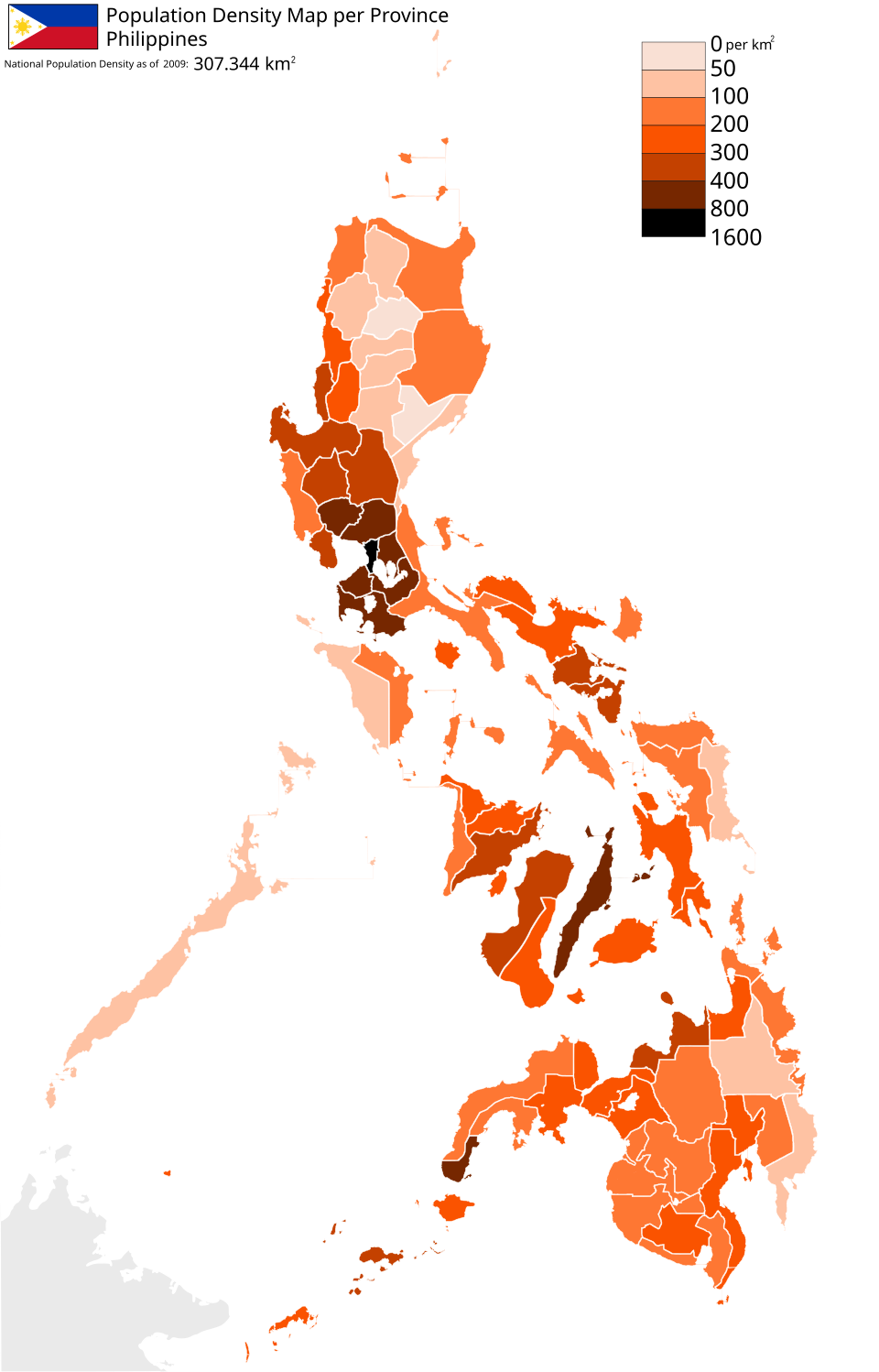
Population: 118,277,063 (2024. male: 59,227,092; female: 59,049,971), making it the 14th most populous country the world. In the early 2010s the Philippines had one of the fastest-growing populations in Asia. It was on track to increase by more than half, to 155 million, by 2050. But the rate has slowed significantly in recent years. Greater Manila is one of the most densely populated places on Earth. About a third of its 15.5 million inhabitants live in poverty, many in teeming shantytowns that sprawl across trash dumps and cemeteries. [Source: Kenneth R. Weiss, Los Angeles Times, July 22, 2012]
The total population of the Philippines was 76.5 million in the census in May 2000. The Philippine National Statistics Office estimated that the total population reached 85.2 million in 2005. There has been a continuing trend of internal migration from rural to urban areas since at least 1991. According to the 2000 census, 52 percent of the population lived in rural areas and 48 percent in urban areas, including about 12 percent who lived in the National Capital Region, or Metropolitan Manila. The Philippines has a negligible loss of population as a result of emigration, which was estimated at –1.5 migrants per 1,000 population in 2004. [Source: Library of Congress, March 2006]
The Manila area is a city bursting at the seams. According to the BBC and data from 2015, more than 70,000 people are squeezed into every square kilometer on average. The overcrowding is evident everywhere, from the mega traffic jams to the jails, where people sleep like sardines in cells that are 300 percent over capacity. And, it is the poor that suffer the most, living in the most overcrowded areas. Former socio-economic planning secretary Ernesto Pernia credited a reduction in the fertility rate with recent poverty reduction gains.[Source: Howard Johnson & Virma Simonette & Flora Drury, BBC News, December 23, 2020]
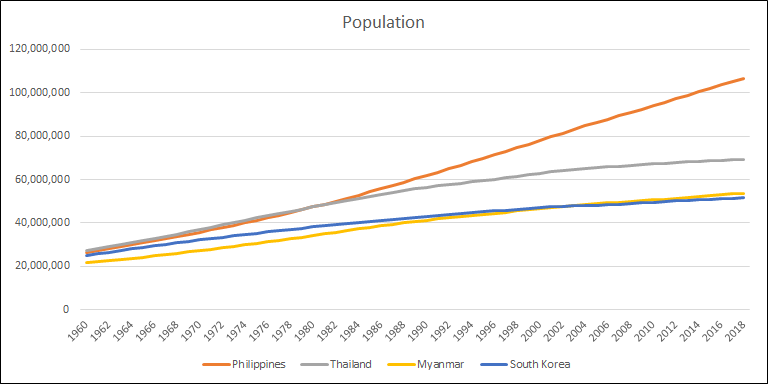
In 1970, Thailand and the Philippines each had populations of about 36 million and were growing at roughly 3 percent annually. Thailand later adopted an aggressive family planning program that provided free contraceptives to the poor, reducing its population growth rate to 0.9 percent. By contrast, the Philippines’ growth rate declined more slowly, to about 2.1 percent, resulting in roughly 26 million more people than Thailand today. Economist Ernesto M. Pernia of the University of the Philippines argued that the demographic divergence had major economic consequences. He noted that the Philippines produced about 16 million metric tons of rice annually but still needed to import 2 million tons to meet domestic demand. Had the country followed Thailand’s population policies, Pernia estimated it would have needed only 13 million tons per year and could have exported a surplus of 3 million tons. Beyond food security, Pernia contended that adopting Thailand’s population growth trajectory could have lifted an additional 3.6 million Filipinos out of poverty. He maintained that, even amid corruption and insurgency, strong population policies across Asia had consistently contributed to meaningful poverty reduction. [Source: Blaine Harden, Washington Post. April 21, 2008 =]
RELATED ARTICLES:
BIRTH CONTROL IN THE PHILIPPINES: CONTRACEPTIVES, CATHOLICS, REPRODUCTIVE HEALTH LAW factsanddetails.com
PEOPLE OF THE PHILIPPINES: FILIPINOS, IDENTITY, CHARACTERISTICS factsanddetails.com
AUSTRONESIAN PEOPLE OF THE PACIFIC, INDONESIA, MALAYSIA, TAIWAN AND THE PHILIPPINES: ORIGIN, HISTORY, EXPANSION factsanddetails.com
MALAYS AND MALAY-RELATED PEOPLE: HISTORY, DEFINITIONS, ORIGINS, LIFE, CULTURE factsanddetails.com
ETHNIC GROUPS AND MINORITIES IN THE PHILIPPINES factsanddetails.com
MAIN ETHNIC GROUPS OF LUZON: TAGALOGS, ILOCANO AND BICOL factsanddetails.com
ETHNIC GROUPS OF THE CENTRAL PHILIPPINES ISLANDS: VISAYANS, CEBUANO, WARAY factsanddetails.com
MOROS: MUSLIMS IN MINDANAO AND THE SOUTHERN PHILIPPINES factsanddetails.com
LANGUAGES IN THE PHILIPPINES factsanddetails.com
RELIGION IN THE PHILIPPINES factsanddetails.com
Philippines Demographics

Philippines Age structure: 0-14 years: 30.2 percent (male 18,234,279/female 17,462,803); 15-64 years: 64.3 percent (male 38,381,583/female 37,613,294); 65 years and over: 5.6 percent (2024 est.) (male 2,611,230/female 3,973,874). Median age: total: 27.1 years (2025 est.); male: 25.1 years; female: 26.3 years [Source: CIA World Factbook, 2025 =]
Ninety-five percent of the Filipinos (Pilipinos) live on the eleven largest islands, with populations concentrated in areas with good farmland. The highest concentrations are northwest and south-central Luzon, the southeastern extension of Luzon, and the islands of the Visayan Sea, particularly Cebu and Negros; Manila is home to one eighth of the national population
Total fertility rate: 1.94 children born (2025 estimate), down from 3.06 children born per woman in 2014. Sex ratio: at birth: 1.05 male(s)/female; 0-14 years: 1.04 male(s)/female; 15-24 years: 1.04 male(s)/female; 25-54 years: 1.01 male(s)/female; 55-64 years: 1 male(s)/female; 65 years and over: 0.76 male(s)/female; total population: 1 male(s)/female (2024 est.). Dependency ratios: total dependency ratio: 55.6 (2024 est.); youth dependency ratio: 47 (2024 est.); elderly dependency ratio: 8.7 (2024 est.) | potential support ratio: 11.5 (2024 est.)
As of 2005, 35 percent of the population was 0–14 years of age; 61 percent, 15–64; and 4 percent, 65 and older. According to 2004 data, the gender ratio for the rising generation was 104 males for every 100 females. The birthrate was 25.8 births per 1,000 population. The death rate was 5.5 deaths per 1,000 population. Infant mortality was 24.2 deaths per 1,000 live births. Life expectancy at birth was 66.7 years for males, 72.6 years for females, and 69.6 years overall. The fertility rate was 3.2 children born per woman. [Source: Library of Congress, March 2006 **]
Population Growth in the Philippines
Population growth 0.74 percent (2025 est.), compared to 1.81 percent in 2014. The average annual population growth rate from 1998 to 2004 was 2.1 percent. Birth rate: 16.02 births per 1,000 population (2025 est.), compared to 24.24 births per 1,000 population in 2014. Death rate: 5.8 deaths per 1,000 population (2025 est.), compared to 4.92 deaths per 1,000 population in 2014. Gross reproduction rate: 0.94 (2025 est.). The Philippines has one of the world's highest negative net migration rates: -2.82 migrant(s)/1,000 population (2025 est.), compared to -1.23 migrant(s)/1,000 population in 2014. [Source: CIA World Factbook]
The population of the Philippines in 1960 was around 27 million, a third of what it is now. The 2.2 percent annual growth rate in the Philippines in the 1990s was among the highest in East Asia. Many economists have argued that the Philippines’s high growth rate is the country’s single largest development and economic problem. Unemployment rates are high and getting higher primarily because the economy can not produce enough jobs to keep up with population growth. High population growth has also resulted in overcrowded classrooms, strained social services, environmental degradation and the large numbers of people seeking jobs overseas.
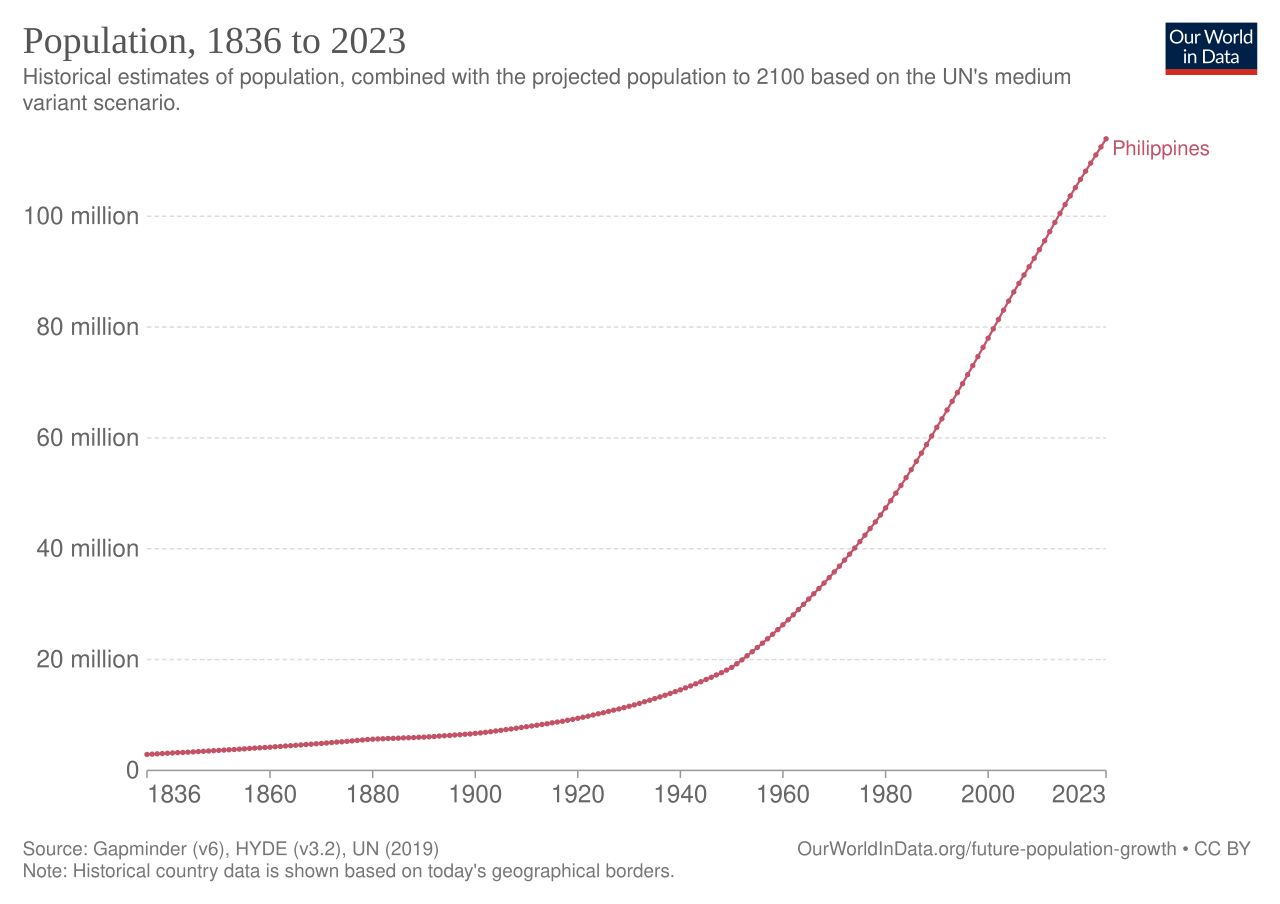
The Philippine population in the early 1990s continued to grow at a rapid, although somewhat reduced rate from that which had prevailed in the preceding decades. In 1990 the Philippine population was more than 66 million, up from 48 million in 1980. This figure represents an annual growth rate of 2.5 percent, down from 2.6 percent in 1980 and from more than 3 percent in the 1960s. Even at the lower growth rate, the Philippine population will increase to an estimated 77 million by the year 2000 and will double every twenty-nine years into the next century. Moreover, in 1990 the population was still a youthful one, with 57 percent under the age of twenty. The birth rate in early 1991 was 29 per 1,000, and the death rate was 7 per 1,000. The infant mortality rate was 48 deaths per 1,000 live births. Population density increased from 160 per square kilometer in 1980 to 220 in 1990. The rapid population growth and the size of the younger population has required the Philippines to double the amount of housing, schools, and health facilities every twenty-nine years just to maintain a constant level. [Source: Library of Congress, 1991]
Philippines Welcomes Its 100 Millionth Baby
A baby girl born in late July 2014 officially pushed the Philippine population to 100 million. Writing in the Philippine Star, Mayen Jaymalin reported that the child, named Chonalyn, was one of ुङsymbolic 100 babies born in state hospitals across the archipelago who were designated as the country’s “100,000,000th baby.” Juan Anh Antonio Perez III, executive director of the Commission on.autoconPopulation (PopCom), described the milestone as both an opportunity and a challenge, noting that while a growing population meant a larger future workforce, it also meant more dependents in a country where about 25 percent of people were living in poverty. [Source: Mayen Jaymalin. Philippine Star, July 28, 2014]
Chonalyn’s mother, Dailin Cabigayan, 27, said she had not known that the Department of Health (DOH) and PopCom were awaiting the milestone birth until after she went into labor. She and her partner, Clemente Sentino Jr., 45, went to Dr. Jose Fabella Memorial Hospital late on a Saturday night, and she gave birth at 12:35 a.m. to a 2.8-kilogram, /cop 45-centimeter baby girl. Chonalyn was Cabigayan’s first child and Sentino’s second. “She is heaven’s gift to us,” Cabigayan said.
Hospital officials noted that several other women had been scheduled to deliver that night, but Cabigayan gave birth ahead of them. A former domestic helper, she hoped to stop working to focus on caring for her child, while Sentino, a van driver, expressed confidence he could support the family. The couple was not yet married but said they planned to wed. “I make just enough to get by but at least my job pays regularly. We will find a way to make it fit,” Sentino said.
Officials from the DOH and PopCom presented gifts and starter kits worth 5,000 pesos to Chonalyn and the other symbolic babies, along with lifetime PhilHealth membership and free immunizations. Health Secretary Enrique Ona said the child would benefit from government health services and could have a life expectancy of up to 80 years. Perez added that the country needed to expand services for poor families while reducing fertility from about three children per woman to two. Efforts to slow population growth, however, had long been complicated by the influence of the Catholic Church, which opposed artificial birth control.
Philippine Population Growth Slows as Contraceptive Use Increases
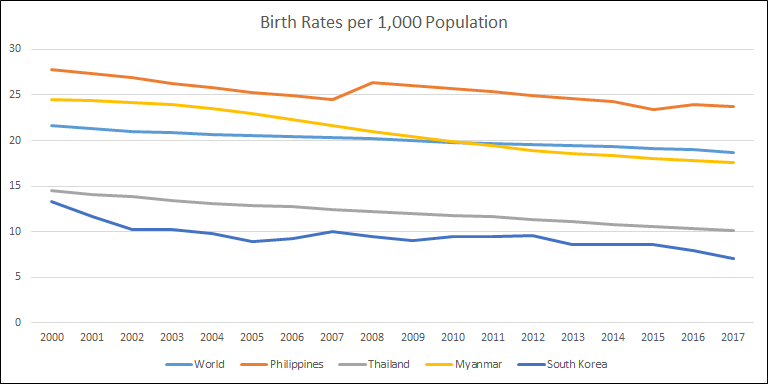
The Philippines’ annual population growth rate in the early and mid 2010s declined as people in the country began using contraception more. Results of the 2015 census showed that the population grew by 1.72 percent, down from 1.9 percent recorded in 2010, according to the Commission on Population. The total population reached 100.98 million—about half a million lower than had been forecast in 2010, said Executive Director Juan Antonio Perez III. According to United Nations data, the Philippines was the 12th most populous country in the world.[Source: Teresa Cerojano, Associated Press, May 25, 2016]
Perez said the increased use of modern contraceptives contributed to the slowdown. By 2015, about 45 percent of couples were using modern contraceptive methods, up from 38 percent in a 2013 national survey. He noted that fertility was also declining naturally as more women chose to have fewer children. Projections using the same growth formula indicated the population would reach 103.48 million by the end of that year.
The trend followed the passage of the Responsible Parenthood and Reproductive Health Act of 2012, which provided government funding for contraceptives despite strong opposition from Catholic Church leaders. The law took effect after the Supreme Court ruled in 2014 that it was constitutional, with a few provisions struck down. Census data also revealed significant differences in family size across socioeconomic groups: wealthier Filipinos typically had one or two children, while the poorest families often had five or more—about two more than women said they desired.
Perez added that poorer regions outside Manila tended to have higher fertility rates. With slower growth, the population was projected to double in about 40 years—two years later than previously expected—giving the country more time to address the unmet need for family planning among an estimated 4 million to 5 million couples. However, Perez said proposals by then-presidential candidate Rodrigo Duterte to limit families to three children could not be mandated, since the law guaranteed couples the informed choice to decide how many children to have.
Covid-19 Baby Boom in The Philippines
Lockdowns during the Covid-19 pandemic in 2019 to 2021 left hundreds of thousands of Filipino women unable to access birth control, leading to a surge in unplanned pregnancies across the country. Projections by the University of the Philippines Population Institute and the United Nations Population Fund estimated that an additional 214,000 unintended babies would be born in 2021. These births were expected to strain hospitals already handling about 1.7 million deliveries annually and to add pressure on families struggling economically. [Source: Howard Johnson & Virma Simonette & Flora Drury, BBC News, December 23, 2020]
Officials from the Commission on Population and Development cautioned that unplanned pregnancies could increase from three in every ten to as many as half of all pregnancies in a worst-case scenario. Hospitals braced for a “baby boom,” including Dr. Jose Fabella Memorial Medical Hospital in Manila, once dubbed “The Baby Factory” for delivering up to 120 babies a day before reforms reduced the number.
Overcrowded maternity wards, unfinished expansion projects, and virus outbreaks among staff highlighted the strain on the health system. Budget constraints further hampered family planning programs, which received only a fraction of the funding considered necessary. Meanwhile, teenage pregnancy—already the second highest in Southeast Asia—was projected to rise by 20 percent. For women like Rovelie, living in poverty in Manila’s densely populated Baseco district, the combined pressures of job losses, limited contraceptive access, and economic recession deepened fears about supporting their children’s education and escaping intergenerational poverty.
High Birthrates Help Keep Filipinos in Poverty
Blaine Harden wrote in the Washington Post, “Maria Susana Espinoza wanted only two children. But it was not until after the birth of her fourth child in six years that she learned any details about birth control. “I knew it existed, but I didn’t know how it works,” said Espinoza, who lives with her husband and children in a squatter’s hut in a vast, stinking garbage dump by Manila Bay. She and her family belong to the fastest-growing segment of the Philippine population: very poor people with large families. There are many reasons why this country is poor, including feudal patterns of land ownership and corrupt government. But there is a compelling link between family size and poverty. It increases in lock step with the number of children, as nutrition, health, education and job prospects all decline, government statistics and many studies show. [Source: Blaine Harden, Washington Post. April 21, 2008 =]
“Birth and poverty rates here are among the highest in Asia. And the Philippines, where four out of five of the country’s people are Roman Catholic, also stands out in Asia for its government’s rejection of modern contraception as part of family planning. In 2008, public alarm in the Philippines over the soaring price of rice has focused attention on the fast-growing population and its dependence on rice imports. Despite steadily increasing rice harvests, farmers here have been unable to keep pace with domestic demand. Economists here have calculated, though, that the Philippines would not need imported rice if it had managed to control population growth — like its neighbor Thailand. =
“In the garbage dump on Manila Bay, Espinoza said she is nervous about getting an IUD. But she sees no alternative. “I already have so many kids I have trouble looking after them,” she said. Until her fourth child was born in October, Espinoza, 26, had time to work as a scavenger in the dump, collecting plastic bottles. On a good 10-hour day, she said, she could collect enough bottles to earn $1. Her husband sells salt and sometimes makes $4 a day. Espinoza is the oldest of nine children and left school after fifth grade. She grew up in another Manila garbage dump, where her parents also worked as scavengers. “I don’t want any more children,” she said. “Life is hard. Rice is expensive.” =
Poor Filipino Family with a Lot of Kids
Kenneth R. Weiss wrote in the Los Angeles Times: “Shortly after sunrise, a woman with soulful eyes and short-cropped black hair hurried down a narrow alley in flip-flops, picking her way around clusters of squatting children, piles of trash and chunks of concrete. Yolanda Naz's daily scramble had begun. Peddling small shampoo packets in the shantytown of San Andres, she raced to earn enough money to feed her eight children. She went door to door in the sweltering heat, charming and cajoling neighbors into parting with a few pesos. After several hours, she had scrounged enough to buy a kilo of rice, a few eggs and a cup of tiny shrimp. [Source: Kenneth R. Weiss, Los Angeles Times, July 22, 2012 |::|]
"My husband and I skip lunch if there is no money," Naz said as she dished rice and shrimp sauce into eight plastic bowls in the 10-by-12-foot room where the family eats and sleeps. This was not the life Naz wanted. She and her husband, who sells coconut drinks from a pushcart, agreed early in their marriage to stop at three children. Though a devout Catholic, she took birth control pills in defiance of priests' instructions at Sunday Mass. |::|
“But after her third child was born, the mayor of Manila — with the blessing of Roman Catholic bishops — halted the distribution of contraceptives at public clinics to promote "a culture of life." The order put birth control pills and other contraceptives out of reach for millions of poor Filipinos, who could not afford to buy them at private pharmacies. "For us, the banning of the pills was ugly," Naz said. "We were the ones who suffered." At 36, she had more children than teeth, common for poor women after repeated pregnancies and breast-feeding. |::|
“Undernourished and living in close quarters, her children were often sick. Measles was sweeping through the shantytown, afflicting two of Naz's sons and her 3-year-old daughter, Jasmine, who hung like a rag doll from her mother's arms. "I pray to God. I pray really, really hard," she said. "Should God decide to take my kids, just don't let them suffer." |::|
“Yolanda Naz began to stack up the plastic bowls and plates from the midday meal. Her family had devoured every morsel. A boy came to the door with an orange garden hose. For a few pesos, Naz can fill a plastic barrel with water for cooking, cleaning and bathing. Naz picked through the remaining coins from her shampoo sales to see if there was enough for the next meal. On a good day, her husband, Noel, earned about $5 selling coconut drinks from his cart. That was enough to pay for rice, instant noodles, some eggs, vegetables, even some milk and a diaper for the baby. But Noel is afflicted with a racking cough that often keeps him from working. Naz sometimes buries her pride and asks neighbors for a loan of 10 cents or a bit of food. |::|
Youthful Filipinos Gives the Philippines an Economic Boost
Floyd Whaley wrote in the New York Times, “In the upscale business district of Manila, a midweek crowd spills out into the street. The New York-themed Borough restaurant is pulsating to the beat of a Bon Jovi song, while young, hip Filipinos take shots of tequila from a passing tray and sing in unison. “Whoa-oh, we’re halfway there!” the crowd sings. “Whoa-oh, livin’ on a prayer!” The revelers have reason to celebrate. Times are pretty good in the Philippines if you are young, skilled and live in the city. Young urban workers are helping to give the country its brightest prospects in decades, economists say.[Source: Floyd Whaley, New York Times, August 27, 2012 ]
“A high population growth rate, long considered a hindrance to prosperity, is now often seen as a driving force for economic growth. About 61 percent of the population in the Philippines is of working age, between 15 and 64. That figure is expected to continue increasing, which is not the case for many of its Asian neighbors, whose populations are aging. “There are a number of countries in Asia that will see their working-age populations decline in the coming years,” Mr. Neumann said. “The Philippines stands out as the youngest population. As other countries see their labor costs go up, the Philippines will remain competitive due to the sheer abundance of workers joining the labor force.”
“Many of those workers are feeding the country’s robust outsourcing industry. The Philippines, where English is widely spoken, surpassed India last year as the world’s leading provider of voice-based outsourcing services like customer service call centers. Other countries in the region, most notably China and Japan, but also Thailand and Vietnam, have successfully developed export-driven manufacturing, bringing millions of people out of poverty and increasing the size of their middle classes. Manufacturing typically draws workers away from agriculture, which pays less. But many of the large foreign companies that financed such transitions to manufacturing in Asia have avoided the Philippines because of periods of political instability. The service sector — including the young call center workers who were recently reveling in Manila — are helping drive an economic boom in the cities.
“But that type of outsourcing still provides only about 1 percent of jobs in the country, according to data from the Asian Development Bank. And the strong sector does not create jobs accessible to farmers or to millions of other Filipinos in rural areas who seek a way out of poverty. “While the Philippines’ business process outsourcing industry has grown impressively, it still employs a very small portion of the country’s work force,” noted Rajat M. Nag, a managing director of the Asian Development Bank. “It needs to aggressively develop its manufacturing sector to create more jobs.”
Migration in the Philippines
The Philippines has one of the world's highest negative net migration rates: -2.82 migrant(s)/1,000 population (2025 est.), compared to -1.23 migrant(s)/1,000 population in 2014. In 2005, the net migration rate was negative at -1.49 migrants per 1,000 population. While the government regarded emigration as too high, it considered immigration levels manageable. Remittances from overseas Filipino workers reached $8 billion in 2003, underscoring the economic importance of migration. [Source: CIA World Factbook, 2025]
Rapid population growth in the Philippines fueled significant internal migration. On Luzon, settlers moved into more remote, frontier-like areas, while the islands of Mindoro and Palawan attracted new migrants. Hundreds of thousands of land-seeking Filipinos also relocated to less densely populated Mindanao. At the same time, large numbers migrated to metropolitan Manila, particularly from central Luzon, intensifying urban growth. [Source: Worldmark Encyclopedia of Nations, Thomson Gale, 2007]
Overseas emigration was also substantial. In the late 1980s and early 1990s, more than 500,000 Filipinos were working abroad, mainly in the Middle East, as well as in Hong Kong and Singapore. Migration to the United States was especially significant. According to the 2000 U.S. census, 1,369,070 Americans—about 0.85 percent of the U.S. population—claimed Filipino ancestry, most residing in California and Hawaii. In
Migration Trends in the Philippines in the 1980s and 90s
There were two significant migration trends that affected population figures in the 1970s and the 1980s. First was a trend of migration from village to city, which put extra stress on urban areas. As of the early 1980s, thirty cities had 100,000 or more residents, up from twenty-one in 1970. Metro Manila's population was 5,924,563, up from 4,970,006 in 1975, marking an annual growth rate of 3.6 percent. This figure was far above the national average of 2.5 percent. Within Metro Manila, the city of Manila itself was growing more slowly, at a rate of only 1.9 percent per annum, but two other cities within this complex, Quezon City and Caloocan, were booming at rates of 4 percent and 3.5 percent, respectively. [Source: Library of Congress *]
A National Housing Authority report revealed that, in the early 1980s, one out of four Metro Manila residents was a squatter. This figure represented a 150 percent increase in a decade in the number of people living in shantytown communities, evidence of continuing, virtually uncontrolled, rural-urban migration. The city of Manila had more than 500,000 inhabitants and Quezon City had 371,000 inhabitants in such neighborhoods. Moreover, rural-urban migrants, responding to better employment opportunities in peripheral metropolitan cities such as Navotas, had boosted the percentage of squatters in that city's total population. *
A second major migration pattern consisted of resettlement from the more densely to the less densely populated regions. As a result of a population-land ratio that declined from about one cultivated hectare per agricultural worker in the 1950s to about 0.5 hectare by the early 1980s, thousands of Filipinos had migrated to the agricultural frontier on Mindanao. According to the 1980 census, six of the twelve fastest growing provinces were in the western, northern, or southern Mindanao regions, and a seventh was the frontier province of Palawan. Sulu, South Cotabato, Misamis Oriental, Surigao del Norte, Agusan del Norte, and Agusan del Sur provinces all had annual population growth rates of 4 percent or more, a remarkable statistic given the uncertain law-and-order situation on Mindanao. Among the fastestgrowing cities in the late 1970s were General Santos (10 percent annual growth rate), Iligan (6.9), Cagayan de Oro (6.7), Cotabato (5.7), Zamboanga (5.4), Butuan (5.4), and Dipolog (5.1) — all on Mindanao. *
By the early 1980s, the Mindanao frontier had ceased to offer a safety valve for land-hungry settlers. Hitherto peaceful provinces had become dangerous tinderboxes in which mounting numbers of Philippine army troops and New People's Army insurgents carried on a sporadic shooting war with each other and with bandits, "lost commands," millenarian religious groups, upland tribes, loggers, and Muslims. Population pressures also created an added obstacle to land reform. For years, there had been demands to restructure land tenure so that landlords with large holdings could be eliminated and peasants could become farm owners. In the past, land reform had been opposed by landlords. In the 1990s there simply was not enough land to enable a majority of the rural inhabitants to become landowners. International migration has offered better economic opportunities to a number of Filipinos without, however, reaching the point where it would relieve population pressure. Since the liberalization of United States immigration laws in 1965, the number of people in the United States having Filipino ancestry had grown substantially to 1,406,770 according to the 1990 United States census. In the fiscal year ending September 30, 1990, the United States Embassy in Manila issued 45,189 immigrant and 85,128 temporary visas, the largest number up to that time. *
In addition to permanent residents, in the late 1980s and early 1990s, more than half a million temporary migrants went abroad to work but maintained a Philippine residence. This number included contract workers in the Middle East and domestic servants in Hong Kong and Singapore, as well as nurses and physicians who went to the United States for training and work experience, a fair proportion of whom managed to become permanent residents. The remittances sent back to the Philippines by migrants have been a substantial source of foreign exchange. *
Image Sources: Wikimedia Commons
Text Sources: “Encyclopedia of World Cultures Volume 5: East/Southeast Asia:” edited by Paul Hockings, 1993; “Culture Shock!: Philippines” by Alfredo Roces and Grace Roces, Marshall Cavendish International, 2010; National Geographic, Live Science, Philippines Department of Tourism, New York Times, Washington Post, Los Angeles Times, Smithsonian magazine, Encyclopedia.com, Library of Congress, The Conversation, The New Yorker, Time, BBC, CNN, Reuters, Associated Press, AFP, Lonely Planet Guides, Google AI, Wikipedia, The Guardian and various websites, books and other publications.
Last updated March 2026