
BEARS IN RUSSIA
Russia has the largest brown bear population in the world, with an estimated population of at least 125,000 animals. There are four brown bear subspecies in Russia: 1) European brown bears (Ursus arctos arctos), 2) Kamchatkan brown bears (Ursus arctos beringianus), 3) East Siberian brown bear (Ursus arctos collaris) and 4) Ussuri brown bear (Ursus arctos lasiotus).
Brown bears are still a common game species in most areas of Russia. European Russia experienced a considerable increase in numbers and range in the late 1970s and 1980s. In the late 1990s, however, the populations in Kola and Karelia decreased. The range of brown bears are expected to remain stable in Asian Russia, although extensive poaching in the Far East will likely cause regional declines. Humans are the most significant source of mortality for adult brown bears. Hunting, human-bear conflicts, and poaching can become significant problems. This is especially true in areas where the human presence is increasing and bears begin to associate humans with garbage and other sources of food. Habitat fragmentation and loss from industrial and other development contributes substantially to overall brown bear mortality. In a few areas, brown bear populations have been reduced to increase the populations of other animals, such as moose. Although the global population of brown bears are in good shape today, the combination of these and other impacts such as climate change are threats to the species in many areas. [Source: barentsinfo.org]
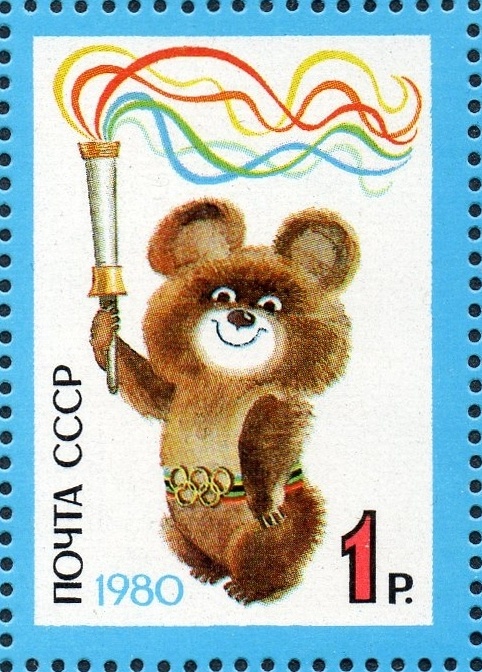
The bear is both a symbol of Russia and a characterization of both the positive and negative image of the country. They are also fixtures of Russian circuses. There are relatively few black bears in Russia and they live in the Far East. The Ussuri black bear (Ursus thibetanus ussuricus), also known as the Manchurian black bear, is a large subspecies of the Asian black bear native to the Russian Far East, Northeast China and the Korean Peninsula. Ussuri Taiga in the Far East is the home of Asian black bears. Wrangell Island is a prime breeding area for polar bears. But the the bear associated most with Russia are brown bears.
East Siberian brown bears (Ursus arctos collaris) occupy a large range, including the majority of Siberia from the Yenisei River to as far south as the Altai Mountains in northern Mongolia, northernmost Xinjiang and northeastern Kazakhstan. They ranges as far north as the southwestern Taymyr Peninsula and the Anabar River and as far east as the coast of the Bering Strait. Their range overlaps with that of Eurasian brown bears in west-central Russia. East Siberian brown bears are fairly dark, but some are as pale as grizzly bears. They are intermediate in size with a proportionately larger skull than other subspecies. In the sub-Arctic region of Yakutia, bears are reportedly quite small compared to other regions.
On the brown bears found in the Russian Far East, the Russian naturalists Yury Dunishenko and Alexander Kulikov wrote: "The brown bear is mostly an herbivore, and its problem is that our winters are long. If a bear can’t store up enough fat for five long winter months, it might as well not bother to hibernate. You can’t just suck nourishment out of your paw! When the taiga was wild and Korean pine forests and walnut groves provided stable harvests, bears encountered fewer problems. Now a bear is sometimes forced, before sacking out, and during the spring famine, to go for higher calorie victims. And so it begins to sneak up on wild boar, red Manchurian deer, and elk; it attacks the helpless newborns. [Source: “The Amur Tiger” by Yury Dunishenko and Alexander Kulikov, The Wildlife Foundation, 1999 ~~]
RELATED ARTICLES:
BEAR ATTACKS IN RUSSIA factsanddetails.com
BROWN BEARS: CHARACTERISTICS, HISTORY, SIZE factsanddetails.com
BROWN BEAR FEEDING: DIET, HABITS, HUNTING, SALMON factsanddetails.com
BROWN BEAR BEHAVIOR: SENSES, HIBERNATION, REPRODUCTION factsanddetails.com
BROWN BEAR SUBSPECIES: BIG, RARE ONES AND WHERE THEY LIVE factsanddetails.com
BROWN BEARS IN EUROPE: LOCAL VARIANTS, WHERE THEY LIVE, REWILDING, ISSUES factsanddetails.com
BROWN BEARS AND HUMANS factsanddetails.com
BEARS: HISTORY, EVOLUTION, HABITAT, HUMANS, PIZZLIES factsanddetails.com
BEAR CHARACTERISTICS: PHYSIOLOGY, DIET, LIFESPAN factsanddetails.com
BEAR HIBERNATION, REPRODUCTION, CUBS factsanddetails.com
BEAR BEHAVIOR: TERRITORIALITY, HABITUATED TO HUMANS, OPENING CARS factsanddetails.com
Bears and Russian Minorities
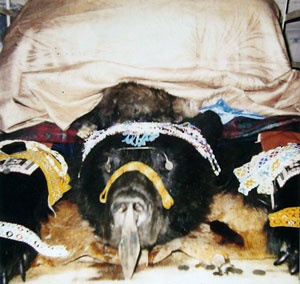
Bears have a high a place in the folklore and religion of several indigenous groups in Siberia. The Yakuts believe it is bad luck to kill a bear and will not do it unless it is absolutely necessary. One man had a friend who shot a polar bear as it was sleeping peacefully on a floating piece of ice. Soon afterwards the friend’s son drowned.
Before firearms became widely used the Even ethnic grooup hunted bears alone with a spear and knife. The hunter encouraged the bear to charge and when it did the hunter threw a piece of cloth in the air to get the animal to rise up on its hind legs, leaving its chest area exposed. The hunter then kneeled and extended the spear forward. When the bear tried to lung for the hunter it impaled itself on the spear. The hunter usually had a dog with him whose purpose was to distract the bear if something went wrong with the hunt, allowing the hunter to escape.
The Khanty believe the bear is the son of Torum, master of the upper and most sacred region of heaven. According to legend the bear lived in heaven and was allowed to move to earth only after he promised to leave the Khanty and their reindeer herds alone. The bear broke the promise and killed a reindeer and desecrated Khanty graves. A Khanty hunter killed the bear, releasing one of the bear spirits to heaven and the rest to places scattered around the earth. The Khanty have over 100 different words for bear. They generally don't kill bears but are permitted to kill them if they feel threatened. The Khanty walk softly in the forest so as not to disturb them.
Khanty Bear Festival
The most important ritual in Khanty life has traditionally been the ceremony that takes place after a bear is killed. Dating perhaps back to Stone Age, the purpose of the ceremony is to placate the bear’s spirit and ensure a good hunting season. The last bear festival to serve as an initiation was held in the 1930s but they have been were held in secular terms since then. Hunting bear was taboo except at these festivals.
Lasting anywhere from one to four days, the bear festival featured costumed dances and pantomimes, bear games, and ancestral songs about bears and the legend of the Old Clawed One. Several reindeer were sacrificed. The climax of the festival was a shaman ritual in which the head of the slain bear was placed in the middle of the table.
Describing a Khanty shaman, Alexander Milovsky wrote in Natural History: "Suddenly Oven took up a frame drum and beat upon it, gradually increasing the tempo. As he stepped into the middle of the room, the sacrament of the ancient dance began. Oven's movements became more agitated as he entered his deep trance and 'flew' to the other world where he contacted the spirits."
Next the man who killed the bear apologized for his actions and asked the bear's head for forgiveness by bowing and singing an ancient song. This was followed by a ritual play, with actors in birch bark masks and deerskin clothes, dramatizing the role of the first bear in the Khanty creation myth.
The Khanty bear games include bawdy sexual role reversal dances, anti-Russian skits, plays that make fun of awkward hunters that fall through holes on the ice, and dances in which female "reindeer" in pink dresses try to get away from male hunters. Tolstoy described similar rituals in his account of the "the theater of the savage Voguls." (Voguls were an old name for the Mansi).
Khanty bear festival
Tolstoy wrote: "A third Vogul played the part of a hunter. He held a bow and arrow and had snowshoes on his feet. A forth depicted a bird that warned the reindeer of danger. The hunter talked to the doe and its young relentlessly. That, indeed, was the drama of the piece. The deer ran off the stage and then came running back. The performance took place in a [tepee]. The hunter came closer and closer and wounded the calf. Exhausted, it pressed up against its mother, who licked the wound. The hunter drew a second arrow. The audience, as those present related, held its breath. There were sighs of sympathy. Someone even sobbed."
Bears in Kamchatka
Kamchatka is the home to between 10,000 and 20,000 bears. About 8,000 of them are brown bears, one of the largest populations in the world. The brown bears found in Kamchatka are slightly larger than American grizzly bears. They grow fat on eating the plentiful supplies of char and salmon and berries that grow in the tundra meadows.
Large numbers of bear live around Kambalnoya Lake in South Kamchatka Sanctuary. A Canadian named Charlie Russell had a cabin in the area and became quite friendly with the about 20 bears in area, raising three orphaned bears himself and writing a popular book about them, “Grizzly Heart”. One spring he returned and found none of the bears but found a bear gall bladder pinned up in side his cabin. He suspects the bears were killed by poachers. It wasn’t clear whether the gall bladder was a message or an oversight. Russell worried that being friendly with the bears might lead to their demise (the bears might have been too trustful of humans and allowed the poachers to approach them).
During the spring the bears around Kurilskoye Lake emerge from hibernation "hungry, sex-starved and irritable" and wander through settlements on the lake as they approach the shore to fish. They often tear up gardens and root through garbage, Over the years more than 100 problem bears have been killed.
In the summer of 1993 one pulled a camper from a tent and mauled him. Local residents later tracked and shot the bear. In 1996, the Japanese-American bear photographer Michio Hoshimo was pulled form his tent and eaten by a bear at Kronotsky Nature Reserve.
Bear Hunting in Kamchatka
In Kamchatka, about a thousand bears are killed each year legally by hunters—300 by foreign hunters who pay US$10,000 for the privilege—and the remainder by professional hunters. No one knows how many of the animals are poached, but with bear gall bladders selling for hundreds, even thousands of dollars in China there is certainly incentive enough.
Officials in Kamchatka banned helicopter hunting after half the population of brown bears was killed in five years. Now the population has stabilize around 5,000. Many of the hunters were old men in their 70s and even 80s who coudd barely see, In some cases helicopters were used to drive the bears into killing zones where the elderly hunters could easily pick them off. Some even shot them from the helicopters. Traditional sportsmen consider this kind of hunting very unsporting and some of these tactics are illegal.
Bear Hunting with Dogs
Bears in Russia are often hunted with dogs, sometimes with packs of 40 dogs. Dogs are trained to find bear tracks, follow the tracks, have no fear when faced with the bear and bark loudly to alert the attention of hunters. Dogs may try to nip the bears but generally are incapable of seriously injuring them. You don't often hear about packs of wolves attacking a bear.
Most dogs instinctively feel fear in the presence of a bear. Bear-hunting dogs have to be trained with special bears who have also been trained. The main aim of the training is to reduce the dog's fear. Describing the training process with a bear named Mashla, Vsevolod Arsenyev wrote, "A long rope with a slip knot tied to a chain is extended across the clearing. The chain holds Mashka...Mashka sorts out dogs instantly, sometimes at a distance. She may dance with some, roaring or even swiping her paw at them so they know their place...She almost ignores cowardly, lazy or drowsy dogs. She wrinkled her nose and showed us her teeth only once when a black dog darted towards her across the uncrisp snow with a violent a bark. In the first three seconds he managed to strike her twice, spring back and dash forward again."
The training bears are fed vegetables, fruit, and fish heads. Condensed milk and ashberries are a special treat. They are not fed meat because her trainers are worried that will encourage her to seek dogs for meat.
Karelian Bear Dog
The Karelian bear dog is a member of the spitz family of dogs and related to the Russian laika dogs and the Norwegian elkhound. Mostly black, with white patches in its legs, chest and face, it is an old breed that is believed to have been around since the time of the Vikings. It is named after the Karelian region of Finland and far northwestern Russia.
Karelian bear dogs have been used to hunt elk, lynx, deer, rabbits, and wolves as well as bears. They are said to be strong, agile and aggressive enough to hold their own in a one on one battle with a wolf. They have extraordinary stamina and has an uncanny ability to find the winter dens where bears hibernate.
In an effort to create a “super bear dog” Russian breeders bred Karelian bear dogs with Utchak sheepdogs, producing an animal that will not shy away from a fight with a bear. In Finland, Karelian bear dogs that are recognized as champions have to demonstrate their hunting skills in a field trial with an elk (moose).
Image Sources: Wikimedia Commons
Text Sources: Animal Diversity Web animaldiversity.org ; National Geographic, Live Science, Natural History magazine, David Attenborough books, New York Times, Washington Post, Los Angeles Times, Smithsonian magazine, Discover magazine, The New Yorker, Time, BBC, CNN, Reuters, Associated Press, AFP, Lonely Planet Guides, Wikipedia, The Guardian, Top Secret Animal Attack Files website and various books and other publications.
Last updated May 2025