
ISLAM IN INDONESIA

Aceh Muslims who attended the Hajj
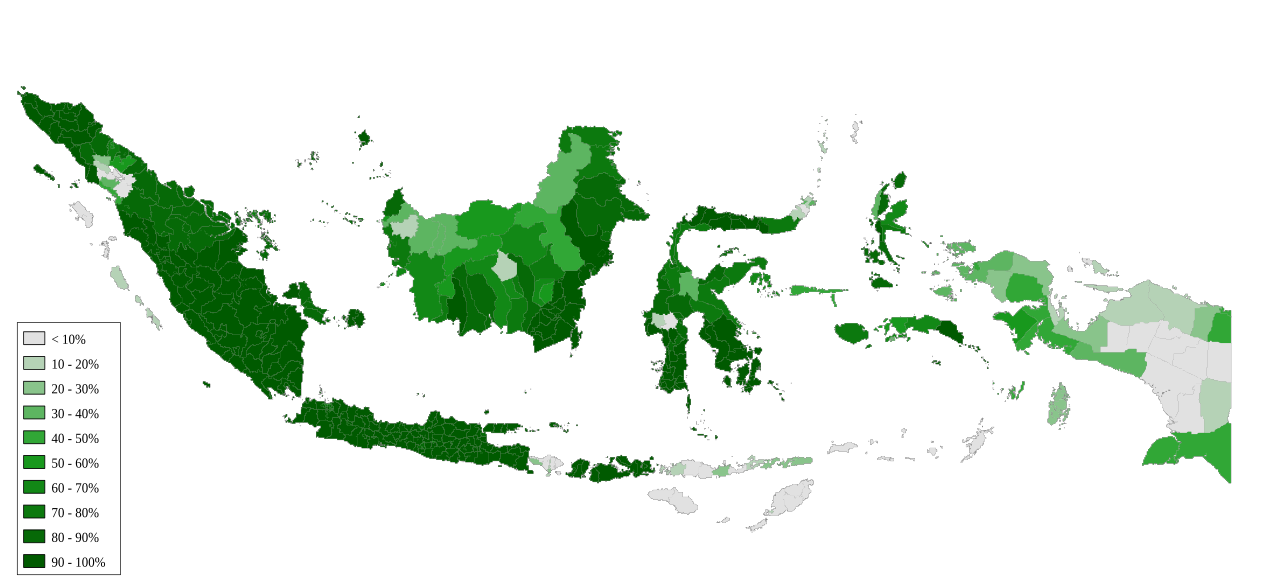
Indonesia is the largest Muslim nation in the world. About 87.2 percent of all Indonesians are Muslims. Islam is not the state religion and Islamic law is not practiced except in a few localities. Islam in Indonesia is composed of three essential elements: 1) “priyayi”, Islam, with classical Hindu Buddhist elements, practiced mainly among the educated urban classes; 2) “santri”, orthodox Islam, most common among merchant and landowners; and 3) “abangan”, Islam with animist folk influences, traditionally practiced by the rural peasantry.
Nearly all Muslims in Indonesia are Sunni. Of the more than 280 million Muslims in 2025, an estimated one to three million are Shiites. Differing understandings of the role of the clergy are a key distinction between Sunni and Shiites. Emphasizing predestination and predetermination by Allah, Sunni clerics emphasize free will and the infallibility of divinely inspired imams to interpret ancient texts. Many smaller Muslim groups exist, including approximately 200,000-400,000 members of the Ahmadiyya Muslim Community.
In Indonesia there is no enforced uniformity in Islam as there is in Saudi Arabia and some other Muslim countries. Indonesian Muslims display a great variety of beliefs and levels of piety. There are “nominal Muslims” (“abangan”) who barely recognize their religion and embrace consumerism and modern life and buy products advertized by pretty girls and zealots (“santri”) who pray so often they have bruises on their foreheads. There are Muslim-oriented and secular-oriented political parties for abangan and santri and various shades in between. In Indonesia you can find Sufi sects and cults that have incorporated local animist, Buddhist and Hindu beliefs and rituals. In many places you can find shrines and tombs dedicated to saints and holy men, something that would be regarded as sacrilegious in conservative Muslim countries.
Indonesia is a secular country and one of the few Muslim democracies. Most Indonesian Muslims practice a moderate form of the faith, which sometimes incorporates Hindu and animist beliefs. though an increasingly vocal extremist fringe has gained ground in recent years. They have in some cases succeeded in influencing government policy, because many leaders depend on the support of Islamic parties. Indonesia’s state ideology, Pancasila, enshrines monotheism, and blasphemy is illegal. However, the Constitution guarantees freedom of religion and speech.
RELATED ARTICLES:
HISTORY OF ISLAM IN INDONESIA: ARRIVAL, SPREAD, ACEH, MELAKA, DEMAK factsanddetails.com
MUSLIM PRACTICES IN INDONESIA: PRAYERS, RITUALS, MOSQUES, ISLAMIC CULTURE, THE HAJJ factsanddetails.com
RAMADAN AND LEBARAN (EID) IN INDONESIA factsanddetails.com
CONSERVATIVE ISLAM IN INDONESIA factsanddetails.com
JAVANESE RELIGION: ISLAM, MYSTICISM, FESTIVALS, BELIEFS, PRACTICES factsanddetails.com
MUSLIM SECTS IN INDONESIA factsanddetails.com
MUSLIM SCHOOLS IN INDONESIA factsanddetails.com
FOLK RELIGIONS IN INDONESIA factsanddetails.com
RELIGION IN INDONESIA factsanddetails.com
CHRISTIANS IN INDONESIA factsanddetails.com
FUNERALS IN INDONESIA factsanddetails.com
See the Different Muslim Practices Among Different Ethnic Groups Under Minorities and Regions:
ETHNIC GROUPS ON SUMATRA factsanddetails.com
ETHNIC GROUPS ON JAVA factsanddetails.com
ETHNIC GROUPS IN NUSA TENGARRA (ISLANDS EAST OF BALI) factsanddetails.com
ETHNIC GROUPS ON SULAWESI factsanddetails.com
BORNEO AND ETHNIC GROUPS IN BORNEO factsanddetails.com
ETHNIC GROUPS IN THE MOLUCCAS AND OTHER ISLANDS factsanddetails.com
ACEH factsanddetails.com
Organization and Groups of Indonesian Muslims

Muslims praying in Java
The vast majority of Muslims in Indonesia —around 99 percent—follow Sunni Islam, primarily within the Shafi‘i school of jurisprudence. There are two major organizations: Nahdlatul Ulama, a traditionalist group with tens of millions of followers, and Muhammadiyah, a modernist movement with a similarly large membership base.
Sunni Islam forms the mainstream of religious life, expressed through both traditionalist and reformist approaches. Nahdlatul Ulama emphasizes continuity with established religious practices and local culture, while Muhammadiyah promotes a more reform-oriented interpretation focused on education, social welfare, and the purification of religious practice. Together, these organizations play a central role in shaping Indonesian Islam.
Smaller Muslim communities also exist within the country. Shi‘a Muslims number between one and three million, with communities in Java, Madura, and Sumatra. The Ahmadiyya movement has a more limited following, estimated at tens to hundreds of thousands, divided into groups such as Jemaah Ahmadiyah Indonesia and Gerakan Ahmadiyah Indonesia. These communities have sometimes faced opposition from more conservative religious authorities.
Sufism, expressed through various mystical orders known as tarekat, is also present and often overlaps with traditionalist practices, especially within Nahdlatul Ulama. In contrast, smaller Salafi-oriented movements promote a more literal interpretation of Islamic teachings and have gained some influence, particularly among younger urban populations.
Character of Indonesian Islam
The character of Indonesian Islam and religious practices vary a great deal from region to region and even individual to individual. Some Indonesian Muslims have incorporated elements of Hinduism, Buddhism and local animist beliefs into their personal belief system. Many Muslims, for example, make offering to volcano spirits and the goddess of the sea.
Although Indonesia is the world’s largest predominantly Muslim nation, Islam developed there in diverse and locally adapted forms shaped by distinct historical experiences across the islands. Compared with practices in parts of the Middle East, Indonesian Islam evolved in ways that reflected existing cultural traditions and social structures. Islam initially appealed strongly to common people because it emphasized equality before God—offering an alternative to the hierarchical systems of earlier Hindu-Buddhist kingdoms, where rulers and priests were believed to have privileged access to the divine. In some of these kingdoms, ordinary people were heavily exploited for labor, including in the construction of monumental structures such as Borobudur. [Source: Jill Forshee, “Culture and Customs of Indonesia”, Greenwood Press, 2006]
Indonesians have a reputation for having a fairly relaxed view about religion and Islam. It, Malaysia and Turkey are regarded as the most liberal and open Muslim countries. In Indonesia, there are two main types of Muslims: 1) the santri, followers of Orthodox Islam; and 2) abangan, the followers of a less stringent form of Islam the influences of Buddhism, Hinduism and folk religion.
Types of Indonesian Muslims

Indonesian image of Muhammad riding a mythical beast
In Indonesia, you can find devout Muslims that leave votive offerings, venerate idols and objects and recognize and honor a pantheon of Buddhist, Hindu and local gods. The annual labuhan ceremony to honor Ratu Kidul, the goddess of the Indonesian seas, begins with a turbaned priest reciting a Muslim prayer and presenting offerings of silk, curry, bananas, hair and toenail clipping from the Sultan of Yogyakarta to the goddess, which are carried in a procession and deposited in the sea by Muslims, who then take turns lighting incense at strange-shaped rock that is the focus of the cult. Muslim participate in similar rituals to honor local volcano gods.
As we have said before there are three main types of Muslims in Indonesia: 1) “priyayi”, who recognize classical Hindu Buddhist elements and mainly belong to the educated urban classes; 2) “santri”, devout followers of orthodox Islam, who have traditionally belonged to the merchant and landowning class; and 3) “abangan”, Muslims who have fused Islam with animist folk beliefs and have traditionally belonged to the rural peasantry. [Source: Library of Congress]
Rural abangan are often ignorant of many of the basic tenets of Islams and tend to fuse indigenous beliefs, Hinduism and Buddhist with Islam. They often recognize and worship Hindu deities and local spirits—in part perhaps to place them and hedge their bets if they do exist—and believe in the magical power of “dukun”, traditional healers. Urban abangan tend be more knowledgeable about Islam and less superstitious and more likely to embrace ideas of secularism. Priyayi tend to embrace mystical beleifs and have a sophisticated philosophy about fate. Some meditate and practice asceticism and consult the equivalent of gurus.
“Santri” are found in all social classes but have traditionally been associated with the merchant classes. They follow the five pillars of Islam. In Java, santri not only refers to a person who is consciously and exclusively Muslim, but also describes persons who have removed themselves from the secular world to concentrate on devotional activities in Islamic schools called pesantren— literally, the place of the santri, but meaning Islamic school. Although these religious boarding schools, typically headed by a charismatic kiai (Muslim religious scholar), provide education for only a minority of Indonesian children (less than 10 percent), they remain an important symbol of Muslim piety, particularly in rural areas. [Source: Library of Congress]
Evolution of Types of Indonesian Muslims
Over the course of the mostly peaceful introduction of Islam to Indonesia beginning in the ninth century AD, tensions periodically arose between orthodox Muslims and practitioners of more syncretistic, locally based religions. These tensions are still evident in the early twenty-first century. In Java, for instance, they are expressed in the contrast between a santri, a pious Muslim, and an abangan, an adherent to a syncretistic blend of indigenous, Hindu-Buddhist beliefs with Islamic practices, sometimes called kejawen (Javanism), agama Jawa (Javanese religion), or kebatinan (mysticism). [Source: Library of Congress]
As Islam spread in Java, it came to be expressed in different forms aligned with social groups. Among rural populations, abangan Islam blended Islamic teachings with older folk beliefs, including practices related to healing, magic, and spirit forces. This syncretic form reflected continuity with earlier animist traditions. [Source: Jill Forshee, “Culture and Customs of Indonesia”, Greenwood Press, 2006]
In contrast, the more prosperous merchant class followed santri Islam, which emphasized orthodox religious practices such as prayer and ritual observance, while also fostering networks of Islamic schools, charities, and social organizations. This group played an important role in shaping Islamic learning and community life. Among the aristocracy, priyayi Islam incorporated elements of earlier Hindu traditions and placed a strong emphasis on refinement, mysticism, and courtly culture. This form of Islam reflected the values and aesthetics of the elite while integrating aspects of the newer religion.
Islam became firmly rooted in Javanese society through institutions such as pesantren—Islamic boarding schools led by religious scholars and supported by community contributions. While these categories are most clearly seen in Java, Islam across Indonesia remains highly varied. As regions adopted the faith, older systems of authority and patronage often persisted, even as expanding Muslim trade networks connected the archipelago to a broader world of ideas, goods, and cultural exchange.
Mystical Islam in Indonesia
In Indonesia there is a long history of religious practice associated with more mystical and often highly syncretistic beliefs. Drawing variously on Hindu-Buddhist ideas about self-control and intellectual contemplation, as well as more animistically inclined ideas about the spiritual character of nature, and often based on miraculous revelations, various kinds of hybrid Islamic beliefs flourished in Java until a presidential decree in 1965 urged consolidation under the rubric of the main scriptural religions (agama), including Islam, Christianity, Buddhism, Hinduism, and Confucianism. Several of the more mystical varieties of Islam continued to flourish under the Suharto regime, and some continued to struggle for autonomy and recognition by the government, eventually receiving recognition in 1973 as keper cayaan (faiths), albeit under the umbrella of one of the scriptural agama. [Source: Library of Congress *]
Among the more prominent of these faiths was kebatinan. Only nominally Muslim, kebatinan is an amalgam of animist, Hindu-Buddhist, and Muslim, mostly Sufi, spiritual practices concerned with harmonizing the inner self with the outer material world. Spirits are believed to inhabit natural objects, human beings, artifacts, and grave sites of important wali (Muslim saints). Illness and other misfortunes are traced to such spirits, and if sacrifices or pilgrimages fail to placate angry deities, the advice of a dukun, or healer, is sought. While it connotes a turning away from the militant universalism of orthodox Islam, kebatinan moves toward a more internalized universalism. In this way, it seeks to eliminate distinctions between the universal and the local, the communal and the individual. *
There are also cults like Salamullah that is headed by a woman who claims to be the Holy Spirit and delivers messages she says are personally given to her by Gabriel, the archangel who delivered the Koran to Mohammed. Frida Mebius Önnerfors, who wrote a dissertation on the group for Centre for Theology and Religious Studies at Lund University in Sweden, wrote: “Salamullah, established in Jakarta at the end of the 1990s, has no ready-made ideology but is open towards impulses. The movement, led by Lia Aminuddin, is from its outset Muslim but has during the years adopted a more 'indonesian' style: Salamullah combines the religions officially accepted in Indonesia to a unique mixture. To the same extent, political and social events as well as Indonesian mythology are integrated into the teachings. Religious content is developing very dynamically and the movement has during the years been in open conflict with religious authorities and institutions.”
Islam in Different Parts of Indonesia
The Javanese are predominantly Muslim, though many are Catholic or Protestant. They are known for their less strict adherence to Islam and their greater connection to Javanese religion, which blends Islam with previous Hindu and animist beliefs. By contrast, the Sundanese of West Java are ardent Muslims. Other notable Muslim ethnic groups include the Acehnese of North Sumatra, who were the first Indonesians to convert to Islam; the Minangkabau, despite their matriliny; the people of South Kalimantan; the Bugis and the Makassarese of South Sulawesi; the Sumbawans of the Lesser Sunda Islands; and the people of Ternate and Tidor in Maluku. [Source: everyculture.com]
Muslims living in urban areas tend to be more liberal and Westernized than those living in the countryside. Muslims on Java weave a lot of Hindu and Buddhist rituals into their brand of Islam. Many Muslim women cover their hair but face coverings are rarely seen. There is a growing fundamentalist Muslim movement among young people on Java.
The Acehnese in northern Sumatra are considered to be the most conservative Muslims in Indonesia. Here, women are not only wear head coverings they are also urged to wear a special garment on their wrists that covers their hands (some Muslims believe the hands as well as head should be covered) and some clerics have called for the stoning of adulterers.
Modernism Verses Traditionalism in Indonesian Islam
Among Indonesian Muslims there is some tension between traditionalism and modernism, with traditionalism being associated with more liberal and inclusive forms of Islam and modernism being associated with more Orthodox forms. Determining how many Muslims are moderates and how many are conservative is difficult to say. It s believed that moderates make up the majority by a large margin.
The nature of this antipathy is complex and a matter of considerable debate. One key issue concerns the self-sufficiency of scripture and the moral responsibility of the individual. Modernists emphasize the absolute and transparent authority of the Quran and the responsibility of individuals to follow its teachings; traditionalists contend that Quranic texts can be ambiguous, and that it is wiser to trust in the collective wisdom of past teaching. While traditionalists accept a variety of ritual forms, they underscore the responsibility of believers to the community, and are less concerned with individual responsibility to interpret scripture. [Source: Library of Congress *]
Specifically, traditionalists are suspicious of modernists’ support of the urban madrassa (madrasah in Bahasa Indonesia), a reformist school that includes the teaching of secular topics. The modernists’ goal of taking Islam and carrying it more directly to the people has been opposed by traditionalists because it threatens to undermine the authority of the kiai. On the other hand, some modernists accuse traditionalists of escapist tendencies and of failing to directly confront the individual responsibility to make sense of a changing world. One point of agreement is that both modernists and traditionalists have sought, unsuccessfully, to add a clause to the first tenet of the Indonesian constitution requiring that, in effect, all Muslims adhere to the sharia. In fact, some even hint that modernist and traditionalist santri harbor greater loyalty toward the ummah (community of believers) of Islam than to the Indonesian state. *
Islam and Tolerance in Indonesia
Most Indonesians follow and practice a tolerant form of Islam. There are no laws that ban premarital sex or call for thieves to have their hands chopped off. Muslim inheritance laws that call for male descendants to get twice as much as females are ignored. To get around rules that ban Muslims from marrying non-Muslims, couples get married overseas.
James Clad, a professor of Southeast Asian politics at Georgetown University, told the New York Times, "Islam in Indonesia has never been an extreme orthodoxy. It's a religion there that has been in tune with traditions that are open to tolerance and a willingness to disagree. Broadly speaking, this a place where Islamic fundamentalism finds the soil pretty thin."
Part of the reason that Indonesian Islam is more tolerant than the Islam found in other places is that it succeeded Hinduism and Buddhism, which coexisted with local animist beliefs. Today, Indonesian Muslims continue to practice elements of Buddhism, Hinduism and animism. One principal at a Muslim school told Time, "We could never be like Iran, because we have too many cultures. All our differences are a gift in the country."
Abdullah Gymnastiar, a popular television preacher in Indonesia said that the concept of fairness is the essence of Islam. “In Christianity the significant word is love,” he told the New York Times. “But in Islam it is fair. Because if we are not fair we hurt someone. If we make war we have to be fair with our enemy.” He pointed out that one of the main reasons why anti-American sentiments run high is that the United States is regarded as unfair, particularly in the way it favors the Israelis over the Palestinians.
Nahdlatul Ulama — the World's Largest Islamic Organization
Nahdlatul Ulama (NU) —whose name means “Revival (or Reawakening) of the Islamic Scholars”—is the largest Islamic organization and and one of the most influential Islamic movements in the world. Founded in 1926, it emerged partly in response to growing concerns among Indonesian scholars about rigid interpretations of Islam associated with developments in the Arabian Peninsula, particularly following the Saudi control of Mecca and Medina. NU positioned itself as a defender of traditional Sunni Islam while remaining open to local customs and spiritual practices. [Source: Ahmet T. Kuru, Professor of Political Science, San Diego State University, The Conversation, September 23, 2021]
NU follows mainstream Sunni Islam, especially the Shafi‘i school, but is distinctive in its embrace of Islamic mysticism (Sufism) and its acceptance of Indonesia’s diverse cultural traditions. Rather than rejecting local practices outright, NU has historically integrated them into religious life, creating a form of Islam that is both orthodox and culturally rooted.
With an estimated membership often cited at tens of millions NU plays a central role in Indonesian society. Its influence extends beyond religion into education, social services, and community life, particularly through its vast network of pesantren (Islamic boarding schools). Despite its size, this moderate and pluralistic expression of Islam has often received less global attention than more hardline movements.
Indonesia’s national ideology, Pancasila, is based on five principles: belief in one God, humanitarianism, national unity, democracy, and social justice. Both NU and Muhammadiyah—the country’s second-largest Islamic organization—have strongly supported this framework and have often worked together to counter extremist interpretations of Islam.
Scholars such as Robert Hefner have highlighted the important role NU and Muhammadiyah played in Indonesia’s democratization during the late 1990s. As the country transitioned away from authoritarian rule, NU’s leader, Abdurrahman Wahid, became Indonesia’s first democratically elected president in 1999, symbolizing the compatibility of Islam, pluralism, and democratic governance.
Wahid, who died in 2009, left a lasting intellectual and religious legacy. He championed tolerance, interfaith dialogue, and a progressive interpretation of Islam that came to influence later initiatives such as “Humanitarian Islam.” Within NU today, his ideas continue to inspire efforts to promote a compassionate, inclusive, and globally engaged vision of the faith.
Nahdlatul Ulama Influence and Ideology
Nahdlatul Ulama (NU) launched a reform initiative in 2014 in response to the rise of extremist groups like Islamic State, developing what it calls “Humanitarian Islam.” Led by figures such as Yahya Cholil Staquf, NU scholars issued declarations aimed at reinterpreting Islamic teachings on issues like political authority, citizenship, and relations with non-Muslims. [Source: Ahmet T. Kuru, Professor of Political Science, San Diego State University, The Conversation, September 23, 2021]
A central feature of this reform is the rejection of a global caliphate. NU affirms instead the legitimacy of modern nation-states and their legal systems, arguing that establishing a state based strictly on Islamic law is not a religious obligation. It also emphasizes equal citizenship, rejecting legal distinctions between Muslims and non-Muslims.
The movement further promotes interfaith cooperation, encouraging collaboration among Muslims, Christians, and others to advance peace. NU has taken practical steps in this direction, including partnerships with international religious organizations to foster dialogue and mutual respect.
However, the reform has limits and exists within a broader Indonesian context where tensions remain. In regions like Aceh, stricter forms of Islamic law are enforced, and controversial issues such as blasphemy laws and religious dress codes have highlighted ongoing struggles between tolerant and conservative interpretations of Islam.
Within Indonesia itself, there is a continuing “tug-of-war” between reformist and conservative forces, even داخل NU. Nonetheless, reform-minded leaders have gained influence, contributing to policies that support religious freedom, such as government action against mandatory religious dress in public schools.
Although “Humanitarian Islam” has the potential to promote tolerance within Indonesia, its global impact remains uncertain. In the Middle East, it has received limited attention and is sometimes viewed as a competing influence. NU hopes to expand its reach—particularly among younger Muslims—by increasing its international presence, but whether it will become a broader force for Islamic reform is still unclear.
Indonesian Ulema Council (MUI)— Indonesia’s Highest Islamic Authority
The Indonesian Ulema Council (MUI) is Indonesia highest Islamic authority. It is a national body of senior Muslim scholars that issues religious rulings, known as fatwas, and provides guidance on matters affecting Islamic life in Indonesia. Representing a broad spectrum of Muslim organizations, it serves as the most influential institution for defining what is considered acceptable or unacceptable in Islamic terms. [Source: Amanda Erickson, Washington Post, February 1, 2017]
In January 2017 after a wave of false stories circulated widely in Indonesia— that among other things claimed that a free HPV vaccine would cause infertility, that Chinese-made chili seeds were part of biological warfare, and that new currency designs secretly featured banned communist symbols — the MUI issued a fatwa out of concerns that “fake news” fueled religious and ethnic tensions. MUI chairman Ma'ruf Amin issued the fatwa declaring the deliberate spread of false information to be “un-Islamic.”
Although MUI fatwas carry significant moral weight, they are not legally binding and their impact varies. In the past, the council has issued rulings on issues ranging from environmental practices—such as banning land-clearing fires—to workplace conduct, including discouraging Muslim employees from wearing Christmas-themed attire. Enforcement depends largely on public acceptance rather than state authority.
Image Sources: Wikimedia Commons
Text Sources: “Encyclopedia of World Cultures Volume 5: East/Southeast Asia:” edited by Paul Hockings, 1993; “Culture and Customs of Indonesia” by Jill Forshee, Greenwood Press, 2006; National Geographic, New York Times, Washington Post, Los Angeles Times, Smithsonian magazine, Encyclopedia.com, Library of Congress, Indonesia Tourism website (indonesia.travel), Indonesia government websites, Live Science, The Conversation, The New Yorker, Time, BBC, CNN, Reuters, Associated Press, AFP, Lonely Planet Guides, Google AI, Wikipedia, The Guardian and various websites, books and other publications.
Last updated April 2026