
MUSLIM SECTS IN INDONESIA

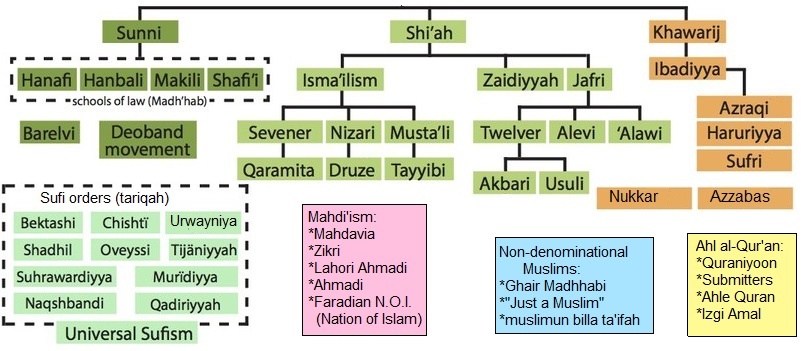
The vast majority of Muslims in Indonesia —around 99 percent—follow Sunni Islam, primarily within the Shafi‘i school of jurisprudence. There are two major organizations: Nahdlatul Ulama, a traditionalist group with tens of millions of followers, and Muhammadiyah, a modernist movement with a similarly large membership base.
Sunni Islam forms the mainstream of religious life, expressed through both traditionalist and reformist approaches. Nahdlatul Ulama emphasizes continuity with established religious practices and local culture, while Muhammadiyah promotes a more reform-oriented interpretation focused on education, social welfare, and the purification of religious practice. Together, these organizations play a central role in shaping Indonesian Islam.
Smaller Muslim communities also exist within the country. Shi‘a Muslims number between one and three million, with communities in Java, Madura, and Sumatra. The Ahmadiyya movement has a more limited following, estimated at tens to hundreds of thousands, divided into groups such as Jemaah Ahmadiyah Indonesia and Gerakan Ahmadiyah Indonesia. These communities have sometimes faced opposition from more conservative religious authorities.
Sufism, expressed through various mystical orders known as tarekat, is also present and often overlaps with traditionalist practices, especially within Nahdlatul Ulama. In contrast, smaller Salafi-oriented movements promote a more literal interpretation of Islamic teachings and have gained some influence, particularly among younger urban populations.
In everyday life, many Indonesian Muslims practice a form of Islam that incorporates local customs and older spiritual traditions, sometimes referred to as “folk Islam.” This blending reflects the country’s long history of cultural exchange and adaptation, in which pre-Islamic beliefs continue to shape religious expression.
Although Indonesia is generally known for religious tolerance, tensions do arise. Minority groups such as Shi‘a and especially Ahmadiyya communities have experienced discrimination and, at times, violence from hardline groups. Additionally, the province of Aceh stands apart as the only region permitted to implement a stricter form of Islamic law, giving it a unique place within Indonesia’s broader religious and legal landscape.
RELATED ARTICLES:
ISLAM IN INDONESIA: CHARACTERISTICS, TYPES, MUSLIM ORGANIZATIONS factsanddetails.com
HISTORY OF ISLAM IN INDONESIA: ARRIVAL, SPREAD, ACEH, MELAKA, DEMAK factsanddetails.com
MUSLIM PRACTICES IN INDONESIA: PRAYERS, RITUALS, MOSQUES, ISLAMIC CULTURE, THE HAJJ factsanddetails.com
RAMADAN AND LEBARAN (EID) IN INDONESIA factsanddetails.com
CONSERVATIVE ISLAM IN INDONESIA factsanddetails.com
JAVANESE RELIGION: ISLAM, MYSTICISM, FESTIVALS, BELIEFS, PRACTICES factsanddetails.com
MUSLIM SCHOOLS IN INDONESIA factsanddetails.com
FOLK RELIGIONS IN INDONESIA factsanddetails.com
RELIGION IN INDONESIA factsanddetails.com
CHRISTIANS IN INDONESIA factsanddetails.com
FUNERALS IN INDONESIA factsanddetails.com
See the Different Muslim Practices Among Different Ethnic Groups Under Minorities and Regions:
ETHNIC GROUPS ON SUMATRA factsanddetails.com
ETHNIC GROUPS ON JAVA factsanddetails.com
ETHNIC GROUPS IN NUSA TENGARRA (ISLANDS EAST OF BALI) factsanddetails.com
ETHNIC GROUPS ON SULAWESI factsanddetails.com
BORNEO AND ETHNIC GROUPS IN BORNEO factsanddetails.com
ETHNIC GROUPS IN THE MOLUCCAS AND OTHER ISLANDS factsanddetails.com
ACEH factsanddetails.com
Discrimination Against Muslim Sects in Indonesia
There Have been cases of forced mass resettlement of members of a religious group resulting from a failure to manage social conflict and discrimination. Authorities resettled approximately 300 of Muluk’s followers to a sports complex in Sampang following an attack against them by Sunni hard-liners. Government spokespeople said that the resettlement was for the group’s own protection. In November members of the group called for help from the central government, as the local government had stopped providing free food and water to the internally displaced persons. At year’s end, 198 of Muluk’s followers were still living in the sports complex. Days after the resettlement of Muluk's followers, Minister of Religion Suryadharma Ali publicly expressed his belief that dialogue between the parties could lead the Shia to convert to “mainstream” Islam, thus removing the source of the conflict. [Source: International Religious Freedom Report for 2012, Indonesia, U.S. Department of State ]
Government officials collaborated with hard-line Islamic groups against members of religious groups deemed “deviant.” For example, on July 8 police and local leaders in the village of Cisalopa, West Java, detained the leader of a fringe group of the At Tijaniyah sect of Islam and several of his followers. A group consisting of local government officials, police, military, members of the local conservative Indonesian Ulama Council (MUI), and the hard-line group Islamic Reform Movement (GARIS) accused the leader, Sumarna, of presenting his followers with a deviant interpretation of Islam and encouraged the sect to return to mainstream Islam. On August 19, approximately 1,000 members of GARIS burned seven homes belonging to Sumarna and his followers. The attack followed the unsuccessful search for the missing GARIS leader, Ustad Edin Zainudin. Police responding to the scene discovered Zainudin’s body approximately 1,500 feet from Sumarna’s house and arrested Sumarna. According to reports by respected human rights groups, Zainuddin had frequently and vehemently criticized Sumarna and his group for their “deviant” teachings. At year’s end, the case against Sumarna was still pending. There were no arrests related to the attack on the sect members.
The government failed to take sufficient action with regard to continued discrimination, restrictions, and occasional attacks toward religious minorities. In June and August followers of jailed Shia cleric Tajul Muluk reportedly informed police that they had received death threats from members of an unknown Sunni group. On August 23, Muluk’s followers reported that a number of Sunni hard-liners had visited their section of Sampang, Madura and that the residents felt unsafe. Three days later, on August 26, a group of roughly 500 Sunni hard-liners descended on Sampang, wielding machetes, knives, and Molotov cocktails. Upon receiving reports regarding the mob, police reportedly dispatched five officers who witnessed the ensuing melee. The violence left two Shiites dead, dozens of homes burned, and 300 people displaced. Following the attack, a combined force of 700 security force personnel arrived to secure the area. Police later arrested eight of the hard-liners for their involvement in the unrest. Militant groups and mobs throughout the country attacked, vandalized, forced to close, or prevented from being established several houses of worship, religious schools, and homes of Muslim groups regarded as unorthodox. In several cases, police temporarily detained members of “deviant groups” who were victims of attacks, ostensibly to ensure their safety, but did not arrest attackers.
Indonesia Bans Muslim Sect
In November 2007, Indonesia’s Coordinating Agency for the Supervision of Religious Faiths and Sects banned the al-Qiyadah al-Islamiyah Muslim sect, accusing the group of deviant teachings after its leader claimed himself to be a prophet after Mohammed. "Attorney General Hendarman Supandji will immediately issue a ruling that will officially prohibit the sect's existence and the spreading of the sect's teachings throughout the country," Wisnu Subroto, junior attorney general for intelligence, was quoted as saying. [Source: DPA, November 8, 2007 +++]
DPA reported: “Subroto said once the ruling is issued, any al-Qiyadah followers attempting to spread the sect's teachings would be charged with religious blasphemy, an offence punishable by up to five years in prison. Two months earlier, the Indonesian Council of Ulemas, the country's highest authority on Islam, declared al-Qiyadah a "misguided" sect, arguing that the sect defied one of Islam's six pillars of faith and followed teachings that run counter to mainstream Islamic beliefs Local media reported that followers of the group do not have to pray five times a day and there was no requirement for the sect's members to go on a hajj, or pilgrimage to Mecca in Saudi Arabia. +++
“Angry Muslims recently vandalized a building used by the sect for meditation in the hill town of Bogor near Jakarta while street protests demanding the disbanding of the sect have been held in several towns on the main island of Java. The incidents prompted the sect's leader, Ahmad Mushaddeq, and six of his followers to hand themselves over to Jakarta police. Mushaddeq, who declared himself the next prophet even though mainstream Islam declares Mohammed the last prophet, is to be charged with blasphemy for allegedly tarnishing the image of Islam. He remained in police custody and claimed the group has 40,000 followers.
Sunni-Shia Tensions in Yogyakarta
Sectarian tensions have recently emerged in Yogyakarta, a city long known for its cultural diversity and reputation as a center of tolerance. Banners containing anti-Shia messages appeared across major streets and nearby areas, promoting statements such as “Shia is not Islam” and labeling Shiites as infidels. Their widespread and coordinated placement suggested an organized campaign that contrasted sharply with the city’s identity. [Source: Azis Anwar Fachrudin, Jakarta Post, March 11, 2015]
These developments mark a shift from earlier efforts to promote harmony. In 2011, local leaders and religious groups had declared Yogyakarta a “city of tolerance,” yet in recent years signs of growing intolerance have appeared. The banners are unprecedented in the city, which has not experienced direct Sunni-Shia conflict, and many residents have limited knowledge of Shia Islam itself.
The spread of anti-Shia sentiment has been reinforced by seminars and publications portraying Shiism as heretical. Some observers believe the campaign may be linked to broader political dynamics, possibly diverting attention from national issues or reacting to incidents elsewhere that have been framed as Sunni-Shia conflicts. Regardless of the motive, the campaign risks deepening divisions.
Moderate responses have been limited, with major organizations such as Nahdlatul Ulama and Muhammadiyah not strongly countering the narrative. This absence has allowed more hardline views to gain visibility, even though Shiites—who share core Islamic beliefs and practices with Sunnis—make up only a small minority in Indonesia.
The situation highlights a broader challenge for Indonesia: balancing religious diversity within a democratic society. If sectarian divisions are allowed to grow, they could undermine the country’s tradition of pluralism. Many therefore look to moderate Islamic institutions and the government to reaffirm unity and prevent further erosion of religious harmony.
Ahmadiyah Sect of Islam
The Ahmadiyya Muslim Community is a global Islamic reform movement founded in 1889 in Qadian, India, by Mirza Ghulam Ahmad. It promotes a peaceful and nonviolent interpretation of Islam, often summarized by its motto, “Love for All, Hatred for None.” Today, the movement has an estimated 10–20 million followers in more than 200 countries and is known for its active missionary work. A central belief of the Ahmadiyya faith is that its founder was the promised Mahdi and Messiah—a divinely guided figure sent to revive the original message of Islam. Ahmadis do not see him as bringing a new religion or law, but rather as restoring what they consider the true, peaceful teachings of Islam.
One of the most distinctive—and controversial—features of Ahmadiyya doctrine concerns prophethood. While mainstream Muslims believe that the Prophet Muhammad was the final prophet, Ahmadis hold that a form of non-law-bearing, subordinate prophethood can continue. In this view, Mirza Ghulam Ahmad is regarded as a prophet under the authority of Muhammad. Ahmadis also differ in their understanding of Jesus. They believe that Jesus survived the crucifixion, later traveled to India, and died there at an advanced age, rather than ascending bodily to heaven as traditionally taught in Islam and Christianity.
The community is organized under a continuing spiritual leadership known as the Caliphate, currently headed by Mirza Masroor Ahmad. Ahmadis emphasize peaceful forms of jihad, focusing on personal moral improvement and the spread of ideas through writing and dialogue rather than violence. Because of their beliefs—especially regarding prophethood—the Ahmadiyya are widely regarded as heretical by many orthodox Muslims. A a result, they have faced discrimination and persecution in several countries. In places like Pakistan, they are legally classified as non-Muslims and are restricted in how they can practice and describe their faith, including limitations on calling their places of worship mosques.
Ahmadiyah Sect of Islam in Indonesia
An Ahmadi official told Reuters that the group has about 500,000 followers in Indonesia, mainly on Java and Lombok islands. The Ahmadiyya community has long faced discrimination in Indonesia. While its followers identify as Muslims, their belief in a prophet following Muhammad is rejected by many orthodox Muslims in Indonesia. , who consider it a violation of core Islamic doctrine. This theological difference has contributed to their marginalization and, at times, violence against them.
AFP reported: “Members of the group, which says it promotes peace and tolerance, have often been the target of hardline anger in countries such as Bangladesh and Pakistan, and now increasingly in Indonesia. Mainstream Muslims reject Ahmadiyya's claim that Mirza Ghulam Ahmadis a prophet and say that Ahmadis must stop describing their religion as Islam, while hardliners have demanded an outright ban. The Ahmadis say that like all Muslims they pray five times a day, follow the Koran and go on the Haj, but the only difference is one of interpretation. [Source: AFP, June 18, 2008]
A 2008 government decree restricts the Ahmadiyya from promoting interpretations of Islam deemed deviant. Critics argue that such regulations have contributed to a climate in which minority groups remain vulnerable to discrimination and persecution.
Discrimination Against the Ahmadiyah Sect of Islam
In 2008 the Indonesian government issued a joint ministerial decree freezing certain activities of the Ahmadiyya Muslim Community. Specifically, it bans both proselytizing by the Ahmadiyya community and vigilantism against the group. Violation of the proselytizing ban carries a maximum five-year prison sentence on charges of blasphemy. Authors of the decree say that it is a compromise designed to give the Ahmadiyya Muslim Community some protection as the minority group would otherwise be subject to a complete ban under the 1965 Blasphemy Law (below). The decree does not prohibit Ahmadi Muslims from worshipping or continuing to practice within their community. Hard-line groups and a government-appointed body, the Coordinating Board for Monitoring Mystical Beliefs in Society, support an outright ban of the group. The minister for religious affairs and the attorney general also publicly support a ban on the Ahmadiyya community. A number of provincial and local laws further restrict practice by Ahmadi Muslims. [Source: International Religious Freedom Report for 2012, Indonesia, U.S. Department of State ]
In June 2008, the Jakarta-based National Commission on Violence against Women said that Indonesian women and children who follow Ahmadiyya have faced discrimination and human rights abuses for many years. The commission, which compiled material from 2000, from Sukabumi district in West Java and from Lombok island, found that several Ahmadi women had given birth prematurely after their houses had been attacked by militant groups, and that Ahmadis were often prevented from marrying other Muslims. “There is no government effort to prevent discrimination against Ahmadis’ children,” Kamala Candrakirana, who heads the commission, told a press conference. She said Ahmadi children tend to be stigmatised at school, where some teachers highlight their faith in their school report cards. [Source: Reuters, June 12, 2008]
In 2012, a number of regional governments enforced decrees limiting or banning the free practice of Ahmadiyya Islam. These decrees were often vague in their language, which led to inconsistent enforcement by local authorities. For example, on October 25, members of the FPI in Bandung, West Java reported to local police that they had observed an Ahmadi Muslim congregation preparing for the ritual slaughter of animals that is part of the observance of the Eid-ul-Adha holiday. The FPI members and police returned to the Ahmadi mosque and arrested three members of the congregation. Police and the FPI reportedly worked together in an attempt to coerce the Ahmadi Muslims to sign admissions of guilt for violating a 2011 gubernatorial decree that limited their right to practice and defined “spreading the sect” as any public display of their faith. Upon the Ahmadi Muslims’ refusal to do so, the FPI members returned to the mosque and vandalized it. Provincial-level police then encouraged the previously detained Ahmadiyya congregation members to file criminal complaints against the FPI for damaging their property, resulting in the arrest of a local FPI leader.
Protests Against the Ahmadiyah Sect of Islam
In July 2008, thousands of Indonesians wearing white to show their religious piety rallied at the presidential palace to demand the banning of Ahmadiyah sect deemed “deviant” by top clerics. AFP reported: “More than 4,000 people from an array of mainstream Muslim political parties and fringe Islamist groups chanted slogans, shouted Allahu akbar (God is great) and waved banners condemning the Ahmadiyah sect. A speaker accused the sect of “staining Islam” and demanded President Susilo Bambang Yudhoyono issue a decree to make it an outlawed organisation. “We ask first that Ahmadiyah repent, return to Islam or make a new religion. If they don’t want to do that then they must be broken up,” said Mohammed Alwi, a student from an Islamic boarding school outside Jakarta. “Ahmadiyah is a criminal organisation,” said another protester. [Source: AFP, June 18, 2008]
“A small cordon of unarmed police was on hand to protect the palace but there was no sign of violence. The protest comes after the government earlier this month ordered the sect, which has peacefully practised its faith in Indonesia since the 1920s, to stop spreading its belief that Mohammed was not the last prophet. The ministerial decree stopped short of the ban demanded by Muslim leaders after the country’s top Islamic body issued a fatwa describing the sect as “deviant.” The case has raised questions over Indonesia’s image as a tolerant, secular democracy and sparked violent tensions between moderates and radical hardliners.” [Ibid]
A few days earlier Reuters reported: “Life for Indonesia's Ahmadis has taken a frightening turn. Their mosques and sympathisers have been attacked by violent militant groups such as the Islamic Defenders Front (FPI), and they are under pressure to say they are not Muslim.Near one of their onion-domed mosques in Jakarta, a lone police patrol car provides protection for the sect, even though at a Jakarta rally earlier this month, FPI supporters beat up and injured participants as they called for tolerance for Ahmadiyya. "Of course, we are afraid and worried," said Deden Sudjana, who handles Ahmadiyya security. "It is very human if everybody is traumatised, especially children and women because they saw blood, how they trampled on the elderly, beat them and kicked them." [Source: Reuters, June 13, 2008 \=]
“The government's resolve to defend freedom of belief has been put to the test over Ahmadiyya. Indonesia's top Muslim religious council has declared Ahmadiyya a deviant sect, and hardline groups want them banned. Earlier this week, vice president Jusuf Kalla said the government would not ban Ahmadiyya as long as its members do not preach or try to convert others. A ministerial decree issued this week stopped short of banning the sect but warned followers could face five years in jail for tarnishing religion. \=\
“Ahmadis are worried about a backlash from hardline groups, said Ahmadiyya spokesman Shamsir Ali, speaking in the mosque as he sat surrounded by books on Islam, pictures of the Ahmadis' founder, and their slogan, "Love for All, Hatred for None"."There is a lot of fear in villages. Radical groups have increased their pressure on us. Overnight people have marked Ahmadiyya homes in Sukabumi area so that they can be easily identified for an attack," Ali said. \=\
“Liberal Indonesians slammed the government decision to curb the Ahmadis, saying it had caved in to pressure from hardliners, who have vowed to continue their fight for a complete ban on the group. "The government does not follow the constitution but is instead trying to accommodate radical groups which are actually very small in number. It is dangerous for the future of religion freedom in our country," said Luthfi Assyaukanie, co-ordinator of Liberal Islam Network. "If they succeed with the Ahmadiyya case, they will start with other cases including trying to push certain teachings in Islam." "The government has to ensure Ahmadis can live properly as common citizens," said Syafi'i Anwar, director of the International Centre for Islam and Pluralism. "This really damages Indonesia's reputation as a moderate Muslim country." \=\
Ahmadiyah House of Worship Attacked
In September 2021, an Ahmadiyya house of worship was attacked in Indonesia’s Borneo region. The incident took place in a village in Sintang district, West Kalimantan, where dozens of individuals were seen damaging the building with hammers and wooden planks. Authorities later described the assault as an unlawful act. [Source: Stanley Widianto, Reuters, September 3, 2021]
Video footage circulating on social media appeared to show the , though its authenticity could not immediately be verified. Police confirmed that the attack occurred shortly after local authorities had revoked the group’s permit to use the building as a place of worship. Security forces were deployed to the area, and officials reported that the situation was eventually brought under control.
Community representatives stated that the attack was not spontaneous but followed months of intimidation and pressure. Indonesia’s religious affairs minister, Yaqut Cholil Qoumas, condemned the violence, stating that the destruction of property and attacks carried out outside the law could not be justified. Around 300 security personnel were sent to maintain order and prevent further unrest.
Image Sources: Wikimedia Commons
Text Sources: “Encyclopedia of World Cultures Volume 5: East/Southeast Asia:” edited by Paul Hockings, 1993; “Culture and Customs of Indonesia” by Jill Forshee, Greenwood Press, 2006; National Geographic, New York Times, Washington Post, Los Angeles Times, Smithsonian magazine, Encyclopedia.com, Library of Congress, Indonesia Tourism website (indonesia.travel), Indonesia government websites, Live Science, The Conversation, The New Yorker, Time, BBC, CNN, Reuters, Associated Press, AFP, Lonely Planet Guides, Google AI, Wikipedia, The Guardian and various websites, books and other publications.
Last updated April 2026