
RELIGION IN INDONESIA
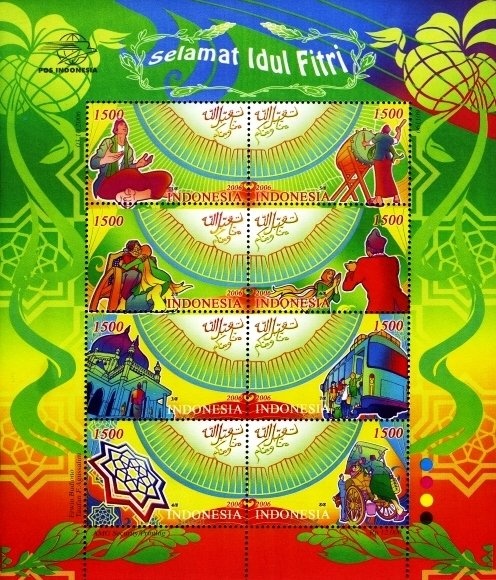
Indonesia is the largest Muslim nation in the world. Sunni Islam is the majority religion throughout most of the country. Notable exceptions include the province of Bali, which is predominantly Hindu, and the provinces of Papua, West Papua, East Nusa Tenggara, and North Sulawesi, which are predominantly Protestant Christian. [Source: International Religious Freedom Report for 2012, Indonesia, U.S. Department of State]
About 87.4 percent of all Indonesians are Muslims; 10.6 percent are Christians (7.5 percent Protestant and 3.1 percent Roman Catholic); 1.7 percent are Hindu; 0.8 percent are Buddhists, Confucian and other (2022 estimate). According to the 2000 census 86.1 percent of Indonesians were Muslims at that time and observed Islamic practices to varying degrees; another 5.7 percent were Protestant, 3 percent Roman were Catholic, 1.8 percent were Hindu, and 3.4 percent were other, including Buddhist, and unspecified. [Source: CIA World Factbook, 2025 Library of Congress]
Nearly all Muslims in Indonesia are Sunnis. Islam is not the state religion and Islamic law is not practiced except in a few localities. Most of the people of Java, Sumatra, Sulawesi and Kalimantan are Muslims.Christianity is practiced in parts of Indonesia where there was formerly a large Dutch presence— parts of Sumatra and the Maluka islands (Moluccas) —or Portuguese presence—East Timor. There are also many Christians in West Papua, where American and European missionaries have had success converting tribes—some of them former headhunters—there. The Minahasa and the Batak in North Sulawesi, the Toraja in South Sulawesi and people in East Nusa Tenggara (islands east of Bali such as Flores) and on Nias island in North Sumatra are largely Christian. Hinduism is practiced on Bali, and animism is practiced by small groups of people in isolated areas scattered around the archipelago.
The Javanese are predominantly Muslim, though many are Catholic or Protestant. Many Chinese people in Java and elsewhere are Christian, mainly Protestant. The Javanese are known for their less strict adherence to Islam and their greater connection to Javanese religion, which blends Islam with previous Hindu and animist beliefs. By contrast, the Sundanese of West Java are ardent Muslims. Other notable Muslim ethnic groups include the Acehnese of North Sumatra, who were the first Indonesians to convert to Islam; the Minangkabau, despite their matriliny; the people of South Kalimantan; the Bugis and Makassarese of South Sulawesi; the Sumbawans of the Lesser Sunda Islands; and the people of Ternate and Tidor in Maluku. [Source: “Encyclopedia of World Cultures Volume 5: East/Southeast Asia:” edited by Paul Hockings, 1993]
Book: “Religion of Java” by Clifforf Geertz (1950s).
RELATED ARTICLES:
FOLK RELIGIONS IN INDONESIA factsanddetails.com
ISLAM IN INDONESIA: CHARACTERISTICS, TYPES, MUSLIM ORGANIZATIONS factsanddetails.com
HISTORY OF ISLAM IN INDONESIA: ARRIVAL, SPREAD, ACEH, MELAKA, DEMAK factsanddetails.com
MUSLIM PRACTICES IN INDONESIA: PRAYERS, RITUALS, MOSQUES, ISLAMIC CULTURE, THE HAJJ factsanddetails.com
CHRISTIANS IN INDONESIA factsanddetails.com
RELIGIOUS DISCRIMINATION IN INDONESIA factsanddetails.com
WITCHCRAFT AND BLACK MAGIC IN INDONESIA factsanddetails.com
GHOSTS AND SUPERNATURAL BEINGS IN INDONESIA factsanddetails.com
JAVANESE RELIGION: ISLAM, MYSTICISM, FESTIVALS, BELIEFS, PRACTICES factsanddetails.com
MYSTICISM IN INDONESIA factsanddetails.com
SUPERSTITIONS IN INDONESIA factsanddetails.com
DUKUN: TRADITIONAL HEALERS factsanddetails.com
FUNERALS IN INDONESIA factsanddetails.com
For information on the Religions of Different Ethnic Groups See Minorities and Regions:
INDONESIAN GOVERNMENT, MINORITIES, CHINESE AND CHRISTIANS factsanddetails.com
ETHNIC GROUPS ON SUMATRA factsanddetails.com
ETHNIC GROUPS ON JAVA factsanddetails.com
ETHNIC GROUPS IN NUSA TENGARRA (ISLANDS EAST OF BALI) factsanddetails.com
ETHNIC GROUPS ON SULAWESI factsanddetails.com
BORNEO AND ETHNIC GROUPS IN BORNEO factsanddetails.com
ETHNIC GROUPS IN THE MOLUCCAS AND OTHER ISLANDS factsanddetails.com
BALI factsanddetails.com
ACEH factsanddetails.com
PAPUA factsanddetails.com
Religion and Life in Indonesia

Religion is perhaps the most important thing for an Indonesian. It is illegal not to have a religion and a person’s religion is stated in her/his ID card beside all the normal information that an ID card usually include: address, date of birth. However, there are people who are called "ID card Muslims, Christians" etc. These are people who are not particularly religious as they do not observe their religious practices, but when asked would say that she/he is a Muslim, Christian etc. according to their family’s belief and what is stated on their ID card. [Source: Canadian Centre for Intercultural Learning, intercultures.gc.ca ||||]
The daily life and activities of an Indonesian are scheduled according to her/his religion; especially for Muslims who pray 5 times a day. During the normal office hour, until 4 or 5 o’clock, you will see Muslims pray twice: the second and the third prayer of the day. That is why in every office, a room is provided for this purpose. Please be sensitive to this need of your colleagues in the workplace. The men will also need to go to the mosque on Fridays to do the second prayer. ||||
Individuals identify strongly with their religion and the attitude is such that everyone belongs to some religious grouping—Muslim, Hindu or Christian. Whether or not they are devout practitioners is not relevant, the identity is still quite strong. It is just assumed that westerners are Christian. In the work place there is a lot of respect for religious duty and time is given for individuals to practice their religion of choice. Thus, the Christians in our office were off at Christmas while the Muslims and Hindus worked, but the Muslims were off at Ramadan while the Hindus and Christians worked. The Hindus have quite a demanding religious calendar and, being in Bali where the majority are Hindu, the office accommodated their needs completely. ||||
Religious Infusions in Indonesia
Religion in Indonesia is best viewed as a series of amalgamations rather than a process of successions. Islam has been infused with the Buddhism and Hinduism that preceded it and Buddhism and Hinduism in turn have been infused with the folk religions that preceded them. Many Indonesian pilgrims visit sights with connections to Muslim saints and associations with Buddhism, Hinduism and animism even though Islam generally discourages such practices.

On the whole the Indonesian people are regarded as religious in nature.Indonesia’s religious make-up is composed of three essential elements: 1) “priyayi”, Islam, with classical Hindu Buddhist elements, practiced mainly among the educated urban classes; 2) “santri”, orthodox Islam, most common among merchant and landowners; and 3) “abangan”, Islam with animist folk influences, traditionally practiced by the rural peasantry.
Many Indonesians are familiar with a number of different faiths. To hedge their bets, they recognize and respect each one. It is not unusual to find devoted Muslims who make offerings to Hindu gods and seek help from faith healers. During December, Jakarta streets are lit up with Christmas lights; Garuda, the name of the Indonesian airline, is a Hindu God. Asking someone their religion in Indonesia is as common as asking someone their job in he United States. In the early Suharto era if you said you were a non-believer the assumption was that you were a Communist and that could get you in big trouble.
Mysticism endures in Java beneath Islam in form of beliefs of benevolent and malevolent spirits and ghosts and magical powers possessed by amulets, heirlooms such as sacred kris knives, parts of the body such as hair and nails and certain musical instruments.
Mystical cults are well established among the Javanese elite and middle classes, and many ethnic groups still adhere to traditional belief systems. The government officially recognises four religions (agama): Islam, Christianity, Hinduism and Buddhism. Other belief systems are simply referred to as beliefs (kepercayaan). Followers of religion are not subject to conversion, but those who hold beliefs are. Belief in ancestral spirits, spirits of various places and powerful relics is found among both peasants and the educated, as well as among many followers of world religions. Witchcraft and sorcery also have their believers and practitioners. The colonial regime had an uneasy relationship with Islam, as does the Indonesian government. The first of the Five Principles extols God (Tuhan), but not Allah by name. Some dissidents have wanted to make Indonesia a Muslim state, but have not succeeded. [Source: “Encyclopedia of World Cultures Volume 5: East/Southeast Asia:” edited by Paul Hockings, 1993]
Early History of Religion in Indonesia
In ancient times most people who lived in what is now Indonesia most likely practiced some form of animism (belief in spirits) and ancestor worship. Perhaps, as is true some Indonesian animists today, many of their beliefs were tied to making sure that ancestors rest in peace, harvests were good and people had enough to eat and maintained good health. Animists remain in West Papua, Sumba and the interiors of Sulawesi and Kalimantan.
In Indonesia, traces of ancestral cults and spirit worship can be found dating back to the Stone and Bronze Ages. These indigenous religions have influenced almost all later introduced beliefs and practices. Hinduism and Buddhism were introduced to the islands in the first or second century CE and remained the dominant religions until the sixteenth century. [Source: Budi Susanto, Worldmark Encyclopedia of Religious Practices, Thomson Gale, 2006]
As early as the seventh century, Indonesian islands, especially Sumatra, were visited by Persian and Arabian traders, including Zoroastrians, Nestorians, Christians and Muslims. As Muslim traders settled in Indonesia, Islamic communities were established in coastal areas. Sufi Muslim missionaries spread the religion to the rest of the region in the late fifteenth century, and it soon replaced Hinduism and Buddhism. Despite the presence of Christian traders — the Catholic Portuguese in the fifteenth and sixteenth centuries, and the Protestant Dutch in the seventeenth to twentieth centuries — Islam has overwhelmed any competing religions to this day. The majority of Indonesia's population is Muslim. [Source: Budi Susanto, Worldmark Encyclopedia of Religious Practices, Thomson Gale, 2006]
See Separate Articles
ISLAM ARRIVES IN INDONESIA factsanddetails.com
HISTORY OF ISLAM IN INDONESIA factsanddetails.com
Arrival of Buddhism and Hinduism in Indonesia
Buddhism and Hinduism arrived in the A.D. first century presumably as traders from India and other places arrived on Indonesian islands and brought their religions with them. Through early trade contacts with India, Hinduism and Buddhism began to spread to Indonesia, taking root in both coastal and inland kingdoms. These religions were readily adapted because their worship of deities resembled existing indigenous traditions, particularly ancestral cults that honored deceased rulers. Ongoing exchanges of priests, monks, and pilgrims linked the Indonesian archipelago with religious centers in India, Southeast Asia, and China. By the sixth century, Hinduism and Buddhism had become dominant across much of the region, a position they maintained until the rise of Islam in the sixteenth century. [Source: Budi Susanto, Worldmark Encyclopedia of Religious Practices, Thomson Gale, 2006]
There are numerous Buddhist and Hindu sites in Indonesia. The oldest Hindu art in Indonesia are Hindu statues found in Sumatra and Sulawesi dated to the A.D. 3rd century. Hindu Sanskrit inscriptions dated to the A.D. 5th century have been found in West Java and eastern Kalimantan. Early Indonesian rulers were regarded as incarnations of the Hindu god Vishnu. Some scholars believe that early Indonesian kings invited Hindu priests from India to provide them with mystical powers and a spiritual justification for their rule.
Buddhism was introduced to Java by the A.D. fifth century and established in Sumatra in the 7th century. It took hold to a lesser extent in Malaysia and Borneo and remained strong until the massive conversion to Islam in the 15th century. Buddhism existed peacefully with Hinduism and indigenous magical beliefs. Buddhism grew from Hindusim in India. In Indonesia the two religions have often been interwoven with each other and with traditional Javanese beliefs. Hindu statues sometimes have Buddhist symbols and Buddhist temples often have depictions of Hindu gods.
Buddhism and Hinduism were embraced by Indonesian royalty and, some speculate, they were used to justify the rule of Indonesian leaders with the god-king beliefs. Many believe they were practiced by royals and elite while ordinary people kept their traditional religion. Many events in the great Hindu epic the Ramayana take place in Java.
Before Islam became dominate, Indonesia was ruled by a succession of Hindu and Buddhist kingdoms for over a thousand years. The first Hindu kingdom—Melayu—was established on Java in A.D. 400. Indian influence between the 8th and 14th century produced a number of small Shaivite-Buddhist kingdoms. In the 7th century the Buddhist Sriwijaya Empire ruled Western Indonesia and controlled trade in much of the area. In the 9th century the Hindu Mataram Kingdom ceded control to the Buddhist Sailendra Kingdom. The effect of India on Indonesia was quite profound but greatly modified. When the great Indian poet Rabindranth Tagore visited Java he said, “I see India everywhere but I do not recognize it.”
Hinduism in Indonesia
Indonesian Hinduism, an amalgam of related traditions and cults that explains the nature of the universe in terms of interactions among numerous gods, is strongly associated with Bali. In 1953, in response to the central government’s exclusion of Balinese Hinduism from its list of officially recognized religions, religious leaders on that island sought official recognition of Agama Hindu Bali (Hindu Balinese Religion) as a creed equivalent to Islam, Catholicism, and Protestantism. Led by Pandit Shastri, various Hindu reform organizations on Bali agreed in 1958 on the Hindu Dharma (Principles of Hinduism), which emphasized the Catur Veda (religious poems), the Upanishads (treatises of Brahmanic knowledge), and the Bhagavad Gita, as well as two Old Javanese texts (Sarasamuccaya and Sanghyang Kamahayanikan). Together, these works came to form the holy canon of Balinese Hinduism. Other Hindu sacred texts, such as the Puranas (Sanskrit cosmogonic histories), were relegated to a minor position. In addition, a daily prayer called the trisandhya was devised by Pandit Shastri to correspond to the five daily prayers of Muslims. These reforms were accepted by Sukarno in 1959, and Balinese Hinduism gained full recognition in 1963. [Source: Library of Congress *]
Arriving in the archipelago before the second century AD with traders and missionaries from India, Hindu beliefs were greatly modified when adapted to Indonesian society. The central concept of ritual purity, maintained through a division of society into occupational groups, or castes (varna, literally color), was never rigidly applied in Indonesia. The categories of Brahman (priests; brahmana in Indonesian), Kshatriya (ruler-warrior; satria in Indonesian), Vaishya (merchant-farmer; waisya in Indonesian), and Shudra (commoner-servant; sudra in Indonesian) do exist in Bali; besides the category of Brahman, however, they appear to have little influence over occupational choices, or even over social status and marital opportunities. Two Hindu epics, the Mahabharata (Great Battle of the Descendants of Bharata) and the Ramayana (The Travels of Rama), have become classics among Indonesians, both Hindu believers and others, especially in Java, and are rendered in wayang and dance performances. *
Indonesian Hindu believers are relatively few outside Bali, where they make up more than 93 percent of the population. Others are scattered throughout the other 32 provinces and special regions, where diverse, and largely indigenous, religious practices have sought and gained recognition as Hindu by the Department of Religious Affairs. On a nationwide basis, only about 1.8 percent of the population was Hindu according to the 2000 census, although the U.S. Department of State reported 10 million adherents in 2009.
Because lacking an official agama was associated with communism during the New Order, and being communist was a crime punishable by death or exile, some of Indonesia’s heterogeneous animist, ancestor worship, and syncretic cults sought refuge under the tolerant Hindu aegis. Among these non-Balinese communities, one finds, for example, the adherents of the Kaharingan religion in Kalimantan Tengah, where government statistics generally have counted them among Hindus as 7.8 percent of the local population. In addition, there are significant communities labeled Hindu among the Toraja in Sulawesi Tengah and Sulawesi Selatan provinces, among the Karo Batak in northern Sumatra, and in Jawa Tengah and Jawa Timur provinces, most notably among the Tenggerese.
Anthropologist Robert Hefner has noted that significant changes in state policy occurred with respect to Javanese Hinduism in the late 1980s and early 1990s. During the early phases of the New Order, syncretically and mystically inclined Javanese previously affiliated loosely with Islam had converted to Hinduism. While there was government support initially for such groups, including the kebatinan, pressure from conservative Muslim groups on the one hand and government leadership on the other resulted in an increasingly poor fit between the syncretic practice of Javanese Hinduism and the official Hindu dharma. *
Garuda—the mythical man-bird and mount of the Hindu god Vishnu—is still revered by Indonesians and is the name of Indonesia’s national airlines. Wayang (traditional Javanese shadow puppet theater) is regarded as one of most uniquely Indonesian cultural art forms. It’s basic story line is from the Hindu epic the Ramayana.
See Separate Articles:
FIRST INDONESIAN KINGDOMS: HINDU-BUDDHIST INFLUENCES, SEAFARING, TRADE AND CULTURE factsanddetails.com
MATARAM KINGDOM: HISTORY, HINDUISM, PRAMBANAN factsanddetails.com
PRAMBANAN TEMPLE
factsanddetails.com
BALINESE RELIGION: HINDUISM, SPIRITS, TEMPLE LIFE, PRIESTS factsanddetails.com
Buddhismin Indonesia
Introduced before the second century AD by the same waves of traders and scholars who brought Hinduism, Indonesian Buddhism is now overwhelmingly associated with the ethnic Chinese and is an unstable product of complex accommodations among religious ideology, Chinese ethnic identification, and a gradually more tolerant policy by the central government. Traditionally, Chinese Daoism, Confucianism (agama Konghucu), and Buddhism, as well as the mass Buddhist organization Perhimpunan Buddhis Indonesia (Perbuddhi), founded in 1958, all had adherents in the ethnic Chinese community. Following the events of 1965, with any deviation from the monotheistic tenets of the Pancasila regarded as treason, the founder of Perbuddhi, Bhikku Ashin Jinarakkhita, proposed that there was a single supreme deity, Sang Hyang Adi Buddha. He successfully sought confirmation for this striking innovation to Buddhist beliefs in ancient Javanese texts, and even in the shape of the Borobudur temple in Jawa Tengah Province. [Source: Library of Congress *]
After 1965 the number of Buddhists swelled; some 90 new monasteries were built, mostly supported by Indonesia’s Chinese population, but also drawing significant numbers from syncretistically oriented Javanese disaffected by the increasingly strict emphasis on doctrinaire forms of Islam. By 1987 there were seven schools of Buddhism affiliated with the Perwakilan Umat Buddha Indonesia (Walubi): Theravada, Buddhayana, Mahayana, Tridharma, Kasogatan, Maitreya, and Nichiren. In 2009 Buddhism had an estimated 2 million followers in Indonesia (less than 1 percent of the population), with a growing presence in Kalimantan Barat Province, home to large numbers of ethnic Chinese. *
Many Chinese Buddhist infuse Taosim and Confucianism into their belief scheme. The New Order administration officially tolerated Confucianism. However, because it was regarded as a system of ethical relations rather than a religion per se, it was not represented in the Department of Religion. Daoism, which is practiced both as a philosophy and a religion, is recognized by the department as an official religion. *
See Separate Articles:
FIRST INDONESIAN KINGDOMS: HINDU-BUDDHIST INFLUENCES, SEAFARING, TRADE AND CULTURE factsanddetails.com
SRIVIJAYA KINGDOM: HISTORY, BUDDHISM, TRADE, ART factsanddetails.com
SAILENDRA DYNASTY: BUDDHISM, BOROBUDUR, HISTORY factsanddetails.com
BOROBUDUR factsanddetails.com
Influence of Hinduism and Buddhism on Indonesia
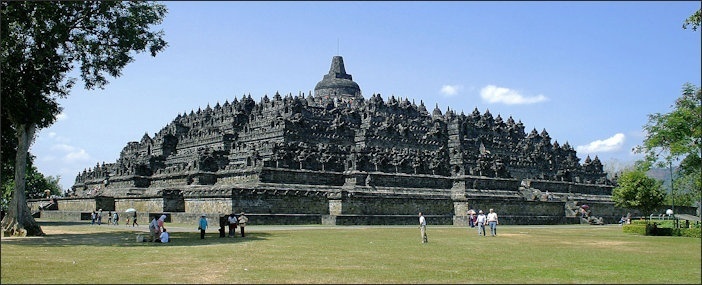
The influence of Hinduism and Buddhism is still visible in monumental sites such as Prambanan Temple, a major Hindu complex dedicated to Shiva, and Borobudur, one of the world’s largest Buddhist monuments. Following the spread of Islam—especially in Java—many Hindus migrated to Bali, where their traditions continue to flourish. Hinduism in Indonesia reflects both Indian and indigenous elements. While it incorporates ideas of social hierarchy rooted in Indian tradition, it also emphasizes a local dualism between divine and demonic forces. Beauty and refinement are often associated with gods, nobility, and higher-status individuals, while more ordinary beings are seen as possessing less refined qualities. [Source: Budi Susanto, Worldmark Encyclopedia of Religious Practices, Thomson Gale, 2006]
Hinduism was adopted by powerful empires on Java and Sumatra where it blended with local beliefs. It also reached Bali, strengthened by close cultural and dynastic ties with Java, though Balinese kingdoms largely remained independent. Bali stands out as Indonesia’s only predominantly Hindu island. Balinese Hinduism developed into a highly elaborate and distinctive form, combining the vast Indian pantheon of gods and goddesses with numerous local deities, ancestral spirits, and supernatural beings. [Source: Jill Forshee, “Culture and Customs of Indonesia”, Greenwood Press, 2006]
Buddhism teaches that the way to reach nirvana is to practise compassion in life and follow spiritual practices such as meditation. Many kings adopted Hinduism or Buddhism in order to establish a connection to divine powers and strengthen their earthly authority. In the ninth century, the Sailendra dynasty of Central Java began construction of Borobudur, the world’s largest Buddhist temple. In the early Indonesian kingdoms, Buddhism and Hinduism were practised alongside each other without conflict. In the Javanese courts of fourteenth-century Majapahit, senior ministers of both Buddhist and Hindu faiths held equal status.
During the Srivijaya period in Java and Sumatra, Hindu–Buddhist devotion stimulated many arts, which reached a high level of refinement. Poetry, theatre, dance, batik textiles and other forms of intricate weaving, metalworking and wood and stone carving all reached extremely sophisticated levels that continue to this day. These profoundly reflect Indonesian sensibilities and thought, revealing how the past lives on in the present. Many Indonesians today consider their arts and cultures to be among the most refined in the world. The term 'halus', meaning refined or polite, reflects a central value in Indonesian societies, as opposed to 'kasar', meaning crude or vulgar. These terms apply to aesthetics as well as social behaviour and echo ancient Hindu–Buddhist teachings and ideals. Following the decline of the Srivijaya Empire, Buddhism waned, although it is still practised by perhaps as many as 2 million people in Indonesia.
Later History of Religion
In the 16th century the Portuguese introduced Catholicism to what is now Indonesia. In the 17th century the Dutch introduced Protestantism. Although some local people who worked with Europeans in the colonial administration converted to the religion, Christianity did not make much headway with the local population expect in a few areas like East Timor and the Spice islands.
When Indonesia became independent in 1949 it was established as a secular state. After an election in 1955 a committee called the Konstituante was established to draft a new Constitution. Some Muslim groups pushed for having Islam made the state religion. Nationalists and Communists opposed the move. A tense situation was resolved when Sukarno disbanded the Konstituante and decreed a return to the 1945 Constitution.
Following the suppression of the 1965 Communist coup, the New Order military regime banned Communism and mandated that all Indonesian citizens subscribe to a religion. As part of this the Indonesia government attempted clamp down on animist and folk belirfs by abolishing all religions except for Islam, Hinduism, Buddhism and Christianity. Later Hindu-Balinese was added and lawyers for the Toraja and others ethnic religions argued that their religion was no different than Hindu-Balinese. As a result of all this new converts to Islam in the 1970s were predominantly former 'atheists' (typically Communists), as well as indigenous tribal people. [Source: Budi Susanto, Worldmark Encyclopedia of Religious Practices, Thomson Gale, 2006]
Kejawen—a Javanese spiritual teaching, which claims that all religions are good—was introduced by Suharto and helps explain how so many religions have managed to co-exist relatively peacefully in Indonesia. AFP reported: “Suharto's personal quirks have also had an influence on Indonesian life. Although a Muslim, Suharto's devotion to traditional pre-Islamic mysticism also influenced the national culture. His Javanese brand of synchretic Islam, popularly known as Kejawen, later was added to the list of five major religions then recognised by the state, but under a different name: Belief in God Almighty. Suharto's 1998 fall was quickly followed by a rise in more orthodox Islamic piety, but the supernatural still looms large — especially when it comes to talk of the ex-dictator himself. While many would see Suharto's team of doctors as the main reason for his survival so far, theories popular among millions of Indonesians include possession by black magic and his ownership of a Javanese royal family's sacred dagger. [Source: Aubrey Belford, AFP, January 14, 2008 /]
Religion and Society
In the Indonesian language there is clear distinction between the concept of religiosity and belonging to a community. Columnist Ignas Kledenin wrote un the Jakarta Post. “The Indonesian word ‘beragama’ comprises both one’s membership in a religious community and the degree of personal internalization of religious values...As a result people tend to equate the spiritual dimension of living religiously with eh organizational aspects of one’s membership in a religious-based grouping.
“Psychologically speaking, religion is not only a membership group but also a reference group. It is not only a physical collective made up of members as its constituents, but also a place where one identifies oneself according to the certain knowledge, ideals, norms and values of that group...But if religion is treated only as a membership group, which is self-contained and exclusive, the outsiders will be easily faced with suspicion, misgivings, prejudice and even animosity. Those who ate not with is must be against us.”
Religion often become more of an issue when times are bad than when they are good. Kledenin wrote, “In Indonesia, religion seems to be a safe base for people to fall back in. People faced with pressing difficulties tend to seek security in their religions by relying more on their religious communities, taking God more seriously and relearning their prayers...People are more inclined to offer an easy explanation for the social and political problems by referring to the degree of one’s adherence to religious norms, which one is supposed to implement as a member of a religious community.”
Religion, Government Policy and Politics in Indonesia
Even though some 87 percent of Indonesians are Muslims, Indonesia is a secular nation. Indonesia guarantees freedom of religion and recognizes six religions :Islam, Hinduism, Buddhism, Confucianism, Catholicism and Protestantism. These religions are granted protection by the Constitution. According the Indonesian philosophy of Pancasila, all citizens are required to believe in God but they can chose between the recognized religions. Atheism is not permitted.
Indonesia presents an interesting case of religious diversity within a formally secular state. While the government promotes pluralism, non-Muslim communities—especially Christians—remain conscious of their minority status. [Source: Budi Susanto, Worldmark Encyclopedia of Religious Practices, Thomson Gale, 2006]
Religion in Indonesia is a complex and volatile issue, not easily analyzed in terms of social class, region, or ethnic group. Long discouraged by the New Order government (1966–98) from political participation, Islam, Christianity, Hinduism, Buddhism, and other religions were increasingly influential frameworks for defining social participation after 1998. The state guaranteed tolerance of certain religions (agama) regarded as monotheistic by the government, but popular violence between Christians and Muslims in Java, Sulawesi, Kalimantan, Ambon, and Halmahera made those guarantees difficult to honor. In some cases, the police and army were on different sides of clashes defined in religious terms.
During the New Order, people without a religion were suspected of being communists, so many areas experienced a rush to conversion, including Java, which gained many new Christians. Followers of traditional ethnic beliefs were under pressure, too. In places such as the interior of Kalimantan and Sulawesi, some people and groups converted to one of the world religions, while others sought government recognition for a reorganised traditional religion through regional and national political manoeuvring. Among the Ngaju Dayak, for example, the traditional belief system Kaharingan gained official acceptance in the Hindu-Buddhist category, even though it is neither. Those who follow traditional beliefs and practices are often viewed with disdain as primitive, irrational and backward by urban civil and military leaders who are Muslim or Christian. However, these groups formed new organisations modelled on urban secular ones to bolster support. These represent both religious and ethnic resistance to pressure from outside sources, including neighbouring Muslim or Christian groups, exploitative government and military officers, and outside developers of the timber and mining industries. In Java, mystical groups such as Subud also lobbied for official recognition and protection. Their position was stronger than that of remote peoples because they had influential followers, including the president. [Source: “Encyclopedia of World Cultures Volume 5: East/Southeast Asia:” edited by Paul Hockings, 1993]
Religious Laws in Indonesia
The constitution protects religious freedom, although some laws, policies, and local regulations restrict religious freedom. The Ministry of Home Affairs holds the authority to review and revoke local regulations that are not in accordance with national legislation. In 2012, the ministry reviewed approximately 13,000 local regulations and revoked 824. A ministry spokesperson reported some of the regulations were revoked because they violated religious freedom, but was not able to provide an exact number. The constitution accords “all persons the right to worship according to their own religion or belief” and states that “the nation is based upon belief in one supreme God.” The first tenet of the country’s national ideology, Pancasila, similarly declares belief in one God. The government does not allow for nonbelief. Government employees must swear allegiance to the nation and to the Pancasila ideology. Other laws and policies at the national and regional levels restrict certain types of religious activity, particularly among unrecognized religious groups and “deviant” sects of recognized religious groups. [Source: International Religious Freedom Report for 2012, Indonesia, U.S. Department of State]
The government requires officially recognized religious groups to comply with directives from the Ministry of Religious Affairs and other ministerial directives, such as the Revised Joint Ministerial Decree on the Construction of Houses of Worship (2006), Overseas Aid to Religious Institutions in Indonesia (1978), and Guidelines for the Propagation of Religion (1978). The 2006 Revised Joint Ministerial Decree on the Construction of Houses of Worship requires religious groups that want to build a house of worship to obtain the signatures of at least 90 members of the group and 60 persons of other religious groups in the community stating that they support the construction. The decree also requires approval from the local religious affairs office, the Forum for Religious Harmony (FKUB). The government established FKUBs under two 2006 joint ministerial decrees. The groups exist at the city or district level and are comprised of religious leaders from the six recognized religions. They are responsible for mediating interreligious conflicts.
The Guidelines for Overseas Aid to Religious Institutions require domestic religious organizations to obtain approval from the Ministry of Religion to receive funding from overseas donors. The Guidelines for Propagation of Religion ban proselytizing to members of recognized religious groups under most circumstances. The Child Protection Act of 2002 makes conversion of minors to a religion other than their own through “tricks” and/or “lies,” terms that can be applied loosely, a crime punishable by up to five years in prison.
Under the National Education Law, religious instruction in any one of the six official religions is required when requested by a student. Religious speeches are permissible if delivered to members of the same religious group and are not intended to convert persons of other religious groups. Televised religious programming is unrestricted for any of the recognized religious groups. Publication of religious materials or the use of religious symbols is permitted; however, the government bans dissemination of these materials to persons who do not adhere to the religion of the group disseminating the materials.
The law does not discriminate against any recognized religious group in employment, housing, or health care. Religious groups and social organizations must obtain permits to hold religious concerts or other public events. The government usually grants permits in an unbiased manner unless a concern exists that the activity would raise strong objections from members of another religious group in the area. Foreign religious workers must obtain religious worker visas, and foreign religious organizations must obtain permission from the Ministry of Religious Affairs to provide any type of assistance (in-kind, personnel, or financial) to local religious groups.
See Sharia Under Justice System, Government.
Small Religious Minorities in Indonesia and Discrimination Against Them
Indonesia has a small Sikh population, estimated at between 10,000 and 15,000, residing primarily in Medan and Jakarta. There are small Jewish communities in Jakarta, Manado, and Surabaya. The Bahai community reports thousands of members, but no reliable figures are available. Falun Dafa (or Falun Gong), which considers itself a spiritual organization rather than a religion, claims several thousand followers, but specific numbers are unavailable. The number of atheists is also unknown, but the group Indonesian Atheists claims to have more than 500 members. [Source: International Religious Freedom Report for 2012, Indonesia, U.S. Department of State ]
The Ministry of Religious Affairs extends official status to six religious groups: Islam, Catholicism, Protestantism, Buddhism, Hinduism, and Confucianism. Unrecognized groups may register with the Ministry of Culture and Tourism as social organizations. Although these groups have the right to establish a place of worship, obtain identity cards, and register marriages and births, they sometimes face administrative difficulties in doing so. In some cases, these challenges make it more difficult for individuals to find jobs or enroll children in school. Identity card applications are now legally acceptable when the “religion” section is left blank. However, some individuals report that they sometimes face obstacles in doing this.
In May 2013, the United States expressed concern over attacks on religious minorities in Indonesia, noting there were 264 violent attacks on religious minorities in 2012, up from 216 in 2010. Targets of the attacks have included Christians, Shiite Muslims and the Ahmadiyah Islamic sect. The civil registration system has continued to discriminate against persons not belonging to one of the six recognized religious groups. Animists, Bahais, and members of other small minority religious groups sometimes found it difficult to register births or marriages, notwithstanding the 2007 regulation pertaining to marriage and civil administration that allowed Aliran Kepercayaan marriages to be officially recognized. According to representatives of the Aliran Kepercayaan communities, adherents sometimes found it difficult to find employment or educational opportunities due to the blank religion field on their identity cards (KTPs).
Human rights groups continued to receive occasional reports of local civil registry officials who rejected applications for KTPs submitted by members of unrecognized or minority religious groups. While civil registry regulations allowed the religion field to be left blank or select the choice “other,” the decentralized nature of the issuance of identity cards meant that some regions did not comply with these regulations. Some members of unrecognized religious groups found it easier to register with a religion other than their own and were issued KTPs that inaccurately reflected their religions. For example, some animists received KTPs that listed their religion as Islam. Many Sikhs registered as Hindu on their KTPs and marriage certificates. Similarly, some Jews registered as Christians or Muslims. Some citizens without a KTP had difficulty finding work. Several NGOs and religious advocacy groups continued to urge the government to delete the religion field from the KTPs, but made no progress.
Image Sources: Wikimedia Commons
Text Sources: “Encyclopedia of World Cultures Volume 5: East/Southeast Asia:” edited by Paul Hockings, 1993; “Culture and Customs of Indonesia” by Jill Forshee, Greenwood Press, 2006; National Geographic, New York Times, Washington Post, Los Angeles Times, Smithsonian magazine, Encyclopedia.com, Library of Congress, Indonesia Tourism website (indonesia.travel), Indonesia government websites, Live Science, The Conversation, The New Yorker, Time, BBC, CNN, Reuters, Associated Press, AFP, Lonely Planet Guides, Google AI, Wikipedia, The Guardian and various websites, books and other publications.
Last updated April 2026