
BORNEO DURING THE COLONIAL PERIOD
.gif)
territorial lose suffered by the Sultanate of Brunei
during the expansion of Western imperialism
(British, Dutch and Spanish) from 1400 to 1890 The British, Dutch and Portuguese made attempts to colonize Borneo beginning in the 17th century but found little to exploit. Much of the interior remained unexplored until fairly recently. Regular contract between Borneo and European did not take place in earnest until the mid 19th century when the British became interested in protecting the safety of its trade routes though the South China Sea. By the late 19th century, northern Borneo, Sarawak, and Brunei were British protectorates, while southern Borneo became a Dutch protectorate. These colonial boundaries largely shaped the modern borders of Malaysia, Indonesia, and Brunei.
European presence in the region began with fall of the Sultanate of Malacca to the Portuguese in 1511. After that Portuguese traders began regular contact with Borneo, particularly with Brunei from about 1530, but they made no attempt to conquer the island. Spanish forces, operating from the Americas, extended their influence into Brunei’s former territories in the Philippines, leading to conflict with Brunei during the Castilian War of 1578. British traders arrived in southern Borneo in 1609, while the Dutch began trading there in 1644. Early European explorers portrayed Borneo as a dangerous land of headhunting societies and pirate infested waters, especially along routes between northeastern Borneo and the southern Philippines.
During the early 19th century, British and Dutch ambitions intensified. The Dutch consolidated control in southern Borneo after 1815, while the British expanded their influence in the north. Foreign commercial interests also appeared briefly. American and German ventures attempted to establish settlements and trading bases in northwestern and northeastern Borneo, but most failed or were later absorbed into British control. Agreements such as the Madrid Protocol of 1885 clarified Spanish, British, and German claims in the region. Under colonial rule, infrastructure expanded, including railways in northern Borneo, and large numbers of Chinese laborers were brought in to work on plantations and in mines. Major oil discoveries from the late 19th century onward transformed parts of eastern and northern Borneo into important energy producing regions.
The naturalist Alfred Wallace and novelist Joseph Conrad were among this who wrote about Borneo and drew attention to it. The current division between Indonesia and Malaysia has roots in the rivalry between Britain and the Netherlands. The present borders between Indonesia and Malaysia were established by the British and Dutch in 1891, After World War II the Brooke family turned over its holdings in Borneo to the British government and both Sarawak and Sabah came under British control. When Malaysia became independent n 1957 Sarawak remained under British control.
RELATED ARTICLES:
EARLY BORNEO HISTORY: FIRST PEOPLE, AUSTRONESIANS, TRADE factsanddetails.com
EARLY HUMANS IN BORNEO: NIAH CAVES 40,000-YEAR-OLD ROCK ART factsanddetails.com
HEADHUNTING IN BORNEO factsanddetails.com
VIOLENCE AGAINST THE MADURESE IN BORNEO factsanddetails.com
BORNEO: GEOGRAPHY, DEMOGRAPHY, STATES, TRAVEL factsanddetails.com
BORNEO BIODIVERSITY: RAINFORESTS, NEW, RARE SPECIES, THREATS factsanddetails.com
TRIBAL PEOPLE OF BORNEO: LONGHOUSES, SAGO, ART factsanddetails.com
BORNEO ETHNIC GROUPS AND INDIGENOUS PEOPLES factsanddetails.com
DAYAKS: HISTORY, LANGUAGE, RELIGION factsanddetails.com
British in Borneo
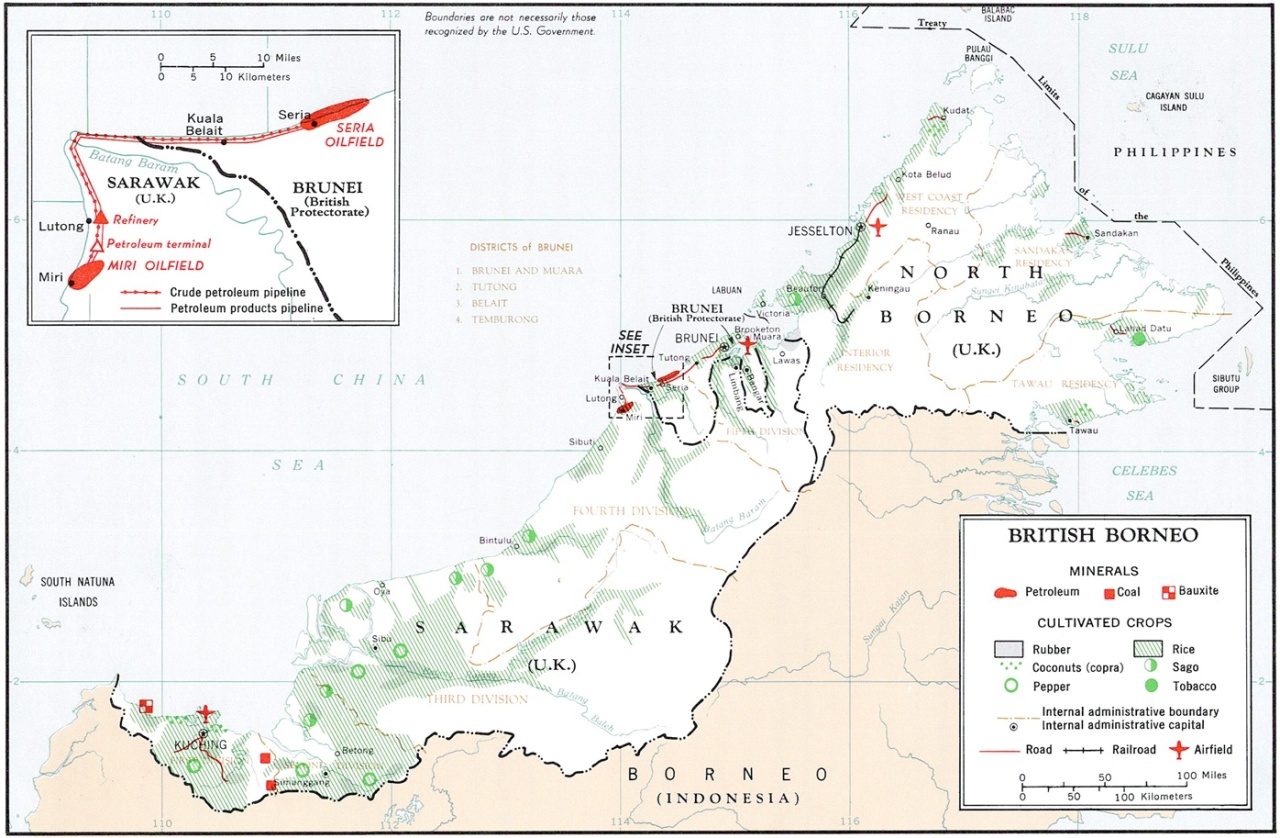
During the British colonial rule of northern Borneo before World War II, Sarawak was known as the Raj of Sarawak (1841–1946), Sabah was known as North Borneo (1881–1946), and Labuan was known as the Crown Colony of Labuan (1848–1946). The Kingdom of Brunei (1888/1906–1984) was a protectorate of the United Kingdom since the 1888/1906 Protectorate Agreement, and was known as British Protectorate State of Brunei.
The British presence in Borneo took the form of colonies and protectorates. British rule was established through individuals and companies such as James Brooke in Sarawak and the North Borneo Chartered Company in Sabah. This presence introduced new administrative systems, economic exploitation, and social change. British control ended after World War II, when Sarawak and Sabah later joined Malaysia and Brunei eventually became fully independent, although British influence remained visible through wartime involvement and postwar administration under the British Military Administration.
The British presence began in earnest in 1842, when the Sultan of Brunei granted territory in Sarawak to James Brooke in return for help suppressing a rebellion. Brooke made himself the first "White Rajah" of Sarawak. A British charter company. the Brooke Raj, was established in 1881. It ruled northern Borneo until 1946. Britain acquired Labuan in 1846, and northern Borneo later came under the North Borneo Chartered Company. Continued British expansion prompted Brunei to accept protectorate status in 1888.
North Borneo, now Sabah, was administered by the North Borneo Chartered Company from 1881, became a British protectorate in 1888, and was turned into a Crown Colony in 1946. Brunei retained its monarchy under British protection until independence in 1984. Labuan was established as a British Crown Colony in 1848 and was later incorporated into North Borneo.
British administration combined direct rule in Crown Colonies with indirect control through local rulers, reshaping political authority, labor systems, and the regional economy. Key figures associated with British Borneo include Brooke; Sir William Hood Treacher, an influential colonial administrator and author on the region; and Alfred Dent, founder and chairman of the North Borneo Chartered Company.
RELATED ARTICLES:
JAMES BROOKE AND MAKING NORTHERN BORNEO PART OF THE BRITISH EMPIRE factsanddetails.com
FIGHTING WITH BORNEO PIRATES factsanddetails.com
DAYAKS: HISTORY, LANGUAGE, RELIGION factsanddetails.com
DAYAKS IN THE 1840s factsanddetails.com
DAYAK LIFE AND CULTURE: FAMILY, ART, FOOD, LONGHOUSES factsanddetails.com
Dutch in Borneo
The southern three-quarters of Borneo — now Kalimantan — was part of the Dutch East Indies. Dutch influence expanded through treaties with local sultans and gradual administrative control, in contrast to more rapid British deal-making and direct rule in northern Borneo. Early Dutch authority was limited and relied heavily on indirect governance through local rulers, while conflicts with Indigenous Dayak groups were frequent. By the early 20th century, the Dutch had shifted toward more direct colonial rule, which lasted until the Japanese occupation during World War II. Dutch influence formally ended with Indonesian independence in 1949. [Source: Wikipedia]
The Dutch presence in Borneo began in earnest when, alarmed by the British in northern Borneo in the early 1800s, the Dutch initiated policies of colonial expansion in the Outer Islands, which brought nearly all the land area of modern Indonesia under their control. Despite Dutch predominance in Java and islands crucial for the spice trade many areas of the archipelago—including Bali, Lombok, Aceh and Borneo—remained largely independent.
Under Dutch rule, the southern regions of Borneo were claimed following the Anglo-Dutch Treaty of 1824 — which followed Britain’s brief rule of Java and other Dutch territories. The treaty made Borneo the largest territorial component of the Dutch East Indies. Dutch control in Borneo initially focused on coastal trade and port settlements before extending inland along major river systems such as the Barito, Mahakam, and Kapuas. These rivers served as strategic corridors for military movement, economic extraction, and administration.
Expansion of the Dutch in Borneo
The Dutch were in Borneo before the Anglo-Dutch Treaty. Expansion inland proceeded slowly between 1817 and 1826 through agreements with local sultanates that acknowledged traditional authority while asserting Over time, the Dutch imposed colonial governance structures and stationed troops throughout the interior, frequently clashing with local rulers and Dayak groups. [Source: Google AI]
Economic motives underpinned much of Dutch policy, as colonial authorities sought to control trade routes and extract resources, reinforcing the long-term division of the island. Dutch rule developed in parallel with, and often in competition against, British control in northern Borneo. Through a combination of military campaigns, treaties, and administrative expansion, the Dutch consolidated authority over fragmented coastal sultanates and inland Indigenous Dayak communities, particularly during the 19th and early 20th centuries. This process helped shape the political boundaries that still define the island.
Resistance to Dutch rule was persistent, particularly among Dayak communities, leading to repeated military expeditions, including actions against Chinese settlements in 1823. Fighting periodically flared up. Hundreds died in the Banjarmasin War (1859-1863) in southeastern Borneo ( Kalimantan), where in 1860 the sultanate of Banjarmasin had been dethroned and replaced by direct colonial rule .
A key moment in this consolidation was the 1894 Treaty of Tumbang Anoi, which sought to end cycles of conflict and introduce a new colonial legal order among Dayak communities. Dutch administration became increasingly centralized around 1900, with new legal and political structures imposed, including outcomes linked to the Tumbang Anoi meeting of Dayak leaders.
How the Borders Within Borneo Were Made
The legacy of Dutch and British rule in Borneo is most clearly reflected in the island’s modern political map. Colonial boundaries drawn during the 19th and early 20th centuries evolved into the present-day division between Indonesian Kalimantan and the Malaysian states of Sarawak and Sabah. [Source: Google AI]
British and Dutch authorities defined Borneo’s borders through a series of treaties, most importantly the 1891 Convention. This agreement established a boundary beginning at latitude 4°10' North on the east coast, extending westward to longitude 117° East and latitude 4°20' North. From there, the boundary followed natural features, including the water divide between the Simengaris and Soedang (Serudung) rivers and the main watershed of rivers running westward to Tandjung Datu on the west coast. Small deviations of up to 5 miles were permitted where rivers crossed the line, generally assigning territory south of 4°10' North to the Dutch and north of it to the British. Sebittik Island was divided along the same parallel.
Between 1912 and 1915, joint survey teams physically mapped and marked the boundary, confirming the watershed-based approach and installing boundary pillars at key river locations such as the Pentjiangan and Agisan. Additional agreements in 1915 and 1928 further refined the frontier between British-protected territories and Dutch-controlled areas.
These agreements formalized the division of the island into Dutch Borneo, which became Kalimantan within Indonesia, and British Borneo, comprising North Borneo (now Sabah) and Sarawak, which later formed part of Malaysia. The combination of fixed latitude and longitude lines with natural features such as rivers and ridge lines produced borders that remain largely intact today.
Borneo During World War II and Afterwards
During World War II, Japanese forces occupied Borneo from 1941 to 1945. The occupation caused widespread suffering, including executions of Chinese communities, indigenous peoples, and Malay elites, particularly in West Kalimantan. Thousands of Allied prisoners of war died in camps or during forced marches, most notoriously in the Sandakan Death Marches. Indigenous groups, especially the Dayak, participated in guerrilla resistance with Allied support. Australian forces played a major role in liberating the island, which was fully freed in 1945.
During World War II, Dutch Borneo was invaded by Japanese forces in early 1942. Dutch naval and military units resisted but were defeated in a series of engagements collectively known as the Battle of Borneo of 1941 to 1942. The Japanese occupation ended Dutch colonial rule and set the stage for postwar political change.
After Japan’s surrender in 1945, the British Military Administration governed Borneo temporarily to restore order and manage the transition back to colonial rule. The Japanese occupation of Indonesia disrupted Dutch control, and led to the subsequent collapse of the Dutch East Indies and to the emergence of Indonesia as an independent state in 1949. The colonial boundary between Dutch and British spheres of influence left a lasting legacy, shaping Borneo’s modern political division among Indonesia, Malaysia, and Brunei.
Between World War II and their independence from Britain, Sarawak became the Crown Colony of Sarawak (1946–1963) whereas Sabah and Labuan combined to form the Crown Colony of North Borneo (1946–1963). In the postcolonial period, Sarawak and Sabah joined Malaysia in 1963, while Brunei chose to remain separate and gained full independence in 1984.
Meanwhile southern Borneo became part of the newly independent Republic of Indonesia following the declaration of independence in 1945 and achievement of full independence in 1949. In the early 1960s, Britain proposed forming the Federation of Malaysia, uniting Malaya with Sarawak, North Borneo, Singapore, and initially Brunei. The plan faced opposition from Indonesia and the Philippines, leading to the Indonesia–Malaysia confrontation from 1962 to 1969 (See Konfrontasi Below) and ongoing Philippine claims to Sabah.
Following investigations by the Cobbold Commission, which found broad local support, Sarawak and North Borneo joined Malaysia on 16 September 1963. Brunei withdrew from the plan after an internal revolt and political disagreements. Since then, northern Borneo has faced intermittent security challenges, including piracy and militant activity. In August 2019, Indonesia announced plans to relocate its national capital from Jakarta to East Kalimantan in Borneo, marking a new chapter in the island’s modern history.
Konfrontasi
Indonesia opposed the Federation of Malaysia. For a number of years it supported guerilla attacks against Sarawak, Sabah and Malaya. In 1960, the northern states of Borneo, , which bordered on Indonesian Kalimantan, were somewhat reluctant to join Malaysia. Indonesian President Sukarno saw himself as the true leader of the Malay people. Indonesia supported an attempted revolution in Brunei and railed against British imperialism. The Indonesian army increased its budget. British forces provided assistance to Malaysia in their fight against the Indonesians. A brief war—known as Confrontation (Konfrontasi) —soon involved Britain, the United States, the Soviet Union, and China and eventually settled rival claims in Borneo.
The Indonesian government led by Sukarno contended that the new federation of Malaysia was a neocolonialist plan to prevent Indonesia and Malaysia from combining into a Greater Malaysia, an entity that Malaysian leaders had previously supported. Soon after the Federation of Malaysia was established, Indonesia attempted to spark a popular revolt in the fledgling country by engaging in acts of terrorism and armed confrontation in various places. However, these actions strengthened popular support for Malaysia, and in 1964 Australia, Britain, and New Zealand sent troops and military aid to Malaysia.
Sukarno was backed by the powerful Communist Party of Indonesia (PKI). Indonesia backed a Communist insurgency in Sarawak, mainly involving elements of the local Chinese community. The Indonesian army mounted offensives along the Kalimantan–Malaysia border and the PKI demonstrated in the streets in Jakarta. Indonesian irregular forces were infiltrated into Sarawak, where they were contained by Malaysian and Commonwealth of Nations forces.
See Separate Article: INDONESIA' S RELATIONS WITH MALAYSIA factsanddetails.com
Image Sources: Wikimedia Commons
Text Sources: Indonesia Tourism websites, Indonesia government websites, Malaysia Tourism websites, Malaysia government websites,UNESCO, “Encyclopedia of World Cultures Volume 5: East/Southeast Asia:” edited by Paul Hockings, 1993; National Geographic; New York Times, Washington Post, Los Angeles Times, Lonely Planet Guides, Library of Congress, Smithsonian magazine, The New Yorker, Time, Reuters, AP, AFP, Wikipedia, BBC, CNN, and various books and other publications.
Last Updated January 2026