
SUKARNO'S FOREIGN POLICY
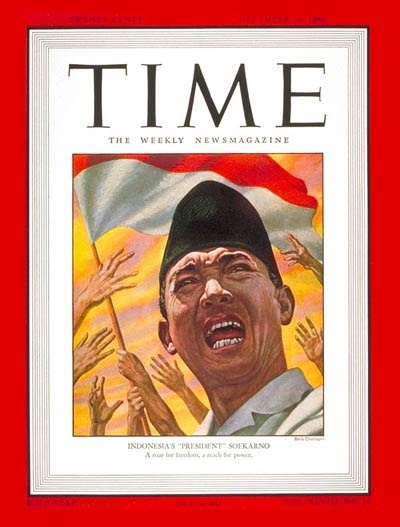
Diplomatically, Sukarno’s rigid ideology proved costly. He distanced Indonesia from Western nations at a moment when the young state urgently needed foreign assistance, instead aligning closely with the Soviet Union and China. His withdrawal of Indonesia from the United Nations in protest over its recognition of Malaysia further isolated the country. By 1965, inflation had soared to 650 percent, aid from the West had dried up, and vital trade networks had collapsed. Extremist Islamic groups gained influence, and corruption deepened. [Source: “Culture and Customs of Indonesia” by Jill Forshee, Greenwood Press, 2006]
Sukarno applied his nationalist policies to foreign policy. He believed that Asia had been humiliated by the West and that Indonesia remained threatened by the remnants of Western imperialism, namely British-controlled Malaysia, Dutch-controlled Irian Jaya (now West Papua) and the Philippines, with its American military bases. “Knofrontasi” became a policy position. He failed in his effort to win northen Borneo from Malaysia in a disastrous confrontation that provoked international condemnation but succeeded in obtaining Irian Jaya.
According to Lonely Planet: First on the agenda was Irian Jaya, which Indonesia had always claimed on the basis that it had been part of the Dutch East Indies. An arms agreement with the Soviet Union in 1960 enabled the Indonesians to begin a diplomatic and military confrontation with the Dutch over the disputed territory, though it was US pressure on the Dutch that finally led to the Indonesian takeover in 1963.” In 1965, Indonesia became the first nation ever to withdraw from the United Nations. It resigned soon after the Federation of Malaysia was given a set on United Nations Security Council.
The international scene was, for Sukarno, a gigantic stage upon which a dramatic confrontation between (as he termed them) the New Emerging Forces and Old Established Forces was played out in the manner of the wayang contest between the virtuous Pandawas and the evil Kurawas. With the assistance and support of the PKI, Sukarno attempted to forge a "Jakarta-Phnom Penh-Beijing-Hanoi- Py'ngyang axis" in order to combat Neocolonialism, Colonialism, and Imperialism (Nekolim). Although the Soviet Union was a major supplier of arms and economic aid, relations with China through official and PKI channels were growing close, particularly in 1964- 65. [Source: Library of Congress *]
See Malaysia, Papua and East Timor.
RELATED ARTICLES:
SUKARNO: HIS LIFE, CHARACTER AND IDEOLOGY factsanddetails.com
SUKARNO AS PRESIDENT: CHALLENGES, AUTHORITARIANISM, GUIDED DEMOCRACY factsanddetails.com
DIFFICULTY MAKING DEMOCRACY WORK IN INDONESIA IN THE 1950s factsanddetails.com
INDONESIA DECLARES INDEPENDENCE IN 1945 AT THE END OF WORLD WAR II factsanddetails.com
INDONESIA’S NATIONAL REVOLUTION: THE STRUGGLE FOR INDEPENDENCE 1945-1949 factsanddetails.com
JAPANESE OCCUPATION OF THE DUTCH EAST INDIES (1942-1945) factsanddetails.com
Sukarno's Hostility Towards Malaysia

Sukarno bitterly opposed the creation of Malaysia in 1963, which called a "neo-colonial plot" and perceived as a means of continuing British influence in the region and off shutting off Indonesia from the rest of the word. He saw Indonesia as the rightful leader of the Malay people and thought it was a British plot to surround Indonesia. British firms were seized by the government and mobs were allowed to attack and burn down the British embassy. Sukarno made a major propaganda issue of Indonesian opposition to the creation of Malaysia. In September 1963, Indonesia announced a "crush Malaysia" policy, aiming to acquire Sarawak and Sabah (which are on the island of Borneo with Kalimantan). [Source: Worldmark Encyclopedia of Nations, Thomson Gale, 2007]
Hostility to Malaysia, which was established on September 16, 1963, as a union of states of the Malay Peninsula, Singapore, and the North Borneo states of Sabah and Sarawak, sprang from Sukarno's belief that it would function as a base from which Nekolim ("neo-colonial") forces could subvert the Indonesian revolution. Malaysia's conservative prime minister, Tengku Abdul Rahman, had agreed to the continued basing of British armed forces in the country, and Sukarno could not forget that the government of independent Malaya had given assistance to the PRRI rebels in 1958. In the wake of Malaysia's creation, a wave of anti-Malaysian and anti-British demonstrations broke out, resulting in the burning of the British embassy. PKI union workers seized British plantations and other enterprises, which were then turned over to the government. [Source: Library of Congress *]
Guerrilla raids into Malaysian territory were staged intermittently for three years until a formal treaty was concluded between the two countries in August 1966. Sukarno provided training to the anti-Malaysian, Chinese guerillas of the Sarawak People’s Guerilla Force, which attacks on Malaysian forces in Borneo. The Dayaks the instability to begun hunting heads again. In 1965, some American interests were seized y the government and American government offices were attacked.
Konfrontasi
Indonesia opposed the Federation of Malaysia. For a number of years it supported guerilla attacks against Sarawak, Sabah and Malaya. In 1960, the northern states of Borneo, , which bordered on Indonesian Kalimantan, were somewhat reluctant to join Malaysia. Indonesian President Sukarno saw himself as the true leader of the Malay people. Indonesia supported an attempted revolution in Brunei and railed against British imperialism. The Indonesian army increased its budget. British forces provided assistance to Malaysia in their fight against the Indonesians. A brief war—known as Confrontation (Konfrontasi) —soon involved Britain, the United States, the Soviet Union, and China and eventually settled rival claims in Borneo.
The Indonesian government led by Sukarno contended that the new federation of Malaysia was a neocolonialist plan to prevent Indonesia and Malaysia from combining into a Greater Malaysia, an entity that Malaysian leaders had previously supported. Soon after the Federation of Malaysia was established, Indonesia attempted to spark a popular revolt in the fledgling country by engaging in acts of terrorism and armed confrontation in various places. However, these actions strengthened popular support for Malaysia, and in 1964 Australia, Britain, and New Zealand sent troops and military aid to Malaysia.
Sukarno was backed by the powerful Communist Party of Indonesia (PKI). Indonesia backed a Communist insurgency in Sarawak, mainly involving elements of the local Chinese community. The Indonesian army mounted offensives along the Kalimantan–Malaysia border and the PKI demonstrated in the streets in Jakarta. Indonesian irregular forces were infiltrated into Sarawak, where they were contained by Malaysian and Commonwealth of Nations forces.
See Separate Article: INDONESIA' S RELATIONS WITH MALAYSIA factsanddetails.com
Sukarno and the Nonaligned Movement
Sukarno is considered the father of the non-aligned movement of Third World nations whose initial aim was to find a nonaligned middle ground between the capitalist United States and the communist Soviet Union. In the 1950s, Sukarno moved Indonesia's foreign policy toward nonalignment, a foreign policy stance supported by other prominent leaders of former colonies who rejected formal alliances with either the West or Soviet bloc. Under Sukarno's auspices, these leaders gathered in Bandung, West Java in 1955 to lay the groundwork for what became known as the Non-Aligned Movement.
The Third World countries that met in Bandung declared they were going to take a path differing from that of both the United States and the Soviet Union. The meeting was filled with anti-first-world theories and terms like "anti-imperialism" and "anti-colonialism." Sukarno said it was time to wipe away the legacy of Western colonialism and called for the 20th century to be "the century of the awakening of the colored people" and "the century of intervention."
The conference was held at the height of the Cold War between the United States and the Soviet Union and their allies. The conference resulted in the Dasasila Bandung, in which most of the principles of the United Nations were incorporated, and which became the guideline for colonized countries in their fight for independence. It also became the fundamental principles in promoting world peace and international cooperation.
Afro-Asian Conference in Bandung
In April 1955, Sukarno hosted the groundbreaking Afro-Asian Conference in Bandung— a former Dutch colonial hill station in Java— that later grew into the non-aligned nation's movement. Among the leaders in attendance were Egypt's Gamal Abdel Nasser, China's Zhou Enlai, India's Jawharlal Nehru, Yugoslavia's Tito and Ghana's Kwame Nkrumah. The twenty-five countries that participated at the Bandung Conference represented nearly one-quarter of the Earth's land surface and a total population of 1.5 billion people more than half the world’s population at that time.
The world leaders stayed at the Savoy Homann Hotel and held meetings at Bandung's historical "freedom" building — “Gedung Merdeka” —from April 18th to 24th 1955. Recognized as milestone in world history for recognizing both the problems and power of the developing world, it was organized and hosted by Sukarno. To underscore solidarity among the nations, leaders and delegates made the dramatic historic walk together from their hotels at Savoy Homann, the Preanger and the Panghegar to Gedung Merdeka.
The Asian African Conference was the first time that 29 Asian and African countries, most of whom had just gained their independence after long years of colonial rule, gathered to join hands to determine their own future. Together the countries that participated covered a quarter of the world’s land surface with a total population of 1.5 billion people, more than half the world’s population at that time. Those attending are a Who’s Who of Asian and African history: Sukarno of Indonesia, Jawaharlal Nehru of India who came with his daughter Indira Gandhi,, the future leader of India, Sir John Kottalawala of Ceylon (Sri Lanka), Muhammed Ali of Pakistan, Prince Norodom Sihanouk of Cambodia, U Nu of Burma, General Abdel Nasser of Egypt, Josip Broz Tito of Yugoslavia, Kwame Nkrumah of Ghana and Zhou En Lai of China and many more.
The leaders gave their commitment to the 10 principles of Bandung in 1955 which inspired the struggle of the Asian and African nations for independence. At an event to commemorate the 50th anniversary of Bandung, that welcomed leaders of nations from South Africa to North Korea, Indonesian President Susilo Bambang Yudhoyono said,"The Bandung spirit has been a guidance, and a rallying cry, for generations of Asian and African leaders.” [Source: Reuters, April 25, 2005]
The 10-point "declaration on promotion of world peace and cooperation," incorporating the principles of the United Nations Charter was adopted unanimously: 1) Respect for fundamental human rights and for the purposes and principles of the charter of the United Nations; 2) Respect for the sovereignty and territorial integrity of all nations; 3) Recognition of the equality of all races and of the equality of all nations large and small; 4) Abstention from intervention or interference in the internal affairs of another country; 5) Respect for the right of each nation to defend itself, singly or collectively, in conformity with the charter of the United Nations; 6a) Abstention from the use of arrangements of collective defence to serve any particular interests of the big powers; 6b) Abstention by any country from exerting pressures on other countries; 7) Refraining from acts or threats of aggression or the use of force against the territorial integrity or political independence of any country; 8) Settlement of all international disputes by peaceful means, such as negotiation, conciliation, arbitration or judicial settlement as well as other peaceful means of the parties own choice, in conformity with the charter of the United Nations; 9) Promotion of mutual interests and cooperation; 10) Respect for justice and international obligations.
The Asian African Conference was formally Initiated by Indonesia, Burma (now Myanmar), Ceylon (now Sri Lanka), Pakistan and India. The other countries that participated were : Afghanistan, Cambodia, the People’s Republic of China, Cyprus, Egypt, Ethiopia, Iran, Iraq, Japan, Jordan, Laos, Lebanon, Liberia, Libya, Nepal, the Philippines, Saudi Arabia, Syria, Sudan, Thailand, Turkey, the Democratic Republic of Vietnam (North Vietnam), the State of Vietnam (South Vietnam), and Yemen.
Sukarno, the United States and the West
Sukarno earned praise in Indonesia and in the Third World for standing up to the West, particularly the United States which he accused of being imperialist. He often aimed his “Konfrontasi” speeches at Washington and described Indonesia as a “coolie between nations,” moored between the continents of Asia and Australia. In the 1950s Sukarno condemned rock 'n roll as a symptom of Western decadence.
On the relation between the east and west, Sukarno said: "To me, both the Declaration of Independence and the Communist Manifesto contain undying truths, but the West doesn't permit a middle road. They manipulate you so you're no longer able to stay independent. To President Roosevelt's four freedoms I add a fifth: the freedom to be free. The West keeps threatening: 'Do you want to be dominated by the communist?' We answer, 'No...but neither do we want to be dominated by you!' At least Communist Russia and China don't call us names when we smile sweetly at America. A nation engaged in surviving must take help from all sides, accept whatever is useful and throw away the rest."
Sukarno told the West to “go to hell with their aid.” On American aid, he said, "Americans are under the impression they're saying to use, 'Here poor, dear, poverty stricken brother...have some money...here poor little underdeveloped Indonesia, we are going to give you aid because we love Indonesia.' This is hypocrisy. America tolerates underdeveloped Asian countries for two reasons. One, we're a good market. We pay back with interest. And two, she worries we'll turn communist. She tries to buy our loyalties. She gives bounty and plenty only because she's afraid. Then if we don't act the way she wants, she yanks back her credit and warns, 'No more unless you behave yourself!' Manual Quezon of the Philippines once said, 'It is better to go to hell without America than to go to heaven with her!'"
Sukarno and Indonesia's Communist Party
The power of Sukarno's regime grew with support form the Communist Party (Partai Komunis Indonesia, PKI). Founded in 1920, the PKI reached its peak under Sukarno when it was the largest communist party in the non-communist world, with over 10 million members. . Though the PKI represented the largest communist party outside the Soviet Union and China, its mass support base never demonstrated an ideological adherence typical of communist parties in other countries.
Sukarno’s relation with the PKI was uneasy. The PKI pushed for more aggressive land reform than the Sukarno government was willing to commit to and encouraged the government to take the law into their own hands and seize land for themselves. In 1964, these tactics led to violent clashes in Java and Bali. Tensions were also high between the military and the PKI. Things reached a head when Chinese leader Zhou Enlai visited Indonesia and prosed establishing a revolutionary army in addition to the four established armed forced. When Sukarno said he supported the move rumors began circulating about an imminent coup.
According to Lonely Planet: “With the PKI and its affiliate organisations claiming membership of 20 million, Sukarno realised he had to give the communists recognition in his government. Increasingly, the PKI gained influence ahead of the army, which had been the main power base of Indonesian politics since independence. ‘Guided Democracy’ under Sukarno was marked by an effort to give peasants better social conditions, but attempts to give tenant farmers a fairer share of their rice crops and to redistribute land led to more class conflict. [Source: Lonely Planet]
During an anti-Communist uprising in 1958, Sukarno said, "With God's mercy, with our own power, we can crush this whole rebellion." But in response to the Communist threat, Sukarno allowed a mob to attack and firebomb the British embassy and United States library in Jakarta; British companies and landholdings were nationalized; and Indonesia withdrew from the United Nations and broke off relations with Malaysia. Sukarno supported guerrillas attempting to bring down the government in Malaysia and launched a border war along the 700 mile border between Indonesia and Malaysia in Borneo.
Sukarno and Foreign Communist States
In the early 1960s, Sukarno moved closer to Asian communist states During the Sukarno years, Indonesia received huge amounts of financial aid from the Soviet Union. As time went by Sukarno became more and more dependent on the Communists for support. He didn't make many friends in the West when he nationalized Western assets and a gave members of the PKI high profile positions.
By the early 1960s, Sukarno had steered Indonesia into a turbulent era of militant nationalism. His dramatic, revolutionary speeches captivated the public, uniting Indonesians against what he portrayed as external enemies—Malaysia, its British allies, the United States, and much of the Western world. [Source: Paige Johnson Tan, Governments of the World: A Global Guide to Citizens' Rights and Responsibilities, Thomson Gale, 2006).
The West became increasingly alarmed at Indonesia’s foreign policy. Foreign aid dried up after the USA withdrew its assistance because of konfrontasi. The cash-strapped government abolished many subsidies, leading to massive increases in public transport, electricity, water and postal charges. Economic plans had failed miserably and inflation was running at 500 percent. As konfrontasi alienated Western nations, Indonesia came to depend more on support from the Soviet Union, and, to a lesser extent, from communist China. Meanwhile, tensions grew between the Indonesian Army and the PKI.
Indonesia and the Domino Theory
By the early 1960s there was real a fear that Indonesia, under Sukarno, would go completely Communist and pave the way for way for other Southeast Asian countries, like Malaysia and the Philippines—which had strong communist resistance movements—to go communist, like a row of dominos. Defending the U.S. support of French colonial rule in Indochina, President Dwight D. Eisenhower said that American financial aid to French was the "cheapest way...to get certain things we need from the riches of the Indonesian territory."
Marvin Ott, a professor of national security policy at the National War College, argued in 1994 that the U.S. had no choice but to get involved in Vietnam. "In those years of 1962-64, at the depths of the Cold War, Southeast Asia appeared to be extraordinarily vulnerable in terms of American national security." [Source: Marvin Ott, Washington Post, August 24, 1994]
"Indonesia," Ott wrote in the Washington Post, "the largest state in the region, was lurching toward economic chaos and political disintegration under the charismatic mismanagement of president Sukarno. To keep power, Sukarno began to collaborate even more closely with the Indonesian Communist Party, and to align Indonesia with China, North Korea and North Vietnam. In 1965 Sukarno initiated a war with neighboring Malaysia, largely on the grounds that Kuala Lumpur was unacceptably friendly toward the West. Late that year a communist-inspired coup in Indonesia very nearly succeeded."
Sukarno, the C.I.A. and the MI6
The U.S. and Western Europe didn't like Sukarno's cozy relations with Communists in his country and abroad. The C.I.A. and the British intelligence agency MI6 both worked to bring to Sukarno down. They supported anti-Sukarno rebellions in Sumatra and Sulawesi.
In 1958, the C.I.A. supported the anti-Sukarno coup in Indonesia with a fleet of B-26 bombers. It also spread rumors that he was a Japanese collaborator (which he was) and helped produce a pornographic films with some porn actors, including one in a Sukarno mask. The film intended to make it look like Sukarno was having sex with prostitutes and undermine him by making him look bad to Islamic conservatives. In the end, the film made Sukarno look macho, the CIA look foolish, and the United States look like a meddler in the affairs of other countries. Prominent Indonesians saw the film and laughed at how low the U.S. was willing to go.
In 1962, the British Prime Minister MacMillian sent U.S. President Kennedy a memo that said he agreed to "liquidate President Sukarno, depending on the situation and available opportunities.” In 1965, the Jakarta office for the MI6 was allocated 100,000 pound and told "to do anything...to get rid of Sukarno." Among other things the MI6 set in motion a propaganda campaign that blamed Indonesia's troubles on "Chinese communist," paving the way for the slaughter of tens of thousand of ethnic Chinese as Sukarno's government collapsed.
Image Sources: Wikimedia Commons
Text Sources: New York Times, Washington Post, Los Angeles Times, Lonely Planet Guides, Library of Congress, Compton’s Encyclopedia, The Guardian, National Geographic, Smithsonian magazine, The New Yorker, Time, Reuters, AP, AFP, Wikipedia, BBC, CNN, NBC News, Fox News and various books and other publications.
Last updated December 2025