
KEDIRI
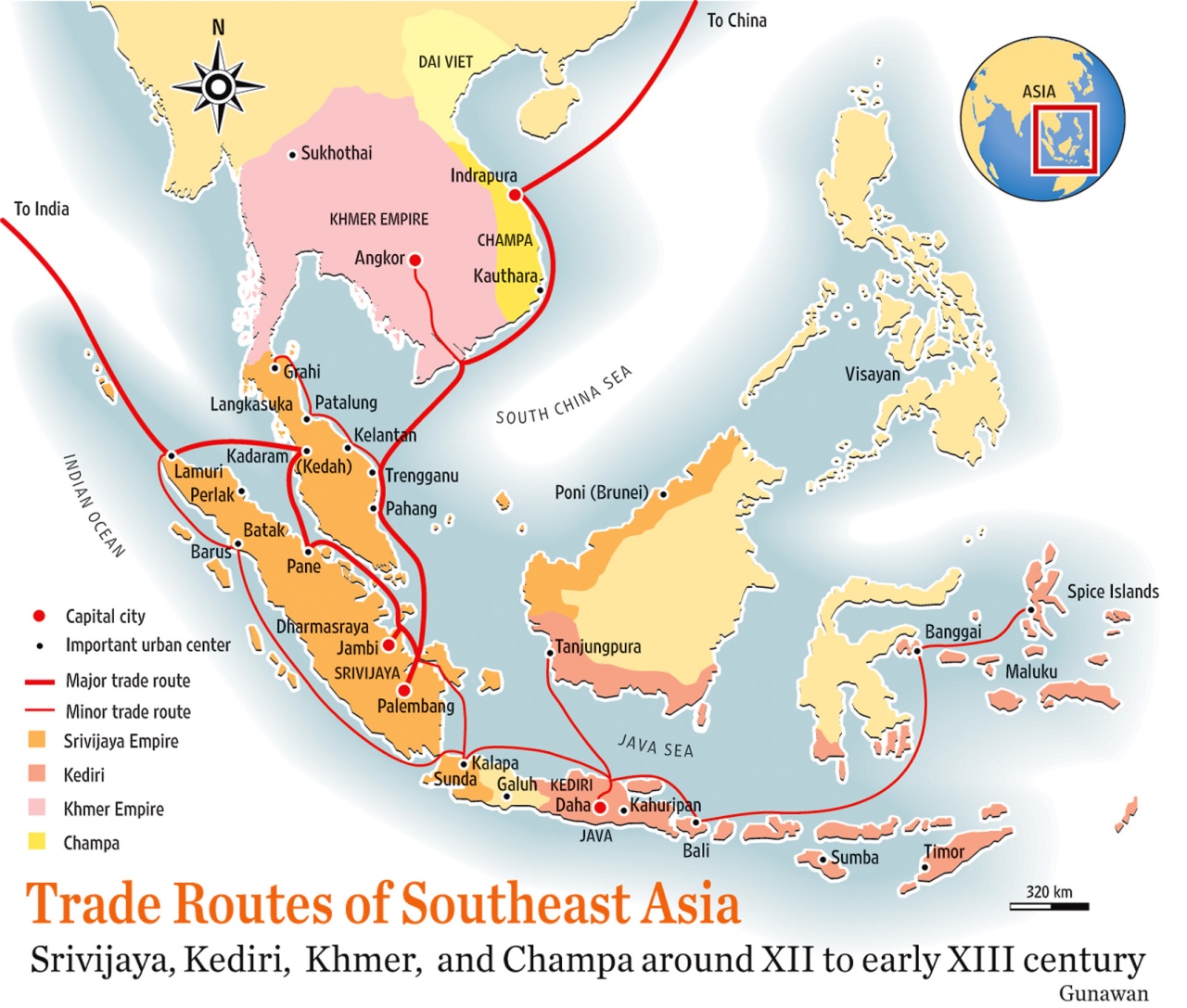
After the Mataram kingdom collapsed In Java, continued population growth, political and military rivalries, and economic expansion produced important changes in Javanese society. Taken together, these changes laid the groundwork for what has often been identified as Java’s—and Indonesia’s— “golden age” in the fourteenth century. [Source: Library of Congress *]
In Kediri, for example, there developed a multilayered bureaucracy and a professional army. The ruler extended control over transportation and irrigation and cultivated the arts in order to enhance his own reputation and that of the court as a brilliant and unifying cultural hub. The Old Javanese literary tradition of the “kakawin”(long narrative poem) rapidly developed, moving away from the Sanskrit models of the previous era and producing many key works in the classical canon. Kediri’s military and economic influence spread to parts of Kalimantan and Sulawesi. *
The Kediri Kingdom, also known as the Kadiri Kingdom or the Panjalu Kingdom, was a Hindu-Buddhist Javanese kingdom based in East Java from 1042 until 1222 (until 1292–1293 under Jayakatwang). Despite the lack of archaeological remains, this kingdom's ancient city, Dahanapura, saw much development in classical literature during its time. Mpu Sedah's Kakawin Bharatayuddha, Mpu Panuluh's Gatotkacasraya, and Mpu Dharmaja's Smaradhana blossomed during this era. The kingdom's capital is believed to have been established in the western part of the Brantas River valley, near modern-day Kediri City and Kediri Regency. [Source: Wikipedia]
RELATED ARTICLES:
OLDEST CULTURES IN INDONESIA AND PEOPLE THERE BEGINNING 10,000 YEARS AGO factsanddetails.com
FIRST INDONESIAN KINGDOMS: HINDU-BUDDHIST INFLUENCES, SEAFARING, TRADE AND CULTURE factsanddetails.com
SRIVIJAYA KINGDOM: HISTORY, BUDDHISM, TRADE, ART factsanddetails.com
MATARAM KINGDOM: HISTORY, HINDUISM, PRAMBANAN, AFTERWARDS factsanddetails.com
SAILENDRA DYNASTY: BUDDHISM, BOROBUDUR, HISTORY factsanddetails.com
MAJAPAHIT KINGDOM: HISTORY, RULERS, CULTURE factsanddetails.com
EARLY INDONESIAN TRADE AND ANCIENT SHIPWRECKS factsanddetails.com
HISTORY OF ISLAM IN INDONESIA: ARRIVAL, SPREAD, ACEH, MELAKA, DEMAK factsanddetails.com
Singosari
The town of Singosari (between Surabaya and Malang) was once the center of the powerful 13th-century East Javanese Kingdom of Singosari (or Singhasari). The kingdom was founded in 1222 by Ken Arok, a commoner who rose to power after murdering the ruler of Janggala and marrying his widow, the renowned princess Ken Dedes. After consolidating his position, Ken Arok defeated the neighboring kingdom of Kediri, reuniting the two territories that King Airlangga had divided between his sons in 1049. Little remains today—only an unfinished temple and two massive guardian statues stand as the last physical traces of this once-great realm. Much of what is known about Singosari today comes from the Pararaton, a 14th-century Old Javanese chronicle often referred to as the “Book of Kings.”
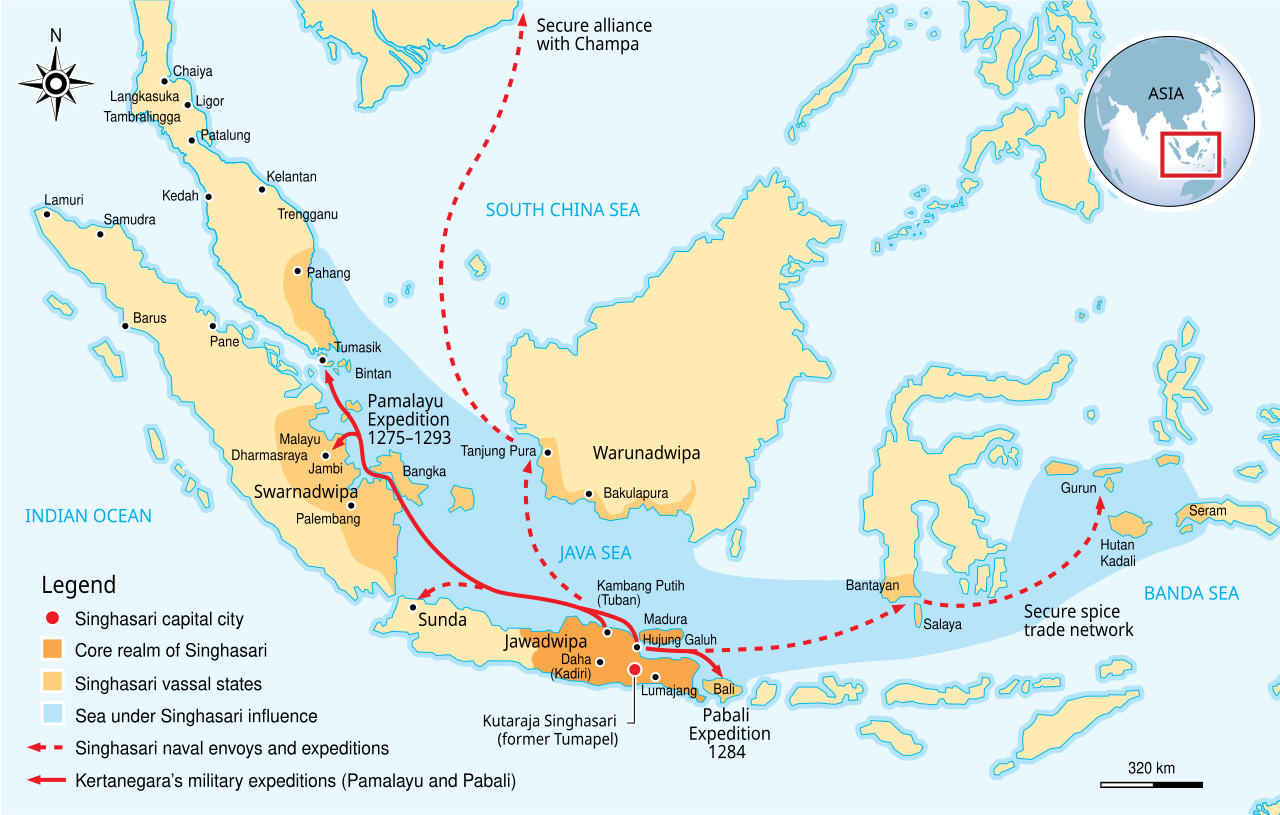
The Singhasari, defeated Kediri in 1222. They developed an aggressive system of state control, moving in new ways to incorporate local lords’ rights and lands under royal control and fostering the growth of mystical Hindu- Buddhist state cults devoted to the powers of the ruler, who came to be accorded divine status.
Singosari prospered by developing the fertile Brantas River basin and controlling lucrative maritime trade in the Java Sea. Under King Kertanegara, the kingdom expanded its influence even further; campaigns in 1275 and 1291 weakened the maritime power of Srivijaya in South Sumatra and secured control over key
sea routes between Java and Sumatra. Kertanegara’s reign ended abruptly in 1293 when he was killed by his vassal, Jayakatwang.
The greatest and most controversial of Singhasari king was Kertanagara (r. 1268–92), the first Javanese ruler to be accorded the title of “dewaprabu”(literally, god-king). Largely by force or threat, Kertanagara brought most of eastern Java under his control and then carried his military campaigns overseas, notably to Srivijaya’s successor, Melayu (then also known as Jambi), with a huge naval expedition in 1275, to Bali in 1282, and to areas in western Java, Madura, and the Malay Peninsula. These imperial ambitions proved difficult and expensive, however: the realm was perennially troubled by dissent at court and rebellion both at home and in the subjugated territories. Afterward, Vijaya founded the Majapahit Empire in 1294 at Porong, north of Singosari. Majapahit soon grew into one of the most powerful empires in Southeast Asia, extending its influence across much of modern Indonesia and reaching into Malaysia and Thailand.[Source: Library of Congress *]
See Separate Article: SURABAYA: SIGHTS, ENTERTAINMENT, TROWULAN factsanddetails.com
Marco Polo in Indonesia
On his journey home from China to Italy in 1291,Marco Polo was forced to spend five months on “Java the Less”—Sumatra—waiting for the monsoon winds to change direction so he could sail to Ceylon and India. His accounts of the island mixed keen observation with sailors’ tales and exaggeration: he described the sago palm, an important staple food, Marco Polo reported described accurately that cannibals lived in Sumatra but then went on to describe strange beasts, including enormous unicorns, in size “not all by any means less than an elephant.” These were probably Sumatran rhinoceroses. On Sumatra, Polo said: “I tell you quite truly that there are men who have tails more than a palm in size.
Marco Polo's account of the major ports, products, and trade routes is remarkably accurate, despite some understandable geographical confusion and unreliable distance estimates. Above all, he conveys a sense of wonder and enthusiasm for a world where "everything is different"—a phrase he repeats frequently. His awareness of human, linguistic, and zoological diversity is what gives his book its great charm. [Source: Paul Lunde, Saudi Aramco World, July-August 2005 ]
“The number of islands in the Indian Ocean, Marco Polo wrote, is 12,700, “as shown by the maps and writings of the practiced seamen who ply in these waters.” He added the disclaimer: “There is no man in all the world who could tell the truth about all the islands of the Indies.” He is also perhaps the first European writer since classical times to mention the monsoon: “I must tell you that it takes a full year to complete the voyage, setting out in winter and returning in summer. For only two winds blow in these seas, one that wafts them out and one that brings them back; and the former blows in winter, the latter in summer.”
See Separate Article: EARLY EUROPEAN EXPLORERS IN INDONESIA: MARCO POLO, NICOLÒ DEI CONTI, MAGELLAN'S CREW factsanddetails.com
Singosari Fends Off the Chinese and Mongols
At its height, Singosari had become the most powerful kingdom in the region—strong enough to draw the attention of Kublai Khan, the Mongol emperor of the Yuan Dynasty. After defeating Srivijaya in Sumatra in 1290 and expanding Singosari’s influence across maritime Southeast Asia, King Kertanegara’s ambitions alarmed the Mongol court, which viewed his rising power as a potential threat. Kublai Khan sent emissaries demanding that Singosari acknowledge Mongol supremacy and pay tribute. Kertanegara not only refused but humiliated the embassy by cutting off one envoy’s ear and sending him back with the message that he would not submit.
Enraged, Kublai Khan dispatched a punitive expedition—reportedly composed of around 1,000 ships and 100,000 men—which reached the coast of Java in 1293. But before the fleet arrived, Kertanegara had already been assassinated by Jayakatwang, a descendant of the Kediri royal line seeking revenge. When the Mongols landed, they found a different political landscape. Kertanegara’s son-in-law, Prince Vijaya, cleverly allied with the Mongols to help defeat Jayakatwang, then turned on the expeditionary force and drove the Chinese troops from Java, setting the stage for the rise of the Majapahit Empire.
See Separate Article: YUAN-MONGOL INVASIONS OF BURMA AND JAVA factsanddetails.com
Image Sources: Wikimedia Commons
Text Sources: New York Times, Washington Post, Los Angeles Times, Times of London, Lonely Planet Guides, Library of Congress, Ministry of Tourism, Republic of Indonesia, Compton’s Encyclopedia, The Guardian, National Geographic, Smithsonian magazine, The New Yorker, Time, Newsweek, Reuters, AP, AFP, Wall Street Journal, The Atlantic Monthly, The Economist, Foreign Policy, Wikipedia, BBC, CNN, and various books, websites and other publications.
Last updated December 2025