
SAILENDRA DYNASTY
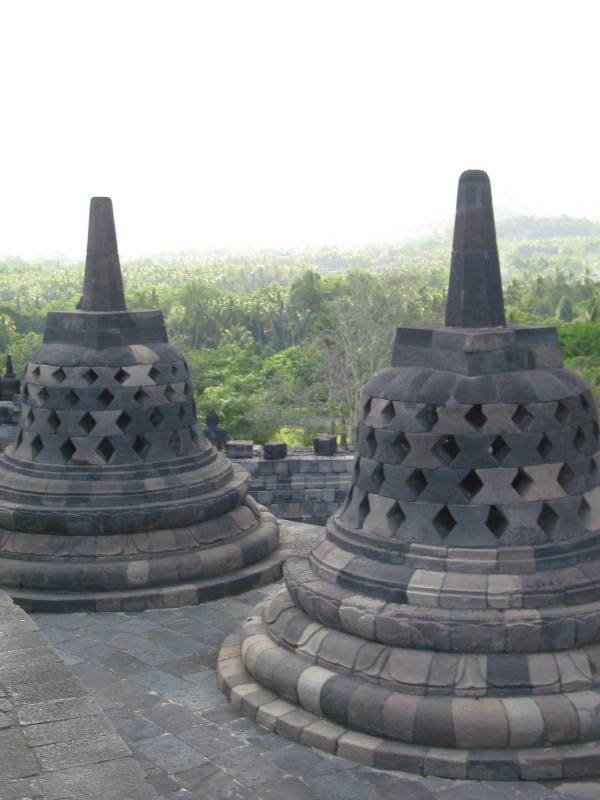
The Buddhist Sailendra Dynasty ruled central Java from the 8th century to 13th century. It gained control over Srivijaya in the 9th century. Borobudur and Prambanan were built during their rule in the middle of the 9th century, which not only shows the strength of Buddhism but also reveals that Hinduism was very much alive. Shortly after they lost control of Java the Sailendras reappeared on the throne of Srivjaya and remained in power there until the 13th century.
In the 8th century, the Hindu Mataram Kingdom based in the Solo River region,and the Buddhist Sailendra Dynasty in the plains of Central Java emerged as powerful inland states. Unlike Srivijaya, whose wealth derived from maritime trade, these kingdoms were land-based and drew their strength from agricultural surpluses and the ability to organize large labor forces. Founded by King Sanjaya, Mataram’s rulers claimed a divine mandate, followed a form of Shaivite Hinduism, and built some of Indonesia’s earliest Hindu monuments on the Dieng Plateau. By the 9th century, however, political control in Central Java shifted to the Buddhist Sailendra dynasty.
Sailendra means "Lord of the Mountain" in Sanskrit. The name may have been associated with the volcanic mountains of Central Java. The name of the dynasty (Sailendra-vamsa) is first attested in the Candi Kalasan Inscription dated 778. The Sailendra practiced intensive rice cultivation and had an administrative hierarchy which controlled the allocation of water for irrigation. The Sailendra dynasty held the concept of the "Dewa-Raja" (God-King), the belief that the King had divine power as a living god among his subjects. Though their economy was based on rice cultivation, they had access to ports on the northern coast of Java and maintained commercial and marital ties with the Srivijaya kingdom in southern Sumatra. The Sailendra participated in the Spice Route trade between China and India, but their level of participation never rivaled that of Srivijaya.[Source: New World Encyclopedia ~]
Hinduism and Buddhism developed in Java and Sumatra. They never took hold in eastern islands such as Sumba, Timor, and Flores. These islands had developed strong animistic cultures apart from the mainstream of world faiths and felt little need to change. In fact, outside religions posed a serious threat to their locally based power structures. House societies characterized the eastern islands, with ancestral homes as cosmological centers of people’s notions of the universe.
According to the traditional account, the Sailendra Dynasty came to an abrupt end when a prince from the rival Hindu Sanjaya Dynasty, named Rakai Pikatan, displaced them in 832. Rakai Pikatan, who was the crown prince of the Sanjaya Dynasty, married Pramodhawardhani, a daughter of Samaratunga, king of Sailendra. The Sailendras were firm followers of Mahayana Buddhism and were credited for building several temples in Java. ~
RELATED ARTICLES:
OLDEST CULTURES IN INDONESIA AND PEOPLE THERE BEGINNING 10,000 YEARS AGO factsanddetails.com
FIRST INDONESIAN KINGDOMS: HINDU-BUDDHIST INFLUENCES, SEAFARING, TRADE AND CULTURE factsanddetails.com
SRIVIJAYA KINGDOM: HISTORY, BUDDHISM, TRADE, ART factsanddetails.com
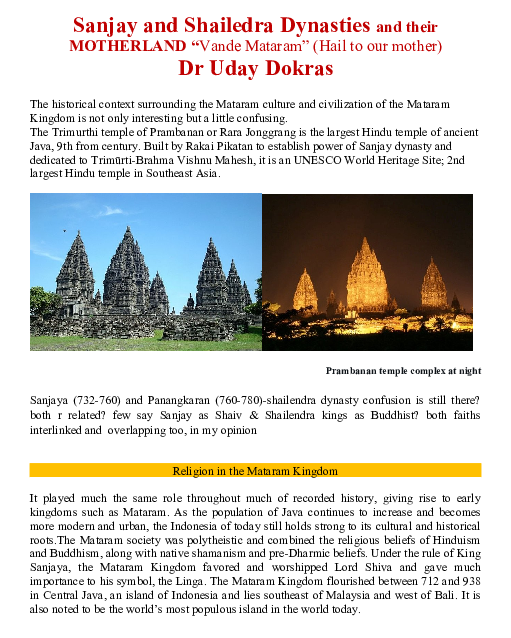
MATARAM KINGDOM: HISTORY, HINDUISM, PRAMBANAN, AFTERWARDS factsanddetails.com
SINGHASARI, KEDIRI, MARCO POLO AND THE MONGOL INVASION OF JAVA factsanddetails.com
MAJAPAHIT KINGDOM: HISTORY, RULERS, CULTURE factsanddetails.com
EARLY INDONESIAN TRADE AND ANCIENT SHIPWRECKS factsanddetails.com
HISTORY OF ISLAM IN INDONESIA: ARRIVAL, SPREAD, ACEH, MELAKA, DEMAK factsanddetails.com
Origins of the Sailendra Dynasty
Most of the historical information about the Sailendras comes from stone inscriptions found at Buddhist temple sites, from oral tradition, and from mentions in the records of other states. The Sailendras were one of many dynastic lineages in Central Java, but they appear to have become dominant between 760 and 860 C.E. The earliest Sailendra inscription dates from 778 C.E. (the Candi Kalasan Inscription). It commemorates the foundation of the temple to the Buddhist goddess Tara in 778 C.E. during the reign of King Panagkaran, who is described as “an ornament of the Sailendra dynasty.” The inscription also lists a number of officials and relatives of the king, who helped to administer specific districts and villages. [Source: New World Encyclopedia ~]
Although the Sailendras clearly manifested themselves most strongly on the island of Java, some historians suggested that the Sailendras had their homeland outside Java. Apart from Java itself, a homeland in the Srivijaya kingdom in Sumatra (c.670-c.1270 C.E.), India, Sri Lanka, and the Funan kingdom (c.100-c.600 C.E. ) in Cambodia, have been suggested. ~
The French scholar George Coedès once proposed that the Sailendras may have been related to the rulers of the ancient Cambodian kingdom of Funan, because the title "Lord of Mountain" used by the Sailendras may have resembled titles used by the Funanese rulers. In support of his hypothesis, Coedès pointed out that the name "Funan" as used by the Chinese is related to the Cambodian term "phnom," which means "mountain." Other specialists on Cambodian history have discounted Coedès' hypothesis.They argue that that no historical evidence exists to show that the Funanese ever ascribed the title "mountain king" to their rulers. ~
Mataram, Srivijaya, Sanjaya and the Sailendra
Mataram, arose as Srivijaya began to flourish in the early eighth century, in south-central Java on the Kedu Plain and southern slopes of Mount Merapi (Gunung Merapi). Mataram’s early formation is obscure and complicated by the rivalry of two interrelated lines of aspiring paramount rulers, one supporting Shivaist Hinduism (the Sanjaya) and the other supporting Mahayana Buddhism (the Sailendra, who had commercial and family connections with Srivijaya).
At some point between 824 and 856, these lines were joined by marriage, probably as part of a process by which the leaders of local communities (“rakai”or “rakryan”) were incorporated into larger hierarchies with rulers, palaces, and court structures. In this process, the construction of elaborately carved stone structures (“candi”) connecting local powers with Buddhist or Hindu worldviews played an important role. The best known and most impressive of these are the Borobudur, the largest Buddhist edifice in the ancient world (constructed between about 770 and 820 and located northwest of present-day Yogyakarta) and the magnificent complex of Hindu structures at Prambanan, located east of Yogyakarta and completed a quarter-century later. These and hundreds of other monuments built over a comparatively short stretch of time in the eighth and ninth centuries suggest that Javanese and Indic (Buddhist and Hindu) ideas about power and spirituality. [Source: Library of Congress*]
See Separate Article: MATARAM KINGDOM: HISTORY, HINDUISM, PRAMBANAN factsanddetails.com
Sailendra Dynasty Rule

Sailendra power centered on the Kedu Plain in south-central Java, an area where paddy field, or sawah, cultivation flourished and whose location made it secure from sea-borne raids that were frequent on the north coast of the island. The ecology of the Kedu Plain required cooperation in the allocation of water among rice cultivators. Local ruling lineages emerged to control and coordinate water in each stream or river basin. According to Clifford Geertz, the American cultural anthropologist, paddy culture requires extensive work on drainage, canals, and terracing. A lineage which could mobilize labor from more than one basin could dominate other local lineages. The Sailendra mobilized labor across the boundaries of each basin by the use of symbolic power associated with the use of Hindu and Buddhist rituals including Sanskrit inscriptions, an Indianized court and the construction of a kraton, temples, and monuments. The kings of the Sailendra-dynasty held, like other Javanese kings, the concept of the "Dewa-Raja" (God-King), the belief that the King had divine power as a living god among his subjects. The Sailendra were the first to use the title Sri Maharaja, derived from a Sanskrit compound meaning “Great King.” [Source: New World Encyclopedia ~]
The Sailendras appear to have had access to ports on the northern coast of Java, and after the formation of Srivijaya in southern Sumatra, the Sailendra maintained close relations, including marriage alliances with Srivijaya. During the late ninth century, when Srivijaya monarchs donated sleeping quarters for monks at the Buddhist pilgrimage site of Nalanda in northern India, they emphasized their Sailendra lineage, indicating that the Sailendras had more prestige among the Buddhist community. ~
The mutual alliance between the two kingdoms ensured that Srivijaya had no need to fear the emergence of a Javanese rival and that the Sailendra had access to the international market. The Sailendra participated in the Spice Route trade between China and India, but their level of participation never rivaled that of Srivijaya. Intensive rice cultivation was the foundation of the Sailendra Dynasty. ~
The Sailendra covered the Kedu Plain with Vajrayana Buddhist shrines and temples, celebrating and affirming their power. The Borobudur temple complex, built between 778 and 824 C.E. by King Samaratunga, who married the Srivijayan princess Dewi Tara, was the greatest accomplishment of the Sailendra. Borobudur was the first massive Buddhist monument in Southeast Asia and influenced the construction of later monuments. Other Buddhist sites associated with the Sailendras are the temple structures of Candi Mendut, Candi Kalsan, and Candi Sewu. ~
Collapse of the Sailendra Dynasty
According to the traditional account, the Sailendra Dynasty came to an abrupt end when a prince from the rival Hindu Sanjaya Dynasty, named Rakai Pikatan, displaced them in 832. Rakai Pikatan, who was the crown prince of the Sanjaya Dynasty, married Pramodhawardhani, a daughter of Samaratunga, king of Sailendra. [Source: New World Encyclopedia ~]
J.G. de Casparis, author of the most comprehensive work on the Sailendra, proposed that, “in 856 Balaputra was defeated by Pikatan, where upon Balaputra retreated to Srivijaya, the country of his mother, to become the first Sailandra ruler of Srivijaya. Thus in the late ninth century Srivijaya was ruled by a Buddhist Sailendra ruler, while Java was ruled by Pikatan and his successors who patronized Siva" (cf. De Casparis, 1956; Hall, 1985:111). ~
Some historians describe the Sailendra collapse as a retreat to Sumatra, implying that the dynasty also ruled Srivijaya. It is possible that Balaputra was a Srivijayan prince with a maternal link to the Sailendra and that his attack on Java was a Srivijayan attempt to annex the former Sailendra domain. The hostile relations between Srivijaya and Mataram tend to confirm the thesis. The Sanjaya Dynasty went on to establish the Javanese Dynasty of Mataram. The relative chronology of the Sailendra and the Sanjaya dynasty is not well understood. A similar problem exists in defining the respective territories ruled by the Sailendra and Sanjaya. ~
Great Temple Building During the Sailendra Dynasty
During the eighth and ninth centuries, central Java underwent a remarkable architectural boom. Under the Sailendra dynasty, the monumental Buddhist complex of Borobudur was constructed—today one of the greatest Buddhist monuments in the world. The surrounding region became dense with religious structures: Hindu temples rose on the Dieng Plateau, and a grand Hindu complex took shape at Prambanan. These temple-building societies thrived on fertile rice plains and followed political dynamics quite different from the cosmopolitan coastal ports. Inland rulers wielded authority through control of irrigation associations that sustained [Source: “Culture and Customs of Indonesia” by Jill Forshee, Greenwood Press, 2006] wet-rice agriculture.
As one historian observed, “the behavior of the gods, like the behavior of the farmers, was shaped by the human planting cycles, for they came down to inhabit their shrines only on special days, usually related to the planting schedule.” This worldview continues across Indonesia today—from rice paddies in Java and Bali to cornfields in Timor—where people invoke supernatural forces to bring water, ensure crop fertility, and maintain harmony between humans, deities, ancestors, and the land.
Hinduism and Buddhism had developed as court cultures not accessible to common people. Indeed, many commoners had been severely exploited in constant, unpaid laboring to construct the Hindu–Buddhist megastructures of their kings. The centuries-long construction of Borobudur probably bankrupted the region of central Java, exhausting its population.
Borobudur
Borobudur (42 kilometers from Yogyakarta) is the largest Buddhist monument in the world. Built in the A.D. 8th century, it ranks with Pagan in Myanmar and Angkor Wat in Cambodia as one of the great archeological sites of Asia, if not the in world. The eminent Dutch archaeologist A.J. Bernet Kempers called it "a Buddhist mystery in stone. An actual meeting of Mankind and the Holy. A shining tower of the law." It’s name is derived from the Sanskrit word "Vihara Buddha Uhr" which means "Buddhist monastery on the hill." Borobudur is located in Muntilan, Magelang, in the Kedu Valley, in the southern part of Central Java. It is about 100 kilometers from Semarang.
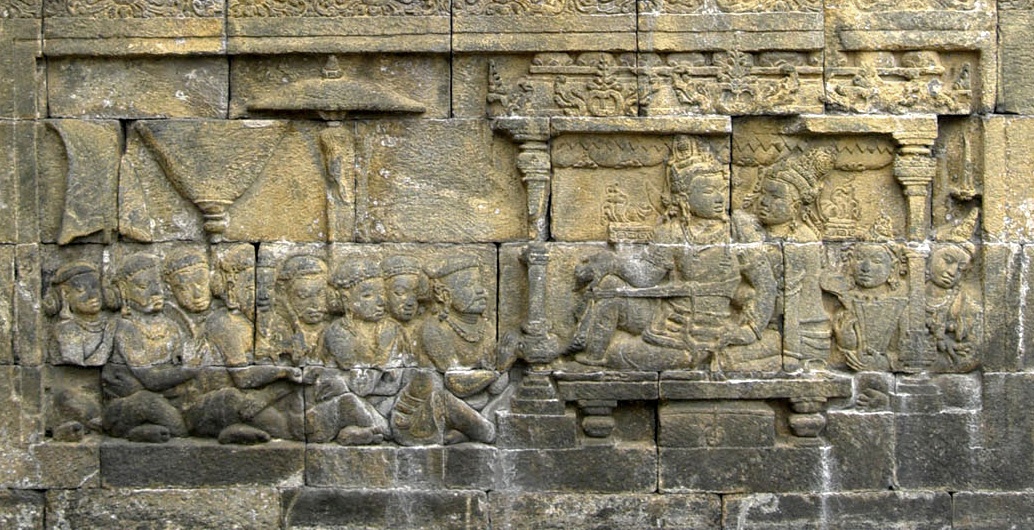
Borobudur is a square 123 meters (403 feet) on each side and 32 meters (105 feet) high.Constructed of unmortared grey andosite and volcanic basalt stone and surrounded by lush green fields of the Kedu Plain and tourist infrastructure, it is about the size of a stadium, and took about 80 years to build. Four large volcanos, including the often-smoking Mount Merapi, and numerous hills are visible in the distance. The temple’s design in Gupta architecture reflects India's influence on the region, yet there are enough indigenous scenes and elements incorporated to make Borobudur uniquely Indonesian. The monument is decorated with 2,672 relief panels and 504 Buddha statues.
Borobudur is a step pyramid, built around a natural hill, comprised of a broad platforms topped by five walled rectangular terraces, and they in turn are topped by three round terraces. Each terraces is outlined with ornaments and statues and the walls are decorated with bas reliefs. More than two million blocks of volcanic stone were carved during its construction. Pilgrims have traditionally walked around the monument in a clockwise manner moving up each of the five levels, and in process covering five kilometers.
See Separate Article BOROBUDUR factsanddetails.com
Sailendra Dynasty and Angkor
King Jayavarman II (802-850) is credited with founding the Khmer Civilization that produced Angkor Wat. According to an 11th century inscription found in northwest Cambodia and a report from an Arab merchant, Jayavarman II spent some time in the court of the Indonesian Sailendras Dynasty and may have originally arrived in Indonesia as a prisoner. The Sailendras Dynasty defeated the Khmers by launching a surprise attack from Tonle Sap and beheaded the Khmer ruler.
Jayavarman II returned to Cambodia around 795 and established a capital at Indrapura and then moved it three times. Possibly to put distance between himself and the seaborne Javanese, Jayavarman II settled north of the Tonle Sap. In 802, the capital was moved to Mount Mahendrapura (modern Phnom Kulen), 25 miles northeast of Angkor Thom, and declared himself the universal ruler. This marks the creation of the Khmer state and its independence from Indonesia.
Image Sources: Wikimedia Commons
Text Sources: New York Times, Washington Post, Los Angeles Times, Times of London, Lonely Planet Guides, Library of Congress, Ministry of Tourism, Republic of Indonesia, Compton’s Encyclopedia, The Guardian, National Geographic, Smithsonian magazine, The New Yorker, Time, Newsweek, Reuters, AP, AFP, Wall Street Journal, The Atlantic Monthly, The Economist, Foreign Policy, Wikipedia, BBC, CNN, and various books, websites and other publications.
Last updated December 2025