
BALUCHISTAN PYGMY JERBOAS — WORLD’S SMALLEST RODENTS
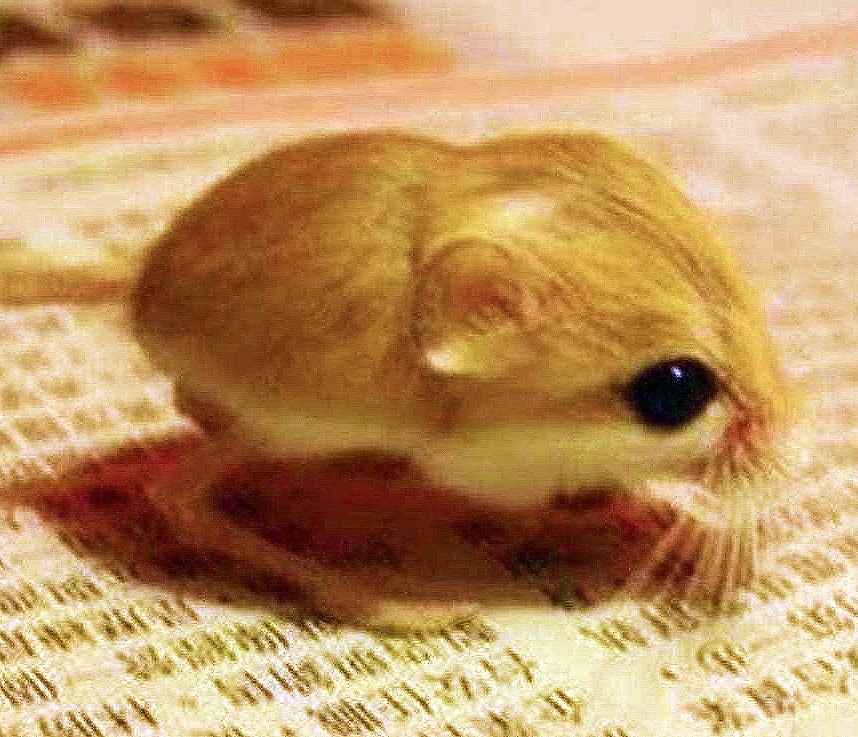
Baluchistan pygmy jerboas (Salpingotulus michaelis) are the world’s smallest jerboa and rodent and a contender for the world’s smallest mammal. Also known as dwarf three-toed jerboas, they are native to the arid regions of southeastern Pakistan — Baluchistan. Adults average only 4.3 centimeters (1.7 inches) in head and body length, with the tail averaging eight centimeters (3.1 inches). Adult females weigh only 3.2 grams (0.11 ounce). At birth newborns weigh an average of 0.48 grams (0.017 ounces).
Don’s let its small size fool you. This jerboa is incredibly resilient, and it has to be to survive in Baluchistan — one of the world’s harshest desert environment, and one that decimated Alexander the Great’s army. There is hardly any water and daytime and nighttime temperatures vary significantly.
In an articles on the world’s smallest mammals, Remy Melina wrote: The smallest mammals in the world may appear cute and defenseless, but their teensy size helps them do much more than just look adorable. From climbing across delicate branches while hunting for insects to dodging predators by hiding in thin crevices, their petite frames work to their advantage. The pygmy jerboa hopped into the spotlight when it became a viral YouTube sensation in 2010, looking like a cross between a mouse and a baby kangaroo.
Baluchistan pygmy jerboas are nocturnal creatures that move through the dry using long hops, balancing themselves with their tail. They live in burrows generally excavated under small bushes and feed on wind blown seeds, succulent leaves of desert-adapted vegetation, and various dead animals such as other rodents and lizards. When plants dry up they dig up roots of desert plants and eat them. These rodents can slow down their respiration and blood circulation dramatically — a process called facultative hypothermia — that helps them make the most of their low nutritional diet. Animals that prey on them include the leaf-nosed vipers, trans-Caspian monitor lizards and sand cats.
RELATED ARTICLES:
JERBOAS OF CENTRAL ASIA: CHARACTERISTICS, BEHAVIOR, SPECIES factsanddetails.com
JERBOAS OF THE MIDEAST AND NORTH AFRICA: CHARACTERISTICS, BEHAVIOR, SPECIES africame.factsanddetails.com
EGYPTIAN JERBOAS: GREATER, LESSER, CHARACTERISTICS, BEHAVIOR africame.factsanddetails.com
HAMSTERS: TAXONOMY, CHARACTERISTICS, BEHAVIOR factsanddetails.com
HAMSTER SPECIES IN EURASIA: EUROPEANS, ROBOROVSKIS, CAMPBELL'S DWARVES factsanddetails.com
GOLDEN (SYRIAN) HAMSTERS: CHARACTERISTICS, BEHAVIOR, DISCOVERY, DOMESTICATION africame.factsanddetails.com
MOUSE-LIKE HAMSTERS: CHARACTERISTICS, SPECIES, BEHAVIOR, AND REPRODUCTION factsanddetails.com
GERBILS: CHARACTERISTICS, BEHAVIOR AND REPRODUCTION factsanddetails.com
GERBIL SPECIES IN ASIA: MONGOLIAN, GREAT, INDIAN factsanddetails.com
GERBILS OF THE MIDDLE EAST AND NORTH AFRICA africame.factsanddetails.com
JIRDS: CHARACTERISTICS, BEHAVIOR, SPECIES AND REPRODUCTION africame.factsanddetails.com
Five-Toed Pygmy Jerboas
Five-toed pygmy jerboa (Cardiocranius paradoxus) are the only members of the genus Cardiocranius. Found in harsh deserts in China, Kazakhstan, Russia and Mongolia, they beat the heat by burrowing underground and use their burrows for food storage and shelter, and, in cold winters, to hibernate in. The lifespan of Five-toed pygmy jerboas is not known but similar species live up to four years in the wild and up to six years in captivity. [Source: Wikipedia]
Five-toed pygmy jerboas are especially adapted for rocky deserts. They prefer to have dunes or outcroppings with ample vegetative cover within their home ranges. Protective shrubbery offers a safe place under which to burrow. These Five-toed pygmy jerboas are found only in a few areas. In Kazakhstan, they live in a small area north of Lake Balkhash, where the species was first discovered. They are also found in western and southern Mongolia and the Nan Shan Mountains of northern China. In Russia they are found in the Ubsu-Nur Depression of Tuva.[Source: Patrick Sherman, Animal Diversity Web (ADW) /=]
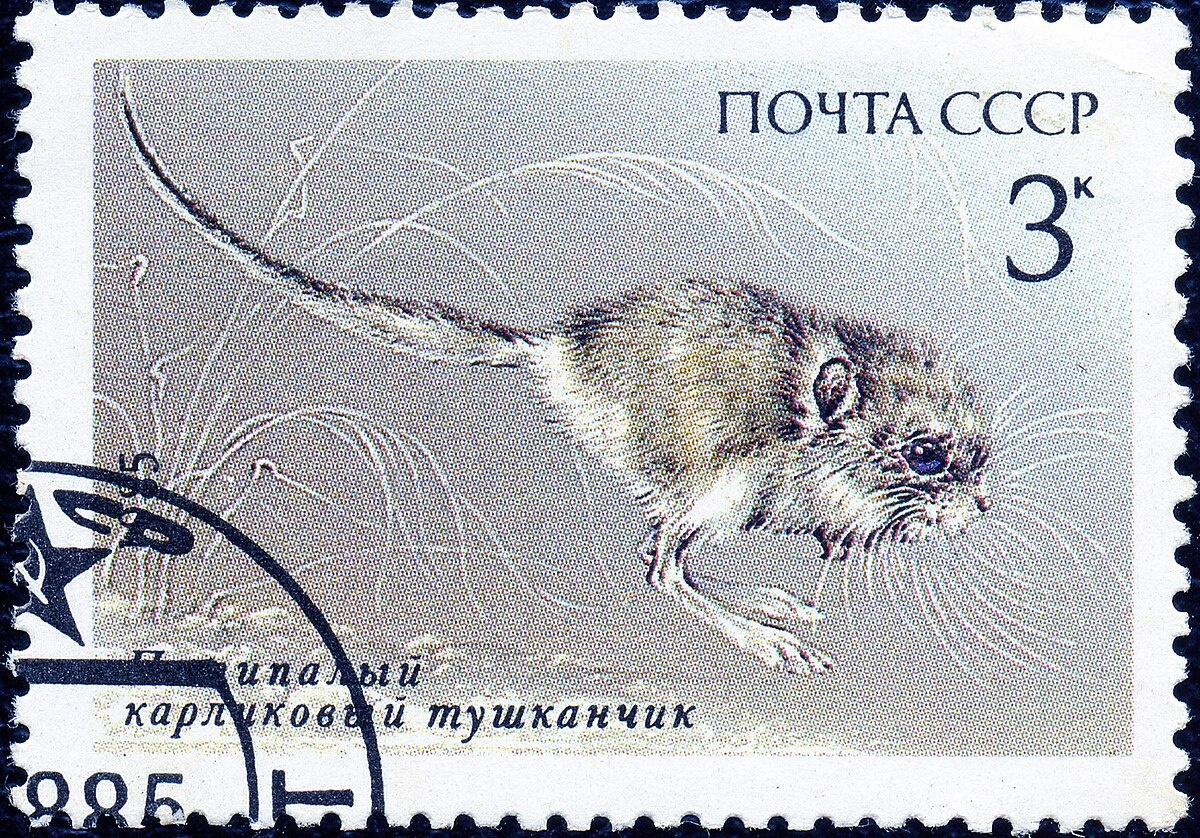
Five-toed pygmy jerboas have a a head and body length of five to 7.5 centimeters (1.97 to 2.95 inches) and tail beteen 7 and 7.8 centimeters. They are grayish buff in color with white underbellies. At the end of the tail is a tuft of hair. Most jerboas have three metatarsals (bones) near the center of each hind foot that fuse to form a cannon bone, giving them a total of three toes on each hind foot. By contrast, Five-toed pygmy jerboas have five individual toes. The two outside toes (digits one and 5) are rather small in comparison to the three central toes, but they are present nonetheless and give this species its common name. The hind foot exhibits a patch of bristly hairs on the sole, which help five-toed pygmy jerboas to obtain better traction on loose sand.
Like other jerboas, five-toed pygmy jerboas have keen senses of hearing, smell, and vision. The skull of these small jerboas is heart-shaped. Although the external ears are extremely small, the auditory bullae are relatively large, indicating that Five-toed pygmy jerboas have good hearing and can sense low frequency vibrations. Five-toed pygmy jerboas have large upper incisors that are grooved on the front surface. As is the case with most rodents, these jerboa likely communicates largely using olfactory cues.
On the International Union for Conservation of Nature (IUCN) Red List, five-toed pygmy jerboas they are listed as Data Deficient. In CITES (Convention on International Trade in Endangered Species of Wild) they have no special status. They are strictly herbivores, mainly eating seeds and leaves of grasses and low-growing vegetation found in its habitat, occasionally consuming flowers and preferring the juiciest parts of leaves. Among the predators of Five-toed pygmy jerboas are common foxes, Corsac foxes, Eversmann's polecats, long-eared hedgehogs, auritus), short-eared owls, and little owls. Their primary defense hopping away rapidly in a zig-zag manner to the cover of a shrub or burrow.
Five-Toed Pygmy Jerboa Behavior and Reproduction
Five-toed pygmy jerboas are terricolous (live on the ground), saltatorial (adapted to leaping), nocturnal (active at night), motile (move around as opposed to being stationary), hibernate (the state that some animals enter during winter in which normal physiological processes are significantly reduced, thus lowering the animal’s energy requirements) and solitary. Their average home range territory size is 1.43 hectares. Observations indicate individuals move throughout the entire home range during foraging, but spend a majority of the time in one or two areas within the range. Jerboas have a number of burrows scattered around the territory so that a safe haven is never too far off. [Source: Patrick Sherman, Animal Diversity Web (ADW) /=]
Five-toed pygmy jerboas are most active mainly from 10:00pm to 4:00am). During this time, they move almost constantly, with roughly 90 percent of their activity devoted to exploring and the rest, feeding, with brief periods of rest (about two to five minutes at a time), and burrowing. Five-toed pygmy jerboas move by small hops, although crawling is occasionally observed. When a jerboa moves, it never moves in a straight line, but rather changes directions constantly so as to appear to move in circles. When startled, an individual might jump as high as 20 to 30 centimeters straight up into the air.
Five-toed pygmy jerboas may dig their own burrows or utilize the abandoned burrows of other animals. When digging its own burrow, an individual uses its hind legs to rake and kick the soil. A burrow is usually dug under a bush that offers cover and the entrance is often hidden by a pile of dry grass. Burrows have been observed to be roughly 25 to 30 centimeters deep with a central nesting chamber about 10 to 11 centimeters in diameter. Burrows are used as a safe place to rest, hibernate, and rear young, although further studies should be pursued for more details on burrow use.
Female five-toed pygmy jerboas engage in seasonal breeding. Females in reproductive condition have been discovered in Kazakhstan in the month of July, Females have eight teats, as do most jerboas, and nurse their young as all mammals do. Young are altricial, meaning they are relatively underdeveloped at birth. Pre-weaning provisioning and Pre-independence protection are provided by females. Most of what is surmised about five-toed pygmy jerboa mating and parenting is bases on observations of their close relatives,four-toed jerboas. During the breeding months, male four-toed jerboas playfully chase female until she briefly stops and allows him to copulate with her. The breeding season of four-toed jerboas is quite long, with a peak during the summer months. Over the course of the year, these jerboas give birth to three litters of three to five young per litter. Their gestation period is 25 to 42 days and the young reach sexual maturity just after one year of age.
Thick-Tailed Pygmy Jerboa
Thick-tailed pygmy jerboas (Salpingotus crassicauda) are found in steppes and deserts in northwest China, southwest Mongolia and Kazakhstan They dig burrows in sand dunes that can extend up to three meters in length. On the International Union for Conservation of Nature (IUCN) Red List they are listed as Data Deficient. The spatial distribution of these animals varies and their populations can experience large fluctuations. Threats include predators, droughts, overgrazing of its habitat, destruction of its burrows and road kills. [Source: Wikipedia, Stephanie Bunker, Animal Diversity Web (ADW)]
Thick-tailed pygmy jerboas have a head-and-body length of around 4.5 to 8 centimeters (1.8 to 2.4 inches). The tail can be more than double the length of the body and may be thick near the base because of fat deposited — the source of the jerboa’s common name. The head is large and the eyes small, the ears are short and round. There are only three toes present in each hind foot. There are tufts of hair beneath each toe, which aid in gripping when running on soft sand.
Thick-tailed pygmy jerboas feed on insects and arthropods such as grasshoppers and spiders and also some vegetable matter, mostly seeds. They get most of their water from the food that they consume; however, they will drink water if they can find it. Thick-tailed pygmy jerboa are mostly solitary and nocturnal. They live in permanent burrows with many passages.The entrances are sealed with loose plugs of sand and if the jerboa is spotted in the open by a predator it attempts to bury itself in the sand. Predators include owls, mountain weasels, marbled polecats and red foxes.
Reproduction takes place in the spring and summer when litters of two to five young are born. The average litter has 2.7 young. Thick-tailed pygmy jerboa are thought to have two litters per season. Other northern species of jerboas breed shortly after emerging from hibernation. Sexual maturity is not reached in the first year.
Pale Pygmy Jerboa
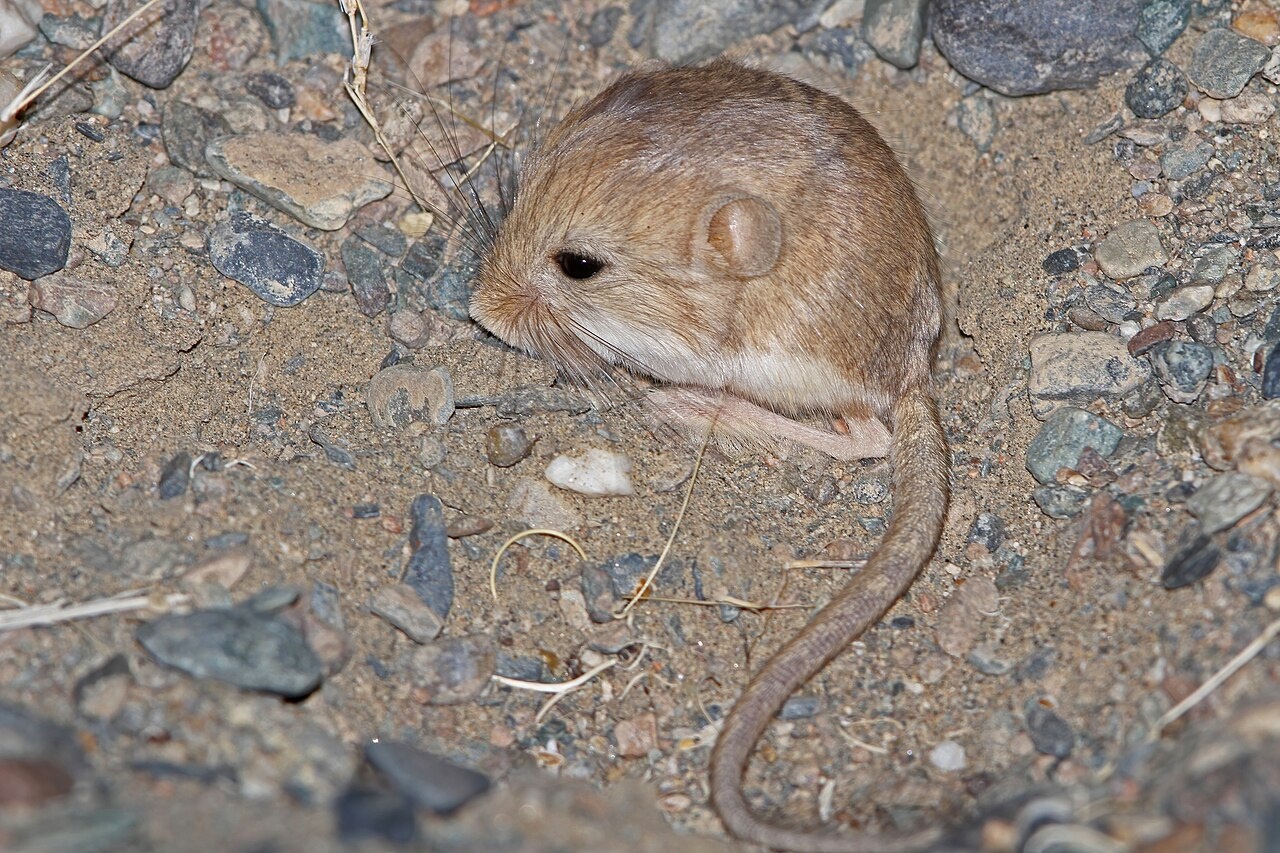
Pale pygmy jerboas (Salpingotus pallidus) are also called Pallid pygmy jerboas. They inhabit sandy semi-deserts with sparse sod-forming grasses in Kazakhstan, where they occupy two distinctly isolated desert habitats — 1) in the Aral Karakums, and the Great and Small Barsuki regions around the northern Aral Sea; and 2) in the southern Lake Balkhash area where they occur in scattered, widely distributed populations — at elevations from 55 to 350 meters (180.45 to 1148.29 feet). Pale pygmy jerboas have a maximum lifespan of 2.5 years in the wild. In captivity they live up to years. [Source: Janae Chavez, Animal Diversity Web (ADW) /=]
In the Aral Karakums, they are found in areas with dense wormwood-cereal vegetation where the sand forms small hills or mounds. In the Great Barsuki area they are found on level ridges characterized by areas of clumped but dense vegetation that grows between 40 and 50 centimeters high. This vegetation is composed of sand wormwood (Artemesia arenaria), goat’s wheat (Atraphazis spinosa), Siberian couch grass (Agropyron sibiricum), gray wormwood (Artemisia glance), feather grass (Stipa joannis), and euphorbia (Euphorbia seguieriana). In the southern Lake Balkhash area they are found in a wider variety of sand types. These include ridged or mounded sand areas and depressions between small hillocks or ridges. The vegetation in these areas is composed mainly of wormwood but also includes sand sedge (Carez physodes) and old-world winter fat (Eurotia ceratoides).
On the International Union for Conservation of Nature (IUCN) Red List, pale pygmy jerboas are listed as Data Deficient. In CITES (Convention on International Trade in Endangered Species of Wild) they have no special status. Population sizes are small, fluctuate yearly, and populations are fragmented. They are considered rare in some parts of their range. No predators of pale pygmy jerboas are reported but is seems likely they are preyed upon, at least occasionally, by owls, foxes and weasels. The legs and feet mature more quickly than the body allowing even juvenile to rapidly acquire the ability to jump and run well. When pale pygmy jerboas sense danger they hide under bushes or bury themselves under the sand. Their nocturnal activity and cryptic coloration also help to protect them from predators.
Pale Pygmy Jerboa Characteristics and Diet
Pale pygmy jerboas are very rodents. They range in weight from 7.6 to 12.5 grams (0.27 to 0.44 ounces), with an average weight is 9.8 grams (0.35 ounces). Their a head and body length ranges from 5.3 to 6.1 centimeters (2 to 2.4 inches), with their average length being 5.5 centimeters (2.2 inches). They have large heads, almost as large as their bodies, and relatively large eyes and a broad snout. The tail is long, being almost twice the length of the body and averaging 10.5 centimeters. The end of the tail is sparsely covered with white hairs in all females and in some males. The tails of males have a black end brush that is 2.5 to three times longer than those of the females. These are their only known sexually dimorphic traits. [Source:Janae Chavez, Animal Diversity Web (ADW) /=]

Janae Chavez wrote in Animal Diversity Web: Fur coloration is characterized by light grey or beige fur. They have a broad dorsal stripe that starts as a light yellow grey color but gets darker as it extends down the back. Fur on the muzzle, neck, belly, legs, and feet is white. Pale pygmy jerboas, and other three-toed pygmy jerboas are distinguished by the three toes on their hind feet. Their hind legs and tails are long to help them jump. The length of the hind foot averages 22.7 millimeters, almost half the length of the body, while both the front feet and limbs are much shorter as they are not used when walking or running. Males can be distinguished with penile morphology, characterized by the coverage of small spines of uniform height. Other differences include thickness of the incisors, the distance between the angular and coronoid processes in the mandible, and the width of the ascending branch of the mandible.
The pale pygmy jerboa diet is almost entirely made up of insects and seeds. In the spring insects make up about 60 percent of their diet, in summer months seeds comprise 70 percent of the diet. Commonly eaten seeds are Carex physodes, Eremopyron oreintale, and Menocus linifolius. Pale pygmy jerboas also eat the dead bodies of lizards, birds, and other small rodents when they find them. Vegetation and bulbs comprise about one to two percent of their diet.
Pale Pygmy Jerboa Behavior
Pale pygmy jerboas are saltatorial (adapted to leaping), nocturnal (active at night), motile (move around as opposed to being stationary), sedentary (remain in the same area), hibernate (the state that some animals enter during winter in which normal physiological processes are significantly reduced, thus lowering the animal’s energy requirements) and territorial (defend an area within the home range). Pale pygmy jerboas are generally solitary. When kept in captivity with members of their own species, they bite or an even kill each other. At night they follow the same route every night in their territories and generally do not go outside of it, except maybe during the breeding season. Pregnant females travel 190 to 210 meters from their burrows during the course of a night. [Source:Janae Chavez, Animal Diversity Web (ADW) /=]
Pale pygmy jerboas begin their nightly activity period shortly after sunset and remain active for most of the night in early spring and all night during the warmest months. When they leave their burrows for the night, they first poke their heads out, go back in, and repeat this behavior several times before actually leaving. Then, when they do leave, they sanbathe themselves, which involves sitting on their hind feet, cleaning themselves with their front paws and then rubbing their bodies with sand. The whole process lasts about 10 minutes.
Pale pygmy jerboas get around by bipedal jumping or hopping. Generally, they take small jumps of three to five centimeters in length when engaging in normal foraging. The distance of the jumps increases to 20 centimeters when the jerboas are running fast. Pale pygmy jerboas can climb bushes and stems of plants by holding on to them with their front paws, teeth, and tail. Pale pygmy jerboas communicate with sound and sense using vision, touch, sound and chemicals usually detected with smell. They respond to vocalizations and have well-developed ears.
Pale Pygmy Jerboa Reproduction and Offsping
Pale pygmy jerboas are believed to be polygynandrous (promiscuous), with both males and females having multiple partners. They engage in seasonal breeding two times a years in late April through early May and again from early July to late August. The gestation period ranges from 30 to 35 days. The number of offspring ranges from two to fiver. Young are altricial, meaning they are born relatively underdeveloped. Pre-weaning and pre-independence provisioning and protecting are done by females. The average weaning age is 30 days, with independence occurring on average at 35 days. Females and males sexual or reproductive maturity at 10 to 11 months.
Male pygmy jerboas invest very little in their offspring. They find and mate with females in the spring and that is pretty much the extent of their contribution. According to to Animal Diversity Web: Female pale pygmy jerboas dig brood burrows that are much more complex than a typical burrow, but are found at the base of ridges or under shrubs, which helps prevent tunnel collapse. Brood burrows consist of about four different exists, multiple blind alleys, additional chambers, and one brood chamber with bedding. Births occur in the beginning of July. A second brood may occur in early August.
Average litter size varies with location, consisting of two to four pups in the northern Aral Sea (average 2.8), while in the southern Lake Balkhash area the average litter contains four to five pups (average 4.1). The birth weight of pups fluctuates from 0.71 to 0.95 grams and body length is approximately 37 percent the length of adults. Pups grow quickly after birth. In the first two days fur appears on the back and by 13 days fur appears on the rest of the body.
At 15 days old the pups have both upper and lower teeth and their body size reaches approximately 68 percent of that of an adult, with the foot length developing more rapidly and reaching 85 percent of its adult length. By 30 days the young begin leaving the burrow to forage on their own, although they will continue to nurse for several more days. The young complete their growth before hibernating for winter and do not reach sexual maturity until the next breeding season, in late April. /=\ Image Sources: Wikimedia Commons
Text Sources: Animal Diversity Web animaldiversity.org ; National Geographic, Live Science, Natural History magazine, CNTO (China National Tourism Administration) David Attenborough books, New York Times, Washington Post, Los Angeles Times, Smithsonian magazine, Discover magazine, The New Yorker, Time, BBC, CNN, Reuters, Associated Press, AFP, Lonely Planet Guides, Wikipedia, The Guardian, Top Secret Animal Attack Files website and various books and other publications.
Last updated May 2025