
JERBOAS

Jerboas are hopping desert rodents found throughout North Africa, the Middle East and Central Asia that belong to the family Dipodidae. They tend to live in hot deserts, are generally nocturnal and can move very quickly. When chased, jerboas can run or hop at up to 24 km/h (15 mph). Most species of jerboas have excellent hearing that they use to locate prey and to avoid becoming prey themselves to predators such as little owls. The typical lifespan of a jerboa is around two to three years. [Source: Wikipedia]
Jerboas feed on insects, seeds, and succulent vegetation. In many ways they are remarkably similar to the kangaroo rats (Heteromyidae) of North America. Both have greatly inflated bullae; a very long tail, often tipped black and white; fused or nearly fused cervical vertebrae; and soft, silky fur, usually pale in color. They both employ leaping locomotion that utilizes their enlarged and powerful hind feet. This is a type of movement is found in many desert rodents and is thought to be beneficial because, although it often wastes energy, it allows an animal to move quickly, change direction rapidly, and even jump up to avoid predators like snakes. This is important in desert environments where there is little cover. [Source: Sharon Jansa, Janae Chavez, Phil Myers, Animal Diversity Web (ADW) /=]
Jerboas are also similar to kangaroos. Again both have long hind legs, short forelegs, and long tails. Jerboas move around in a similar way as kangaroos — hopping — however, the anatomy of jerboas is more adapted to erratic hopping locomotion, making use of sharp turns and great vertical leaps to confuse and escape predators, rather than for sustained hopping over long periods of time, which is what kangaroos are good at. Researchers have found that, when jerboas execute their vertical leaps, the primary tendons in the hindlimbs only recovered and reused on average 4.4 percent of energy contributed to the jump — lower than many hopping animals.
Jerboas are generally quiet, although some species tap with their hind fwwt. They move about by walking or hopping on their hind legs. Their forelimbs are used for gathering food. Jerboas may move using all four limbs when hopping or jumping to escape predators. Some jerboas hibernate through the winter and some enter torpor during hot or dry periods.
Jerboas are designed for jumping. Their hind limbs are at least four times as long as their front legs and their fused bone structure gives them greater leverage for making long and high leaps. Metatarsal (foot) bones in the hind feet are fused into one "cannon bone" with the first and fifth toes missing. Undersides of the three remaining long toes are laterally compressed. The combination of these features improves traction and provides powerful leverage, allowing them to jump to heights of nearly 2.25 meters when escaping predators . Jerboas that live in sandy areas have fur made up of stiff hairs on the undersides of their feet, which gives the animal greater traction on the loose sand. The front limbs are not used for locomotion; instead, they are employed in the gathering of food and for burrowing. [Source: Sharon Jansa and Phil Myers, Animal Diversity Web (ADW) /=]
RELATED ARTICLES:
JERBOAS OF THE MIDEAST AND NORTH AFRICA: CHARACTERISTICS, BEHAVIOR, SPECIES africame.factsanddetails.com
EGYPTIAN JERBOAS: GREATER, LESSER, CHARACTERISTICS, BEHAVIOR africame.factsanddetails.com
PYGMY JERBOAS (WORLD'S SMALLEST RODENTS): CHARACTERISTICS, BEHAVIOR, SPECIES factsanddetails.com
HAMSTERS: TAXONOMY, CHARACTERISTICS, BEHAVIOR factsanddetails.com
HAMSTER SPECIES IN EURASIA: EUROPEANS, ROBOROVSKIS, CAMPBELL'S DWARVES factsanddetails.com
GOLDEN (SYRIAN) HAMSTERS: CHARACTERISTICS, BEHAVIOR, DISCOVERY, DOMESTICATION africame.factsanddetails.com
MOUSE-LIKE HAMSTERS: CHARACTERISTICS, SPECIES, BEHAVIOR, AND REPRODUCTION factsanddetails.com
GERBILS: CHARACTERISTICS, BEHAVIOR AND REPRODUCTION factsanddetails.com
GERBIL SPECIES IN ASIA: MONGOLIAN, GREAT, INDIAN factsanddetails.com
GERBILS OF THE MIDDLE EAST AND NORTH AFRICA africame.factsanddetails.com
JIRDS: CHARACTERISTICS, BEHAVIOR, SPECIES AND REPRODUCTION africame.factsanddetails.com
Dipodoidea
Dipodoidea is the superfamily of rodents, also known as dipodoids, to which jerboa belong. Found across the Northern Hemisphere, this superfamily includes more than 50 species among the 16 genera in three families — jerboas (family Dipodidae), jumping mice (family Zapodidae), and birch mice (family Sminthidae). Different species are found in grassland, deserts, and forests. They are all capable of saltation (jumping while in a bipedal stance), a feature that is most highly evolved in the desert-dwelling jerboas. Formerly, Dipodoidea contained only a single large family, Dipodidae, which contained jerboas, jumping mice, and birch mice as subfamilies. However, phylogenetic evidence found all three to be distinct families from one another.

Dipodoids are small to medium-sized rodents, with a head and body length ranging from 4 to 26 centimeters (1.6 to 10.2 inches). They are all adapted for jumping, although to varying degrees. Jerboas have very long hind legs which, in most species, include cannon bones. They move either by jumping, or by walking on their hind legs. Jumping mice have long feet, but lack the extreme adaptations of the jerboas, so that they move by crawling or making short hops, rather than long leaps. Both jerboas and jumping mice have long tails to aid their balance. Birch mice have shorter tails and feet, but they, too, move by jumping.[4]
Most dipodoids are omnivorous, with a diet consisting of seeds and insects. Some species of jerboa, however, such as Allactaga sibirica, are almost entirely insectivorous. Like other rodents, they have gnawing incisors separated from the grinding cheek teeth by a gap, or diastema. The dental formula of dipodids is 1/1, 0/0, 1-0/1-0, 3/3 = 18 or 16.
Fossil dipodids are known from the Oligocene Period (33 million to 23.9 million years ago). Despite the remarkable similarity of some dipodids and heteromyids (kangaroo rats) , these two families are no believed to be especially closely related, and the affinities of the dipodids are not known. /=\
Blanford's Jerboas
Blanford's jerboas (Jaculus blanfordi) are also known as Turkmen jerboas. They occur in the southern and eastern desert plains of Iran, southern and western Afghanistan, and western Pakistan. They very arid rocky basins and areas of extensive rolling or flat sand dunes interspersed with gravel plains as far south as the shores of the Persian Gulf near Bushehr. On the International Union for Conservation of Nature (IUCN) Red List they are listed as a species of Least Concern. Their diet consists mainly of leaves and sprouting vegetation in wet seasons and of succulent roots, seeds and grains in the dry summer. In CITES (Convention on International Trade in Endangered Species of Wild) they have no special status. [Source: Sheda Morshed, Animal Diversity Web (ADW) /=]
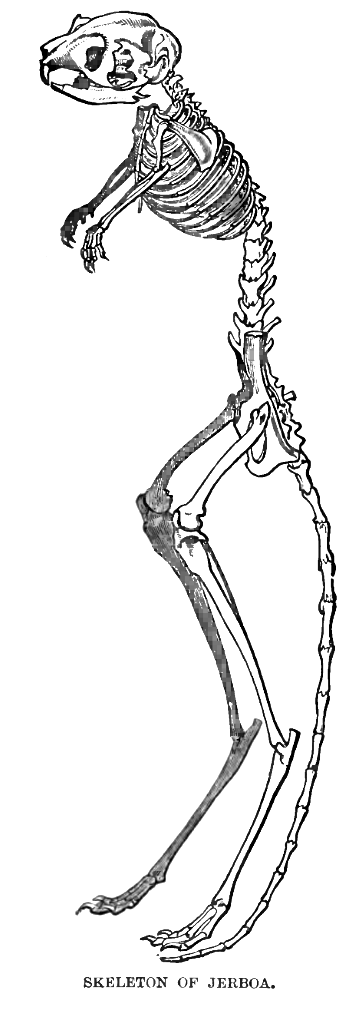
Blanford's jerboa was first described in 1884 by the British zoologist James Albert Murray, who named the animal in honour of the British geologist and zoologist William Thomas Blanford. Like all jerboas, Blanford’s jerboas are adapted for jumping and hopping in desert environments and have elongated hind-limbs that are about four times as long as their forelimbs. The short forelimbs are positioned close to the head and used for gathering food and burrowing. Locomotion is performed using the hind-feet and the posterior end of their long tails. The fur is thick, comprised of thin and soft hairs that are dorsally cream-colored but blending with white ventral hairs along the sides of the body. The eye-lashes and long sensory hairs are gray or black, and the whiskers are white. The thick and compressed toe hairs are white near the skin and dark brown on the outer edges. The tail tuft is divided black anteriorly and white posteriorly. They have large, round eyes that are set close to the elongated ears that are relatively small compared to other dipodids, and a fold of skin which can be pulled over the nose while burrowing. /=\
Blanford’s jerboas are non-colonial, nocturnal rodents that spend their days sleeping and nights foraging. They build intricate burrows by beating and shaping the sand with their blunt heads and muscular noses, forming tunnels between 1.5-2.5 meters long. The burrows are characterized by one entrance and several exits. If a mound of soil is visible from above-ground, it is an indication of an emergency exit that the individual sometimes forms by lightly packing a hole and leaving it closed until an emergency arises. There are no food storages or excrements kept inside the burrows, but camel fur or other soft materials may be used to line the dens during the winter months . During the summer months, the openings are sealed with approximately 50 centimeters of soil, an act that bedouins believe is to prevent snakes or warm air from penetrating into the burrow . /=\
At night Blanford’s jerboas forage independently, sometimes over distances of several kilometers. Individual burrow systems are in close proximity to each other and, on numerous instances, individuals have been found sleeping in the same burrow during the day. As far as anyone knows Blanford’s jerboas do not hibernate although similar species sometimes do. Blanford’s jerboas in Iran have been observed to be actively foraging above ground late in December when temperatures were below freezing. Daily cycles of complete torpidity in colder winter months have also been observed in captive individuals. Very little is known about their reproductive behavior. Based on data from similar species and the handful of collected specimens of Blanford’s jerboas, their gestation period is around 40 days long. One to three litters are born each year and litters generally consist of three to four altricial young . /=\
Small Five-Toed Jerboa
Small five-toed jerboas (Scarturus elater or Allactaga elater) are distinguished by their five digits. Found from eastern Asia Minor and the lower Volga River in the east to Xinjiang in China and western Pakistan, they occur in rocky deserts in Afghanistan, Armenia, Azerbaijan, China, Georgia, Iran, Kazakhstan, Pakistan, Russia, Tajikistan, Turkey, and Turkmenistan. Their average lifespan in captivity is 5.2 years. [Source: Cortney Closey, Animal Diversity Web (ADW) /=]
Small five-toed jerboas generally feed on seeds, insects and the succulent parts of plants. They obtain their food by burrowing in the sand or soil. They do not require free water in their environment as the obtain suffient amounts of water from their food. On the International Union for Conservation of Nature (IUCN) Red List they are listed as a species of Least Concern. In CITES (Convention on International Trade in Endangered Species of Wild) they have no special status. In the past and maybe still sometimes today they killed by humans for their fur. Small five-toed jerboas are carries and transmits disease but because they generally live in remote places where few humans go they are not considered a danger.
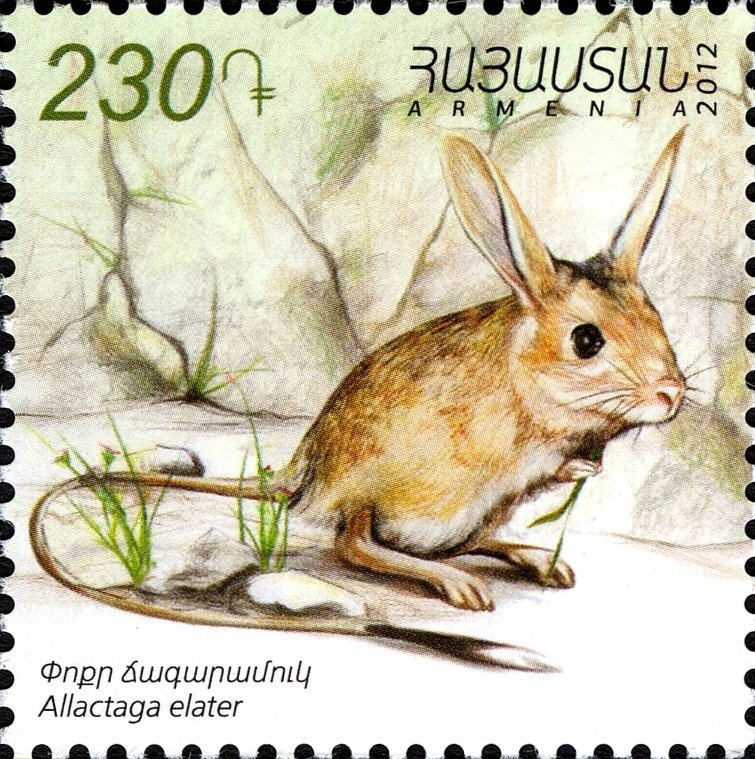
Small five-toed jerboas have long hind feet, short forelimbs, and walk upright. Their head and body length ranges from five to 15 centimeters (2 to 6 inches) and their tail ranging from seven to 25 (2.8 to 10 inches). Their average weight is 58.7 grams (2.07 ounces). They have large ears in comparison to their body size. Their large tail serves as support when the jerboas are standing upright and provides balance when they jump. Small five-toed jerboas are sandy color on their backs and whiter color underneath. The texture of coat can be silky or velvety. Their coloration helps camouflage them in the desert. The tip of the tail is usually black. Hair is also found under their feet, which provides better traction in the sand. Sexual Dimorphism (differences between males and females) is present: Males are usually larger than females.
Small five-toed jerboas are nocturnal (active at night) and normally solitary. They usually travel on their hind legs and use their tails to prop themselves up and for balance. They are able to cover up to three meters (10 feet) in a single bound. They burrow into the ground during the day and emerge at night to find food. They do not hibernate in the winter. When hopping full out they can reach speeds up to 48 km/h. The forelimbs of the jerboa serve as a pair of hands for feeding, grooming and digging.
Females give birth twice each year. The average number of offspring in a littter is three to five. being 4.5. The young are born in an average litter size of three. The gestation period ranges from 20 to 28 days. After birth, the mother stays with her young for several months to protect and teach them until they are old enough to fend for themselves in the wild. On average females and males reach sexual or reproductive maturity at around five months.
Long-Eared Jerboa
Long-eared jerboas (Euchoreutes naso) have exceptionally large ears — about one third longer than their heads — and are distinct enough from other jerboas that they are regarded as the only member of both their genus, Euchoreutes, and subfamily, Euchoreutinae. Inhabiting deserts, semi-deserts and sandy valleys that are covered with low growing bushes, long-eared jerboas are found in southernmost Mongolia and the the Taklamakan Desert in Xinjiang and the Qinghai-Tibet Plateau regions of northern and western China. The places they live can get very cold in winter and hot in the summer. It is believed their lifespan is two to three years. The places [Source: Nicole Swanson, Animal Diversity Web (ADW) /=\; Wikipedia ]
Long-eared jerboas have a head and body length that ranges from 7 to 9 centimeters (2.76 to 3.54 inches). Their tail is about twice as long as their body at 15 to 16 centimeters (5.9 to 6.3 inches). Upper parts of their body are reddish yellow to a light russet color. The belly is white. The tail is covered with short hairs that are similar in color to the rest of the body except for the terminal tuft, which is white and black. The hind foot is 4 to 4.6 centimeters in length, with five digits. The two lateral digits are shorter than the three central ones. The central metatarsals are fused for a small distance. The feet are covered with tufts of bristly hairs. The incisors are thin and white. A small premolar can be found on each side of the upper jaw. Sexual Dimorphism (differences between males and females) is not present: Both sexes are roughly equal in size and look similar. But females have eight mammae.

Long-eared jerboa: 1) Fur: Sandy-colored, allowing the jerboa to blend in with its desert surroundings; 2) Ears: A third longer than its head; handy for hearing stealthy predators; 3) Front Legs: Comically short, but perfectly suited for holding insects close to its mouth; 4) Back Feet: Connected to powerful legs and extremely elongated; act as springs when the jerboa hops; 5) Soles: Covered in tufts of stiff hair, which give the animal’s feet a firmer grip on slippery sand; 6) Tail: Serves as a prop when the jerboa stands upright
Long-eared jerboas are primarily insectivorous (eat insects). They often eat flying insects by using sound to locate them and then capturing them by performing fast leaps into the air. It is believed that owls are among their most worrisome predators as they are good at hunting at night when jerboas are most active. Little owls are predators of some species of jerboa in Central Asia. In general, jerboa use their their excellent hearing to avoid predation by making a big leap when they hear appraoching danger. Jerboas are also cryptically colored.
On the International Union for Conservation of Nature (IUCN) Red List, long-eared jerboa are listed as a species of Least Concern. In CITES (Convention on International Trade in Endangered Species of Wild) they have no special status. The major threat to long-eared jerboas is ongoing human disturbances, which have reduced populations in some areas by 80 percent in a period of ten years, but many places where they live are still relatively untouched by humans. Long-eared jerboas may pass on diseases and parasites in humans.
Long-Eared Jerboa Behavior
Long-eared jerboas are terricolous (live on the ground), fossorial (engaged in a burrowing life-style or behavior, and good at digging or burrowing), saltatorial (adapted to leaping), nocturnal (active at night), motile (move around as opposed to being stationary), sedentary (remain in the same area), and hibernate (the state that some animals enter during winter in which normal physiological processes are significantly reduced, thus lowering the animal’s energy requirements). [Source: Nicole Swanson, Animal Diversity Web (ADW) /=\; Wikipedia ]
Related jerboas often create four different types of burrows. A temporary, summer day burrow is used for cover while hunting during the daylight. They will have a second, temporary burrow used for hunting at night. They will also have two permanent burrows one for summer and one for winter. The permanent summer burrow is actively used throughout the summer and the young are raised there. Jerboas hibernate during the winter and use the permanent winter burrow for this. Temporary burrows are shorter in length than permanent burrows.
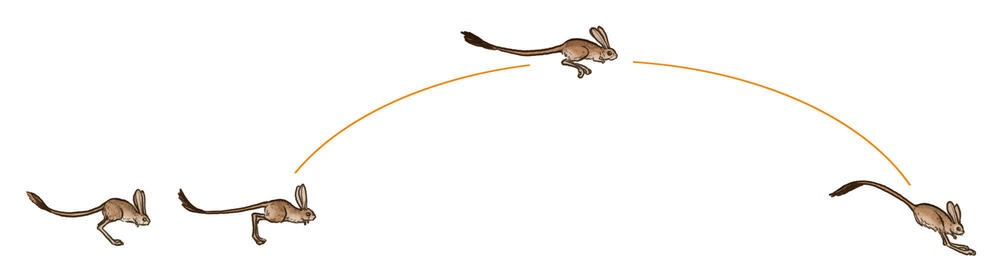
JUMPING AND DODGING: The long-eared jerboa relies on its incredible jumping abilities to dodge birds of prey and other predators when it’s out foraging. Jerboas can also rapidly hop sideways to fake out and confuse their predators
Long-eared jerboas sense using vision, touch, sound and chemicals usually detected with smell and communicate with sound and chemicals, leaving scent marks produced by special glands and placed so others can smell and taste them. Many jerboas engage in dust bathing as a way of using chemical communication. Their keen hearing suggests they may use sounds or vibrations to communicate.
The mating behavior of long-eared jerboas is not known but the behavior of closely-related jerboa species suggest that they may be polygynous (males have more than one female as a mate at one time) and begin mating not long after awaking from winter hibernation. Breeding can occur twice each season. The gestation period ranges from 25 to 35 days. The number of offspring ranges from two to six. During pre-weaning provisioning and protecting are done by females. /=\
Comb-Toed Jerboas
Comb-toed jerboas (Paradipus ctenodactylus) are the only members of the genus Paradipus. Occur from the Caspian Sea in the west to the Syr Darya River in the east, they are found in the Karakum Desert in Turkmenistan, the southern Kyzylkum Desert in Kazakhstan, Turkmenistan, and Uzbekistan, and Dasht-e Kavir in Iran, concentrated in regions with deserts with bushy vegetation such as sand acacia, calligonum, and tufts of three-awn. In such areas they are more common than any other rodent. Based on similar species it is believed they have a lifespan of two years.[Source: Elle Glueckert, Animal Diversity Web (ADW) /=]
Again based on similar species, it is thought Comb-toed jerboas are preyed on by foxes, ermines, owls, cats, and steppe polecats. When threatened, they make short dashes to escape. They are the fastest of any jerboa species, reaching speeds up to 180 meters per minute, but they tire quickly. When disturbed in their burrows, these animals respond by digging deeper into the sand, since they do not construct emergency exits.
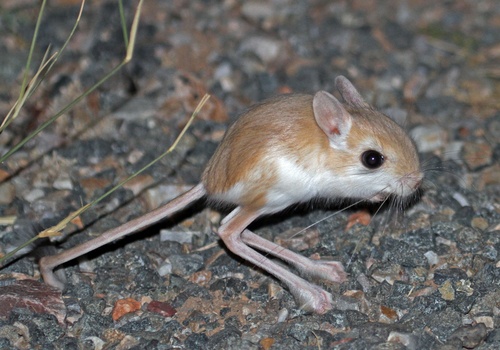
Comb-toed jerboas are herbivores (eat plants or plants parts). Among the plant foods they eat are leaves, wood, bark, stems, seeds, grains, nuts and flowers. On the International Union for Conservation of Nature (IUCN) Red List they are listed as a species of Least Concern. In CITES (Convention on International Trade in Endangered Species of Wild) they have no special status.
Comb-toed jerboas are extremely hard to observe. Thus many inferences have been made by analyzing their tracks — which are very distinctive and can easily be distinguished from the tracks of jerboa species. Their tracks are large because of the unusually large feet and have characteristic contours on the edges. Their tracks also tend to lie alternatively in a symmetric bipedal pattern, rather than in twos like hopping jerboas. Comb-toed jerboas appears to "play" in the sand, leaving rolling body marks as well as broad trampled stretches
Comb-Toed Jerboa Characteristics and Diet
Comb-toed jerboas have an average weight of 140 grams (4.9 ounces) and have a head and body length that ranges from 11 to 15.5 centimeters (4.3 to 6.1 inches). The tail is very long — approximately 20.6 to 221 centimeters (8.1 to 8.7 inches) . Relative to other jerboas, their hind feet are very long at 7.3 to 8.2 centimeters (2.9 to 3.2 inches). These highly specialized hind limbs allow these jerboas to leap up to three meters horizontally and one meter in height. They are also surprisingly agility climbing on shrubs and rocks as well. Sexual Dimorphism (differences between males and females) is not present: Both sexes are roughly equal in size and look similar. [Source: Elle Glueckert, Animal Diversity Web (ADW) /=]
Comb-toed jerboas have pinkish cinnamon to beige fur with white underparts and a broad white area around each eye. There are rusty colored patches on the cheeks and chest and the tail has a large white tuft at the end. The animals’ get their name from a comb of stiff bristles on the three toes of their hind feet , with the longest bristles on the medial toe and internal edges of the outer toes. These combed toes are thought to assist the jerboas in moving about in sandy habitat. Although the forelimbs are reduced, they are used for burrowing and have prominent claws, around seven millimeters in length, which also assist in climbing and collecting food. The ears are longer than those of most other jerboas, at 33 to 38 millimeters . Compared to other species in the subfamily Dipodinae, the cervical portion of the vertebral column is shorter, with complete fusion from vertebrae two to 6. Paradipus ctendactylus has white upper incisors, without the medial groove that is present in some jerboas. Premolars are absent
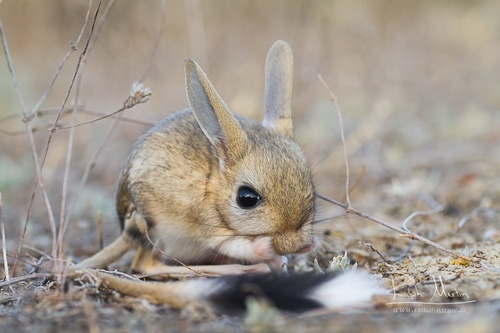
Comb-toed jerboas are completely herbivorous, eating only desert shrubs. Although they eat a variety of plant parts and species, they are picky about plant species and which parts of the plants are eaten. Individual differences as well as seasonal and local food preferences have been noted. Identified foods include shoots of Salsola richteri, Haloxylon persicum, and Calligonum arborescens, flowers and leaves of Calligonum caputmedusae, Calligonum arborscens, Ammodendrum conollyi, Astragalus paucijugus, Artemesia ereocarpa, and Acanthophyllum borszewi, the seeds or ovaries of Ammodendrum conollyi, Aristida karelini, Horaninovia ulicina, Malcolmia bungei, Corispermum papillosum, Euphorbia heirolepis, and the fruit of less than less than Haloxylon persicummore than more than and Peganum harmala
Comb-toed jerboas use their remarkable leaping ability and skill at climbing shrubs with their forelimbs and teeth to reach high into shrubs. Their balance allows them species to move around and find and obtain food in desert shrubs and trees. Once the food is obtained, rather than being dragged back to the burrow, the food is dragged to an open area at the top of a sand dune to be eaten.
Comb-Toed Jerboa Behavior and Reproduction
Comb-toed jerboas are terricolous (live on the ground), saltatorial (adapted to leaping), nocturnal (active at night), motile (move around as opposed to being stationary), sedentary (remain in the same area), hibernate (the state that some animals enter during winter in which normal physiological processes are significantly reduced, thus lowering the animal’s energy requirements) and solitary. Their average territory size is 10 square kilometers. Individuals make nightly rounds of their territories, which are 1.5 to two kilometers in radius, meaning they travel seven to 11 kilometers per night, sometimes even more, depending on the distance from their burrow to foraging areas. Territories for individuals overlap considerably, especially during the summer, and territories may shift in their boundaries. [Source:Elle Glueckert, Animal Diversity Web (ADW) /=]
Elle Glueckert wrote in Animal Diversity Web: Days are spent in their burrows, usually dug at the base of the windward side of a barkhan dune. While most jerboas dig an emergency exit and seal their burrows off, Comb-toed jerboas do not. Only one exit is present. When threatened in the burrow comb-toed jerboas dig new exits to escape. Although they dig burrows in somewhat damp or compacted sand, the burrow is extremely difficult to open because of the layers of dry sand on top of the barkhan sliding down into the tunnel. It is not known whether comb-toed jerboas dig permanent burrows; it appears that they may not based on the large number of freshly dug burrows each morning. The burrow is generally 25 to 65 centimeters in length and ends in a nest chamber. Compared to the burrows of other jerboas, this is relatively simple, with no branches, a small nest chamber, and an unsealed exit.
From December to February, comb-toed jerboas hibernate. When the ground temperature drops to 16-18 degrees Celsius, hibernation begins. Hibernation appears to coincide with the dying of the fruits and the growing of the shoots of the white saxaul tree, which they feed on. The burrows dug for hibernation are deeper than normal burrows and have a small amount of course bedding in the nest chamber.
Comb-toed jerboas engage in seasonal breeding, which seems to occur in April and May and again in July. Young are altricial meaning they are born relatively underdeveloped. Pre-weaning provisioning is provided by females. Otherwise, little is known about the reproductive behavior of Comb-toed jerboas. A closely related species,rough legged jerboas, breeds in the same season as Comb-toed jerboas and appears to have other similarities as well. During breeding season, rough legged jerboas, often fight over females. Males have been observed with multiple injuries and are occasionally even killed in these fights. It has been suggested that the April-May period of breeding may include mostly older females, while the July period may also include yearling females. The gestation period is approximately 25 to 30 days and the Litter size is around two to five offspring for rough legged jerboas. Young remain in the burrow for several months, until the middle of the summer.
Bobrinski's Jerboas
Bobrinski's jerboa (Allactodipus bobrinskii) are the only members of the genus Allactodipus. They live in northern and western areas of Turkmenistan and central and western areas of Uzbekistan in the Karakum and Kyzylkum deserts. he Kyzylkum desert is made up of red sand while the Karakum desert is mostly salt marsh sands. Both deserts have areas of sparse vegetation and scrub. Bobrinski’s jerboas avoid the completely sandy area and only inhabit the loamy and hard gravel plains in these deserts at elevations no higher than 300 meters (984 (high) feet). They construct burrows on a slightly raised mound that is free from vegetation. Their numbers are freatly influenced by the abundance or lack of vegetation they feed on. Their lifespan in the wild is typically two to three years. [Source: Jaime Andrzejewski, Animal Diversity Web (ADW) /=]
On the International Union for Conservation of Nature (IUCN) Red List Bobrinski's jerboa are listed as a species of Least Concern. In CITES (Convention on International Trade in Endangered Species of Wild) they have no special status. Under certain circumstances Bobrinski’s jerboas may be crop pests and transmit disease but as a rule they live such a harsh environment they rarely come in contact with humans.
Potential predators include snake, small and medium-sized nocturnal mammals such as sand cats Corsac foxes. Bobrinski's jerboas have a limited ability to fight back if attacked; therefore their primary means of defense is jumping or running away or by avoiding predators by moving very quietly and being well camouflaged with coloration that mimmicks the color of the sand in their environment.
Bobrinski's Jerboa Characteristics and Diet
Bobrinski's jerboas on average weigh is 65 grams (2.3 ounces) and have a head and body length that ranges from 27.8 to 29 centimeters (10.9 to 11.4 inches). Their long, slender tails measure 16. to 17 centimeters (6.3 to 6.7 inches) and has a tuft on the end. They use this tail for balance when jumping or to prop themselves up when standing. Their hind limbs are elongated and 5.8 centimeters (2.23 inches) in length and are behind thier extraordinary leaping abilities. The hind feet of Bobrinski's jerboas have three middle toes that are densely covered in a brush of stiff hairs. These stiff hairs provide traction in the sand. Sexual Dimorphism (differences between males and females) is not present: Both sexes are roughly equal in size and look similar. [Source: Jaime Andrzejewski, Animal Diversity Web (ADW) /=]
Bobrinski's jerboas have a silky coat with upper parts composed of a yellow straw colored hair that is markedly darkened in color by dark hair tips that are grey-brown. They have white underparts and hip patches, and the front of the head is slightly paler in color than the back. They also have protruding upper incisors and greatly inflated auditory bullae. Their relatively small ears (2.2 to 2.3 centimeters) are about one fifth of their body length.
Bobrinski's jerboas are omnivorous, eating mostly seeds, green parts of plants, and insects. In most seasons, they forage about equally on vegetation and insects. In the spring insects become a much more significant part of the diet. They can use the hairs on their forelimbs to sift through the sand for food. Bobrinski's jerboas do not need to drink water; instead they generate metabolic water from their food.
Bobrinski's Jerboa Behavior and Reproduction
Bobrinski's jerboas are terricolous (live on the ground), saltatorial (adapted to leaping), nocturnal (active at night), motile (move around as opposed to being stationary), sedentary (remain in the same area), hibernate (the state that some animals enter during winter in which normal physiological processes are significantly reduced, thus lowering the animal’s energy requirements) and solitary. [Source: Jaime Andrzejewski, Animal Diversity Web (ADW) /=]
Bobrinski's jerboas are shy and seldom seen. They forage only at night and hibernate during the winter. Hibernation is not very deep as there may activity when temperatures briefly warm up. They are burrowing rodents, with separate types of burrows for both night and day and for summer and winter. Some of the burrows are permanent, while others are temporary and much shallower in depth. Among similar species a single animal typically inhabits a burrow. Bobrinski’s jerboas also builds a separate burrow for nesting.
Bobrinski's jerboas sense using vision, touch, sound and chemicals usually detected with smell and communicate with vision, sound and chemicals. They have large eyes which allows them see well in low light. They also have very large auditory bullae which is an indication they can hear and pick up low sounds extremely well. They tap theirs foot inside of the burrow, producing a low drumming noise, which may be a form of communication.
Bobrinski's jerboas engage in seasonal breeding, with the breeding season occuring April to June and again September to October. Generally they start breeding soon after emergence from hibernation. Usually females breed at least twice in a season. The gestation period ranges from 25 to 35 days. The number of offspring ranges from three to seven with the average number being being 5.3. Young are altricial, meaning they are born relatively underdeveloped at birth. During the pre-weaning and pre-independence stages provisioning and protecting are done by females. Weaning is believed to take place at around 30 to 45 days old. Both sexes become sexually mature around five months.
Image Sources: Wikimedia Commons, World Wildlife Fund
Text Sources: Animal Diversity Web animaldiversity.org ; National Geographic, Live Science, Natural History magazine, CNTO (China National Tourism Administration) David Attenborough books, New York Times, Washington Post, Los Angeles Times, Smithsonian magazine, Discover magazine, The New Yorker, Time, BBC, CNN, Reuters, Associated Press, AFP, Lonely Planet Guides, Wikipedia, The Guardian, Top Secret Animal Attack Files website and various books and other publications.
Last updated May 2025