
GERBILS
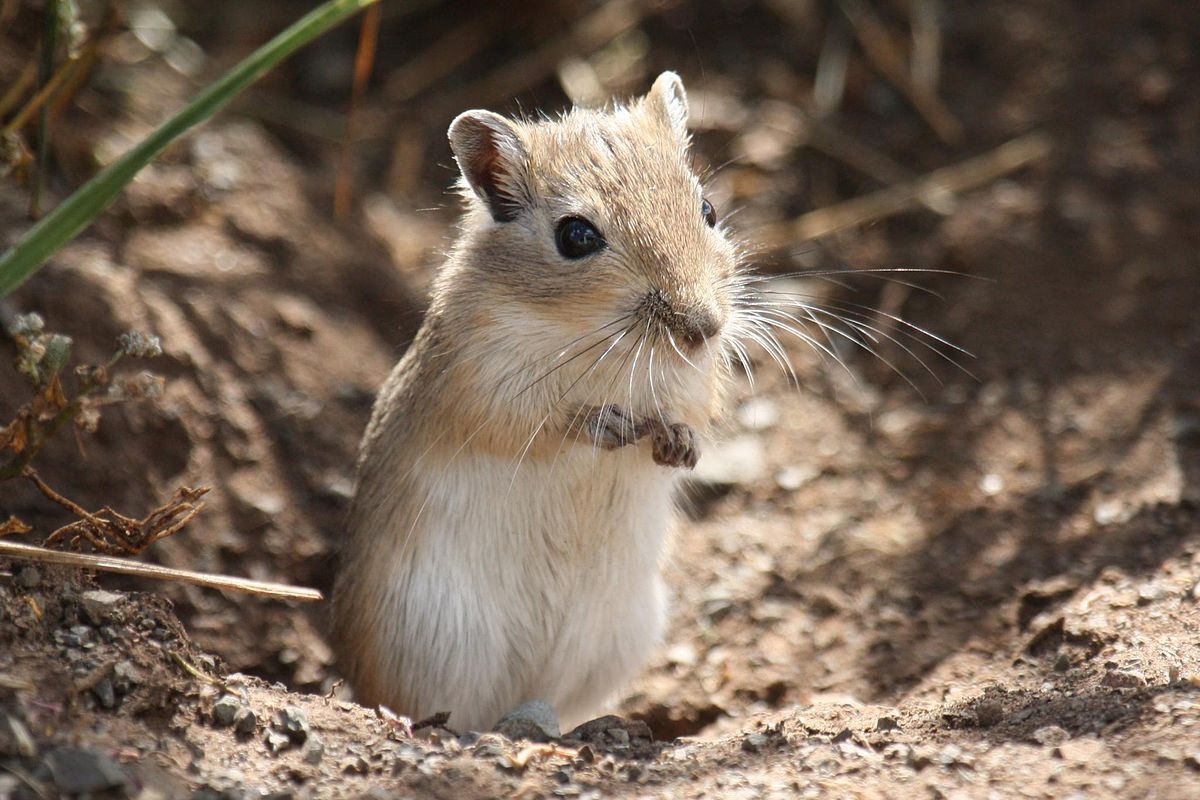
Gerbillinae is a subfamily of the rodent family Muridae that includes gerbils, jirds, and sand rats. Once known as desert rats, the subfamily includes about 110 species in 16 genera that live is Asia and Africa, all of which are adapted to arid habitats. They are good at leaping and most gerbillines do not live longer than three or four months in the wild although they can live as long as eight years in captivity. Most are primarily active during the day and almost all are omnivorous. [Source: Wikipedia, Allison Poor, Animal Diversity Web (ADW) /=]
Gerbils get their name from the diminutive form of "jerboa", an unrelated group of rodents that live in similar environments. Gerbils are usually between 15 and 30 centimeters mm (6 and 12 inches) long, including the tail, which makes up about half of their total length. The average adult gerbil weighs about 70 grams (2.5 ounces). Great gerbils (Rhombomys opimus), originally native to Turkmenistan, can grow to more than 40 centimeters (16 inches). Mongolian gerbils (Meriones unguiculatus), also known as the clawed jird or the Mongolian jird, are the species most often kept as house pets. They are gentle and hardy animal also used in some scientific research.
Gerbils are Old World rodents. They are distributed throughout Africa, the Middle East, and Central Asia including much of India and eastern Mongolia and live in dry, open habitats with sparse vegetation, including deserts, sandy plains, mountain slopes, steppes, grasslands, and savannahs. Some species also inhabit moist woodlands, agricultural fields, and mountain valleys.
Gerbils are different from hamsters and jerboa although they look kind of similar. All three are small rodents, but they have distinct physical and behavioral differences. Gerbils are generally more slender and athletic, with long, furry tails, while hamsters are rounder and have shorter, stubby tails. Gerbils are also more social and enjoy being in pairs or small groups, whereas hamsters are typically solitary animals. Gerbils and jerboas are both desert-dwelling rodents, but they belong to different families and have distinct characteristics. Gerbils are part of the Muridae (mouse) family and are known for their shorter legs and burrowing habits. Jerboas are in the family Dipodidae and are characterized by their long hind legs, hopping locomotion, and longer tails. [Source: Google AI]
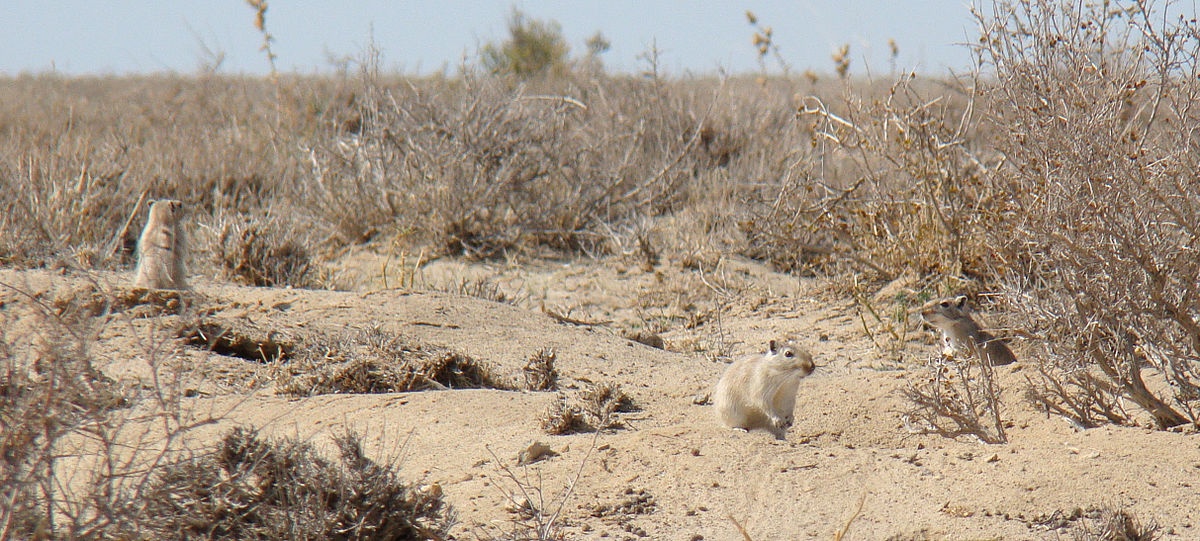
Gerbils are primarily herbivorous or omnivorous. They consume nuts, seeds, roots, bulbs, fruits, grasses, insects, bird eggs and nestlings, and even other gerbils. Gerbils store large quantities of plant food in their burrows — sometimes as much as 60 kilograms. They are preyed upon by a variety of animals including snakes, owls, other birds of prey, and small mammalian carnivores such as foxes and weasels. To prevent predators from entering their burrows, some gerbils block the entrances with sand. Others construct bolt holes into their burrow systems, into which they can make a hasty retreat if caught out in the open. In addition, gerbils usually have sandy or grey-colored fur, which serves as camouflage, helping blend in to their sandy or rocky habitats.
RELATED ARTICLES:
GERBIL SPECIES IN ASIA: MONGOLIAN, GREAT, INDIAN factsanddetails.com
GERBILS OF THE MIDDLE EAST AND NORTH AFRICA africame.factsanddetails.com
JIRDS: CHARACTERISTICS, BEHAVIOR, SPECIES AND REPRODUCTION africame.factsanddetails.com
HAMSTERS: TAXONOMY, CHARACTERISTICS, BEHAVIOR factsanddetails.com
HAMSTER SPECIES IN EURASIA: EUROPEANS, ROBOROVSKIS, CAMPBELL'S DWARVES factsanddetails.com
GOLDEN (SYRIAN) HAMSTERS: CHARACTERISTICS, BEHAVIOR, DISCOVERY, DOMESTICATION africame.factsanddetails.com
MOUSE-LIKE HAMSTERS: CHARACTERISTICS, SPECIES, BEHAVIOR, AND REPRODUCTION factsanddetails.com
JERBOAS OF CENTRAL ASIA: CHARACTERISTICS, BEHAVIOR, SPECIES factsanddetails.com
JERBOAS OF THE MIDEAST AND NORTH AFRICA: CHARACTERISTICS, BEHAVIOR, SPECIES africame.factsanddetails.com
EGYPTIAN JERBOAS: GREATER, LESSER, CHARACTERISTICS, BEHAVIOR africame.factsanddetails.com
PYGMY JERBOAS (WORLD'S SMALLEST RODENTS): CHARACTERISTICS, BEHAVIOR, SPECIES factsanddetails.com
Gerbil Characteristics
Gerbils are small to medium-sized rodents. They have a head and body length that ranges from five to 20 centimeters (two to eight inches), with tails measuring 5.6 to 24.5 centimeters (2.2 to 9.6 inches) They weigh between 10 and 227 grams (.35 and 8 ounces). Allison Poor wrote in Animal Diversity Web: Gerbils vary in the amount to which they are sexually dimorphic; even within a species males may be heavier than females in one population and the sexes may be the same size in another population. [Source: Allison Poor, Animal Diversity Web (ADW) /=]

gerbil range
Most gerbils have well-furred, long tails and are modified for saltatorial (adapted to leaping), locomotion, with long, narrow hind feet. Some species are cursorial (with limbs adapted to running),. Gerbils are generally slender animals with long claws. They may have long or short ears. Their fur is long, thick, and soft or short and harsh. Some have tufted tips on their tails. Fur color varies widely, and may be reddish, mouse gray, yellowish, clay-colored, olive, dark brown, orangish, sandy buff, or pinkish cinnamon on the dorsal surface. The underparts are generally paler shades of gray, cream, or white. Some species have whitish spots on their heads, especially behind the ears.
The gerbil dental formula is 1/1, 0/0, 0/0, 3/3 = 16, except for the genus Desmodilliscus, which only has two lower molars on each side. The layers of enamel on the incisors are very thin compared to other muroid rodents. The molars are rooted, with lophate, planar, or prismatic enamel patterns. The coronoid process is very small or absent. Gerbils have 12 thoracic vertebrae and seven lumbar vertebrae. Females have three or four pairs of mammae. The stomach consists of just a single chamber. There are no supraorbital or mandibular branches of the stapedial artery, and instead, the infraorbital (below the eye sockets) artery supplies blood to the orbits. Gerbils have diploid chromosome numbers between 18 and 74. /=\
Gerbil Behavior
Gerbils are cursorial (with limbs adapted to running), terricolous (live on the ground), saltatorial (adapted to leaping), diurnal (active during the daytime), nocturnal (active at night), crepuscular (active at dawn and dusk), motile (move around as opposed to being stationary), nomadic (move from place to place, generally within a well-defined range), migratory (make seasonal movements between regions, such as between breeding and wintering grounds), sedentary (remain in the same area), have daily torpor (a period of reduced activity, sometimes accompanied by a reduction in the metabolic rate, especially among animals with highmetabolic rates), territorial (defend an area within the home range), solitary, social (associates with others of its species; forms social groups) and colonial (live together in groups or in close proximity to each other). [Source: Wikipedia, Allison Poor, Animal Diversity Web (ADW) /=]
Gerbils are good at leaping. Some species are capable of extraordinary leaps of up to 3.5 meters. Other species move around mainly by running on all fours. Those that live in rocky habitats are often good climbers. For the most part, gerbils are active during the daytime but some species are active at night and active at dawn and dusk,, or active both day and night. Gerbils take dust baths to keep their silky coats in good condition. /=\
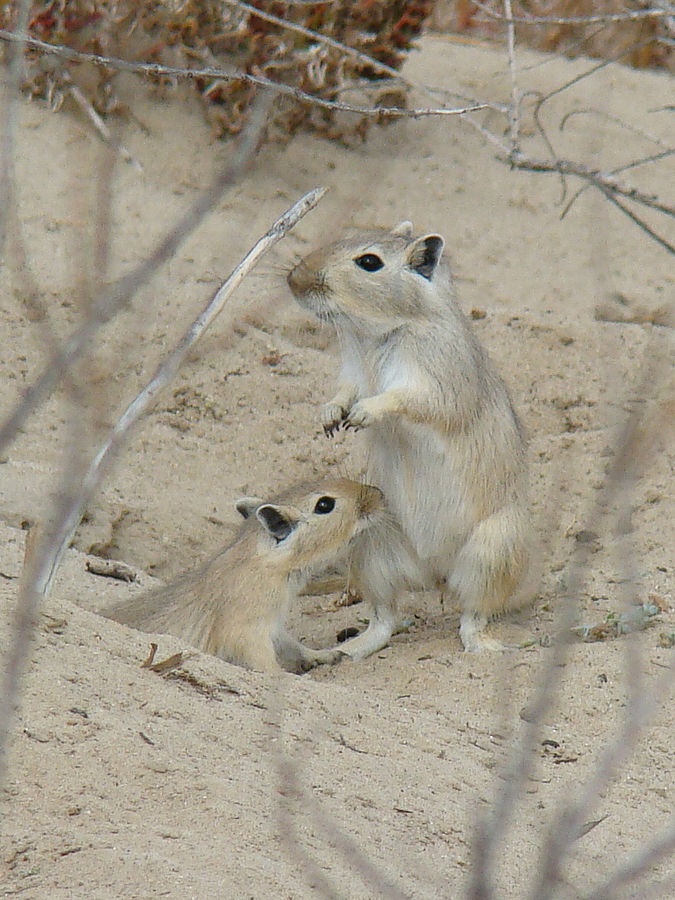
Some gerbil species are solitary, aggressive, and territorial, with individuals inhabiting their own burrows. Other species are highly gregarious and form large colonies, with many individuals inhabiting tunnel networks tens of meters long and two or three meters deep. Still others live in small family groups, with each family group defending its own territory. There is much socializing among some gerbils while they are in the nest. The pups groom one another, chase each other, and play-fight when they are between 18 and 35 days old. /=\
Gerbils build burrows, which may be simple structures with just one entrance and nest chamber, or elaborate networks of tunnels with multiple entrances and chambers for nesting, food storage, and excrement. Gerbils are mainly sedentary though the young may go through a nomadic period until they are able to establish permanent home ranges, and some species migrate in times of drought. Gerbils do not hibernate or aestivate, but in some areas they experience long bouts of torpor in the winter and remain in their burrows living off of stored food for months at a time. /=\
Gerbils Senses and Communication
Gerbils sense using vision, touch, sound and chemicals usually detected with smell. They have large eyes and good vision. They also use auditory, chemical, and tactile cues in perceiving their environment. [Source: Wikipedia, Allison Poor, Animal Diversity Web (ADW) /=]
Gerbils communicate with sound and chemicals and employ pheromones (chemicals released into air or water that are detected by and responded to by other animals of the same species) and scent marks (produced by special glands and placed so others can smell or taste them) and vibrations.
Gerbils have a range of vocalizations that they use to communicate with one another. Young gerbils squeak when their mother enters the nest, grunt when they are resting together or climbing on one another, and they also make a clicking noise. Adult gerbils squeak and sometimes produce a high-pitched rattle. They also are known to drum their hind feet on the ground. Gerbils use pheromones to signal reproductive and social status. Male gerbils communicate territory ownership by scent-marking with their large ventral sebaceous glands. /=\
Gerbil Mating and Reproduction
Gerbils are polygynandrous (promiscuous), with both males and females having multiple partners. Some gerbil species breed year-round, and some breed seasonally. Gerbils engage in delayed implantation (a condition in which a fertilized egg reaches the uterus but delays its implantation in the uterine lining, sometimes for several months). [Source: Wikipedia, Allison Poor, Animal Diversity Web (ADW) /=]
Females have an estrous cycle, which is similar to the menstrual cycle of human females. During mating, copulatory plugs form in the reproductive tracts of females that hinder subsequent matings. The presence of these copulatory plugs suggests a polygynandrous mating system.
Females of most species are polyestrus and are able to bear multiple litters in a year. Some also experience a postpartum estrus and delayed implantation so that a new litter begins developing as soon as the first is weaned. Gestation periods, if females are not lactating, last three to four weeks, longer if lactating. Overall, litter sizes range from one to 13, with litters of four to seven being most common.
Gerbil Offspring and Parenting
Gerbils are altricial. This means that young are born relatively underdeveloped and are unable to feed or care for themselves or move independently for a period of time after birth.
Young gerbils are born completely naked and blind. They begin to grow fur between eight and 13 days after birth, and are fully furred at 13 to 16 days. Eyes open about two or three weeks after birth. The young can walk quickly and hop about on all fours at about three weeks. At around one month of age, the young are weaned and independent; they reach sexual maturity at 10 to 16 weeks. [Source: Wikipedia, Allison Poor, Animal Diversity Web (ADW) /=]
Most of the parenting duties are done by females. During the pre-birth stage provisioning and protecting are done by females. During the pre-weaning stage provisioning is done by females and protecting is done by males and females. Mothers frequently groom their young; licking the neonates' hindquarters to stimulate them to produce urine and feces, which the mothers then consume. Gerbil mothers groom their litters until the young go off on their own; the young of some species begin grooming each other and their mothers 25 days after birth. Males of some species brood and groom their young in the same manner as females. /=\
According to Animal Diversity Web: Female gerbils brood their young until the young are about 30 days old. When brooding, they stand on all fours with their feet splayed out around the litter. Gerbil mothers are known to move their young to new nests several times for the first couple of days after birth, and also to switch burrows between litters. When they leave the young in the nest to go out foraging, they sometimes cover their brood with grass and sand and block up the nest entrance. Females carry their young by gripping them around the midsection in their mouths. Once the young are able to move around more, mothers grab them by their tails and pull them near, then carry the young back to the nest. They stop retrieving their young when the young are between 17 and 23 days old.
Gerbils, Humans and Conservation
Humans utilize gerbils for the pet trade, research and education. Mongolian gerbils (Meriones unguiculatus) especially are clean, easy to take care of, and breed readily in captivity, and are thus sought after as pets and in many laboratories for medical, physiological, and psychological research. Some gerbil species have been trapped for their skins. [Source: Wikipedia, Allison Poor, Animal Diversity Web (ADW) /=]
Some gerbils are considered pest animals as they can eat crops, damage embankments and irrigation systems with their digging, and spread the bubonic plague and other diseases. There are also concerns that captive gerbils might escape and establish feral populations, which could outcompete native rodents.
A total of 35 gerbilline species are listed on the IUCN Red List of Threatened Species — A) one critically endangered species (Cheng's jirds, Meriones chengi), B) four endangered species (Arabian jirds, Meriones arimalius, Dahl's jirds, Meriones dahli, Buxton's jirds, Meriones sacramenti, and Zarudny's jirds, Meriones zarudnyi), C) two vulnerable species (western gerbils, Gerbillus hesperinus, and Allenby's gerbils, Gerbillus andersoni allenbyi), D) one near threatened species (Hoogstral's gerbils, Gerbillus hoogstraali), E) one lower risk species (large Aden gerbils, Gerbillus poecilops), and F) 26 species that lack data.
Image Sources: Wikimedia Commons
Text Sources: Animal Diversity Web animaldiversity.org ; National Geographic, Live Science, Natural History magazine, CNTO (China National Tourism Administration) David Attenborough books, New York Times, Washington Post, Los Angeles Times, Smithsonian magazine, Discover magazine, The New Yorker, Time, BBC, CNN, Reuters, Associated Press, AFP, Lonely Planet Guides, Wikipedia, The Guardian, Top Secret Animal Attack Files website and various books and other publications.
Last updated April 2025