
WILD SHEEP AND GOATS
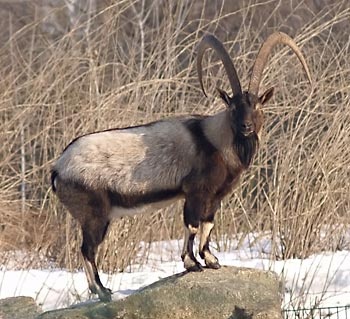
Ovis is a genus of mammals, part of the goat-antelope subfamily of the ruminant family Bovidae. Its five or more highly sociable species are known as sheep. The domestic sheep is one member of the genus, and is thought to be descended from the wild mouflon of central and southwest Asia. Five species and numerous subspecies of sheep are currently recognised, although some subspecies have also been considered full species. These are the main ones: 1) Argali (Ovis ammon); 2) domestic sheep (Ovis aries aries); 3) Mouflon (Ovis aries orientalis); 4) Urial (Ovis vignei); 5) bighorn sheep (Ovis canadensis); 6) Dall sheep (Ovis dalli); 7) snow sheep (Ovis nivicola). [Source: Wikipedia +]
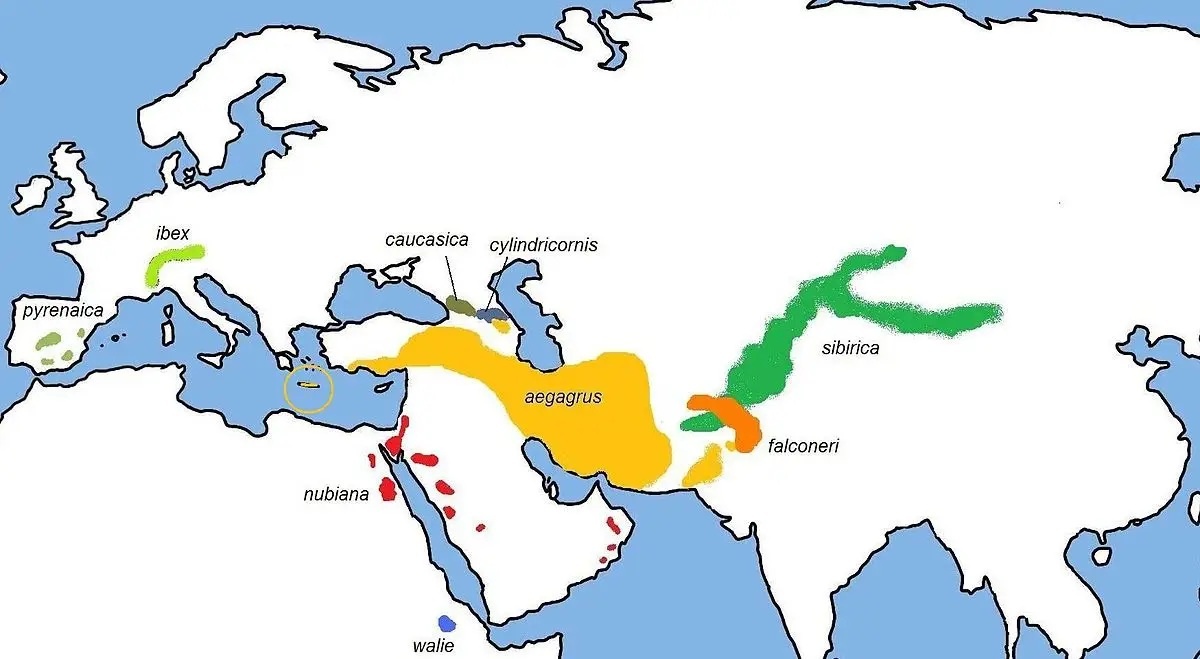
Capra is a genus of mammals that embraces goats, domesticated goats and wild goats. It is composed of up to nine species: 1) West Caucasian tur (Capra caucasica), including the East Caucasian tur (Capra caucasica cylindricornis); 2) Markhor (Capra falconeri); 3) Domestic goat (Capra aegagrus hircus), includes feral goat and Bezoar ibex (Capra aegagrus aegagrus), the progenitors of domesticated goats; 4) Alpine ibex (Capra ibex); 5) Nubian ibex (Capra nubiana); 6) Spanish ibex (Capra pyrenaica); 7) Siberian ibex (Capra sibirica); 8) Walia ibex (Capra walie); 9) Wild goat (Capra aegagrus)
The wild goat (Capra aegagrus) is a widespread species of goat, with a distribution ranging from Europe and Asia Minor to central Asia and the Middle East. It is the ancestor of the domestic goat. Subspecies include: 1) Bezoar ibex (Capra aegagrus aegagrus); 2) Sindh ibex (Capra aegagrus blythi); 3) Chiltan ibex (Capra aegagrus chialtanensis); 4) Kri-kri (Capra aegagrus cretica); 5) domestic goat ( Capra aegagrus hircus); 6) Turkmen wild goat (Capra aegagrus turcmenica); 7) Capra aegagrus pictus.
Ibex are wild goats that live in the mountainous regions of Europe, north central Asia and northern Africa. There are five species of ibex, according to the Integrated Taxonomic Information System (ITIS). Of the eight species of goat, five are ibex: Capra ibex (Alpine ibex), Capra nubiana (Nubian ibex), Capra pyrenaica (Spanish ibex), Capra sibirica (Siberian ibex) and Capra walie (Walia ibex).
RELATED ARTICLES:
GOATS: HISTORY, CHARACTERISTICS, MILK AND MEAT factsanddetails.com
IBEX: CHARACTERISTICS, BEHAVIOR, REPRODUCTION, SPECIES factsanddetails.com
SIBERIAN IBEX: CHARACTERISTICS, BEHAVIOR AND REPRODUCTION factsanddetails.com
NUBIAN IBEX: CHARACTERISTICS, BEHAVIOR AND REPRODUCTION africame.factsanddetails.com
Bovids
Wild goats and sheep are bovids. Bovids (Bovidae) are the largest of 10 extant families within Artiodactyla, consisting of more than 140 extant and 300 extinct species. According to Animal Diversity Web: Designation of subfamilies within Bovidae has been controversial and many experts disagree about whether Bovidae is monophyletic (group of organisms that evolved from a single common ancestor) or not. [Source: Whitney Gomez; Tamatha A. Patterson; Jonathon Swinton; John Berini, Animal Diversity Web (ADW) /=]
Wild bovids can be found throughout Africa, much of Europe, Asia, and North America and characteristically inhabit grasslands. Their dentition, unguligrade limb morphology, and gastrointestinal specialization likely evolved as a result of their grazing lifestyle. All bovids have four-chambered, ruminating stomachs and at least one pair of horns, which are generally present on both sexes.
Bovid lifespans are highly variable. Some domesticated species have an average lifespan of 10 years with males living up to 28 years and females living up to 22 years. For example, domesticated goats can live up to 17 years but have an average lifespan of 12 years. Most wild bovids live between 10 and 15 years, with larger species tending to live longer. For instance, American bison can live for up to 25 years and gaur up to 30 years. In polygynous species, males often have a shorter lifespan than females. This is likely due to male-male competition and the solitary nature of sexually-dimorphic males resulting in increased vulnerability to predation. /=\
See Separate Article: BOVIDS: CHARACTERISTICS, BEHAVIOR, SUBFAMILIES factsanddetails.com
Ruminants
Cattle, sheep, goats, yaks, buffalo, deer, antelopes, giraffes, and their relatives are ruminants — cud-chewing mammals that have a distinctive digestive system designed to obtain nutrients from large amounts of nutrient-poor grass. Ruminants evolved about 20 million years ago in North America and migrated from there to Europe and Asia and to a lesser extent South America, where they never became widespread.
As ruminants evolved they rose up on their toes and developed long legs. Their side toes shrunk while their central toes strengthened and the nails developed into hooves, which are extremely durable and excellent shock absorbers.
Ruminants helped grasslands remain as grasslands and thus kept themselves adequately suppled with food. Grasses can withstand the heavy trampling of ruminants while young tree seedlings can not. The changing rain conditions of many grasslands has meant that the grass sprouts seasonally in different places and animals often make long journeys to find pastures. The ruminants hooves and large size allows them to make the journeys.
Describing a descendant of the first ruminates, David Attenborough wrote: deer move through the forest browsing in an unhurried confident way. In contrast the chevrotain feed quickly, collecting fallen fruit and leaves from low bushes and digest them immediately. They then retire to a secluded hiding place and then use a technique that, it seems, they were the first to pioneer. They ruminate. Clumps of their hastly gathered meals are retrieved from a front compartment in their stomach where they had been stored and brought back up the throat to be given a second more intensive chewing with the back teeth. With that done, the chevrotain swallows the lump again. This time it continues through the first chamber of the stomach and into a second where it is fermented into a broth. It is a technique that today is used by many species of grazing mammals.
See Ruminants Under MAMMALS: HAIR, HIBERNATION AND RUMINANTS factsanddetails.com
Taxonomy of Sheep and Goats
The taxonomy of the genus Ovis (sheep) is controversial. Various authorities have lumped domestic sheep (O. aries) with mouflon (O. orientalis) as members of the same species. Others recognize the two as distinct species, but claim that Mouflon is the ancestral species from which domestic sheep were derived. Some consider populations of sheep on the islands of Corsica and Sardinia as subspecies of Mouflon, whereas others separate them as a distinct species. In north India, populations of Argali and urial occur near one another, and some think they represent a single species. There are also those who consider Mouflon and urial (Ovis vignei), usually considered two species, to be a single species. [Source: Andrew Hagen, Animal Diversity Web (ADW) /=]
Complicating matters further, the genus Ovis has also been considered by some to be synonymous with the genus Capra (goats) because of fertile hybrids produced between domestic goats (C. hircus) and domestic sheep.
All wild species of sheep are allopatric, however, hybridization can, and does, occur.Urial sheep represent a chromosomal, geographic and morphological extreme amongst the wild sheep of Iran. Urial sheep (2N=58) hybridize with Ovis orientalis (2N=54), producing a 150 kilometer zone of hybridization. Hybrids in the hybridization zone display variable fur and chromosome number (54-58).
Wild Goats
Wild goats (Capra aegagrus) are a species of wild goat that are believed to be the ancestors of domestic goat (Capra hircus). They inhabit forests, shrublands and rocky areas ranging from Turkey and the Caucasus in the west to Turkmenistan, Afghanistan and Pakistan in the east. They are listed as near threatened on the International Union for Conservation of Nature (IUCN) Red List and are threatened by poaching, habitat loss due to logging, and competition with domestic livestock for food resources. [Source: Wikipedia]
Both Bezoar ibex (C. a. aegagrus) and Sindh ibex (C. a. blythi) are considered to be valid subspecies of the wild goat. There is debate as to whether or not Chiltan ibex (C. a. chialtanensis) should be included too. Though they were initially thought to be a distinct subspecies, they are is now regarded as a variant of the wild goat, with some scientists suggesting it may be a hybrid with markhor. Cretan goats (formerly C. a. pictus), or kri-kri, were once thought to be a subspecies of wild goat, but they are now considered to be a feral descendant of domestic goats (Capra hircus), now known as Capra hircus cretica.
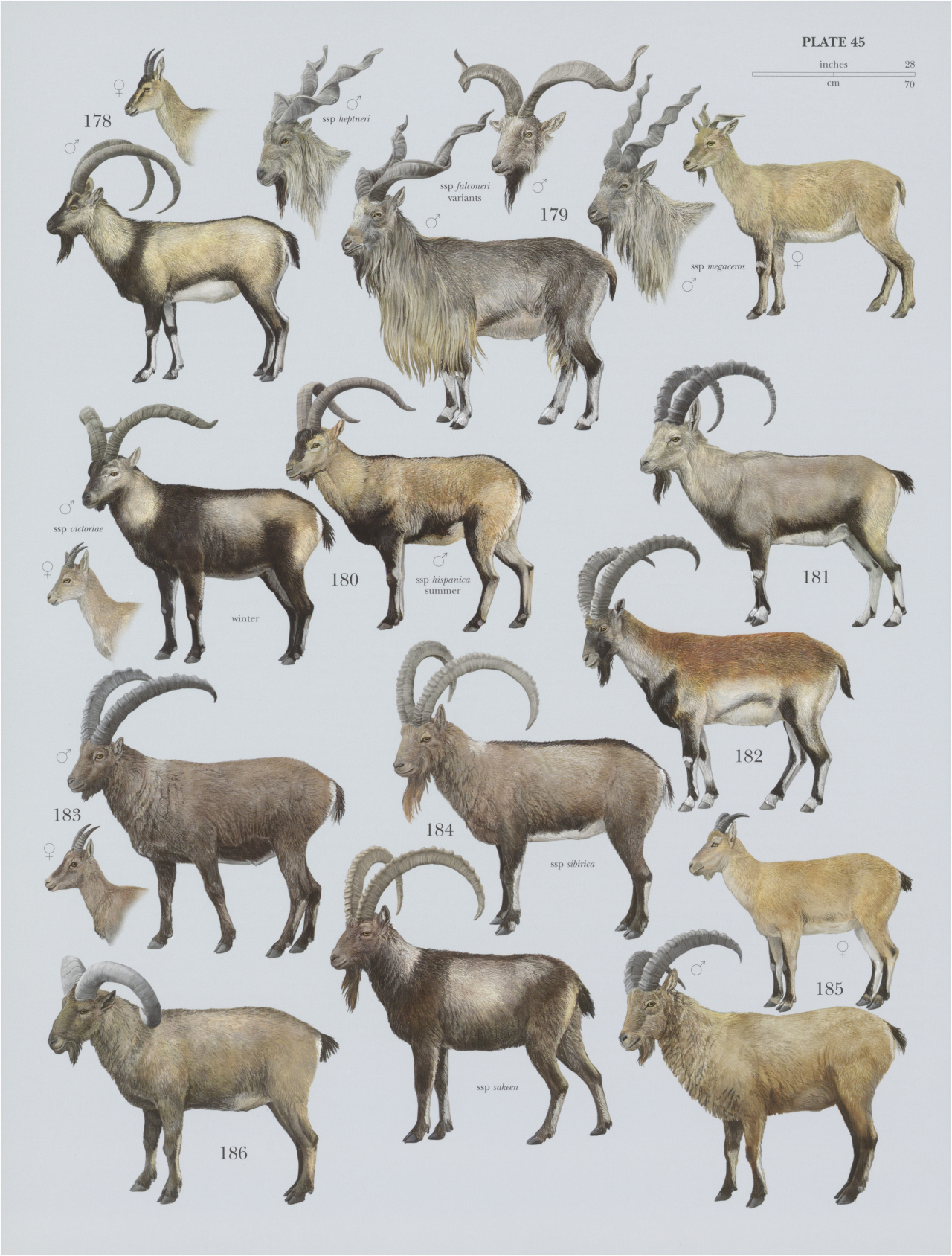
Wild goat and ibex species: 178) Wild Goat (Capra aegagrus), 179) Markhor (Capra falconeri), 180) Iberian Ibex (Capra pyrenaica), 181) Nubian Ibex (Capra nubiana), 182) Walia Ibex (Capra wale), 183) Alpine Ibex (Capra ibex), 184) Siberian Ibex (Capra sibirica), 185) Kuban Tur (Capra caucasica), 186) Daghestan Tur (Capra cylindricornis)
In Turkey, the wild goat can be found in the Aegean, Mediterranean, Black Sea, Southeastern and the Eastern Anatolia Regions up to 3,250 meter (10,660 feet) in the Taurus and Anti-Taurus Mountains. In the Caucasus, they inhabits montane forests in the river basins of Andi Koysu and its tributaries in Dagestan, Chechnya and Georgia up to 2,700 meter (8,900 feet).
In Armenia, wild goats have been recorded in the Zangezur Mountains, in Khosrov State Reserve, and in highlands of the Syunik Province. In Azerbaijan, they goats occur in Ordubad National Park, Daralayaz and Murovdag mountain areas in Nakhchivan Autonomous Republic. In Iran's Haftad Gholleh Protected Area, wild goat herds live foremost in west-facing areas in rocky substrates and on steep slopes are far from roads. In Turkmenistan, wild goat populations inhabit the mountain ranges of Uly Balkan and Kopet Dag. In Pakistan, wild goat herds occur in Kirthar National Park.
In Kirthar National Park, 283 wild goat groups were observed for 10 months in 1986. The group sizes ranged from two to 131 individuals but varied seasonally, with a mean ratio of two females per male. In Dagestan, male wild goats start courting females in mid December. The rutting season lasts until the third week of January. Females give birth to between one and three kids in late June to mid July. Older males drive younger males from the maternal herds. The gestation period averages 170 days. Kids are mobile almost immediately after birth. Kids are weaned after 6 months. Female goats reach sexual maturity at 1½–2½ years, males at 3½–4 years. The lifespan of a goat can be from 12 to 22 years.
See Separate Article: GOATS: HISTORY, CHARACTERISTICS, MILK AND MEAT factsanddetails.com
Bezoar Ibex
Bezoar ibex (Capra aegagrus aegagrus) are a vulnerable subspecies of wild goat and ancestor of domestic goats. They are 1.2 to 1.6 meters in length, with a six to eight centimeter tail and weigh 55 to 210 kilograms. They are found in varied habitats from arid scrub to alpine pastures up to elevation of 4,200 meters. Females are red-gray to yellow-brown. Adult males are bearded and silver gray with drank markings. Both sexes have horns. Males fight for dominance in their bachelor herd for access to females.
The bezoar goat, if not the sole progenitor of the modern domestic goat, was at least its main progenitor. The archaeological evidence traces goat domestication as far back as ca. 10,500 year Before Present and DNA evidence suggests 10,000 years BP. [Source: Wikipedia +]
The bezoar ibex (Capra aegagrus aegagrus) is native to Afghanistan, Armenia, Azerbaijan, Georgia, Iraq, Iran, Russia and Turkey. It has been extirpated from Lebanon. They were also introduced to the Florida Mountains of New Mexico. The bezoar goat is found in the mountains of Asia Minor and across the Middle East. It is also found on some Aegean Islands and in Crete where it is accepted that the goats constitute relict populations of very early domestic animals that were taken to the Mediterranean islands during the prehistoric period and now live as feral populations. +
Argali
Argali (Ovis ammon) are the world’s largest sheep. Also known as mountain sheep, they are native to the highlands and mountains of Central Asia, the Himalayas, Tibet, and the Altai region. They weigh between 43 and 356 kilograms (95 to 729 pounds) and have a shoulder height of 85 to 135 centimeters (three to four feet) . North American bighorn sheep may approach comparable weights but are normally considerably to be slightly smaller than by the argali. Argali have large corkscrew-shaped horns with rounded combat edges similar to those of North American bighorn sheep. Both males and female argali have horns. The horns of males can be up to 1.9 meters (six feet) in length when measured along the coil. Those of females are smaller.
Currently nine subspecies of argali are recognized: 1) Altai argali, (Argali ammon); 2)Karaganda argali, (Argali collium); 3) Gobi argali, (Argali darwini); 4) Tibetan argali, (Argali hodgsoni); 5) North China argali, (Argali jubata); 6) Tian Shan argali, (Argali karelini); 7) Kara Tau argali, (Argali nigrimontana); 8) Marco Polo argali, (Argali polii); and 9) Severtzov argali, (Argali severtzovi). Subspecies are distinguished by seasonal age related fur differences, body size and geographic location. /=\
The lifespan of Argali sheep averages 10 to 13 years, with the oldest being about 20 years old. Predators and extreme climatic conditions kill older sheep, so maximum lifespan is seldom achieved. Males can generally live longer than females. [Source: John Tonda, Animal Diversity Web (ADW) /=]
See Separate Article: ARGALI; CHARACTERISTICS, BEHAVIOR AND REPRODUCTION factsanddetails.com
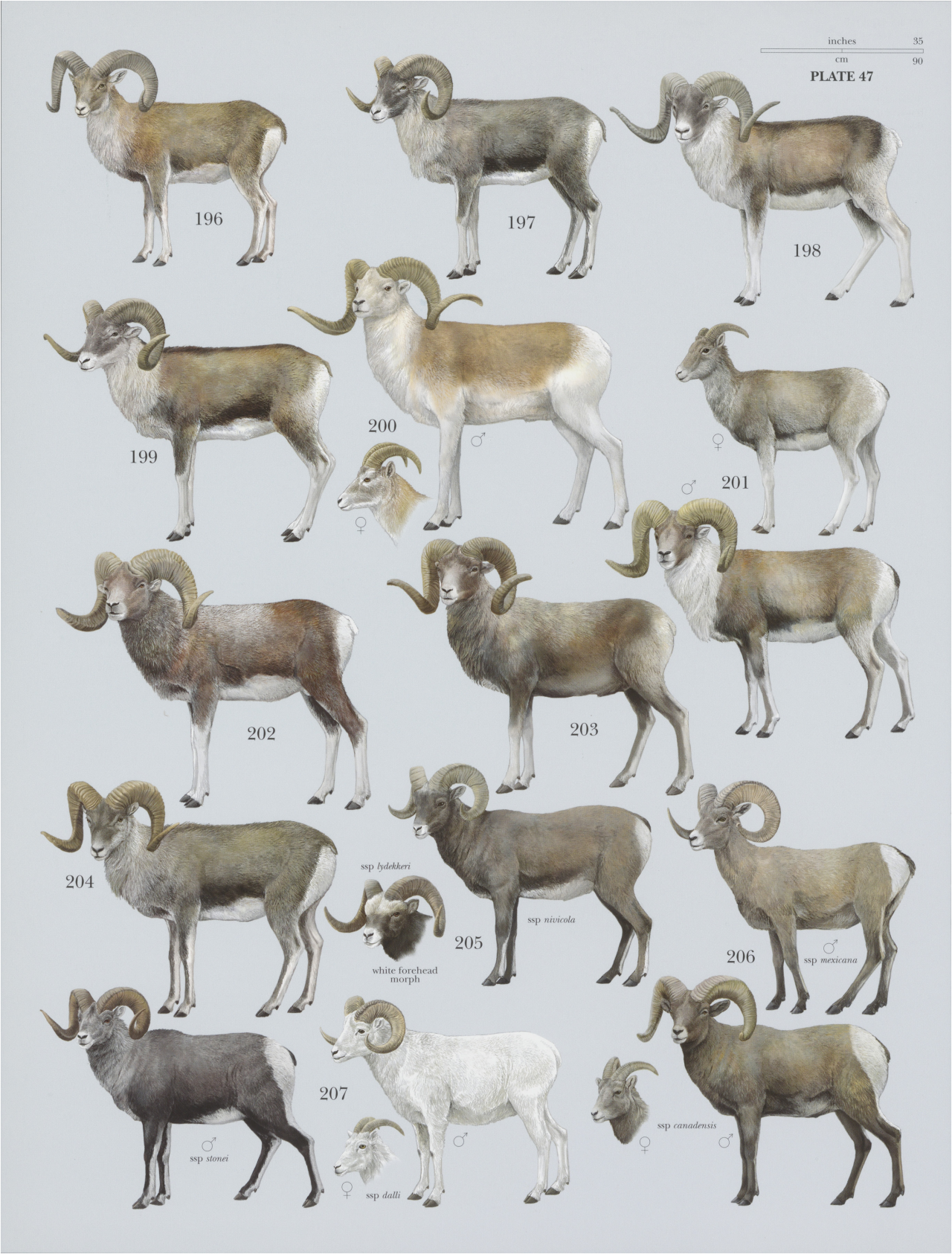
Wild sheep species: 199) Kazakhstan Argali (Ovis collium); 200) Marco Polo Argali (Ovis poli); 201) Tibetan Argali (Ovis hodgsoni); 202) Altai Argali (Ovis ammon); 203) Gobi Argali (Ovis darwini); 204) Shansi Argali (Ovis jubata); 205) Snow Sheep (Owvis nivicola); 206) Bighorn Sheep (Ovis canadensis); 207) Dall's Sheep (Ovis dalli)
Marco Polo Sheep
Marco Polo sheep (Ovis ammon polii) are subspecies of argali, named after Marco Polo. They are found mainly in the Pamir Mountains region adjacent to the borders of Afghanistan, Pakistan, Kyrgyzstan, Tajikistan and China. They are generally found at elevations from 3,700 to 4,800 meters (12,100 to 15,700 fet). They are found in the greatest numbers in Pakistan in the northwestern part of the Hunza district along the Chinese border, where they inhabit the Kilik Mintaka border and the northwestern area of Khunjerab National Park. Marco Polo sheep also inhabit the Wakhan Corridor, along the Afghanistan border. They share much of their habitat with animals such as the Siberian Ibex. [Source: Wikipedia]
Marco Polo sheep are also known as Marco Polo's argali and Pamir argali. They are named after the 13th century explorer Marco Polo because he described them in his book The Travels of Marco Polo after witnessing them in the Pamirs before his arrival in China. The Marco Polo subspecies was first described scientifically by zoologist Edward Blyth in 1841. Marco Polo sheep are distinguishable mostly by their large size and spiraling horns, which resemble those of North American big horn sheep. Their conservation status is "near threatened" and efforts have been made to protect their numbers and keep them from commercial hunting. It has also been suggested that crossing them with domestic sheep could have agricultural benefits.
Marco Polo sheep are particularly known for their long, spiraling horns which may reach an uncoiled length of 1.4 meters (3.75 feet). They have the longest horns of all sheep, with the longest individual horn ever recorded — measuring 1.9 meter (6.2 feet) and weighing 60 pounds (27 kilograms). Marco Polo sheep horns follow a coil pattern, with the tips pointed directly away horizontally from the head; in spite of this, the tips are rarely broken. The horns have long been a popular attraction for trophy hunters. They begin growing 15 to 20 days after the sheep are born. Their growth in length is most pronounced during the first year. Thickness growth is most noticeable during the first two years.
See Separate Article: ARGALI; CHARACTERISTICS, BEHAVIOR AND REPRODUCTION factsanddetails.com
Mouflon
Mouflon (Ovis gmelini) are the smallest wild sheep. Regarded as the ancestors of domesticated and resembling goats more than sheep, they are 1.1 to 1.3 meters (3.6 to 4.3 feet) in length, with a seven to 12 centimeter tail (2.7 to 4.7 inch) and weigh 25 to 55 kilograms (55 to 122 pounds). They have relatively long legs. Their coat is red-brown with a dark central back stripes, flanked by a paler “saddle” patch. Males are horned; some females have horns, while others are polled. The curved horns of males reaches 85 centimeters (2.7 feet) in length.
Mouflon are native to Cyprus, and the Caspian region, including eastern Turkey, Armenia, Azerbaijan, Georgia and Iran and also found in a few parts of Europe. They live in uplands and shrubby, grassy plains. Their normal habitats are steep mountainous woods near tree lines. In winter, they migrate to lower altitudes.
The scientific classification of the mouflon is disputed. The mouflon group (Ovis orientalis orientalis) is a subspecies group of the wild sheep (Ovis orientalis). Populations of O. orientalis can be divided into the mouflons (orientalis group) and the urials (vignei group). Mouflon have short-haired coats. The horns of mature rams are curved in almost one full revolution. Mouflon have shoulder heights of about 0.9 meters and body weights of 50 kilograms (males) and 35 kilograms (females). [Source: Wikipedia +]
See Separate Article: MOUFLON: CHARACTERISTICS, BEHAVIOR AND REPRODUCTION factsanddetails.com
Urial
Uurial (pronounced OOR-ee-uhl; Ovis vignei) are wild sheep native to Central and South Asia. They are also known as arkars, shapo, or shapu, and are listed as Vulnerable on the IUCN Red List. Their lifespan in the wild is typically eight to 12 years. [Source: Andrew Hagen, Animal Diversity Web (ADW) /=]
Urial sheep are widely distributed in Central Asia — in southwestern Kazakhstan through Turkmenistan, Uzbekistan, Tajikistan, Afgahnistan, Pakistan, and into the Kashmir region of India. They range eastward into Iran, and some are found in Oman, although that population is thought to have been introduced. Urial sheep inhabit steep to undulating grassy terrain up to an elevation of 6,000 meters (19,685 feet) . Their habitat tends to be moderately to very. arid. They may also be found in agricultural fields and sometimes enter partly wooded areas.
The vignei subspecies group consists of six individual subspecies:
1) Ladakh urials (Ovis vignei vignei) live in India (Ladakh and Kashmir), northern Pakistan.
2) Transcaspian urials (Ovis vignei arkal) can be found in Ustjurt-Plateau (Turkmenistan, Uzbekistan, northern Iran) and western Kazakhstan.
3) Blanford's urials (Ovis vignei blanfordi) are also known as or Baluchistan urial. They can be found in Balochistan in Pakistan.
4) Bukhara urial (Ovis vignei bochariensis) live in Uzbekistan, Tajikistan, Turkmenistan and Afghanistan
5) Afghan urials (Ovis vignei cycloceros)are also known as Turkmenian sheep : southern Turkmenistan, eastern Iran, Afghanistan, Pakistan (north Balochistan).
6) Punjab urial (Ovis vignei punjabiensis): provincial animal of Punjab, Pakistan [Source: Wikipedia]
See Separate Article: URIALS: CHARACTERISTICS, BEHAVIOR AND REPRODUCTION factsanddetails.com
Ibex
Ibex are wild goats that live in the mountainous regions of Europe, north central Asia and northern Africa. There are five species of ibex, according to the Integrated Taxonomic Information System (ITIS). Other sources list six or more. They have long, curved horns and cloven hooves. Males have long beards. Ibex are related to antelopes, buffalo, bison, cattle, goats and sheep. About 8,000 to 10,000 years ago in southwest Asia and the Middle East, humans began domesticating wild goats. [Source: Alina Bradford, Live Science, July 23, 2014]
Relatives of mountain goats, ibex were depicted in Ice Age paintings and immortalized as the zodiac sign Capricorn. People have hunted the ibex for thousands of years, providing them with meat to eat and hide for clothing. Over the centuries they have been intensively hunted in part because of the therapeutic properties attributed to various body parts. Folk remedies made from ibex horn and organs were some of the most sought after items in medieval pharmacies. The horns were injected for cramps and morning sickness and hot ibex blood was mixed with parsley to prevent bladder stones.***
The name ibex comes from Latin, borrowed from Iberian or Aquitanian (Old Spanish) word bezerro, meaning 'bull'. A male ibex is called a buck, a female is a doe, and young juveniles are called kids. Buck are usually larger and heavier than does. The most noticeable difference between the sexes is the larger size of the bucks' horns. Does have horns but they are smaller, thinner and grow much more slowly than those of bucks. Horns appear at birth and continue to grow through the rest of an ibex's life. [Source: Wikipedia]
See Separate Article: IBEX: CHARACTERISTICS, BEHAVIOR, REPRODUCTION, SPECIES factsanddetails.com
Siberian Ibex
Siberian ibex (Capra sibirica) are also known as Asian ibexes. Inhabiting long and vast mountain systems of the central Asian deserts and the northwestern Himalayas, they stand .8 to one meter (2.5 to 3.3 feet) at shoulder, and weighs an average 60 kilograms (132 pounds. Adult males have long pointed beards and scimitar-shaped horns with prominent ridges on the frontal surface. Their coat is dark brown with greyish underparts. A stripe runs across the back from neck to tail. Adult males also have grey saddle patches on their backs. Females are smaller with small straight horns that are widely separated at the base. Siberian ibex are widely distributed over an area stretching from the Hindu Kush Mountains in Afghanistan to Sayan Mountains in Mongolia. They animals are found most often at elevations ranging from 3000 to 5300 meters (9,842 to 17,900 feet) are occasionally soppted as low as 1000 meters (3930 feet) in the Altai Mountains. Their main anti-predator strategy is to hang out in rugged terrain. [Source: Wikipedia]
Siberian ibex are found as far north as southern Siberia. There are numerous distinct populations in Mongolia and China, and throughout the central Asian ranges of Afghanistan and Pakistan. Male Siberian ibexes can live up to 15 years, and females up to 17 years in the wild, though males generally live for eight to ten years . A female Siberian ibex has been reported to live over 22 years in captivity in a London Zoo. [Source: Jeffrey Williams, Animal Diversity Web (ADW) /=]
Siberian ibex are the largest members of the Capra (goat) genus. Their bow-shaped horns are also the largest within the genus. Throughout their Siberian ibex inhabit rocky mountain zones, especially those with steep slopes. The elevation inhabited by can range greatly due to seasonal weather conditions. There is also a large elevation difference between the mountain ranges they occupy.
See Separate Article: SIBERIAN IBEX: CHARACTERISTICS, BEHAVIOR AND REPRODUCTION factsanddetails.com
East Caucasian Turs
East Caucasian turs (Capra cylindricornis) are also known as the Daghestani tur, They are mountain-dwelling caprine (goat) living in the eastern half of the Greater Caucasus mountains, in Azerbaijan, Georgia, and European Russia. Inhabits rough mountainous terrain, where they eat mainly grasses and leaves, they are is listed as near threatened on the International Union for Conservation of Nature (IUCN) Red List. [Source: Wikipedia]
The eastern boundary of where East Caucasian turs (also referred to as Capra caucasica cylindricornis) live is well defined by Babadagh Mountain in Azerbaijan, but the western boundary is less definite. The southern portion of their range extends to the area of the headwaters of the Inguri River. The northern extent of their range reaches Bezengi Cherek River or the headwaters of the Malka River in the Elbrus Mountain massif. The total length of the range of the East Caucasian turs is about 500 kilometers and has changed little since the 19th century. [Source: Julia Fromfeld, Animal Diversity Web (ADW) |=|]
East Caucasian turs are found at elevations from 1,000 to 4,000 meters (3,300 to 13,200 feet) in forest, and alpine areas. Areas above 3,500 meters are only occasionally visited. East Caucasian turs migrate from lower elevations during the winter into higher elevations during the summer. Females prefer to live in the forests whereas males prefer to live in the open grasslands.
See Separate Article: EAST CAUCASIAN TURS: CHARACTERISTICS, BEHAVIOR AND REPRODUCTION factsanddetails.com
Chamois
Chamois (Rupicapra rupicapra) are small goatlike antelope found in the mountains of central and southern Europe — namely the Alps, Apennines, Pyrenees and Carpathians — and in Asia Minor and the Caucasus. They look sort of like black prong-horn antelope and have been introduced to the South Island of New Zealand. Chamois can be found in both relatively steep and flatter terrain. They live in alpine and sub alpine meadows above the timberline. It winters they gather in forested areas and on steep slopes where snow does not accumulate. Chamois are not endangered. They are designated a species of least concern on the International Union for Conservation of Nature (IUCN) Red List. In CITES (Convention on International Trade in Endangered Species of Wild) they have no special status.
Chamois are small compared to mountain goats. They are incredibly swift and sure-footed. They can leap two meters straight up on the air and six meters in distance and can run at speeds of 50 kilometers per hour (31 mph) on flexible soft pads that give them a sure grip on uneven, slippery surfaces. When alarmed, the have been observed leaping across chasms and darting up and on the face of seemingly sheer cliffs.
Chamois hunting was once a popular sport. But overhunting led to a decline in their numbers. They are now protected by law and were listed as endangered. The fine soft leather known as "shammy", widely used for cleaning glass and polishing cars, was originally made from chamois skin. Now most shammy is made of sheepskin or synthetics. The meat of chamois is highly valued by some people. The winter hair from the back is used to make "gamsbarts" — the brushes of Tyrelean hats.
See Separate Article: CHAMOIS CHARACTERISTICS, BEHAVIOR AND REPRODUCTION factsanddetails.com
Image Sources:
Text Sources: New York Times, Washington Post, Los Angeles Times, Times of London, Lonely Planet Guides, Library of Congress, U.S. government, Compton’s Encyclopedia, The Guardian, National Geographic, Smithsonian magazine, The New Yorker, Time, Newsweek, Reuters, AP, AFP, Wall Street Journal, The Atlantic Monthly, The Economist, Foreign Policy, Wikipedia, BBC, CNN, and various books, websites and other publications.
Last updated April 2025