
EAST CAUCASIAN TURS
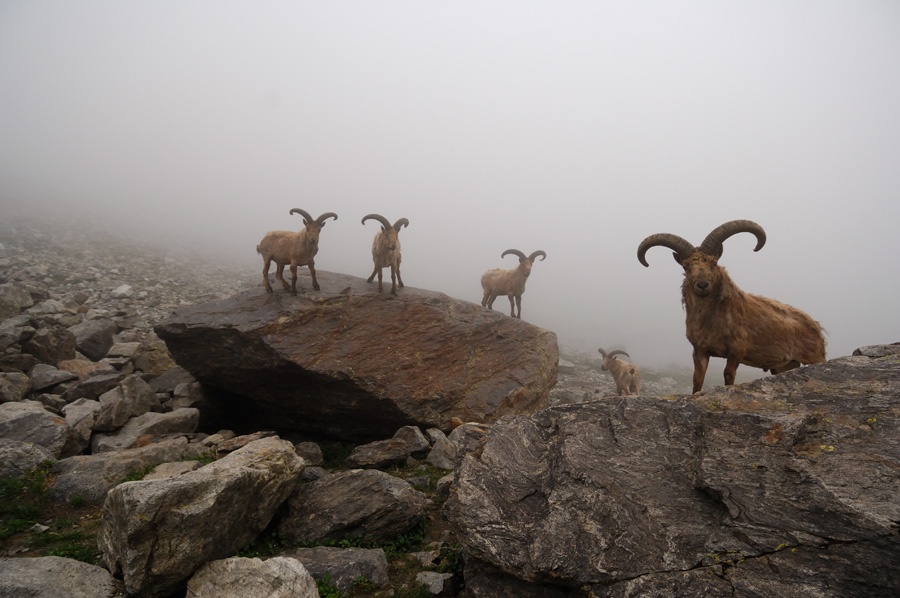
East Caucasian turs (Capra cylindricornis) are also known as the Daghestani tur, They are mountain-dwelling caprine (goat) living in the eastern half of the Greater Caucasus mountains, in Azerbaijan, Georgia, and European Russia. Inhabits rough mountainous terrain, where they eat mainly grasses and leaves, they are is listed as near threatened on the International Union for Conservation of Nature (IUCN) Red List. [Source: Wikipedia]
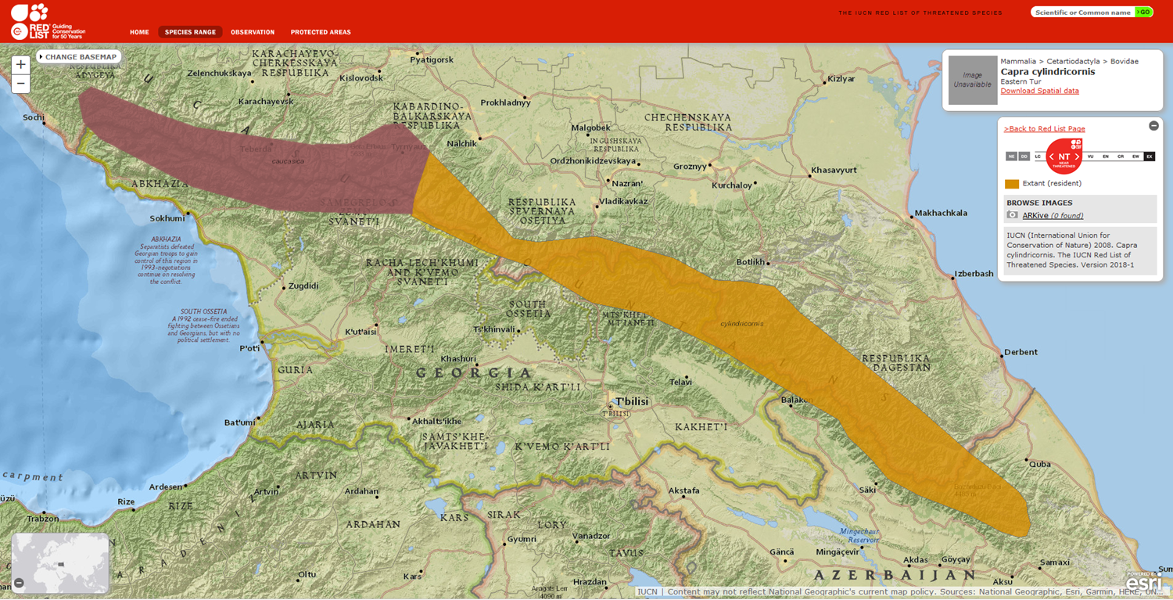
The eastern boundary of where East Caucasian turs (also referred to as Capra caucasica cylindricornis) live is well defined by Babadagh Mountain in Azerbaijan, but the western boundary is less definite. The southern portion of their range extends to the area of the headwaters of the Inguri River. The northern extent of their range reaches Bezengi Cherek River or the headwaters of the Malka River in the Elbrus Mountain massif. The total length of the range of the East Caucasian turs is about 500 kilometers and has changed little since the 19th century. [Source: Julia Fromfeld, Animal Diversity Web (ADW) |=|]
East Caucasian turs are found at elevations from 1,000 to 4,000 meters (3,300 to 13,200 feet) in forest, and alpine areas. Areas above 3,500 meters are only occasionally visited. East Caucasian turs migrate from lower elevations during the winter into higher elevations during the summer. Females prefer to live in the forests whereas males prefer to live in the open grasslands.
East Caucasian turs live up to 15 years in the wild and up to 22 years in captivity. Known predators include Eurasian lynx and gray wolves. Traditionally, Humans utilized East Caucasian turs for food and their body parts are sources of valuable materials. They are an ecotourism draw. The use of their hide and wool has largely been abandoned, but horns of East Caucasian turs are still valuable and widely used. In the Caucasus, their horns have long used as home decorations and are often mounted in silver as traditional cups for wine and beer. East Caucasian turs compete with livestock for forage and sometimes are regarded as crop pests.
East Caucasian Tur Characteristics and Diet
East Caucasian turs range in weight from 56 to 140 kilograms (123.3 to 308.4 pounds) and range in length from 1.4 to 1.9 meters (4.5 to 5.2 feet). Their tail is 11 to 15 centimeters (4.3 to 6 inches) long. Sexual Dimorphism (differences between males and females) is present in size, fur and horn development. Females have a body length of 1.4 meters (4.5 feet), shoulder height of .85 meters (2.8 feet), and weigh 56 kilograms (123 pounds). Males have a body length of 1.9 meters (5.2 feet), shoulder height of one meter (3.3 feet) and weigh 140 kilograms (308.4 pounds). The coat in males varies seasonally, from chestnut-brown with lighter underparts in the winter to an overall lighter rusty-brown color in the summer. The coat of females, juveniles, and yearlings is the same year round. Female horns grow to 20 to 22 centimeters (8.1 to 8.8 inches) whereas males grow to 70 to 90 centimeters (27.5 to 35.4 inches) in length.[Source: Julia Fromfeld, Animal Diversity Web (ADW) |=|]
East Caucasian turs have thick and stout body supported by short legs. Like most goats, a beard is found on males and is most noticeable when these animals display their winter fur but East Caucasian turs differ from other species of Caprids (wild goats) by having much shorter beards. They also lack the stripes on their forelegs that are typical of Siberian ibex, Nubian ibex, and wild goat. Also Unlike other goats, the skull of East Caucasian turs does not have a bulge on the forehead below the horns. The horn base is cyndrical, and the horns curve up and out from the forehead and then slightly down and inward curling at the tips. |=|
The winter color of male East Caucasian turs is brown, helping to distinguish them from males of other wild goat species such as West Caucasian tur, which are grayish-yellow at that time of year. Alpine ibex are also similar to East Caucasian turs. These two species have a similar color coat and a short beard, but can be easily distinguished from each other by their horns. West Caucasian turs are smaller and less massive than East Caucasian turs (East Caucasian turs). |=|
East Caucasian turs are herbivores (eat plants or plants parts) and also recognized as folivores (eat leaves). Among the plant foods they eat are leaves, roots, tubers, and wood. They graze primarily on grass and shrubs. Grasses are eaten in autumn and the beginning of winter. Low shrubs such as Vaccium myrtillus are key to the ability of East Caucasian turs to get through the winter. Euonymus, Pinus, Rosa, and Salix are preferred browsing plant. |=|
East Caucasian Tur Behavior
East Caucasian turs are terricolous (live on the ground), diurnal (active during the daytime), crepuscular (active at dawn and dusk), motile (move around as opposed to being stationary), migratory (make seasonal movements between regions, such as between breeding and wintering grounds), solitary social and have dominance hierarchies (ranking systems or pecking orders among members of a long-term social group, where dominance status affects access to resources or mates). Their average territory size is four to six square kilometers for female groups. Males have a larger home range. [Source: Julia Fromfeld, Animal Diversity Web (ADW) |=|]
East Caucasian turs engage in seasonal migrations between elevations by 1,500 to 2,000 meters (4930 to 6,600 feet). They move up the mountain slopes, following retreating snow, in March and descend to lower slopes in August. Males generally are solitary and inhabit higher elevations with more open areas than females. Females prefer lowland forest areas. In summer feeding occurs at intervals in late afternoon, night, and morning with the goats spending most of hot hours resting in sheltered, shaded places. In winter, herds remain in open pastures throughout the day grazing and resting.
There are three basic types of East Caucasian social units: 1) Females found in groups with young; 2) young male groups; and 3) solitary males. Males are found with females only during the mating season. Group sizes are usually around ten individuals, but group size fluctuates with precipitation levels. East Caucasian turs observe a hierarchical order in which adult males dominate younger males during the mating season. Young males dominate females year-round, and females dominate yearlings and juveniles.
East Caucasian turs sense and communicate with vision, touch, sound and chemicals usually detected by smelling. They also leave scent marks produced by special glands and placed so others can smell and taste them. They employ a variety of vocalizations. They have a sharp, hissing alarm whistle. Females and kids bleat to each other. Males mark areas during the rutting season by debarking trees by rubbing their horns on the trunk and then mark the bare place by rubbing it with their scent glands. Such markings do no appear to be territorial in nature but only for identification.
East Caucasian Tur Mating, Reproduction and Offspring
East Caucasian turs are polygynandrous (promiscuous), with both males and females having multiple partners. They engage in seasonal breeding, once a year, in December or January. The gestation period ranges from five to 5.3 months. The number of offspring ranges from one to two, with the average number of offspring being 1.2. [Source: Julia Fromfeld, Animal Diversity Web (ADW) |=|]
East Caucasian turs breed in December or January, depending on where they are located in the species range. Males and females live separtedly except during rut (mating season) when males come down from the higher elevations to breed. Adult males may fight with each other for access to females. Females can also be aggressive during the rut, chasing younger males away if they try to breed. Young males do not attempt to mate until after adult males have done so. Home ranges of males overlap those of females, but males are highly territorial with other males during the breeding season. |=|
Young are altricial, meaning they are relatively underdeveloped at birth. Pre-weaning provisioning and protecting and Pre-independence protection are done by females. The post-independence period is characterized by the association of offspring with their parents. Parental care provided by males has not been reported. The age in which young are weaned ranges from one to two months and the average time to independence is 18 months. On average females reach sexual or reproductive maturity between two to four years; males do so between four to six years. However yearling females, sometimes breed.
Females isolate themselves before birth and keep their young hidden for three to four days after birth. Mothers provide their young with milk, grooming, and protection. Females and yound form groups with around a dozen individuals. The young begin to eat grasses in July. Weaning begins in December, by which time the young have been grazing for several months. Young East Caucasian turs mature quickly and are able to run soon after birth. East Caucasian turs live in groups to help protect them from predators.
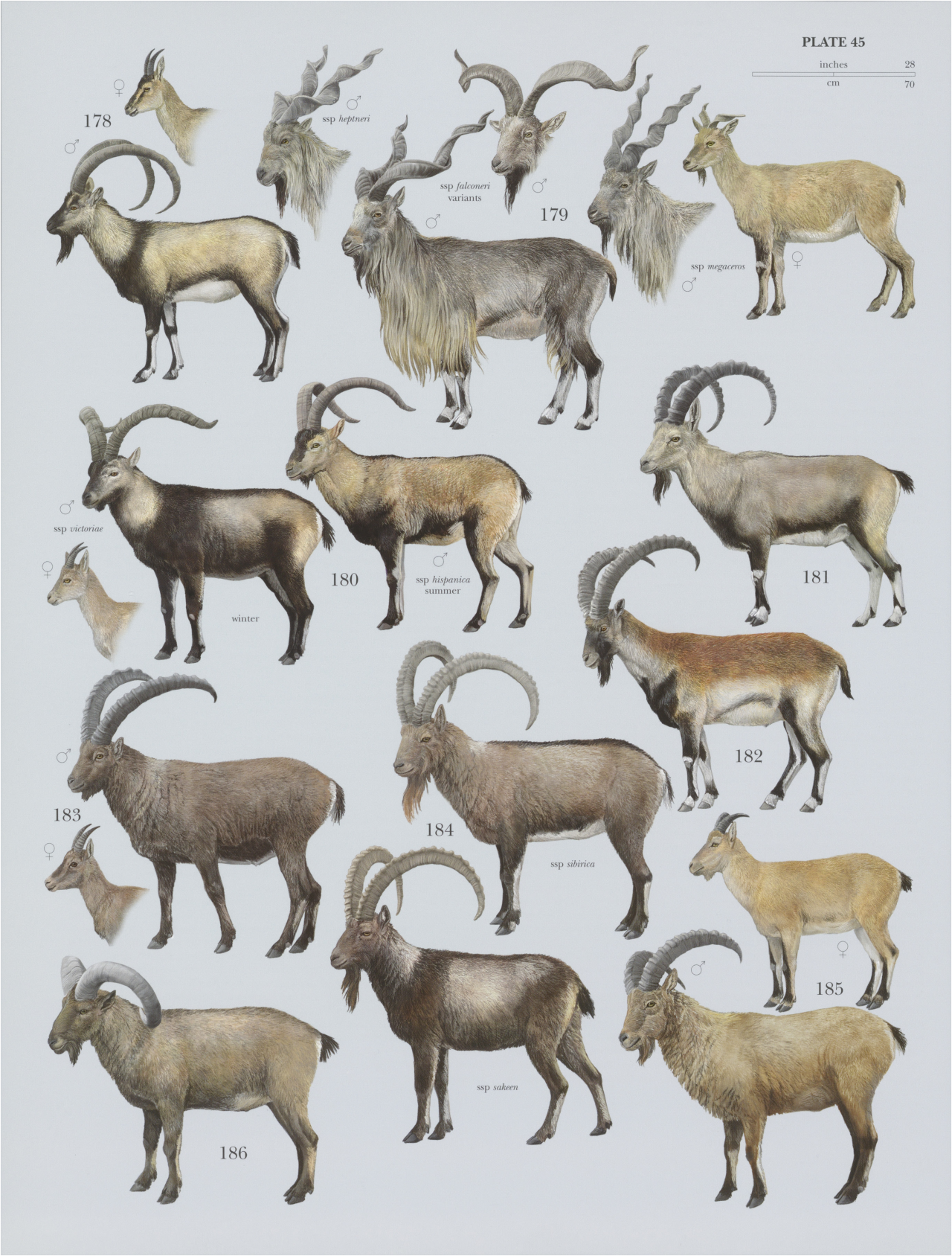
Turs, wild goat and ibex species: 178) Wild Goat (Capra aegagrus), 179) Markhor (Capra falconeri), 180) Iberian Ibex (Capra pyrenaica), 181) Nubian Ibex (Capra nubiana), 182) Walia Ibex (Capra wale), 183) Alpine Ibex (Capra ibex), 184) Siberian Ibex (Capra sibirica), 185) Kuban Tur (Capra caucasica), 186) Daghestan Tur (Capra cylindricornis)
Image Sources: Wikimedia Commons
Text Sources: Animal Diversity Web animaldiversity.org ; National Geographic, Live Science, Natural History magazine, CNTO (China National Tourism Administration) David Attenborough books, New York Times, Washington Post, Los Angeles Times, Smithsonian magazine, Discover magazine, The New Yorker, Time, BBC, CNN, Reuters, Associated Press, AFP, Lonely Planet Guides, Wikipedia, The Guardian, Top Secret Animal Attack Files website and various books and other publications.
Last updated May 2025