
CHAMOIS
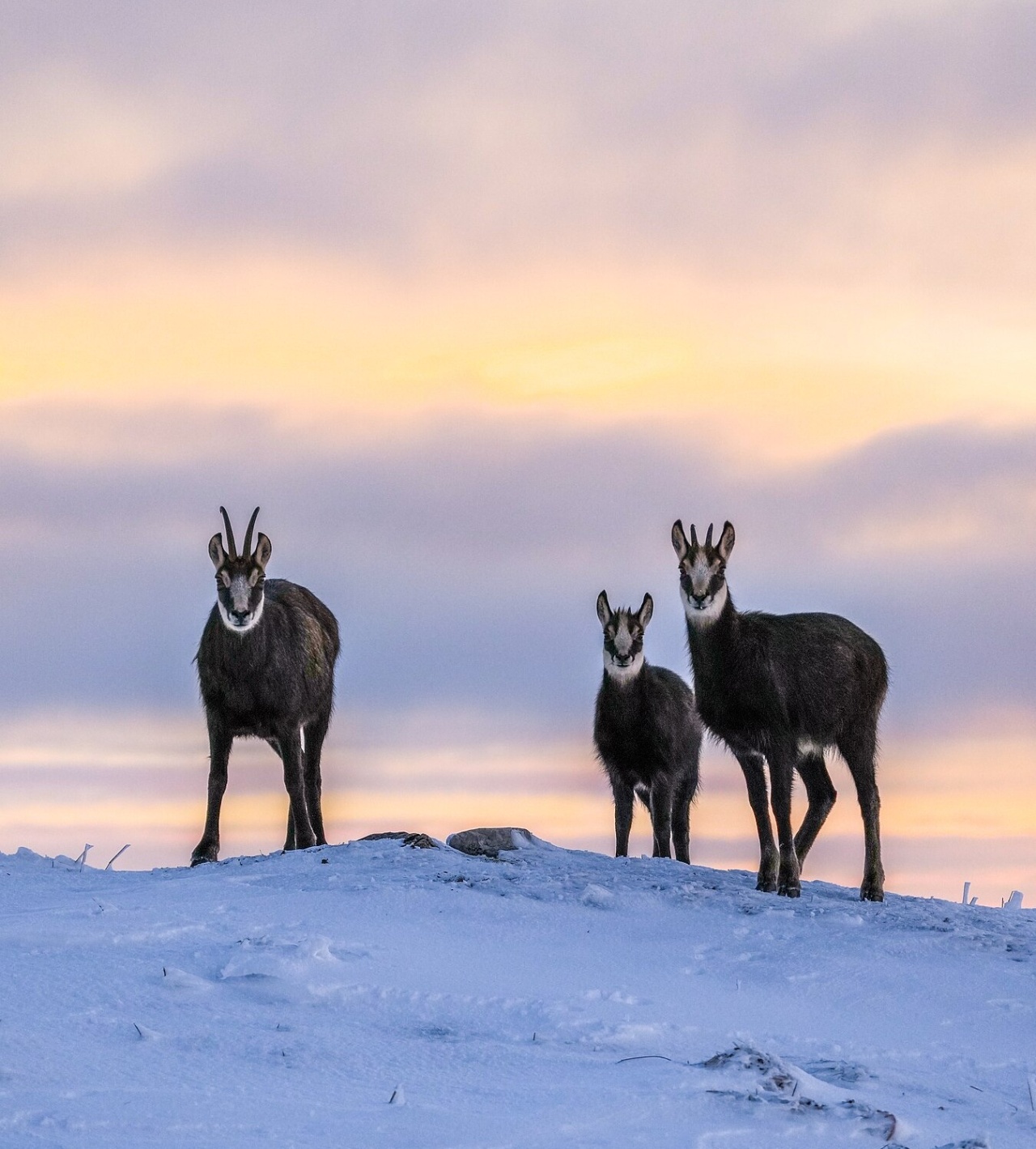
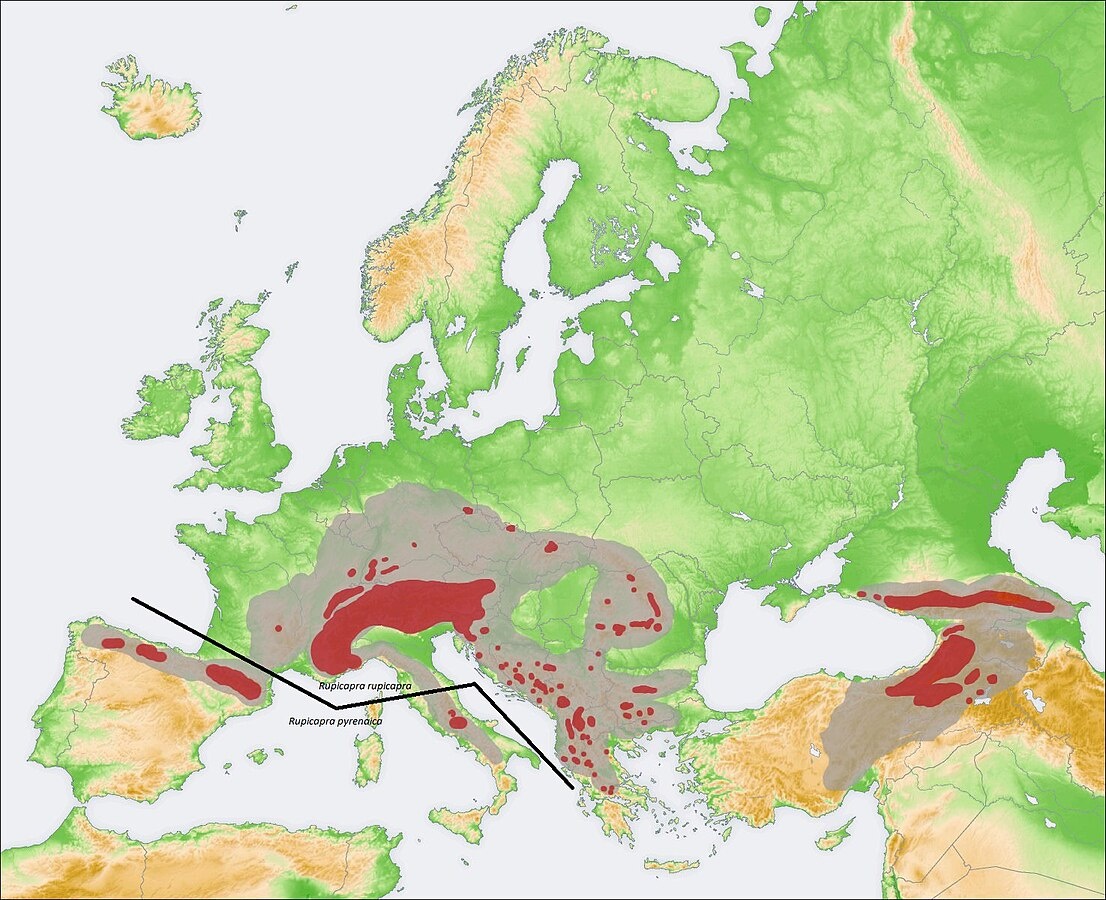
Chamois (Rupicapra rupicapra) are small goatlike antelope found in the mountains of central and southern Europe — namely the Alps, Apennines, Pyrenees and Carpathians — and in Asia Minor and the Caucasus. They look sort of like black prong-horn antelope and have been introduced to the South Island of New Zealand. Chamois can be found in both relatively steep and flatter terrain. They live in alpine and sub alpine meadows above the timberline. It winters they gather in forested areas and on steep slopes where snow does not accumulate. Chamois are not endangered. They are designated a species of least concern on the International Union for Conservation of Nature (IUCN) Red List. In CITES (Convention on International Trade in Endangered Species of Wild) they have no special status.
Chamois are small compared to mountain goats. They are incredibly swift and sure-footed. They can leap two meters straight up on the air and six meters in distance and can run at speeds of 50 kilometers per hour (31 mph) on flexible soft pads that give them a sure grip on uneven, slippery surfaces. When alarmed, the have been observed leaping across chasms and darting up and on the face of seemingly sheer cliffs.
Chamois hunting was once a popular sport. But overhunting led to a decline in their numbers. They are now protected by law and were listed as endangered. The fine soft leather known as "shammy", widely used for cleaning glass and polishing cars, was originally made from chamois skin. Now most shammy is made of sheepskin or synthetics. The meat of chamois is highly valued by some people. The winter hair from the back is used to make "gamsbarts" — the brushes of Tyrelean hats.
The lifespan of the chamois in the wild ranges from 14-22 years. Eurasian lynx and grey wolves are the main predator of the chamois. When alarmed, chamois flee to difficult-to-reach locations. In some places they compete with domestic sheep for grazing. In the Tatra Mountains on the border of Poland and Slovakia, the Caucasus Mountains, and in Massif de la Chartreuse in southeastern France, excessive hunting, loss of habitat, competition with livestock, and harassment by people and dogs greatly reduced the number of chamois. Otherwise, chamois now are generally increasing in number and have been introduced and reintroduced in various parts of Europe. There were estimated to be around 400,000 in Europe in the late 1990s. [Source: Dan Gunderson, Animal Diversity Web (ADW) |=|]
Chamois Subspecies:
Anatolian chamois (Rupicapra rupicapra asiatica) are also known as Turkish chamois) live in Turkey
Balkan chamois (Rupicapra rupicapra balcanica) live in Albania, Bosnia and Herzegovina, Bulgaria, Croatia, northern Greece (the Pindus Mountains), North Macedonia, Serbia, Montenegro, and Slovenia (isolated populations)
Carpathian chamois (Rupicapra rupicapra carpatica) live in Romania
Chartreuse chamois (Rupicapra rupicapra cartusiana) live in France
Caucasian chamois (Rupicapra rupicapra caucasica) live in Azerbaijan, Georgia, Russia
Alpine chamois (Rupicapra rupicapra rupicapra) live in Austria, France, Germany, Italy, Switzerland, Slovenia, Slovakia (Veľká Fatra, Slovak Paradise) and New Zealand (introduced)
Tatra chamois (Rupicapra rupicapra tatrica) live in Slovakia (Tatras and Low Tatras) and Poland (Tatras)
Chamois Characteristics and Diet
Chamois range in weight from 24 to 50 kilograms (53 to 110 pounds) and range in length from 0.9 to 1.35 meters (3 to 4.4 feet). Their slender body terminates with a short three to four centimeter tail. They stand about 75 centimeters (2½ feet ) at the shoulder. Sexual Dimorphism (differences between males and females) is present: Males are larger than females. Males and females have different shapes. Ornamentation is different. Both males and female have horns. The horns of males rise directly above the head then hook sharply back at the tips. Female horns, are slimmer than those of males but can be longer. [Source: Dan Gunderson, Animal Diversity Web (ADW) |=|]
Chamois have coats of reddish brown hair and a thick, warm underfur that grows in the winter. Their coats are lighter in the spring and summer. In the winter they grow long guard hairs over their dark brown under fur. Under parts are pale and the rump is white at the tail. A dark brown band runs from each side of the muzzle to the ears and eyes, and the rest of the head and throat is white.
Chamois also have a pair of short horns that rise from the forehead. Both males and females have horns although those of females are shorter. The horns can reach 20 centimeters (8 inches) in length and curve backwards. The long, pointed hooves of the chamois are excellent for gripping slippery rock. They have an elastic base and hard, thin edge. The sole of their hooves are slightly depressed below the outer margin allowing them get a foot hold on small projections.
Chamois are herbivores (eat plants or plants parts) and also recognized as folivores (eat leaves). Among the plant foods they eat are leaves, flowers, bryophytes (mosses) and lichens. During the summer their diet consists mainly of herbs and flowers, but in winter they feed chiefly on lichens, mosses, and young pine shoots. They have been known to fast for two weeks and survive when snow is so deep they can not reach food. |=|
Chamois Behavior
Chamois are motile (move around as opposed to being stationary), solitary. diurnal (active during the daytime),social (associates with others of its species; forms social groups) and have dominance hierarchies (ranking systems or pecking orders among members of a long-term social group, where dominance status affects access to resources or mates). They sense using touch and chemicals usually detected with smell. [Source: Dan Gunderson, Animal Diversity Web (ADW) |=|]
Chamois females and young males generally live in herds with 5 to 30 members, while adult males are solitary and can be aggressive in the mating season. Both sexes spend most their awake time grazing and foraging grass and Alpine vegetation. They feed on herbs and flowers in alpine pastures during the summer and mosses, lichens and shoots in the winter.
Chamois don't like warm weather. They graze at highland pastures in the summer and only descend to the valleys in the winter. Sometimes it is possible to see them in May and June at the bottom of the valleys but as the snow melts they move higher up.
Chamois are very skittish and shy and take off with the slightest noise. This and the fact they live in such inaccessible places makes them hard for tourist to spot and hunters to shoot. When feeding they often post a lookout who warns the others of approaching danger with stamping hooves and a whistling noise.
The majority of female chamois are philopatric (remain in or return to the area of their birth) whereas males have relatively high dispersal rates. Chamois announce danger with a whistling sound and foot stamping. When alarmed, these animals flee to inaccessible places, often making death-defying leaps on cliffs.
Chamois Mating, Reproduction and Offspring
Chamois are polygynous (males have more than one female as a mate at one time). They engage in seasonal breeding. Breeding occurs annually from October through December, with young born in May and June. The gestation period ranges from 5.33 to 6.17 months. The number of offspring is usually one, rarely two. [Source: Dan Gunderson, Animal Diversity Web (ADW) |=|]
Males are generally solitary except during the breeding season. They join the maternal herds during the late summer. Older males are known for forcing younger males from the herd, and sometimes killing them. Males sometimes engage in battles to gain access to females. At this time males become more territorial, marking their tree trunks and branches with a smelly secretion from a gland at the base of their horns. The sound of the crashing horns of battling males can be heard from some distance away.
Chamois young are precocial and able to follow their mother shortly after birth. Parental care is provided by females who produce milk for their young. The post-independence period is characterized by the association of offspring with their mother. The age in which young are weaned ranges from two to three months. Sexual maturity is reached at the age of 2.5 years in females and 3.5 to four years in males.
Females give birth in May and June in a shelter of grass and lichens. Young weigh two to three kilograms each. The kids quickly improve their leaping ability within the first few days of life. If a mother is killed, other chamois take care of the young. Young males stay with the mother's group until they are two to three years old and then live nomadically until they are fully mature at eight to nine years, when they become attached to a definite area.
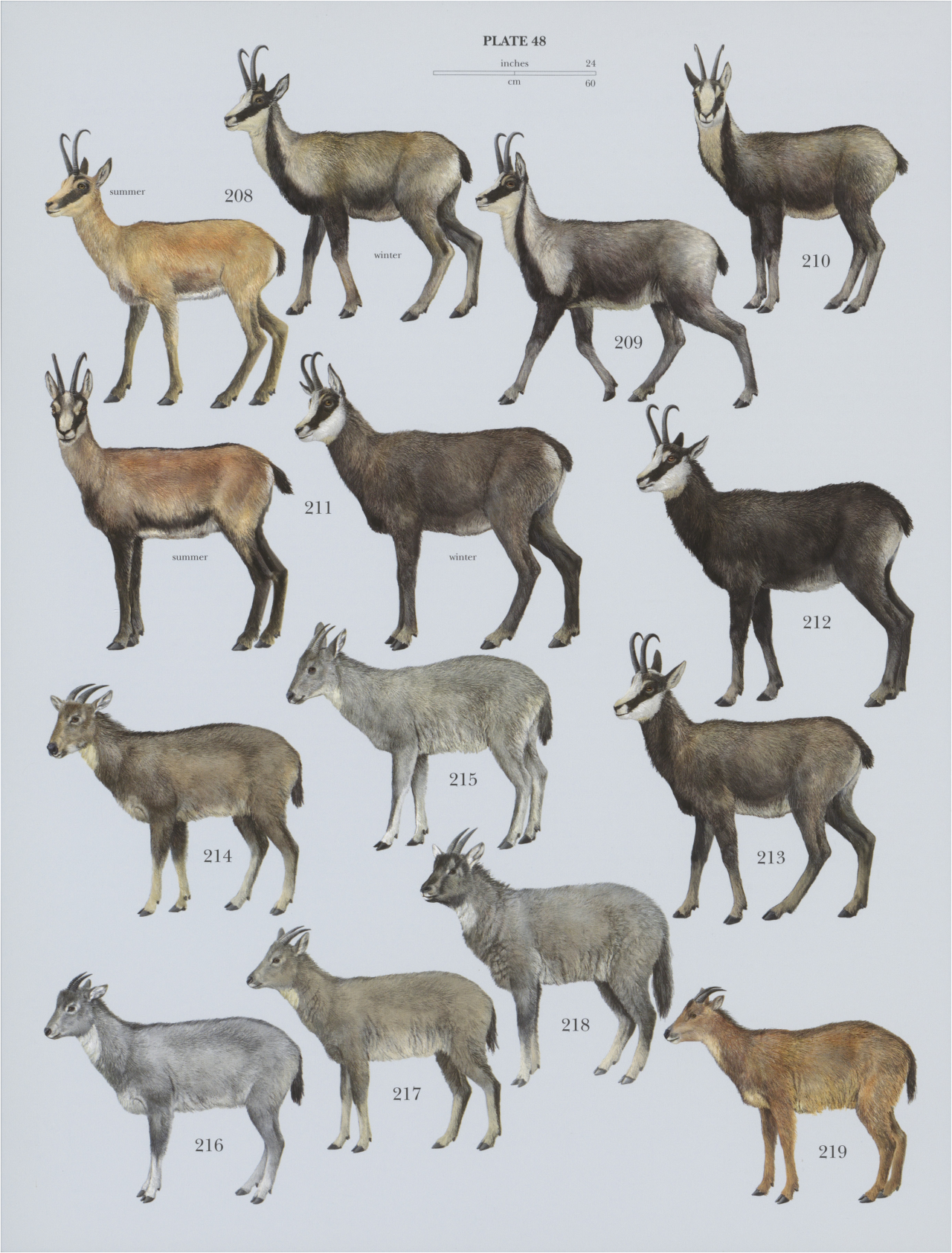
Chamois and Goral species: 208) Pyrenean Chamois (Rupicapra pyrenaica), 209) Abruzzi Chamois (Rupicapra ornata), 210) Cantabrian Chamois (Rupicapra parva), 211) Alpine Chamois (Rupicapra rupicapra), 212) Carpathian Chamois (Rupicapra carpatica), 213) Asia Minor Chamois (Rupicapra asiatica), 214) Himalayan Brown Goral (Nemorhaedus goral), 215) Himalayan Gray Goral (Nemorhaedus bedfordi), 216) Chinese Goral (Nemorhaedus griseus), 217) Burmese Goral (Nemorhaedus evansi), 218) Long-tailed Goral (Nemorhaedus caudatus), 219) Red Goral (Nemorhaedus baileyi)
Image Sources: Wikimedia Commons
Text Sources: Animal Diversity Web animaldiversity.org ; National Geographic, Live Science, Natural History magazine, CNTO (China National Tourism Administration) David Attenborough books, New York Times, Washington Post, Los Angeles Times, Smithsonian magazine, Discover magazine, The New Yorker, Time, BBC, CNN, Reuters, Associated Press, AFP, Lonely Planet Guides, Wikipedia, The Guardian, Top Secret Animal Attack Files website and various books and other publications.
Last updated May 2025